Skip to content
Plant Care Basics
  • Snake Plant Care
  • ZZ Plant Care
  • Pothos Care
  • Monstera Care
  • Peace Lily Care
  • Moth Orchid Care

Avatar of PANG NAM FUIPANG NAM FUI

Pang Nam Fui is the founder of Plant Care Basics, a friendly online resource dedicated to helping beginners grow happy and healthy houseplants. With a passion for demystifying plant care, he shares simple, practical, and well-researched advice to empower new plant parents with the confidence they need to thrive. His goal is to prove that everyone can develop a green thumb.

Home » Archives for PANG NAM FUI » Page 8

How to save a snake plant from root rot: unpot, cut to firm tissue, replant

August 22, 2026 by PANG NAM FUI
How to save a snake plant from root rot: an unpotted Dracaena trifasciata with its brown, mushy rotted root ball exposed.

I saved a snake plant from root rot by trusting the soft base over the green leaves. Unpot today, cut every mushy root back to firm white tissue, dust the cuts with cinnamon, and replant snug in dry gritty mix. Then I hold the water until new growth proves the roots came back.

Categories Snake Plant Care

Home » Archives for PANG NAM FUI » Page 8

Why are my snake plant leaves curling? The wet-vs-dry test that settles it

August 22, 2026 by PANG NAM FUI
Why are my snake plant leaves curling: a Dracaena trifasciata with several blades in a tight inward curl and dry brown tips.

A curling snake plant almost always has a water problem — but curling strikes whether the mix is bone-dry or soggy. I show you how I read moisture at the pot’s base first, then rule out cold and low light, so you fix the real cause instead of feeding the wrong one.

Categories Snake Plant Care

Home » Archives for PANG NAM FUI » Page 8

Why is my snake plant falling over? The 4 causes and how to fix each

August 22, 2026 by PANG NAM FUI
Why is my snake plant falling over? A Dracaena trifasciata leans hard, gray-green leaves splaying from a terracotta pot.

A snake plant falling over has four very different causes, and the fix depends on which one you are facing. I show you how to read the base and the light in under a minute, match the right correction, and skip the stake that only hides the real problem.

Categories Snake Plant Care

Home » Archives for PANG NAM FUI » Page 8

How to get rid of bugs on a snake plant: spot, isolate, clear

August 22, 2026 by PANG NAM FUI
How to get rid of bugs on a snake plant: a Dracaena trifasciata with cottony mealybugs and pale stippling.

Clearing bugs off a snake plant starts with proving the white speck is alive, since half are not. I walk you through the 60-second wipe test that tells a live mealybug from harmless mineral crust, then the gentle, contact-only routine I trust to end an infestation without a systemic poison.

Categories Snake Plant Care

Home » Archives for PANG NAM FUI » Page 8

How to treat snake plant fungus: spot it, prune it, dry it out

August 22, 2026 by PANG NAM FUI
How to treat snake plant fungus: an upright Dracaena trifasciata carries brown, black-dotted fungal leaf spots.

When my snake plant first freckled with brown, black-dotted spots, I nearly wiped them off and moved on. That smudge was a fungus. Here is the read-the-sign routine I now trust — isolate, cut back to firm tissue, and dry the canopy — so a few early flecks never claim a whole leaf again.

Categories Snake Plant Care

Home » Archives for PANG NAM FUI » Page 8

How to propagate a snake plant step by step: water, soil, and division

August 22, 2026 by PANG NAM FUI
How to propagate a snake plant step by step: notched Dracaena trifasciata leaf sections rooting in a clear water jar.

A snake plant cutting lives or dies on one detail: the fresh cut has to dry into a firm callus before it ever touches water or mix. I walk through the water, soil, and division methods, plus the warmth and restraint that coax new roots instead of rot.

Categories Snake Plant Care

Home » Archives for PANG NAM FUI » Page 8

How to repot a snake plant without killing it: the snug-pot, dry-settle method

August 22, 2026 by PANG NAM FUI
How to repot a snake plant without killing it: a Dracaena trifasciata eased into fresh gritty mix in a new terracotta pot.

Repotting a snake plant goes wrong when the pot is too big and the first watering comes too soon. I match a barely-larger terracotta pot to the roots, mix in coarse grit, and keep everything bone-dry for a week so the rhizome knits back without rot.

Categories Snake Plant Care

Home » Archives for PANG NAM FUI » Page 8

How to identify snake plant varieties: a leaf-shape visual guide

August 22, 2026 by PANG NAM FUI
A lineup showing how to identify snake plant varieties, telling each Dracaena trifasciata type by leaf shape and margin.

For years I bought snake plants by the tag instead of the leaf, and half of mine turned out mislabeled. I identify every variety now by reading three features in strict order — leaf cross-section, then margin color, then height — so the plant names itself, no sticker required.

Categories Snake Plant Care

Home » Archives for PANG NAM FUI » Page 8

What is the best soil for a snake plant? A fast-draining, gritty mix that blocks rot

August 22, 2026 by PANG NAM FUI
What is the best soil for a snake plant? A gritty, fast-draining mix, shown here beside a potted Dracaena trifasciata.

I lost two snake plants to a bag of ordinary potting soil before it clicked: the problem was never the brand, it was drainage. Now I build a lean, mostly mineral blend and skip the gravel-layer myth entirely. The payoff is roots that ride dry and firm between soaks.

Categories Snake Plant Care

Home » Archives for PANG NAM FUI » Page 8

Is a snake plant toxic to cats and dogs? Yes, but rarely an emergency

August 22, 2026 by PANG NAM FUI
Is a snake plant toxic to cats and dogs? A Dracaena trifasciata with a pet-chewed lower leaf indoors.

My cat mouthed a low leaf, and I learned my snake plant is toxic to cats and dogs in a mild, soap-like way that upsets the gut for a day. I cover the poisoning symptoms, what to do at home, and the height trick that keeps my curious pets out of reach.

Categories Snake Plant Care
Newer posts
← Previous Page1 … Page7 Page8
PANG NAM FUI, founder of Plant Care Basics and plant care expert.

Hi, I'm Pang. Founder of Plant Care Basics. I share simple, well-researched advice to help beginners develop a green thumb. Welcome to my green corner!

You May Also Like

How often to water a ZZ plant: a healthy Zamioculcas zamiifolia deep-soaked in a plain terracotta pot.

How often to water a ZZ plant? Read the soil, not the calendar

Watering a ZZ plant confuses most owners, so I stopped counting days and started reading the soil instead. My method is simple: check the gritty mix deep with a bamboo skewer, soak only when it comes up bone-dry, then drain it fully. Here is the routine that ended years of overwatering for me.
Monstera deliciosa vs Monstera adansonii side by side on one table, the leaf margins telling them apart.

Monstera deliciosa vs Monstera adansonii: the leaf-margin test that settles it

I settled the tag argument in my own collection with one finger. Running it out to the leaf edge tells you everything: a cut that breaks the margin belongs to Monstera deliciosa, and a hole that stays closed inside the blade belongs to its smaller look-alike.
How to repot a snake plant without killing it: a Dracaena trifasciata eased into fresh gritty mix in a new terracotta pot.

How to repot a snake plant without killing it: the snug-pot, dry-settle method

Repotting a snake plant goes wrong when the pot is too big and the first watering comes too soon. I match a barely-larger terracotta pot to the roots, mix in coarse grit, and keep everything bone-dry for a week so the rhizome knits back without rot.
What causes black spots on a ZZ plant: dark brown spots down the green stem of a Zamioculcas zamiifolia.

What causes black spots on a ZZ plant? How to tell harmless from harmful

Most black spots on a ZZ plant turn out to be harmless natural coloring, not a disease worth cutting for. I show you the two-signal press test that separates a firm, flat fleck from active soft rot, sort the white mineral film from powdery mildew, and explain why a cut ZZ stalk never grows back.
Hands separating the root ball of a peace lily on a potting bench, illustrating the process of propagating peace lily.

Propagating Peace Lily: 2 Proven Methods To Multiply Your Plants Safely

I wasted weeks trying to root a leaf and watched it rot, but I learned from my mistake. In my experience, propagating peace lily requires root division. Here is exactly how I multiply my collection now without losing a single leaf.
How and when to repot a Monstera deliciosa is read here: a pot-shaped root ball, pale roots circling.

How and when to repot a Monstera deliciosa: read the root ball, not the pot

I used to repot my Monstera deliciosa on a schedule and wondered why it sulked every time. Now I lift the plant, read the root ball, and only move up one size when the roots hold the shape of the pot. Depth beats width under a top-heavy crown.
How to save a ZZ plant from root rot — a lifted Zamioculcas zamiifolia shows black mushy rhizome beside firm pale tissue

How to save a ZZ plant from root rot: cut to firm tissue and dry it out

When my ZZ plant wilted over soaking-wet soil, I learned the culprit was root rot, not thirst. The fix is to cut every mushy rhizome back to firm, pale tissue, dry the wounds, then repot into a gritty mix. Inside, I walk through the full rescue and how to judge what can still be saved.
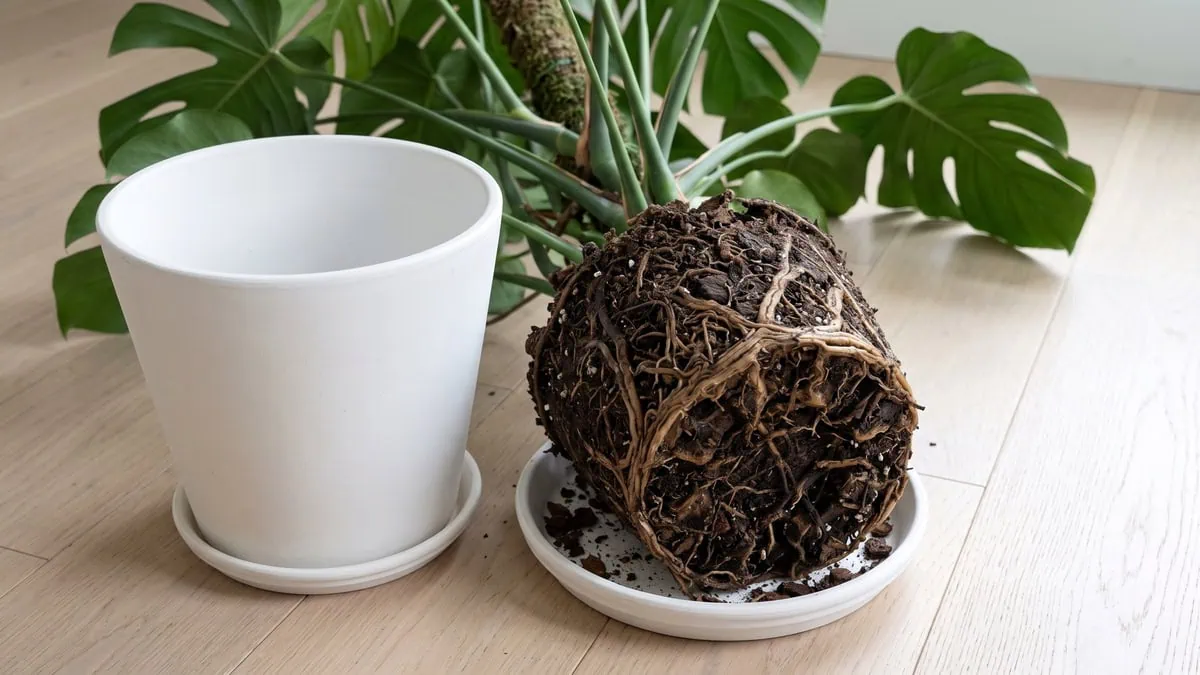
How to save a Monstera deliciosa from root rot starts here, the plant lifted out beside its pot, roots blackened.

How to save a Monstera deliciosa from root rot: the 3-test check and the rescue cut

The first Monstera deliciosa I lost to root rot looked healthy above the mix right up to the day it collapsed. Since then I bare the root mass, work along every strand with my fingertips, and let what has gone soft decide where the blade goes and how small the next container must be.

  • Privacy Policy
  • Cookie Policy (EU)
  • Terms of Service
  • Image License
  • About Us
  • Contact Us
  • Sitemap
© 2026 Plant Care Basics. All Rights Reserved.
Manage Consent
To provide the best experiences, we use technologies like cookies to store and/or access device information. Consenting to these technologies will allow us to process data such as browsing behavior or unique IDs on this site. Not consenting or withdrawing consent, may adversely affect certain features and functions.
Functional Always active
The technical storage or access is strictly necessary for the legitimate purpose of enabling the use of a specific service explicitly requested by the subscriber or user, or for the sole purpose of carrying out the transmission of a communication over an electronic communications network.
Preferences
The technical storage or access is necessary for the legitimate purpose of storing preferences that are not requested by the subscriber or user.
Statistics
The technical storage or access that is used exclusively for statistical purposes. The technical storage or access that is used exclusively for anonymous statistical purposes. Without a subpoena, voluntary compliance on the part of your Internet Service Provider, or additional records from a third party, information stored or retrieved for this purpose alone cannot usually be used to identify you.
Marketing
The technical storage or access is required to create user profiles to send advertising, or to track the user on a website or across several websites for similar marketing purposes.
  • Manage options
  • Manage services
  • Manage {vendor_count} vendors
  • Read more about these purposes
View preferences
  • {title}
  • {title}
  • {title}