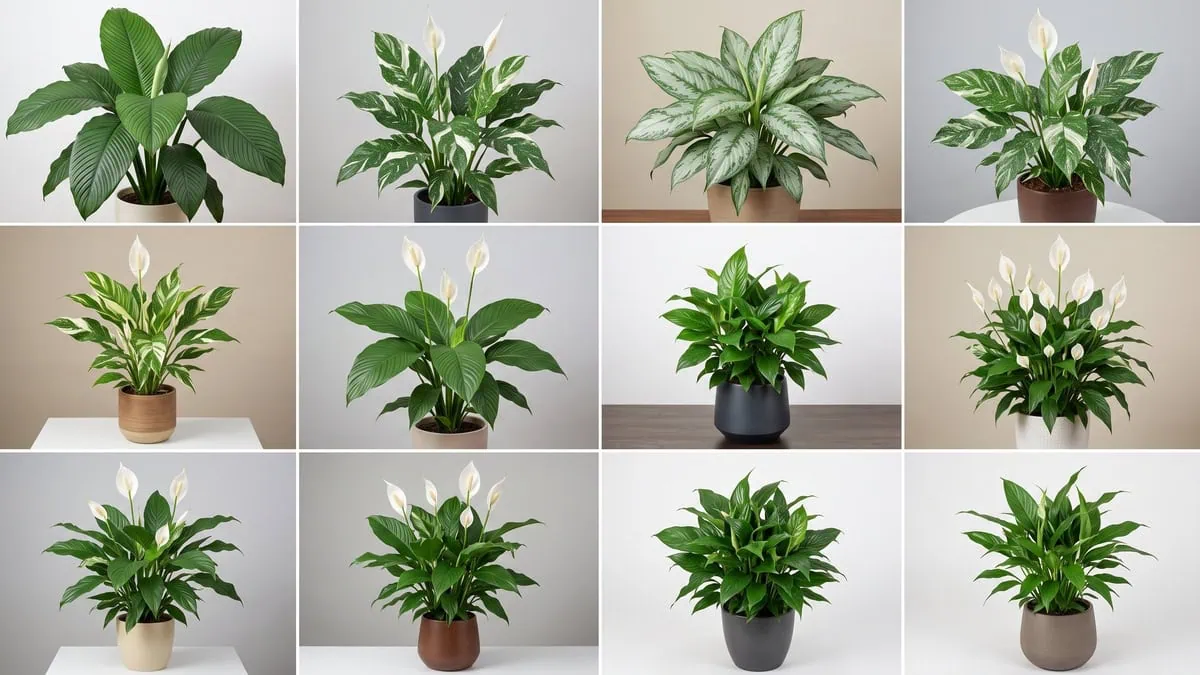
🎯 Quick Answer: telling the varieties apart
Peace lily varieties and how to identify them melts into three traits on Spathiphyllum, a member of the Araceae family: 12-60 inches. Read the marking first, then the leaf surface, then the clump height. Those three checks name the size class — the label almost never does.
- Measure first: substrate surface to tallest blade tip, in inches
- Under 12 inches: call it a dwarf desktop selection and plan shelf space
- Over 3 feet: plan floor space for it, not a shelf or a tabletop
- Ribbed surface: expect a giant-group plant and allow room around the clump
- White marking: judge pattern type, never how bright it looks
Many peace lilies have passed through my hands over seven years, and for most of that run I could not have told you which cultivar I was holding. The first few died on me — a sour, wet-cardboard smell rising off a peat-and-bark mix I had kept soaked (I’ll explain in a sec).
So I started buying by name. Honestly, that’s not quite right… Instead of chasing a cultivar tag, I realized the blade answers first: a thin, non-succulent Spathiphyllum leaf in the Araceae family holds its marking, its ribbing and its mature size as fixed traits.
Spathiphyllum cultivars run from 12-inch dwarfs to 4-foot giants like ‘Sensation’, with ‘Mauna Loa’ and ‘Petite’ filling the middle. Name the traits and the size class comes with them. The care underneath barely moves — which is why how every selection in this group is grown reads the same for all of them.
Skip straight to the table if you are short on time. Six rows carry the whole identification call, and the sections below just fill in why.
Peace lily varieties and how to identify them at a glance
| What to check | What the plant shows |
|---|---|
| Traits that actually separate varieties | Size class, blade texture, and white marking pattern |
| Blade texture of the largest group | Deeply ribbed — shared by ‘Sensation’, ‘Knockout’ and ‘Viscount’ |
| Height of the largest cultivar | 4-5 feet or more for ‘Sensation’, by two extension guides |
| Height of the dwarf class | About 12 inches for ‘Petite’, ‘Sonya’, ‘Gemini’ and ‘Variegata’ |
| Is white marking a variety trait? | Yes — ‘Domino’, ‘Gemini’ and ‘Variegata’ carry it; most cultivars are plain green |
| Does the cultivar change the care routine? | No for light, which is identical across cultivars; yes for temperature hardiness and vigor |
Tap the button below to get more plant fixes in your Google Search results

Table of Contents
How to tell which peace lily variety you have
Three visible traits name a peace lily variety: the white marking pattern, the blade surface, and the measured height of the clump. Read them in that order. Each one asks less of you than the last — no flower needed, no root ball lifted.
The following sections take those three traits in order, then handle the plant that refuses to be named.
Read the blade first: what a white marking means
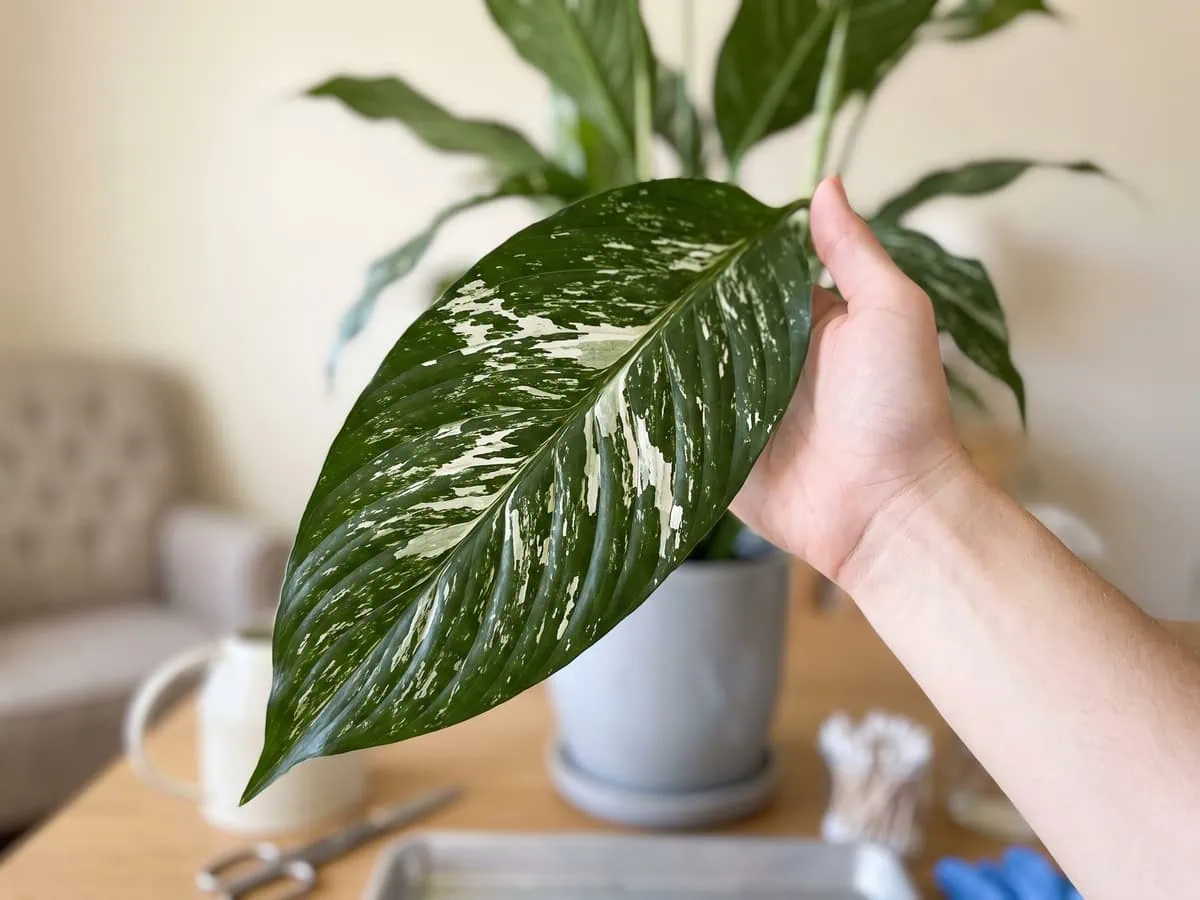
White on the blade is a cultivar trait, not a symptom. ‘Domino’ carries the marking through the mainstream trade, while ‘Gemini’ and ‘Variegata’ hold it on compact plants of about 12 inches, and ‘Hi Ho Silver’ shows light-colored veins instead of streaks. Judge the pattern, never the brightness.
And pattern type is the half that survives a change of room. Ask one question of a single leaf: does the white follow the veins, sweep from base to tip, or sit as discrete blotches with green closed around them?
Brightness shifts with light and with feeding. A plant that reads washed out all over is answering a different question, because pale washed-out foliage and what it usually means comes down to the pot rather than to the name.
Then the surface: ribbed blades mark the giant group
Run a thumb across the blade. Deep ribbing marks a group rather than one plant: ‘Sensation’ is the largest of them, while ‘Knockout’ and ‘Viscount’ carry the same corrugated surface, so ribbing on a small plant proves nothing on its own. Smooth, glossy, lance-shaped blades point instead at ‘Mauna Loa’ and at most of the other selections.
According to the University of Florida IFAS Extension, Spathiphyllum cultivars grown for interiors run from 12 inches to 4 feet — one genus, one growth form, dozens of selections.
Then the size: measure the clump, do not eyeball it
Take two numbers: substrate surface to the tallest blade tip, then one outer blade tip across to the opposite one.
Type “small versus large peace lily varieties for indoors” into a search bar and the class names come back undefined, because no two sources cut small from large at the same figure. Numbers travel. Labels do not.
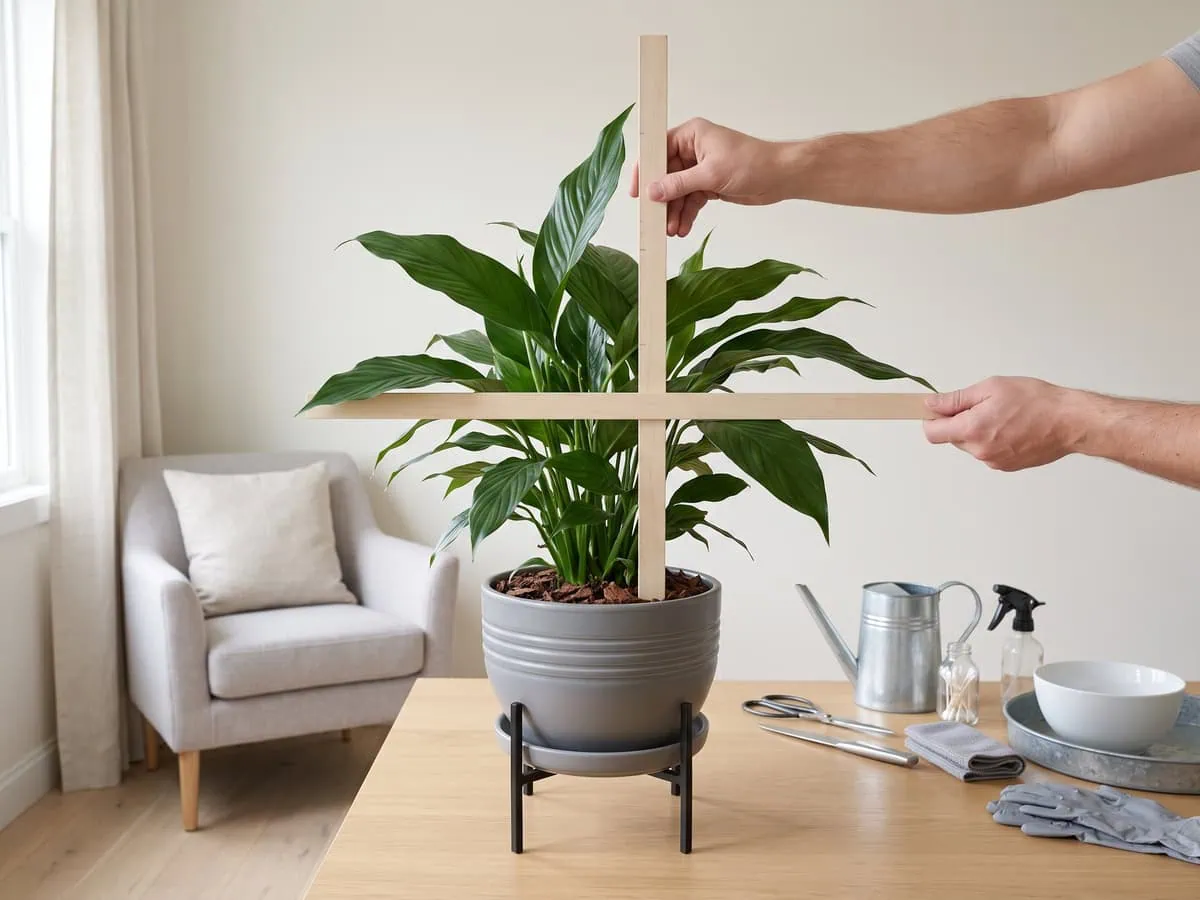
Measuring puts your face level with the mix, and a peat-and-bark blend gone stale-sour — that shut-cellar smell after weeks of never drying out — tells you more about the pot than any tag does.
Compact selections finish near 4 to 20 inches, the classic Spathiphyllum wallisii hybrids sit at about 2 feet, and the giant ‘Sensation’ reaches 3.3 feet. Spread stays narrow at every one of those heights.
Of the plants that have passed through my hands, only two arrived carrying a cultivar name (yeah, learned this the hard way). The rest were tagged with the genus, or with nothing at all. Which is the normal case, not the unlucky one.
Work in the order the plant allows: marking and surface need only your eyes, height needs a tape, and any marker that wants a flower or a lifted root ball comes last, since most shop plants offer neither.
When the three traits do not settle it
Some plants never resolve, and that is a legitimate ending. Peace lilies leave the nursery unlabeled or tagged with the genus alone, and the interior trade runs far more selections than any single published list names.
So record the two measurements, photograph the whole plant plus close-ups of new growth and petioles, and place it by size class and marking group instead of by name. A plant without a cultivar name is still a plant you can grow, and the care underneath it does not move.
Tap the button below to get more plant fixes in your Google Search results

Sensation vs the unlabeled plant on the shelf
Two things separate ‘Sensation’ from the plant most shops sell unlabeled: a deeply ribbed blade and an adult size measured in feet rather than inches. Everything else about the two plants is the same species-level package. Same clump, same spathe, same care.
The following table sets the two side by side, and the sections after it take baseline then size.
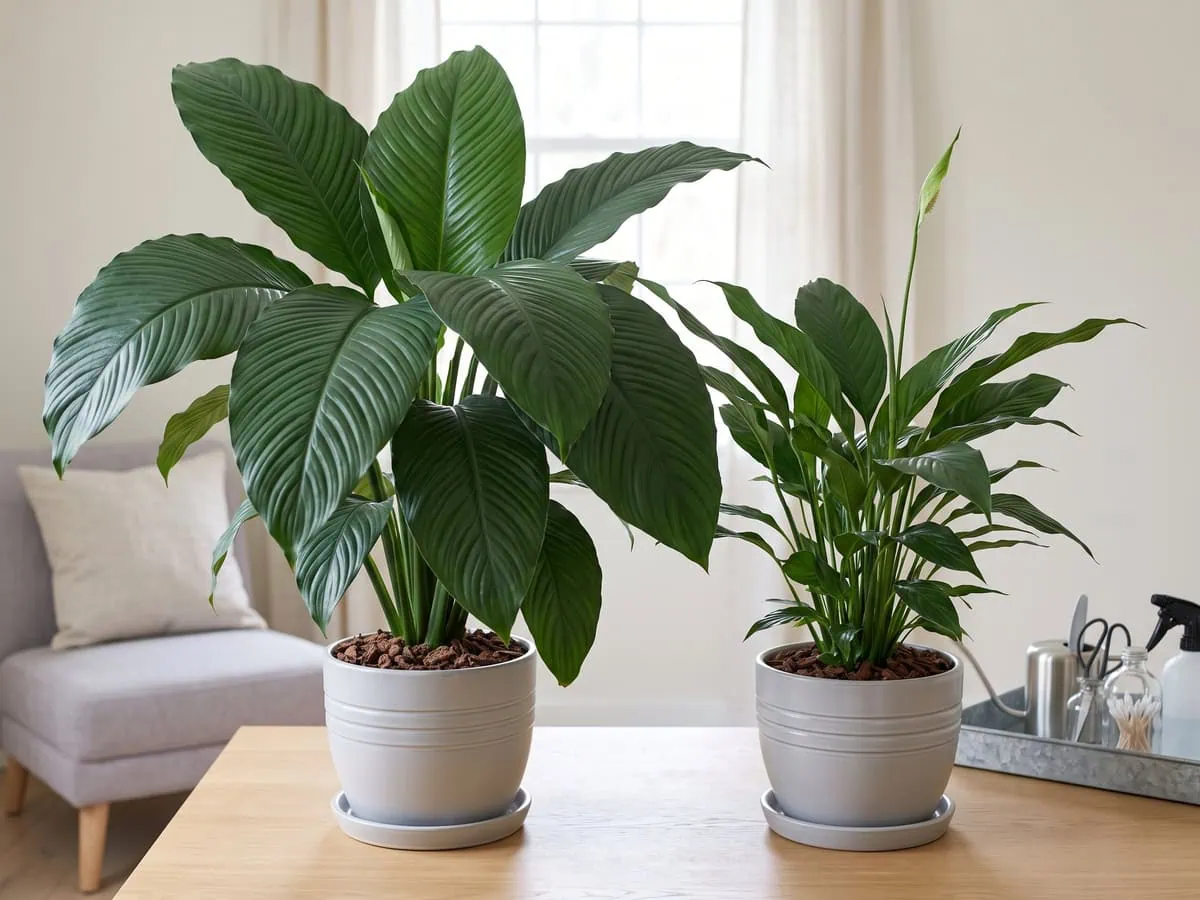
| What you check | ‘Sensation’ against the unlabeled plant |
|---|---|
| Blade surface | Deeply ribbed on ‘Sensation’; smooth and glossy on most shelf stock |
| Mature height | 4-5 feet or more, against roughly 2 feet for the common hybrid |
| Time to that size | 6.5-9 months in production light; 2-5 years in a home |
| Care routine | Identical light and water; only the floor space changes |
Verdict: Choose ‘Sensation’ only where floor space is already free, because a 4-to-5-foot clump of ribbed blades needs room no shelf or desk can give it.
What a regular peace lily actually means
A regular peace lily is an unlabeled plant with uniformly green, smooth, lance-shaped blades and no white marking anywhere. Both traits read plain. That is the baseline every shop comparison quietly assumes and almost none of them defines.
Type “difference between a sensation peace lily and a regular one” into a search bar and you will meet that undefined baseline over and over.
Behind the shelf label sits a genus of 76 accepted species, yet the interior trade runs on Spathiphyllum wallisii and a modest set of hybrids bred from it. Most of them look alike. So an unlabeled plant is rarely mysterious — it is usually a plain-green mid-size selection, sold before anyone printed the cultivar name.
How big Sensation gets, and how long it takes
Readers who type “how big does a sensation peace lily get” want one number, and the honest answer is a bracket: 4 feet by one extension guide and over 5 feet by a second, both describing mature specimens rather than the plant on the shelf. One figure will not cover it.
Height is the only dimension that moves much. Spread stays inside roughly 4 to 20 inches across every documented selection, because this plant widens along a creeping surface rhizome instead of throwing out branches.
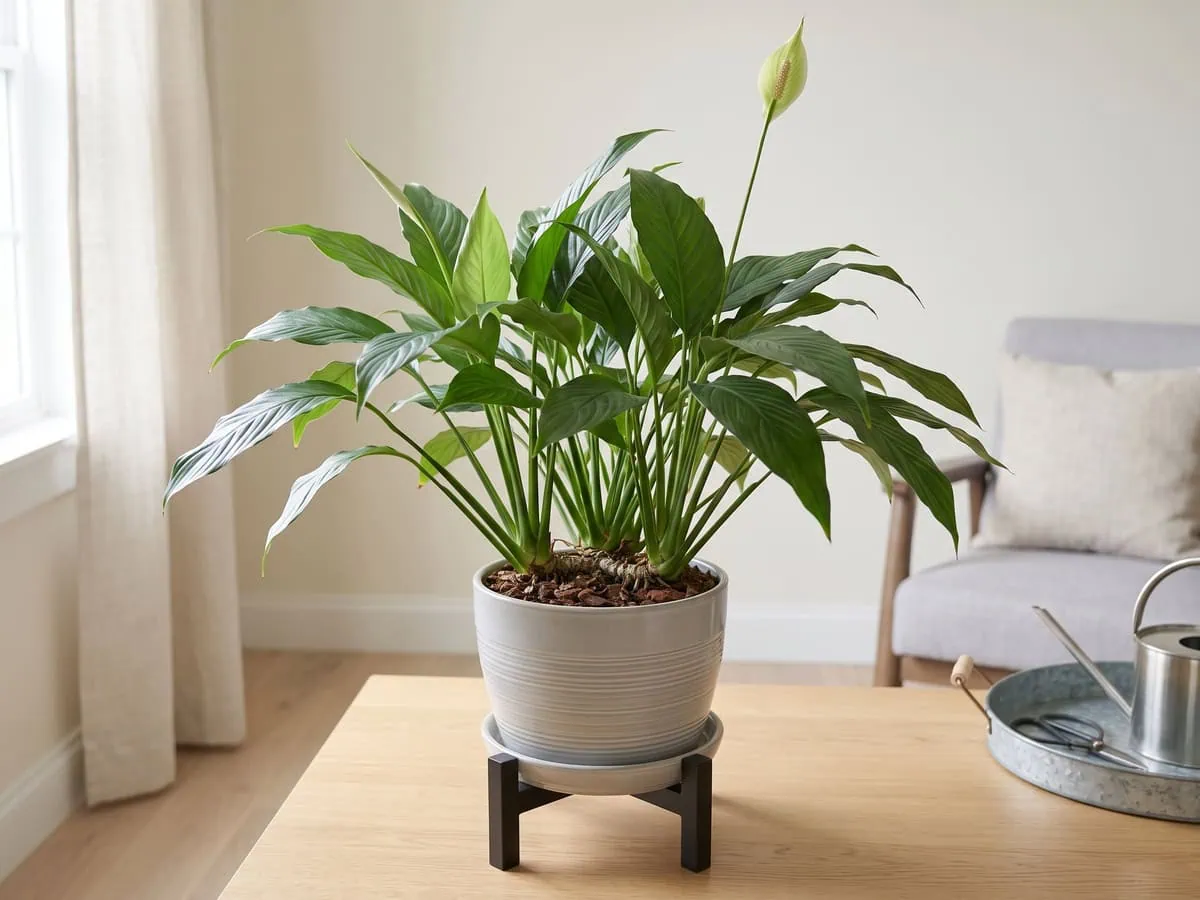
Time is the part the shelf tag never prints. Under production light near 1,500 foot-candles — a level a greenhouse holds and a room does not — a standard cultivar takes 6.5 to 9 months to reach a finished flowering plant near 21.7 inches, while a compact cultivar finishes in about 20 weeks at roughly 10.6 inches.
Your room is dimmer, so stretch the timeline. Newer selections reach full size in 2 to 5 years, the older species type takes 5 to 10, and light is the lever that decides where in that band you land — which is also why stretched growth and the light level behind it shows up first in dim corners.
I read ribbing before height now. The plant that taught me was young and short, and its blades were already corrugated.
But the pot told the older story — a root ball shrunk back from the wall after a fortnight unwatered, giving off the flat dry-paper smell of mix gone past dry. It was small for its cultivar, not by nature.
Domino and the white-marked group: reading the marking
White-marked peace lilies separate by the shape of the marking, not by how much white a blade shows. Three patterns cover the group — speckles, veins, stripes. Each one belongs to a different selection.
Below, the pattern comes first, then the reason it shifts, then the care question.
Pattern type, not intensity, separates the marked group
Search “what is a domino variegated peace lily” and the answers arrive in adjectives — bold, striking, dramatic. Pattern type is the sturdier reading. ‘Domino’ carries speckles and spots, ‘Hi Ho Silver’ carries light-colored veins, and the striped compacts are described in shop listings as banded along the length of the blade.
One extension guide calls ‘Domino’ the only variegated peace lily on the market, while another documents ‘Gemini’ and ‘Variegata’ as white-striped plants of about 12 inches. Both statements hold, because the first describes the mainstream shelf and the second the full documented list.
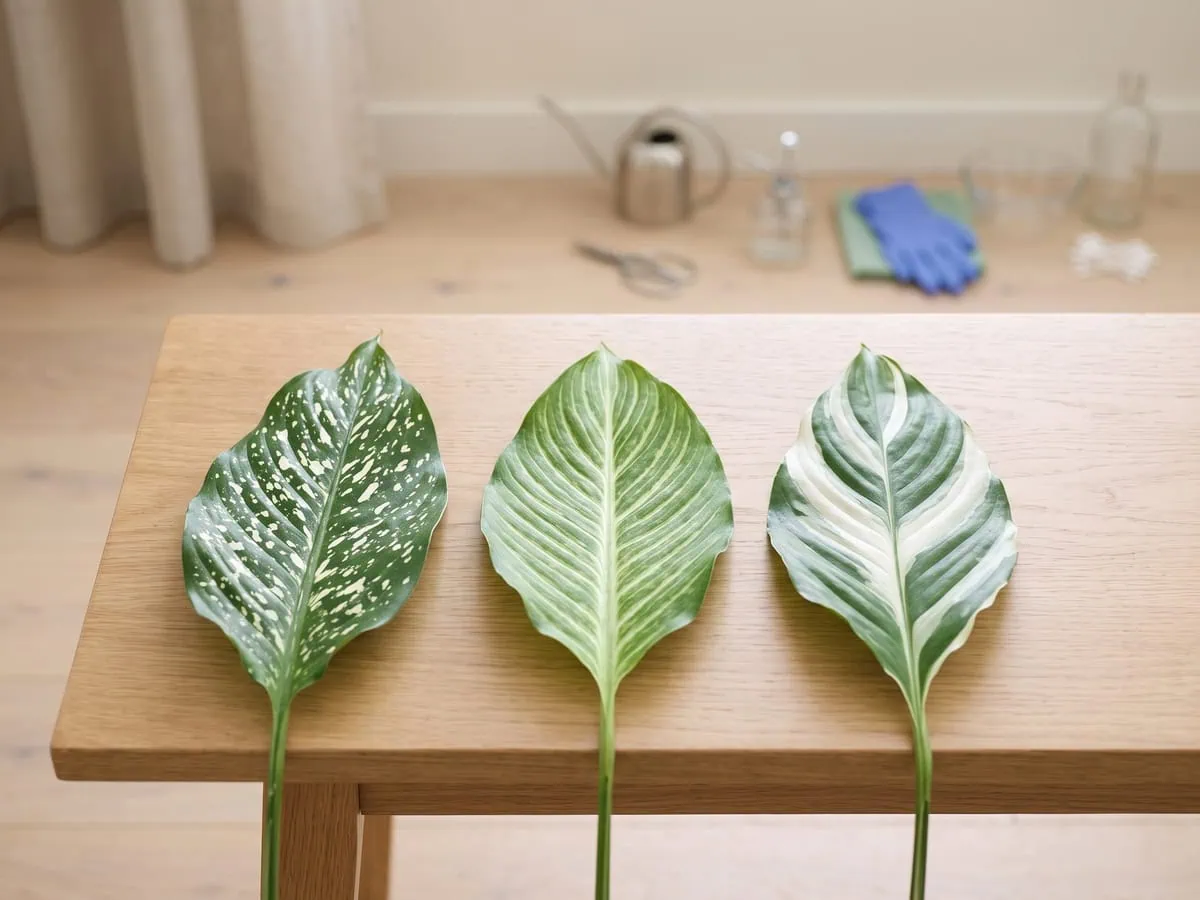
White is the trait most buyers are paying for, so shelf and record rarely line up.
Trade copy still calls speckled ‘Domino’ the only variegated peace lily on the market. Extension guides disagree: white-striped ‘Gemini’ and ‘Variegata’ finish near 12 inches, and ‘Hi Ho Silver’ shows light veins instead of speckles. Pattern class first, height second.
Why a marked blade can come back plain
Marked plants do lose their white, and two conditions travel with the loss: light that is too dim, and nitrogen that is too generous. My working theory is… the pale zones carry less chlorophyll, so they are the first thing a plant stops paying for when the light level it sits under drops.
The part no shop page states is what that white actually is. The trade calls it chimeral variegation, and the part you can act on is visible rather than cellular: watch the newest blade as it unrolls and note whether the white comes with it.
Division rather than seed is the method the source records for holding variegation in some chimeral plants. A blade that unrolls plain came from a growing point the white did not reach.
Does variety change what you actually do?
No, not for the things you do weekly. Light is identical across cultivars, and so is the sap: every selection carries the same irritant crystals, so what the sap does to a cat or a dog never depends on the tag.
Two axes do move. Vigor differs — several selections are listed as fast growers while others stay sparse — and one cultivar, ‘Jetty’, is recorded as more cold and heat tolerant than most.
Size is where variety turns into work rather than into a trait. A 4-foot ribbed clump simply takes a larger volume of the same mix.
The sharp resin smell off a freshly opened bag of pine bark is identical for a dwarf and for a giant, which is why the potting medium built to let air reach the roots reads the same for both.
Frequently asked questions about peace lily varieties
How do I know what type of peace lily I have?
The type is named by three visible traits: the white marking pattern, the blade surface, and the measured height of the clump. Take them in that order. Most shop plants answer all three without a flower and without a lifted root ball.
When the traits still do not settle it, record both measurements, photograph the whole plant plus close-ups of new growth and petioles, and place the plant by size class and marking group instead. A Spathiphyllum carrying no cultivar name is still fully placed at genus rank.
Is a Sensation Peace Lily the same as a regular peace lily?
No. ‘Sensation’ is a distinct cultivar with enormous, deeply ribbed blades, reaching 4 feet by one extension guide and over 5 feet by a second.
An unlabeled, smooth-bladed plant of roughly 2 feet is what fills most shelves. Both share one growth form, one spathe and one care routine, so mature size and blade texture are the only working separators.
What are the different varieties of peace lily?
Thirty-nine distinct cultivars and forms are documented across extension and horticultural-society rosters, running from 12-inch dwarfs to 4-foot giants.
Variety roundups typically repeat about a dozen of them: ‘Mauna Loa’, ‘Sensation’, ‘Petite’, ‘Domino’, ‘Gemini’, ‘Variegata’ and a few breeder selections such as ‘Sonya’ and ‘Hi Ho Silver’. The remainder sit inside commercial production tables rather than on shop benches, which is why published variety counts disagree so widely.
Are peace lily and Spathiphyllum the same?
Yes. Spathiphyllum is the botanical genus and peace lily is its common name, so both strings point at the same Araceae plant.
Precision differs below that point: one authority binds the common name to the whole genus, another binds it to Spathiphyllum wallisii. Neither name signals a true lily, and the family behind the shared word is Araceae rather than the lily family.
Read it, measure it, then choose by size
Three traits do the whole job: marking pattern, blade surface, measured height. None of them needs a label, a flower or a lifted root ball. Confession time: I still measure before I name a plant, because a tape settles in seconds what a tag never settles at all.
Once the size class is fixed, watering rhythm is the next question, and judging thirst by weight rather than by calendar is where a broad ribbed clump and a 12-inch dwarf genuinely differ, and a saucer left full turns sour with that faint stagnant tang.
One pass is enough. Getting peace lily varieties and how to identify them straight takes one reading of the plant, not a purchase decision. Skip the tag and read the plant instead: surface, marking and height name the variety every time, sticker or no sticker.
Tap the button below to get more plant fixes in your Google Search results