
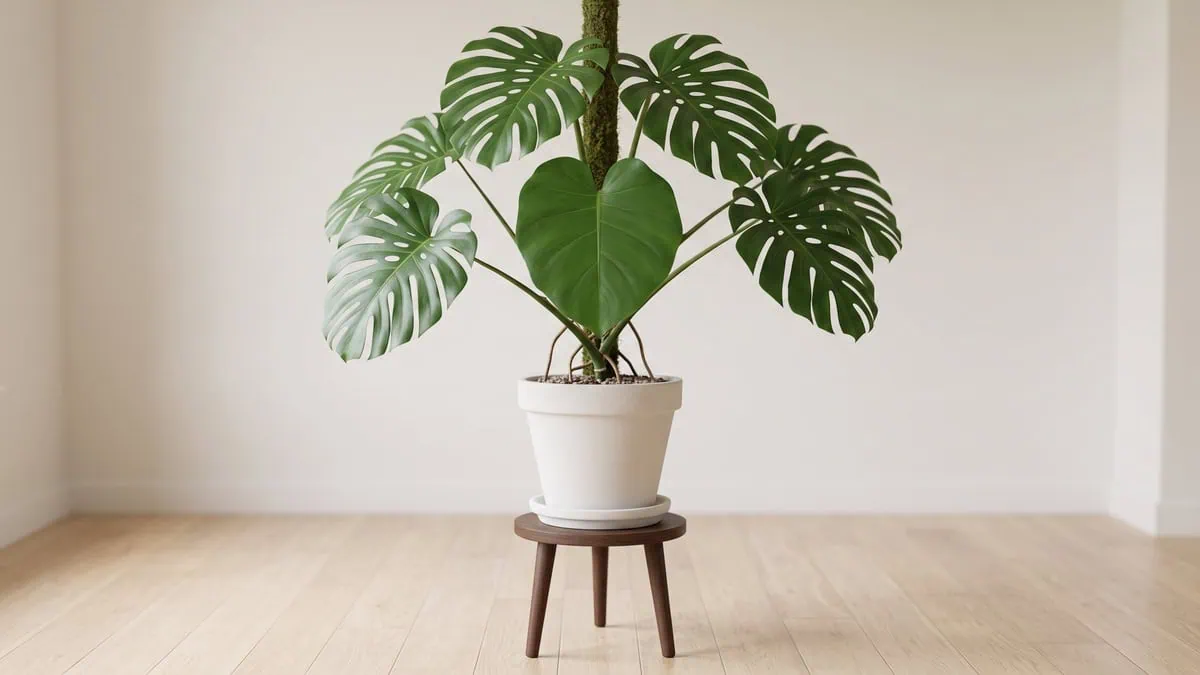
🎯 Quick Answer: why are my Monstera deliciosa leaves not splitting
Why are my Monstera deliciosa leaves not splitting: fenestration lags maturity in Monstera deliciosa, an Araceae family member, not 200-1000 FC. A juvenile blade opens solid and stays solid. Check the newest blade against an older one before changing anything.
- Look first: compare the newest opened blade with an older one
- Wait, do not fix: a solid juvenile blade needs time, not new conditions
- Light: hold the plant in 200-1000 FC before expecting change
- Count blades, not months: note the date on which each new blade opens
- Stop assessing: a blade that already flattened will never open later
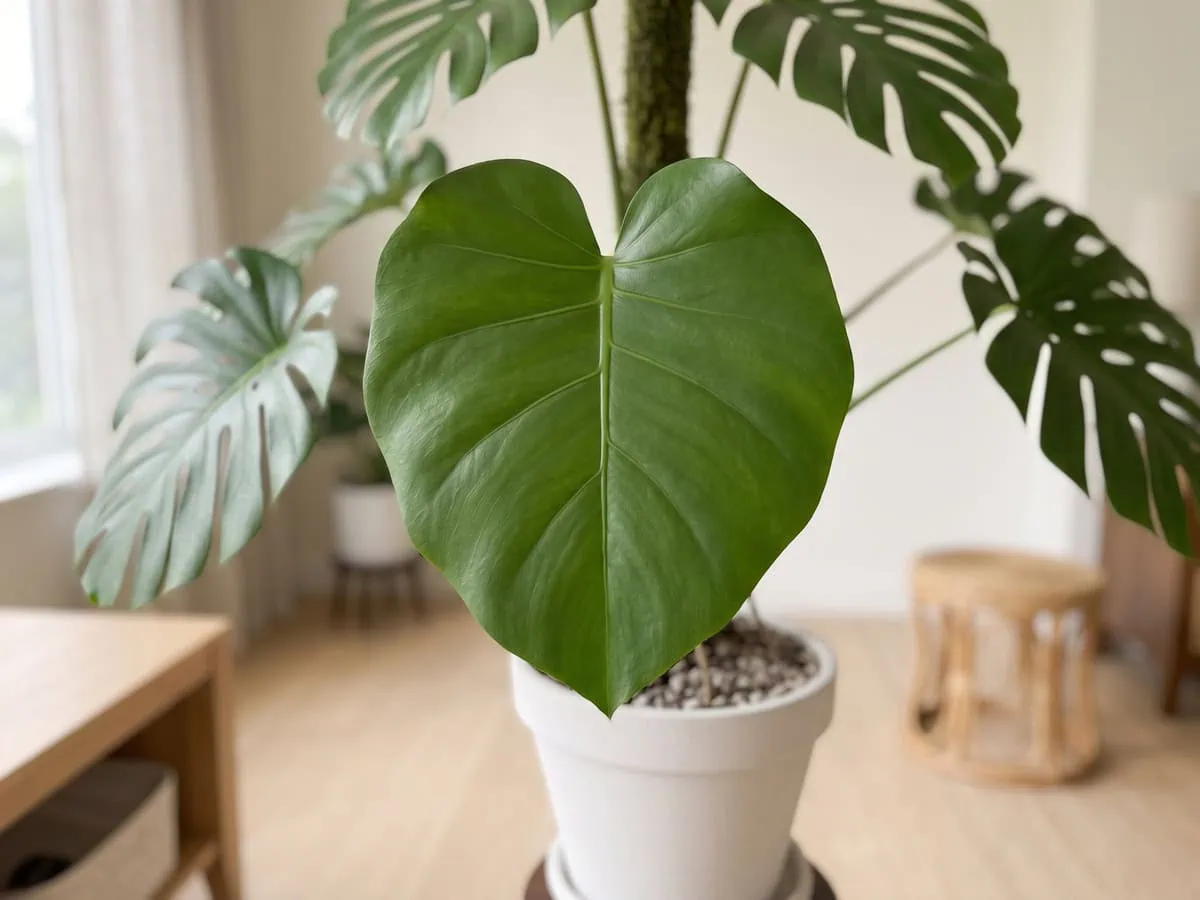
Let me level with you: a Monstera that will not split is the most common panic that reaches me. The blades come up a flat, even mid-green — no pale margin, no dark blotch, just uninterrupted lamina running between the primary veins (TBH — that unbroken color is itself the clue).
Conventional splitting advice sends you to the window. The real fix is usually to leave the plant where it is.
Let me rewind for a second: leaf fenestrations belong to adult leaf morphology, so a juvenile blade cannot be argued into holes by better light, richer feeding or a bigger pot, however patient you are.
Two plants, one check. Sixty seconds decides which one you own. If you want the wider picture first, start with the full indoor care routine for a Swiss cheese plant.
Nothing on this page is a fault report. The fast facts this check rests on are collected in the card immediately underneath.
Why are my Monstera deliciosa leaves not splitting: the fast facts
| Monstera specs | What the evidence says |
|---|---|
| Blades that can split | Adult blades only; a juvenile blade emerges entire and stays entire. |
| Typical onset age (from care guides, not measured on the species) | 2-3 years, per care guides; read maturity from the leaves instead. |
| Can an existing entire blade split later? | No — the shape a blade opens with is the shape it keeps. |
| Is brighter light alone enough to force splits? | No; maturity gates it first. |
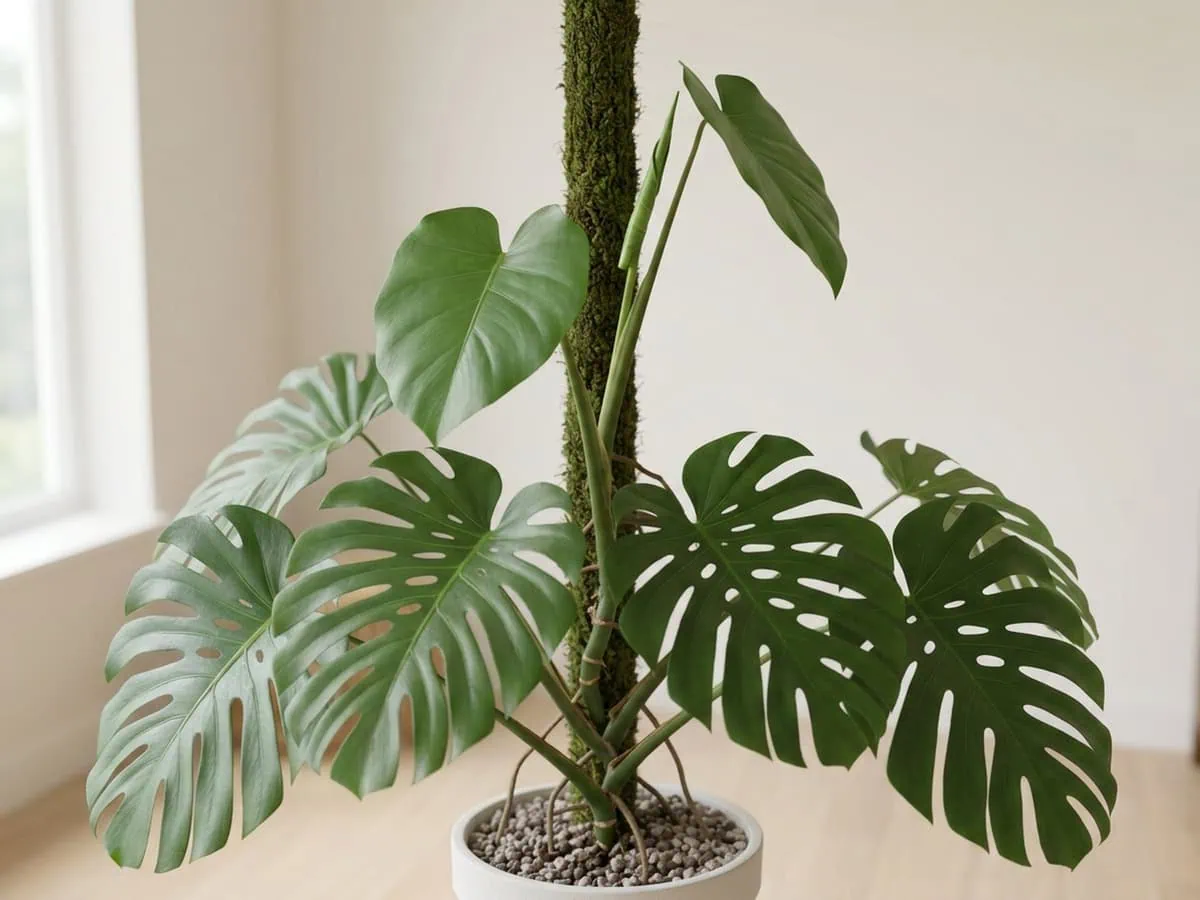
| The two features to tell apart | A marginal split reaching the blade edge, against an enclosed hole. |
| When the perforation pattern is fixed | While the developing leaf is under 1-2 mm, by programmed cell death. |
Tap the button below to get more plant fixes in your Google Search results

Table of Contents
Is your plant old enough to split? Start with the two-blade check
A Monstera is old enough to split when its newest blade opened with a cut in the margin — not before. Seven plants passed my bench in one year carrying that same question, and on six of them the newest blade was flat, unmarked and even in tone from midrib to edge. Nothing was wrong.
The following sections separate the two features first, then say what to do with a blade that has neither.
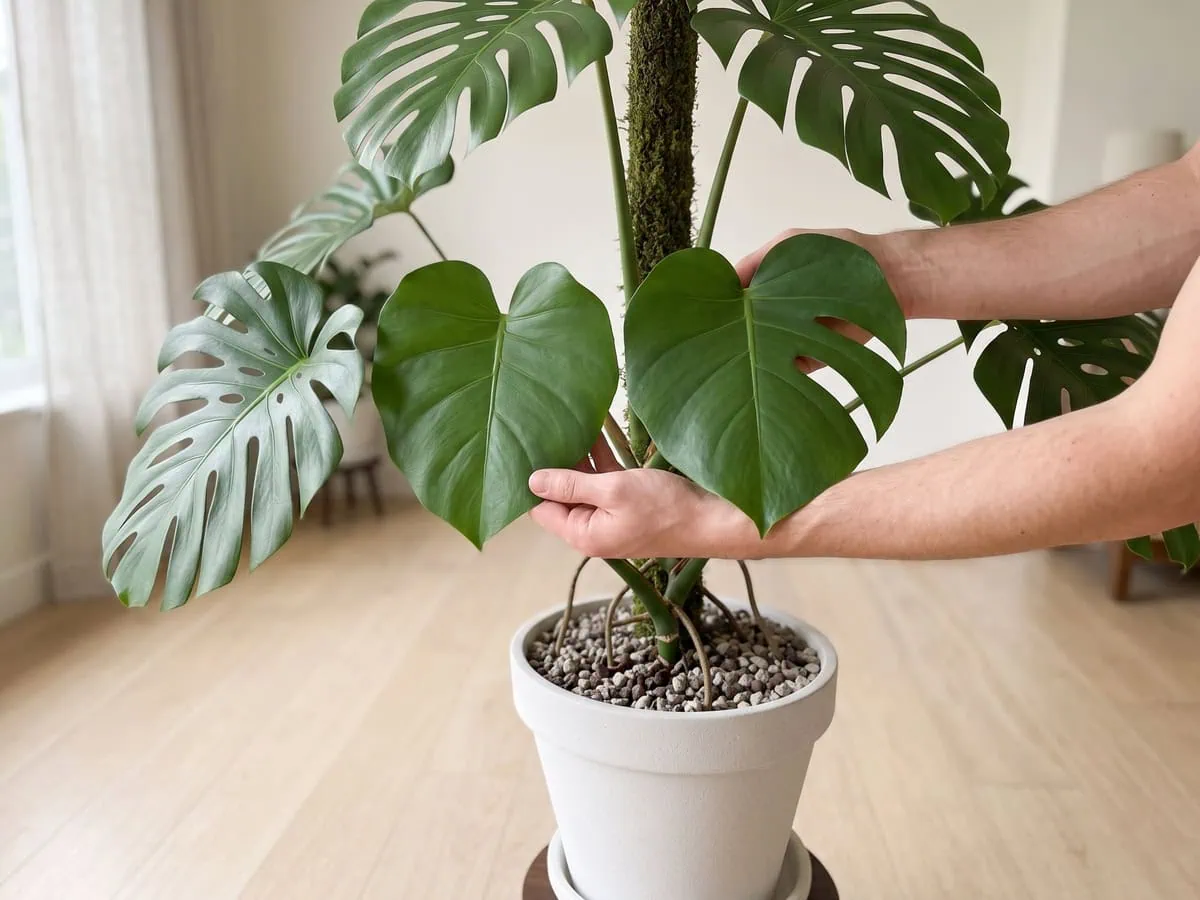
Marginal splits versus enclosed holes
A marginal split runs inward from the blade edge, while an enclosed hole sits fully surrounded by lamina between the primary veins. Most sources call both by one word.
| Feature | What you are looking at |
|---|---|
| Marginal split | A cut that reaches the blade edge and opens it. |
| Enclosed hole | An opening ringed by lamina, never touching the edge. |
Verdict: record which of the two your plant produced most recently, because that is a far finer progress marker than a yes-or-no answer about whether the plant splits at all.
If you are unsure which species you own, work through telling this species apart from its narrow-leaved relative first.
- Fenestration: the enclosed holes a mature blade carries between its veins.
- Pinnation: the marginal cuts that reach the edge, which arrive first.
The solid juvenile blade, and why waiting is the answer
So what does an entire blade actually tell you? It says the plant has not reached adult leaf morphology yet, because leaf fenestrations form on mature leaves through a genetically encoded process in which cells organize their own destruction. That pattern settles while the blade is still developing.
Therefore an entire blade that has already flattened will never gain holes later — the pattern was set before it unfurled.
Owners who type “why does my young Monstera deliciosa have no holes” into a search bar are usually describing a healthy plant. Botanical records list juvenile leaves as entire and unbroken; the blade acquires its perforations and split edges only as the plant develops.
Type “how long until a Monstera deliciosa develops holes” into a search bar and the answer comes back as an age in years — a figure you cannot check, since a shop plant arrives with no birthday attached. Count blades instead. Note the date each new one unfurls.
Tap the button below to get more plant fixes in your Google Search results

What actually decides fenestration: maturity first, then light
Maturity decides whether a blade can carry holes at all, and light decides how well the plant performs once it can. Take this with a grain of salt on the exact trigger: the perforation pattern is laid down by a genetically encoded program of cell death inside the developing blade.
Why that program evolved is still recorded as not fully understood. The sequence itself is not in doubt.
Below come the two yardsticks, the one-way rule, and the light question in turn.
The age and size yardsticks, and what they cannot tell you
Ask “at what age do Monstera deliciosa leaves split” and the answer comes back in years — useful to a grower, useless to a buyer whose plant arrived with no birthday. Measure, do not guess.
So read the blade instead: fenestrations form at the mid-rib and increase as leaf size progresses, which makes every newly opened blade a progress report on the one before it and turns a shelf of old leaves into a timeline you can actually read.
Why an entire blade never splits later
An entire blade stays entire — its pattern was settled before it unfurled.
That is also why the honest answer to “how to get a Monstera deliciosa to grow split leaves” is about the next blade — not the ones already open.
The holes are often explained as a way of increasing leaf area to catch more sun. Removing tissue cannot increase area. A tropical-ecology field study that tested three competing explanations for leaf fenestrations found the wind-damage account unsupported and herbivory higher, not lower, on holed leaves, while water reaching the roots rose.
Why more light alone will not force splits on a juvenile
Brighter light will not open a juvenile blade, because maturity gates the process first. Owners still ask “do Monstera deliciosa leaves split with more light”. On an adult plant, yes.
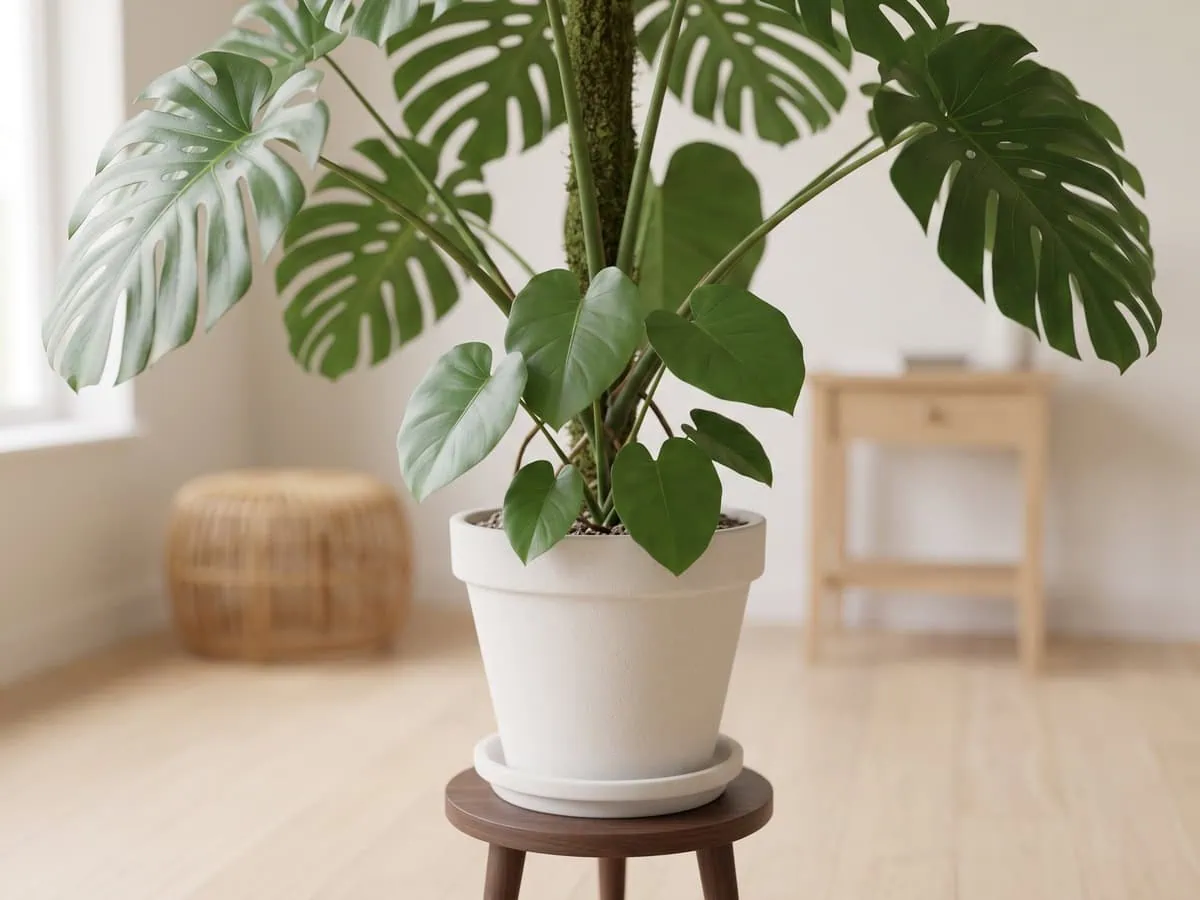
Below roughly 75-100 FC a plant survives but pushes out stunted, hole-free leaves in a flat uniform green, with no widening pale rim at the edge and no darkening at the tips to read the change by — which is exactly why an owner watching color alone sees nothing happening for months.
For the numbers behind that band, see the foot-candle range this plant grows in.
When a Monstera deliciosa goes backwards: splits that stop
A plant that made holes and then stopped is reporting a change in its conditions, not a change in its age (that distinction is the whole page). Blades that already opened never revert.
Read the series, not the specimen.
One plant I kept on a shaded landing for a year showed the shift cleanly — the newest blades came in a washed, yellowish light-green beside the deep glossy green of leaves two years older, and every new blade was solid.
Two sections below take the pattern itself first, then what it means.
Older blades with holes, newer blades without
Look for holes low on the plant and none at the top, because that order is the one thing youth cannot produce. A juvenile Monstera works the other way round: solid first, then cut, then perforated.
Extension records tie the reversal to light. Not to age. Those records name stretching leaf stems and stunted, hole-free leaves as the signs of light that has dropped too low for the plant to keep building holes into each new blade.
A second horticultural record says it plainly. Indoor perforations will not form if the light is too low. Forum owners land in the same place, describing long thin stems with very small adult leaves and being told to raise the light.
Reading that pattern as a change, not as immaturity
A hole-bearing lower canopy is proof the plant is already past the maturity gate. Waiting is no longer the answer to act on. Something moved — the plant, a curtain, a run of shorter days — and the newest blades recorded it.
Forum evidence keeps the claim honest, though. One owner moved a plant into brighter light and still saw fewer splits, and the responder put that down to youth rather than to the move.
The balanced statement there is that splitting depends on age, light and genetics together. So brighter light is a fair first correction — but it never beats age.
Long bare internodes carrying that same small solid growth are a second, structural problem, and shortening a stem that has run bare is the response to it.
Frequently asked questions about split leaves on a Monstera deliciosa
How do you encourage Monstera leaves to split?
Give an already-mature plant bright filtered light and something to climb, then wait for the next blade. Light is the lever that matters once maturity is reached, and a horticultural record states that indoor perforations will not develop if the light is too low.
Climbing is the second lever. Extension records describe staking the vine or mounting it on a moss pole that mimics the porous surfaces it climbs in the wild, and note that leaf size increases sharply once the vine attaches. Neither lever reaches a blade that has already opened.
Why are my Monstera leaves not cracking?
In most cases the plant is simply still juvenile, and juvenile blades are recorded as entire and unbroken. They acquire the characteristic perforations and split edges only as the plant develops, so an unsplit leaf on a young plant is a stage rather than a fault.
Two other readings apply to older plants. One that made holes before and stopped is reporting a change in light, not in age. A plant with long thin stems and very small adult leaves is being told by its own growth that the light is too weak.
How long does it take for Monstera deliciosa leaves to split?
Read maturity from the leaves rather than from the calendar. Botanical records describe the approach to maturity by leaf shape rather than by calendar age, tracking the change from entire juvenile leaves to progressively cut and perforated adult ones.
Care guides commonly quote two to three years. Age is unusable anyway on a shop plant that arrived with no known birthday. Reading the sequence of new blades gives you a marker you can actually verify.
Why do some Monstera leaves not have splits?
The blade fixes its perforation pattern while it is still developing, and never revises it afterwards. Fenestration forms on mature leaves through a genetically encoded process in which cells organize their own destruction, so a blade that opened solid stays solid for its whole life.
That is why a single plant can carry both kinds at once. Blades formed under adequate light and adult development open cut and perforated, while blades formed earlier, or under weaker light, open plain and remain that way on the same stem.
How long does it take for a Monstera to push out a new leaf?
Indoor leaf intervals stretch and shrink with light, warmth and feeding, so read the plant rather than a fixed interval. Extension records describe indoor growth qualitatively instead, as vigorous in soil and condition-dependent, reaching up to sixteen feet or more only when the plant is cared for properly.
What published sources do establish is which conditions move that rate. Soil culture outgrows water culture, bright indirect light and warmth around 70F support active growth, and a climbing support drives larger leaves once the aerial roots attach.
From anxious to confident in three new blades
Worth saying plainly: the check you just ran beats any age estimate, because it reads the plant in front of you rather than an average. One blade tells you the stage. Three tell you the direction.
So stop watching the leaves you already have. Start dating the ones still to come — the newest blade deepens from a soft yellow-green to the settled glossy green of the canopy below it.
Once the sequence turns, supporting the stem as it climbs is the step that follows this one. Ask why are my Monstera deliciosa leaves not splitting once, answer it with the two-blade check, and you never ask it again.
Every new blade is a progress report, and the newest one tells you exactly how close the first split really is.
Tap the button below to get more plant fixes in your Google Search results