🎯 Quick Answer: reading the mix, not the calendar
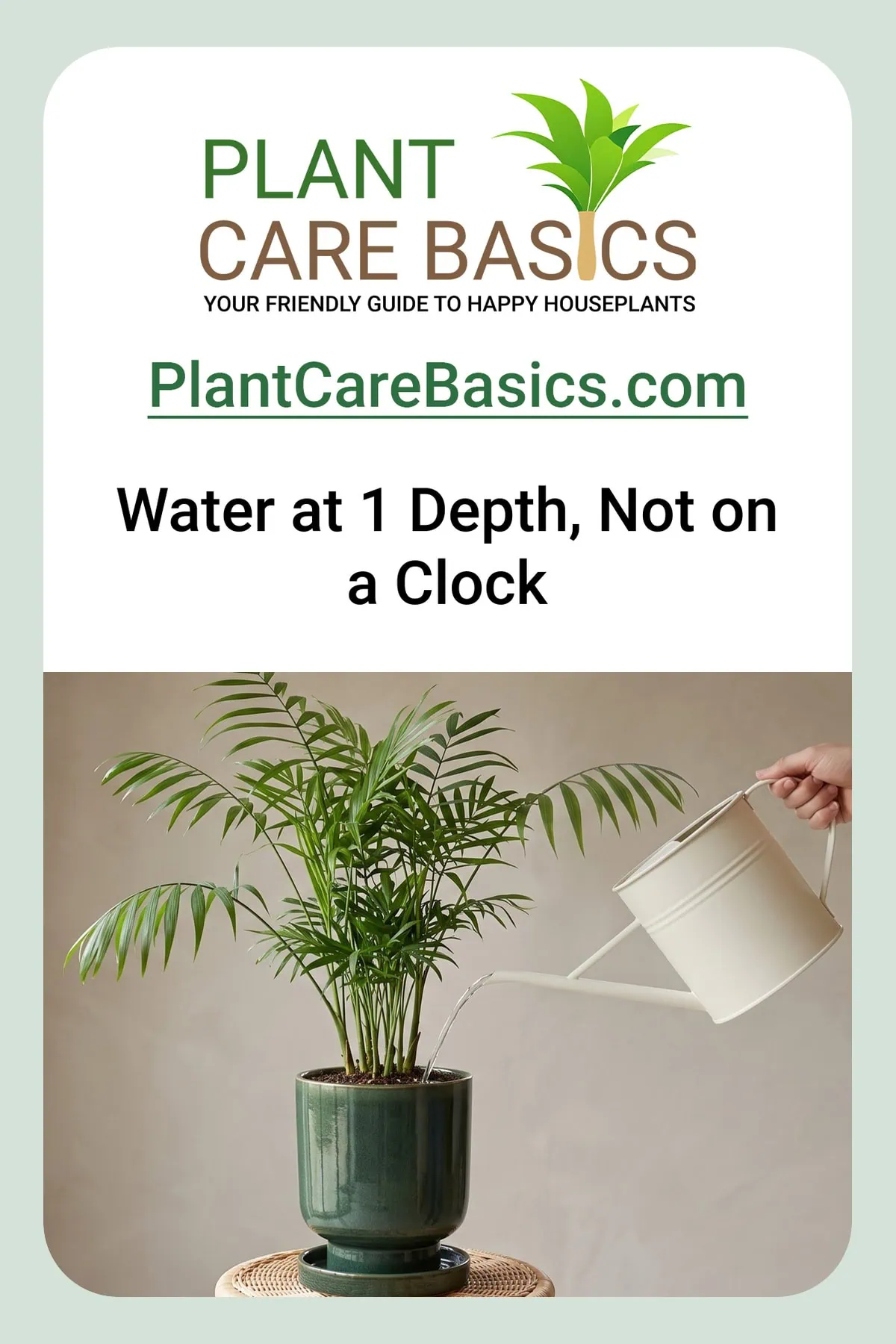
How often to water a parlor palm without root rot: soggy mix ignites decay under the top 1-2 inches of Chamaedorea elegans, an Arecaceae palm. Every palm builds from a single tip. Check the depth, never the calendar. Water thoroughly, then empty the saucer once the pot finishes draining.
- Finger check: push a fingertip in to the second knuckle
- Pot weight: a dry pot lifts noticeably lighter than a watered one
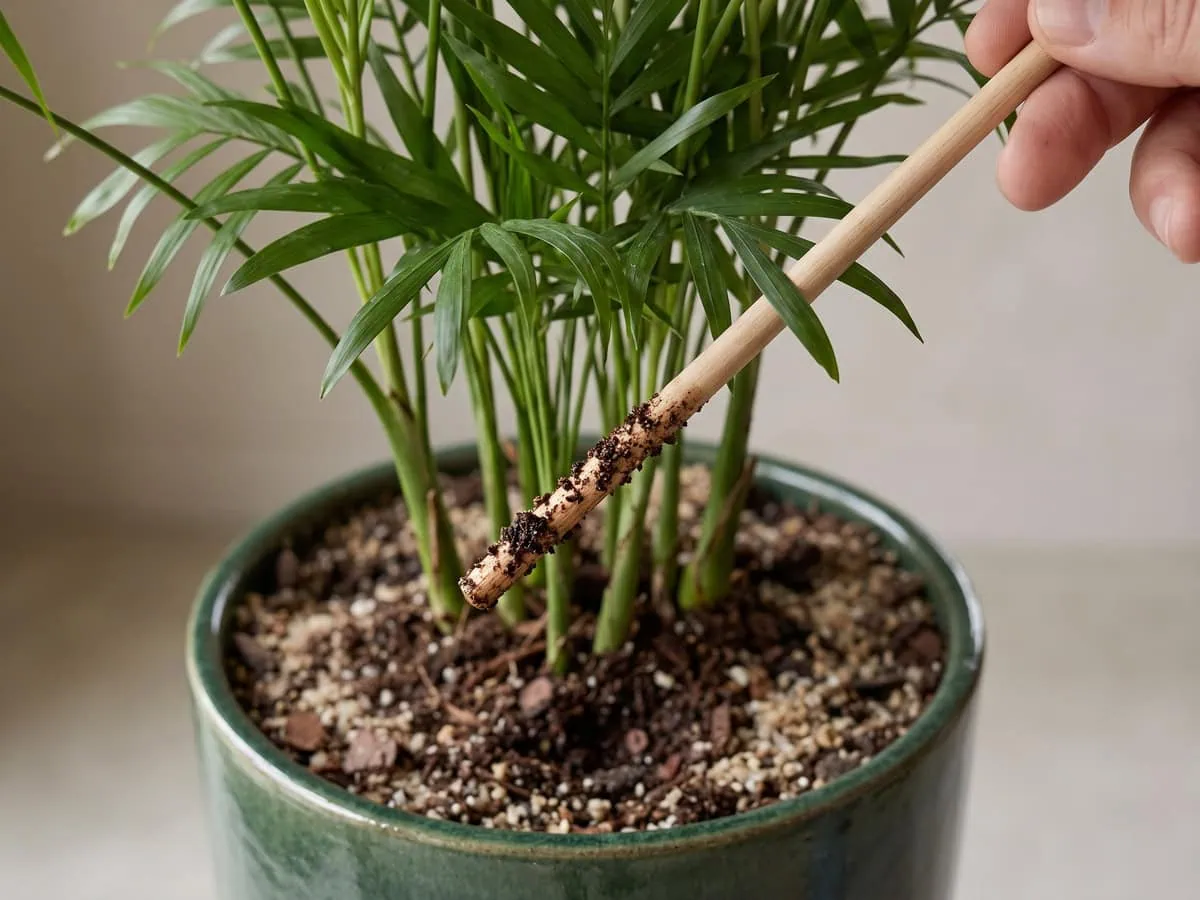
- Stick test: a wooden dowel comes out clean when the mix is dry
- Warning sign: soft stem bases mean the roots are already failing
- Never: let it dry out completely or stand in water
Confession time: soft stem bases took three parlor palms off me, and every one was on a tidy weekly schedule. The pot stayed cold against my palm hours after the room had warmed. And still damp.
I was treating root rot as a frond problem, but the real fix had nothing to do with that. It was overwatering. Hmm, on reflection, the giveaway was underfoot the whole time (trust me on this): Chamaedorea elegans carries no water store, so root rot starts in whatever the mix holds.
So the question stops being how many days and starts being how deep. Poor drainage is the other half of it, and the reading that heads both off lives in the top 1-2 inches of mix. The rest sits inside the overall conditions this plant is grown in.
The table below is the whole answer in six lines, and not one of them is a date. Read it, then keep your finger honest.
How often to water a parlor palm without root rot: the numbers at a glance
| Parlor palm specs | Recommended care |
|---|---|
| Water when | The top 1-2 inches of the mix are dry to the touch |
| Watering interval | Whatever that top 1-2 inches takes to dry in your room, not a day count |
| Water until | The excess drips freely from the drainage holes |
| Empty the saucer after the pot finishes draining? | Yes, so the pot never stands in the water it shed |
| Growing medium | A coarse free-draining palm mix of two parts coir to one part pine bark fines to one part coarse sand, top-dressed with a thin layer of the same coarse sand |
| After a root-zone rescue | Hold the next watering until the roots have dried, possibly over a week |
Tap the button below to get more plant fixes in your Google Search results

Table of Contents
The moisture reading that sets your watering interval
The reading that sets the interval is the top 1-2 inches of mix, checked by finger, because that band dries at a rate set by the pot size, the room and how fast the crown is pushing new fronds. Not the calendar. Myths come first here, then the deeper checks.
Two watering myths worth dropping
Most care pages tell you a yellowing frond means the plant wants more water. On a pot whose mix has not dried, uniform yellowing reads as the opposite, and the observation that settles it is the state of the medium when the color appears.
The second myth is the calendar itself. Published intervals for this palm run from one week to three, and the same pages that print a number also say the number is the wrong instrument. Set the condition instead; the days follow from your room.
Myth: yellow fronds mean a thirsty palm. Fact: on an undried mix, that color reads as the opposite.
Myth: a fixed weekly slot is safe. Fact: the interval belongs to your room, not to the species.
The dowel and pot-weight checks that read deeper
Put “how do I know when a parlor palm needs water” to any search engine and a depth comes back, usually one inch. That depth is a fraction of whatever pot you own, not a constant of the species.
A thin wooden dowel about a quarter inch across, pulled from the bottom of the pot, comes out cool and damp against the back of my hand, ten minutes after the surface read bone-dry. I have watered on the day rather than on that reading, and lost stems for it.
Lift the pot. A dry one is noticeably lighter, and a knuckle rapped on the wall sounds hollow rather than dull.
Nothing in this palm stores water, so the mix is its only supply. Why some pots in the same room dry so much faster than others, I have a hunch about this but no peer-reviewed source.
Read it twice. Two readings several days apart tell you more than any single one, because if the top 1-2 inches dries noticeably faster one week than it did the next, the room changed rather than the plant, and the interval changes with it.
Tap the button below to get more plant fixes in your Google Search results

How to water a parlor palm so the root zone drains
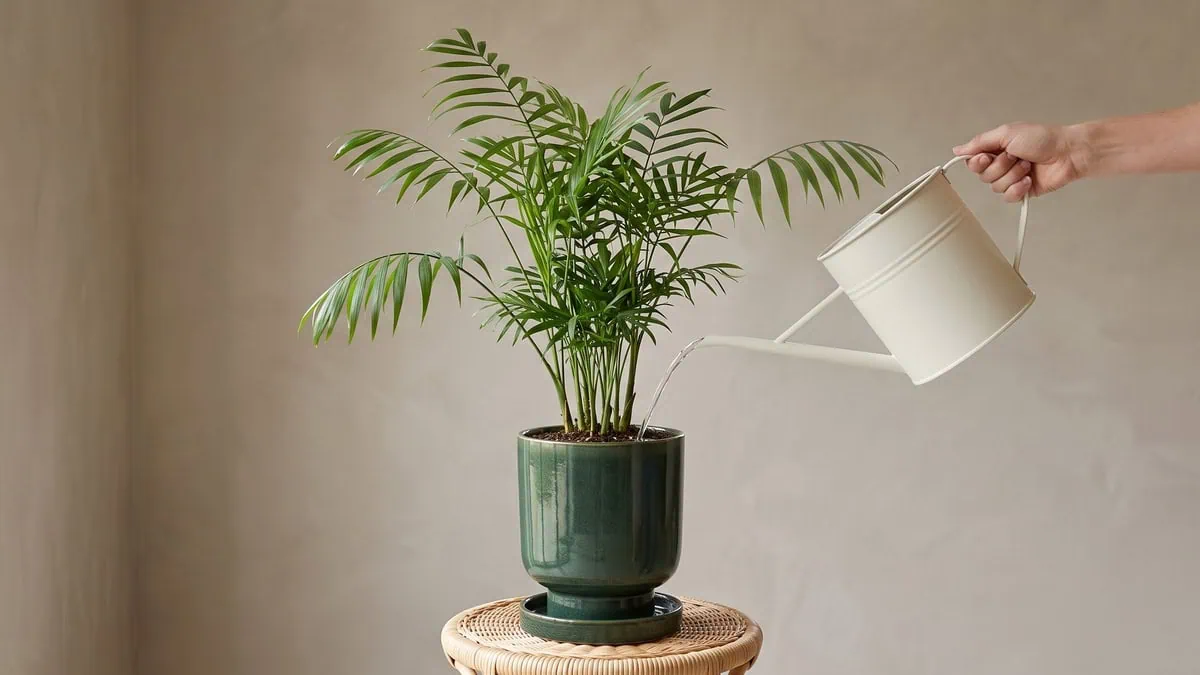
Water until the excess drips freely from the drainage holes, then deal with what lands underneath, because a parlor palm’s fine roots sit in the top few inches and drown in whatever the saucer keeps holding. That is the whole method. Below, the base of the pot comes first, then the saucer.
Why the pot base stays damp longer than the surface
The question “is it normal for the bottom of a parlor palm pot to stay damp” has a physics answer, and it is direct. Evaporation reaches the surface and nothing else, so the base of any pot is the last part to dry.
The reading is the trend, not the state. Check the same depth twice, several days apart: if the damp zone shrinks, the pot is working, and if it sits at the same level for a fortnight, the mix is too fine or the pot is too big for the root plug.
What to do with the water that reaches the saucer
Half the care pages tell you to empty the saucer and none of them says when (yes, this sounds pedantic — bear with me). One return trip settles it: water, walk away, come back once, and pour off whatever has collected.
Standing water re-submerges the root plug the drainage holes just emptied, which is how poor drainage turns into root decay in a pot that drains perfectly well on paper. Never add gravel to the bottom either; it perches water rather than moving it.
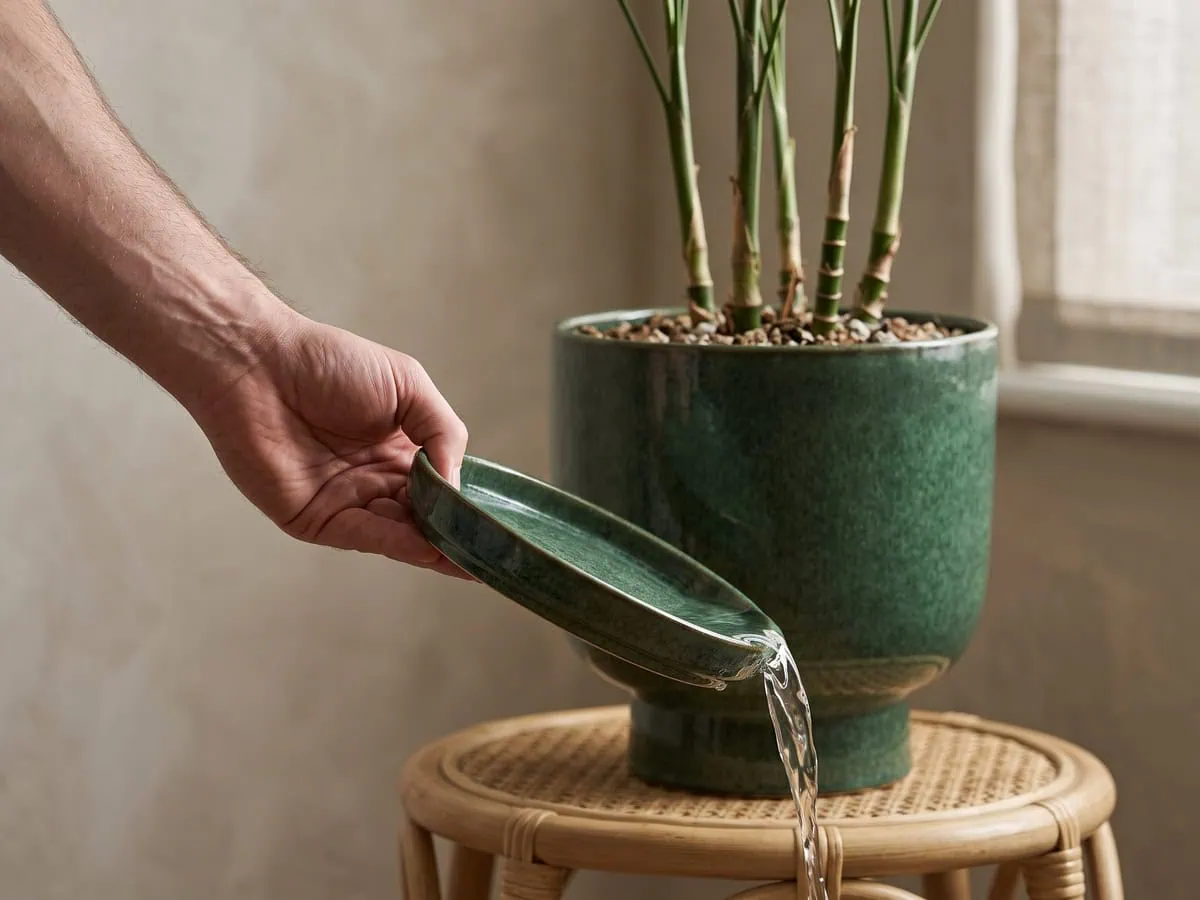
On volume the care pages are nearly silent, so here is the endpoint instead: keep pouring until it runs from the holes. Under-filling is the real risk, because a splash wets only the top inch you were about to check, and the next reading tells you the plant was watered when it was not.
There is a bonus in the surplus. The free-draining palm mix this plant sits in lets a full pour run through and the water that leaves the holes carries dissolved minerals out with it. That is why a thorough pour beats three small ones in the same week, and why I take mine to the sink.
Three things decide whether that surplus actually leaves:
- The drainage hole stays open, not blocked by a root or a shard.
- The mix is coarse enough to let water pass rather than hold it.
- The saucer gets poured off once the pot stops dripping.
Reading a root zone that has already gone sour
A sour root zone is read at the stem base, not at the fronds, because the fronds hold their color for days after the roots below them have already turned soft, dark and unmistakable to the nose. Lift the plant out. The sections that follow split the dry case from the wet one.
Search results for “why do my parlor palm stems go soft and pull out easily” carry the phrase root rot everywhere and the presentation almost nowhere. A stem that has lost its base gives way when you lift it; one that has not, resists. That base reading is not what a browning frond tip actually points to.
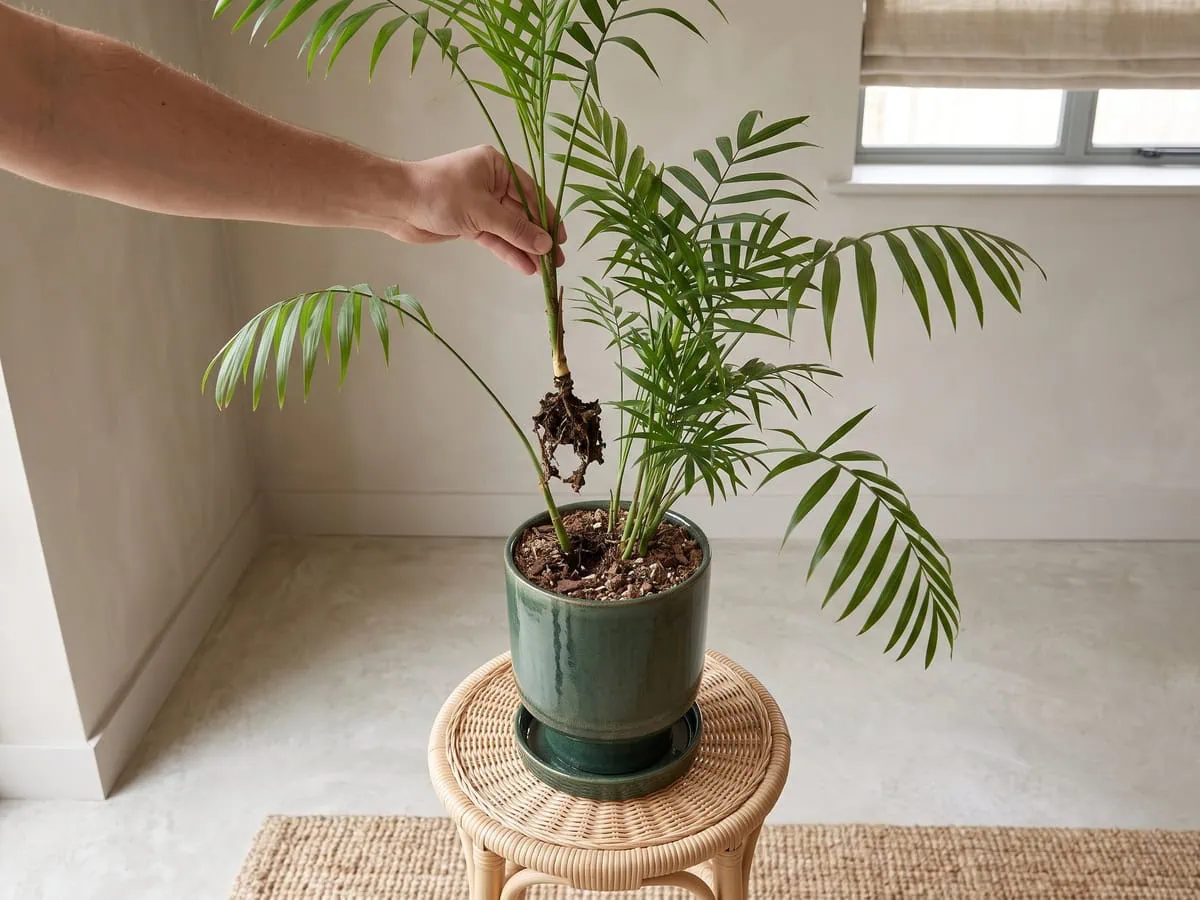
Hold the plug over a tray. Brush the mix back. A live root is pale cream to light tan, firm, carrying fine feeder branches; a lost one is dark and soft, and its outer sheath slips off the thin core between your fingers.
The smell arrives before the sight. The cause lies in the mix. According to the UC Statewide IPM Program, the water molds behind root rot swim through saturated mix, which is why the fault travels upward from soil level rather than downward.
When a dried-out palm needs a soak instead
For “what happens if a parlor palm dries out completely” the useful answer is a condition, not a count of days. What you can read is the mix: once it shrinks from the pot wall, water runs down the gap and straight out, and the plug never wets.
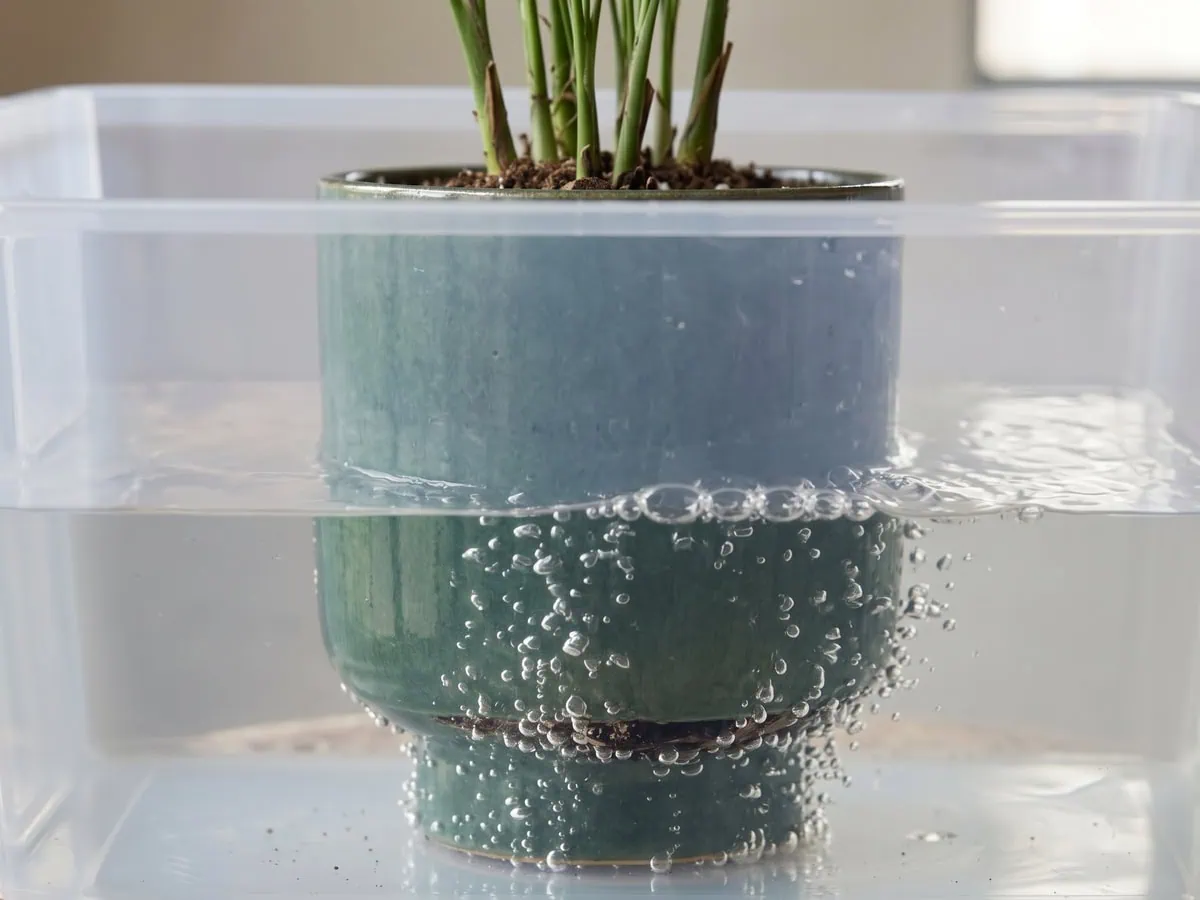
Stand the whole pot in a tub of tepid water for twenty to thirty minutes. When the air bubbles stop rising, the mix is saturated; lift it out and let it drain.
Trimming back to firm root tissue, and when not to
The caution against disturbing these roots applies while the plant is healthy. It stops applying the moment the root zone has failed, because at that point leaving the plug intact does more harm than lifting it.
Wipe or dip the blade in 70 percent alcohol between every cut, and clean the work surface and the pot the same way afterwards. A plant whose root mass is mostly dark and soft is discarded, not replanted.
Cut above each rotted segment so only firm tissue remains, and if all or most of the mass is dark and soft, the plant is discarded rather than nursed. Then hold the next watering until the roots have dried, which may take more than a week, and read why a freshly moved plant takes up less water for a while.
Frequently asked questions about watering a parlor palm
How often should I water my indoor Parlor Palm?
Water when the top 1-2 inches of mix are dry to the touch, not on a fixed day. The interval that follows is whatever your room produces, and it moves with light, warmth and how hard the heating is running.
A pot in a bright warm corner may hit that reading in a week; the same plant in a dim cool room may take three. Both are correct. What holds steady is the free-draining palm mix this watering rhythm assumes.
Do Parlor Palms like to be misted?
No. Misting wets the fronds for a few minutes and does not change the air the plant sits in, so it is not the way to raise humidity around this palm.
It also leaves foliage damp, which the published guidance warns against on this species. Aim for 40-60% relative humidity by other means instead. Why that band matters in full is a question the main care guide answers, not this one.
How do I tell if my palm tree needs water?
Push a finger into the mix to the second knuckle; if the top 1-2 inches read dry, it is time. Three no-gadget checks confirm it without a meter.
Weigh it in your hands, because a dry pot is noticeably lighter than a watered one. Rap the wall with a knuckle and listen for hollow rather than dull. Push a wooden dowel to the base and see whether it comes out clean or damp.
Do palms need to be watered every day?
No. Daily watering keeps the root zone saturated, which is the single condition that lets root rot establish in an indoor pot.
There is no internal water store to draw on, so it does need a steady supply, but steady means never bone-dry and never standing wet. Published intervals for it run from one week to three, and that spread is exactly why the mix, not the calendar, decides.
Should I spray my palm with water?
No, not as a watering method or as a humidity method. Spraying delivers nothing to the roots and its humidity effect ends as the droplets evaporate.
A spray bottle has one real use on this plant, and that is applying an insecticidal soap to frond undersides when an organism is present. For ambient moisture, the main care guide covers the methods that actually hold.
How long can a palm tree go without water?
That depends on your room rather than on the plant, and the pot in front of you is the only reliable gauge.
Read the mix instead. Once it has shrunk away from the pot wall, water runs down the gap and out of the holes without wetting the plug, and ordinary watering stops working. At that point a twenty to thirty minute tub soak is what rewets it.
Rescue, revive, repeat: the parlor palm version
Weigh the two: the reading takes four seconds. The rescue takes a fortnight. But only one of those is optional.
The mix under your finger is the whole instrument, and the pot base still reads cold and damp under a dowel long after the surface has gone pale and dry to the touch. Two inches down, a different pot entirely.
Rescue once. Then revive on the reading rather than the date, and repeat until it is habit. Once that rhythm holds, the next thing the pot collects is mineral load, which is where the mineral load a pot collects and how to flush it picks up.
Master how often to water a parlor palm without root rot and the rest of this plant looks after itself. A calendar has never once known what the mix in that pot is doing; your fingertip does, two inches down.
Tap the button below to get more plant fixes in your Google Search results