⏱️ 30-Second Answer: what this plant needs indoors
Monstera deliciosa care plateaus below 200 FC, where this member of the Araceae family survives but stops cutting new holes. Hold the mix until the top 1-2 inches are dry, then water until it drains.
Room temperature carries it: 65-80F by day, and never below 60F. Humidity of 40-60 percent is enough, and misting does not hold that band. Feed a diluted balanced 20-20-20 while new leaves open, then flush the pot with three times its volume.
Over-watering leads the reported losses at 10 of 53 owner reports; under-watering follows at 8.
- Check 1-2 inches down: finger or quarter-inch wooden skewer, never a moisture meter
- Empty the outer pot: standing water in a cachepot suffocates the lowest roots first
- Repot one size only: over-potting damaged the roots in 7 of 53 cases
- Read the white rim: crust at the pot edge calls for a flush, not feed
- Watch the newest leaf: one old yellow leaf is ordinary shedding, not failure
The newest leaf on a struggling Monstera deliciosa comes up small, solid and rubbery to a light bend, with no holes at all. Sidebar — that flat leaf is a reading.
Seven years of root-zone failure forced me to learn that this plant reads its container before its watering can, because a secondary hemi-epiphyte grips bark with aerial roots and breathes rather than sitting in saturated peat. Wait — I’m getting ahead of myself… In 53 owner reports of decline, 18 trace to the root zone, and over-watering alone accounts for 10.
So the honest framing is that water kills this plant in both directions (I’ll explain in a sec), with deficit close behind at 8 of 53. Light decides whether the blade ever cuts a hole; the root zone decides whether the plant is alive to cut one. That distinction is what the card below is built on.
Most of this plant’s care fits on one card. Six numbers do the deciding, and they are set out immediately below in the order I check them.
Monstera deliciosa care at a glance
| Monstera specs | Indoor target |
|---|---|
| Light | Survival 75-100 FC, optimal 200-1000 FC, maximum tolerance 1000-2000 FC filtered |
| Water | Water when the top 1-2 inches are dry – finger or skewer, never calendar |
| Growing medium | A chunky aroid mix of equal parts fine pine bark, sphagnum peat and perlite, top-dressed with a thin layer of coarse horticultural grit |
| Temperature | Preferred 60-85F; comfort 65-80F day, 60-68F night; chilling floor 50F |
| Humidity | 40-60 percent, above 50 percent preferred |
| Feeding | Balanced 20-20-20 at reduced strength in growth; flush 3 times pot volume every 4-6 months |
| Pet safe? | No – toxic to cats and dogs (ASPCA) |
Tap the button below to get more plant fixes in your Google Search results

Table of Contents
Overview and natural habitat: the understory climber indoors
Monstera deliciosa is a climbing liana of warm, wet lowland forest, and every rule further down follows from that one fact. According to Kew’s Plants of the World Online, the accepted name and native range for this liana run from southern Mexico into Guatemala.
It is a secondary hemi-epiphyte, so it establishes low and then hauls itself up a trunk toward brighter light. Cord-like aerial roots do the gripping, and against a damp pole they roughen from smooth and waxy to something closer to dry bark under the fingers.
- Secondary hemi-epiphyte: a plant that starts in the soil, then climbs a host tree and lives partly on it.
- Fenestration: the holes that open inside a mature blade, formed by cells that shut themselves down in a set pattern.
Because the wild plant is an understory climber, a home copy of that niche is filtered light, warmth and something to climb. The following sections cover the climb, the flowering question and the label problem.
From forest floor to canopy: what this vine climbs for
Seedlings lean away from light rather than toward it, which steers them into the dark shape of a trunk. That negative phototropism is the whole strategy in one behavior. Trunk first, light afterwards.
Holes are the second half of it. I could be wrong here, but the best-supported reading is that fenestration spreads a wide light-catching blade across patchy sunflecks for less leaf material, which is a real advantage on a forest floor where the light arrives in moving scraps rather than in a steady sheet.
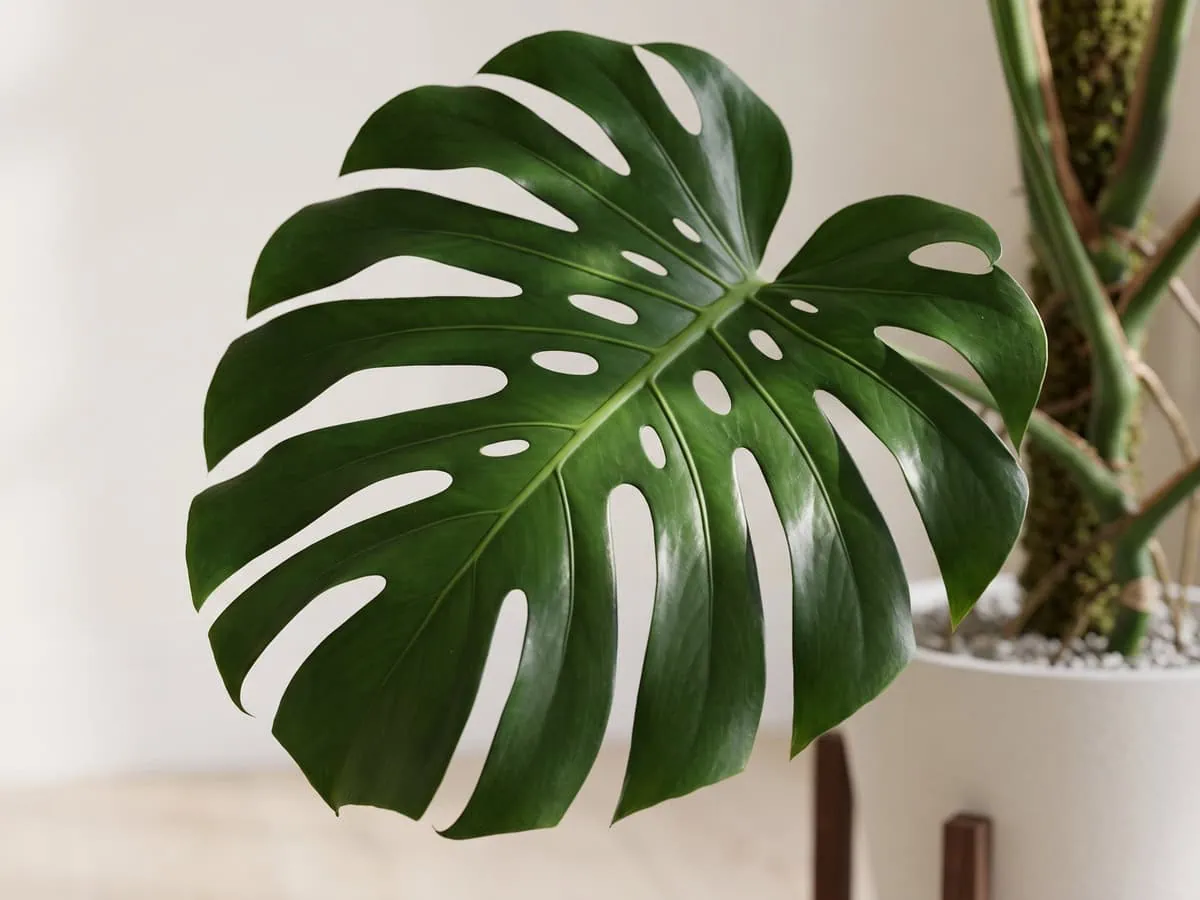
One field study on this species tested water capture, wind damage and herbivory, and supported only water capture. The botanic-garden position is still that the reason is not fully understood. Either way, the care instruction does not move.
Indoors that logic sets your job. A damp, grippable pole is what those roots enter (they ignore a dry plastic rod), and a supported plant carries larger blades than a sprawling one.
If your plant is mature and still solid-leaved, the timing question has its own guide on when a young plant earns its first perforations.
Nothing about those cords is a defect to tidy away. Some grip the pole, some stay in the air, and the lowest can be steered down into the mix. Three jobs sit in one organ.
Which of those three you pick changes the pot, so the routing decision gets its own walkthrough on steering the cord-like roots into the pole or the pot.
Does Monstera deliciosa flower or fruit indoors?
Indoor flowering is close to a non-event. Five institutions converge on it, and the wording runs from rarely if ever to extremely unlikely to fruit.
The barrier is scale, not technique. A wild plant climbs 30-70 feet before it flowers, while an indoor specimen tops out near 7-8 feet and needs roughly 10-20 years to reach full size.
Deliberate root-binding, a cold snap and a change in daylight hours do not trigger bloom in this species. One safety point travels with the question and must never be split from it: the fruit is edible only once fully ripe, and unripe material carries oxalic-acid crystals that punish a taste test.
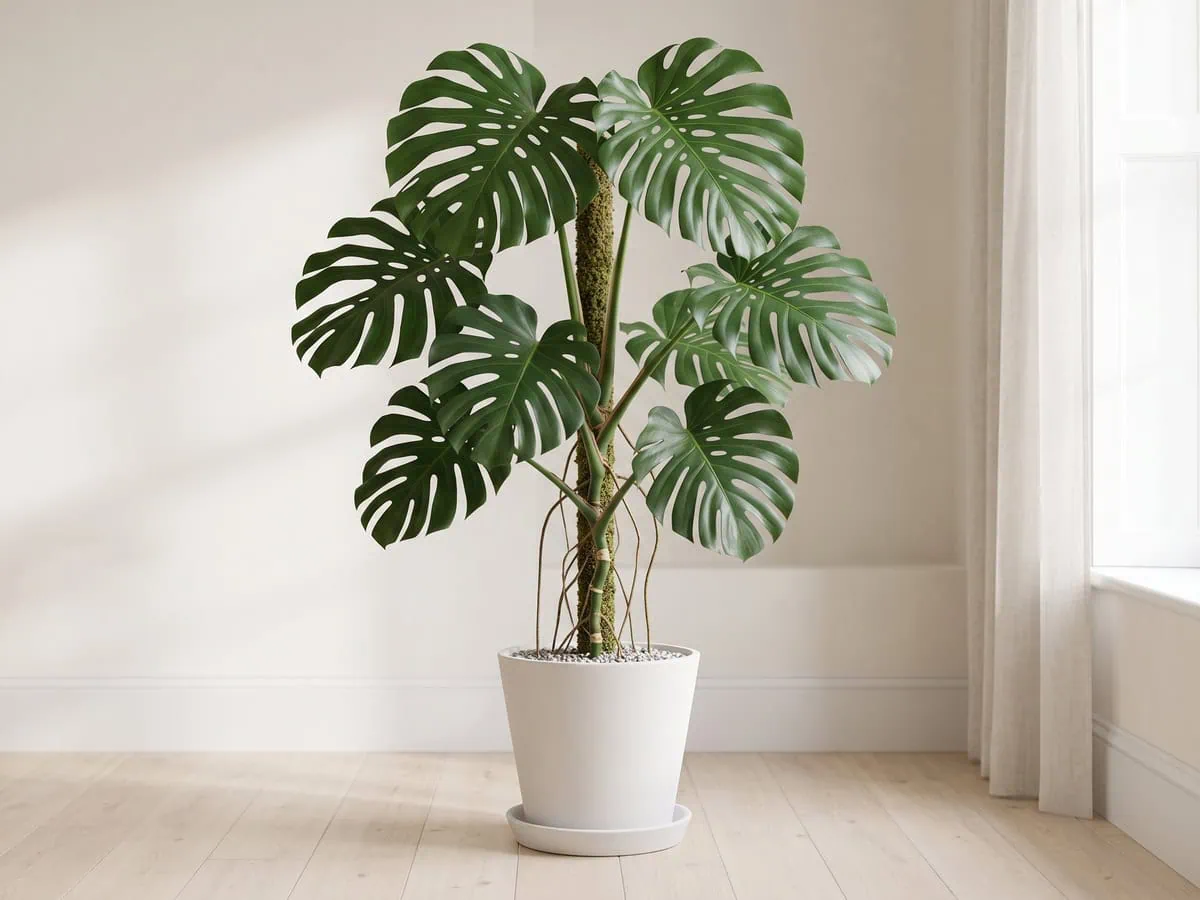
Names on the label that point at other plants
The two commonest tags name a genus this plant is not in. Split-leaf philodendron and cutleaf philodendron both say Philodendron, while the extension services place this vine in the arum family instead.
Swiss cheese plant is no safer, because the same name is printed on three species (this one, Monstera adansonii and Monstera epipremnoides). Then add borsigiana, a string that circulates at once as a cultivar label, a former species and a former variety.
Morphology settles what a label cannot, and the leaf margin is the fastest tell in the guide to telling the two Swiss cheese species apart. The plant sold as mini Monstera is Rhaphidophora tetrasperma, a different genus again, so it is not a small version of this one.
Root-zone failure: why this plant dies in the pot, both ways
Root-zone failure is the leading way this plant dies indoors, and I open here rather than with light because the counts say so: 18 of 53 owner reports of decline trace back to the roots, with over-watering the largest single class at 10.
I lost 6 plants over 7 years learning the mechanism, and each died the same quiet way. The medium stayed heavy, the lowest roots turned from firm and white to soft and brown, and the canopy looked acceptable until it folded. Unpotting on suspicion is what stopped it.
The mechanism is oxygen, not water volume. A saturated medium holds no air, so the roots suffocate and what owners call rot follows behind that.
Three accelerants do most of the damage: a pot with no drainage hole, a decorative outer pot left holding standing water (a saucer counts too), and a step-up of several pot sizes at once. Technique sits underneath all three, so the cadence question has its own guide on the full watering routine.
A collapsed root system rarely recovers, and a container with no drainage hole is the standing cause. Empty the outer pot after every watering, because water sitting under the root ball is where most of these losses begin.
The following sections split the container decision, the fungal growth question and the root-ball read.
Terracotta or plastic: matching pot to your watering hand
Match the material to your own habit, because the pot is a moisture dial rather than a decorating decision.
- [PROS] Unglazed terracotta breathes, dries fast, and forgives a heavy hand. (Best For: owners who water on a schedule)
- [CONS] Paired with a gritty, bark-only mix it dries too fast, and that pairing is what two reported deficit deaths came from.
Verdict: Choose unglazed terracotta if you water often, plastic if you forget, and in both cases keep a mix that still holds a reserve. Both extremes kill.
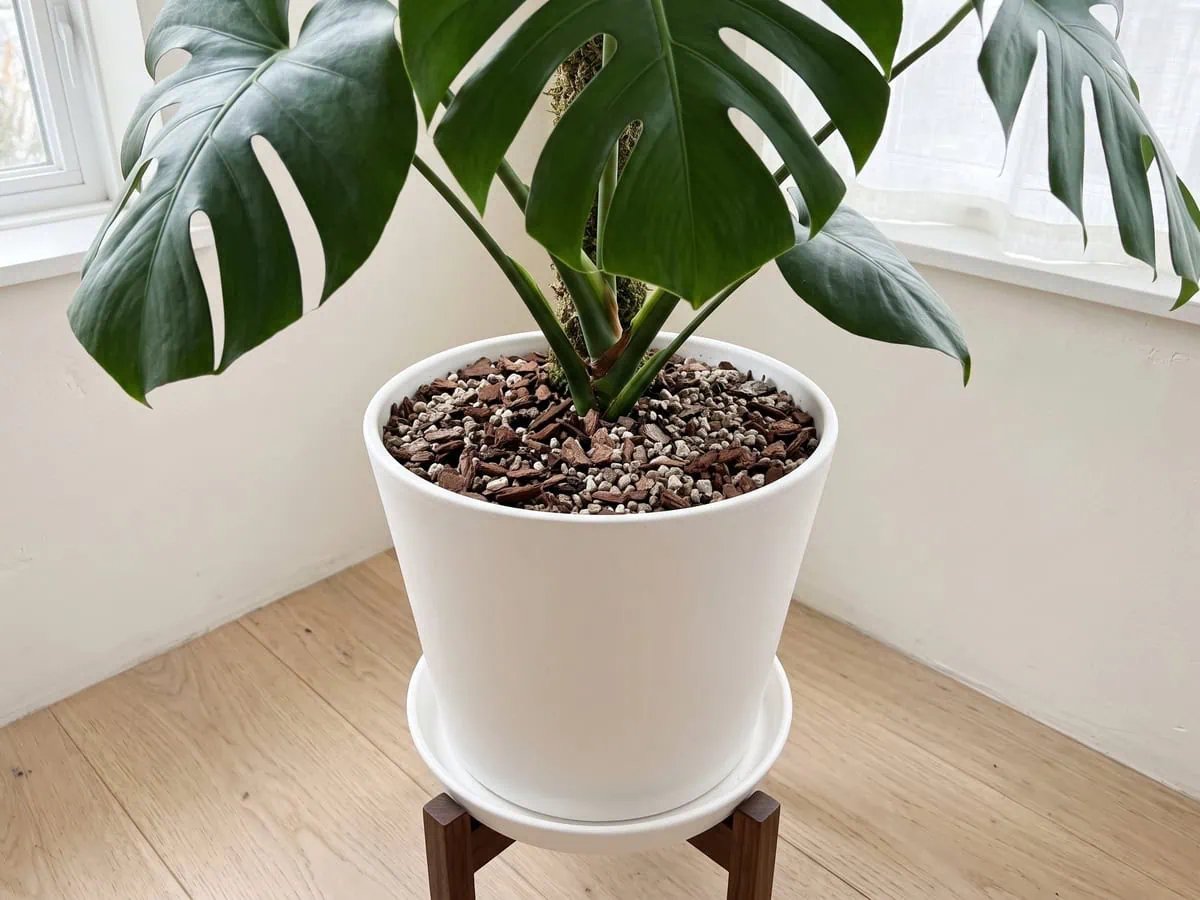
Whatever the material, the drainage hole is not optional and the step-up is one size only. Over-potting damaged roots in 7 of 53 cases, which is why sizing gets its own walkthrough on stepping the container up by one size.
White mushrooms growing in Monstera deliciosa soil
A pale mushroom in the pot reports on the medium rather than on your plant, because it is a saprophyte feeding on bark and other organic matter in a mix that has been staying wet for longer than the root zone can tolerate.
The fruiting body itself leaves the plant alone. What the appearance does tell you is measurable: the top of the medium is not drying between waterings.
Pull the caps, let the top 1-2 inches dry properly, and confirm that water leaves the pot instead of pooling beneath it. If the mix stays heavy for days, the recipe is the fault, and mixing a chunky aroid medium at home fixes it at source.
Reading the root ball: firm and white against soft and brown
Healthy roots are firm and white and carry plenty of fine feeder roots. Rotted roots run brown to black, feel soft, and often smell sour.
Check depth first. Sink a slim skewer 1-2 inches into the mix and read the tip as it comes out: damp grit clinging to it means wait (the surface lies about the root zone). Color comes second.
Color and shrivel arrive before softness does, which is why a squeeze test alone clears tissue that is already lost. If the ball smells sour and squashes between finger and thumb, the full sequence is set out in rescuing a collapsed root system.
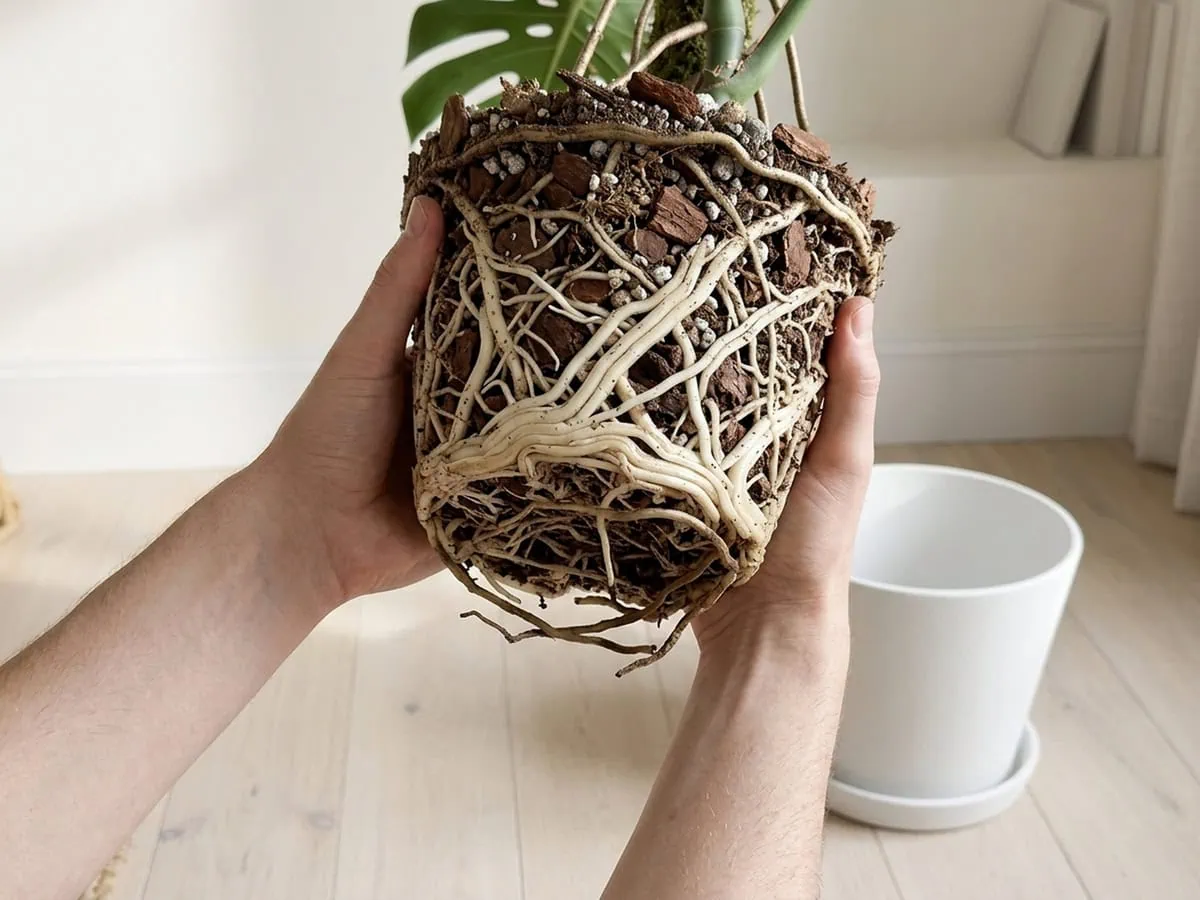
One correction most rescue advice gets wrong: never wash rotted roots with household detergent, which injures the plant and damages the soil in the pot.
Temperature and humidity across the heating and cooling year
Ordinary room air already suits this plant, so the work is keeping it off the two extremes your heating and cooling create rather than moving the thermostat. Per Penn State Extension, growing this species as a warm-room houseplant means steady warmth across the year, with a preferred band of 60-85F.
The floor is where published advice looks contradictory, and the split is real rather than a disagreement. Growth halts near 50F. 60F is the conservative line to hold, because one number answers survival and the other answers damage.
Below are the working numbers, then the overnight low.
Ideal temperature and humidity for a Monstera deliciosa
Hold 65-80F by day, 60-68F at night, and 40-60 percent relative humidity, with above 50 percent preferred.
That band is easier to hit than the internet suggests (FYI – this species tolerates lower humidity than most of the aroids it shares a shelf with), so the honest risk is a heated room falling to 10-20 percent for months at a time.
Rank the methods by what they hold rather than by how often they are repeated. A humidifier moves the room number, grouping plants lifts the air immediately around the foliage, and a gravel tray gives a modest local lift. Misting raises nothing for longer than a few minutes.
Then buy the instrument none of the pages I checked mentions. A small hygrometer beside the pot turns this from an argument into a reading you can take in one second.
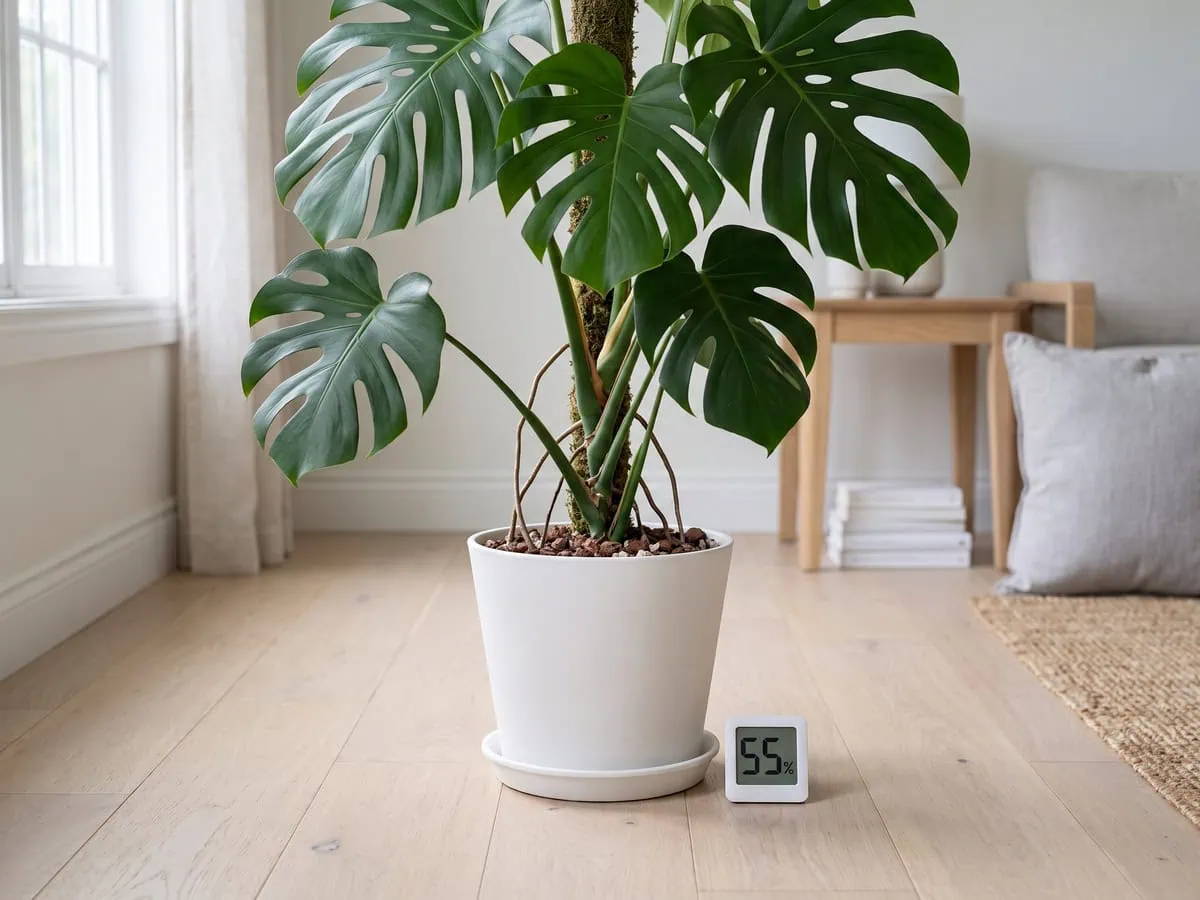
One honest gap deserves naming here. The exact humidity at which margin damage starts is not fixed anywhere I can cite, although the direction is documented well enough (dry heated air and accumulated salt are what brown a leaf edge).
So read the leaf edge and the hygrometer together, and act on the pair rather than on either alone. Two readings, one decision.
The overnight low that no care page measures
Indoor air is not one temperature all day, and the night drop matters as much as the day reading.
Keep the night side of the room at 60-68F, and read the glass rather than the room average as the cold spot. A blade resting against a cold window sits in a microclimate your thermostat never reads.
Cold damage also arrives without frost. Chilling injury happens above freezing for a tropical, so a 45-50F corner is already enough, and a steady 61F stream from an air-conditioning vent sits under the comfort floor while never touching the chilling line.
Move the pot a few feet out of the airflow, then confirm the new spot with a thermometer instead of a hand. Read the leaf as well: a blade that feels cold and slightly stiff under the fingers first thing in the morning is reporting its position.
If that same corner is also dim, the placement question continues in the guide to the window placement that decides leaf size.
Tap the button below to get more plant fixes in your Google Search results

Feeding without building a salt load
Feed a balanced 20-20-20 at reduced strength while new leaves are opening, then carry the leftovers back out with a flush. The ratio is the easy half. The container is the half that bites.
Salt is what stays behind when the water leaves and the minerals do not. It gathers at the surface and the rim, pulls moisture back out of the root zone, and blocks uptake of the feed you just applied.
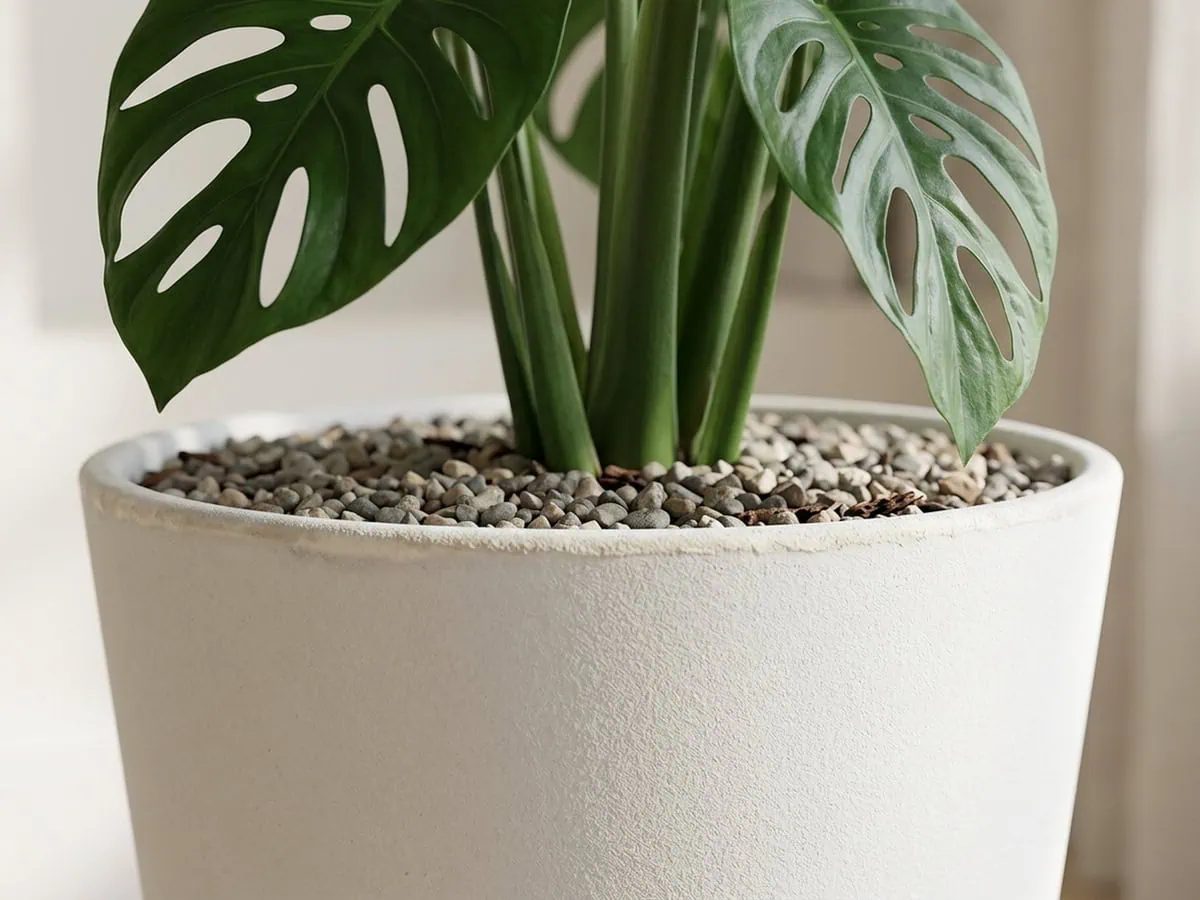
Pick one schedule and hold it (stacking two is how the white rim arrives): one-tenth strength at every watering, label rate every two to three months, or full strength at every seventh watering.
This is anecdotal, so weigh it as context – published cadences for this plant run from three feedings a year to one at every watering, and none is anchored to a measured dose. None of them is measured.
Feed to the light instead. A plant barely growing under short days takes up almost nothing, so the unused fraction stays in the mix as residue.
The following sections give the routine, the kitchen-amendment question and the flush.
How to fertilize a Monstera deliciosa indoors
Use a balanced liquid feed and dilute it, because a dilute solution carries less burn risk than a concentrated one sitting against root tissue. Extension guidance puts foliage houseplants on 20-20-20.
Skip the bloom formulas with the big middle number. A 15-30-15 is built for flowering plants, and a foliage plant cannot use that phosphorus, so it joins the salt load instead of the leaves.
Micronutrients need their own thought (a “complete” label guarantees only the three macronutrients). Replenish them about once a year, and read pale new leaves with green veins as an uptake problem rather than a call for more nitrogen.
One timing rule outranks the rest. A plant rebuilding a damaged root system gets nothing until it grows again, and the yellowing that follows a mistimed feed is covered in reading a yellowing leaf before you act on it.
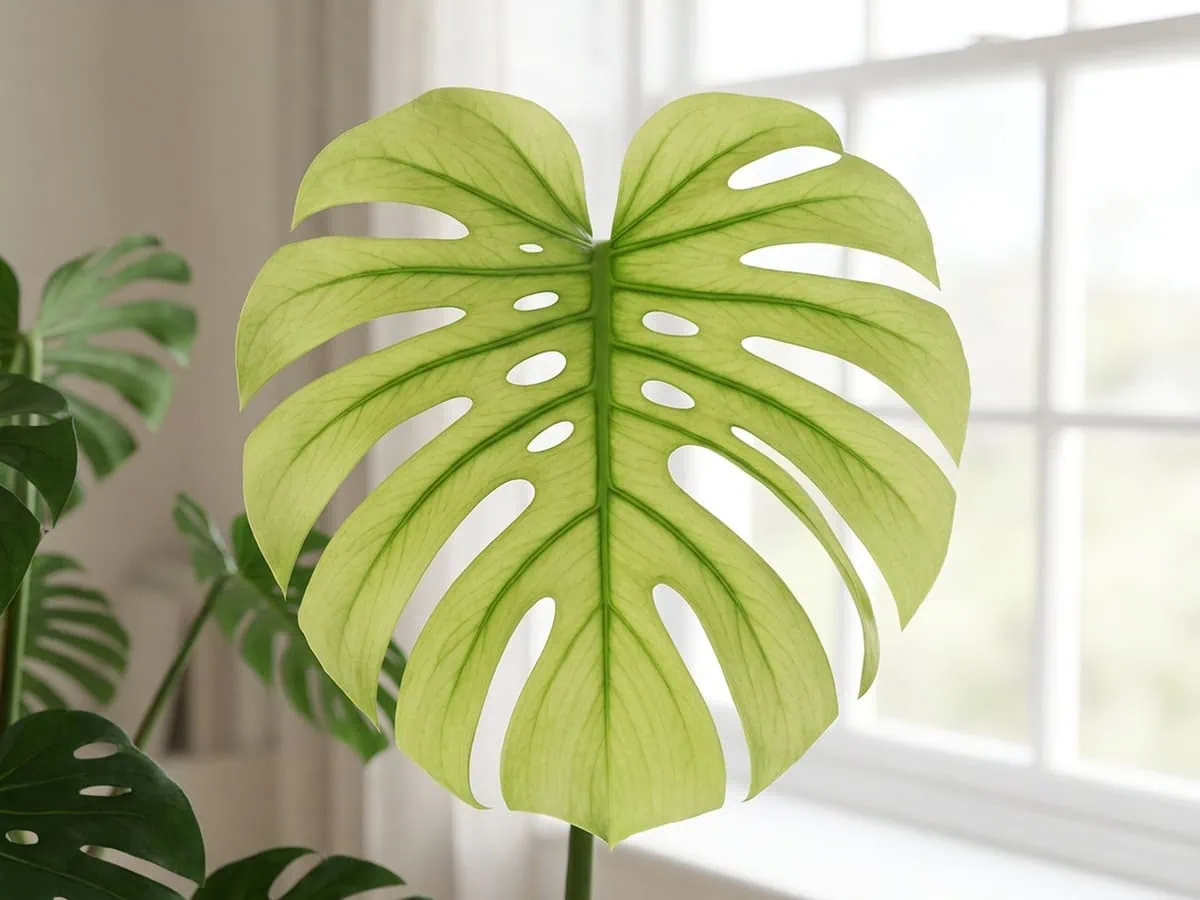
Do coffee grounds help, or just sit there?
No. Not as a feed, anyway.
Kitchen grounds carry no usable nutrient ratio for a container mix. The routine above delivers a known ratio at a known strength.
There is a physical objection too. A damp organic layer over the surface works against the one thing this pot needs, which is a top couple of inches that genuinely dries between waterings.
Flushing the pot: how much water and how often
Pour clear water through the pot at three times its volume, let it drain completely, and repeat every 4-6 months. That is the routine leach, and it answers ordinary accumulation on its own.
Measure the flush in pot volumes rather than seconds at the tap. A 2-gallon pot wants 6 gallons passed through it, poured in stages, with the saucer emptied afterward so the runoff is not drawn back up.
Salt that has gone further needs the harder version: several pot-volume irrigations in succession rather than one pass. Where a small pot is heavily loaded, replacing the medium beats rinsing it.
A cloth reads the result. Drag a dry one along the rim and the grit top-dressing before a flush and it comes away chalky, snagging on a fine crust; the same cloth stays clean a week after a proper leach.
Between leaches, one habit does most of the work. Pour until the excess leaves the pot, then tip the saucer out.
Placing a full-size specimen: floor space, stability and drafts
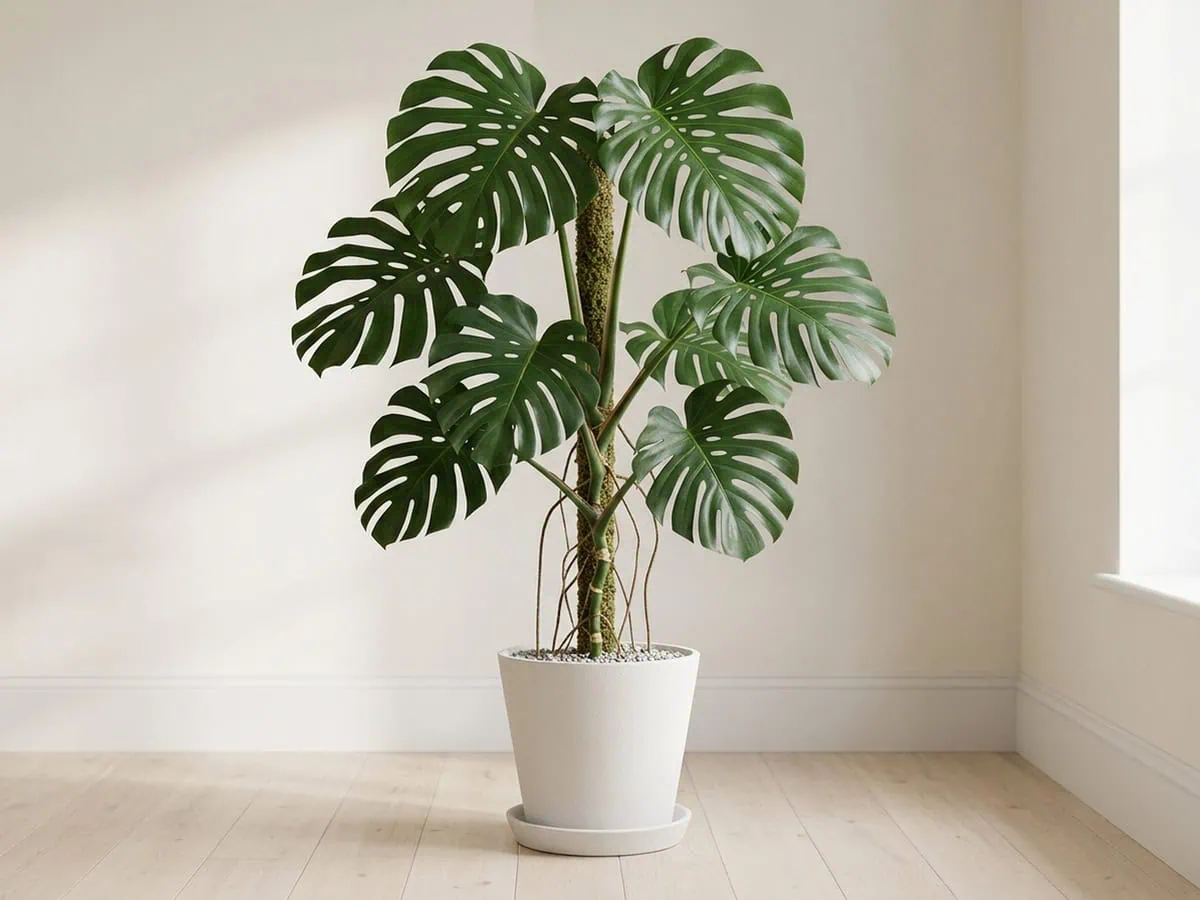
Stage a mature plant on the floor, in a corner, clear of the nearest air outlet. At 7-8 feet indoors it is a statement specimen rather than a shelf plant, and its blades carry the width.
Height is the number every care page hands you. Width decides the corner, and none of the ten care guides I compared converts it into a dimension.
The plant is also toxic, which shapes placement as firmly as any measurement. The ASPCA Animal Poison Control Center publishes the insoluble calcium oxalate listing for this plant, and it covers leaves, stems and stalks alike.
Two exposure routes, two different services. A chewed leaf fires needle-shaped crystals into the mouth of a cat, a dog or a child – burning, drooling, painful swallowing. Broken leaves and cut stems put the same crystals onto skin, so wear gloves and rinse under cold running water for 60 seconds.
This information is for educational purposes only and is not a substitute for professional veterinary advice. If your pet ingests any part of this plant, seek immediate veterinary intervention or contact the ASPCA Animal Poison Control Center (888-426-4435) or the Pet Poison Helpline (855-764-7661) immediately.
This content is for informational purposes only. If you experience a severe reaction, seek medical attention. For suspected ingestion by a child, contact Poison Control (1-800-222-1222 in the US) immediately.
Height on a shelf is the standing answer in a household with animals, and the ranked defense sits in the animal poison-control picture for this species.
The following sections work through the footprint, the summer excursion and the dust.
Floor space, mature height and keeping the pot upright
Plan the floor circle from the leaf rather than the pot. A mature blade reaches about 36 inches across on a petiole of similar length, so a pole-grown plant claims roughly a yard of floor in every direction.
The leaf span is what is published, and it is what your walkway meets.
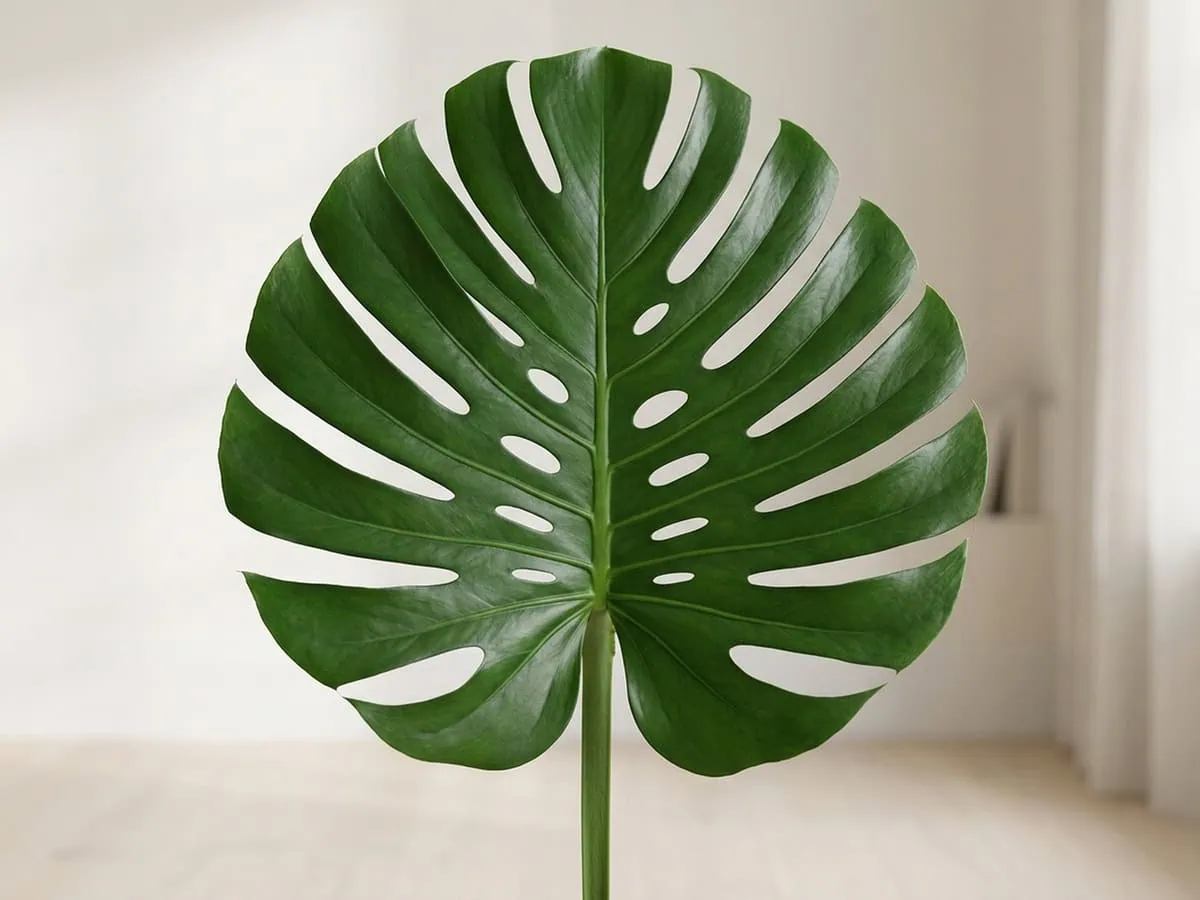
Stability follows from the same anatomy. A thick stem carrying 2-3 foot leaves on 3 foot petioles is top-heavy by construction, which is why a moss totem earns its place over a bare rod – the routine is in propping a top-heavy stem against a damp totem.
Can you grow Monstera deliciosa outdoors in your climate?
Regard any outdoor period as a temporary excursion from the house, never as a planting. The return leg is where owners lose the plant.
Two gates govern the trip (both are thermometer readings, not forecasts): move it out once night temperatures hold above 60F, and bring it in before anything approaches 50F.
Change the light in stages at both ends. Outward means deep shade for several days before anything brighter, because a plant taken straight into sun burns. Inward means about a week of decreasing shade.
Wash the foliage before it re-enters, then keep it apart from your other plants for three to six weeks, because outdoor time raises pest exposure.
Keeping the leaves clean enough to work
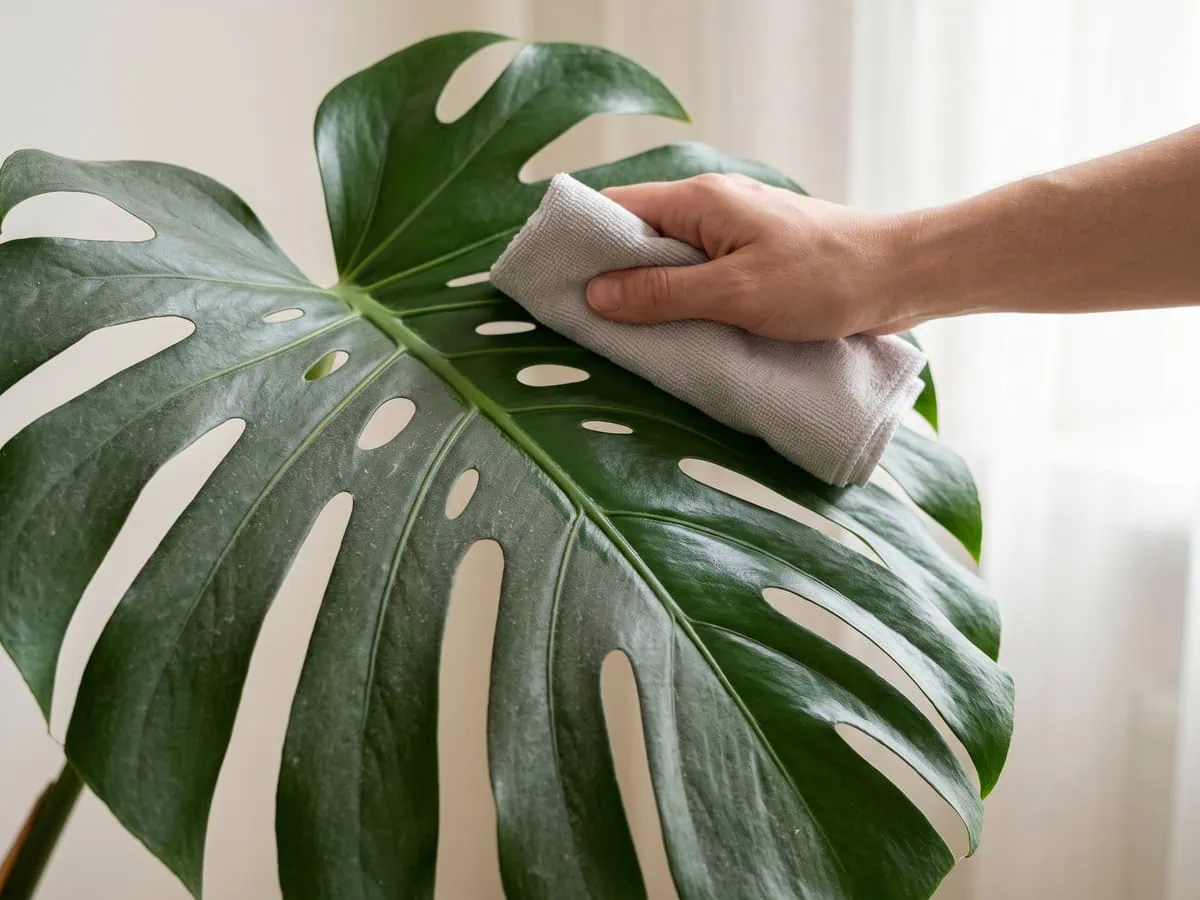
Clean the blades with plain water on a soft cloth, or stand the plant in a lukewarm shower. Dust blocks light and cuts what the leaf can photosynthesize; none of my sources quantifies how much, and I will not guess at a percentage.
The trigger is tactile rather than scheduled. Run a knuckle across the upper surface – a clean blade drags smooth and glossy, a dusted one feels faintly powdery and leaves a gray film on your skin.
Two products earn a refusal. Leaf shine clogs the pores it is sold to polish, and household soap strips the waxy cuticle and browns the blade; keep a dilute mix (a quarter teaspoon of dish soap per quart of water) for a grimy plant or a pest wash, rinsed off afterward.
Common mistakes and myths this plant does not forgive
Three habits account for most losses here: watering to a calendar, feeding through the dark months, and misting instead of measuring. What the plant will not forgive is a confident wrong action taken on a misread symptom.
Nobody puts this part on the label: extension services file this species under low-maintenance houseplants for beginners, which means it tolerates a wide light range, inconsistent watering and dry air. The plant is not difficult. The routine usually is.
The following sections take the three misreadings in turn.
Burnt tips are a salt problem, not a light problem
A brown tip on a firm, otherwise healthy leaf reports accumulated salt or dry air rather than a light deficit. One widely copied care page routes the symptom to insufficient light and leaves the feeding routine that produced it running.
Read the pattern instead of the color. Crispy edges on firm blades point to salt and dry air; crispy new growth over bone-dry mix (checked 1-2 inches down, not at the surface) is deficit; yellow and brown mixed on one leaf, with a black ring at the soil line, is the root zone failing.
Your tap water is unlikely to be the culprit: this species tolerates ordinary tap water. Flush the pot, hold the feed, and leave the plant where it stands.
Insect feeding is the other listed cause of a brown margin, and it is settled by looking – the routine is in identifying and clearing indoor arthropods.
Misting does not hold the humidity band
Misting lifts the moisture around a leaf for minutes, and the extension guidance says plainly that it does nothing to raise the humidity around the plant. It is the most repeated humidity advice for this plant and the weakest.
A second penalty follows. Wet foliage is how leaf spot travels, and the extension answer written about a spotted specimen of this species says to water at the medium surface and stop misting altogether.
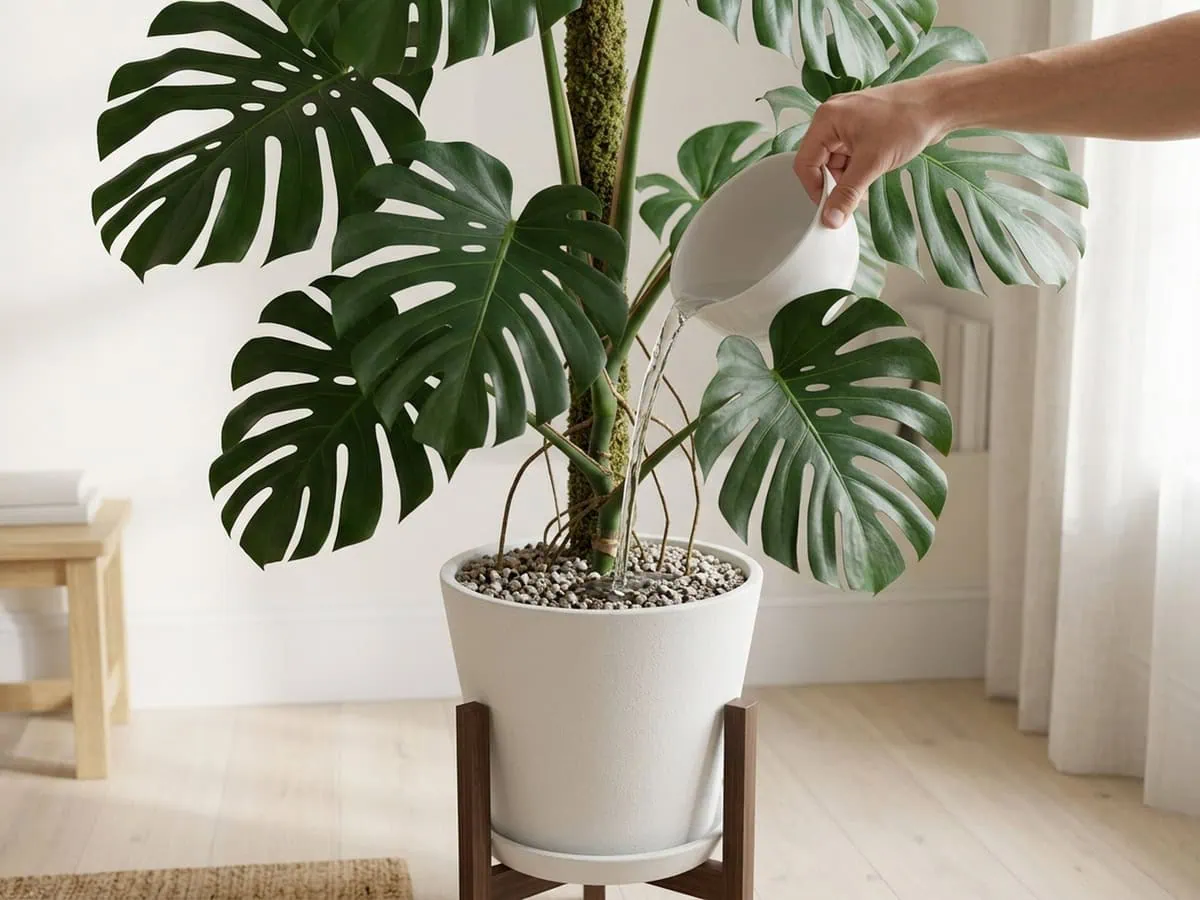
So water the pot, not the canopy (the roots are what take it up anyway), and buy the instrument instead of the spray bottle.
What a thriving specimen actually looks like
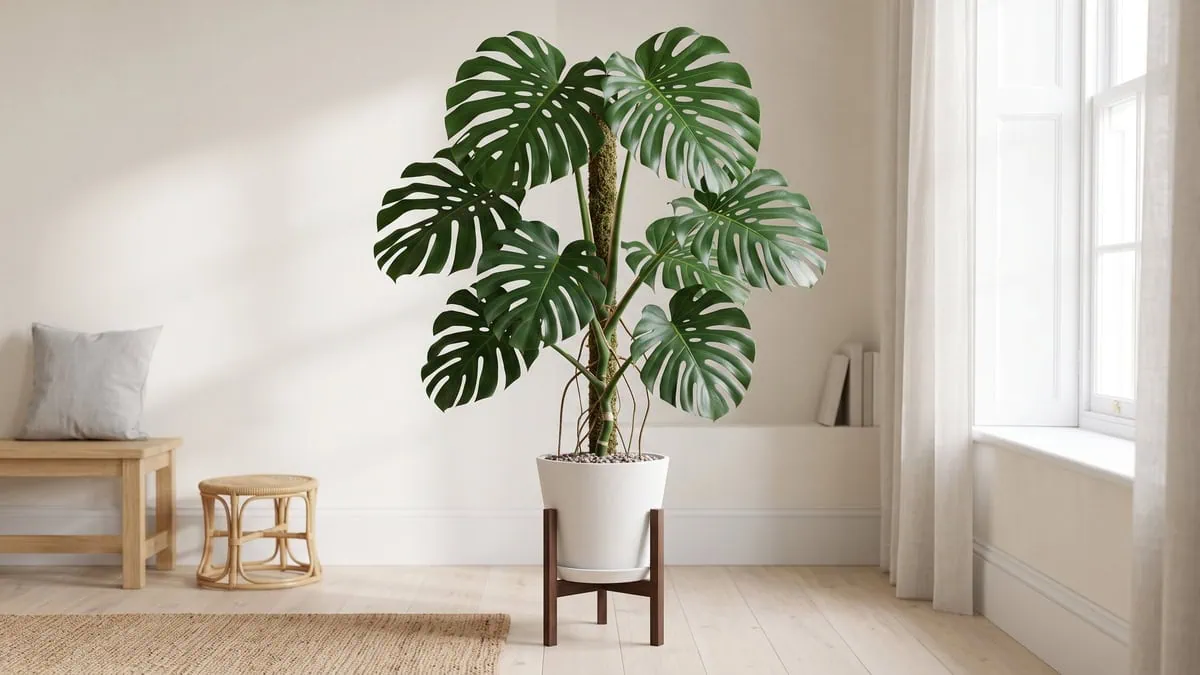
Judge the plant by its newest leaf rather than by an adjective. A healthy specimen opens each blade larger and more deeply cut than the last, and holds them firm and glossy instead of limp. Under a dry fingernail a thriving blade rides firm and waxy; a starved one dents like cool candle wax.
Judge leaf production by the plant rather than by a calendar: a healthy specimen pushes its next blade when light, warmth and feeding are all in band. What is published is the direction of travel: perforations do not develop at all if the light is too low, and blade size steps up once the aerial roots attach to a damp pole.
Flat, unsplit new leaves on an otherwise sound plant mean light, not age. A stretched bare stem with the leaves crowded at the top says the same thing, and the corrective is in cutting a stretched vine back to a node.
Nothing is wasted there. The node that made the aerial root is the node that makes the next plant.
So the removed top is a cutting, and the method is in taking a stem cutting at the node.
Frequently asked questions
What should you not do with Monstera?
Do not water it on a fixed calendar, feed it while it is barely growing, or leave the pot standing in its own drainage. Those three habits produce most indoor losses.
Two more belong on the list: potting into a container with no drainage hole, and washing rotted roots with household detergent, which injures the plant and strips the leaf’s waxy cuticle.
How to tell if your Monstera is happy?
Read the newest leaf. On a thriving plant each blade opens larger and more deeply cut than the one before it, firm and glossy rather than limp.
Aerial roots gripping a damp pole are the second signal, because blade size steps up once they attach. New growth that opens flat and solid on an otherwise healthy plant points to a light shortfall rather than to age.
Where is the best place to put a Monstera in the house?
A bright corner out of direct sun, away from vents and doorways, and out of reach of animals and small children. Aim for 200-1000 FC at the leaf.
Toxicity decides the rest: this species is listed toxic to cats and dogs, so height or a closed room does more for safety than any deterrent. Keep the pot off cold glass and out of the walkway.
What is the lifespan of a Monstera?
Lifespan here is set by care rather than by a fixed figure. What published sources do support is that a well-kept specimen simply keeps enlarging.
Indoors that means a climbing vine reaching 7-8 feet on a support, replacing its own leaves as older ones age out. Regard it as a long-term plant rather than a fixed term.
What makes a Monstera happy?
Bright indirect light at 200-1000 FC, room warmth of 65-80F, humidity of 40-60 percent, a chunky aroid mix, and something to climb. That combination covers almost everything.
Water when the top 1-2 inches of mix are dry, feed a diluted balanced fertilizer while new leaves are opening, and give the aerial roots a damp moss pole they can grip. Warmth matters more than any spray.
Is it bad to touch Monstera leaves?
No. Handling an intact leaf is harmless, and wiping dust off the blades with a damp cloth is part of routine care.
Damaged tissue is the exception: sap from a torn blade or a cut stem carries needle-shaped calcium oxalate crystals that irritate skin and eyes on contact. Wear gloves for any pruning or repotting, keep the sap away from your face, and wash your hands afterward.
Do coffee grounds help Monstera?
Grounds are not a substitute for feeding: a balanced liquid feed delivers a known ratio at a known strength, which is what the plant responds to. A diluted balanced fertilizer during active growth is the published routine.
Spread over the mix they also hold moisture where this plant needs a dry-down, and that damp surface is exactly where fungus gnats lay their eggs. Keep the top of the mix bare and airy.
Do Monsteras like small or big pots?
Step up by one size only, roughly 1-2 inches of extra diameter. An oversized pot holds water that the current root system cannot draw on, which is how root-zone failure starts.
Repot on root evidence rather than on a schedule: roots leaving the drainage holes, a root mass that holds the shape of the pot, or a container that dries unusually fast between waterings.
What are common Monstera problems?
Root-zone failure leads by a distance, accounting for 18 of 53 owner reports of decline, with over-watering the single largest class at 10.
Moisture deficit follows close behind at 8 of 53, then repotting-inflicted root damage at 7. Salt-burned leaf tips, sap-feeding pests such as thrips and spider mites, and fungal leaf spot make up most of what remains.
Are Monsteras happier inside or outside?
Indoors is the default for this plant as a houseplant, and a summer outdoors is optional rather than an upgrade. Shade and temperature decide whether it is safe.
Move it out only once nights hold above 60F, keep it in deep shade, and bring it back before anything nears 50F. Quarantine it for three to six weeks on its return.
Skip the myth. Use the science.
You now have the three readings that decide this plant: the mix at 1-2 inches, the light at the leaf, and the white rim at the pot edge. Each one takes seconds, and each replaces advice you were told to take on faith (I have stopped arguing with the label).
Run a fingertip along the rim each time you water and you will catch a salt load months before a leaf edge browns. That is the whole discipline. The rest is patience.
The next question most owners meet is what a yellow leaf means on a plant that looks otherwise fine, and the yellowing guide linked above answers it in the same order: test first, act second. Good Monstera deliciosa care is measurement plus restraint.
May your Monstera set its firm white roots against the grit and earn one more split with every leaf it unfurls.
Tap the button below to get more plant fixes in your Google Search results