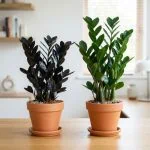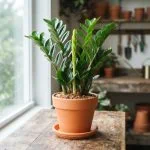
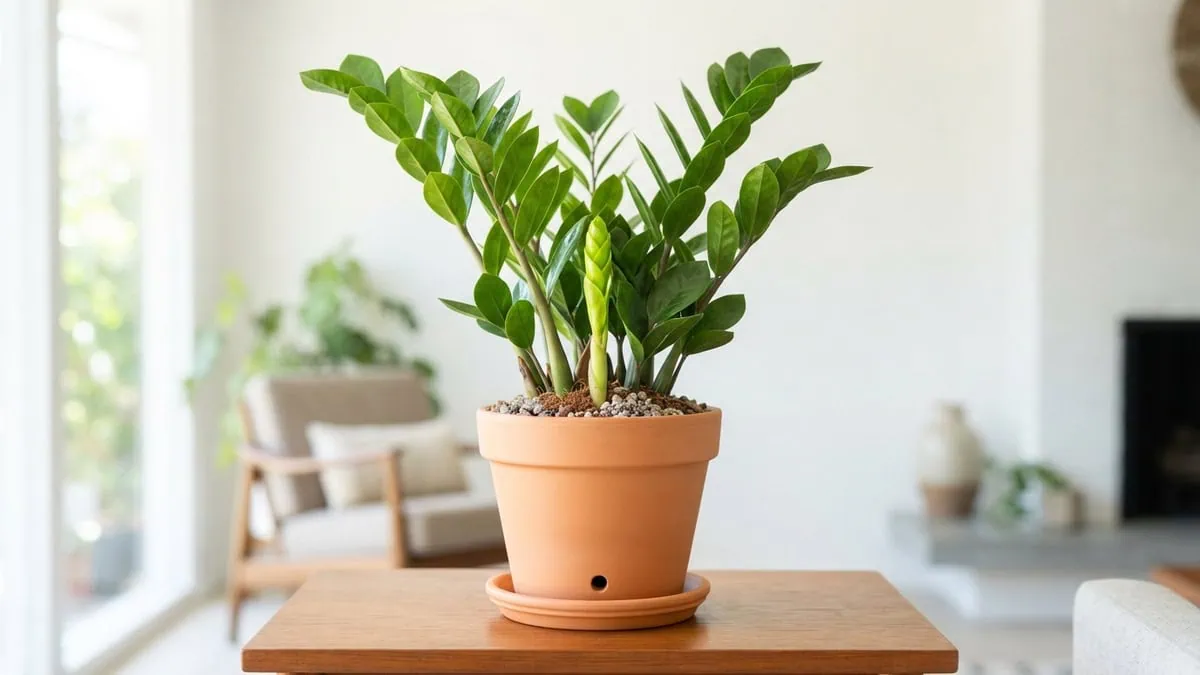
🎯 Quick Answer: why a ZZ plant stops pushing new shoots
A ZZ plant (Zamioculcas zamiifolia, family Araceae) requires brighter light, and a young one adds 1 to 2 new shoots a year. The answer to “why is my ZZ plant not growing new shoots” is usually light. It is slow by design, so a long pause is normal.
- Light first: move it into bright, indirect light at a good window.
- Check warmth: keep the room above 60F for active growth.
- Ease off water: soggy roots stall new shoots faster than dry soil.
- Feed only in the warm season: extra fertilizer alone will not force new growth.
- Repot only: once the rhizomes bulge against the pot wall.
Get the one-page care card for this guide, plus a printable A4 copy
We condense this guide into one card for your phone and a print version for the pot shelf. Enter your email and we send both to your inbox. Subscribe once, then request the card of any guide you read.
By subscribing you agree to get emails from Plant Care Basics about plant care guides, about once a week at most. Unsubscribe in one click. Privacy policy
Confession time: I once read a perfectly still ZZ plant as a plant in trouble. It sat for months, leaflets as stiff and waxy as fresh bay leaves, throwing no new stalks. I mistook that stillness for slow death — a wrong read.
Across the ZZ plants in my care, that panic did more damage than neglect ever could. Twice I overwatered a “stuck” plant to jolt it awake, and one mushy, swamp-smelling rhizome later I understood: the plant was never dying, and never truly dormant. Just unlit.
Rather than keep feeding and repotting a plant that would not move, I discovered that every new ZZ shoot is funded entirely by light, banked in the underground rhizome, then spent one slow spear at a time (yes, this sounds oddly patient for a houseplant — bear with me). Here is the full growing routine for this rhizomatous aroid; this guide answers the one question that panics owners most.
Hmm, on reflection, “stuck” is the wrong word for most of these plants. Take a breath, then read the growth numbers in the table below before you change anything.
Why is my ZZ plant not growing new shoots? Growth numbers at a glance
| ZZ plant specs | What is typical |
|---|---|
| Indoor growth speed | Slow, even in ideal conditions; growth comes in spurts |
| Time to mature size indoors | Several years to reach 3-4 feet tall and wide |
| New stems added per year | About 1-2 new shoots on a young plant |
| New growth arrives in | The warm, bright part of the year, not on a calendar |
| Growth-stall temperature | Slows below about 60F; keep it above 50F |
| Growth pauses in the cool season? | Yes, but it restarts when light and warmth return |
| Does extra fertilizer speed a light-starved plant? | No; it builds up as salts, not new shoots |
You are subscribed
Press the button and we prepare this guide's one-page care card and its A4 print copy and email both to you within a few minutes.
Tap the button below to get more plant fixes in your Google Search results

Table of Contents
Normal spurt cycle or real stall: how to tell them apart
A ZZ plant that pushes only a stalk or two a year is almost always growing normally, not stalling. According to University of Illinois Extension, how long this tropical takes to reach a significant size is measured in years, not months. So before you fix anything, the following sections separate a normal pause from a real stall.
What a normal ZZ growth year looks like
The honest answer to “how fast do ZZ plants grow” is slowly, and in bursts rather than a steady creep. A healthy plant sends up a fresh spear now and then (a new stalk every few months at best), rests, then repeats. Each new stem hardens off firm and stiff, carrying the same waxy sheen as the older leaves.
That stop-start rhythm is the plant’s normal setting, not a warning light. Stillness is not sickness. Spears come slowly.
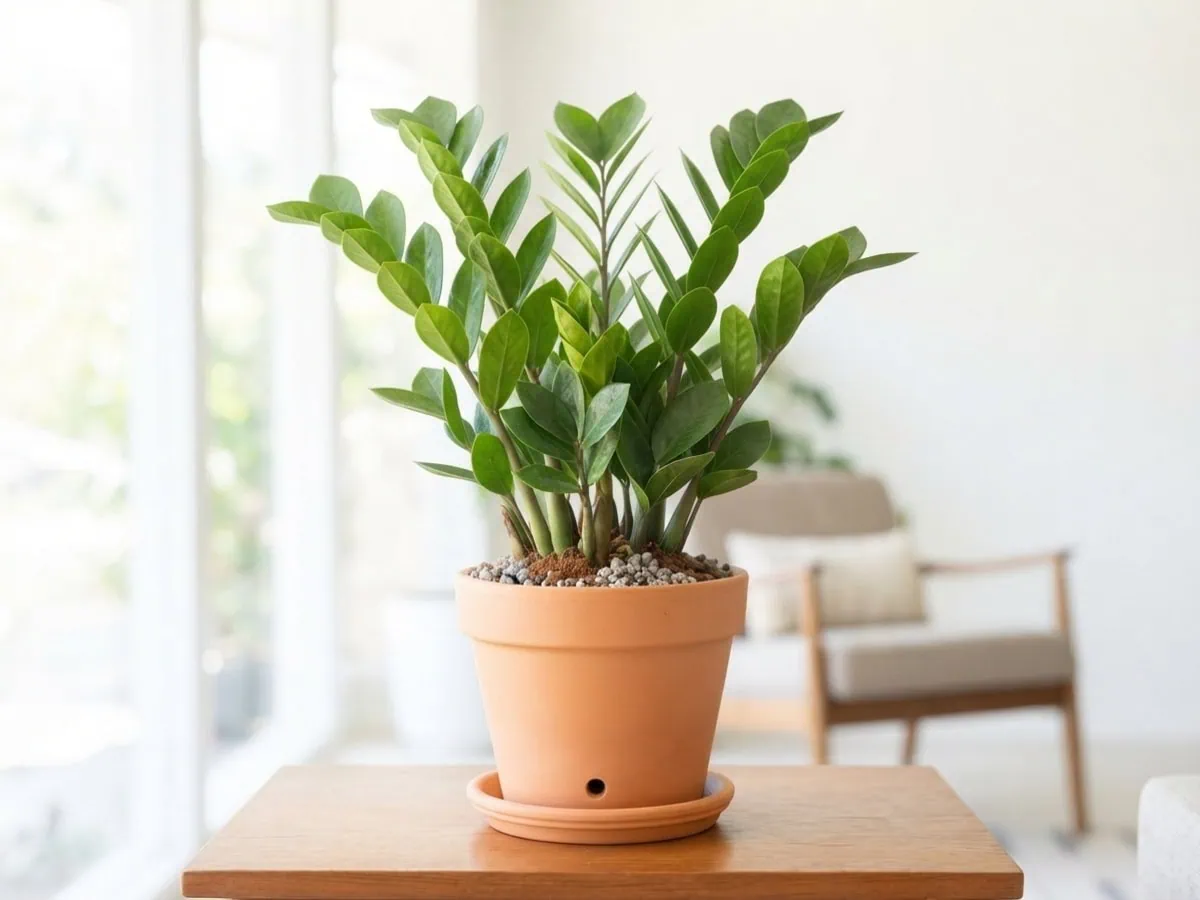
The establishment phase before visible top growth
A young, freshly divided, or newly repotted ZZ often shows no top growth for months because it is busy underground first. Roots and rhizome mass come before any visible spear (the classic “sleep, creep, then leap” pattern).
On an establishing plant, “how many new stems does a ZZ plant grow per year” is often one or two, and sometimes none in the first year while it is still building the reserves it will grow from. Establishment, not failure.
When the cool-season pause is normal
In the cool, dim part of the year, ZZ growth slows to a near-stop, and that pause is normal. That raises the real question, “do ZZ plants go dormant in winter”? In a sense: growth tracks light and warmth, so as days shorten and rooms cool, new shoots pause.
That rest is conditions-driven, not a calendar lock, and a plant given enough light and warmth can push a spear outside the usual season. It slows because conditions dropped, not because a date arrived.
- Weeks 1-8 after a move or repot: little to no top growth while roots re-establish.
- Warm, bright months: the odd new spear unfurls, then the plant rests again.
- Cool, dim months: growth slows to a near-stop and restarts when light returns.
- Across a full year: roughly 1-2 new stalks on a young plant.
- Several years: the slow climb toward a mature 3-4 foot clump.
Get the one-page care card for this guide, plus a printable A4 copy
We condense this guide into one card for your phone and a print version for the pot shelf. Enter your email and we send both to your inbox. Subscribe once, then request the card of any guide you read.
By subscribing you agree to get emails from Plant Care Basics about plant care guides, about once a week at most. Unsubscribe in one click. Privacy policy
Tap the button below to get more plant fixes in your Google Search results

What actually drives a new ZZ plant spear underground
Every new ZZ shoot is a spear pushed up from the rhizome, the underground storage organ that makes this species a geophyte; it never branches off an existing stalk. The following sections cover the four levers behind that spear.
- Rhizome: the thick, potato-like underground stem where a ZZ banks water and starch between growth spurts.
- Geophyte: a plant that rides out lean spells by storing energy in an underground organ like that rhizome.
Light: the rate-limiter for every new spear
Light is the single biggest lever on new-shoot production, because a ZZ funds every spear from the sugars its leaves make. In a dim corner it survives happily (it holds on at office-fluorescent levels), but surviving and growing spend from different pools.
Starved of light, it lives off the rhizome and stops making new stalks. Light writes the schedule. Sugars build each spear.
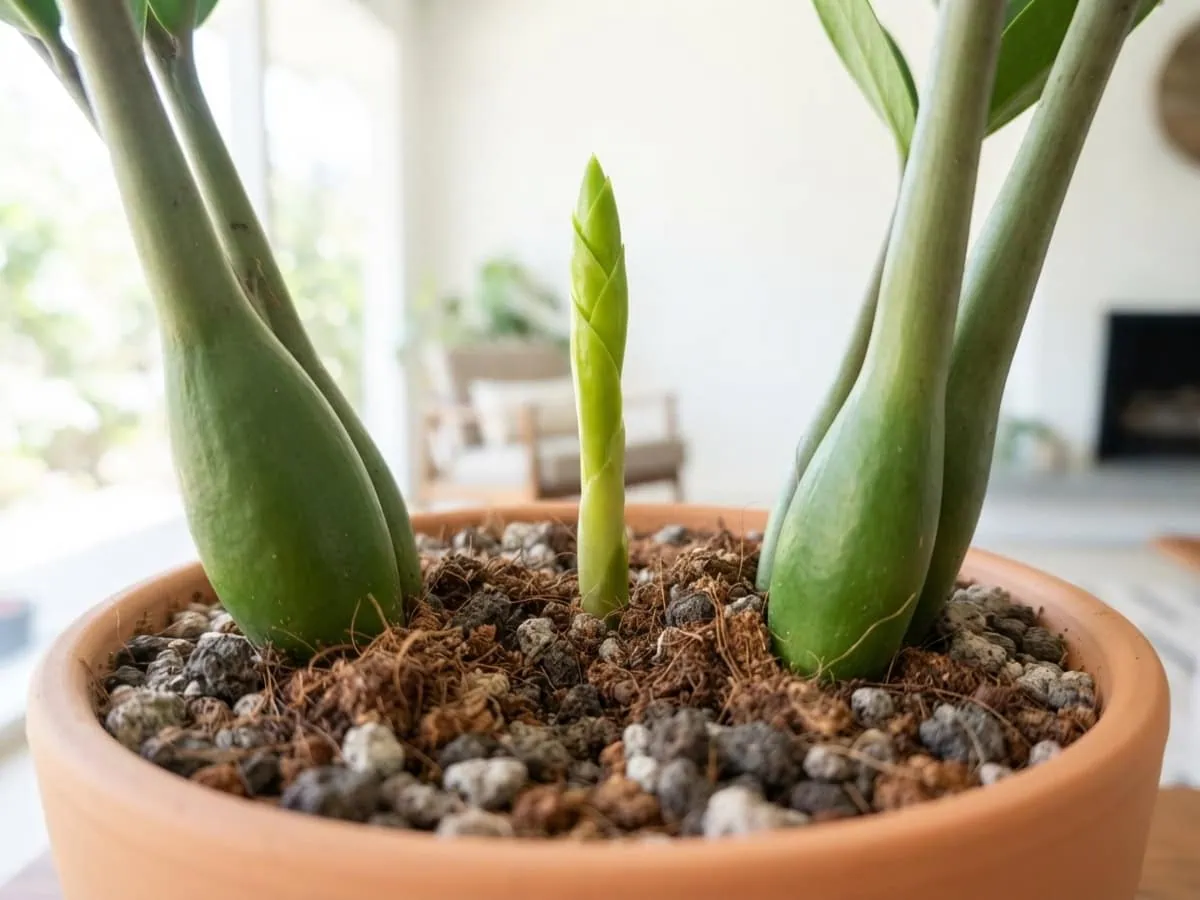
I have a hunch about this but no peer-reviewed source pinning the exact light level where new spears switch on; what is documented is only the direction, that brighter (still indirect) light means more shoots.
For the measured numbers, see the measured foot-candle light bands. Move a stalled plant to a bright north or east window, off any direct sun, then give it weeks, not days, to answer.
Warmth and the sub-60F stall line
Warmth sets the pace. A ZZ grows fastest in warm rooms; production research notes that daily temperatures below about 76F already delay new shoots. Growth slows further below roughly 60F and pauses in a cold room, though the plant stays safe to about 50F and only takes cold damage near freezing (32F).
In a cool room, “is slow ZZ plant growth normal”? Yes, cool air alone throttles the pace. Watch for hidden chill too: a spot that feels fine to you can still catch a draft off winter glass or an AC vent below the stall line.
Rhizome crowding, wet soil, and thirst
Below the soil, three quieter problems can stall shoots. The worst is overwatering: a rhizome left in soggy mix rots, and rotted tissue cannot fund growth. If a stalled plant also yellows or leans, check the roots and work through the rhizome rot rescue first.
A dense, water-holding mix does slower damage, smothering the rhizome’s air supply for weeks. Crowding adds to it: once the rhizomes pack the pot and bulge against the wall, they throttle their own growth. A crumbly, gritty mix that never packs down keeps oxygen at the roots.
Real thirst is the rarer stall, since this plant stores its own water, but a pot left bone-dry for a month or two pauses as well. The fix is not a schedule; match the plant’s own dry-down watering rhythm, then let the rhizome carry it.
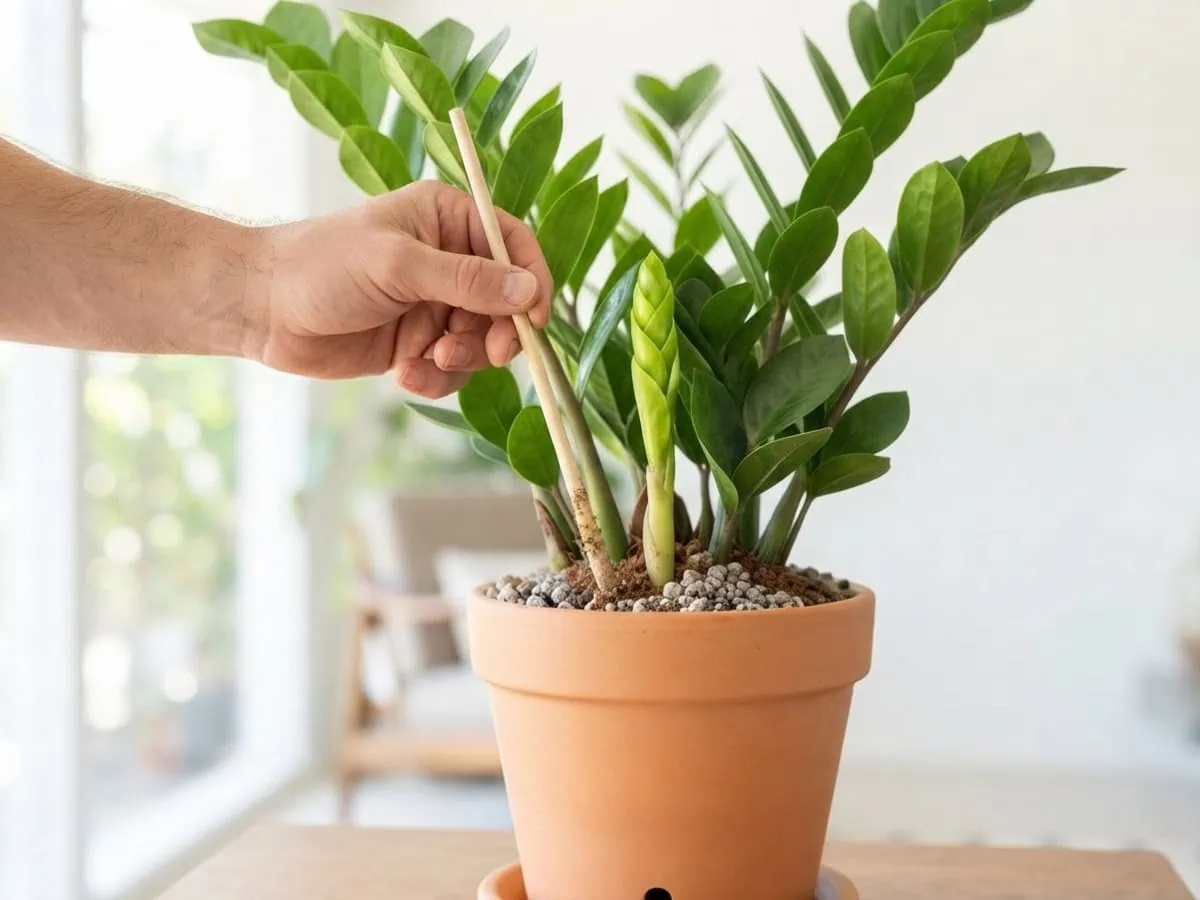
What to fix first, and how long to wait
So “how to encourage a ZZ plant to grow faster”? Work the levers in order of impact. First, more light, the one change that reliably moves this plant.
Second, warmth above the stall line. Third, sort out the roots: ease off water, and if the mix stays wet, switch to the fast-draining substrate build. Only then feed, and only in the warm season; repot last, and only if truly crowded.
Then wait: a new spear can take two weeks to a month or two after the real limit is lifted, so judge the fix on that clock.
Common mistakes that will not force new shoots
The fastest way to waste effort on a stalled ZZ is to reach for the wrong fix. The following mistakes feel productive but will not force a single new shoot.
❌ Myth: feeding, repotting, or a growth gadget will force a stalled ZZ to sprout. ✅ Fact: new shoots are gated by light, warmth, and a healthy rhizome. Fix those and the plant grows on its own slow clock; skip them and nothing else makes up the difference.
Why feeding a light-starved plant backfires
Fertilizer cannot substitute for light. Feed a dim-lit, non-growing ZZ and the unused nutrients build up in the pot as a crusty salt film that can scorch the roots (no new shoots, just damage).
This plant is a light feeder anyway; it wants a weak dose only while it is actively growing in the warm season, and none at all during the cool-season pause. No growth, no feeding.
Music, air-purifying claims, and other myths
No sound, scent, or wellness trick makes a ZZ grow. Some guides promise it purifies your air or grows faster to certain music (not joking), and both claims miss the plant’s actual biology.
New shoots run on light, warmth, and an intact rhizome, full stop. A playlist will not change that, and an under-lit plant stays slow no matter what is playing beside it. Sound is not sunlight.
The repot trigger: snug until rhizomes bulge
A snug pot actually helps a ZZ push shoots, so being a little root-bound is not the enemy it sounds like. The tipping point is visible: repot only once the firm, potato-like rhizomes bulge hard against the pot wall or poke out of the drainage holes.
Until then, a bigger pot just holds extra wet soil around the roots and raises the rot risk.
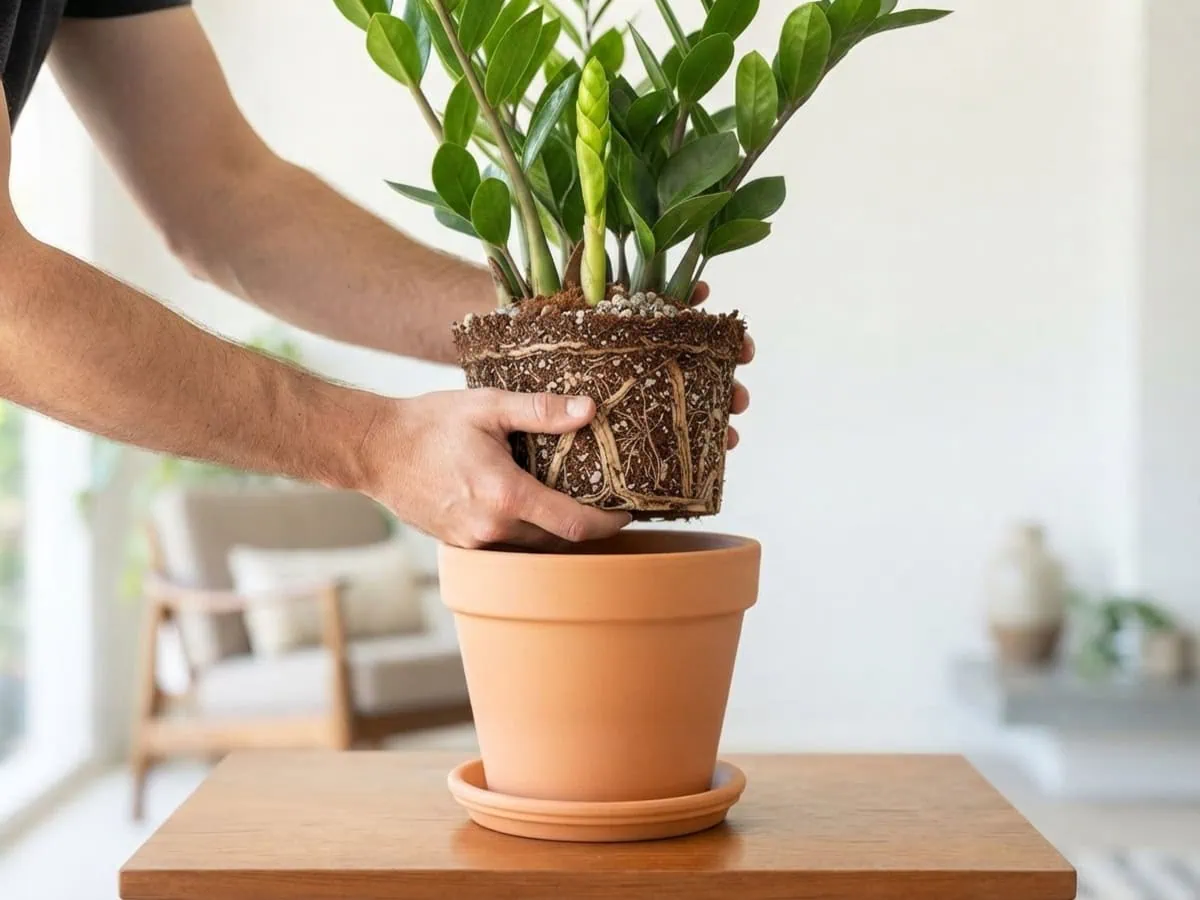
When the plant genuinely bursts its pot, step up just one size, an inch or two wider, and follow the shock-free repotting sequence. Oversizing stalls more shoots than it ever starts.
Frequently asked questions about ZZ plant growth
How to encourage ZZ plant to grow more shoots?
Give it more light first, the single lever that reliably moves a ZZ plant. Shift it to a bright north or east window, keep the room above 60F, ease off watering, and feed only lightly in the warm growing season. Each new spear is funded by the sugars its leaves make in that light and banked in the underground rhizome, so this drought-adapted geophyte answers in weeks, not days.
How often do ZZ plants grow new shoots?
Only a few times a year, and in short spurts rather than a steady creep upward. A healthy, well-lit young plant still puts out only about one or two new shoots across an entire year, and each is pushed up slowly from below ground during the warm, bright months rather than on any fixed calendar. Those long gaps suit a drought-adapted geophyte, which banks its reserves in a water-storing rhizome and spends them on just one fresh spear at a time.
How to boost ZZ plant growth?
Lift the one factor holding it back, which is almost always too little light. Bright, indirect light plus steady warmth above 60F does far more for new growth than any fertilizer or a bigger pot, and feeding a dim, idle plant only leaves root-burning salts behind. New shoots are funded by the sugars the leaves make, so a drought-adapted geophyte pushes a fresh spear from its rhizome only once the light is genuinely brighter.
Why is my ZZ plant not producing new growth?
Usually too little light, sometimes cold, wet roots, or simple slowness. A ZZ funds each new shoot from the stored energy it earns in the light, so a dim corner stalls it while the mix must never stay soggy around the roots. Check light and warmth first, then confirm the plant is not simply a young geophyte still building its underground rhizome before it can push a spear.
Can I use all-purpose fertilizer on a ZZ plant?
Yes, a balanced all-purpose houseplant fertilizer works well at half strength. A ZZ is a light feeder, so feed only once or twice a year, in the warm growing season and stop entirely in the cool-season pause. Never feed a stalled, light-starved plant, since with the rhizome not spending on new spears the unused nutrients only build up as root-burning salts around the geophyte.
How long does it take for a ZZ plant to get big?
Several years, and there is genuinely no shortcut to that pace. A ZZ grows slowly even under ideal light and warmth, needing a year or more just to establish from a stem cutting and several more after that to fill out a full 3-4 foot clump. That patient climb is set by a drought-adapted geophyte, which banks its energy in an underground rhizome and releases it into a new spear only a little at a time.
Read the plant, act on the light, and watch it grow
So the next time your ZZ sits still, resist the urge to fuss. Slow is not stalled.
Truth is — a ZZ is not lazy or dying but a slow, drought-built saver, so read what it is telling you: brighten its light, warm the room, keep the rhizome firm and barely watered, then step back and let its own patient clock run.
Master that rhythm, and “why is my ZZ plant not growing new shoots” stops being a worry and becomes a simple routine. May your ZZ plant reward your patience with a fresh lime-green spear, pushed up from a firm rhizome the moment its light is finally bright enough.

Get the one-page care card for this guide, plus a printable A4 copy
We condense this guide into one card for your phone and a print version for the pot shelf. Enter your email and we send both to your inbox. Subscribe once, then request the card of any guide you read.
By subscribing you agree to get emails from Plant Care Basics about plant care guides, about once a week at most. Unsubscribe in one click. Privacy policy
Tap the button below to get more plant fixes in your Google Search results