🎯 Quick Answer: how the pot sets the interval
How often to water Aloe vera indoors step by step switches to roughly every 2-4 weeks for Aloe vera, a member of the Asphodelaceae family. That figure is a starting point, not a rule. The pot decides: water only when the mix is dry all the way to the bottom.
- Lift test: a dry pot weighs noticeably lighter than a freshly watered one
- Depth beats surface: a finger reaches two inches; the root zone sits deeper
- Cold plus wet: chilled damp mix is the dangerous pairing, not cold alone
- Tap water: fine for this plant; skip softened water and distilled bottles
- Dry air: no misting, no pebble tray, no humidifier for this rosette
Get the one-page care card for this guide, plus a printable A4 copy
We condense this guide into one card for your phone and a print version for the pot shelf. Enter your email and we send both to your inbox. Subscribe once, then request the card of any guide you read.
By subscribing you agree to get emails from Plant Care Basics about plant care guides, about once a week at most. Unsubscribe in one click. Privacy policy
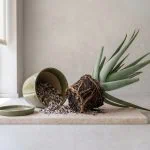
The lowest two leaves on my desk Aloe slid from gray-green to a soft yellow-brown right at the base, and by the time I tipped the plant out of its pot the crown had gone. Two rosettes. Sidebar — the leaves look fine long after the roots are finished.
A weekly Sunday watering sounds right. It isn’t. Wait — I’m getting ahead of myself…
Aloe vera runs crassulacean acid metabolism, a gas exchange it postpones until the room goes dark, so transpiration stays low through the hot hours and the blade keeps its reserve. Here’s what that water use efficiency does instead: it stretches the safe gap between waterings far past a week (low-key skeptical about this).
Read the pot, not the calendar. The routine below measures your own container rather than handing you a schedule, and it belongs alongside the everyday care of a windowsill succulent.
Nobody has to memorize a schedule to get this right, and the rows underneath hold the whole routine, so nothing below depends on remembering a date.
How often to water Aloe vera indoors step by step at a glance
| Aloe specs | What to do |
|---|---|
| Watering trigger | The mix is dry all the way to the bottom, not just at the surface |
| Do you need a moisture meter? | No – a wooden skewer pushed to the bottom reads the same thing |
| Starting interval, warm months | Every 2-4 weeks, then replaced by the interval you measure in your own pot |
| Cold-month adjustment | Roughly double the interval you measured in the warm months |
| How much at one watering | Water through until it runs from the drainage hole |
| Longest the pot may stand in water | No more than 60 minutes; empty the saucer as soon as it stops draining |
You are subscribed
Press the button and we prepare this guide's one-page care card and its A4 print copy and email both to you within a few minutes.
Tap the button below to get more plant fixes in your Google Search results

Table of Contents
The interval is set by how fast your pot dries, not by the calendar
How often you water an indoor Aloe vera is an outcome of drying speed, never a date. The root zone fails first here, and the leaves keep looking convincing while it does. The following sections give you the test, the starting number, and the water-quality answer.
According to Frontiers in Plant Science, potted Aloe vera reaches its best water use efficiency near 75% of field capacity rather than at saturation. Its inverse stomatal behavior opens the leaf pores at night, so the stored water lasts. So the dry-down is the routine, and your only task is timing it.

How do I know when my Aloe vera soil is dry enough to water?
Push a plain wooden skewer to the bottom of the pot and read the color as it comes up. If the lower inch lifts out stained a dark chocolate brown against pale dry wood higher up, the root zone is still wet. Pale wood the whole way means water now.
A fingertip goes two inches down. Aloe roots sit deeper.
Lift the pot instead, because a gritty succulent mix swings sharply in weight between soaked and bone-dry.
The starting interval, and how to replace it with your own
Start at every 2-4 weeks in the warm months, then throw the number away. Published figures for this plant run from 7 to 30 days. Almost none of them state the room they were written for.
Replace it by measuring. Water to runoff, note the date, and check the skewer every few days until it lifts out dry at the tip; the count of days you reach is your interval, in your room, in your pot.
I watered two rosettes on one windowsill on the same day and lost the smaller one to a soft crown. That pot had dried a week ahead of the larger one. Same plant, different pot.
So the container sets the pace, and how the potting medium sets the drying speed shifts it again.
Does tap water change how often you water?
Tap water is fine for Aloe vera, which is absent from every extension-service list of fluoride-sensitive and chlorine-sensitive houseplants. Those lists name thin-leaved plants such as spider plant, dracaena and calathea. But skip softened water, since it adds dissolved sodium that a seldom-drenched pot never clears.
Watch the mix surface for a white-to-tan crust. Flush it out. That crust is accumulated salt rather than a watering cue, so water through until it runs from the drainage hole and carries the load out.

Get the one-page care card for this guide, plus a printable A4 copy
We condense this guide into one card for your phone and a print version for the pot shelf. Enter your email and we send both to your inbox. Subscribe once, then request the card of any guide you read.
By subscribing you agree to get emails from Plant Care Basics about plant care guides, about once a week at most. Unsubscribe in one click. Privacy policy
Tap the button below to get more plant fixes in your Google Search results

How the water goes in, and how the excess gets out
Water an indoor Aloe vera from the top until it runs from the drainage hole, then take the runoff away. That runoff is your only direct proof the whole pot was wetted. Below: the method, the amount, and the step that finishes it.
Should I water Aloe vera from the top or the bottom?
Top watering wins here. Bottom watering leaves you guessing where the water stopped, and a coarse mix draws unevenly from below.
| Top watering | Bottom watering |
|---|---|
| Runoff at the hole confirms the whole mix was wetted | No visible signal that water reached the surface layer |
| Carries accumulated salts down and out of the pot | Draws salts upward, leaving a crust on the surface |
| Finishes in one pass at the sink | Needs a timed soak and a second removal step |
Verdict: Choose top watering, because only runoff at the drainage hole proves the mix was wetted through.
How much water does a potted Aloe vera need each time?
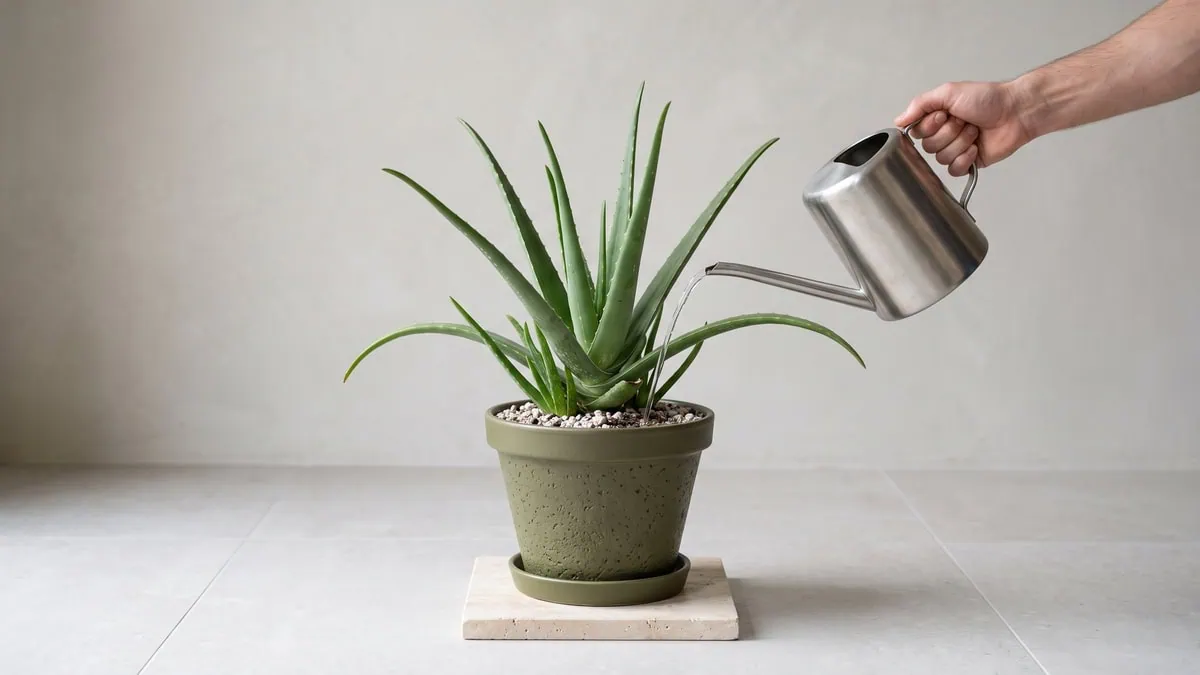
There is no cup measurement for this. The amount is set by a stopping condition: pour steadily until water leaves the drainage hole, then stop pouring. Watch for the first drip at the base of the pot, give it a few more seconds, and let the size of the pot decide the rest.
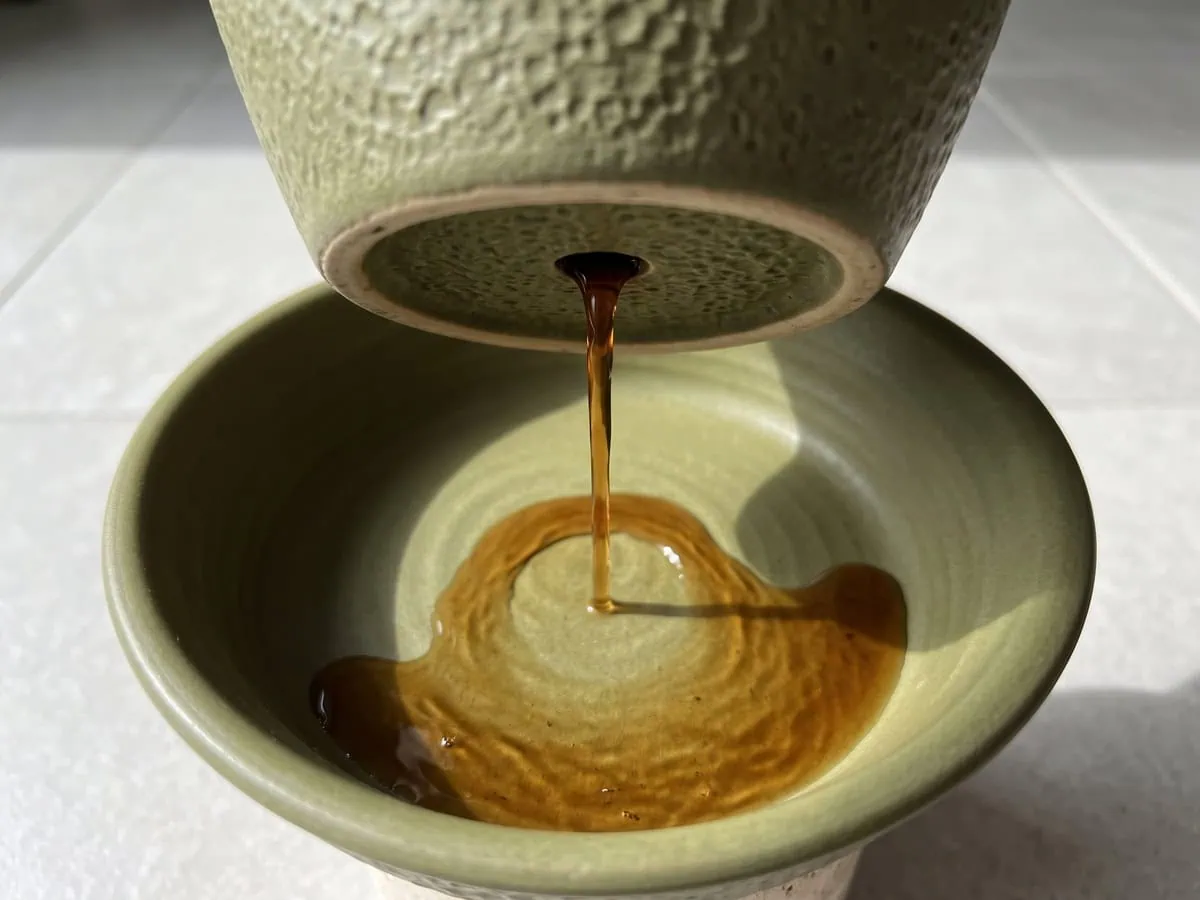
Watch the color of that runoff. On a pot that has gone months without a flush, the first water out is tea-brown with dissolved salts, then clears within a few seconds.
A surface splash is the failure that looks like care. The top dries on cue while the lower mix never wets and never dries. Soak the whole volume.
The step most people skip: emptying the saucer
Pour the saucer off as soon as the pot stops draining. Sixty minutes is the outer limit for a pot standing in its own water, because saturated mix loses the air in its pore spaces and the roots suffocate.
A pot parked in a full saucer turns every careful watering into standing water, which is how a measured interval still ends in reversing decay once it reaches the roots. Empty it. Then check the rim for that white crust.
Lift the inner pot out and water it at the sink. Once the drips stop, seat it back in the decorative sleeve, and the saucer never fills at all.
When the interval changes, and what Aloe vera shows you first
Two things move the interval you measured: the cold months, and a slow drift toward too much water. Below come the cold rule, the early signs, and one myth worth dropping.
Does an Aloe vera need less water in the cold months?
People ask “does an aloe vera need less water in the cold months”. The answer is yes. Roughly double the interval you measured in the warm months, then confirm that with the skewer once the heating is running.
Cold alone is survivable to about 50F. Cold plus wet is not. So move the pot off a freezing sill at night, and read the cold-month routine that keeps it from chilling before the first hard night.
Signs you are slightly overwatering an Aloe vera every week
The early signature is a rosette that never firms up. Leaves stay half-filled and slack. They hold a dull gray-green instead of tightening back to clean bright green after a watering.
Check the mix, not the leaf. If it never reaches dry at the bottom between pours, and the pot never returns to its light dry weight, the routine is already too wet.
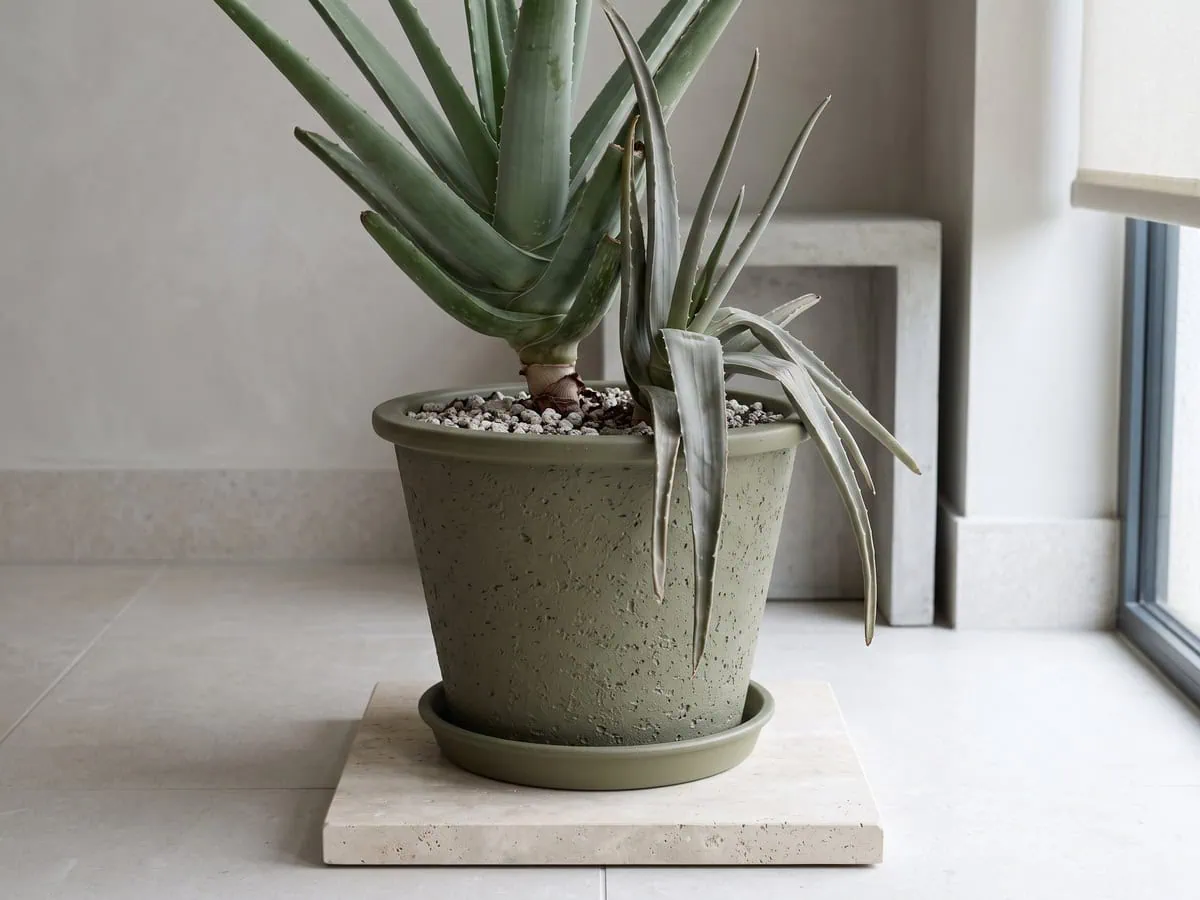
I ran that check on my own sill and found a pot that had not been dry in six weeks while its leaves still looked convincing. That lag is the whole problem, and reading leaves that have gone limp and thin comes much later.
The dry-out myth, and whether it can live in water only
Some care sheets tell you never to let the mix dry out completely. For this plant the instruction is backwards. It recovers from drought and does not recover from waterlogging, so the full dry-down is the safer error.
I could be wrong here, but every care guide I compared puts Aloe vera in a medium that dries out between waterings.
Published care guidance holds the opposite. A medium that stays wet is the leading way this plant is lost indoors. A jar of water is therefore a condition to avoid rather than a setup to try.
Frequently asked questions about watering an indoor Aloe vera
Can Aloe survive a month without water?
Yes. A healthy established plant in a gritty mix goes weeks between waterings without harm, and a month is inside that range in cool, low-light conditions.
Judge the plant instead of the date. Firmness is the readout: the newest central leaves are the last reserve to be drawn down, so while they stay plump and rigid the plant is still holding its own.
Do you water Aloe vera from the top or bottom?
Water it from the top. Pouring in at the surface until water leaves the drainage hole is the only method that shows you the whole mix was wetted.
Top watering also drives accumulated salts down and out of the pot instead of drawing them up to the surface. Bottom watering gives no visible endpoint, and a mineral-heavy succulent mix pulls unevenly from below.
How often should I water Aloe vera indoors?
Begin at every 2-4 weeks in the warm months, then replace that figure with the interval your own pot measures.
Soak to runoff, note the date, and count the days until a skewer pushed to the bottom lifts out dry. That count is your interval for that room, that pot and that light level. Double it for the cold months.
How to tell if Aloe vera needs to be watered?
Push a wooden skewer to the bottom of the pot. Dry wood the whole way up means water now, and a darkened lower inch means wait.
The leaves are the slower second opinion. Pinch one at mid-height: a blade that gives slightly has begun drawing on its own reserve, while the newest central ones stay firm long after the outer ones soften. Read the mix first and let the leaf confirm it, never lead.
How long can Aloe vera sit in water?
No longer than 60 minutes, and only in a saucer of its own runoff rather than a deliberate soak.
Beyond that the pore spaces in the mix stay full and the root zone runs short of air. Empty that saucer the moment the pot stops draining. A pot standing in water overnight has spent that night in the one condition its biology cannot handle.
Can Aloe live in water only?
No. Every account of this plant puts it in a substrate rather than standing water.
What published guidance does describe, repeatedly, is the opposite: a medium that stays wetter than a desert-adapted root system tolerates is the leading way the plant is lost indoors. Water culture asks the roots to live in the exact condition the species is built to avoid.
Lesson locked. Take the measurement your own pot gives you
No sense pretending otherwise. The routine is one number. You take it yourself.
Water to runoff, count the days until a skewer comes up dry at the bottom, and use that count instead of a calendar. That number beats any published figure.
It already carries your light, your room and your pot (I mean that literally), which no borrowed cadence can match. Re-take it when the heating goes on and the gray-green blades still hold their color through a longer gap than the one you measured in the warm months.
Next comes the mix itself, which moves your interval further than any other single change. Getting how often to water Aloe vera indoors step by step right is the groundwork the rest of the care sits on. This rosette forgives a late pour and never the early one.
Get the one-page care card for this guide, plus a printable A4 copy
We condense this guide into one card for your phone and a print version for the pot shelf. Enter your email and we send both to your inbox. Subscribe once, then request the card of any guide you read.
By subscribing you agree to get emails from Plant Care Basics about plant care guides, about once a week at most. Unsubscribe in one click. Privacy policy
Tap the button below to get more plant fixes in your Google Search results