🎯 Quick Answer: naming the pest on a Monstera deliciosa
How to get rid of bugs on a Monstera deliciosa, a member of the Araceae family, has one rule: soap kills at 1-2 percent. It reaches soft-bodied feeders only. Scale sits under a shell; scrape it off by hand. Fungus gnats breed in the mix, not in the air.
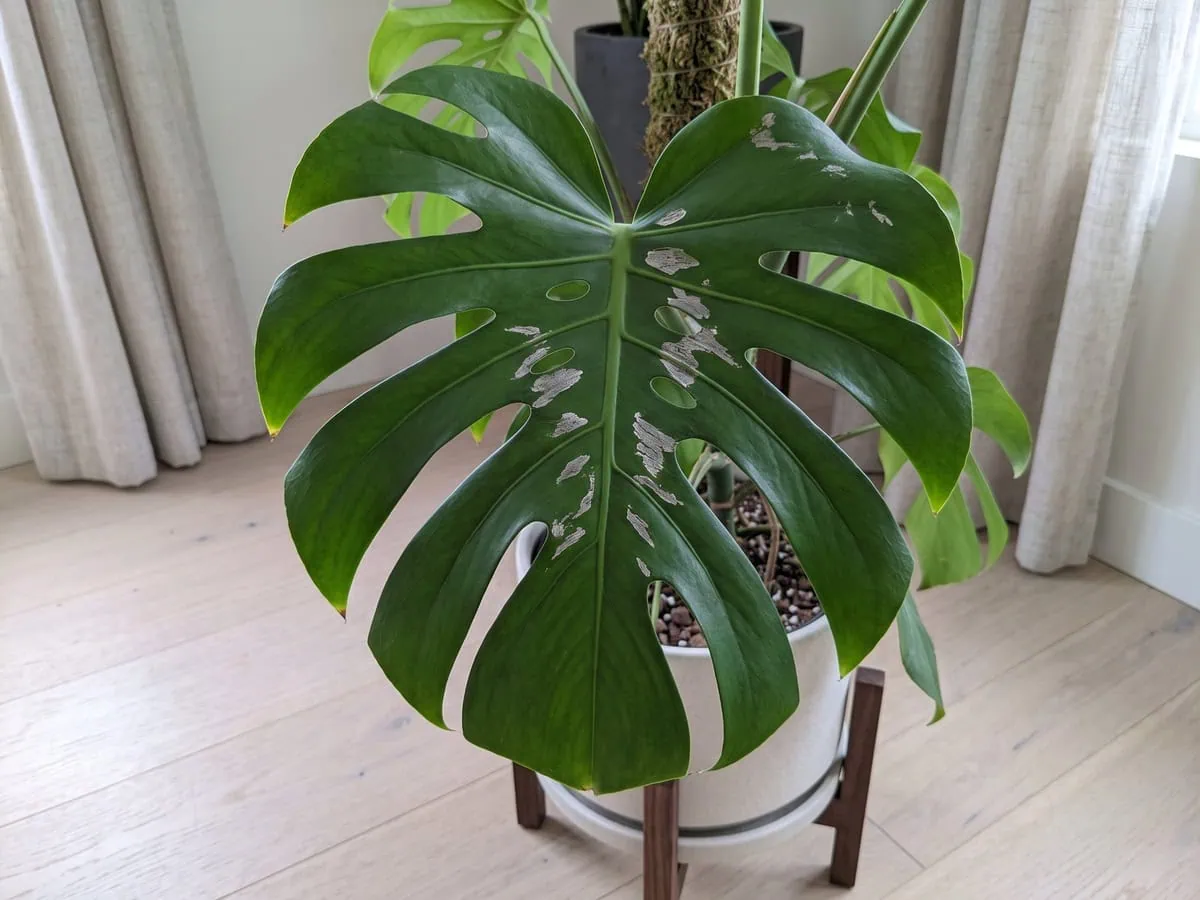
- Thrips: silvery streaks plus tiny dark frass spots glued to the blade
- Spider mites: fine webbing and pale stippling on undersides near veins
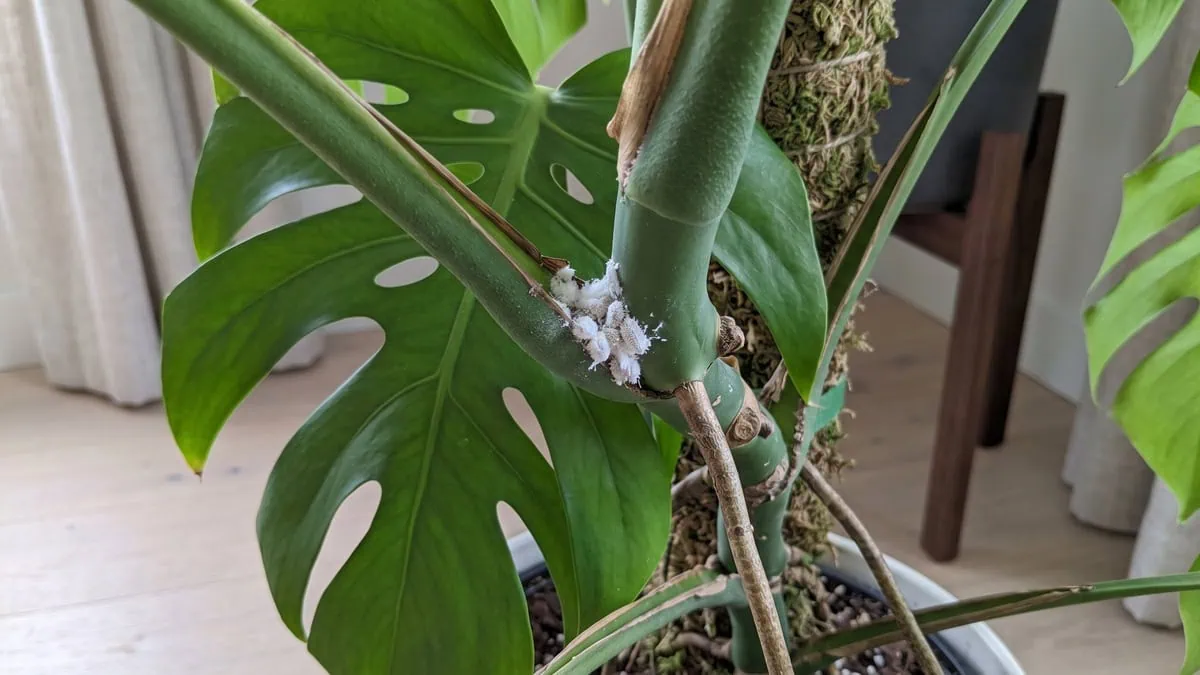
- Mealybugs: white cottony masses tucked into leaf axils and petiole sheaths
- Scale: raised brown bumps that scrape off with a fingernail
- Sticky leaves: honeydew from sap-feeders, later blackened by sooty mold
Pause for a sec. Two specimens went out with the compost here across seven years, and not one was ever named — thrips, spider mites and mealybugs leave marks I read alike, so I sprayed, and sprayed again. Across 53 owner reports of decline, only 4 traced to pests, while one traced to the owner’s own spray.
More product sounds right. It isn’t. Let me try that again — the spray was never the weak link; the papery sheath at every node was, because a Monstera deliciosa climbs as a hemiepiphyte and leaves cord-like aerial roots and dried cataphylls wrapped around the crevices a sprayer never wets.
Here’s what naming it changes: soft-bodied feeders fall to contact chemistry, armored scale does not, and gnat larvae sit in the top 1-2 inches of mix where no leaf spray reaches. If the pests keep returning after a clean routine, the fault is usually upstream in everything else this species asks for indoors.
Slow down before you spray (yes, this sounds fussy — bear with me). Six numbers decide whether the next application works, and they are laid out directly under this line.
How to get rid of bugs on a Monstera deliciosa: fast facts
| Monstera specs | Fast answer |
|---|---|
| Pests that actually reach this plant indoors | Thrips, spider mites, mealybugs, scale, whitefly, fungus gnats |
| First move on any sighting | Isolate the plant, then remove by hand before spraying |
| Insecticidal soap working strength | 1-2 percent, about 2.5-5 tablespoons per gallon |
| Repeat interval | Every 4-7 days until no pests are found |
| Where fungus gnat larvae live | The top 1-2 inches below the surface |
| Do sticky traps clear an infestation? | No – they catch adults while larvae stay below the surface |
Tap the button below to get more plant fixes in your Google Search results

Table of Contents
Which pest is on your Monstera deliciosa? Read the damage first
Six arthropods reach a Monstera deliciosa indoors, and each leaves a different mark: thrips silver the blade, spider mites stipple it, mealybugs and scale sit still, whitefly lifts off when the plant is knocked, and fungus gnats never touch the leaves at all. Each mark gets its own read-out, in that same order.
According to Clemson Cooperative Extension, thrips and other houseplant insects are separated by damage pattern long before anyone sees the insect. And that is the whole game (a hand lens helps, but the pattern does most of the work).
Sticky honeydew residue on Monstera deliciosa leaves is evidence rather than the problem: mealybugs, scale and whitefly excrete it, and the black film that grows on it later is sooty mold, not a leaf disease. Wash the leaf, then clear the producer.
Where these pests hide on this plant
Start at the growing tip and work down. The thick stem carries a node every few inches, and each node holds a dried papery cataphyll, a cord-like aerial root and a petiole base that can run to 3 feet.
That is four sheltered surfaces per node. A top-down spray wets none of them, and the crevice under one lifted sheath smells faintly of damp bark and stale peat.
That is the pocket a sap-feeder crawls into. That is where they turn up on every plant I have opened up.
Cataphyll: the dry papery bract each new leaf unfurls from, which stays wrapped at the node.
Thrips: silvery streaks and dark specks
Thrips scrape the surface and leave irregular silvery patches with tiny dark specks of frass, or insect droppings, glued beside them. Look for movement, not color. Type “how to identify thrips on a Monstera deliciosa” into a search bar, then tap a leaf over white paper.
Adults run under 1/16 inch, so a hand lens is not optional (the naked eye reads the damage, never the animal). Every time. Strip the worst-hit leaves, then run the removal order in the section that follows.
Spider mites: fine webbing and pale stippling
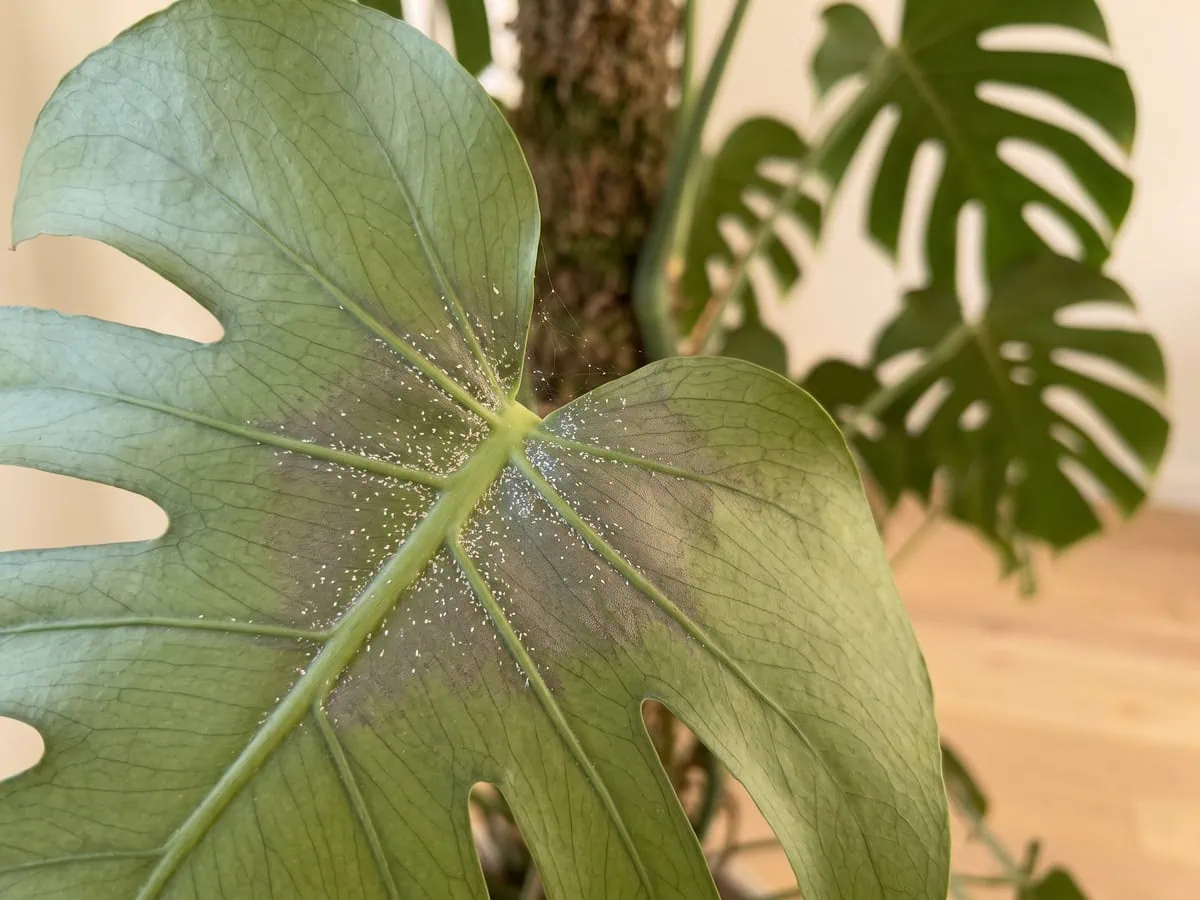
Spider mites feed on the underside and leave white flecks near the base of the leaf veins, which broaden into a gray or bronzed cast.
Spider mite webbing on Monstera deliciosa leaves is the late sign rather than the earliest, since by then the colony has fed for weeks. Water beats chemistry here. Rinse the undersides hard before reaching for a product.
Mealybugs, scale and whitefly: the pale sap-feeders
Mealybugs show as white cottony masses where a petiole meets the stem. Scale looks like a raised brown bump. It does not move when nudged, it scrapes off with a fingernail, and it never chews holes.
Whitefly flies, so knock the plant and watch for a cloud that lifts and settles. Holes with no insect present are usually transit damage, although spreading marks deserve magnification. Lift these off by hand before anything else; the swab work follows.
Sweep in one direction: newest leaf undersides, then node sheaths, then petiole bases, then the stem and totem, and finish on the outside and underside of the pot. Ending at the container matters, because anyone who finds nothing on the foliage stops one step early.
Tap the button below to get more plant fixes in your Google Search results

Clearing the population without scorching the leaves
Clear a population by removing what you can reach, then applying one product at one strength on one interval until nothing is left. On this plant that means the node sheaths, not just the blades. Each stage gets its own run-through, in that same order.
Remove by hand before anything is sprayed
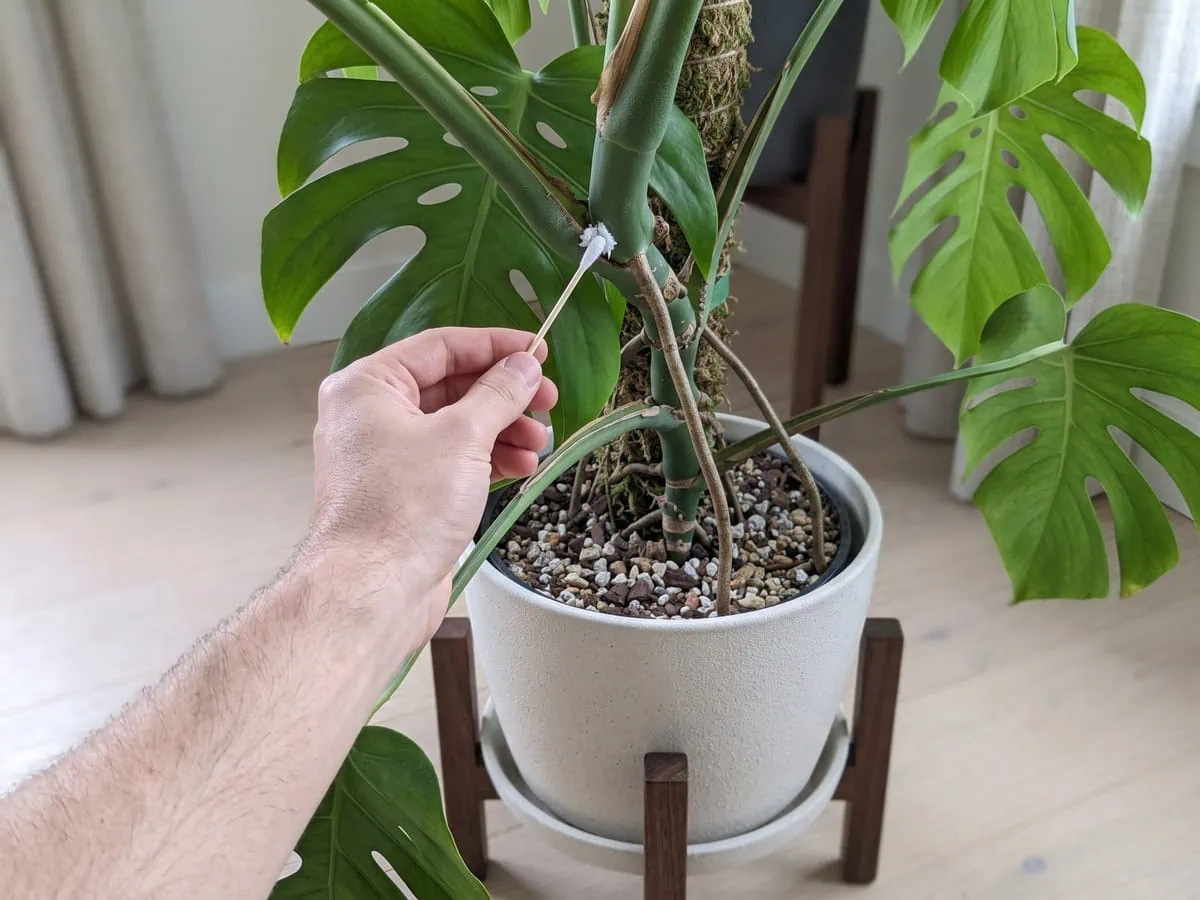
Start with hands. Isolate the plant first, because a second specimen on the same shelf turns a small problem into a collection-wide one. So work mechanically: a swab of rubbing alcohol lifts individual mealybugs, a fingernail takes scale off a petiole, and a vacuum nozzle removes drifting whitefly adults.
Anyone searching “how to get rid of mealybugs on a Monstera deliciosa” meets a spray straight away, since the cottony masses sit in exactly the node crevices a spray skips. I have watched a swab clear what three sprays never reached.
Soap and oil strength, spot test, failure signal
Insecticidal soap works at 1-2 percent, which is about 2.5-5 tablespoons per gallon (the arithmetic matters here) — and horticultural oil runs at the same strength for mites and scale, which soap barely touches.
Spot-test one leaf and wait 24 hours (the slow symptoms are the dangerous ones), because soap injury can take 7-10 days to show on foliage. Repeat every 4-7 days until nothing is found.
Never put a household oxidizer on roots, crown, leaves or stems; that chemistry belongs to empty containers and tools only. Apply any product in a ventilated room, keep animals and small children away until the foliage has dried, and stop entirely if the tested patch browns.
Fungus gnats live in the mix, not in the air
Fungus gnats in Monstera deliciosa soil are a wetness reading before they are a pest, because the larvae feed in the top 1-2 inches and need that layer damp. Let the surface dry, or cap it with a half-inch of coarse grit.
A sour, faintly yeasty smell off a wet surface is the same signal, and it points at the watering rhythm that keeps the surface from staying wet rather than at any spray.
But sticky cards catch only the adults, and they tell you the population is still running. They clear nothing on their own. Not one larva.
If the surface refuses to dry within a few days, the mix is holding too much water on top, which is a job for building a fast-draining aroid mix.
What does not work, and what a stalled recovery really means
Two failures look identical on a leaf: a control that never reached the population, and damage that was already permanent before you started. One is fixed by method or interval. The other is answered only by the next unfurling leaf, because a Monstera deliciosa blade cannot refill a cell it has already lost.
Repeated clean rounds that still turn up live pests usually mean the product never reached them, not that it was too weak. A spray wets the blade; eggs, and the stages living in the mix or under a node sheath, sit outside that film. The two sections below cover the humidity myth, then the old marks.
Interval, not strength. Nothing here names a product that moves inside a Monstera deliciosa leaf, because every spray covered here is a contact spray, and a stronger mix only buys the phytotoxicity described above.
Raising room humidity will not clear mites
Dry air favors the two-spotted spider mite (Tetranychus urticae), so a humidifier reads like a fix. It is not one.
Speculative, but ambient moisture reads as a control because of timing: people raise the humidity and rinse the plant in the same week, and the rinse is what did the work. Moisture is a pressure factor, not a removal step.
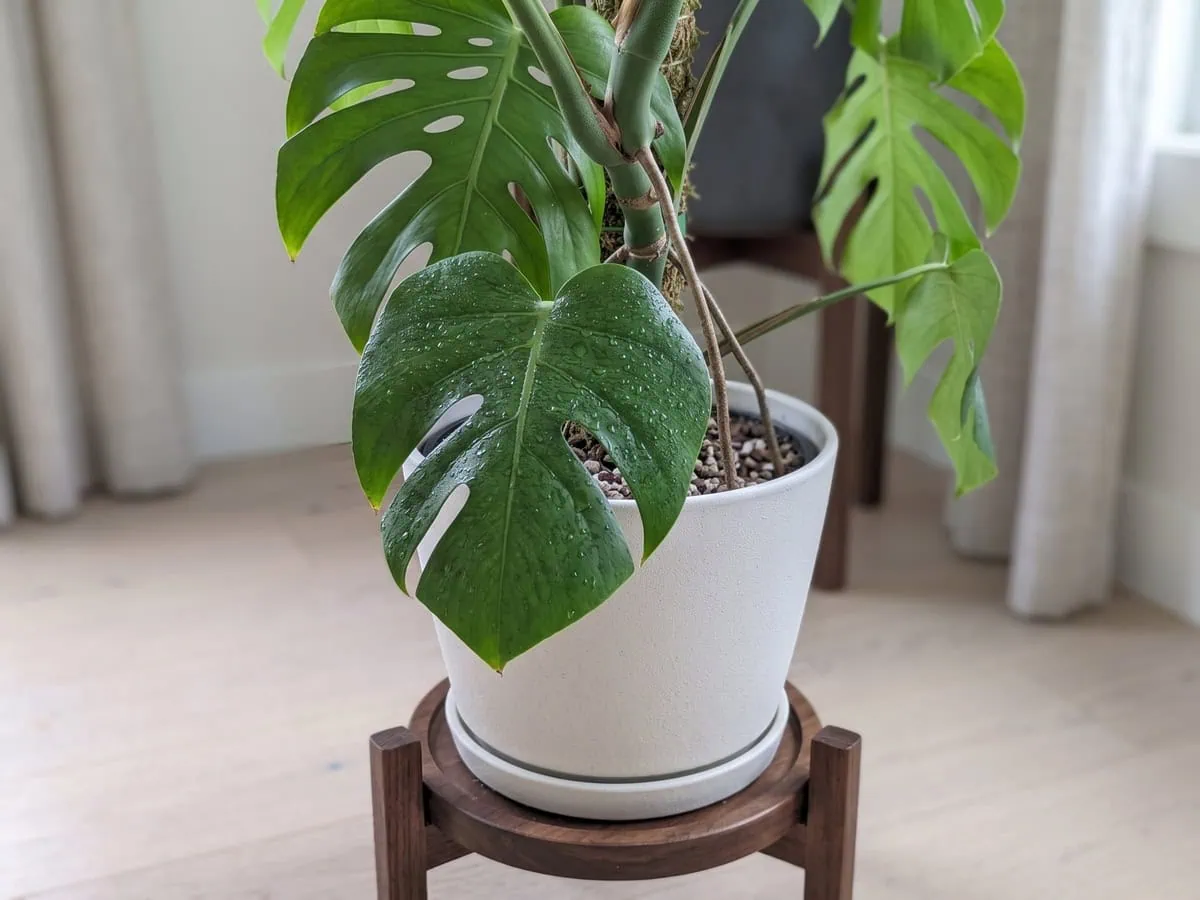
A directed jet of water forces mites and their eggs off the leaf undersides, and repeated weekly over several weeks that alone drops the numbers to low levels. Horticultural oil at 1-2 percent finishes it, because soap is only marginally effective against mites.
Hold the room in the ordinary 40-60 percent band and stop there (a hygrometer settles that argument in about ten seconds). Heating-season air can fall to 10-20 percent, which raises pressure — pressure is not a population.
Dry the foliage afterwards, though. Leaf surfaces that stay wet for long periods let disease spores enter, and a gravel tray standing full for a week smells flat and mineral, like a wet pebble held in a closed hand.
Old marks never fade back to green
Every silvered patch and stipple on a blade is final. Feeding destroys the cells; the tissue does not refill. Judge the round by new growth instead — the leaf that unfurls clean is the verdict, not old leaves changing their minds.
So unchanged spotting a week later is not a failed spray. Escalating the product at that point is how phytotoxicity starts, and a dead scale stays stuck in place looking alive (nudge it: a live one grips, a dead one lifts).
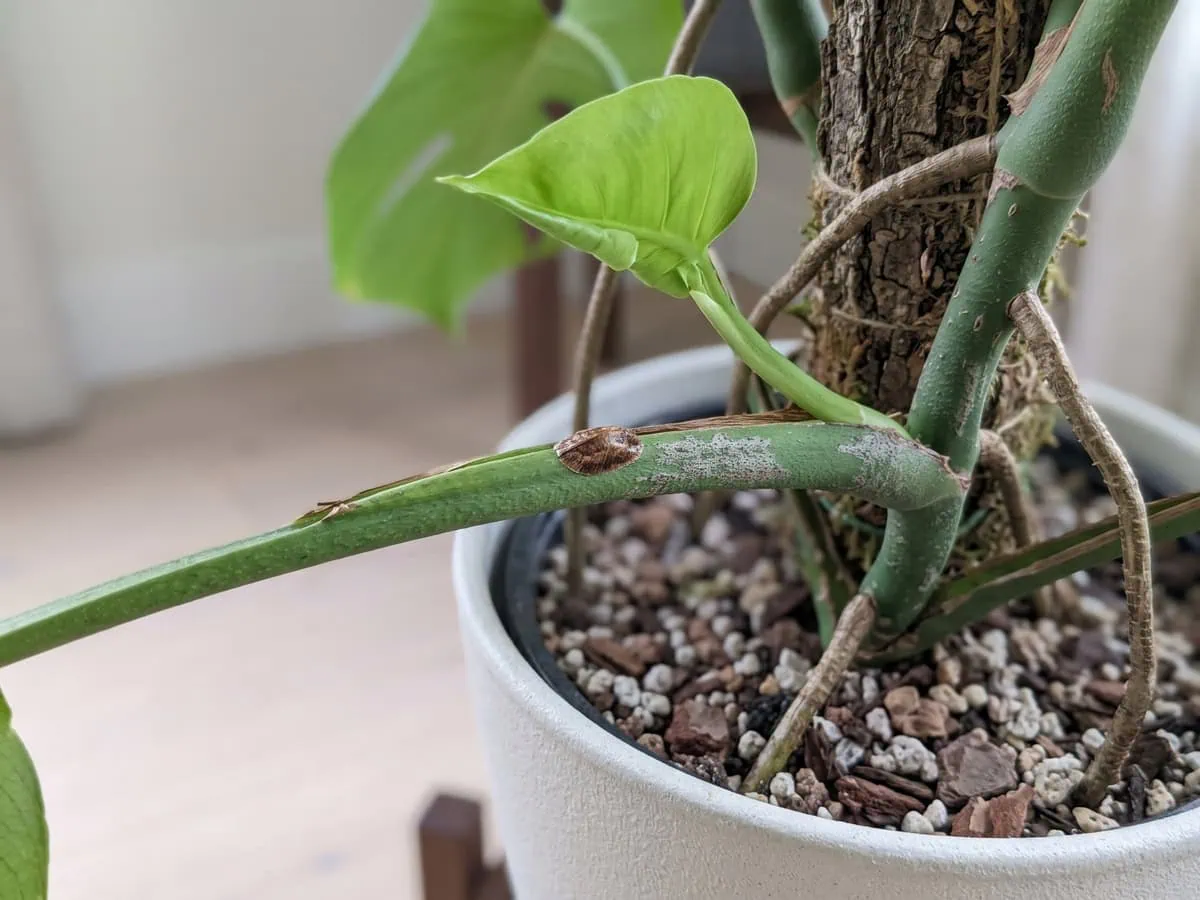
Cosmetic leaf spotting from a home remedy reads the same way. Leave a leaf on the plant while any green remains, since it is still feeding the new growth you are waiting for. If you are separating pest marks from watering marks, that split belongs to the yellowing and leaf-damage differential.
Frequently asked questions about Monstera deliciosa pests
Why does my Monstera have so many bugs?
Almost every indoor outbreak arrives on a newly bought plant rather than starting on the one you already own. That entry route is the only one four independent sources agree on.
Conditions then decide whether it spreads: a surface that stays damp supports fungus gnat larvae, and dense untouched growth shelters sap-feeders. Quarantine anything new for three to six weeks before it joins a shelf.
What can I spray on my indoor plants to get rid of bugs?
Insecticidal soap at 1-2 percent, which is about 2.5-5 tablespoons per gallon of water, is the product to reach for indoors.
Horticultural oil runs at the same strength and works where soap does not, on spider mites and on scale. Spot-test a single leaf and wait a full day before covering the whole plant, because soap injury can take 7-10 days to show on foliage.
What are the most common pests in Monstera?
Six species reach a Monstera deliciosa indoors: thrips, spider mites, mealybugs, scale, whitefly and fungus gnats.
Thrips and mites mark the blade itself, mealybugs and scale sit still on petioles and stems, whitefly lifts off in a cloud when the plant is knocked, and gnats never touch the foliage at all. In one review of 53 indoor declines, only four traced to arthropods.
How to get rid of Monstera bugs?
Separate the plant, remove by hand what you can reach, then apply one product at one strength on a 4-7 day interval until nothing is found.
Hand work comes before spraying because a swab of rubbing alcohol reaches the node crevices a sprayer skips. Keep repeating past the first clean-looking leaf, since eggs and soil-dwelling stages sit out of reach of any surface application.
What is the hardest indoor plant pest to get rid of?
Scale is the slowest to clear indoors, because coverage has to be held through an entire generation of the insect, which runs two to four months.
Its shell blocks contact products, so the mobile crawler stage is the only window a spray reaches. Thrips are the other hard case, since many strains resist insecticides and the egg and soil stages sit where no foliar spray goes.
How do I get little bugs out of my plant soil?
Those are fungus gnat larvae, and they live in the top 1-2 inches of the mix rather than in the air.
Let that layer dry between waterings, or cap it with a half-inch to one inch of coarse sand or fine grit. A Bacillus thuringiensis subspecies israelensis drench every five to seven days reaches the larvae, and three to four weeks is the realistic span.
What can I spray on my Monstera leaves?
Soap or horticultural oil, both at 1-2 percent, and nothing stronger than either of those on foliage.
Plain water is the better opening move against mites, applied forcefully to the undersides. Otherwise keep the blades dry, because leaf surfaces that stay wet for long periods let disease spores enter, and a household oxidizer belongs on containers and tools, never on roots, crown, leaves or stems.
Stop spraying blind, start clearing the pest you actually have
The product was never the hard part. Naming the pest was. Match the name to the method and the rest is arithmetic: a swab for the ones that sit still, a rinse and then oil for mites, a drier surface for gnats.
Then hold the interval. Four to seven days, past the point where a leaf looks clean, until a full run turns up nothing (the drained saucer, wiped and left dry, gives back a faint clean-clay smell). If it stays clean, the question that follows is a watering and substrate one.
Old marks stay exactly as they are, so read the next leaf rather than the last one. So the honest answer to how to get rid of bugs on a Monstera deliciosa is identification, then patience. Name the pest first, and the next swab you draw across a Monstera leaf underside comes back clean.
Tap the button below to get more plant fixes in your Google Search results