🎯 Quick Answer: keep, steer, bury or cut
What to do with Monstera deliciosa aerial roots: leaf enlargement decelerates without support, and wild Monstera deliciosa, an Araceae family member, climbs up to 70 feet. Keep them, steer them onto a moss pole, bury them, or cut them off. Cutting injures nothing, but the roots return at the nodes.
- Cut here: on the root side of the stem collar, never the stem
- Tool: wipe the blade with 70% isopropyl alcohol between cuts
- Pace: take only the roots in your way, then stop and look
- Moisture: never stand aerial roots in a glass; water the pot
- Wall contact: slide cardboard weekly between roots and paint, or shift the pot
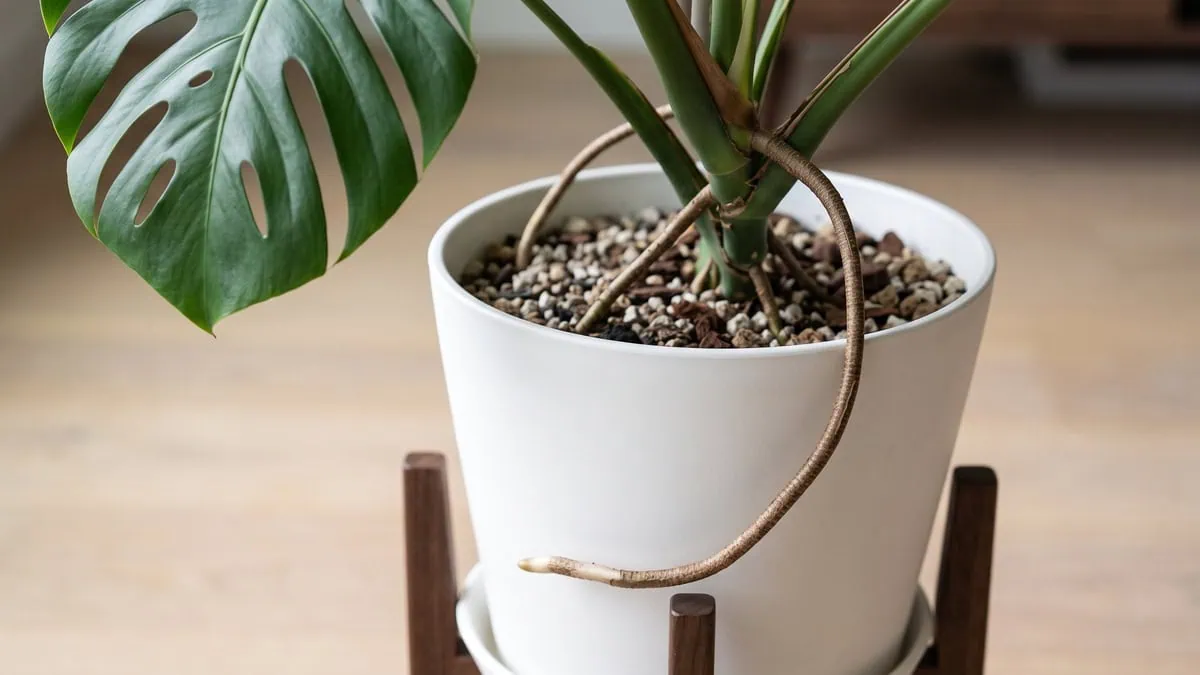
A thick brown cord leaves the stem at a node and arcs over the pot rim. Quick story: I cut 9 of those cords off one specimen across 7 years, and the plant replaced every one at the same nodes. Every single time.
The stumps dried to pale papery nubs inside two weeks. Backtrack: the cord is the visible problem. The actual problem is that Monstera deliciosa carries aerial roots and underground roots for different work, and it relies on adventitious roots for climbing rather than on anything you water.
Root hairs on contact grip a damp pole (nine severed cords taught me that). The roots in the mix do the drinking, and a wild specimen hauls itself up to 70 feet of host tree. So pick which of four jobs that cord should do, and set it inside the whole indoor care routine this plant runs on.
None of this is urgent, and none of it is damage. The whole decision reduces to the one card printed after this paragraph.
What to do with Monstera deliciosa aerial roots: the quick reference
| Monstera specs | Aerial-root answer |
|---|---|
| Primary function | Climbing and anchoring, with moisture uptake supplementary |
| Safe to remove? | Yes – removal does not injure the plant |
| Will they grow back? | Yes – new roots follow at the nodes, so trimming recurs |
| Lowest-effort default action | Steer into a damp support, or redirect into the mix |
| Medium a redirected root enters | A chunky aroid mix of equal parts fine pine bark, sphagnum peat and perlite, top-dressed with a thin layer of coarse horticultural grit |
| Blackened and soft aerial tissue | Inspect the root zone in the pot |
Tap the button below to get more plant fixes in your Google Search results

Table of Contents
What aerial roots are for on a potted specimen
Aerial roots are climbing and anchoring organs first, and moisture organs second. That ranking gets one read-through; what your watering must reach gets another.
Climbing first, moisture second
Type “what are Monstera deliciosa aerial roots for” into a search bar. You get a flat list of jobs. The ranking is the part that matters.
Aroid vines are root-attaching climbers. They carry both aerial roots and underground roots, and they rely on adventitious roots for climbing.
Grip depends on contact: root hairs form only where a root meets a surface. Elsewhere it stays hairless. That grip carries a wild specimen as high as 70 feet up a host tree, and it is the same mechanism behind getting a climbing stem to take hold of a damp totem.
Caveat: this might be wrong for your plant. No source compares a supported specimen against an unsupported one. So the climbing story explains the organ, not your pot.
Watch the root, not the theory. The growing tip stays pale and soft on every cord I have followed. Over the weeks behind it, that same length goes matte gray-brown and stiff enough to hold its own curve.
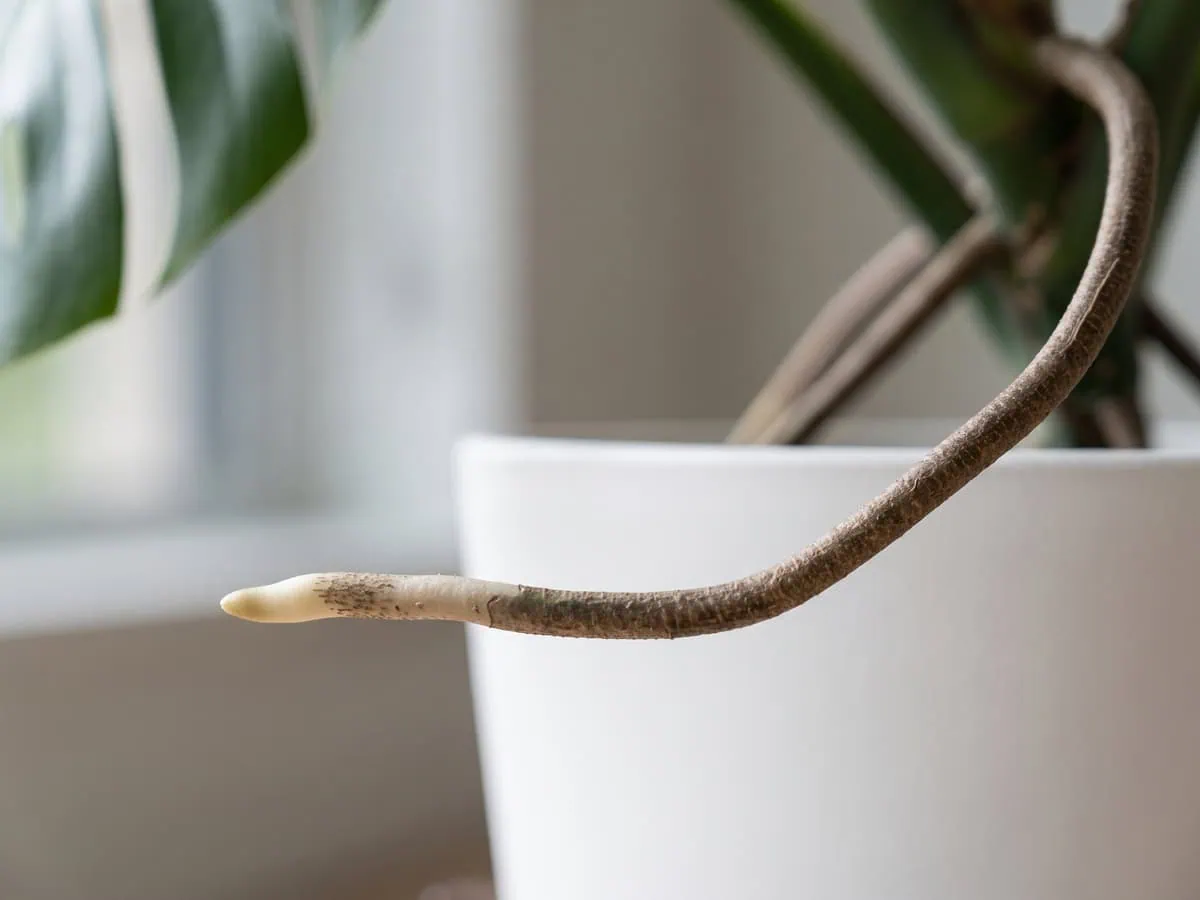
Most guides say the exposed roots drink from the air and stop there. They do take up some atmospheric moisture, but indoors there is no rain, so the roots in the pot stay the supply line. Misting them changes nothing measurable, because Iowa State and Penn State both report that misting does not raise relative humidity.
Why your watering still has to reach the pot
Type “do Monstera deliciosa aerial roots need water” into a search bar. The honest answer is no. Never stand one in a glass.
The two root systems show functional and morphological dimorphism. They are not interchangeable.
Water the medium instead. Sink a finger in about 2 inches; if it comes out dry at that depth, water thoroughly and let the excess drain.
Hold the room near 40-60% humidity. Count that as background, not as a job the aerial roots are doing for you.
Your four options, and what each one commits you to
You have three answers: leave the root (steering it onto a support is one way of leaving it), bury it in the mix, or cut it off. Two of them need technique; those two get worked through here.
| Option | What it commits you to |
|---|---|
| Leave them | Nothing at all, and it stays reversible |
| Steer onto a support | Keeping that support damp so the roots can grip it |
| Redirect into the mix | More root mass in the pot, so the next repot arrives sooner |
| Cut them off | A recurring task, because new roots follow at the nodes |
Verdict: Choose leaving or steering for the lowest effort, because both stay reversible and neither changes what happens inside the pot.
Redirecting a root into the mix
Type “can you bury Monstera deliciosa aerial roots in soil” into a search bar and the answer is yes. Ask Extension states that training aerial roots back to the soil is worth doing after a repot.
Guide the root in on a curve. Let the tip find its own depth. It enters the same medium the pot already holds: a chunky aroid mix of equal parts fine pine bark, sphagnum peat and perlite, top-dressed with a thin layer of coarse horticultural grit.
A buried root converts and starts working as part of the soil system (note to self: that added mass brings the next repot forward). The change shows at repotting, not at watering.
Cutting: where, how much, and what grows back
Type “should you cut Monstera deliciosa aerial roots” into a search bar and you meet three different answers. Removal does not injure the plant. The roots return at the nodes, so trimming recurs.
Cut on the root side of the collar with bypass pruning shears, and stop before the stem tissue itself. Take only the roots that are in your way. Then stop and look.
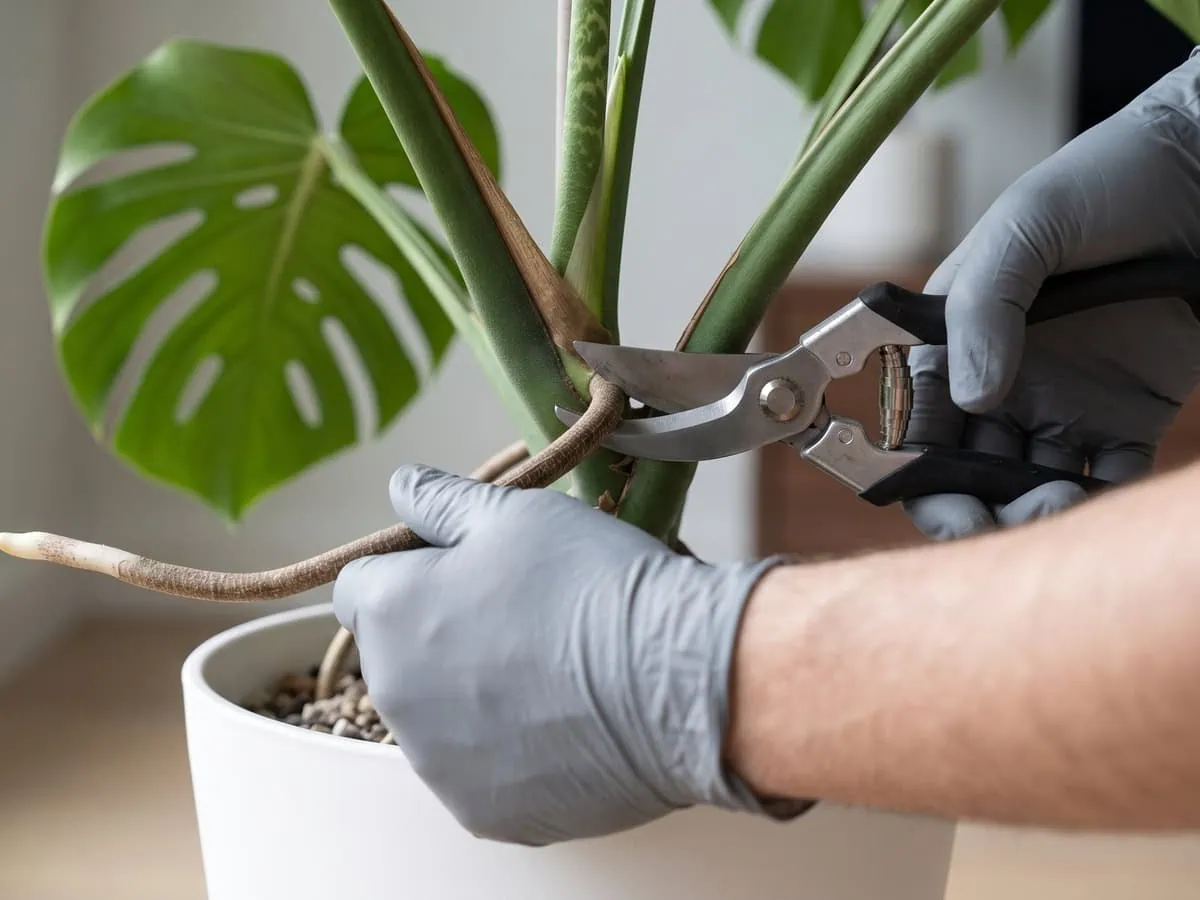
Cut stems and broken leaves release sap carrying insoluble calcium oxalate raphides, which cause rash, redness and swelling on contact. Wear nitrile or thick gardening gloves, and wipe the blade with 70% isopropyl alcohol between cuts. If sap reaches skin, rinse with cold running water for at least 60 seconds, and keep dripping stems off shared surfaces. If a severe skin reaction develops (blistering or intense burning), seek medical attention immediately. For chemical exposure, you can also contact Poison Control (1-800-222-1222 in the US).
A severed length is not a shortcut to a new plant. That job starts at a node, and it belongs with starting a new plant from a node cutting.
One caution on quantity. Strip a stem bare and it loses its grip on the support, which turns a tidy look into a staking problem, and a leaning stem is a far harder thing to correct afterwards than an untidy one. Work slowly.
If the roots multiply while the plant also looks tired, the real question is when the root ball has filled its pot.
Tap the button below to get more plant fixes in your Google Search results

Reading your plant’s aerial roots
A working aerial root is firm and springs back under a thumb. One root gets read first; the number of them gets read after.
Firm, dry or rotting: telling the three apart
Press the root between finger and thumb. Springy under the thumb is live tissue; papery and dented is spent. Neither one needs anything from you.
Dark and soft is the reading that matters. Extension sources describe failing root tissue as brown to black, soft or mushy, sometimes carrying an odor, against live tissue that stays firm, creamy and holds together when it is tugged.
And blackening is not a wait-and-see sign. Growers working with this genus report that a cord can be lost while it still feels firm, because the darkening and the shrivel run ahead of any softness.
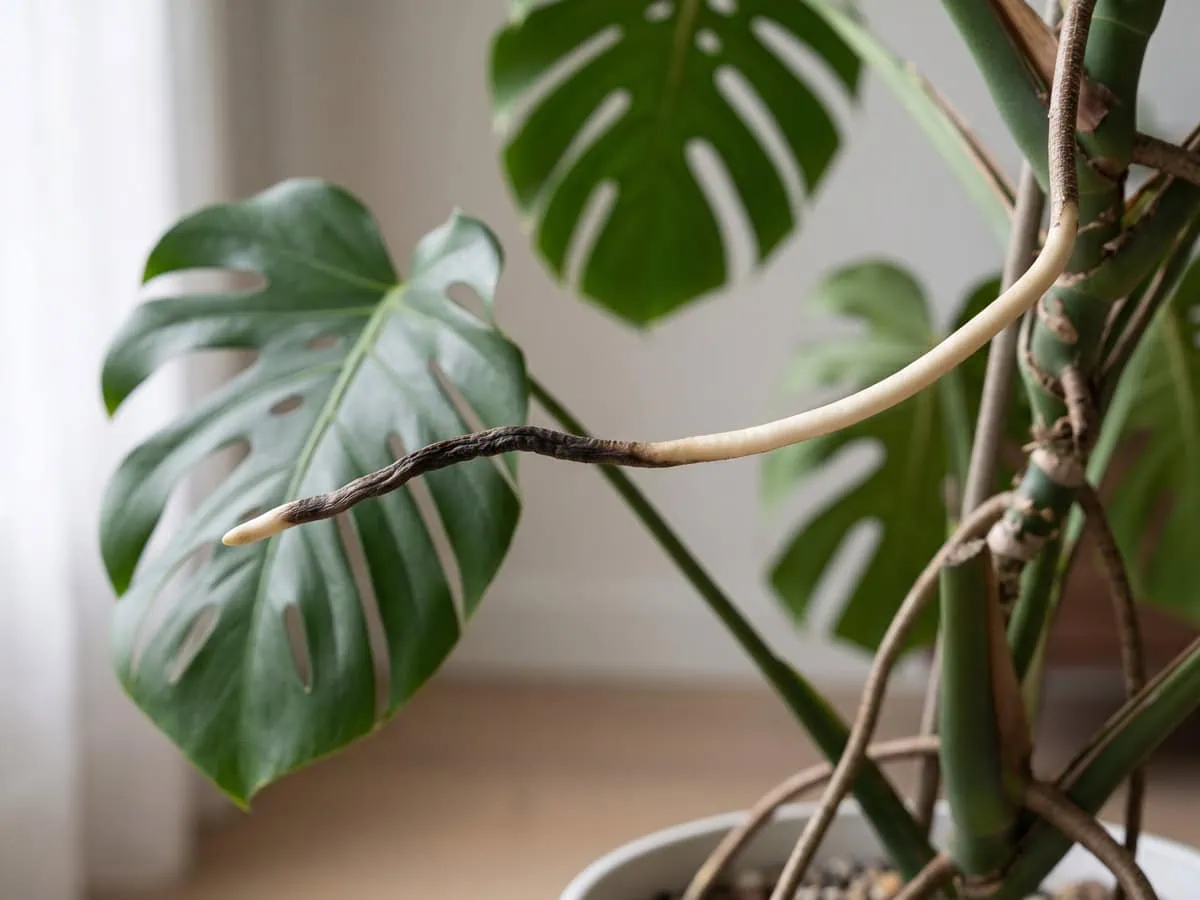
Across my own plants a spent cord goes matchstick-brittle in about a month. The skin then lifts under a thumbnail in papery strips. Nothing else changes.
| What the root feels like | What it means |
|---|---|
| Firm, springs back, pale tip | Live and growing; leave, steer or bury it |
| Light, papery, holds its dent | Spent; no action needed, trim only for looks |
| Dark, soft, yielding, sour | Read the pot, not the root |
Verdict: Choose the pot inspection whenever the tissue is dark and soft.
You need no instrument here. Roll the root once between finger and thumb. Papery and light reads spent; dark and yielding reads failing.
Dark, soft aerial tissue points below the line. If the pot roots are going the same way, the job in front of you is the rescue sequence for a collapsing root zone.
Too many roots, or none at all
Owners search “why does my Monstera deliciosa have no aerial roots” and expect a fault. Usually there is none. Few show until the stems have run on.
What brings them on is contact and damp air. Long internodes on searching shoots stretch out for a surface, and keeping the pole attached to aerial roots is what a damp totem is for.
The opposite worry has no settled answer. One account reads a dense mass as an outgrown pot. Another says roots at the drainage holes are no reason to repot.
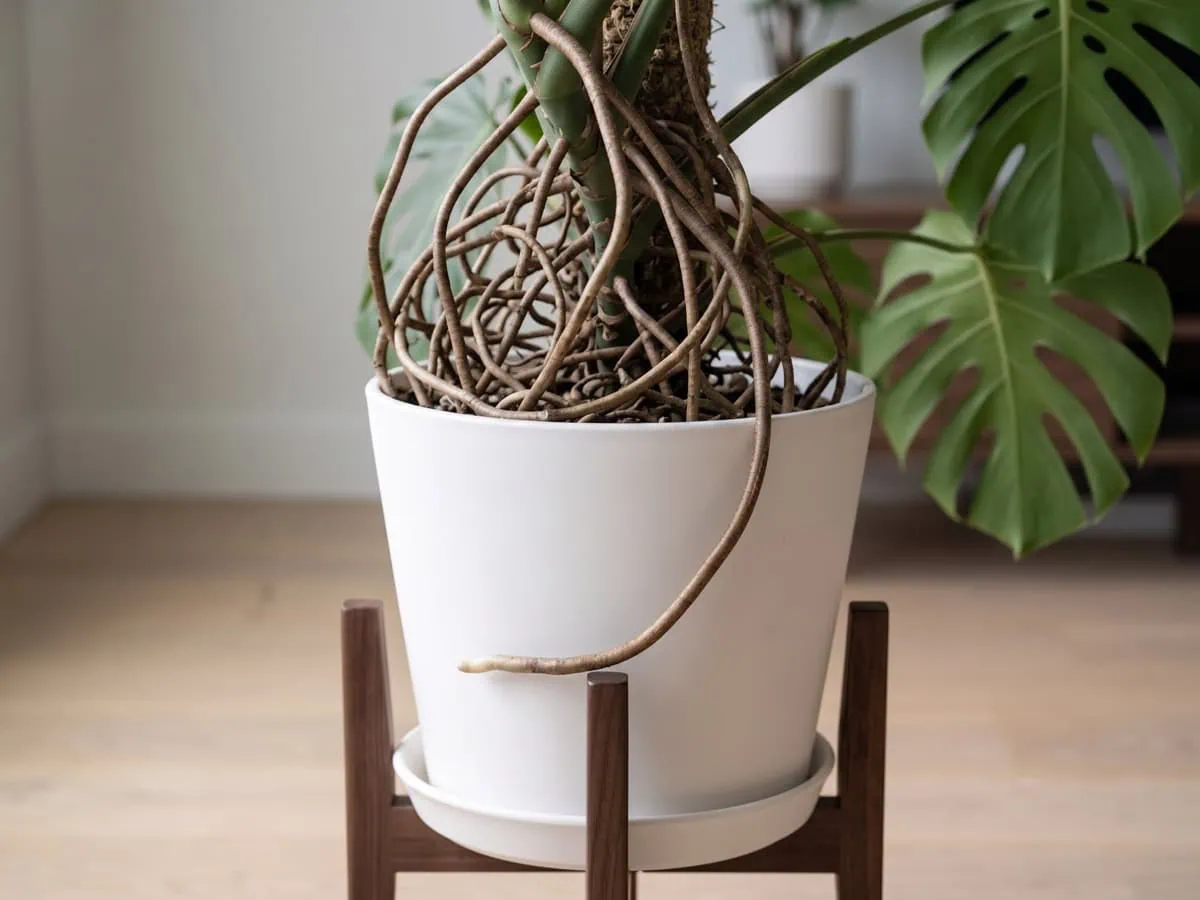
So the pot is what you read the count against. Extension lists five outgrown signals: roots through the holes, roots on the surface, a soil mass solidly filled with roots, new leaves coming in smaller, and wilting between ordinary waterings. A crowd of aerial roots, even six stacked above the stem base, is not on that list.
Frequently asked questions about aerial roots
Is it okay to cut off Monstera aerial roots?
Yes. Removing an aerial root does not injure the plant, and extension guidance for this root-climbing aroid group states that plainly.
Cut close to the main stem with a blade wiped in 70% isopropyl alcohol, and disinfect between cuts. A botanic-garden source takes the opposite view on appearance and recommends keeping healthy aerial roots, so removal is a look choice rather than a care requirement. A stem stripped bare loses its grip on its support.
Why does my Monstera plant have so many aerial roots?
A dense set of aerial roots is normal on a climbing specimen. No source calls a high count a fault on its own.
The roots emerge at the nodes and multiply as the stem lengthens, which is why a tall, well-supported plant shows more of them. Sources disagree about whether a thick mass signals an outgrown pot, so read the container instead: roots through the drainage holes, roots on the surface, a soil mass solidly filled with roots, smaller new leaves, or wilting between waterings.
Can a plant survive with just aerial roots?
No. Pot roots remain the main supply line, and the aerial roots only supplement them.
Extension and botanic-garden sources describe exposed aerial roots as taking up moisture already present in the air, which indoors is a small contribution with no rainfall behind it. This species also carries no water-storage organ of any kind, so the pot has to be watered on its own schedule: water once the top 2 inches of mix are dry, then let it drain freely.
Should I bury my Monstera aerial roots?
You can, and after a repot it is the recommended move. An extension answer on this plant advises training aerial roots back toward the soil once the plant is repotted.
Feed the root in on a curve rather than forcing a bend, and let the tip find its own depth in the same chunky aroid mix the pot already holds. A buried root roots in and adds support, which also adds root mass and brings the next repot forward.
Can you do anything with Monstera aerial roots?
Yes. There are three answers: leave them alone or steer them onto a damp support, bury them in the pot, or cut them off.
Leaving and steering are the lowest-effort choices, and both stay reversible. Steering commits you to keeping that support damp, since the roots grip a porous moist surface rather than a smooth dry one. Cutting commits you to a recurring task, because new roots follow at the nodes.
Will aerial roots grow back if cut?
Yes. New aerial roots emerge at the nodes, so trimming is a recurring job rather than a one-time fix.
The node is the origin point: peer-reviewed work on aroid climbing vines describes aerial roots emerging at the node, then secreting mucilage for adhesion once they meet a surface. Cut back the roots that are in your way, wipe the blade with 70% isopropyl alcohol between cuts, and expect the same nodes to produce replacements as the stem grows.
Can I propagate from aerial roots?
No, not from an aerial root on its own. Propagation starts at a node, and a severed root has no growing point of any kind.
Take a stem section with at least one node, 3 to 6 inches long, remove the lower leaves, and bury at least one node in the medium. Most houseplant stem cuttings form roots in three to six weeks. A cutting whose node already carries an aerial root establishes quickly, so keep that root attached rather than trimming it.
What is the purpose of aerial roots?
Climbing and anchoring come first, with moisture uptake second. Botanic-garden sources describe these roots as important for climbing and for nutrition.
On a wild specimen the roots grip a host trunk and haul the vine up to 70 feet toward better light, and root hairs form only where a root meets a surface. Indoors the same equipment works on a damp totem. Any moisture the exposed roots take from the air is a bonus, not a substitute for watering the pot.
End the cut-them-off-on-sight era
For what it is worth, none of this was ever a test you could fail. A firm cord is working equipment, a papery one is finished, and only dark, soft tissue sends you to the pot rather than the root.
Steer one into a damp totem this week. Leave the rest exposed. Nothing more.
The cord you bury darkens a shade at a time until it matches the bark around it, and that slow match is the only confirmation this job ever gives you.
If the count keeps climbing, the next question is the container, and the repotting piece linked earlier answers it. Reading them, not removing them, is what to do with Monstera deliciosa aerial roots. Steer them, bury them, or leave them be — just remember the pot roots are still the ones doing the drinking.
Tap the button below to get more plant fixes in your Google Search results