🛠️ Quick Prep Summary: taking a cutting that roots
Anyone asking how to propagate a Monstera deliciosa from cuttings needs one node, one clean cut, and patience. Gather these three things before the blade touches the stem. Every cut is a wound, and the piece has to defend it while it roots.
- Blade: sharp shears wiped with 70 percent alcohol before every single cut
- Timing: cut in any month; short days slow rooting, never block it
- Skill: one node is the whole requirement, and a leaf is optional
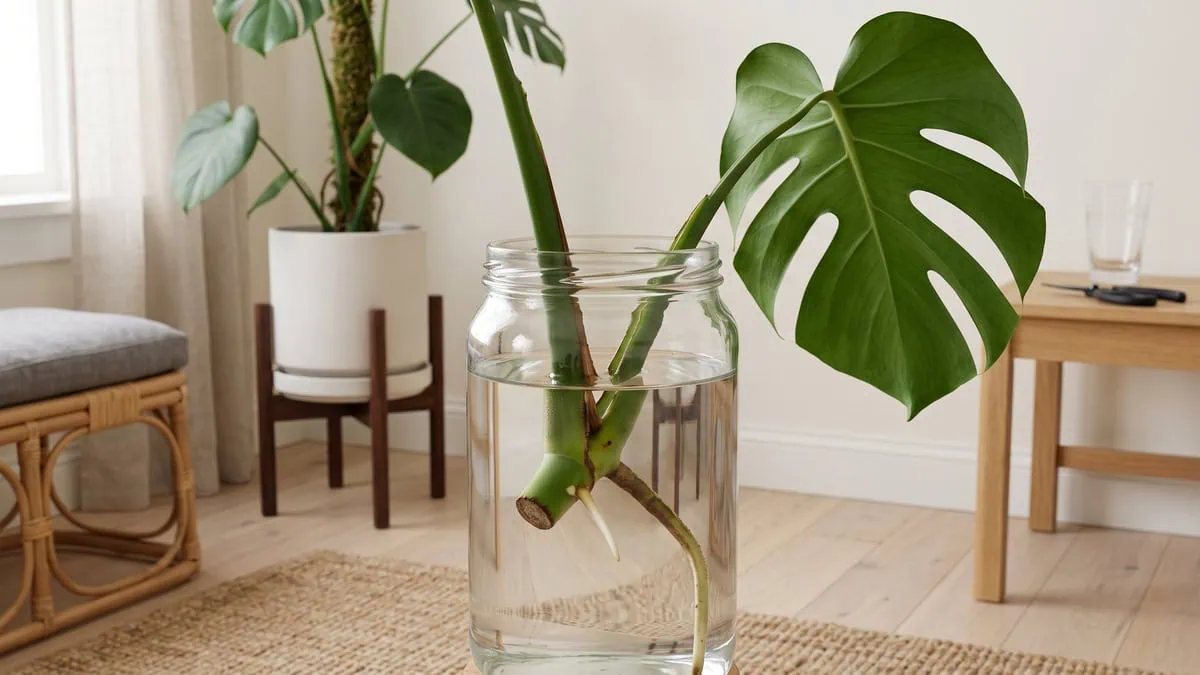
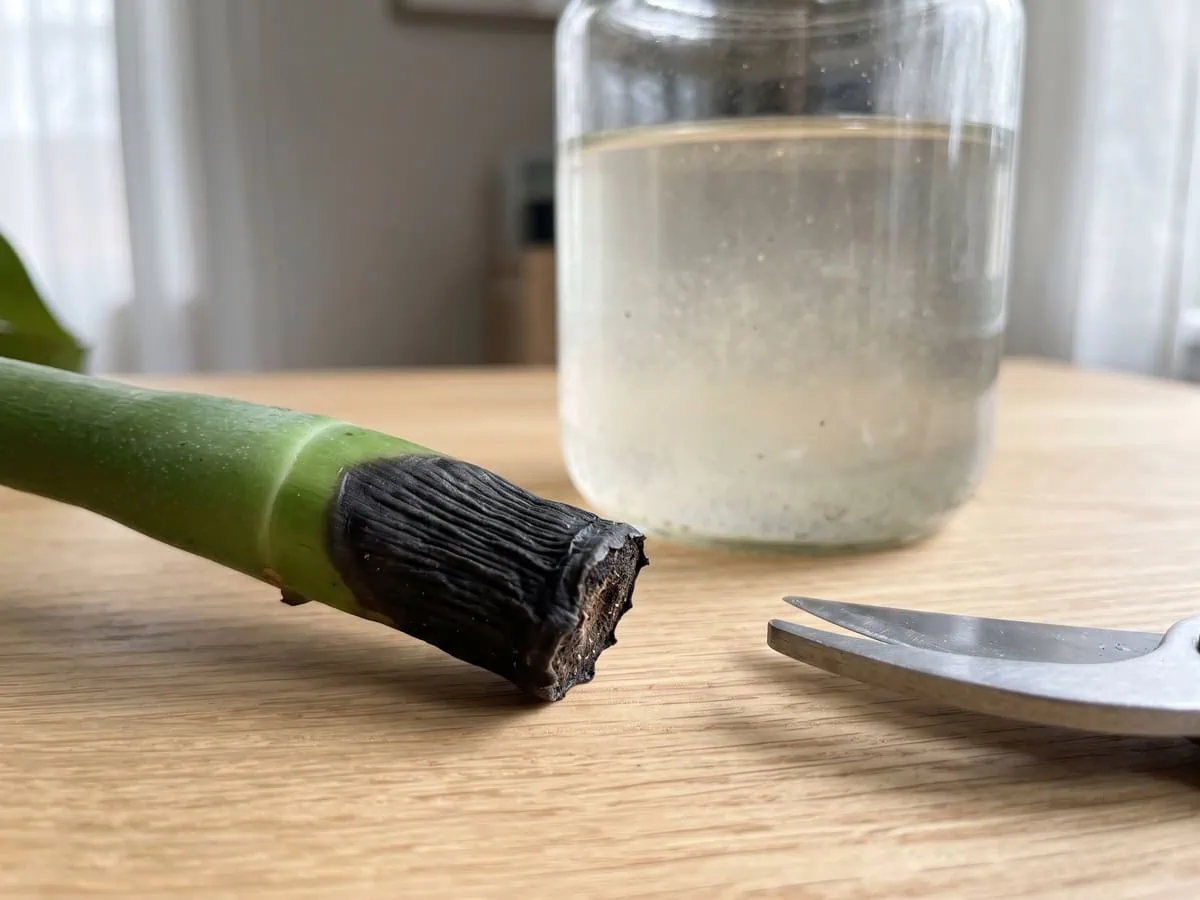
The cut end sat in a jar of cloudy water, soft and brown a finger’s width above the node. Nine stem cuttings over seven years taught me what that softness means (stay with me here) — I was changing the water on a schedule, not on a look.
Rot in water is the visible problem. The actual problem is oxygen. Change the water one to two times a week and the node keeps breathing; leave it still and the wound loses its dissolved oxygen long before roots can form.
Correction — what I meant was that the water is not the enemy; the stillness is. So the job is two habits: cut in the right place, then keep the water moving. Which is the half nobody explains.
None of that replaces the whole-plant care routine this cutting will eventually need.
Read the card before the blade, not after. The numbers underneath account for the whole job, ready to check against the piece in your hand.
How to propagate a Monstera deliciosa from cuttings at a glance
| Monstera specs | What it takes |
|---|---|
| Difficulty level | Low (Beginner) |
| Minimum viable piece | 1 node on 3-6 inches of stem |
| Water changes while rooting | 1-2 times a week |
| Rooting hormone required? | No – optional on aroids |
| Roots in | 3-6 weeks from a stem cutting; 3-4 months by air layering |
| Mix for potting up | A chunky aroid mix of equal parts fine pine bark, sphagnum peat and perlite, top-dressed with a thin layer of coarse horticultural grit |
Tap the button below to get more plant fixes in your Google Search results

Table of Contents
Before you cut: what a viable piece actually needs
A viable piece is a piece with a node. Cut, break, blade, route — four questions, taken one after another.
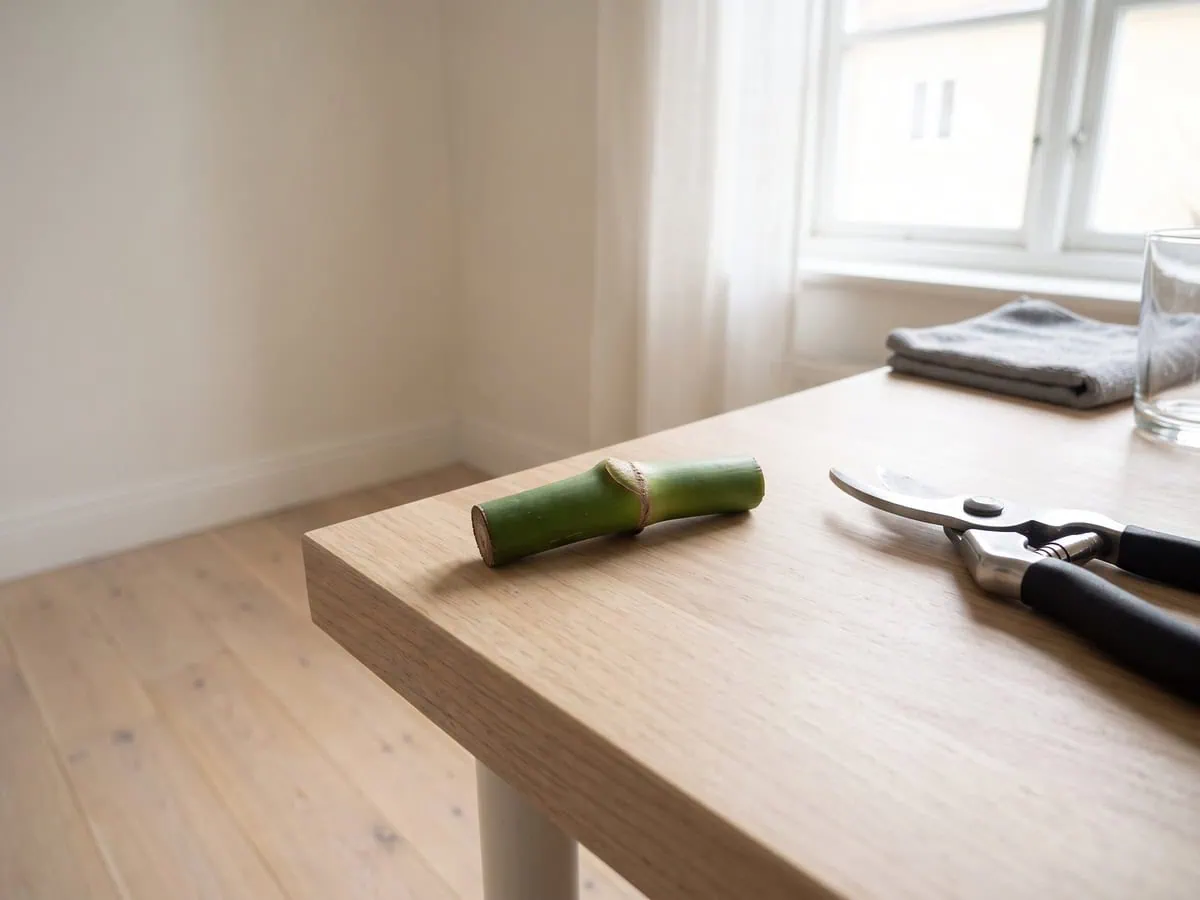
Find the node – and decide how far below it to cut
Cut half an inch to one inch below the node. Type “where to cut a Monstera deliciosa node for propagation” into a search bar and four different numbers come back. A rule beats a number here: measure the internode, then take the smaller of half its length or one inch.
The node is the swollen band where a leaf attached. It carries the bud that becomes the new plant. The stub below it is anchorage, not the rooting site, so a longer stub is not a better one.
Tentatively, an attached stub of aerial root looks like an advantage. Those cord-like roots grip, and they take moisture from the air, so on a severed piece they are already working while the node has nothing else. Whether they shorten rooting is unsettled.
Read what those thick cord-like roots are actually for as a bonus on the piece, never as a requirement for taking one.
If the stem snapped: triage before you cut anything
A broken stem is propagation material if the break left a node on the piece. Anyone searching “how to root a broken Monstera deliciosa stem” is usually holding the piece already. Start with the break, not with a jar.
Ragged tissue is the problem. Trim the torn end back to clean green with one square cut, half an inch to one inch below the nearest node.
A piece with no node will not root. The leaf alone produces nothing, however good it looks.
Now decide which half is worth keeping. Squeeze the stem. Green and still rigid stays; soft, and browning at the break, goes.
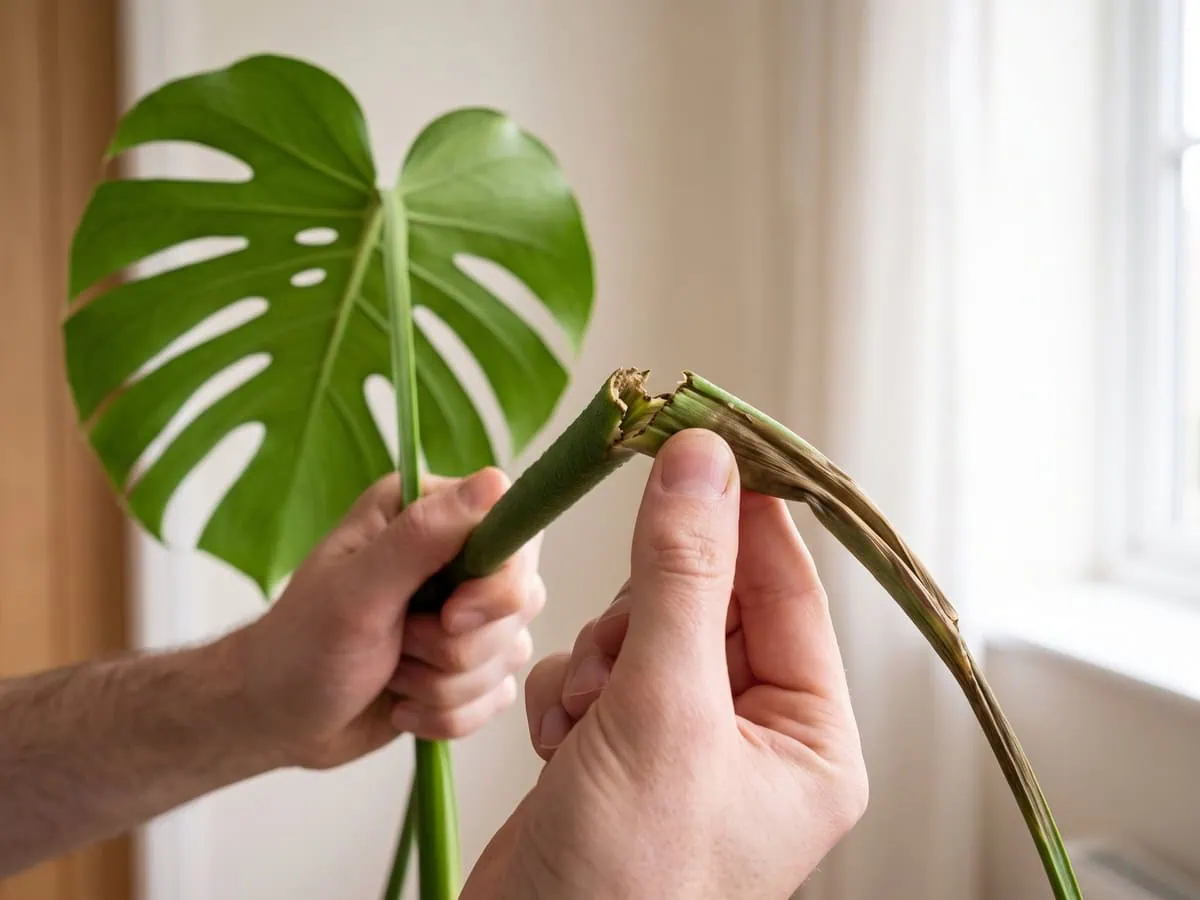
The keeper has always been the half carrying a node, whatever the leaves looked like.
Blade, cut surface, and the sap you should not touch
Sharp, clean and disinfected are three different states of a blade. Wipe or dip it in 70 percent isopropyl alcohol, with no soak needed. Then wipe it again between cuts.
According to the North Carolina Extension Gardener Handbook, single node cuttings are made by cutting the stem below and above a leaf petiole carrying a developed bud. That is the anatomy your blade must respect.
Then there is the sap. Broken leaves and cut stems release it, and it carries needle-shaped calcium oxalate crystals that irritate skin and eyes on contact.
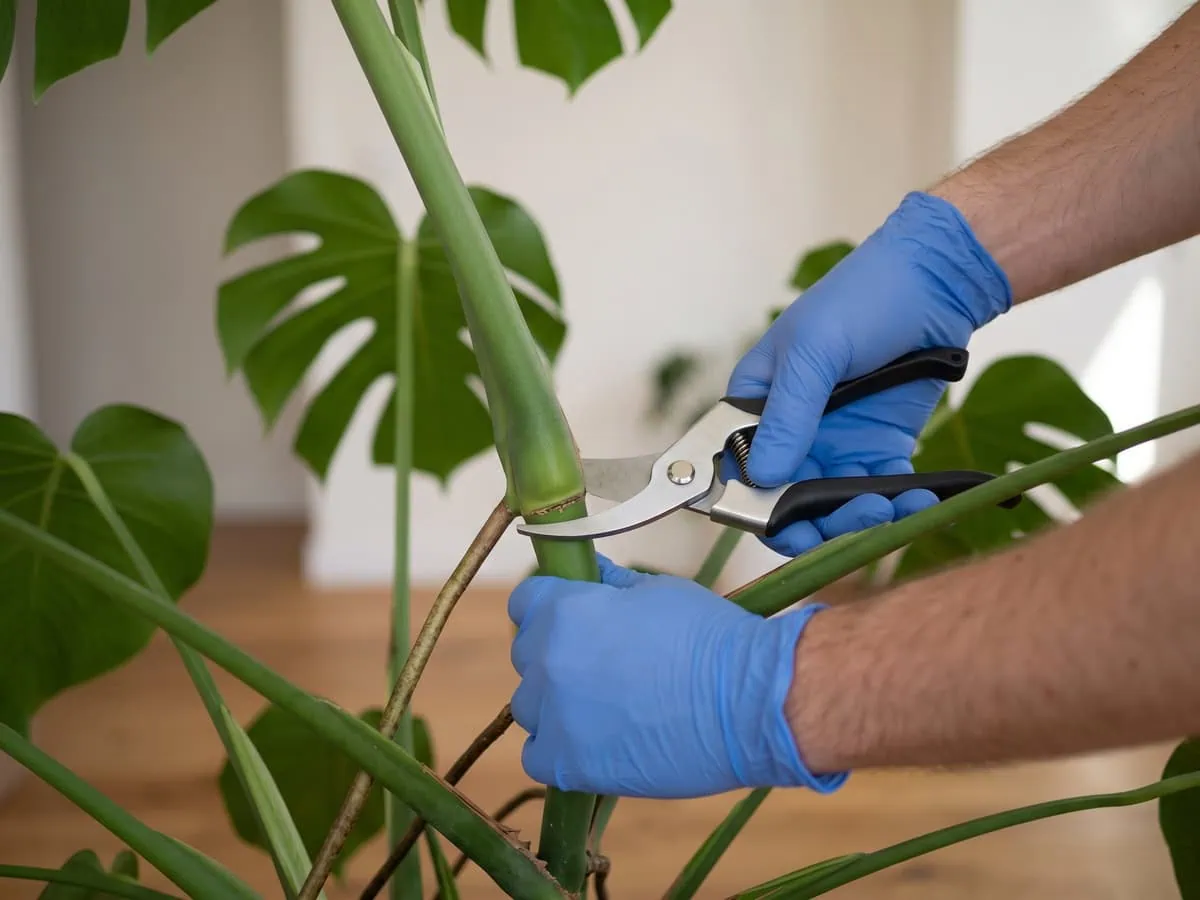
Wear nitrile or thick gardening gloves for any cut that can reach sap. If sap contacts skin, rinse with cold running water for at least 60 seconds. Keep cuttings and dripping stems off shared furniture, and wash hands and surfaces afterwards.
If a severe skin reaction develops (blistering or intense burning), seek medical attention immediately. For chemical exposure, you can also contact Poison Control (1-800-222-1222 in the US).
That does not make the plant dangerous to own. Gloves settle it. It does make the sap irritation and the poison-control routing worth reading before a session with pets or a small child in the room.
Water or a rooting mix: pick the route before you cut
Pick the route first, because it changes how you handle the piece. The following table sets the two routes against each other on the four points that actually differ.
| What differs | Water | Rooting mix |
|---|---|---|
| What you can see | Root growth, day by day | Nothing until you tug |
| Risk at the wound | Greater risk of infection at the cut | Lower, while the mix stays lightly moist |
| Upkeep | Change the water 1-2 times a week | Keep it lightly moist, never wet |
| Moving to a pot | Water roots adapt to mix afterwards | No transition step at all |
Verdict: Choose water when you want to watch the roots and will change it twice a week. Choose a mix when the piece is large, or when you would rather not run a schedule, because the mix steadies the stem while the wound closes.
A rooting mix is not the bark-based medium a potted-up piece grows in. Rooting wants low fertility, free drainage and moisture that never swings, which is why unmilled sphagnum moss, squeezed out until it is only lightly damp, does the whole job on its own. Nothing else needed.
Tap the button below to get more plant fixes in your Google Search results

Step by step: taking and rooting the cutting
Five steps carry the piece from the plant to a rooted plant of its own. Five steps, in order, each one setting up the next.
Step 1: Choose the piece and count its nodes
Slide a thumb up the stem until you feel the raised band of a node, then measure 3-6 inches of stem around it. Keep one node at least. Two is better, if the stem gives you the length. Strip the lowest leaf so nothing green will sit in water or mix. A leaf speeds the work by feeding it, but the node is the part that is not optional, because the bud that becomes the new plant sits there and nowhere else.
Step 2: Make one clean square cut below the node
Make one square cut half an inch to one inch below the node. Cut once. A sharp blade passes through in a single push; a dull one skids and drags. A sawing action crushes the tissue you are asking to seal, and crushed tissue is exactly what the rot organisms are waiting for at a fresh wound. An angled cut is a florist’s habit borrowed from cut flowers, and it only enlarges the surface you then have to defend.
Step 3: Let the cut surface dry to the touch
Set the piece down and leave the cut end until it feels dry to a fingertip. That is a few minutes in ordinary indoor air. A thumb-thick stem takes longer. An hour sits at the far end of what anyone reports. Two sources call this step necessary and nine never mention it, so the dry-to-the-touch condition is the instruction here and the clock is only a guide.
Step 4: Set the piece to root in water or mix
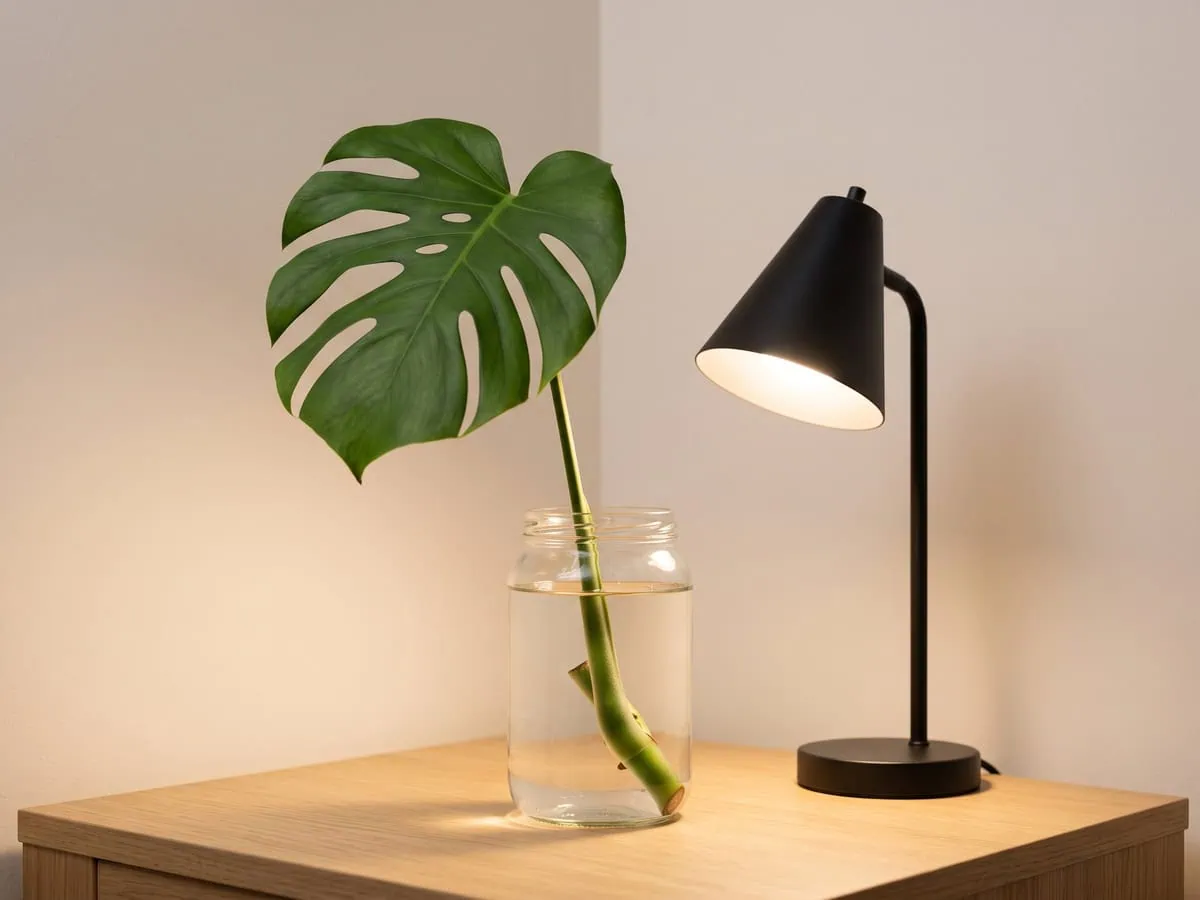
Stand the piece the way it grew, node down. A cutting set upside down will not root. Polarity is not negotiable. Most people asking how to propagate Monstera deliciosa in water start with a clear jar filled so the node is covered while every leaf stays clear of the surface. In a mix, press the node into lightly damp unmilled sphagnum moss in a pot with a drain hole, and skip the rooting hormone if you like, because aroids root well enough without it.
Step 5: Hold the rooting station steady for weeks
Hold the station at 65-80F, with humidity in the 40-60% band and bright indirect light on the leaf. Change the water 1-2 times a week. Change it early if it clouds. Short days slow rooting and do not forbid it, so a fixture run 12-14 hours a day answers the low-light part of the year better than waiting for a warmer month does.
The rooting station is not where the grown plant eventually lives. The measured light band an established plant grows in is a separate question. Pieces held under a desk lamp in a windowless corner rooted on the same schedule as pieces at a bright window.
After the cut: rooting time, rot, and potting up
Most stem cuttings root in 3-6 weeks. Wait, rot, stall, parent plant — four outcomes, in that order.
How long a cutting takes to root, and when to pot it up
Roots appear in 3-6 weeks on a stem cutting kept at ordinary room temperature. Air layering runs 3-4 months. Pot up early.
The trigger is one root about 1 inch long, not a jar packed with them. Anyone typing “how long does a Monstera deliciosa cutting take to root” into a search bar wants a date. The honest answer is a range.
Water roots come in coarse. They stall when they first meet mix. Pot into a container of that potting mix with a drain hole, water until it runs out of the bottom, then empty the saucer after 20 minutes.
Wait until the top 1-2 inches feel dry before the next watering. Hold the fertilizer until new growth appears.
Rot at the cut: what it looks like, what to do
Rot at the cut reads black and shriveled long before it reads mushy. Waiting for softness loses you the piece.
Pinch a root between finger and thumb: a live one stays firm and creamy, while a failed one pulls apart at once and its outer layer slides off a stringy core.
- Stem darkening upward from the cut, the surface wrinkling inward
- Brown, soft tissue that smells sour rather than green
- Water that goes cloudy again within a day of a change
Still water is the mechanism. The wound loses its dissolved oxygen. Re-cut half an inch to one inch above the failed tissue, with a blade wiped in 70 percent isopropyl alcohol.
Restart the piece in lightly damp unmilled sphagnum moss, inside a covered container with a drain hole. Rinse it with plain water only. Household detergent injures the tissue you are trying to keep.
Why is my Monstera deliciosa cutting not rooting?
A stalled cutting is usually missing a node rather than missing time. Check the piece first.
A stem carrying a leaf and no node has no axillary bud at all. Patience will not grow one there.
White fibers at the cut end are not roots either. That is internal tissue lengthening as it waterlogs. Real roots break out of the scar above the cut.
Warmth from below is the third stall. A piece parked over a heat source rots at its base faster than it roots. A snapped aerial root wants 12-24 hours to callus first.
What the mother plant does after you take the piece
The mother plant answers at the node below your cut. Nothing new appears from the soil.
Each vine carries a single growing tip. An unpruned plant simply gets longer. The bushy specimen in a shop is several plants sharing one pot.
Remove no more than a third of the plant in one session.
Nobody publishes a reliable week count for that new shoot, so watch the node rather than the calendar. A plant cut back to bare stems re-leafs from those nodes while its roots stay sound.
Frequently asked questions about taking and rooting cuttings
What are the common mistakes in Monstera propagation?
Three mistakes ruin most pieces: a nodeless cutting, still water, and a blade nobody disinfected. Each one is avoidable in seconds.
A leaf without a node has no bud, and nothing else on it will ever make one. Still water loses the dissolved oxygen the wound needs, so change it one to two times a week. Wipe the blade with 70 percent alcohol between cuts.
Do Monsteras propagate better in water or soil?
Neither route wins outright. Water lets you watch the roots and adds a transition step, while a rooting mix hides them and skips it.
Coarse water roots stall briefly when they first meet mix, which is why the piece moves across at about an inch of root. A lightly damp mix instead steadies the stem while the wound closes over.
Where do I cut a Monstera for propagation?
Take the cut half an inch to one inch below the node, square across the stem, in one clean pass.
Measure the internode first, then take the smaller of half its length or one inch, so the cut never sacrifices the node below it. The stub under the node is anchorage rather than the rooting site, so a longer one buys you nothing.
How long does it take for Monstera cuttings to propagate?
Stem cuttings root in 3-6 weeks at ordinary room temperature. Air layering runs far longer, at 3-4 months.
Warmth, light and a piece that already carries an aerial root shorten the wait, while a cool dim corner lengthens it. Pot up when one root reaches about an inch, rather than waiting for a jar full of them. Air layering trades that speed for a much bigger start.
What is the most successful Monstera propagation method?
One node on 3-6 inches of stem is the most forgiving method, rooted in lightly damp sphagnum moss.
The route matters less than the wound, so work with a sterile blade, a dry cut surface and oxygen at the node. Air layering is the lowest-risk option on a tall bare stem, because the piece grows its roots before it is ever severed.
Can you put Monstera cuttings straight into soil?
Yes. A cutting can go straight into a rooting medium, and doing so skips the water-to-mix transition entirely.
Press the node into lightly damp unmilled sphagnum moss, or a chunky mix, in a pot with a drain hole. Keep it lightly moist rather than wet, and resist tugging the piece to check for roots. The mix route also skips the coarse water roots entirely.
Will Monstera regrow after cutting?
Yes. New growth pushes from the node below your cut, and never from the soil.
One growing tip per vine means the parent grows on from that node rather than branching along its length. Take no more than a third at one session, and watch the node instead of the calendar for the shoot. Parent and cutting then grow on separately.
The 3-move propagation protocol
Truth is — the whole job is three moves. One node, one square cut, one vessel you keep oxygenated. Everything after that is patience (said without hedging).
Roots in 3-6 weeks. Pot at an inch. Then read the pot by hand: heavy on the day you soak it, noticeably lighter before the next one.
That is the only watering schedule a young piece ever needs, because a pot still weighing heavy holds water the roots have not used yet. Next question is the pot itself, and the outgrown signals that decide when this piece moves up.
Put the blade in the right place and the rest of how to propagate a Monstera deliciosa from cuttings takes care of itself.
One node is all a cutting really needs, and a square cut a finger’s width below it is what turns a severed piece into a rooted Monstera.
Tap the button below to get more plant fixes in your Google Search results