🎯 Quick Answer: the mix a Monstera deliciosa actually needs
What is the best soil for a Monstera deliciosa — an Araceae family member — accelerates drainage at 2:1 aeration to moisture. Bark and perlite hold that air open; peat or rinsed coir carries the water reserve. Skip any pot without a drainage hole, whatever the bag promises.
- Squeeze test: a damp handful should crumble apart, not hold shape
- Cutting a bagged mix: one part mix to one part bark and perlite
- Rinse coir first: unrinsed coir carries salt into a closed pot
- Weigh the pot: no lighter on day seven than on the day you watered means too wet
- No gravel layer: a base of stones does not improve drainage
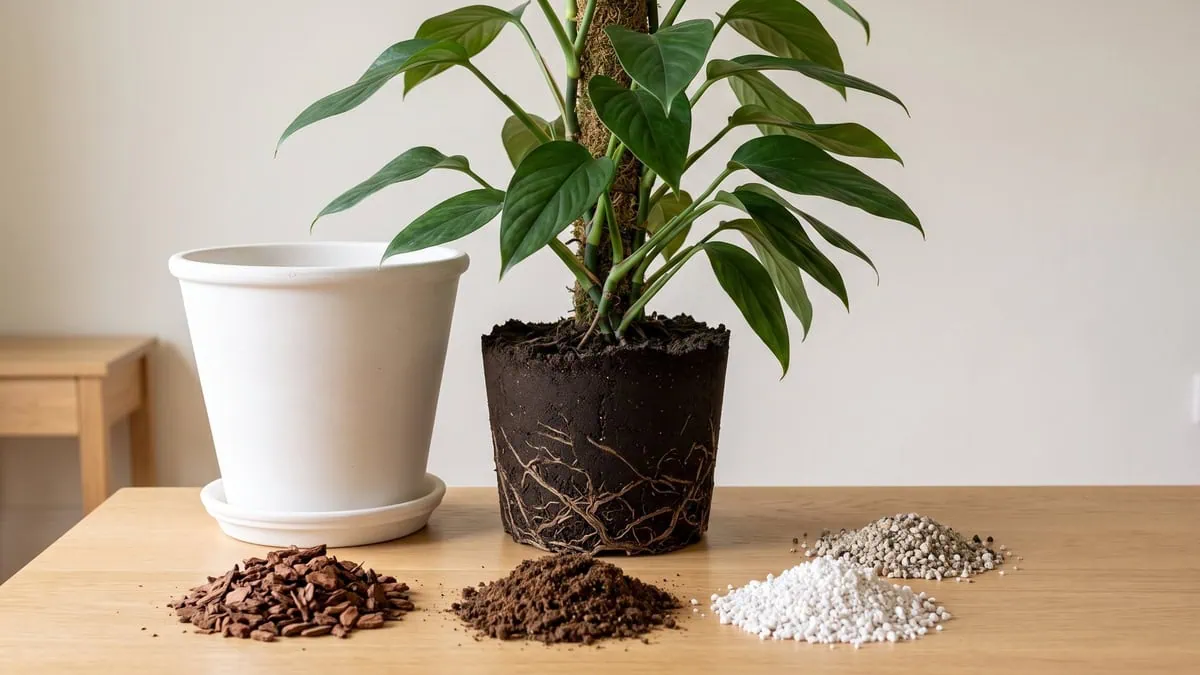
The old mix came out of the pot as one solid plug, still holding the shape of the container, with every root inside it flattened against the side. Four Monstera deliciosa went that way over seven years (the reason is two paragraphs down), all of them sitting in a fine peat moss blend that looked perfectly respectable in the bag.
Buying the bag labeled for houseplants sounds right. It isn’t. Strike that — the bag is a fine starting point, but left unamended it settles into compacted soil, the large air-holding pores close, and roots that cannot reach oxygen die quietly.
A chunky aroid mix does the opposite, because bark and perlite hold open the channels a climbing hemiepiphyte’s roots evolved to sit in. Aeration is the whole point. Get the medium right first and the indoor care routine a good mix has to support stops fighting you.
Quick aside: if your plant is already sulking in a dense mix, nothing here is an emergency. The numbers that follow are laid out one screen down.
What is the best soil for a Monstera deliciosa at a glance
| Swiss cheese plant specs | Recommended specification |
|---|---|
| Growing medium | A chunky aroid mix of equal parts fine pine bark, sphagnum peat and perlite, top-dressed with a thin layer of coarse horticultural grit |
| Substrate pH | 6.0-6.5 optimal, 5.5-7.5 tolerable band |
| Aeration to moisture-holding weighting | About 2 parts aeration to 1 part moisture-holding |
| Drainage hole required? | Yes – no medium compensates for a sealed container |
| Mix refresh | Fresh mix about every 2 years, sooner once particles collapse |
Tap the button below to get more plant fixes in your Google Search results

Table of Contents
The aroid mix ratio, component by component
A good mix for this plant is equal parts fine pine bark, sphagnum peat and perlite, finished with a thin layer of coarse grit. According to Clemson Cooperative Extension, that is the shape of the Cornell epiphytic potting mix. Next, the recipe comes apart component by component.
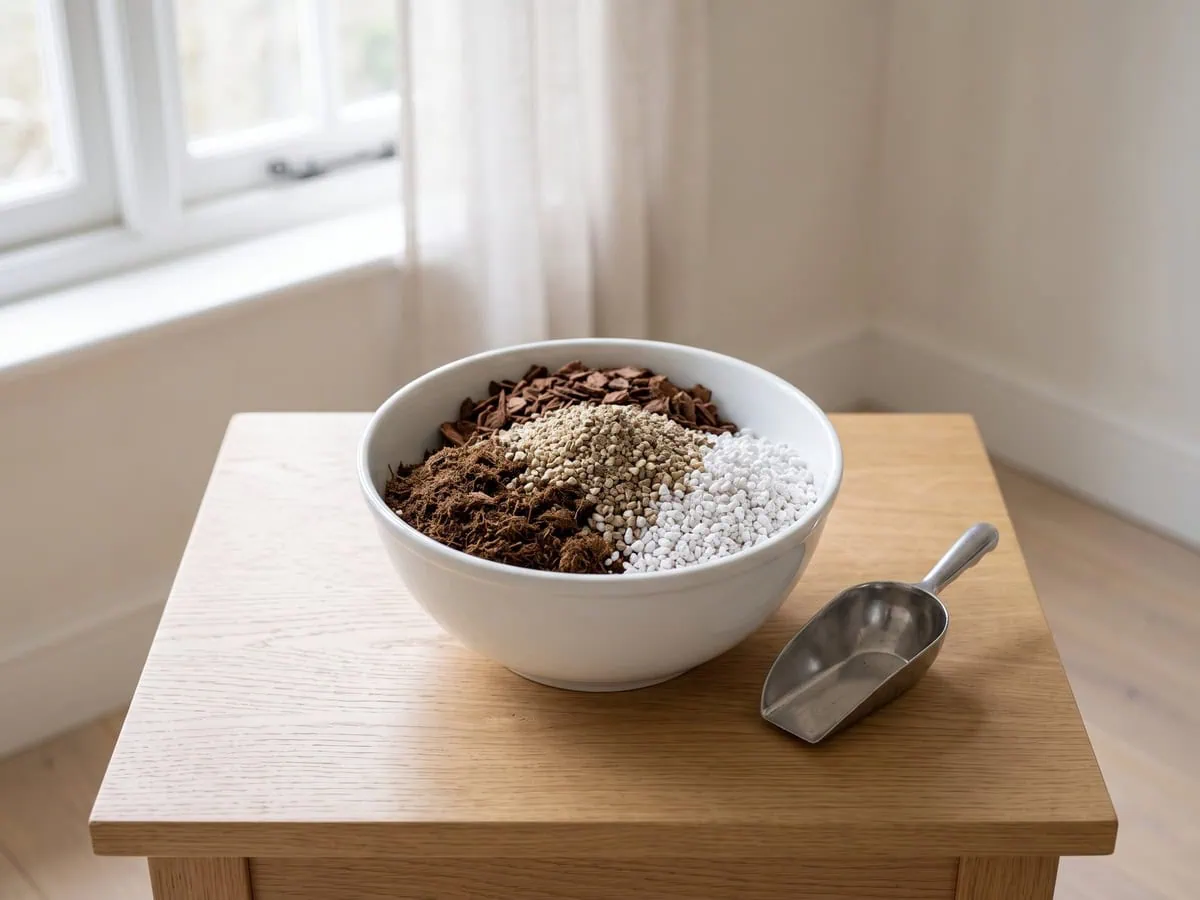
Type “how to make a DIY aroid soil mix for Monstera deliciosa” into a search bar and a dozen ratios come back. Use one. Three scoops bark, three scoops peat or rinsed coir, three scoops perlite, then one thin scoop of grit across the surface.
What each component does in the pot
Bark is the skeleton (it holds the air channels open as everything else settles around it), perlite is the permanent air, and peat or rinsed coir is the water reserve. Rinse the coir first, because unrinsed coir carries salt into a closed pot.
- Hemiepiphyte: a plant that starts in the ground and then climbs a tree, so its roots spend years on open bark rather than buried in soil.
- Aeration: the share of a potting mix that is air rather than solid or water.
Those two words explain the recipe. This plant is a climbing hemiepiphyte, so its roots evolved against bark, not inside a dense bed of fine particles. The mix copies the bark, and every component in it is structure, air or reserve.
- One mixing bowl: big enough to turn the batch over twice without spilling.
- One dry scoop: any repeatable measure, since the recipe is by volume.
- The mix itself: a chunky aroid mix of equal parts fine pine bark, sphagnum peat and perlite, top-dressed with a thin layer of coarse horticultural grit.
Why bark stays in the mix
Type “does a Monstera deliciosa need chunky bark in its soil” into a search bar and the answer is that something has to do bark’s job. Perlite floats to the top over a season and peat packs down (bark keeps the two apart). Skip it and you are soon matching the watering interval to an open mix that isn’t.
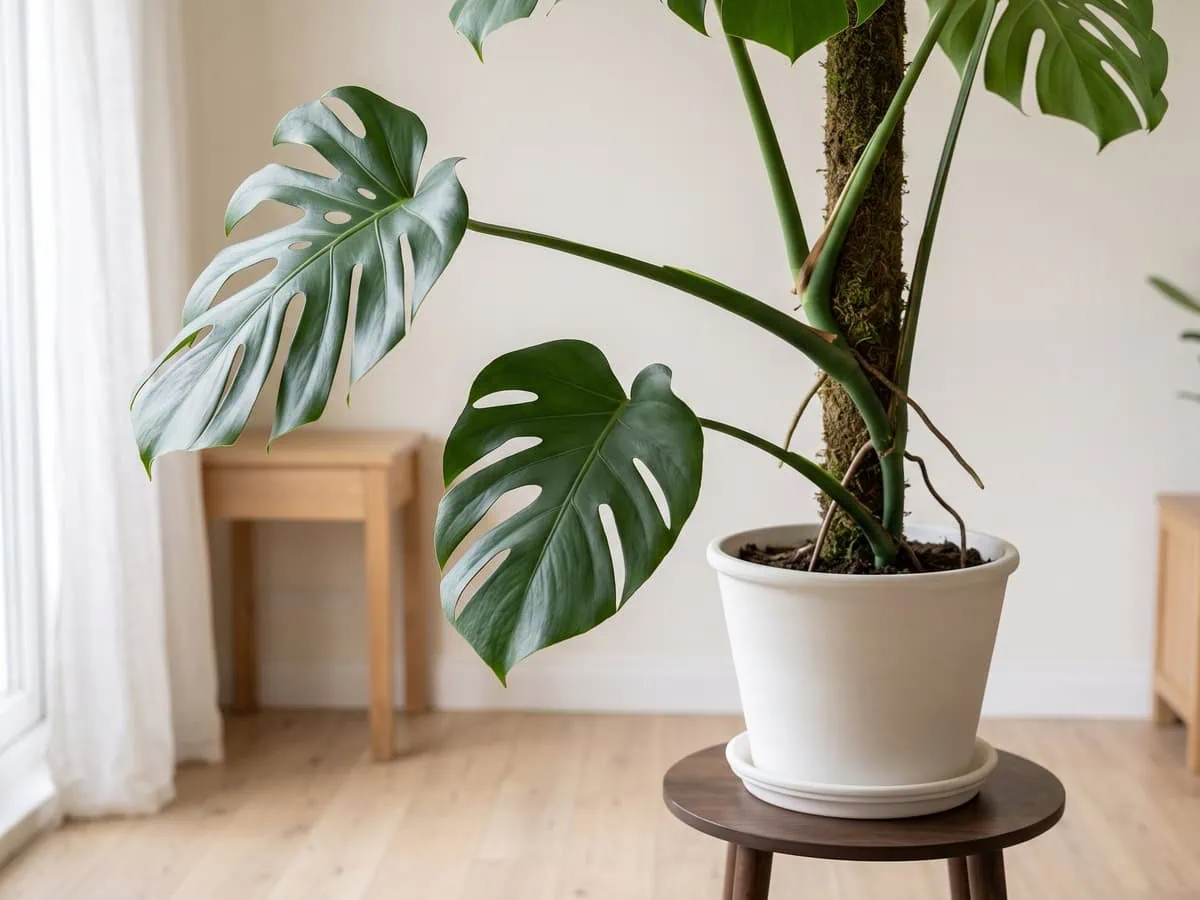
You see the loss before you feel it. Within a week or two of the mix packing down, the newest leaf opens at a flatter angle than the one below it, and the stem leans off the pole instead of gripping it — movement, not color, is the first tell.
Substrate pH, and when testing is worth it
Keep the mix slightly acidic and stop worrying about it. A peat or coir base lands in that band on its own, so a test kit earns its place only when something else has gone wrong — a plant fed hard for a year, or a supply leaving white crust on the grit.
Tap the button below to get more plant fixes in your Google Search results

Reading the medium: density, air space and drainage
A mix is too dense when a damp handful holds its shape instead of falling apart. Density is the whole question here. Next come three checks — the squeeze, the days to dry, and the pot.
The squeeze test on a damp handful
Type “what makes soil too dense for a Monstera deliciosa” into a search bar and you get adjectives. Do this instead: wet a handful, close your fist, open it, and read what is left in your palm. A ball that keeps its shape is too dense (four pots taught me that); crumbs are right.
Days to dry, and the particle size you should see
Two useful numbers here come from general care guides rather than published data on this species. Read them as rules of thumb. A full watering should leave the pot dry again within five to seven days (a statement about how the medium behaves, not a watering schedule).
Particle size matters too. Coarse pieces should look roughly a quarter to five-eighths of an inch across.
Nobody publishes an air-filled porosity figure for a mix like this. That is the honest gap. I’m honestly not sure why this works — but it does: the squeeze and the drying time together track the property that number would have measured.
If the handful crumbles and the pot feels light within a week, then the medium is still doing its job. However, if the handful holds its shape and the pot stays heavy, then the pore space has gone and the mix needs replacing rather than more time.
Drainage holes, container walls and drying rate
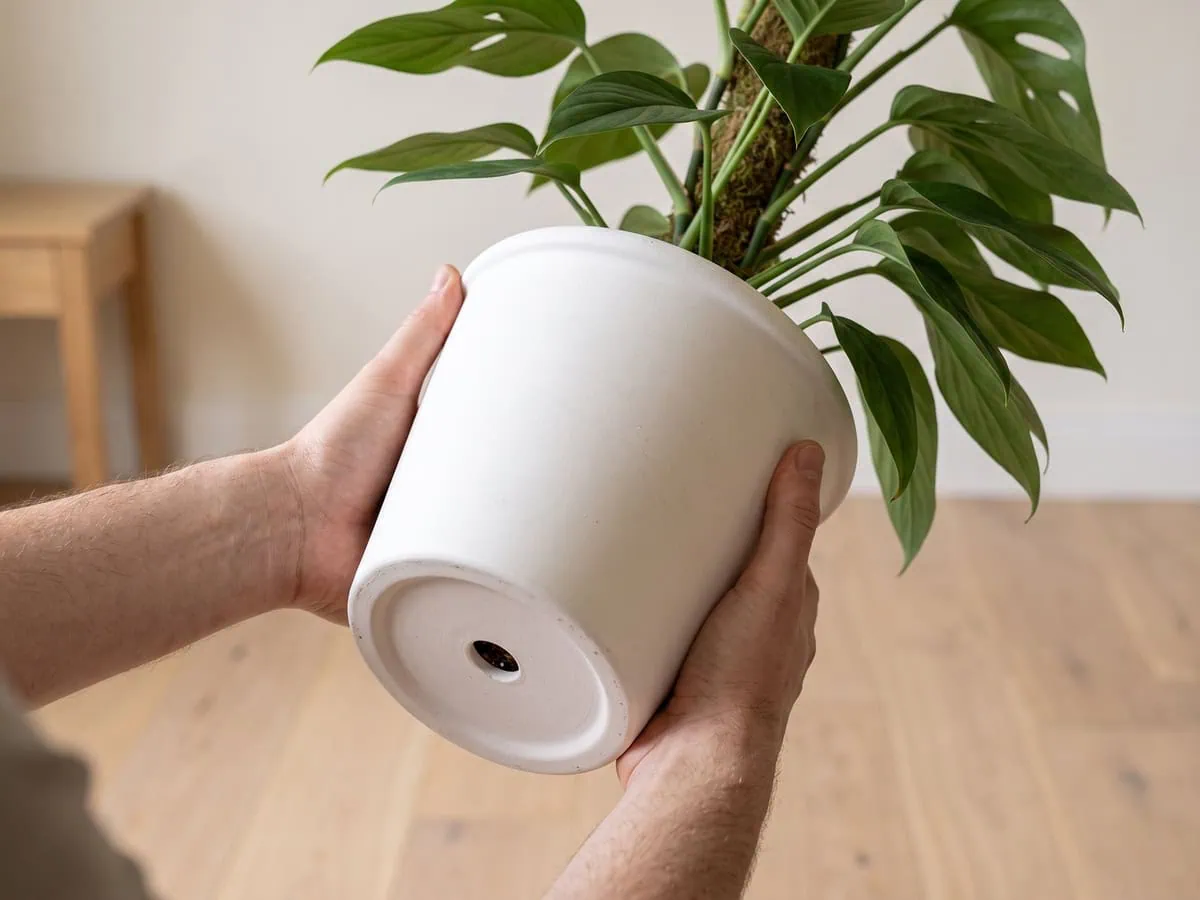
One question has a settled answer: “does a Monstera deliciosa need a pot with drainage holes”. The answer is yes. No medium compensates for a sealed container, and an unglazed wall dries the same mix faster than a glazed one (which is why one recipe behaves differently in two pots).
Get that combination wrong for long enough and you end up reading what to do when the root zone has already collapsed.
When a mix is spent, and what to do with it
A spent mix looks uniform. The bark edges have gone soft and dark, the grit has sunk out of sight, and the surface stays wet for days after a watering. The plant reports it first — new leaves come in smaller than the last, and the stem drifts away from its pole.
Replace it.
Bagged mix, gritty mix or a home blend
Cutting a bagged mix is the route most readers should take, because it reaches an open structure with one bowl. Next, the three routes are weighed in turn.
| Behavior compared | Bagged mix, cut | Purely mineral | Home-blended mix |
|---|---|---|---|
| Drying rate | Moderate once cut | Fastest of the three | Set by the bark share |
| Air space after settling | Holds if the cut is coarse | Stays open | Stays open longest |
| Particle breakdown | Fine base collapses first | Almost none | Bark softens over two years |
| Wetting after a dry-out | Rewets readily | Water runs through | Coarse blends can shed water |
| Hand-mixing asked | One cut, one bowl | None, bought ready | Several parts to measure |
Verdict: Choose the cut bagged mix for a first plant, because it reaches open structure with one bowl.
The instruction to pot this plant in a dense, rich medium with no bark still circulates online. It is the inverse: bark and perlite hold the air channels open once the fine base settles.
Cutting a bagged mix with perlite and bark
Cut the bag one to one. One part bagged mix, one part coarse bark and perlite, turned until separate particle sizes stay visible rather than one uniform texture (that visible mix of sizes is the stopping point).
And the medium your plant arrived in was never chosen for your room. A nursery pots for mass production, so that medium is dense and peat-based (only one care guide raises this). Plan the change within the first month.
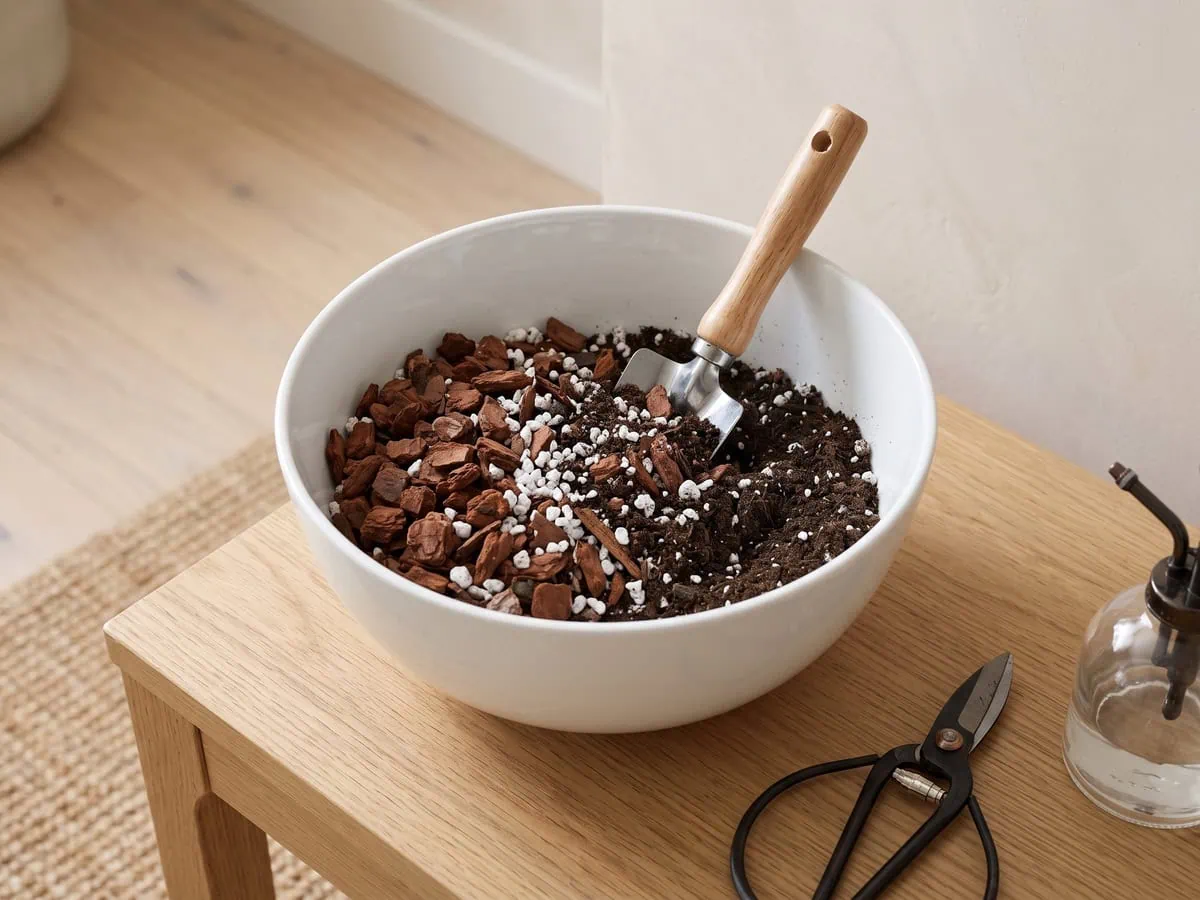
I keep a scoop of every batch aside for a week. The perlite drifts upward as the bowl turns, the coarse bark rides up with it, and the fine base settles out underneath. That separation is the test.
Where a purely mineral mix falls short here
Readers phrase it as “is gritty mix good for a Monstera deliciosa“, and the guides do not take the formulation up. The biology answers it anyway. A purely mineral blend holds its air space, but it carries no water reserve, and this species has no water-storage organ.
So the fix is not to abandon the mineral idea. Rinsed coir or chunk peat moss returns the water-holding third that bark and perlite cannot supply, and that third is what keeps the pot from going bone-dry days before you next reach for the watering can.
Expanded clay: a different route, not an upgrade
Expanded clay pebbles are a different route, not a better one. Semi-hydro culture is described at genus level rather than for this species, so read any semi-hydro instruction as a genus-wide starting point and watch this plant’s own roots. It removes the guesswork about when the medium is wet (and hands you nutrients and acidity to manage yourself).
But the route you pick changes the surface, not the rule. A base that stays wet on top is where you meet the small flies that breed in a wet surface layer; a coarse blend sheds water instead, where wetting agents earn their place.
Frequently asked questions about Monstera deliciosa soil
What soil is best for repotting Monstera?
A chunky aroid mix is best at repotting: equal parts fine pine bark, sphagnum peat and perlite, top-dressed with coarse horticultural grit. It keeps air channels open around roots that evolved on bark.
Whatever mix you use, the container needs a drainage hole. A sealed decorative pot works only as an outer sleeve around a holed inner pot, emptied after watering.
Can I use regular potting soil for my Monstera?
Regular potting soil works only after you cut it one to one with coarse bark and perlite. Straight from the bag it settles, and the large air-holding pores close.
The failure is slow rather than dramatic. Roots that cannot reach oxygen decline quietly while the leaves still look fine, which is why the medium is worth fixing before anything looks wrong.
What soil does the garden center use for Monstera?
Nurseries pot into a dense peat-based production medium chosen for mass growing, not for a home. It waters evenly under overhead irrigation.
One care guide raises this and the rest are silent, so read it as a lead rather than a settled fact. Slide the plant out, look at the root ball, and plan a change of medium within the first month.
Can I make my own Monstera soil mix at home?
Yes. Equal parts fine pine bark, sphagnum peat and perlite, measured by volume in one bowl, gives the same medium at any quantity.
Home blends run coarser than bagged products, so water them slowly or from below; poured fast, water can run between the coarse particles without wetting them. Rinse coir first if you use it in place of peat.
Prove it yourself: the squeeze test
No laboratory reading is needed here. Wet a handful, squeeze, and open your hand: crumbs mean the mix works, and a ball that keeps its shape means the pore space has gone.
Then watch the new leaves unfurl. Wider than the last means it worked. And when the pot runs short of room, the signals that a container has been outgrown come next.
One squeeze answers what is the best soil for a Monstera deliciosa. A chunky mix is a wear part, not a purchase — refresh it before it packs down, and your Monstera keeps breathing at the root.
Tap the button below to get more plant fixes in your Google Search results