🚨 Emergency 30-Second Answer: curling and drooping Pothos leaves
One hydraulic fault produces both faces of this. Epipremnum aureum, a member of the Araceae family, loses leaf pressure whether its roots sit bone dry or drowning. Read the medium 2 inches down. The question “why is my Pothos curling and drooping” has two opposite answers, and the blade reports neither.
Read the medium instead. Dry mix and a light pot mean thirst; damp mix and a heavy pot mean the roots are drowning.
A thirsty plant firms within a few hours and stands upright by the next morning; a waterlogged one does not.
- Humidity: 50 to 70 percent preferred; heated rooms run 10 to 30 percent
- Pot weight: lift it — feather-light means thirst, brick-heavy means saturation
- Feeding: half strength every two weeks, and flush when salt crusts
- Cold air: chilling starts near 55F; slide it off vents and sills
- New growth: small, deformed young leaves point to root supply, not humidity
The leaf edges had rolled toward the midrib like paper lifting off a hot pan, the whole vine hung slack over the pot rim, and every instinct said the plant wanted a drink. Squeezed between finger and thumb, the blade felt cool and slack rather than crisp. The mix underneath was wet.
Stomata shut either way, and I have watched that same picture on bone-dry mix and on a pot standing in mud. Instead of reading the leaf, I realized the leaf reports pressure, not direction.
A Pothos blade holds its shape on turgor pressure, the internal water pressure that stiffens each cell wall, and that pressure drops whether the roots sit bone dry or drowning. Same sign, opposite cause.
The fix therefore opens with a reading, not a pour. If you want the wider picture behind that habit, start with keeping an indoor Pothos steady year-round.
Nothing on this page asks you to guess. Every number the reading calls for is gathered a few lines down, before you start sorting one fault from the other.
Why is my Pothos curling and drooping? The at-a-glance read
| Pothos specs | The reading |
|---|---|
| Probe depth for the curl-and-droop read | 2 inches |
| Dry-side rebound after a thorough soak | Firms within a few hours, upright by next morning |
| Comfortable room band | 70-85F days, 60-70F nights |
| Post-repot settling droop | Roughly 2-4 weeks, then it should ease |
| Heat-driven curl direction | Downward at the leaf tips |
| Does a droop in damp medium mean it needs more water? | No |
| Do already-curled leaves flatten out again once the cause is fixed? | No |
Tap the button below to get more plant fixes in your Google Search results

Table of Contents
Read the medium before you act: the 2-inch check
The medium, not the leaf, decides which fault you are looking at, so put the watering can down until you have read it 2 inches down. Watering a saturated pot is the one action that turns a recoverable droop into root rot.
Read it in order below: depth first, then weight, then the physiology underneath both.
Two inches down, then lift the pot
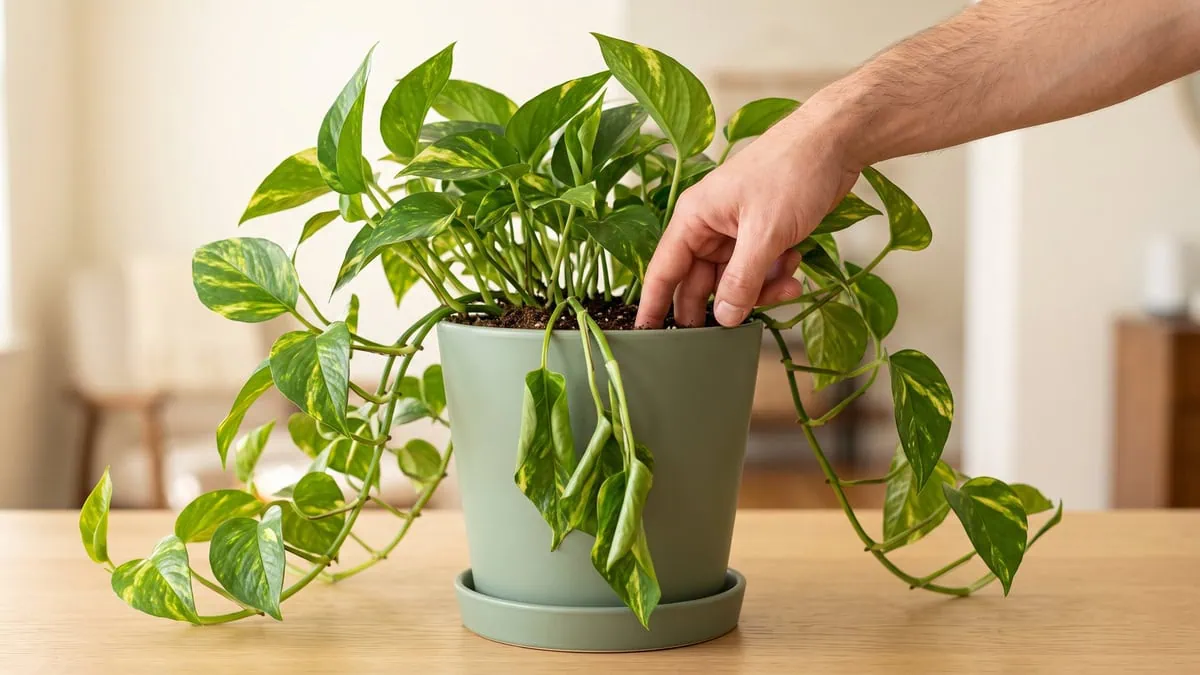
Push a finger straight down to the second knuckle, a full 2 inches, no less than that, because a shallower reading answers when to water, not which fault you have. Then lift the pot.
A dry pot comes up feather-light and shifts in the hand as you raise it; a saturated one is dead weight and barely moves against the palm at all.
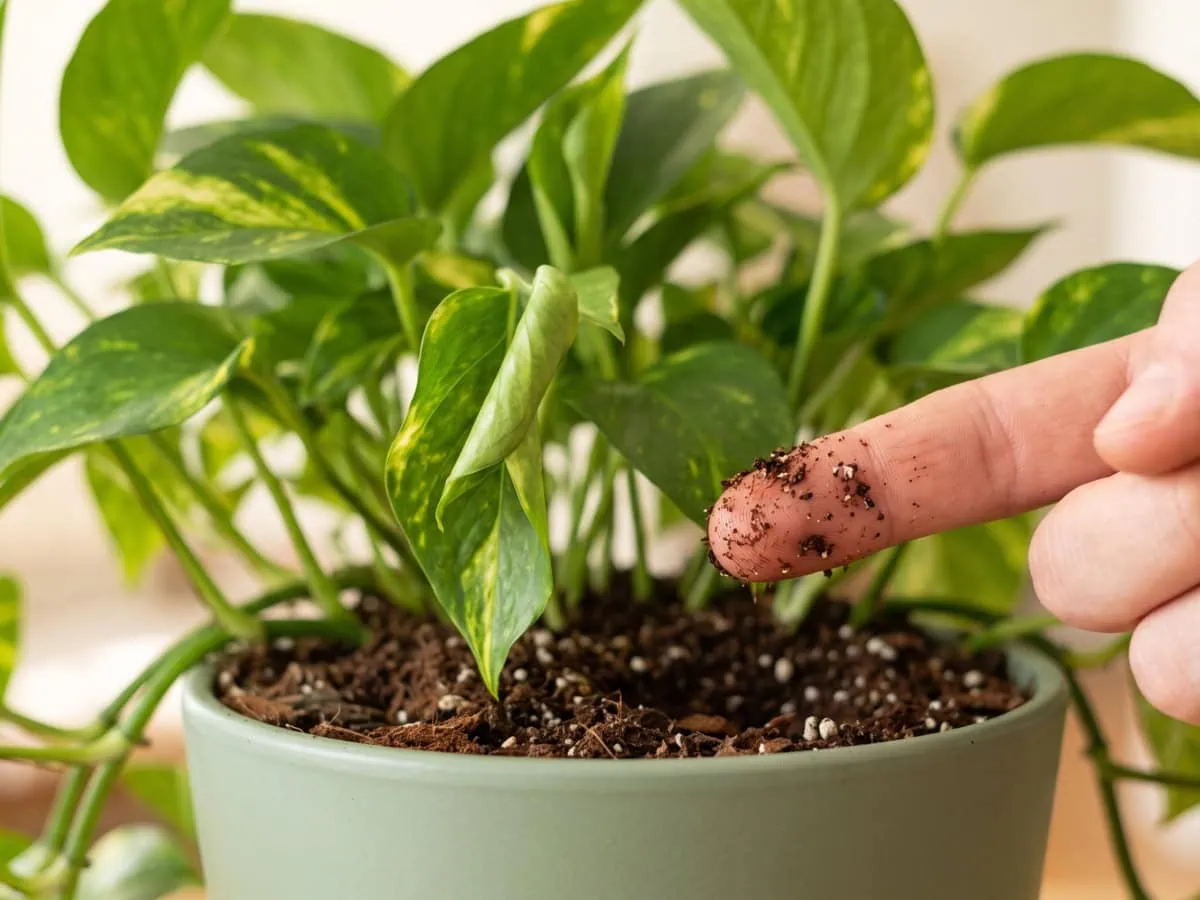
Put “why are my pothos leaves drooping and soft” to a search engine and you get watering schedules. What you actually need is how long to wait between waterings, measured from this reading.
Damp but not soggy: the middle reading
Most of the plants I am asked about land in neither camp: the mix reads damp, the pot is neither light nor heavy, and nothing smells sour. Do not water yet. Probe again at the same depth once the surface has dried back.
If the 2-inch mark has dried by then, the pot drains and the fault was thirst. If it reads exactly as damp as before, water is not moving through, and what mushy, blackened roots actually look like is the next reading to take.
And searchers typing “why are my pothos leaves curling inward” usually sit in this middle band. The inward roll is the plant closing its stomata, the microscopic leaf pores, to save what water it has.
Why both extremes end in one limp leaf
A leaf stands up because water pressure inside its cells pushes outward against the cell walls; drop that pressure and the whole structure sags. Epipremnum aureum shares the Araceae family’s aerial-rooting climbing habit but keeps no water-storage organ, so nothing is held in reserve when supply fails. Dry mix starves that pressure from the supply end.
Saturated mix starves it from the other direction: with nothing left down there to breathe, root tissue dies, and dead roots move no water at all no matter how much the pot is holding. Same collapse, opposite road.
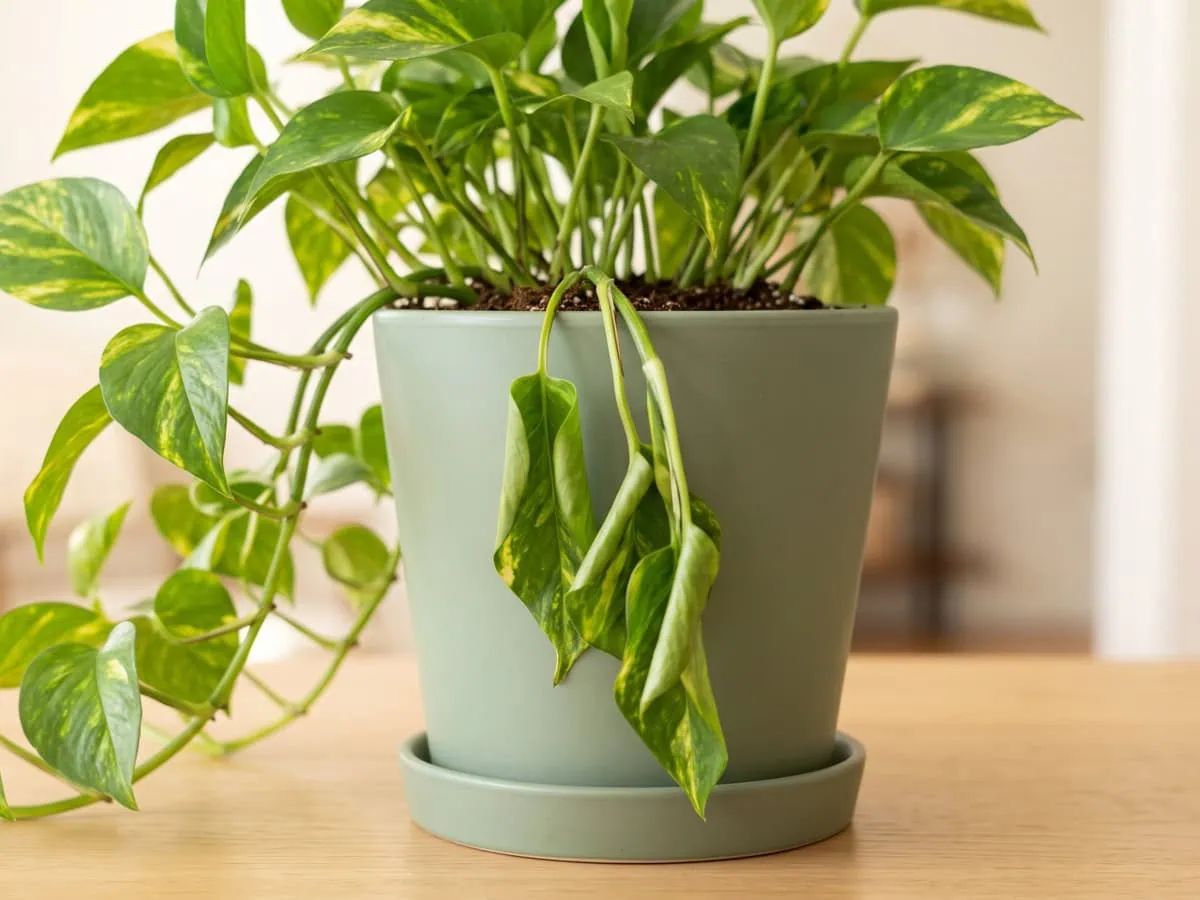
So a query like “why is my pothos limp and wilting” has no single answer. The leaf reports a failure, never its direction.
Tap the button below to get more plant fixes in your Google Search results

What the leaf tells you when water is not the cause
Three faults besides water curl a Pothos leaf. Dry air first, then heat and drafts, then feeding.
Curl direction can also be a light reading rather than a water one, which is a separate check: what too little light does to this vine.
Sap-feeding insects deform a leaf too, and they leave cottony white masses wedged into the leaf axils.
Check the undersides before you blame the water, because sap-feeding insects on the leaf undersides curl new growth first.
One fault stays hidden below the soil line.
When the medium stays airless, root tissue fails and uptake stops; the Clemson Cooperative Extension Home and Garden Information Center names soils with little to no oxygen as the condition that invites soil-borne pathogens.
Dry air, and the humidity number to read
Epipremnum aureum, still labeled Scindapsus aureus on older tags, prefers 50 to 70 percent relative humidity, and a heated room in the cold months routinely reads 10 to 30 percent.
So the answer to “do pothos leaves curl from low humidity” is yes, but the tell is the mix: a humidity curl shows up while the medium still holds moisture at 2 inches. Read the room first.
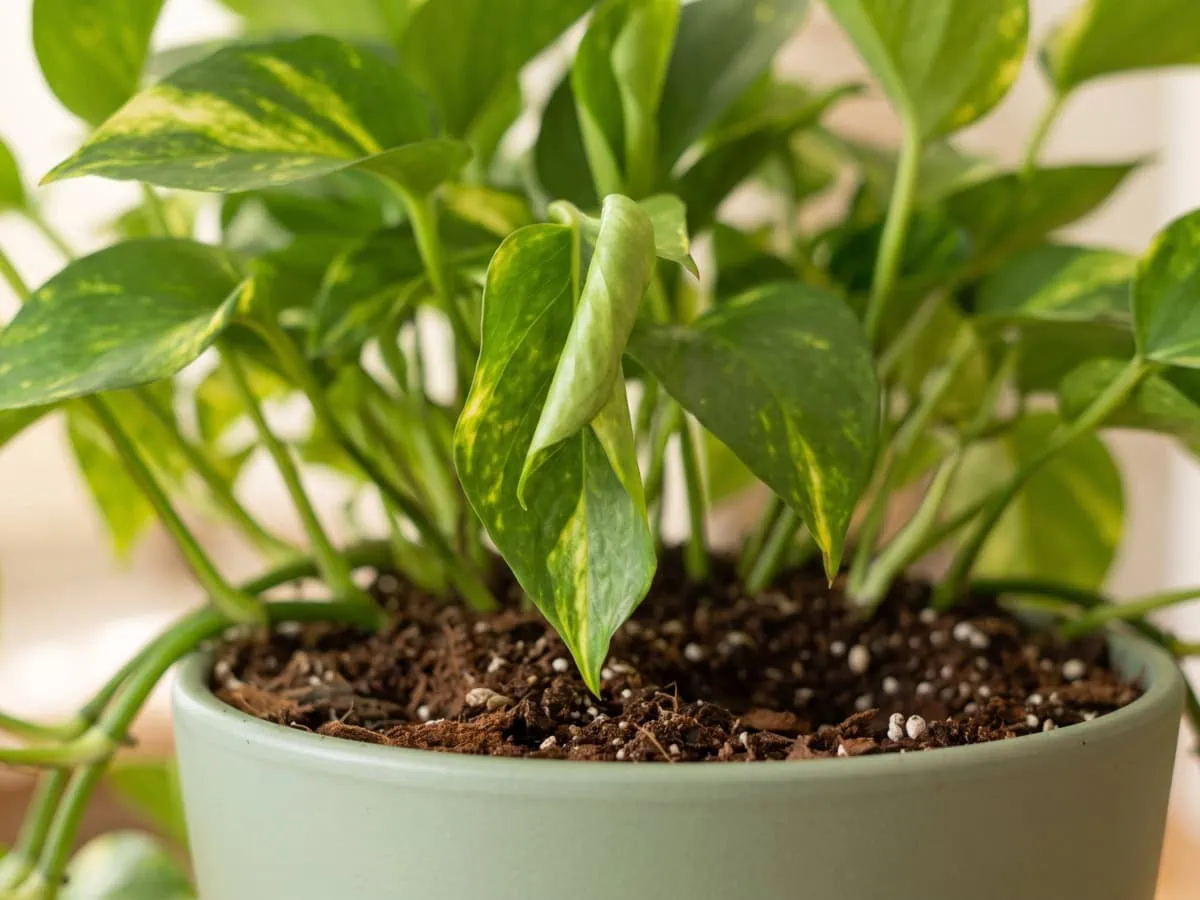
Dry-air damage sounds different: a stressed leaf snaps with a dry, papery crack when you fold the margin, while a thirsty one folds silently.
Heat, drafts and the day-night temperature band
Hold the room at 70-85F through the day and 60-70F at night, and heat stops being the suspect. Above that band, the curl runs downward at the leaf tips rather than inward at the margins.
A draft is a separate exposure from room average, and this is where I see most readers get caught: a thermometer on the far wall can read a comfortable 72F while a vent pushes a cold stream across one side of the plant all day. Chilling damage starts near 55F, above freezing.
Downward tip curl from too much feeding
Excess feeding curls the tips downward and shrinks the new leaves, and the confirming sign is not on the leaf at all: a white to gray crust on the mix surface or around the pot rim.
Flush it out. Pour plain water through until it runs from the drainage hole, wait 2 to 3 hours, and repeat with a full pot volume. Feed at half strength every two weeks once new growth restarts.
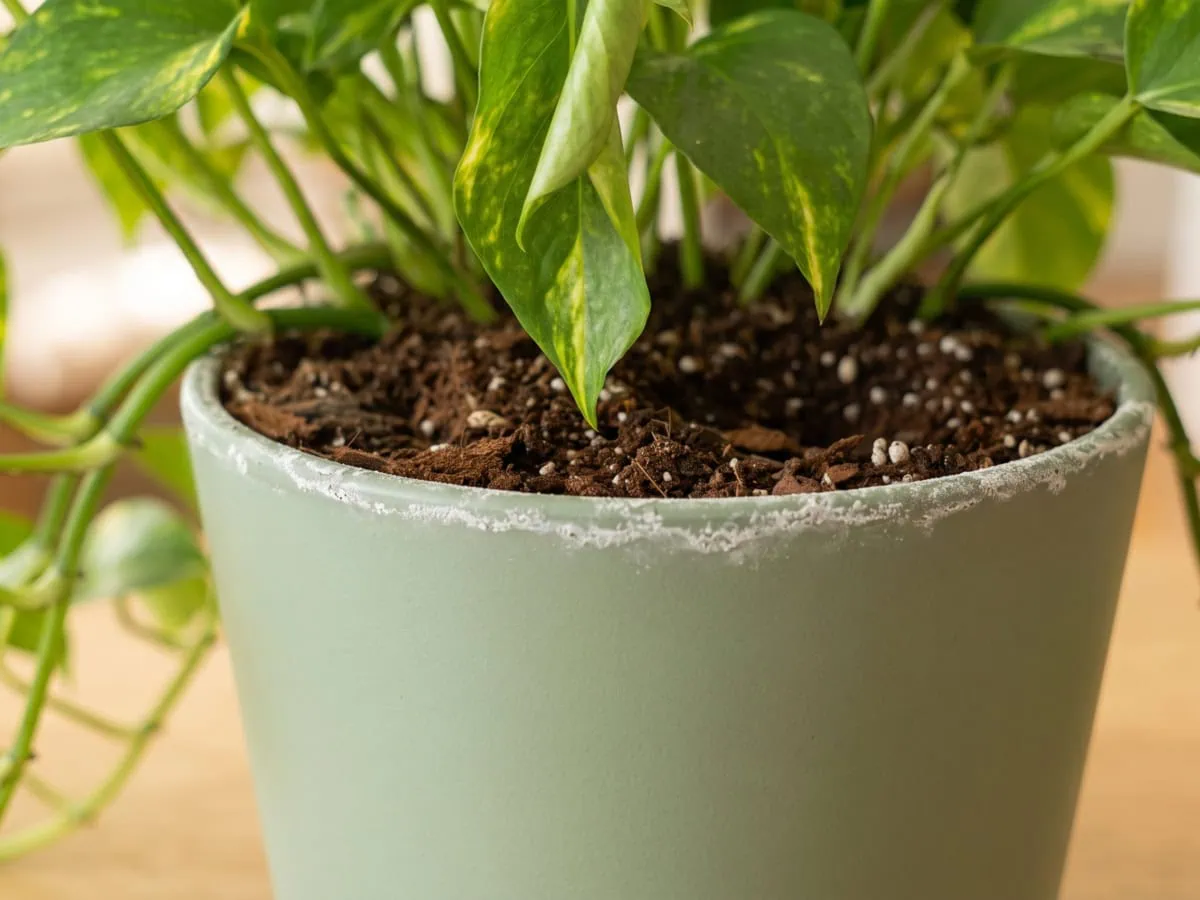
The leaves already curled will stay curled — that damage does not reverse, and the honest measure of success is what the next leaf looks like.
Common mistakes that make a drooping Pothos worse
What makes a drooping Pothos worse comes down to three reflexes, and they run in order below. Each one is easy to undo, and each one is common.
Misting will not unroll a curled leaf
Misting a curled leaf does nothing to unroll it, and the reason is a plumbing one: the water lands on the wrong side of the plant entirely. A blade rolls because internal pressure has dropped, and that pressure is refilled through the root, never through the cuticle.
Wet the outside of a leaf and nothing about the supply line feeding it has changed. Group your plants instead.
Standing the pot on pebbles above a shallow reservoir works as well. Neither move shifts a large open room much, but both hold on a shelf.
Reading the water verdict from the leaf alone
The most damaging habit I see in this whole symptom family is assigning a water verdict from the leaf. A drooping, wilted plant is not evidence for either direction, and acting on that guess waters a pot that is already saturated.
Take the readings in order.
- Medium first, at 2 inches.
- Then pot weight, lifted in the hand.
- Then the smell at the drainage hole — a sour, swampy note means the roots have been sitting wet, and a squelch when you press the surface says the same thing out loud.
Small new leaves and post-repot droop
Searches for “why are my new pothos leaves small and deformed” almost always land on feeding advice, but small or deformed new growth points to a root-supply or light limit.
Feeding harder does not fix that, and it only loads the pot with salt on top of it. But a plant recently moved into a bigger pot gets a pass: settling droop after moving a rootbound vine into a slightly larger container runs roughly 2 to 4 weeks and eases on its own.
Past four weeks with no change, the settling explanation has run out and the fault is elsewhere. Read it again.
Frequently asked questions about a curling, drooping Pothos
With the reading done, these are the ones that keep coming back.
How to fix a droopy pothos?
Probe the mix at 2 inches before you do anything else. A dry reading with a light pot means water thoroughly until it drains, and the plant should firm within a few hours. A damp reading with a heavy pot means the opposite: stop watering and let the top 2 inches dry.
Pressure returns through the roots, never through the leaf.
How long does it take for pothos to recover from transplant shock?
The settling droop eases on its own in roughly two to four weeks. The plant is rebuilding fine root hairs disturbed in the move, so it cannot pull water at full rate. Past four weeks with no improvement, stop calling it shock and take the 2-inch reading again.
Keep the mix damp rather than wet, and hold the fertilizer for now.
Why is my pothos droopy and curling?
The leaf has lost internal water pressure, and both too little and too much water produce that same loss. Dry mix starves the supply; saturated mix suffocates the roots so they stop moving water at all. Less often the cause sits outside water: dry air, a cold draft, or a salt load.
The leaf reports the failure and never its direction.
How to perk up a pothos?
Water thoroughly only after the 2-inch reading comes back dry, then wait. A genuinely thirsty Epipremnum aureum firms within a few hours and stands upright by the next morning. If it is still slack the following day, water was not the problem and more water will make it worse.
Check the room band at 70-85F and move the pot off any vent path.
Will wilted pothos come back?
Yes, if the roots are still firm and white. A wilt driven by thirst reverses within hours of a thorough soak and looks normal by the next morning.
A wilt driven by saturation reverses only where living root tissue remains, and recovery there runs in days rather than hours, usually with some leaf loss. Leaves that already curled will not flatten out again.
How to recover overwatered pothos?
Stop watering and get air back to the roots. Move the pot out of any saucer, set it in bright indirect light, and let the mix dry to 2 inches. If the surface smells sour or a squelch answers your thumb, root tissue has already failed, and the next reading is at the roots rather than the medium.
Recovery then runs in days, with some leaf loss.
Prove it yourself: the 2-inch test
You do not need a meter to settle this. After years of taking this measure on plants that looked identical from across a room, the fingertip and the lift have never disagreed with what the medium was holding.
Cadence is what comes after it. Two inches, one lift. That is the entire test.
Answering why is my Pothos curling and drooping begins at your fingertip, not at the blade. Read two inches down before you reach for the watering can, and your Pothos will tell you which fault it has: the thirsty one lifts by morning, the waterlogged one only needs you to stop.
Tap the button below to get more plant fixes in your Google Search results