🛠️ Quick Prep Summary: training a Pothos on a moss pole
Pothos (Epipremnum aureum, formerly Scindapsus aureus), a member of the Araceae family, climbs by root attachment. Learning how to train a Pothos on a moss pole takes twenty to forty minutes of setup. Settle three things first. Node contact decides the outcome, not tie tension.
- A pole taller than your longest vine — measure the vine you have, not the pot it sits in
- Soft ties — they hold the vine in contact without pinching the stem
- Timing: check the drainage hole first — roots showing means wait for the repot
Every aerial root on that tied vine still stood clear of the damp moss substrate, curled over like a small gray hook that had missed its mark entirely. Vine after vine went onto poles in my own testing, and the first few never gripped, every one of them. Every one of them tied correctly.
Rewind a second. I had been blaming the moss, the tie material, the room.
A vine that slides down the pole reads as a tie that failed. It is an orientation failure instead: this species puts one short adventitious root — one that grows straight out of the stem — at every node, and a root facing open air never makes contact.
So turn the node inward, keep the moss damp, and the vine that has been ignoring the pole starts fixing itself to it. For the wider routine this sits inside, read what a climbing plant still needs down at the pot.
Nothing here is delicate work. Everything worth deciding before the pole goes into the pot is settled in the specs that come next.
How to train a Pothos on a moss pole: quick prep specs
| Pothos specs | Setup detail |
|---|---|
| Difficulty level | Low (Beginner) |
| Time needed | 20-40 minutes |
| Support type | Moisture-holding moss or coir totem |
| Best install moment | At repotting, or before the root ball is crowded |
| Pole moisture target | Damp through, no runoff into the mix |
| Extendable support required? | Yes |
| Ties removable once bonded? | Yes |
Tap the button below to get more plant fixes in your Google Search results

Table of Contents
Before the pole goes in: what to check and what to expect
Before a pole goes in, settle four things: support material, pole height, install moment, and what a bigger leaf actually depends on. That is the sequence below, and it does not reorder well.
A climbing Pothos is not a true epiphyte. It is a soil-rooted climber that keeps its ground connection while it climbs.
Araceae climbers grip with roots, not tendrils. One short aerial root sits at every stem node, pointing down and out.
Take this with a grain of salt — the sources describe what those roots do on contact, not how many days a node needs to commit.
Moss pole, coir pole, trellis or bare stake
Only a damp, rough, penetrable surface earns an aerial root. According to Clemson Cooperative Extension, this vine is commonly grown up totem posts that give climbing aroids a place to attach and for support.
| Support | What an aerial root can do with it |
|---|---|
| Sphagnum moss totem | Grips, then grows into the damp medium |
| Coir totem | Grips the texture; runs drier than moss |
| Trellis | Holds a tied vine; little surface to grip |
| Bare stake | Smooth and dry; nothing to root into |
Verdict: Choose a moisture-holding moss totem, because it is the only surface here that aerial roots root into rather than merely lean on.
Pole height and thickness for your vine length
Size the pole against the vine you already have. Indoor vines run 6 to 8 feet of stem over a 3 to 6 foot spread. A standard ceiling caps the climb long before the plant runs out of ambition.
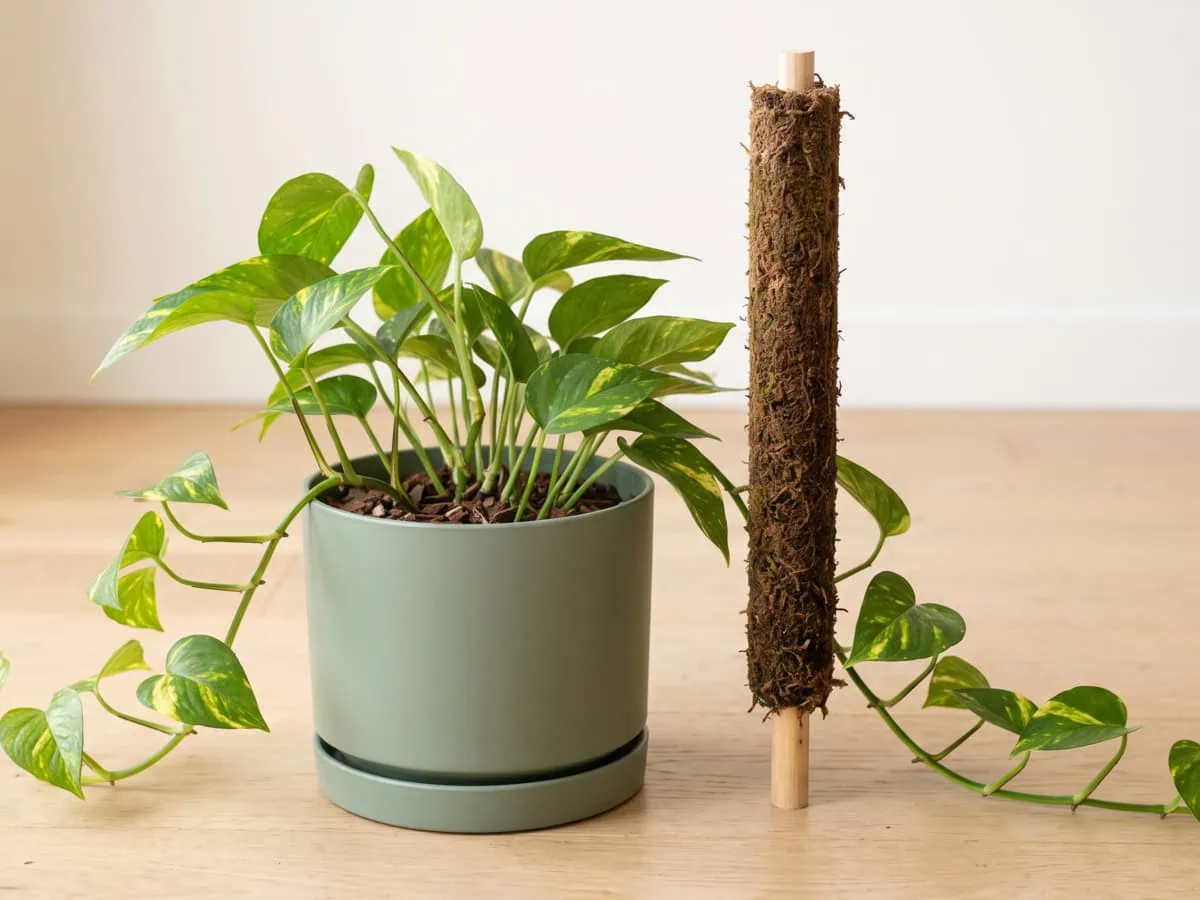
Pick a totem a little taller than your longest current vine. Then plan to add a section. Surface beats girth: in my testing, a slim totem with damp moss beat a fat dry one every time.
Root density decides install timing
Root density decides the timing, not the calendar. A pot that is not yet crowded takes the pole today; a pot already packed with roots waits for the repot rather than being speared.
Read it from outside: roots at the drainage hole, water racing straight through, or a plant that wilts soon after watering all say the root ball has gone solid. Do the job then, while stepping it up one pot size without breaking the root ball.
Larger leaves: what a pole can and cannot change
Support changes what the next leaves can do. Light decides whether they get bigger. The “does a pothos grow bigger leaves on a moss pole” question turns on both, and the gain is real but forward-looking.
Leaves already open stay the size they are. Judge the next flush instead. If it comes in no larger, start with reading whether a room is bright enough for it.
Indoors it holds its juvenile form. A pole buys a bigger juvenile leaf, not the adult one.
Tap the button below to get more plant fixes in your Google Search results

Step-by-step: setting the pole and bonding the Pothos vine
Work in order: seat, moisten, orient, tie, then water. The sequence matters. A dry pole cannot hold a root.
A root facing outward cannot find the pole. Nothing here is optional. Each step below takes a minute or two.
Snapping a vine while you bend it releases sap. That sap carries insoluble calcium oxalate crystals, which irritate skin and eyes. Wear gloves. Rinse skin at once. Keep hands away from your eyes and mouth until you have washed. If a severe skin reaction develops (blistering or intense burning), seek medical attention immediately. For chemical exposure, you can also contact Poison Control (1-800-222-1222 in the US).
Step 1: Seat the pole without spearing roots
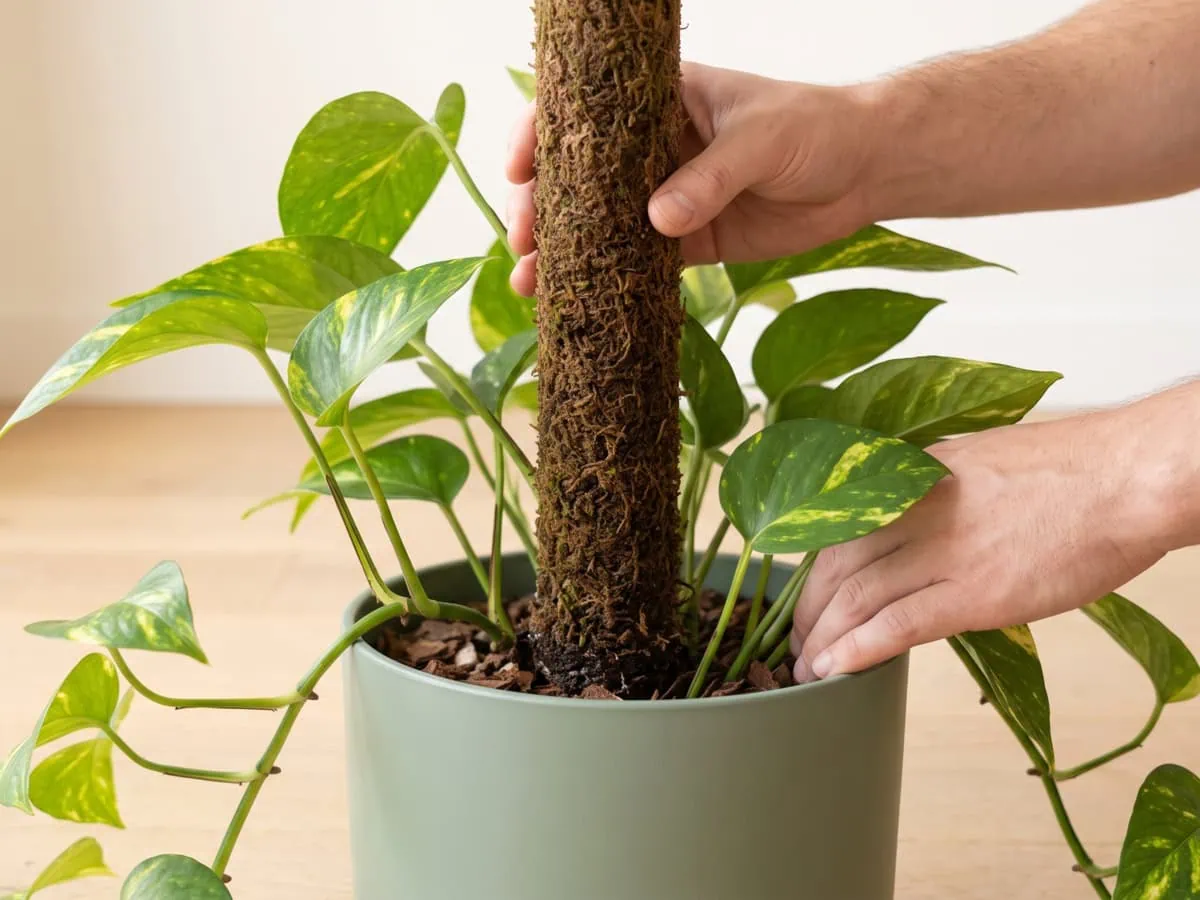
Push the totem down at the back or center of the pot, just behind the main stem. Stop at resistance. Resistance means roots, and forcing through a solid root ball turns a training job into a rescue. If the pot is already packed with roots, wait for the repot and set the pole into fresh mix instead of driving it down through a root mat you cannot see from above. A dark damp ring pushes up around the base as it seats, and a firm push on the top should not rock it.
Step 2: Pre-moisten the moss surface
Soak the totem before the vine ever touches it. Run water through the moss until it is damp all the way through, then squeeze the surface. The moss goes from pale straw to deep brown as it takes water, and a correctly damp surface springs back under a thumb without releasing a drip. Wring it out. A pole that has gone stiff and pale gives a root nothing to enter.
Step 3: Turn nodes and aerial roots to the pole
Nearly every answer to “how to get a pothos to climb a moss pole” stops at wrap-and-tie. Orientation decides it. Look for the small blunt nub opposite the leaf stalk; it sits a shade darker than the green stem around it. Rotate the vine until that nub lies flat against the moss rather than bridging over it, and hold it there with a thumb while you get the tie around the stem. Flush contact beats a hover.
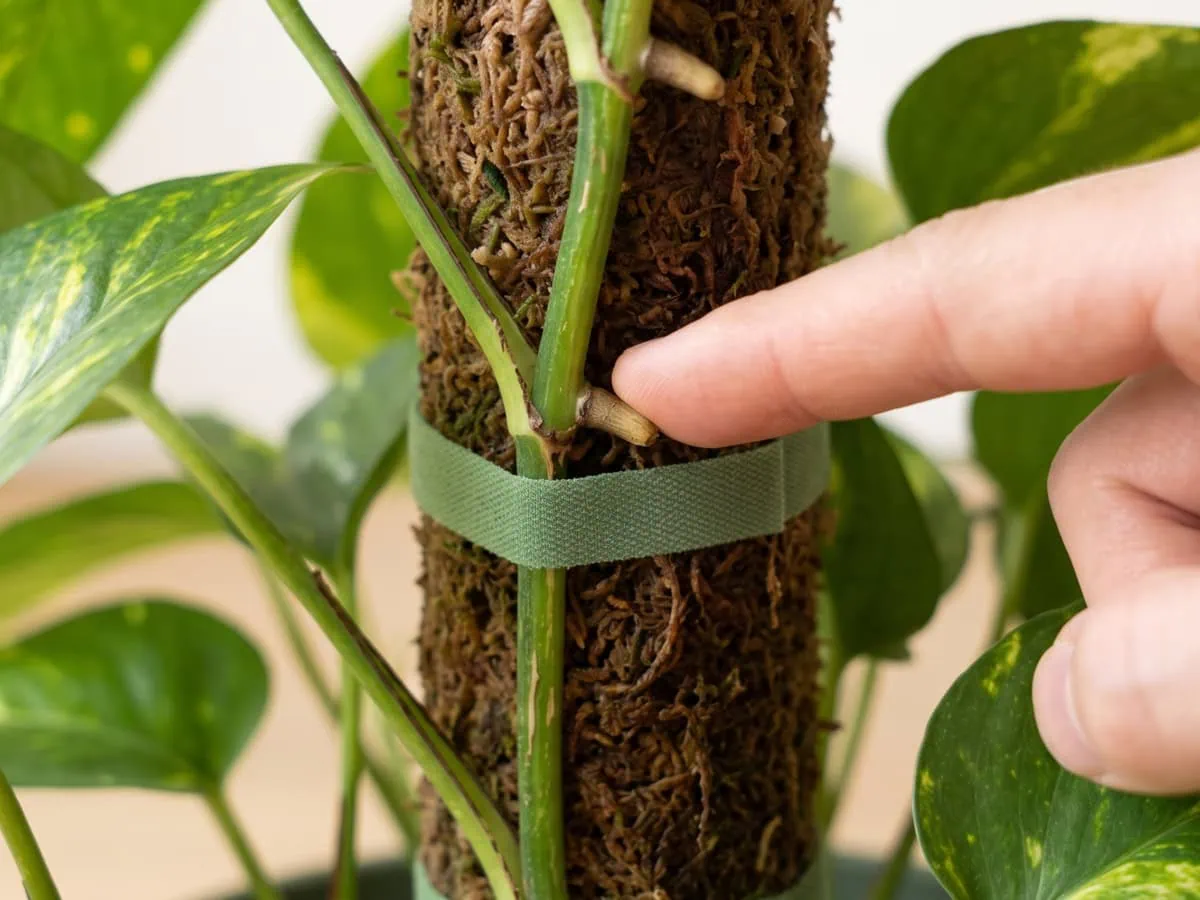
Step 4: Tie with slack, never on the leaf stalk
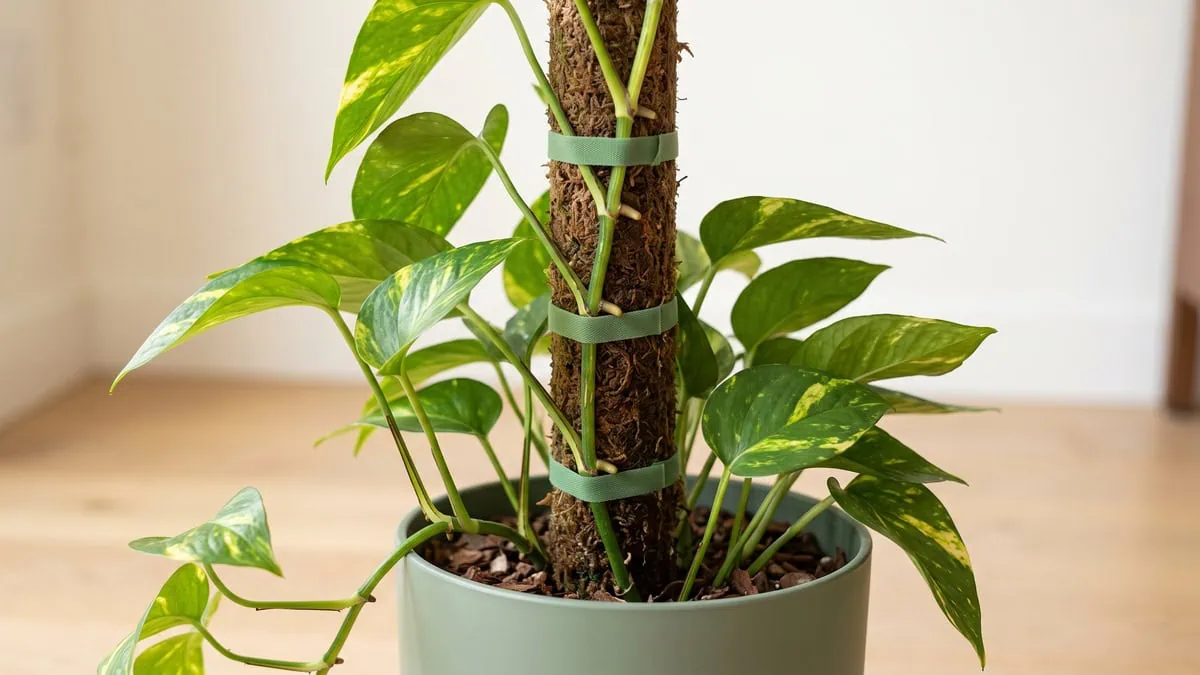
Most guides answering “how to attach pothos vines to a moss pole” stop at the knot. Put the tie on the stem just below a node, never around the leaf stalk and never on the soft new tip. Then leave slack. You should see a clear gap of about a finger’s width between tie and stem, so that the tie holds the node in contact without pressing into green tissue. The tie exists to hold contact, not to hold the vine up.
Step 5: Water the mix and the pole separately
Searchers ask “do you have to keep a moss pole wet for pothos” as though it were a yes-or-no. Read the pole and the pot as two separate readings. Water the mix when the top inch or two has dried, and dampen the pole on its own schedule; if the mix is still wet, wet only the pole. Stop at the first bead. Water running down the shaft keeps the zone at the pole base wet and airless, and a root left sitting there is where roots that have turned soft and dark begin.
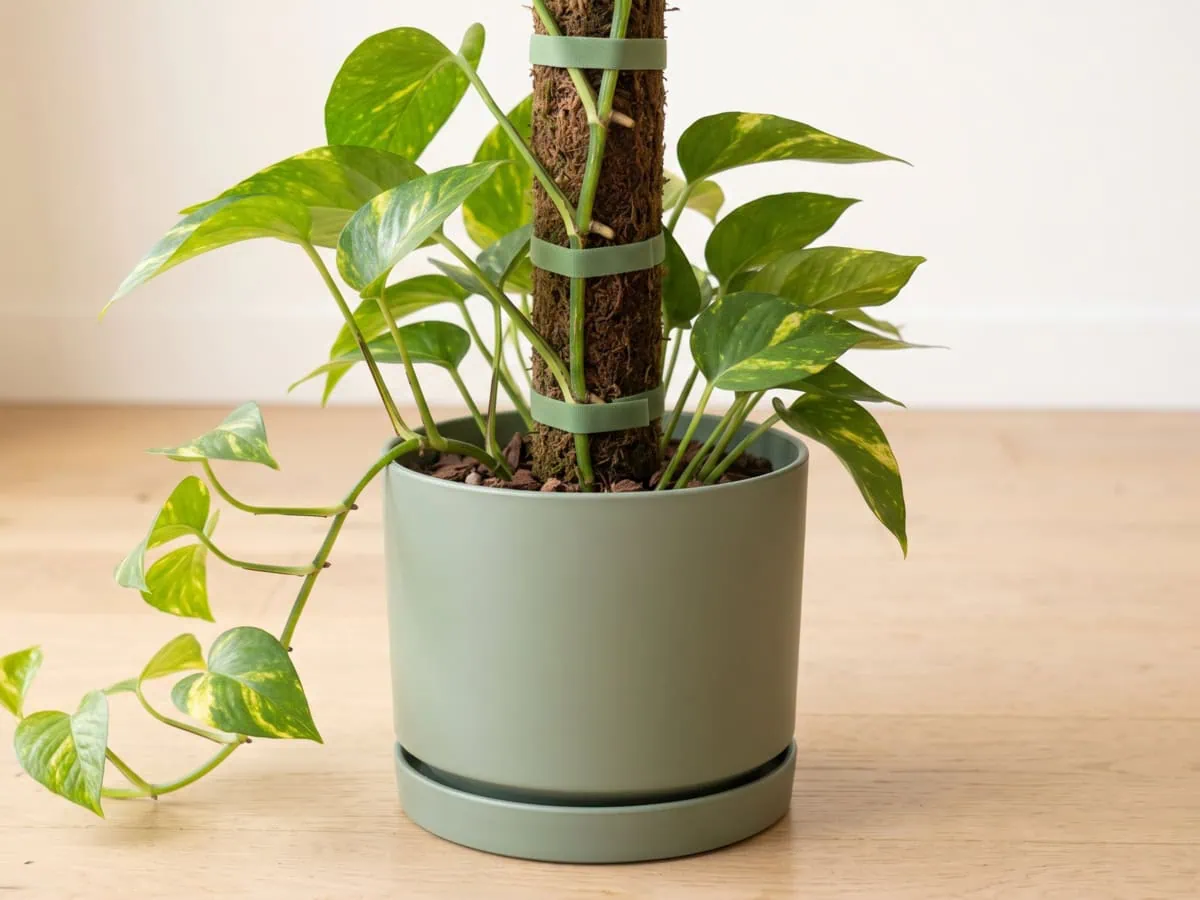
After tying: confirm the bond, then troubleshoot
Confirmation comes from a gentle lift, not from a calendar. Nothing published gives a reliable day count for adhesion on this species. The checkpoint has to be physical.
Ahead: the test itself, the tie check, the failure branch, and what happens at the top of the pole.
The tug test that confirms a node has bonded
Lift the vine gently away from the pole at a node and feel for resistance. A bonded node pulls back. An unbonded one lifts free, with the tie doing all the work.
Resistance is the whole test.
Adhesion happens out of sight, so the visible cue matters: bonded roots flatten against the moss and darken, while failed ones stay pale and round, standing clear of the surface. Check on a two-week rhythm rather than daily. When a node holds on its own, the tie there can come off.
Monthly tie check as new climbing growth comes in
Re-check the ties once a month. Leave deliberate slack when you tie, because a tie can start to bite into a thickening stem within 1 month. This vine has no woody trunk and no secondary thickening, so the stem does not swell the way a sapling does.
What changes is the growth itself. Climbing stems come in with longer, thicker internodes — more stem between nodes — than the trailing growth they replace, so a tie sized to thin trailing stem can end up gripping a fatter one. A tie that has pressed a visible groove into green tissue has been on too long.
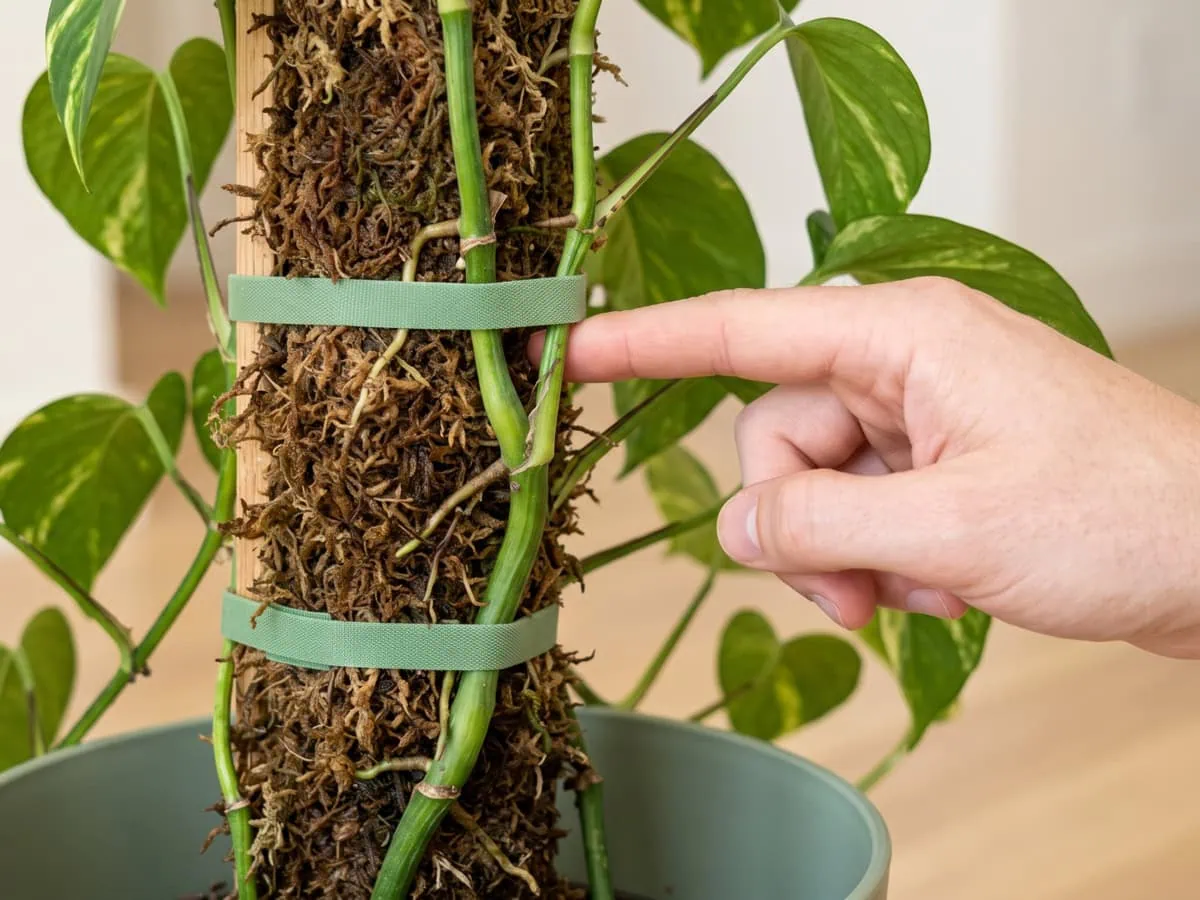
Aerial roots still not gripping? Change these in order
The “why won’t my pothos aerial roots attach to the pole” question comes down to four variables, and you change them in this order.
- Contact geometry. Rotate the vine so the root nub lies flat on moss, not bridging over it.
- Pole moisture. A surface that has gone pale and stiff gives a root nothing to enter.
- Tie tension. A slack tie holds the node against the surface; a tight one levers it away.
- Placement. Move the pot somewhere brighter before you conclude the method has failed.
Give each change two weeks. I have watched a node sit untouched for weeks and then bond once the moss stopped drying out. Change one thing at a time, otherwise you will never know which one worked.
When the vine reaches the top of the pole
You have three routes at the top. Doing nothing is the only one with a stated downside. Add a section to the totem, guide the vine back down to hold its current height, or cut it back and root the trimmings.
A vine turned downward has its nodes facing away from the surface. Re-orient every node you want to bond on the second pass. Cutting back is the route that also feeds rebuilding fullness on a bare stretched vine.
Frequently asked questions about training a Pothos on a moss pole
Once a pole is actually in the pot, these are what growers ask next.
How to train a Pothos to climb a moss pole?
Seat a damp moss totem behind the main stem, orient each node against the moss, then tie loosely. That order is the whole method.
Tying first and orienting later is what fails, because a tie only holds a vine in place; it does not decide which way the growth points face. Keep the totem damp without letting water run into the mix, and re-check the ties monthly until nodes hold on their own.
Will Pothos attach to moss poles?
Yes. Aerial roots on this species grip a damp, rough surface and grow into it, which is why a moss or coir totem works and a bare stake does not. Each stem node carries one short root oriented downward, and on contact with a moisture-holding medium it produces fine roots that anchor the vine. Attachment is not automatic, though: the node has to sit in physical contact with the surface, and the surface has to be damp.
When to put moss pole for Pothos?
Install the pole at a repot, or any time before the root ball is crowded. Root density decides the timing, not the calendar or the age of the plant.
If roots already show at the drainage hole and water races straight through the pot, wait for the repot rather than driving a totem through a solid root mass. A pot with room left takes the pole today, and the sooner the vine starts orienting, the less re-training you do later.
Can Pothos climb without moss pole?
Yes, but only where the surface gives the aerial roots something to enter. This vine climbs by root attachment, not by twining or tendrils, so it can hold a rough damp surface and will simply hang from a smooth dry one.
On a trellis or bare stake you can tie the vine upright and it will stay there, but the roots will not fix themselves to it. Trailing from a shelf is a fully valid alternative, not a failure.
How long does it take for a Pothos to start vining?
Extension is fast once light is adequate. This species puts on as much as 12 to 18 inches of stem in a month during active growth.
That figure is a stated maximum under good conditions, not a year-round average, and growth slows sharply in a dim corner. A plant you just bought already has vines; what people usually mean is when the vines lengthen visibly. Bright indirect light does more for that than any support does.
How to encourage Pothos to climb?
Give it a damp, rough vertical surface and hold the nodes against it. Climbing is a response to contact, not to encouragement: research on this vine records growth switching from horizontal to vertical once it finds something to climb, and vertical support increasing leaf area.
In practice that means a moist totem, node-first orientation, slack ties, and brighter placement. Remove the ties once the roots have taken hold.
How long does it take for a plant to attach to a moss pole?
Bonding runs on the plant’s own clock rather than on a day count, so use a test instead of a timer. Lift the vine gently away from the pole at a node: a bonded node resists, an unbonded one comes free with the tie carrying the load.
Check on a two-week rhythm. If nothing has changed after two checks, work through contact geometry, pole moisture, tie tension and placement in that order rather than waiting longer.
How to encourage Pothos to trail?
Do nothing structural: mount the plant high and let the stems fall. The stems are soft and pendent with no self-supporting rigidity, so trailing is what they do without a surface to grip.
A hanging basket or a high shelf gives the 6 to 8 feet of indoor vine somewhere to hang clear of the floor. Trim the tips at a node when the length gets away from you, and the trimmings root.
From anxious to confident in one growth flush
Plainly put: the totem I bought looked flawless and delivered nothing at all. But the equipment was beside the point. Geometry was everything.
Judge the flush that has not arrived yet. Bonded roots press flat and darken against the surface, while the ones that failed stay pale, round and standing clear of it.
Once several growth points hold on their own, cut the ties away without hesitating. Then one question is left: what to do with the trimmings. Knowing how to train a Pothos on a moss pole is really just knowing which surface a root will enter, which one it will ignore, and how long to leave it alone.
None of this is force – a soaked pole, one node turned inward, and your Pothos climbs because it finally can.
Tap the button below to get more plant fixes in your Google Search results