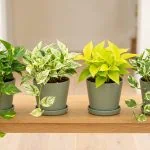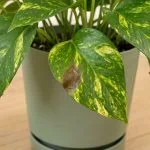
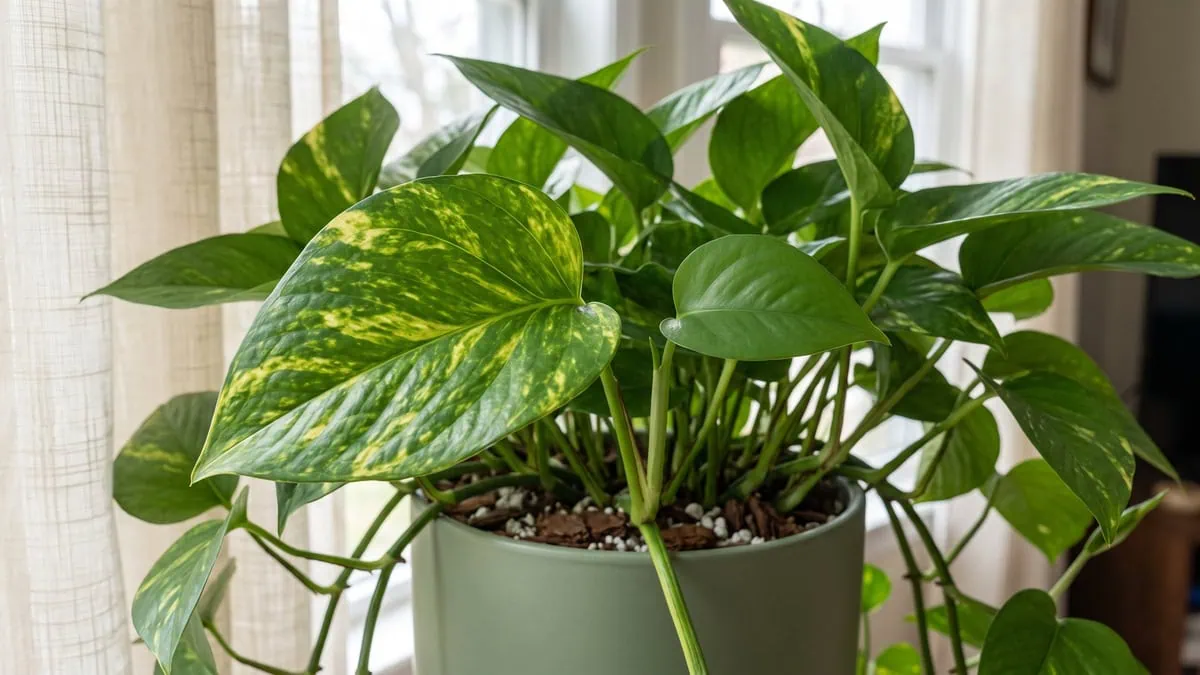
🎯 Quick Answer: Pothos light levels
How much light does a Pothos need triggers leaf size: Epipremnum aureum, of the Araceae family, holds at 150 FC. Cross it and new leaves come in smaller. Bright indirect light means 500-1,500 FC.
Direct afternoon sun is the ceiling. At 50 FC it lives, but stops looking well.
- Read new growth: smaller, plainer new leaves mean the light is too low
- Read the burn: bleached patches face the light and never recover
- Rotate a quarter turn: each time you water, not when you remember
- Move in stages: two hours a day brighter, then extend gradually
- Windowless rooms: a fixture must replace the window, not supplement it
Get the one-page care card for this guide, plus a printable A4 copy
We condense this guide into one card for your phone and a print version for the pot shelf. Enter your email and we send both to your inbox. Subscribe once, then request the card of any guide you read.
By subscribing you agree to get emails from Plant Care Basics about plant care guides, about once a week at most. Unsubscribe in one click. Privacy policy
The newest leaf on that vine is the tell: it opens plainer and a full inch shorter than the one below it, and every stem leans the same way, toward the window. All of them. It took years of Pothos before I stopped calling that lean a habit of the plant and started calling it a measurement of the room.
Years of placement failure forced me to learn that foot-candles, not adjectives, decide what this shade-adapted climber does with its next leaf. I’d like to retract that (yes, this sounds like hair-splitting — bear with me): one number decides nothing; photosynthesis answers to where in the 50 to 1,500 foot-candle range you parked the pot.
Four foot-candle bands settle it: three it can grow in, and a fourth, direct afternoon sun, that burns it. If placement is only one of the habits you are still working out, start with every habit an indoor Pothos depends on.
You do not need a meter to use any of this. Bands, window setbacks and fixture hours are set out side by side in the block that follows.
How much light does a Pothos need: the numbers at a glance
| Pothos specs | Recommended care |
|---|---|
| Survival minimum light | 50 FC (about 540 lux) – alive, but new leaves shrink |
| Maintenance floor | 150 FC (about 1,600 lux) – holds leaf size and color |
| Optimal band, bright indirect | 500-1,500 FC (about 5,400-16,150 lux) |
| Tolerates direct afternoon sun? | No – unshaded afternoon sun bleaches and scorches leaves |
| Window placement (Northern Hemisphere reference) | East or north at close range; west or south about 3 feet back |
| Supplemental fixture run time | 14-16 hours daily under a full-spectrum grow light |
| Needs a grow light in a windowless room? | Yes – a purpose-made grow light, never an ordinary desk lamp |
You are subscribed
Press the button and we prepare this guide's one-page care card and its A4 print copy and email both to you within a few minutes.
Tap the button below to get more plant fixes in your Google Search results

Table of Contents
How much light does a Pothos need, measured in foot-candles
A Pothos needs 500 to 1,500 foot-candles to look its best, holds its size from 150, and survives at 50. Each band gets its own section, along with what more light actually buys you.
The three bands: survival, maintenance, and full growth
Epipremnum aureum germinates on a shaded forest floor and climbs toward the canopy, so it carries a real tolerance for dim rooms. Tolerance is not preference.
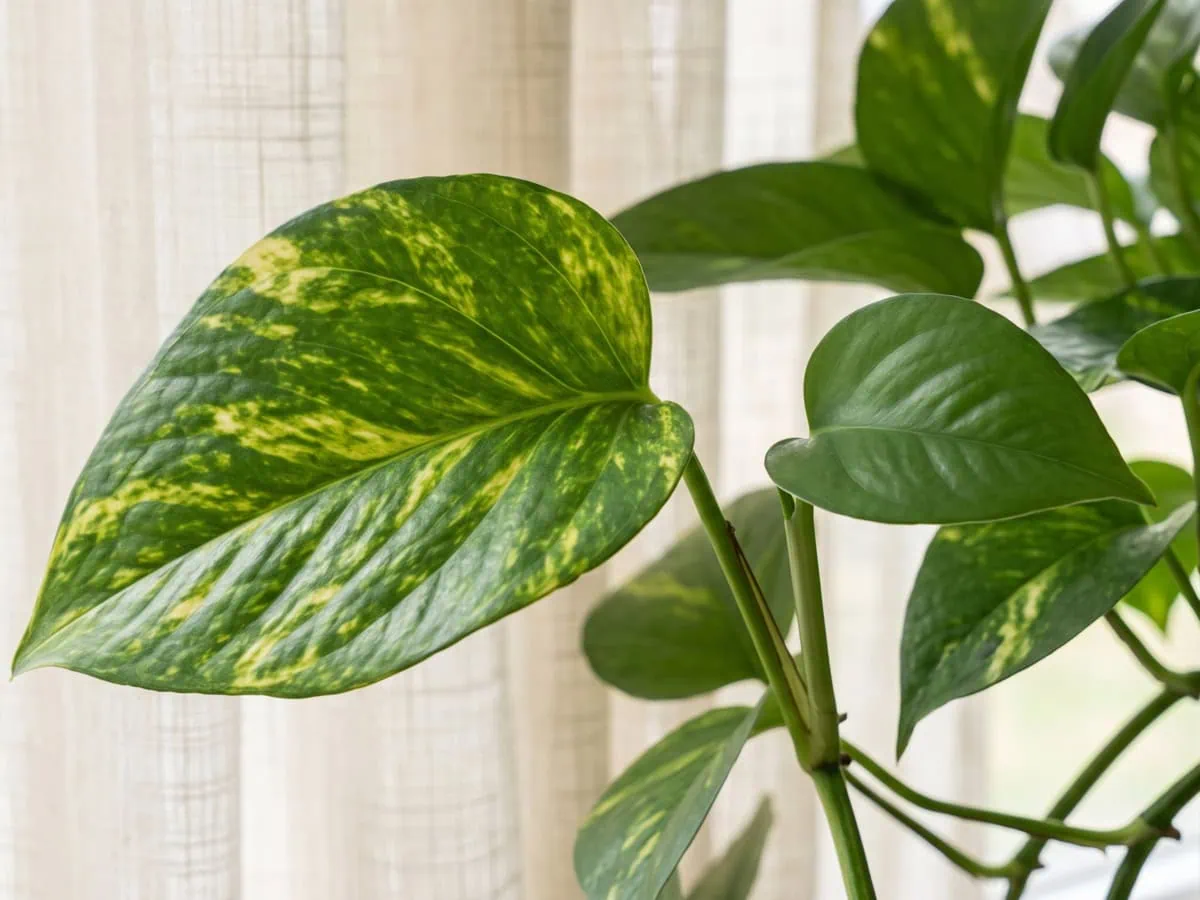
According to the University of Florida IFAS Extension, the published interior light levels for Epipremnum run as low as 50 FC, and at that floor new leaves come in small while variegated selections lose their color.
- 50 FC — survival. It lives; new leaves come in small and variegation fades.
- 150 FC — maintenance. Leaf size and existing color hold steady.
- 500 to 1,500 FC — full growth. The bright indirect band worth aiming at.
The signal arrives in new growth every time: each new blade opens a shade shorter than the last, and the tip pushes flat toward the glass.
What “bright indirect light” means in numbers
Bright indirect light is the phrase every care page uses and none defines. Calibrated against the standard indoor scale, it is 500 to 1,500 FC.
What brighter light actually changes
Brighter light changes what each leaf becomes, measurably: across two light levels this species’ relative growth rate rose from roughly 0.012 to 0.021 milligrams per gram per day.
Indoors that shows up as leaf size, not speed. Judge the blade.
This is an open question for me: nobody publishes a measured foot-candle optimum for Pothos, so the top of the band is inferred from the bright-indirect label.
The white tissue is not in question. Green Pothos tissue measured about 7.26 milligrams of chlorophyll per gram of fresh weight against about 0.02 in colorless tissue.
So a marbled leaf carries less working surface than a solid green one and needs a brighter spot to hold its pattern. And if you are unsure which selection you own, start by telling the marbled and chartreuse selections apart.
Get the one-page care card for this guide, plus a printable A4 copy
We condense this guide into one card for your phone and a print version for the pot shelf. Enter your email and we send both to your inbox. Subscribe once, then request the card of any guide you read.
By subscribing you agree to get emails from Plant Care Basics about plant care guides, about once a week at most. Unsubscribe in one click. Privacy policy
Tap the button below to get more plant fixes in your Google Search results

Where to place it: window orientation, distance, and rotation
Stand a Pothos at an east or west window, or several feet back from a south one, because distance from the glass is the real dial and every foot back cuts the light reaching a leaf. Orientation comes first, then rotation, then how to move a plant in stages.
East, west, north, or south: how far back to stand it
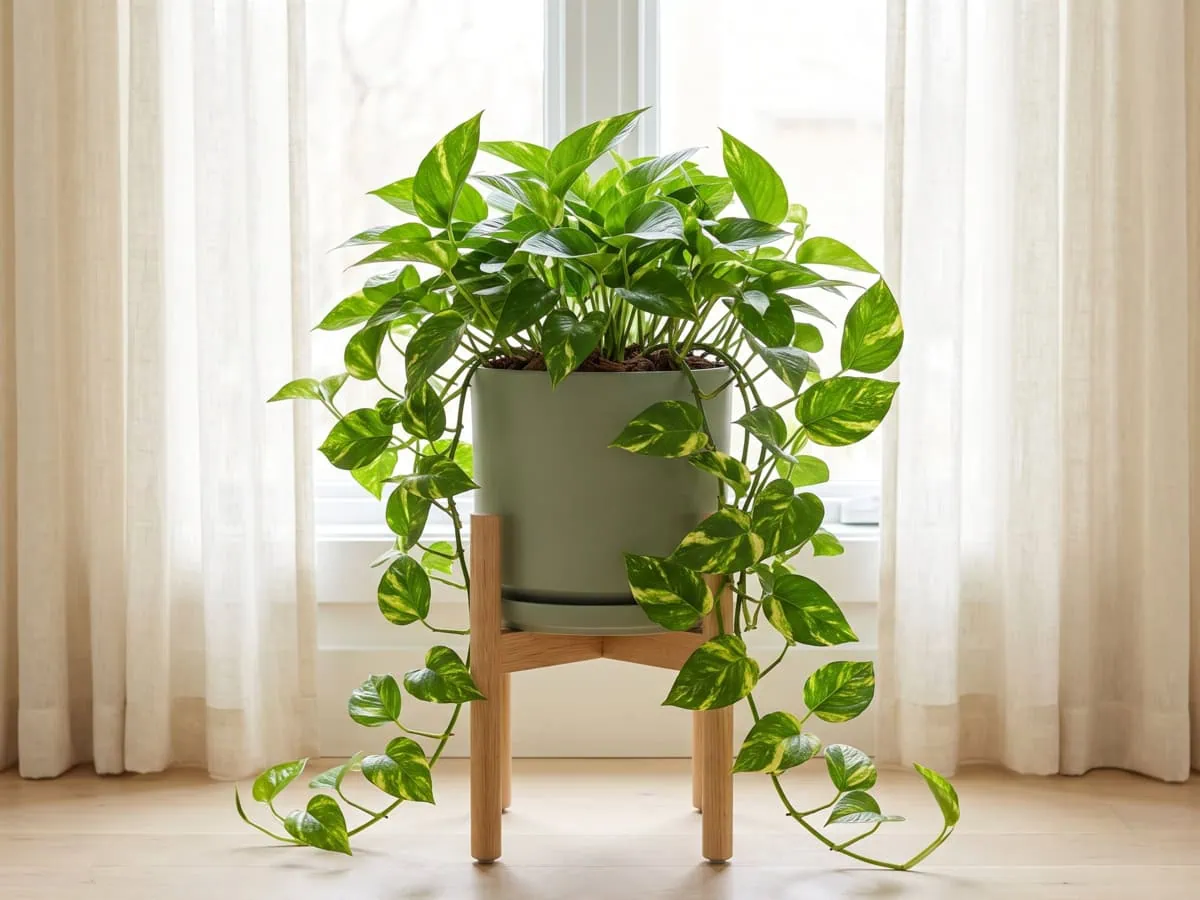
An east or north window (Northern Hemisphere reference) is the sweet spot at close range, east giving gentler morning sun.
Typed as “how far from a window should I place my pothos”, west and south are the orientations where setback matters, as the following table sets out: about 3 feet back, out of the beam.
| Window | Where to stand the pot |
|---|---|
| East | At the glass or within a few feet |
| West or south | About 3 feet back, out of the afternoon beam, or behind a sheer curtain |
| North | At the glass or within a few feet |
Verdict: Choose an east or north window for full leaf size at close range: it delivers the bright indirect band without the afternoon beam. West and south need a sheer curtain or about 3 feet of setback, and thinning stems deeper in mean rebuilding a vine that has run long and bare.
Rotate it on a schedule, not when you remember
Give the pot a quarter turn every time you water it. Care pages say to turn it now and then; that is not a schedule, and only the leaves that open after the turn answer to it.
Skip it and the far side of the crown goes thin: those stems point flat across the pot instead of arching over the rim. I turn mine at every watering. Every pot, one habit.
Move it in stages when the room gets darker
Shorter days pull a room’s light down while nothing else changes, so a placement that worked in bright months stops working.
But move it in steps. Give it about two hours a day in the brighter spot, then extend over the following weeks.
Never move a dim-room Pothos straight into a bright window. Bleached patches turn brown and brittle, and that tissue does not come back.
Light without a window: grow lights, run time, and dark rooms
A Pothos can live without a window, but only if a full-spectrum fixture replaces the window rather than topping it up, and runs long enough each day to pay for the leaves. Three questions answer that: the dark room, the fixture, the daily hours.
Can a Pothos live in a windowless room?
Typed as “can pothos grow in low light or a room with no windows”: low light, yes, since this plant survives at 50 FC and holds its leaf size at 150 FC.
No light is different. Photosynthesis runs on light, so a room delivering none is not a dim placement at all; only a fixture changes that.
The distinction is not survival but appearance: at the floor the blade shrinks and the pattern washes out, and a fixture buys the leaf size back. The fixture is about holding leaf size, not staying alive.
Choosing and positioning a grow light
Can pothos grow under artificial grow lights? Yes, under a purpose-made one: full-spectrum LED bulbs and gooseneck LED grow lights are the extension-named fixtures for low-light interiors, with cool-white fluorescent tubes suiting foliage plants.
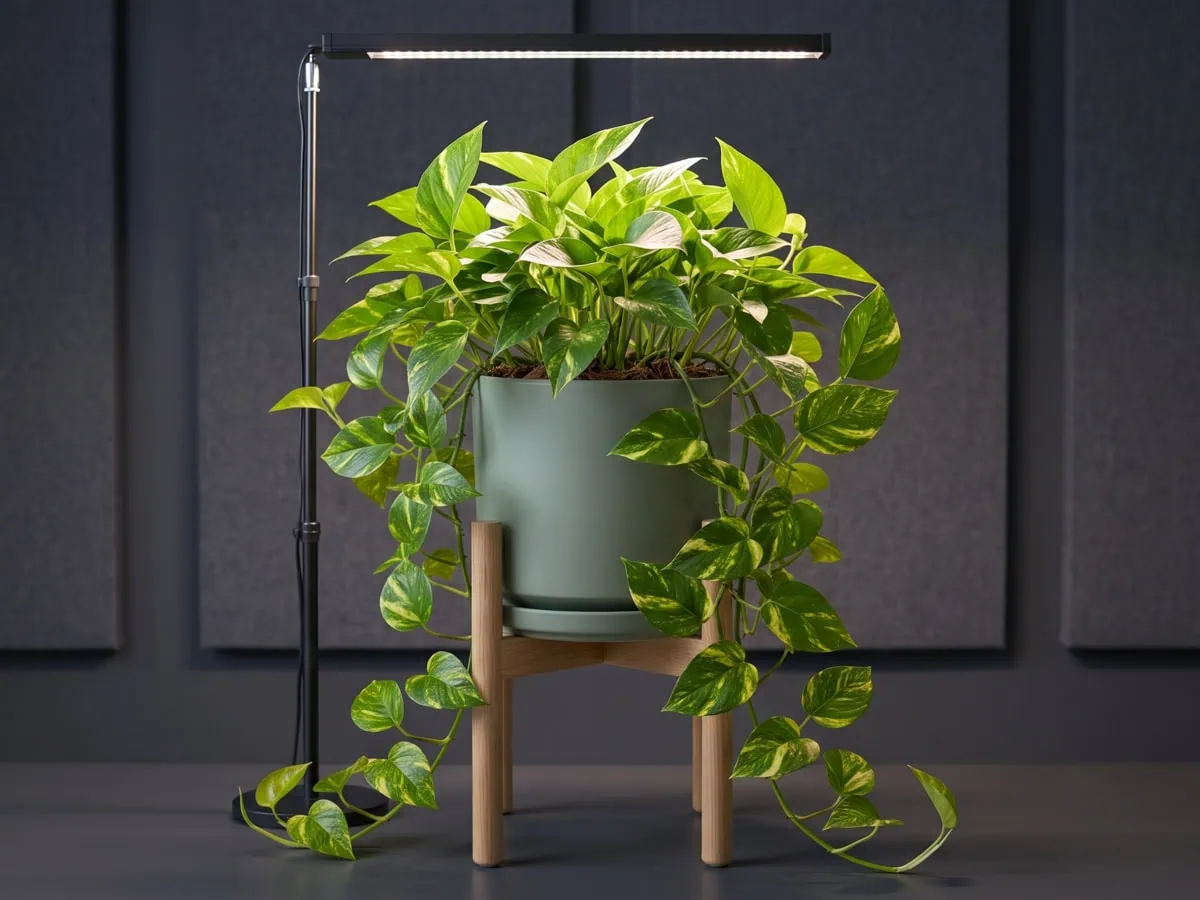
An ordinary desk lamp is not that: it lacks the output and the spectrum this plant needs. Three settings decide the rest:
- Fixture: a full-spectrum LED, or cool-white fluorescent.
- Position: foliage inside the maker’s rated coverage.
- Heat check: leaves felt for warmth under the running fixture.
Always follow the manufacturer’s instructions and applicable safety standards for any electrical equipment.
How many hours of light per day
Typed as “how many hours of light does a pothos need a day”: under a fixture, 14 to 16 hours on a timer.
The long run time does real work: lower intensity is partly offset by a longer day, which is why a modest fixture on a long timer suits this plant.
Watch the new growth, not the fixture. Under my own timer the change shows as direction: the newest tips stop reaching sideways and rise straight at the light. Direction first, then size.
What too little and too much light look like
Too little light and too much light both drain the color out of a Pothos, and the difference is where the change starts. Two signatures get split apart below, then the myths that put a plant in the wrong spot.
Signs the light is too low
A light deficit reads in the new growth first. Blades come in undersized, the gaps between them lengthen, and any cream or gold sectors drift toward plain green.
Slowed growth travels with the color loss, since the plant is short of the light its blades collect. Uniform yellowing on a wet mix is another story: solid yellowing that points at the pot, not the window.
Distinguish it from age: one old basal leaf yellowing and dropping is ordinary turnover; a run of undersized new leaves is not.
Signs the light is too strong
Search for “how to tell if my pothos is getting too much light” and you get symptom lists. The answer sits on the surface facing the glass.
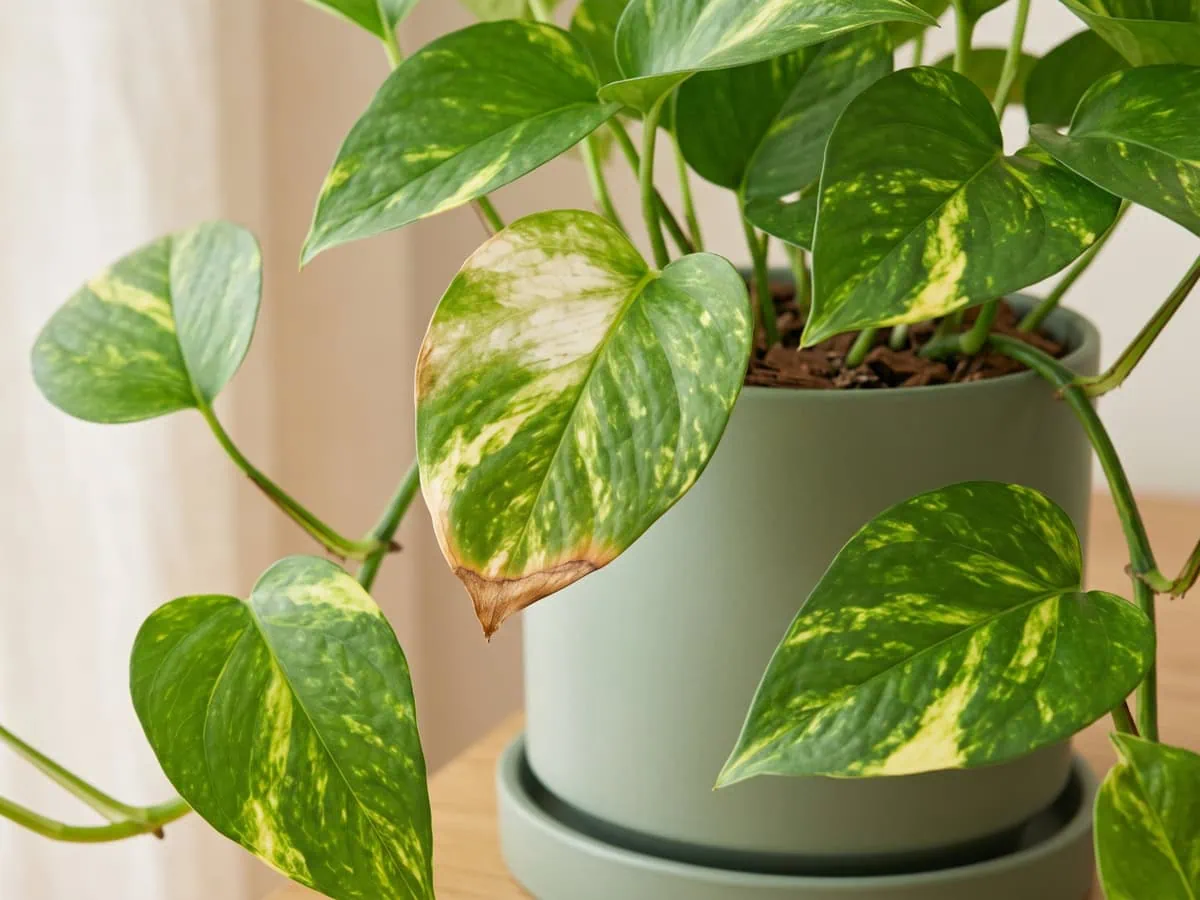
Strong light bleaches before it burns. Pale washed-out patches show up on the flattest surface aimed at the window, then dry to brown and brittle: the brown marks that are burn rather than pathogen.
Onset separates the two. Deficit fading creeps in over months and lands on new growth; strong sun arrives within days, and in an acute exposure they go limp before they brown. Days, not months.
Two light myths that put a Pothos in the wrong spot
Two beliefs do most of the damage, and both survive because they are half true.
Myth one: the leaves hold their color wherever you put the plant. They do not. White and gold sectors go first in low light.
Brighter light restores the pattern only in leaves that open afterward. An expanded plain-green blade stays green; cut an all-green shoot out at its base.
Myth two: a low-light plant loses nothing in a dark corner. It loses leaf size and pattern.
Frequently asked questions about Pothos light
Do pothos do well in low light?
No. A Pothos survives low light rather than doing well in it: 50 foot-candles is the documented floor, and at that floor every new blade opens smaller than the last while the pale sectors green over. Give it 150 foot-candles or more and leaf size and marbling hold steady. Bright indirect light is the preference; low light is only a tolerance.
How do I know if my pothos is getting enough light?
Read the newest leaves rather than the mature ones, because new growth registers a change in level first. Enough light shows as new blades opening as wide as the ones below them, pattern intact, gaps along the stem short. Too little reverses all three, and too much bleaches the surface facing the glass to a washed-out pale that dries brown and brittle.
Can pothos survive with no light?
No. Every leaf pays for itself in light, so a room supplying none cannot keep a Pothos alive. Low light and no light are different problems: 50 foot-candles is a floor the plant can hold at, while zero is an absence, not a dim spot. A room with no light source needs a fixture, not a plant that asks for less.
Can a pothos survive in a windowless room?
Yes, provided a fixture does the window’s work. A full-spectrum LED grow light or a cool-white fluorescent tube on a timer running 14 to 16 hours a day supplies it. A decorative bulb will not: buy a fixture built for plants, mount it so the whole crown falls inside the maker’s stated coverage, and feel a leaf under the running fixture to rule out heat.
Master the three bands, skip the guesswork
Three numbers settle this, and nothing else does. They settle any room you own. Fifty foot-candles keeps a Pothos alive, 150 holds leaf size and marbling, and bright indirect light out of the afternoon beam is where it looks its best.
The plant answers back. Move it brighter and the newest blades stop lying flat against the shelf and lift to a visible tilt toward the window. Watering is next, since a brighter spot dries the pot faster.
Answer how much light does a Pothos need in foot-candles rather than adjectives, and you stop shuffling the plant. Marbling is the one thing in this vine’s care that a dim room quietly takes away, and the one thing three numbers quietly give back.
Get the one-page care card for this guide, plus a printable A4 copy
We condense this guide into one card for your phone and a print version for the pot shelf. Enter your email and we send both to your inbox. Subscribe once, then request the card of any guide you read.
By subscribing you agree to get emails from Plant Care Basics about plant care guides, about once a week at most. Unsubscribe in one click. Privacy policy
Tap the button below to get more plant fixes in your Google Search results