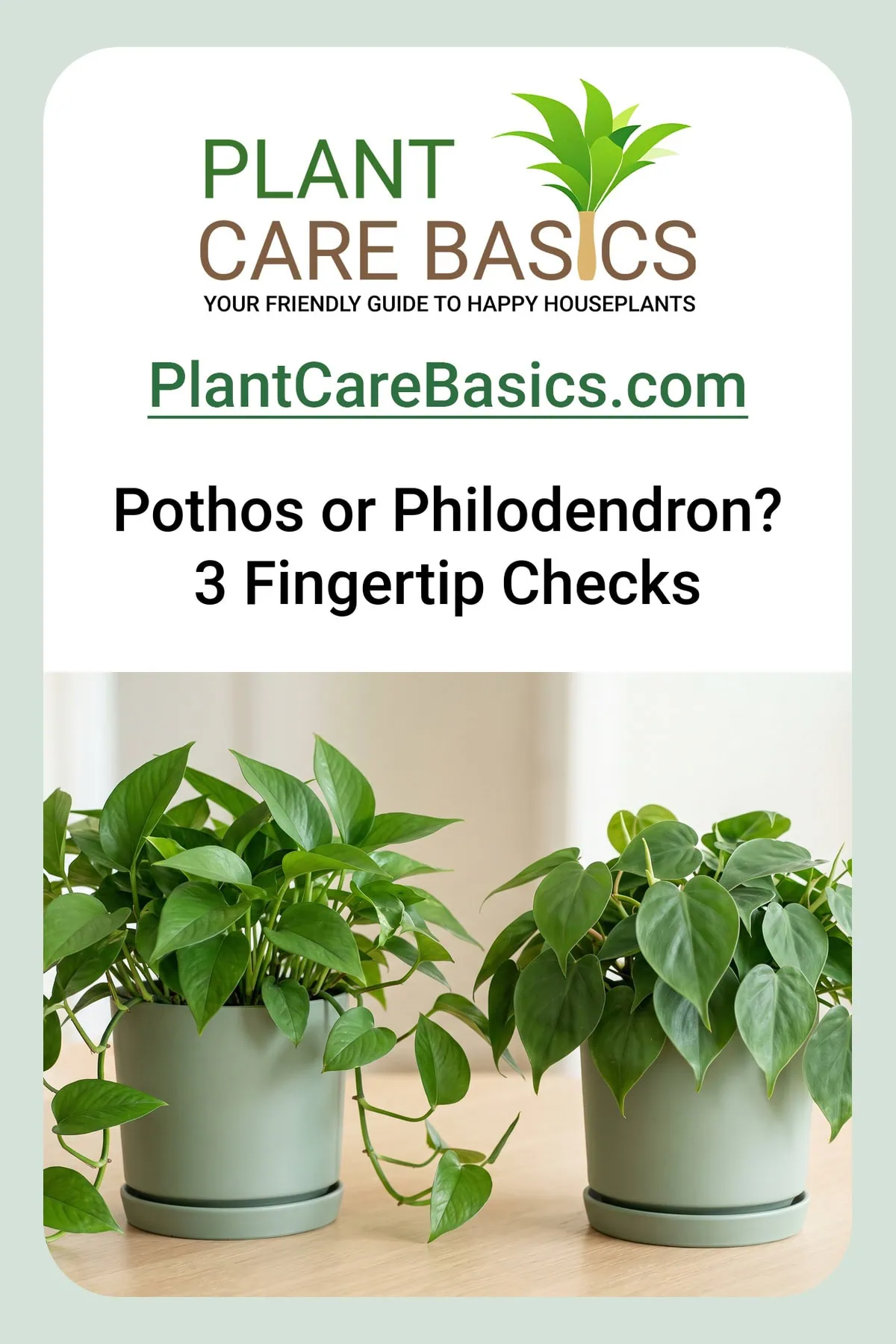
🎯 Quick Answer: Pothos or Philodendron, settled by hand
Pothos vs Philodendron flips on one blunt aerial root per node: Epipremnum aureum, of the Araceae family, carries one. Philodendron pushes several thinner roots from one node. When no new leaf is unfurling, the stalk decides it. Pothos stalks carry a groove; Philodendron stalks stay round.
- Start at a node: one check that works without a second plant
- Read the growth point: whichever leaf is unfurling right now shows the difference
- Run a fingertip down the stalk: your fallback whenever nothing on the plant is growing
- Distrust the plant tag: these two are mislabeled at the point of sale
- Confirm before you move it: relocating a misidentified vine fixes nothing by itself
Thick, stiff and faintly bumpy under a thumb — and the tag wired to the pot said Philodendron. Vine after vine went to the wrong shelf because I trusted a tag (and I say this confidently). Wrong genus, wrong light, slow decline.
Every identification table I could find sent me back to the leaf, which is exactly where this comparison goes wrong — the real fix is the node, because every stem joint on this aroid carries exactly one downward-pointing aerial root that a Philodendron never matches. That is not quite right on its own: the count settles it.
A Philodendron puts several thinner roots out of the same joint. One glance beats any leaf comparison.
Three checks settle it, and two work on a single plant. If you are still sorting out keeping this trailing aroid healthy indoors, start by confirming you own one.
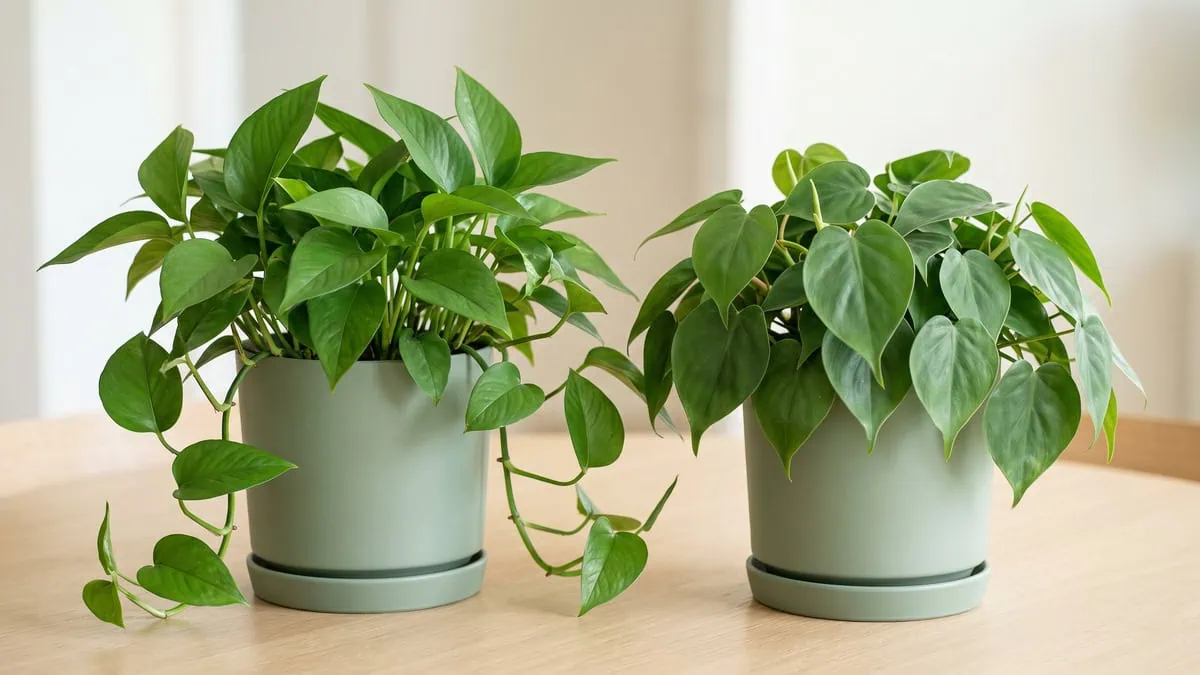
All of this gets easier the moment you stop reading the whole plant at once. Seven cues sit lined up in the grid underneath, Pothos side first.
Pothos vs Philodendron at a glance
| Pothos specs | What Pothos shows |
|---|---|
| Genus and family | Epipremnum, family Araceae (Philodendron is a separate genus, same family) |
| Aerial roots per node | One short blunt nub (Philodendron: several thinner roots) |
| Sheath on new growth? | No – the new leaf unfurls from the previous leaf |
| Leaf stalk profile | Grooved – a channel runs down the stalk (Philodendron: round) |
| Blade substance | Thick, stiff, waxy, faintly bumpy to a fingertip |
| Indoor leaf form | Entire heart-shaped juvenile blade, 3-6 inches, no holes |
| Same genus as satin pothos? | No – satin pothos is Scindapsus, a different genus |
Tap the button below to get more plant fixes in your Google Search results

Table of Contents
Which one is in your hand? Two checks that need only one plant
Two cues resolve this on one plant alone: the node, then the growth point. Every other comparison needs both genera side by side — which a reader with one unlabeled vine lacks.
- Count the roots on one node.
- Read the leaf that is opening.
- Feel a mature leaf stalk.
Look up “how to tell the difference between pothos and philodendron” and what comes back is tables of comparatives.
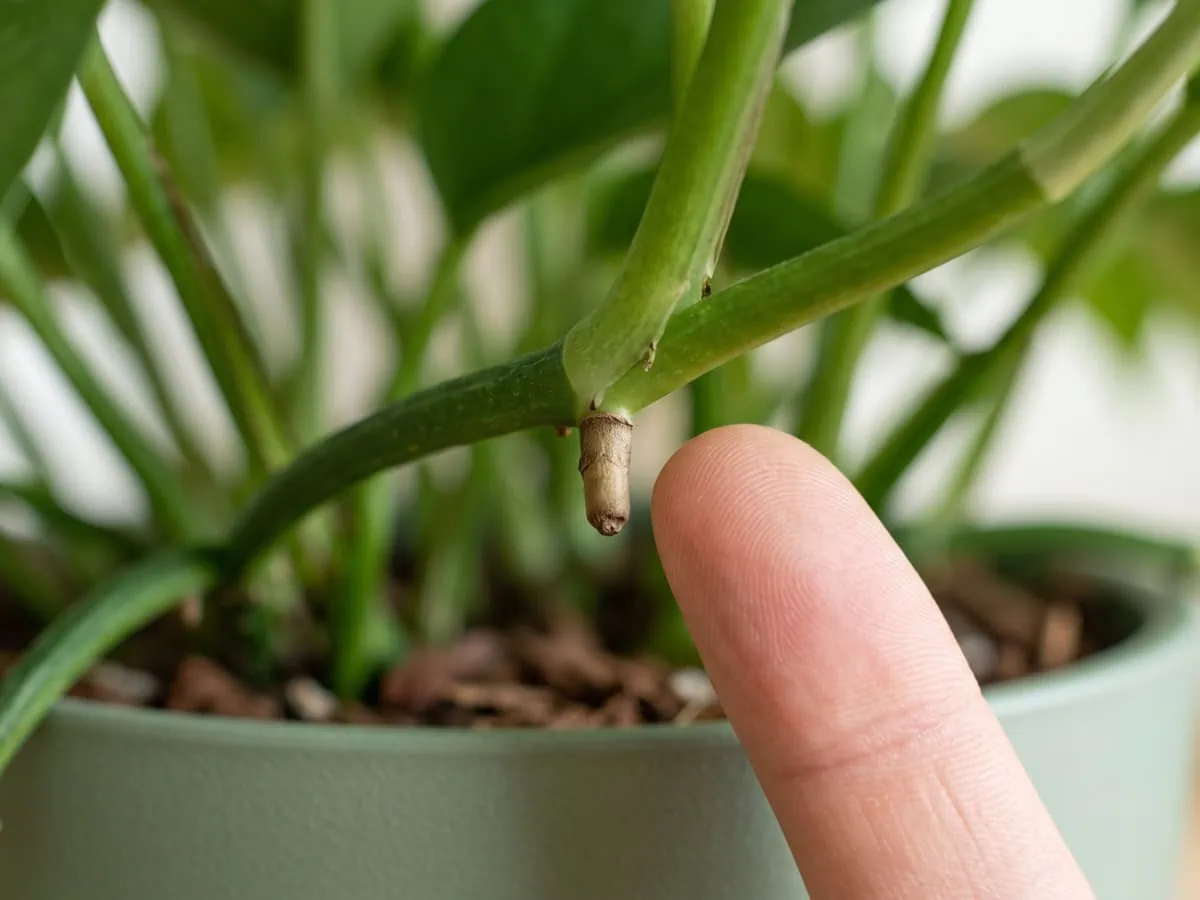
The node check: one nub or several roots
Find any point where a leaf stalk joins the stem. On Pothos that joint bears exactly one stubby aerial root — set opposite the stalk, pointing down. Several thinner roots mean Philodendron.
That single nub is not decoration. Where it reaches damp medium it puts out fine feeding roots, which is why the airy mix this vine roots best in matters more than it looks.
The growth-point check: sheath or no sheath
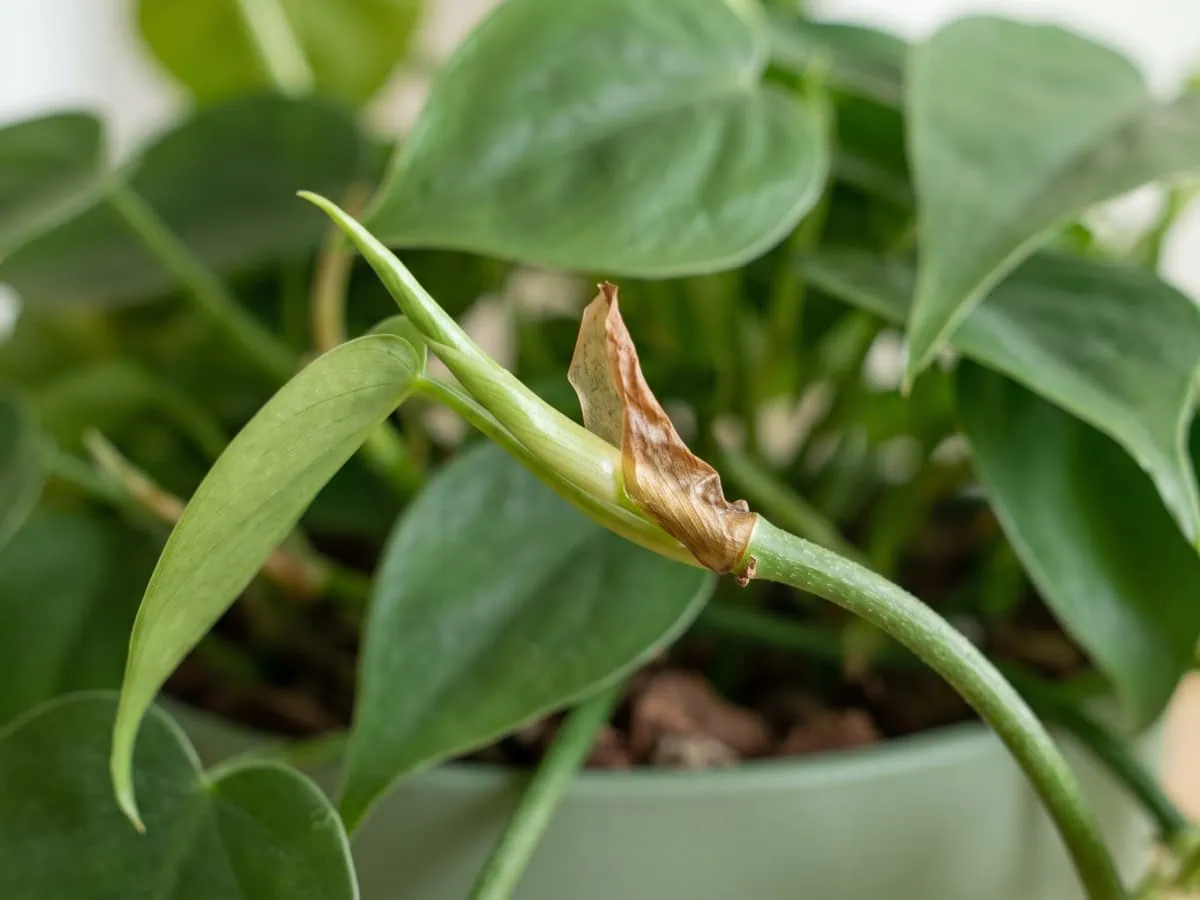
Then look at whatever leaf is currently opening. On Pothos the new blade extends straight from the previous leaf and unfurls a lighter green — no wrapper, no papery scrap. On Philodendron that same leaf pushes out from inside a thin opaque sheath that stays on the stem.
- [PROS] Node check, readable on any mature joint. (Best For: one unlabeled vine, no second plant)
- [CONS] Growth-point check, dead until a leaf opens.
Verdict: Start at the node, because the nub is there whether or not the vine is pushing a leaf.
What that sheath is, and what it does
The structure has a name. In aroid morphology it is a cataphyll, one of the foliaceous organs at the shoot apex, and on Philodendron it wraps every new leaf before drying to a brown scrap that crumbles like the skin off a garlic clove.
Cataphyll: a papery protective sheath on emerging growth. Philodendron carries one on new growth; Pothos does not.
It stays green while the blade is coming out, then browns off. My working theory is that this dried scrap outlasts every other cue on an unlabeled plant. So scan the stem for one before you reach for a leaf.
Tap the button below to get more plant fixes in your Google Search results

Stalk, blade and stem: the cues that need both plants
Put the two side by side and three cues separate them: the leaf stalk, the blade, the stem. Only the stalk still answers on one plant.
| Paired cue | Pothos | Philodendron |
|---|---|---|
| Leaf stalk | Grooved; dries to two papery edges | Round, unbroken |
| Blade substance | Stiff, waxy, faintly raised | Thin, soft, matte |
| Base and midrib | Flatter, often lopsided; midrib sunken | Deeper notch; midrib flat |
Verdict: Trust the stalk over the blade, because a channel is either there or it is not, while blade feel needs the other genus in your other hand.
Run a fingertip down the leaf stalk
Pinch the leaf stalk where it meets the blade, then draw a fingertip down toward the stem. Take your time. You feel a channel on Pothos — deepest where it clasps the stem.
Philodendron, however, gives back nothing at all under the same fingertip. No channel anywhere along it.
The check has one failure mode. On very young growth the channel is shallow enough to miss, so I run it on a mature stalk.
Blade substance, base and outline
Blade substance is the fastest paired cue. A Pothos blade sits closer to a playing card than to the thin, soft, matte sheet a heartleaf Philodendron gives you. Feel both.
Then move to where the stalk enters the blade. Pothos runs flatter and often lopsided, one basal lobe larger than the other. And the midrib settles ties — sunken and paler on Pothos, flat on the other.
Variegation color families and the silver look-alike
Color families narrow the field before you touch the plant. Pothos variegation runs gold, cream, white and lime — ‘Golden’ yellow on green, ‘Marble Queen’ white and cream, ‘Neon’ chartreuse. Gold is rare on Philodendron, which trends pink and lime.
Silver changes the answer entirely. The “is a satin pothos actually a real pothos” question belongs in another column: silver blotching on a thick, obliquely oval blade is neither genus.
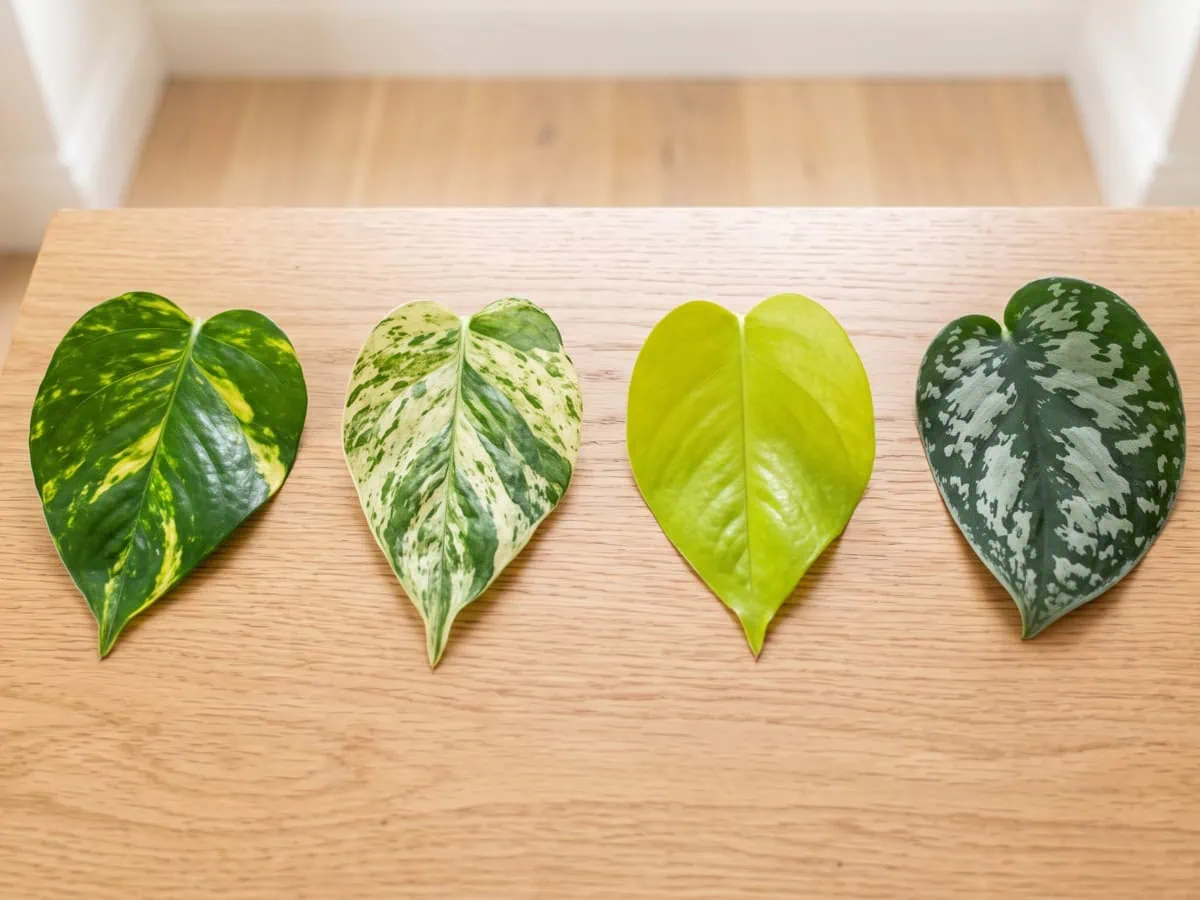
Within Pothos the named cultivars sort on the same logic, and telling the named varieties of this species apart starts here.
Scindapsus, Monstera and the mix-up inside Epipremnum
The label was wrong before you saw it: garden centers mislabel Pothos and Philodendron, so the tag settles nothing.
| Sold as pothos | Blade tell | Same genus? |
|---|---|---|
| Philodendron | Thin matte blade, sheathed new growth | No |
| Scindapsus | Silver blotching, obliquely oval blade | No |
| Juvenile Monstera | Whole unsplit blade, holes not yet formed | No |
| Epipremnum pinnatum | More fenestrations; ‘Cebu Blue’ cultivar | Yes, different species |
Verdict: Settle the genus before the species, because three of the four are not Epipremnum at all.
Satin Pothos is not an Epipremnum
Satin pothos is the third candidate. The “is my plant a pothos or a scindapsus” question answers cleanly. It is Scindapsus, a genus that borrowed the name.
Monstera, the fourth look-alike
Monstera is the candidate nobody compares. At selling size its blade is still whole and unsplit — holes not yet formed. Epipremnum blades stay whole or split along the midrib; Pothos never perforates indoors.
Epipremnum aureum vs Epipremnum pinnatum ‘Aureum’
One level down, genus becomes species. Drop “epipremnum aureum vs epipremnum pinnatum difference” into a search box and you meet a plant that is a pothos but not this one.
It was filed as Epipremnum pinnatum ‘Aureum’ for years. And one institution still does.
Per Kew’s Plants of the World Online, the accepted botanical name and its recorded synonyms settle the label.
Guides merge the genera on a shared-origin claim. They share none — Philodendron is native to the tropical Americas, Epipremnum aureum to the Society Islands per Kew. Convergent habits are not shared care.
What the answer changes about care
Care advice is where published guidance falls apart: the “is pothos or philodendron easier to care for” question has no settled answer.
One finding holds everywhere. A variegated Pothos loses its markings long before its life. It survives near 50 foot-candles, holds pattern from 150, and does best in bright indirect light — roughly 500 to 1,500.
Neither genus takes direct afternoon sun. Placement follows the foot-candle bands this vine grows in. Not the label.
Water is where they diverge, and failure shows early — hold a Pothos too wet and I get a flat, stale-water note off the mix, a week or more before a leaf yellows.
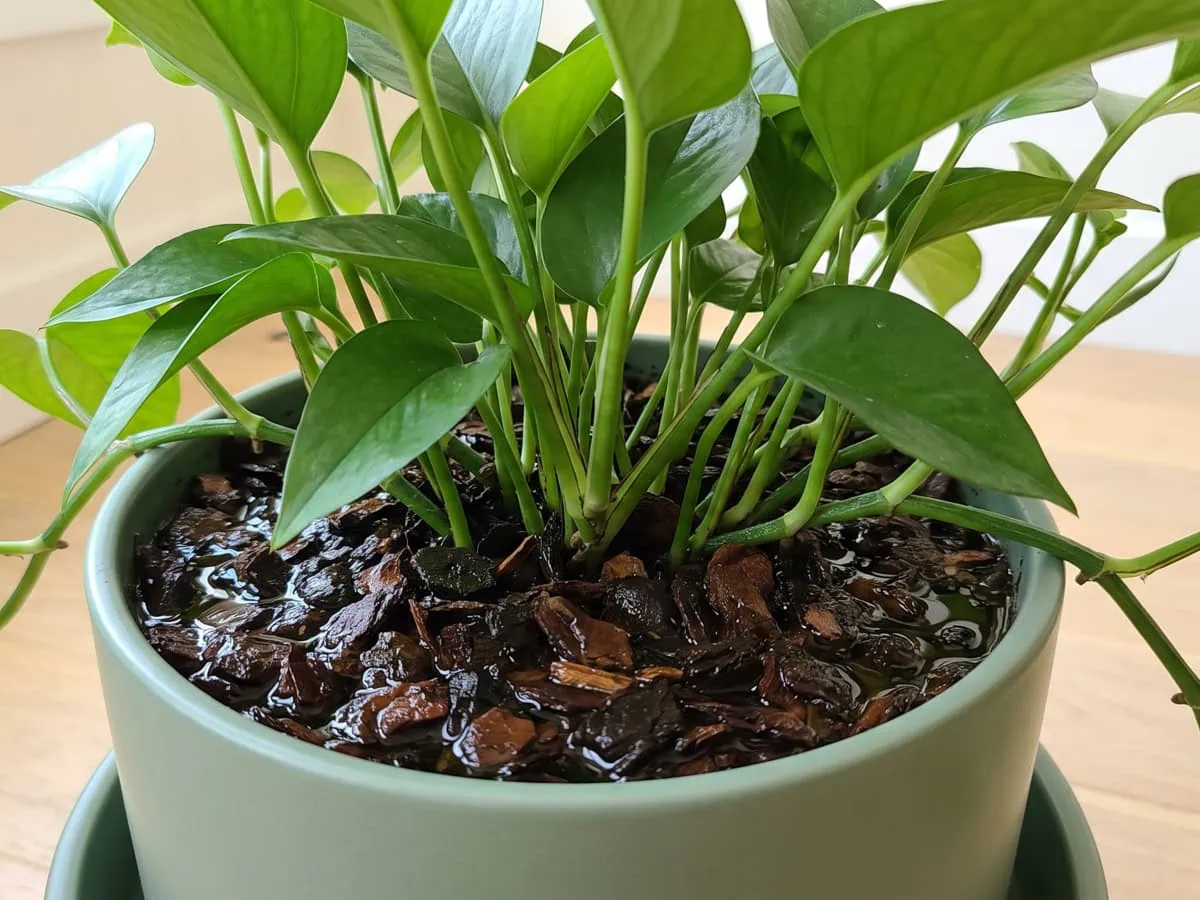
Pothos wants the top 1 to 2 inches dry before the next pour; reading the mix before the next watering beats a schedule.
Frequently asked questions about identifying the vine you own
How do I tell if I have a pothos or Philodendron?
Count the aerial roots at a single stem node: Pothos carries exactly one short blunt nub there, while Philodendron pushes out several thinner ones. If a new leaf is opening, read that too — Philodendron wraps each emerging blade in a papery cataphyll, and a Pothos leaf unrolls directly out of the one before it. Both checks work on one unlabeled plant, which is why they beat any side-by-side leaf table.
Is pothos or Philodendron better for low light?
Published guidance splits in both directions here and measures nothing, so neither genus wins that comparison outright. Two Pothos figures are firm — about 50 foot-candles is the survival floor and 150 holds leaf size and pattern — while roughly 500 to 1,500 foot-candles is the calibrated band for bright indirect light, not a measured optimum. A dim room takes the markings first.
Is a Philodendron the same as a pothos?
No. They are separate genera inside one family — Pothos is Epipremnum aureum, Philodendron is its own genus, and both sit in Araceae. That shared family explains the heart-shaped blades and the climbing habit. It does not make their care identical: the two evolved on opposite sides of the planet, Philodendron in the tropical Americas and this species in the Society Islands.
What plants are mistaken for pothos?
Four plants account for nearly all of it. Philodendron leads, then Scindapsus — the satin or silver pothos, a separate genus entirely — followed by juvenile Monstera, whose blades have not split yet. The fourth is Epipremnum pinnatum, a genuine pothos but a different species sold widely as ‘Cebu Blue’, and the only one of the four sharing a genus with this plant.
What does a real pothos look like?
A Pothos leaf is thick, glossy and heart-shaped, 3 to 6 inches long indoors, with an entire margin and no holes. Each stem node carries a lone blunt nub opposite the stalk, and the stalk itself is grooved rather than round. Indoor plants hold this juvenile form permanently — the large perforated adult leaves of the wild vine never appear on a houseplant.
How can I tell if my plant is a Philodendron?
Look for two positive signals rather than the absence of Pothos traits. A Philodendron pushes several thin aerial roots at one node instead of a single nub, and each new leaf emerges from inside a sheath that dries to a brown papery scrap and clings on once the blade is fully out. Its leaf stalk stays a smooth round cylinder with no channel running down it.
What does a Philodendron look like?
Heartleaf Philodendron blades feel thin, soft and matte beside a Pothos leaf, with an even heart outline, a deeper notch where the stalk meets the blade, and a longer drawn-out tip. New growth often flushes pink or brownish before it darkens. Variegated forms trend pink and lime — gold is rare in this genus, which is a fast cue at a nursery bench.
How do I identify my pothos?
Work the checks in a fixed order and stop at the first clear answer: begin at a node and count aerial roots, because one blunt nub is Pothos. If a leaf is opening, confirm it emerges from the older leaf with no sheath. If nothing is growing, draw a fingertip along a mature stalk and feel carefully for the groove.
Rescue, revive, repeat: correct the genus and the care follows
Confession time: the tag is the last thing I read now, not the first — a lone nub at the joint, or several thin roots, settles the genus on a plant nobody else has examined.
Get the genus right and the care follows. Get it wrong and the vine fades slowly — pale new leaves, markings washing out like old newsprint, months before anything looks urgent.
No app needed. Settling Pothos vs Philodendron takes one joint, one growth point and one stalk — read in that order. Trust the node and the stalk over whatever the label says, and the vine on your shelf will never be a stranger again.
Tap the button below to get more plant fixes in your Google Search results