🎯 Quick Answer: naming the Pothos in front of you
How to identify Pothos varieties sparks constant mislabeling of Epipremnum aureum, a member of the Araceae family. Four leaf characters settle it. Read the pale tissue color, the boundary, the flecking, then the blade. Shop tags mislead — work from the plant, not a photo gallery.
- Order matters: the first two characters narrow, the last two decide
- Flecking decides: green speckles in the pale tissue split the confused pair
- Ignore proportion: the green-to-white ratio shifts with each plant’s light history
- Stop when unsure: a dim or young plant is not yet readable
- Check the tag: a denomination and patent number outrank the trade wording
A run of pothos came home in one year and I could not confidently place most of them. Marble Queen, Golden, N’Joy — that is what the tags said. I caught the two wrong ones later, when the variegation on one plant drained back to green sector by sector over a single season while its neighbor kept every chlorophyll-free block it started with.
What kept tripping me up was the habit of matching my plant against photo galleries, where every shot is another plant carrying another pigment load. Updating my earlier point — what fixed it was four characters read off one blade of 3 to 6 inches. Two tags lied.
Variegation is not a care setting you dial in — it records which shoot your cutting came from, and tissue without chlorophyll cannot rebuild a pattern it never had. The leaf tells the truth. For the routine rather than the label, start with what a Pothos needs week to week indoors.
Before you scroll another gallery, the following table fixes what an indoor Pothos always looks like (stay with me here) and what genuinely varies between cultivars.
How to identify Pothos varieties at a glance
| What to check | What you should see |
|---|---|
| Indoor blade form | Entire heart-shaped (cordate) blade, no lobes and no holes |
| Indoor blade size | 3-6 inches long, measured along the midrib on a fully expanded leaf |
| Pale-tissue color family | Cream-white group, or lime-yellow chartreuse group |
| Boundary character | Hard-edged sectors, diffuse marbling, or fine green flecking in the pale tissue |
| Pattern response to light | Brighter light acts on new growth only; an expanded plain-green blade stays green |
| Perforated mature blade indoors? | No |
| Store tag reliable on its own? | No |
Tap the button below to get more plant fixes in your Google Search results

Table of Contents
Read four leaf characters in a fixed order
Four leaf characters, read in one fixed order, identify an indoor Pothos. Order matters: the first two narrow the field to a handful, and the last two close it on one cultivar.
Each of the four gets a section of its own. Anyone searching “what variety of pothos do I have” lands in a photo gallery — the wrong tool for a plant already in your hands.
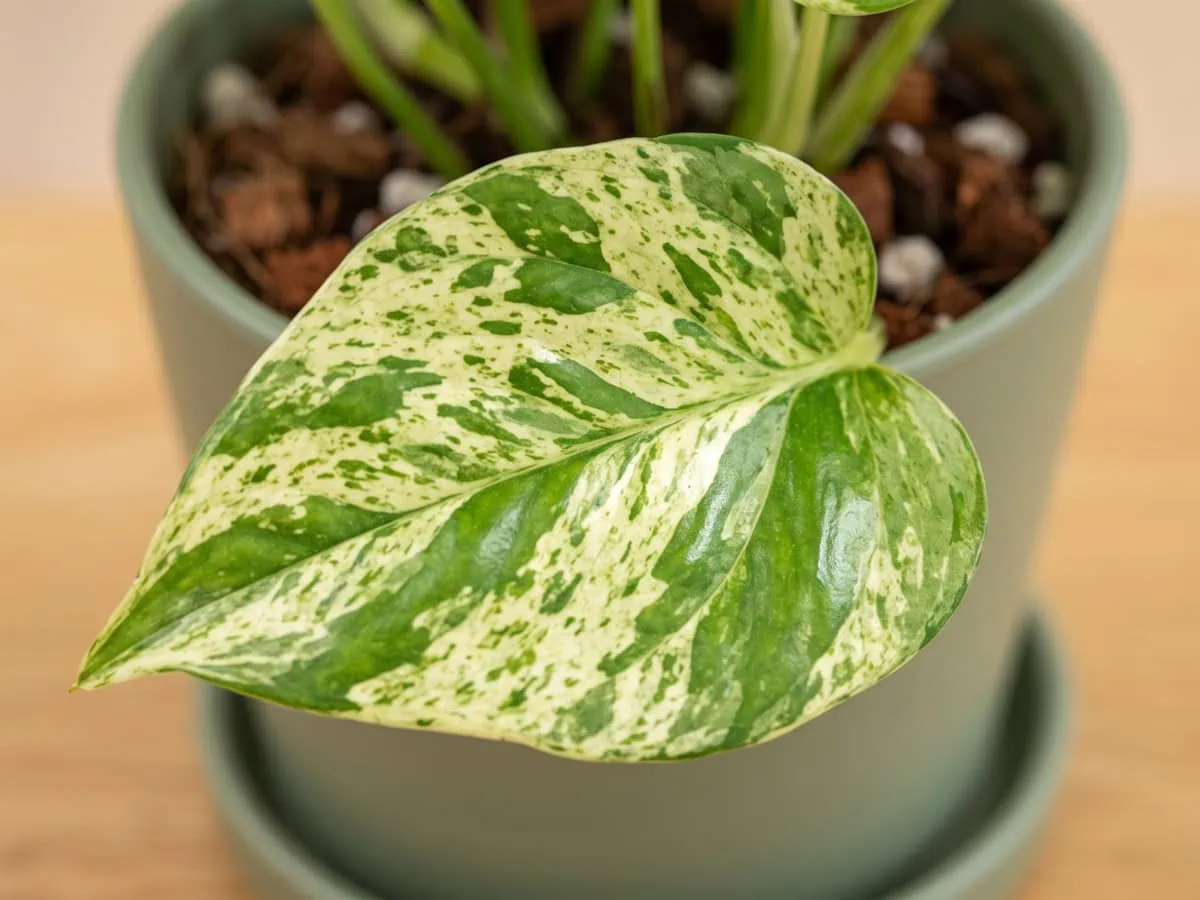
- Color family: cream-white, or lime-yellow chartreuse.
- Boundary quality: hard-edged blocks, soft marbling, or fine speckling.
- Green flecking: present inside the pale tissue, or absent from it.
- Blade size: 3 to 6 inches long on an indoor plant.
Which color family is the pale tissue?
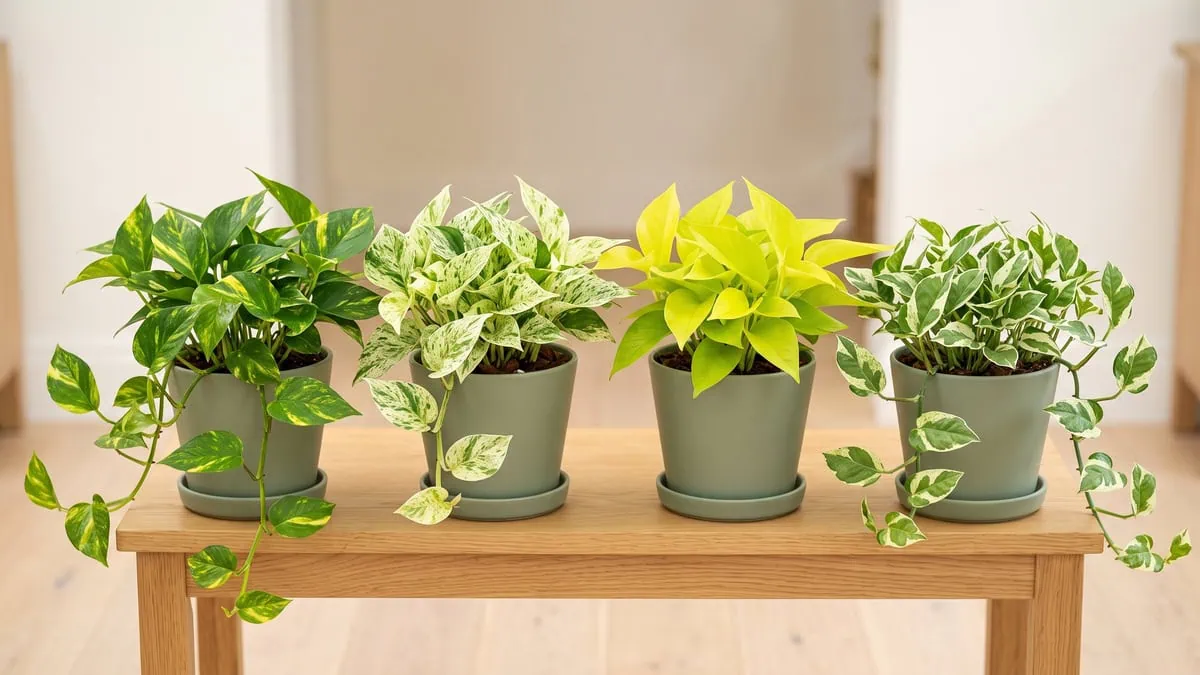
Every cultivar sorts into one of two color families first, and Marble Queen, Snow Queen, Pearls and Jade, N’Joy and Manjula all sit in the cream-white family. Golden, Neon, Lime and Jessenia sit in the yellow-to-chartreuse family.
That single split halves the candidate list. Judge it under indirect daylight — a warm bulb pushes cream toward yellow and drops a plant into the wrong family. One cultivar sits outside the split entirely: ‘Jade’ is solid dark green and offers no second color to sort at all.
How sharp is the boundary between green and pale?
Boundary quality separates cultivars sharing a color family. It holds when color proportion does not. Look at where green stops and pale begins, then sort into one of three:
- Hard-edged — pale sits in defined blocks with a clean line, as on N’Joy.
- Marbled — green and cream run together in streaks, as on Marble Queen.
- Speckled — fine flecks scatter across the blade, not in blocks.
Boundary reads steadier than color proportion, which is why it ranks second. Two honest writers photographing two correctly labeled Marble Queens describe the green-to-white ratio in opposite terms, because that ratio moves with the light each plant grew under.
Do green flecks sit inside the pale tissue?
Green flecks scattered within the white separate the two most-confused cultivars on the shelf. Pearls and Jade shows fine green speckling through its pale sectors. N’Joy shows cream blocks with no green in them at all.
Tilt the blade toward a window and look into the pale area rather than at it. Snow Queen is the near miss here. It reads predominantly white speckled with green across the whole blade, which is another arrangement entirely from discrete flecks sitting in one pale block.
When a plant is too dim or too young to call
Two conditions make an honest call impossible, and saying so beats guessing. Light is one. A plant kept dim for months loses pale tissue on every new leaf, so a Snow Queen and a Marble Queen converge on one washed-out look.
A young trailing plant has not yet grown the blade outline that separates several cultivars. Hold the call. Move it to brighter indirect light and read only the next 2 leaves that open afterward — the split returns on new growth while old blades stay unchanged.
And if the blade has holes or deep splits, this is probably not the species at all — telling this genus apart from Philodendron and Scindapsus covers that fork.
Tap the button below to get more plant fixes in your Google Search results

Separate the cream-and-white cultivars that get confused
The cream-and-white cultivars are the ones that get swapped, and two characters separate all five: how the pale tissue is arranged, and whether green flecks sit within it. Blade shape then breaks the last ties.
First the five, then the two pairs behind almost every wrong call. Per the Clemson Cooperative Extension Home & Garden Information Center, the cultivar-by-cultivar pothos foliage descriptions behind this table run to eleven named selections.
| Cultivar | The character that settles it |
|---|---|
| Marble Queen | Cream streaked through green, green still dominant |
| Snow Queen | Predominantly white, speckled green, no large green blocks |
| Pearls and Jade | Green flecks inside the white; small teardrop blades |
| N’Joy | Hard-edged cream blocks with no green inside them |
| Manjula | Broad upright blades, pointed tips, barely vines |
Verdict: read flecking and blade outline before color proportion, because proportion shifts with growing conditions and those two stay steady.
Marble Queen against Pearls and Jade
The “how to tell marble queen and pearls and jade pothos apart” question resolves on two characters, blade size and flecking:
- Pearls and Jade — small teardrop blades, white sectors with green flecks inside them.
- Marble Queen — larger pointed blades, cream streaked through green that still dominates.
They sit closer than they look, and one widely republished guide calls Pearls and Jade a cross of two cultivars. It is not (and I say this confidently) — it is a patented sport of Marble Queen itself, registered as ‘UFM12’ under plant patent PP21,217.
Every re-tagging run I have done came back to the flecking, though never on the newest leaf: on a half-open blade the flecks read as one smudge, and only once it hardens flat do they resolve into separate dots. Wait for a hardened leaf.
N’Joy and Pearls and Jade are two cultivars
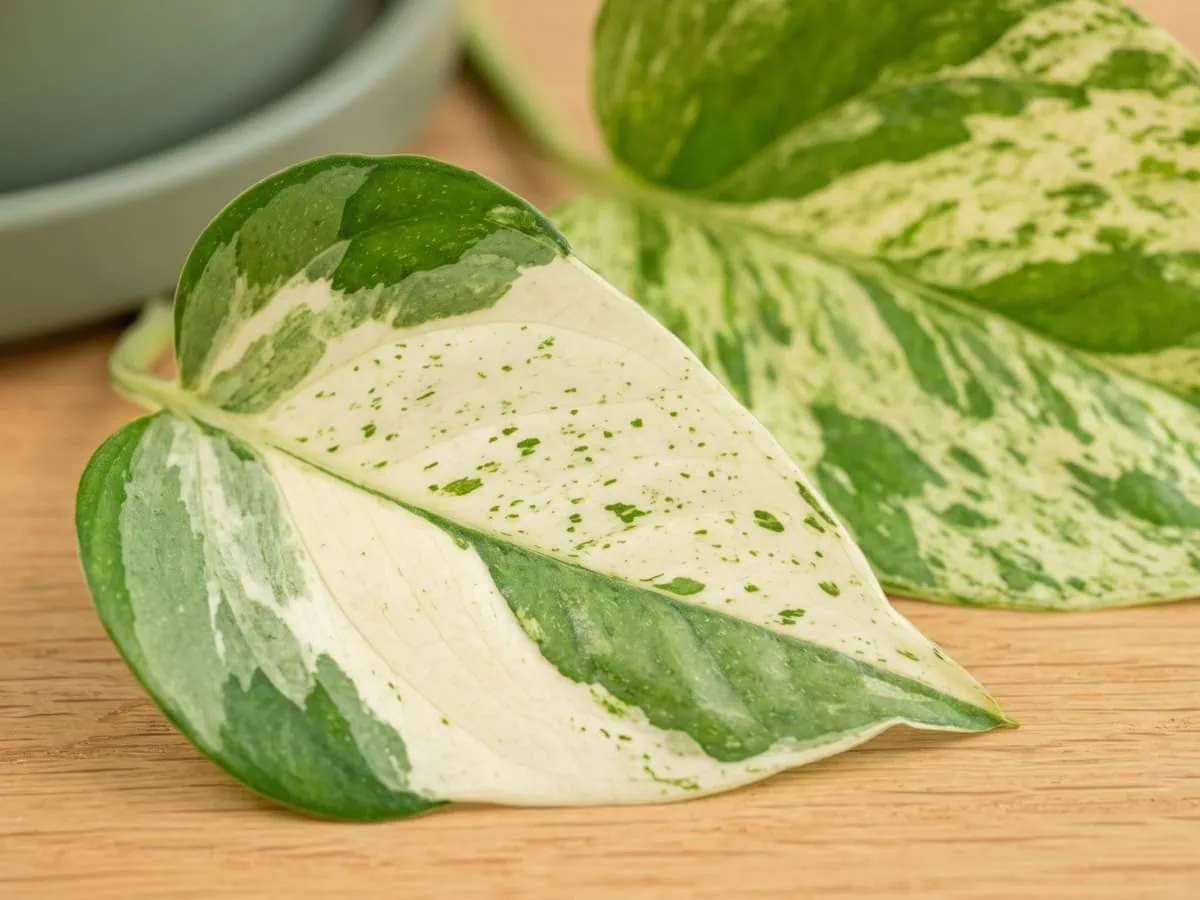
N’Joy and Pearls and Jade are separate registered cultivars, not one plant filed twice. The flecking test settles them: N’Joy’s cream blocks are clean, and Pearls and Jade’s white shows green within it.
A widely republished source presents N’Joy and Pearls and Jade as one plant. They have separate registry denominations, their blade outlines differ, and only one bears green flecks within its pale sectors.
One more separation. A pale block that has gone yellow across a whole leaf is not a pattern change. That is whole-leaf yellowing that is a watering fault rather than a pattern change, and it clears when the watering does.
Check the tag: cultivar denomination and patent number
A patented cultivar has two fixed handles the shop label cannot overwrite: a denomination in single quotes and a plant patent number. Both stay put. And the trade wording printed above them is still chosen by whoever made the tag.
- Denomination — the registry-bound identifier, such as Pearls and Jade’s ‘UFM12’.
- Patent number — a PP-prefixed string; catalogs transcribe these inconsistently.
- Where it fails — long-established cultivars have no number at all.
Where two catalogs print different patent numbers for one cultivar, trust the denomination — it is the steadier of the two handles.
Confirm a Neon and read variegation that has drifted
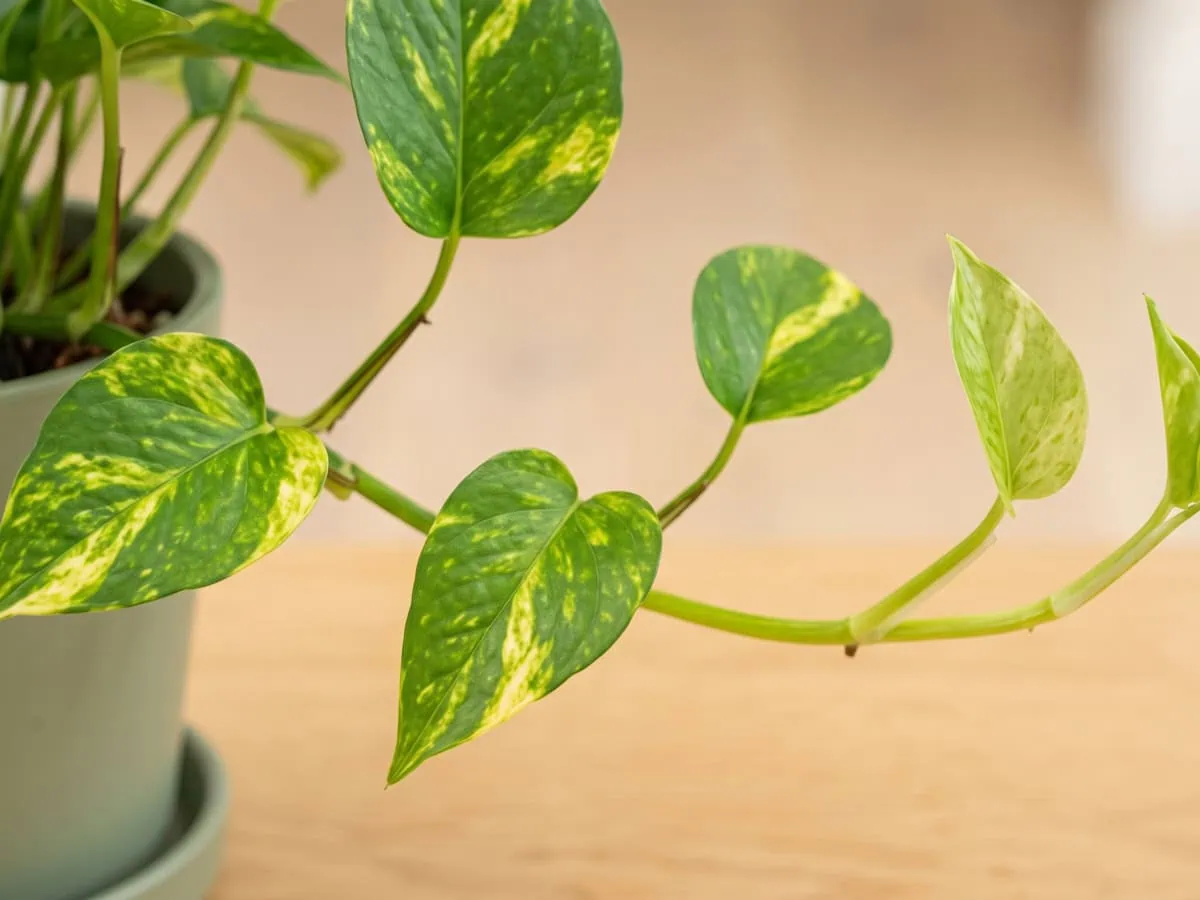
A Neon Pothos carries no variegation at all — the whole blade is one color, pale yellow-green on new leaves and chartreuse to lime once they mature. Two colors on one blade means it is not a Neon.
What is left: confirming a Neon, reading a pattern that has drifted, and whether variety changes the routine at all.
What a true Neon looks like at every leaf age
Search “how to identify a neon pothos” and you get photographs of mature foliage, which is only half the plant. New leaves emerge pale yellow-green, then darken toward chartreuse as they harden.
Two marks confirm it:
- Slender blades — thinner than the other cultivars, on a plant that tolerates lower light than the white-heavy ones.
- One color at every age — no second color anywhere, on new blades or hardened ones.
The near neighbor is ‘Lime’, a yellow-green cultivar that reads much the same in a photograph and separates on tone rather than on pattern.
A shoot that turned plain green will stay green
The question “why is my variegated pothos reverting to all green” has one answer: that blade will not change back. Brighter light reaches only leaves opening after the move.
The reason sits in the tissue. Cream and white sectors carry almost no chlorophyll — about 0.02 milligrams per gram against 7.26 in green tissue — and cannot photosynthesize.
I have watched this on a schedule. Near the 50 foot-candle floor each new leaf opens smaller and greener; at 150 foot-candles, size and color steady.
I’m still figuring this out: why one shoot bears more pale tissue than another.
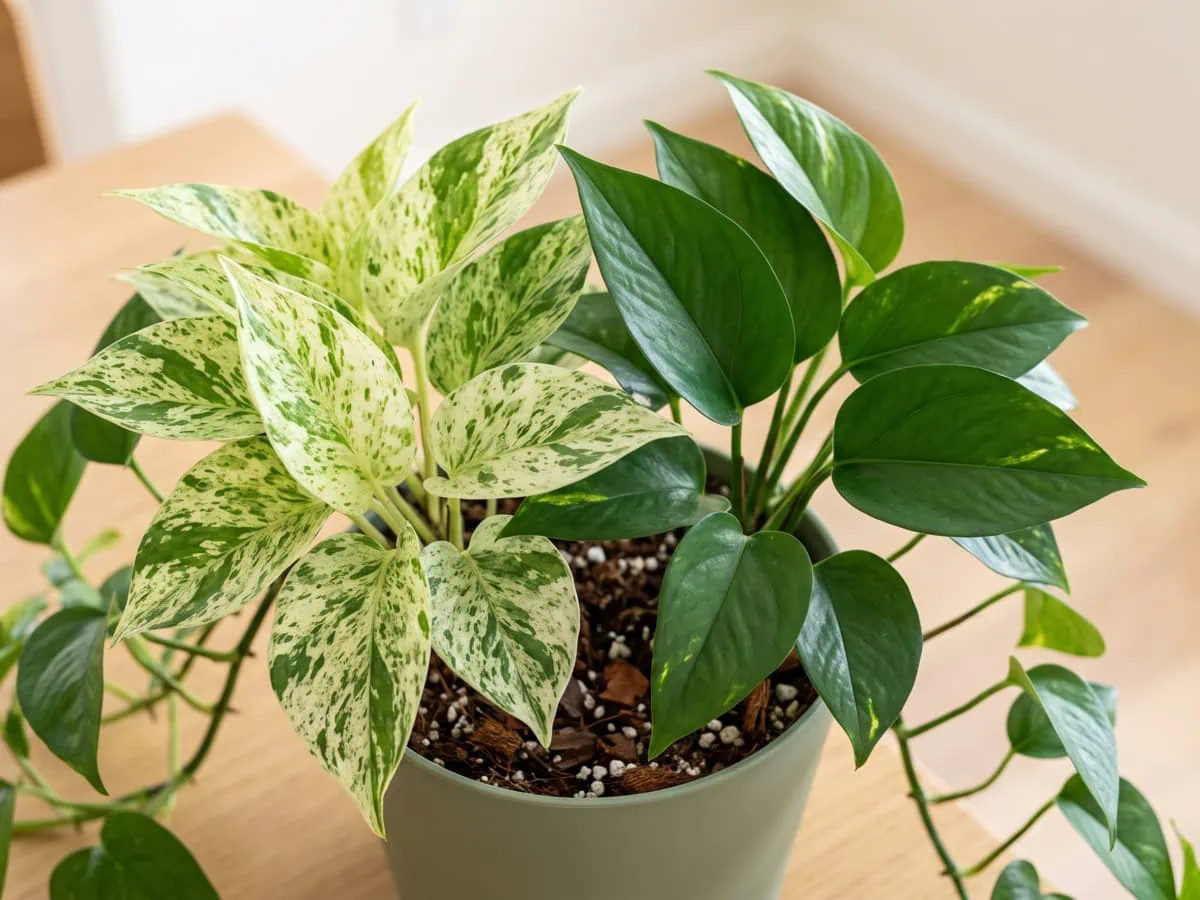
So cut a reverted shoot at its base before it outgrows the patterned growth — the pattern travels with the branch, and taking a cutting from the branch whose pattern you want is the trick.
Choose the cutting, not the care routine. A new plant’s pattern is settled at that moment.
Does the variety change how you grow it?
Mostly no. Two things shift with the cultivar and nothing else does, so “do different pothos varieties need different care” has a short answer:
- Light — the more white tissue a blade carries, the more light it needs to hold its pattern.
- Growth rate — Neon grows quickly, Marble Queen outpaces Snow Queen, and Manjula runs slower.
- Everything else — water, mix, temperature and feeding do not change by cultivar.
Do not read that as a ranking by brightness. The usable comparison keeps conditions constant: two plants under one light level differ in how much pale tissue each retains. The numbers sit in how much light a pale-leaved cultivar needs to hold its pattern.
Frequently asked questions about Pothos varieties
How do I tell what type of pothos I have?
Read four characters in order: pale-tissue color family, boundary sharpness, green flecking, and blade size. Color family splits the whole lineup in two, cream-white against lime-yellow. Boundary sharpness separates hard-edged blocks from diffuse marbling.
Flecking within the white settles the closest pair. Blade size confirms it, since dimension shifts least with growing conditions — measure along the midrib, where indoor blades run 3 to 6 inches.
Can different pothos types be mixed?
Yes. One container takes several cultivars, provided you match two things beyond simple room to grow: how much light each needs to keep its pattern, and how fast each one runs.
Mismatch either and the container shows it within a season — a faster cultivar buries a slower one, and a white-heavy cultivar set for a green neighbor fades.
Pair from one color family and the planting fills in evenly.
What is a rare pothos type?
The specialty end of the lineup is the newer patented sports, not the long-established ones. ‘Shangri La’, with dark green leaves that curl and point inward, is the least commonly stocked of the documented cultivars.
Two more selections circulate in the trade — ‘Glacier’ and ‘Global Green’ — that no botanical garden or extension service profiles at all. That absence is itself the clearest signal of specialty status.
Which pothos has the most variegation?
‘Snow Queen’ has the most pale tissue of the common cultivars: predominantly white leaves speckled with green. It shows less green surface than ‘Marble Queen’, which is its closest neighbor on that axis. The pale tissue comes with a light demand to match, because white sectors contain almost none of the chlorophyll that green tissue supplies and cannot photosynthesize on their own.
What is the most popular pothos variety?
‘Golden’ is the most widely stocked cultivar, and the only one sources call outright easy to find. Horticultural guidance places it in most garden centers and nurseries, often under another label — Devil’s Ivy or Hunter’s Robe are the two you will meet most — which is part of why shelf wording is unreliable. Its foliage is the reference point for the whole lineup: heart-shaped blades patterned green and gold.
Are all pothos the same species?
No. Plants sold under this common name span three separate groups, not one species. The first is Epipremnum aureum, with its dozen or so cultivars.
The second is a sibling species in the same genus, Epipremnum pinnatum, which supplies Cebu Blue, Albo and Skeleton Key. The third sits outside the genus entirely. Knowing which of the three groups you own matters more than the cultivar does.
Are all pothos Epipremnum?
No. The satin pothos sold beside them belongs to Scindapsus, a separate genus entirely. Silver Streak is Epipremnum amplissimum, a sibling species, rather than Epipremnum aureum.
The common name travels across all of them because of taxonomic history: Epipremnum aureum was itself once filed as Pothos aureus, then Scindapsus aureus, then Rhaphidophora aurea. Old labels still carry those synonyms, which is why the word on the tag does not track the genus.
What is the prettiest pothos plant?
That one has no botanical answer, though the green-to-white ratio is the axis that decides it for most growers. More white tissue reads brighter and more dramatic, running ‘Snow Queen’ ahead of ‘Marble Queen’ ahead of ‘Pearls and Jade’.
Less white reads plainer and forgives more, with solid-green ‘Jade’ at that end. Pick the look you want, then place the plant where that ratio can last rather than fade.
Troubleshoot, assess, fix — the four-character test
The store tag was never going to settle this. Four characters will, in this order: color family, boundary sharpness, flecking, blade size. Every time.
Let the next leaves open and the picture settles: the cream sectors stop drifting in size, and a boundary that read smudged in a dim corner comes up crisp beside a bright window.
The next question most growers then hit is whether the plant is a pothos at all. A separate genus wears the same label, so that comparison deserves its own guide.
Put the gallery away. How to identify Pothos varieties is settled at a bright window, by four readings taken off one hardened leaf in a fixed order — nothing on a screen improves on that. An unlabeled pothos stays unlabeled only until somebody looks into the pale tissue instead of at it.
Tap the button below to get more plant fixes in your Google Search results