🚨 Emergency 30-Second Answer: brown marks on a Pothos
Put the scissors down first: Epipremnum aureum, a member of the Araceae family, browns from four separate causes. A 7-10 day recheck separates them. Why does my Pothos have brown spots? The mark’s own texture, position and behavior answer that.
Soft and water-soaked means a wet medium. Bleaching on one side points to direct sun. A crisp tan tip means salt or supply water. A dark center ringed pale and still widening signals a living infection.
Fix the condition first, then judge the result on new growth, never on the old marks.
- Move it out of direct sun: shift it clear of the afternoon beam today
- Keep the blades dry: never let foliage stay wet past 6 hours
- Flush a crusted pot: pour through to free drainage, then repeat once
- Limit removals: no more than a third of the foliage at once
- Recheck at 7-10 days: clean new growth means the mark has stopped
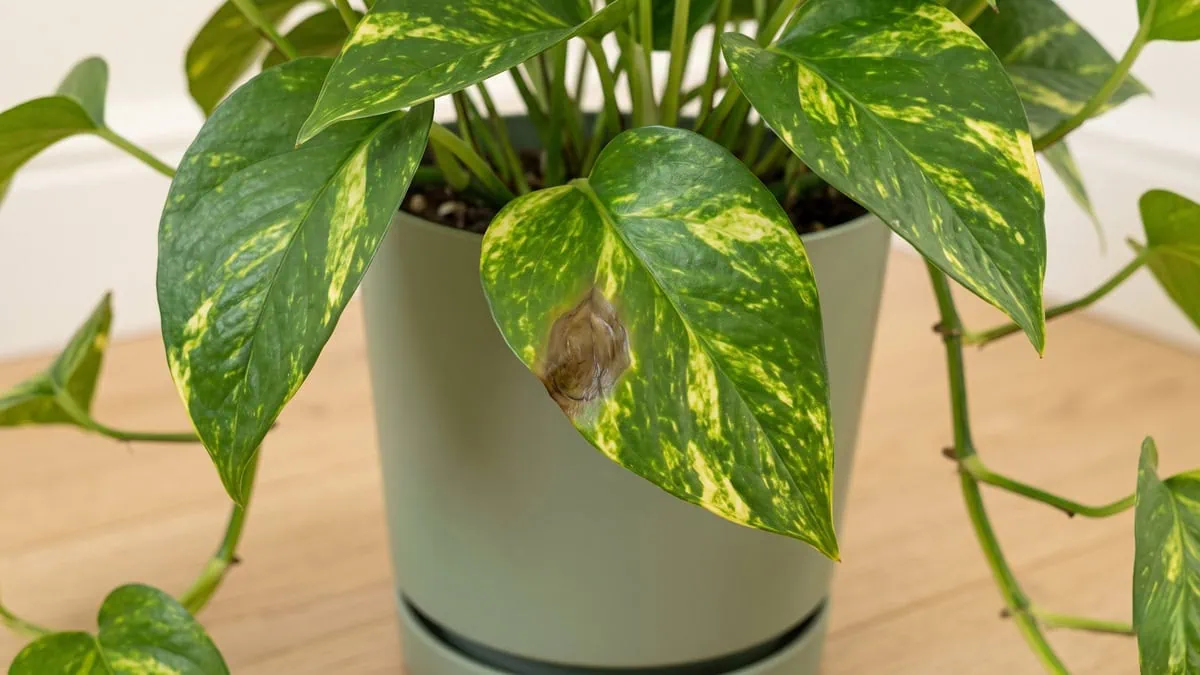
The blade in my hand carried a dark, water-soaked patch the size of a thumbnail, ringed by a thin pale halo. I moved the plant off the windowsill and felt responsible. The patch widened anyway.
I assumed a mark was a mark — until that widening taught me that a bacterial front keeps eating into living tissue while a sun burn is dead tissue that cannot travel. So read the mark before you move the plant. Necrotic spots, brown leaf tips and a bleached patch each demand a different correction.
Four causes, one blade, one correction that has to be right. For everything upstream of the mark, start from what governs a healthy blade in the first place.
The blade in your hand is already telling you which of the four causes it belongs to. One table below turns that mark into a reading you can act on.
Why does my Pothos have brown spots? A quick mark-reading card
| What to check | What it tells you |
|---|---|
| Does the mark have a yellow ring? | Yes points to a pathogen, but it never confirms one alone |
| Is the mark still enlarging after the plant was moved? | Yes means a living infection; no means fixed, finished damage |
| Mark texture | Soft and water-soaked, or dry, papery and brittle |
| Mark position on the plant | Lower older blades, the light-facing side, or mid-blade |
| Time from a light move to visible bleaching | 2-3 days: pale first, then brown and brittle |
| How long foliage may stay wet after watering | Under 6 hours; dry blades stop a lesion spreading |
| Room humidity preference | 50-70% relative humidity, though this vine tolerates drier air |
Tap the button below to get more plant fixes in your Google Search results

Table of Contents
Match the mark to its cause before moving the plant
Four mark classes appear on this vine, and the following sections separate them by texture, position and timing.
Do not move the plant, cut a blade or change the watering until you have read the mark itself. A wrong correction wastes weeks of growth. It also destroys the evidence you need.
Soft, water-soaked marks on lower older leaves
Soft, dark marks on the lowest, oldest blades point to a wet medium, not a pathogen. Press one. Water-soaked tissue gives under a fingertip and looks glassy; a dry mark crackles.
Read the medium before the leaf. The top 1-2 inches must be dry before you water again. A blade that slides from a yellow margin to brown, and then to black at the leaf base, is reporting roots that can no longer drink.
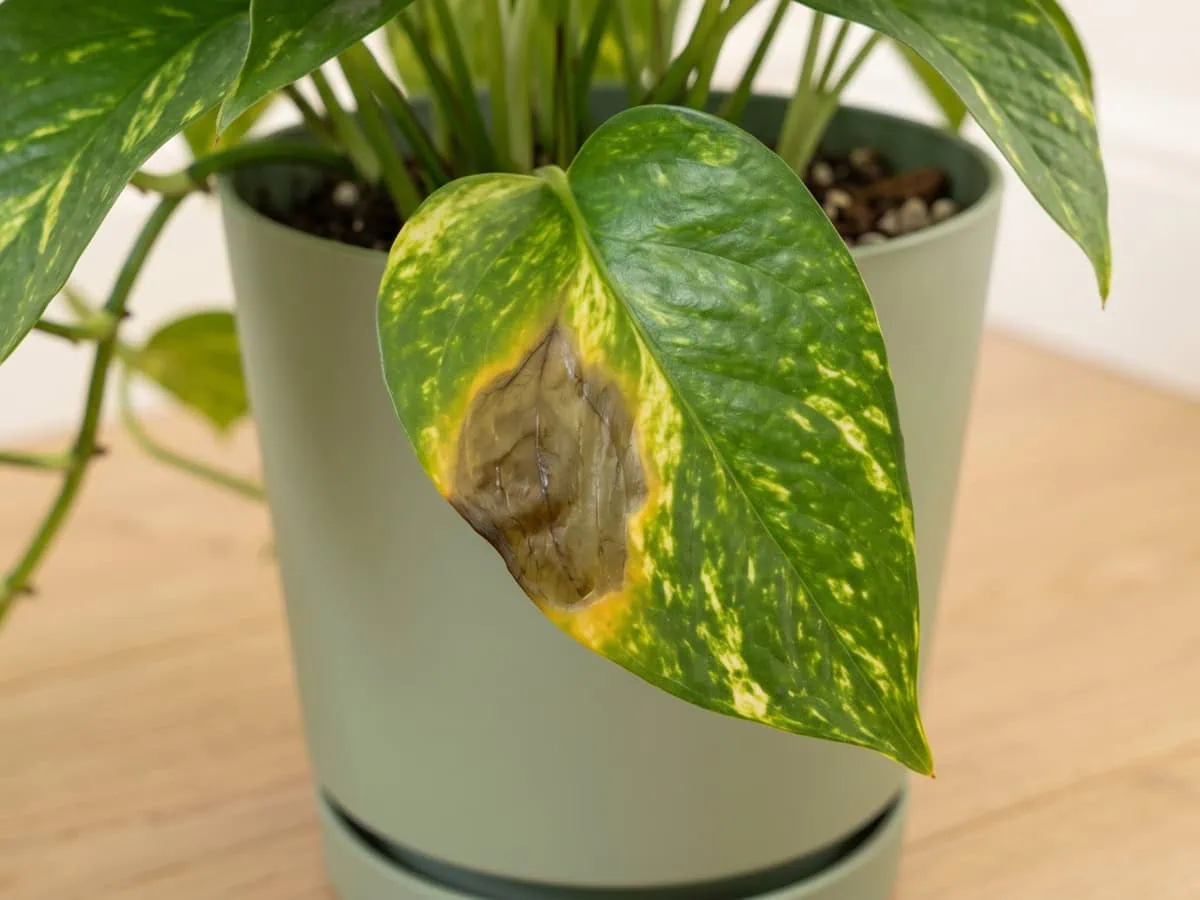
Phytophthora root rot turns Pothos leaves dark brown to black from the roots up. Soft roots send the job to a root system that has gone soft in a saturated medium.
Bleached patches on the side facing the light
Scorch lands on one side. Pale, bleached areas appear on the surface that faced the window, then turn brown and brittle within 2-3 days.
Searchers keep asking “are brown spots on pothos caused by too much sun” and want a yes. The plant answers better. Sun damage sits on the light-facing half and skips the shaded half.
Shift it clear of the afternoon beam today. The exact setback waits in how far back from the glass this vine belongs.
Crispy tips: salt crust or supply water
Crisp tan tips are a margin problem, not a spot problem. Check the pot rim.
The “why does my pothos have brown crispy leaf tips” question splits two ways, and the pot rim decides which. Hot dry air and erratic watering crisp tips too.
| Where the evidence sits | Which cause it names |
|---|---|
| Crusty white deposit on soil or rim | Salt accumulation |
| Clean rim, brown streaks along the veins | Minerals in supply water |
Verdict: Choose the salt reading for a crusted rim, because concentrated salts burn tip tissue first; a clean rim with vein streaks means supply water.
Then flush. Pour through until water runs free, and repeat once. Flushing only clears salt through a chunky mix that drains instead of staying sodden.
Tap the button below to get more plant fixes in your Google Search results

Is the mark still spreading? A pathology assessment
One lesion, outlined today and re-read a week later, settles it: living infections widen, dead damage holds.
The yellow ring points; it does not confirm
A yellow ring narrows the field. But it does not close it. Bacterial marks read black-brown with a thin yellow border, and that border creeps outward while a scorch mark stays exactly where it started.
Every result behind “dark brown spots with a yellow ring on pothos leaves” reads the ring as proof. Three traits must travel with it: sunken and water-soaked rather than dry, present on more than one blade, and enlarging.
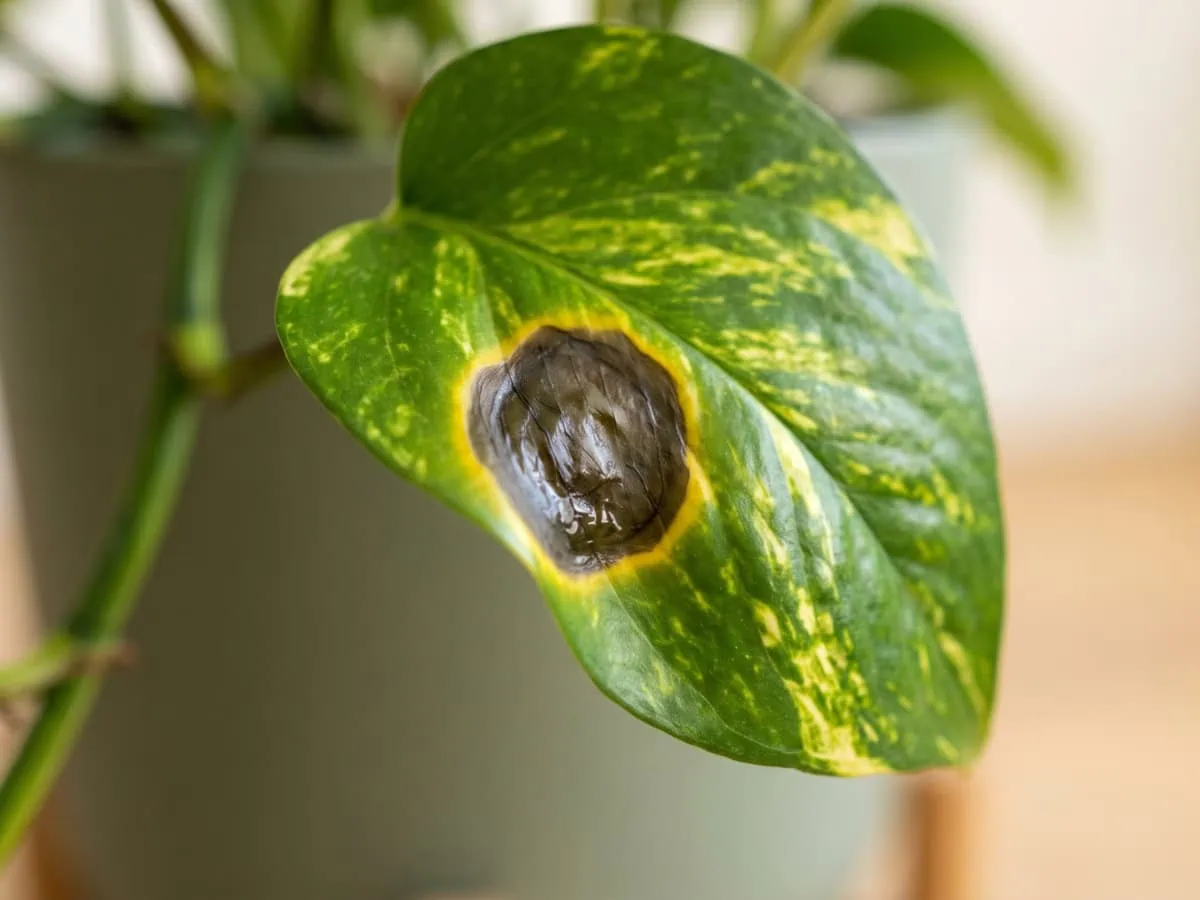
According to UF/IFAS Extension, bacterial wilt disease turns up mostly in commercial production, not on a windowsill. Marks at home get called infection far more often than they earn it.
The 7-to-10-day check that says it stopped
Existing damage never turns green again. That is not failure. Judge the correction on clean new growth instead, and give it 7 to 10 days before you read the result.
In my testing across indoor rooms, the marks that had truly stopped simply sat there while fresh blades came in unmarked. Blades already lost drop on their own over weeks, so let them fall rather than pulling them off. Uniform yellowing across whole blades is a different fault, covered in blades going uniformly yellow instead of marked.
One threshold ends the waiting. If marks reach more than half of the new growth within 7 days despite the corrections, stop reading and escalate.
Still spreading: what to cut, what to leave
Cut by class, not by appearance. A mark that has stopped can stay on the plant. Leave a partially marked blade in place unless it is more than seventy percent gone, and remove no more than a third of the foliage in one session.
An advancing mark is the opposite case. Searching “how to treat bacterial leaf spot on pothos” returns endless spray lists, and the published answer is removal. Pick off and destroy spotted blades while they are dry, and disinfect the blade between every cut with a 10% bleach solution or alcohol.
Not the brown margin alone. Trimming the edge off a blade that still carries an advancing front opens fresh wounded tissue on a plant the pathogen is already moving through. Wet foliage is what that front depends on.
Common mistakes that keep the marks coming back
Every correction above can be undone by one of three reflexes, each named below with its replacement.
Misting to fix brown edges
Wetting the blades is the correction that feeds the problem. Water sitting on a leaf surface is what a bacterial or fungal front needs to enter and travel.
Ask a search engine “why does my pothos have brown edges on the leaves” and misting tops the answers. Route the water to the base instead. Blades must be dry again within 6 hours.
Air movement finishes the job. Space the plants, run a small fan, and let the surface dry between waterings.
Wiping living blades with a household oxidizer
Keep household oxidizer solutions off living blades. Their place is an emptied pot or a cutting blade, where they act on an inert surface, not leaf tissue.
Ordinary dish detergent is no safer. Household soaps damage the waxy cuticle, and that damage shows as discoloration and browning — a second brown mark over the first.
Plain lukewarm water on a soft cloth is the whole method. Across years of wiping dust off these blades, I have never seen plain water harm one.
Cold-shock patch or pest stipple, misread as disease
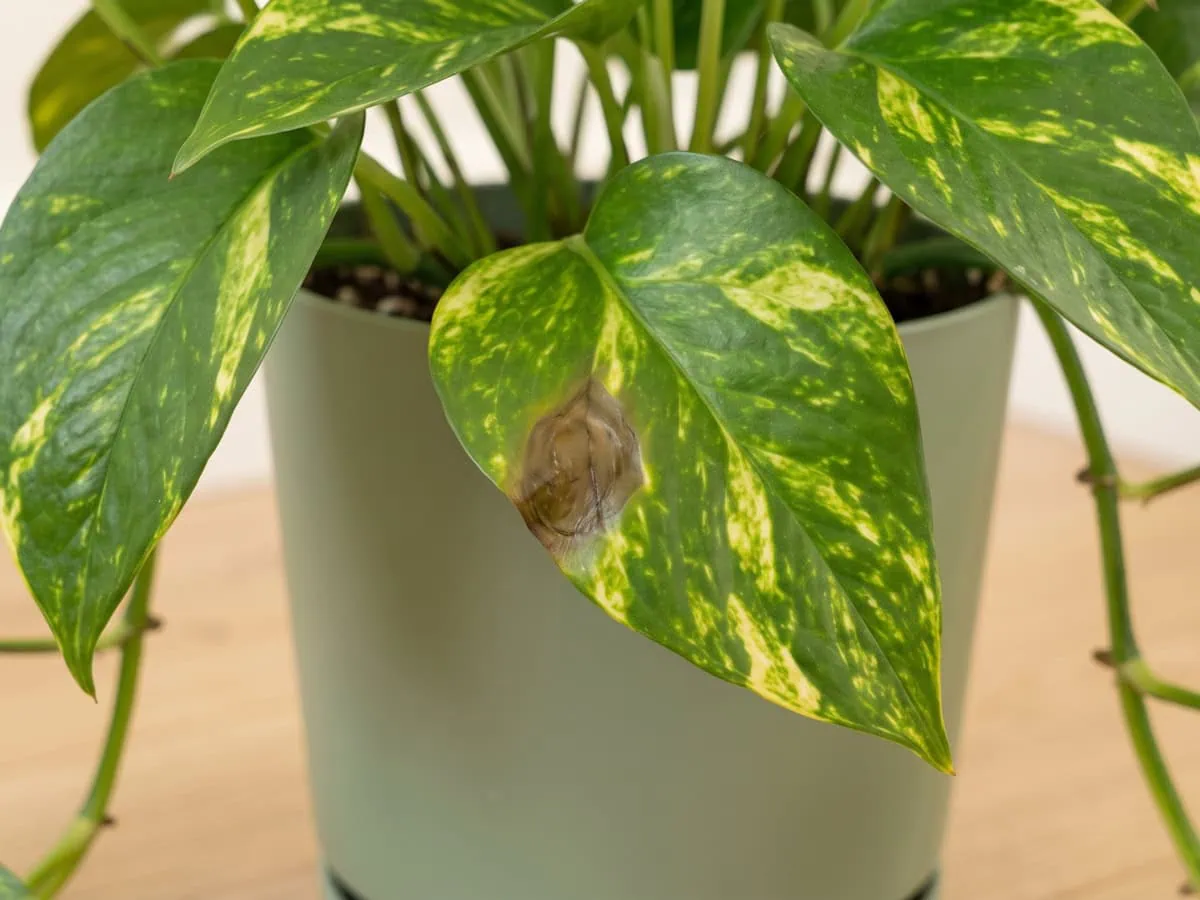
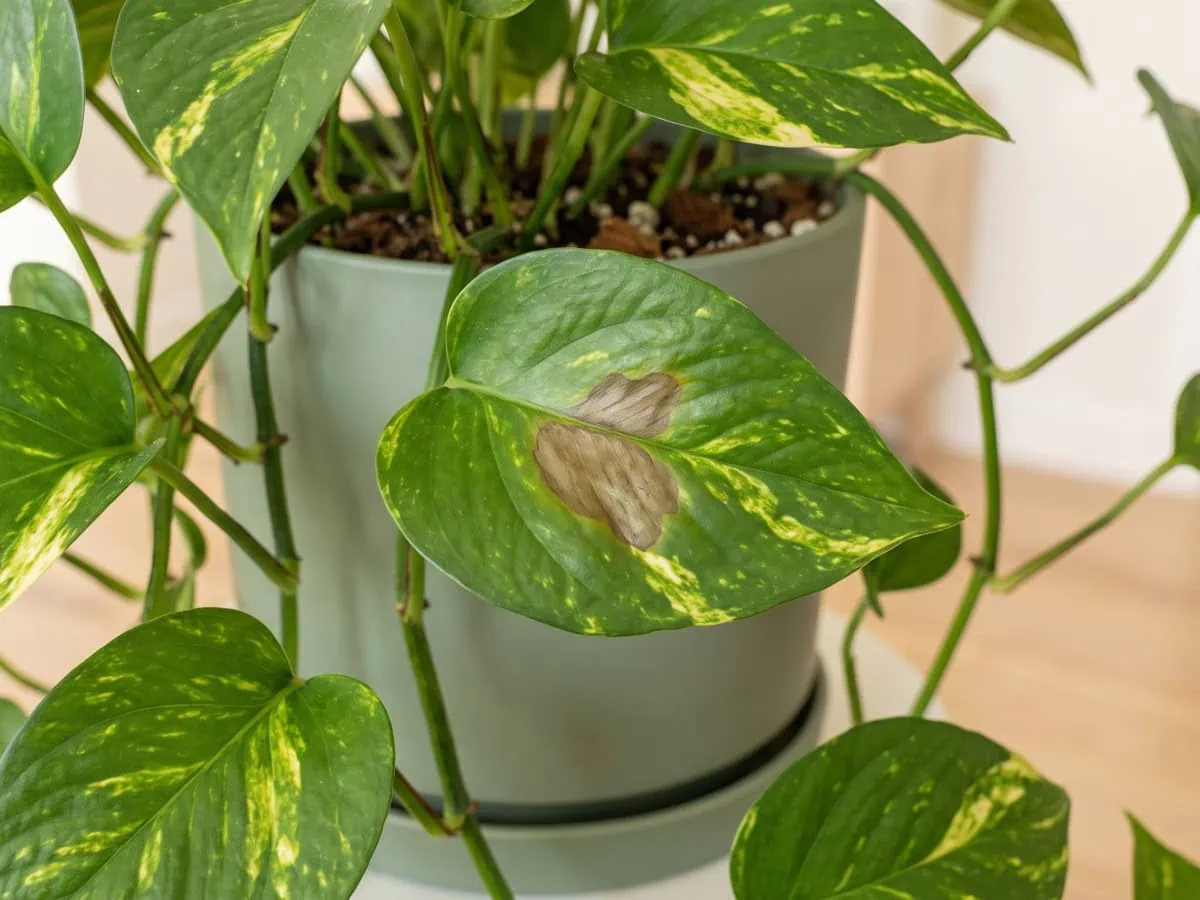
Two look-alikes get filed as infection. Neither is. A cold-struck patch sits mid-blade, irregular and darkened to a bruised brown against tissue that stays green right to its edge.
Growth stalls below 60F, and chilling injury runs from 32F to 55F. That damage is permanent.
Pest damage reads differently. Fine pale specks scattered across a blade, with webbing beneath, point to sap-feeding insects rather than a pathogen.
| What you see | What it is |
|---|---|
| Irregular mid-blade patch that never widens | Cold shock |
| Fine pale specks with webbing beneath | Sap-feeding pests |
Verdict: Choose cold shock for a mid-blade patch that never widens, because an episodic chill kills a fixed block of tissue instead of advancing through it. Webbing sends the job to the pinprick stippling sap-feeding insects leave behind.
Frequently asked questions about brown marks on Pothos
How to get rid of brown spots on Pothos?
You cannot remove an existing mark; you correct the condition that made it. Existing damage never re-greens. Judge the plant on the blades that open next.
Dry the top 1-2 inches before watering. Keep foliage dry within 6 hours and keep the pot out of the afternoon beam. Flush a crusted pot, then look for clean new growth at 7 to 10 days.
Should I cut brown spots off Pothos?
No. A blade under seventy percent damage still feeds the plant, and stripping past a third of the foliage at once sets growth back further than the marks do.
Cutting the brown out of living tissue opens a fresh wound, and on a blade carrying an advancing front that wound is an entry point. Marked blades drop on their own; let them fall.
Should I cut off leaves with brown spots?
No. Whole-blade removal belongs to one class only, the mark that is still enlarging, and there it limits spread rather than tidies the plant.
Pick those blades off while they are dry and destroy them well away from the pot. Disinfect the cutting edge between every cut. Anything that has quit widening is spent tissue, and spent tissue harms nothing.
Do brown spots on leaves mean overwatering?
Water excess is the most common cause on this vine, but it is not the only one. Direct sun bleaches the light-facing half. Salt accumulation crisps the tips.
A chill mark sits mid-blade and never widens, and insects that draw sap leave fine pale specks instead of a lesion. Texture sorts them: soft and water-soaked reads wet, dry and papery does not.
What does fungus look like on Pothos?
Fungal leaf spots read as tan to reddish brown to black, roughly circular lesions that merge as they grow. Powdery mildew looks different: small white spots that spread into a thin white film across the surface.
A bacterial mark is water-soaked with a yellow margin. Surface growth you can wipe away is not a lesion inside the tissue at all.
What causes brown spots on indoor plants?
Six causes make up the sorting set to work through indoors: water excess, direct sun, salt accumulation, minerals in supply water, chilling, and sap-feeding pests. Pathogens are the smallest share and the most over-called.
The sorting sequence stays the same whichever plant you happen to be holding. Read texture first, then position on the plant, and then whether the mark is still moving.
How do you fix brown spots on leaves?
Each mark class takes its own correction, so route by cause rather than running one checklist. A wet medium needs a longer dry-down. Direct sun needs distance from the glass.
Crusted salt needs a flush, and a lesion that is still widening needs dry foliage plus removal of the worst blades. Match the fix to the class, and the next blades open without a mark.
Your next step: from guessing at the mark to reading it
You can read a mark now. The next blade that opens is the one that tells you whether it worked. It should come in unbroken green from midrib to margin, with no pale rim and no sunken center.
What comes after this is keeping those blades clean: light level, watering rhythm, the mix underneath.
Read first. So the next time the question is why does my Pothos have brown spots, take the reading before you take the scissors. Your Pothos already named the cause on that blade; the only real work left is to trust that reading and to leave the snips alone.
Tap the button below to get more plant fixes in your Google Search results