🎯 Quick Answer: the mix, the ratio and the test
What is the best soil for a Pothos stalls without air: Araceae vine Epipremnum aureum needs open structure. It takes 1:1:1 coir, bark, perlite. Two of the three parts are coarse material, not fine. Then time the drain at the sink before you trust it.
- Standard dose: perlite at 30 percent of the finished mix volume
- Heavy base: raise perlite to 40 percent when the bag clumps
- Drain check: water should clear the drainage hole within 30 seconds
- Refresh: fresh medium on a 12 to 18 month cycle
- Squeeze check: a squeezed handful should break apart, not smear
Water pooled on the surface with the drainage finished, and the mix underneath had the color and density of wet cardboard. I ran pot after pot of Pothos through that same collapse inside a single year — same bagged peat moss, same schedule, same cold flat crust hours after a soak.
The bag took the blame for a year. Tipping one of those pots out ended that: the roots had never been fighting a brand. Backtrack — not the bag at all, but air they never had.
Pothos roots are adventitious — built to grip bark and drink through the same tissue — so what they read first is the air-filled pores between particles, not fertility. The fix turned out to be a ratio and a stopwatch, not a better bag, because the mix tells you plainly when it has failed.
Start with what the mix has to support day after day.
The ratio took one afternoon to settle and has not needed revisiting since. Every spec behind it is right underneath.
What is the best soil for a Pothos: the specs at a glance
| Pothos specs | Specification |
|---|---|
| Substrate | A chunky coir-based aroid mix, 1 part coco coir to 1 part orchid bark to 1 part perlite, top-dressed with a thin layer of fine orchid bark |
| Moisture-holding base | Coco coir |
| Aeration amendments | Orchid bark plus perlite |
| Target substrate pH | 6.0-6.5, with 6.2 as the working target |
| Outdoor bagged soil or yard soil suitable indoors? | No |
| Sand required for aeration? | No |
Tap the button below to get more plant fixes in your Google Search results

Table of Contents
The exact mix ratio: one part coir, one part bark, one part perlite
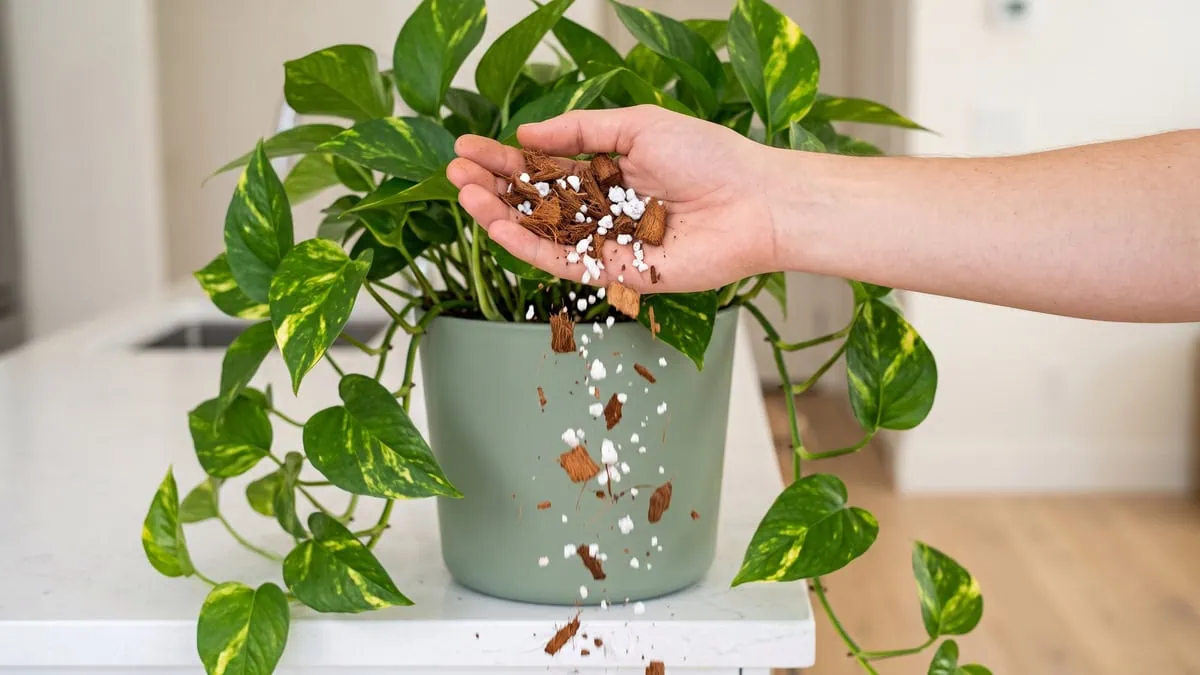
A Pothos wants two of its three parts coarse: one part coco coir as the moisture-holding base, one part orchid bark, one part perlite. That ratio beats any brand choice — it sets how much air survives the first watering.
Iowa State University Extension describes the goal as a light, porous substrate that still holds water. Coir holds the water. Bark and perlite hold the gaps — see what air-filled pores do in a potting medium.
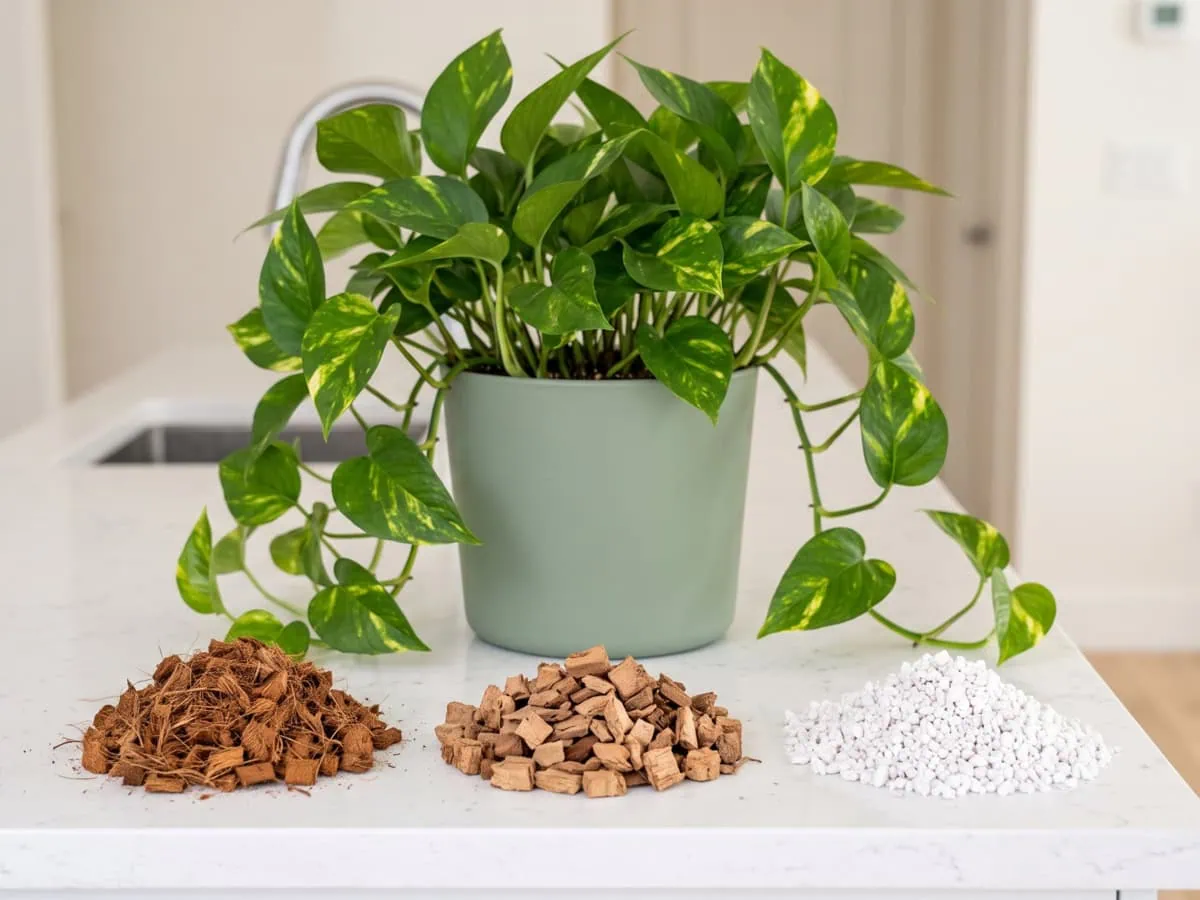
That ratio gets built two ways below: from scratch, or out of a bag you already own.
Building the mix from scratch, part by part
Search for a “best diy soil mix recipe for pothos” and the ingredient lists agree while the proportions do not. Mine is one part coco coir, one part orchid bark, one part perlite. Nothing here is exotic.
Coir is the base because it rewets more easily than peat.
The bark and perlite are not filler. They are why the pot still has air once the water has drained. Air is what the coarse fraction is there for.
Amending a bag of ordinary potting mix
“can I use regular potting soil for pothos” is the common question, and the answer is yes — once you cut it. A bagged mix is built to hold moisture, the opposite of what an adventitious root system wants.
So add perlite until roughly 30 percent of the volume is white. Add bark until the mix stops packing in your fist.
What you are buying is not a different product. Just air.
How much perlite the base actually needs
The honest answer to “how much perlite to add to pothos soil” moves with the bag. Thirty percent is the working default. That is the floor.
Push it to 40 percent when the base is heavy — dense, dark, cold to the hand out of a warm room.
A volume percentage tunes nothing on its own: two bags labeled for the same job can hold very differently sized grains, so buy the coarse grade and judge the result in the pot rather than on the label.
The pH band to aim for: 6.0 to 6.5
Aim slightly acidic, just on the acid side of neutral. No meter is needed. A peer-reviewed propagation study established Epipremnum aureum plantlets at that acidity, with a 75 percent survival rate.
A coir or peat base does not hold that band forever — hard tap water nudges it alkaline over time.
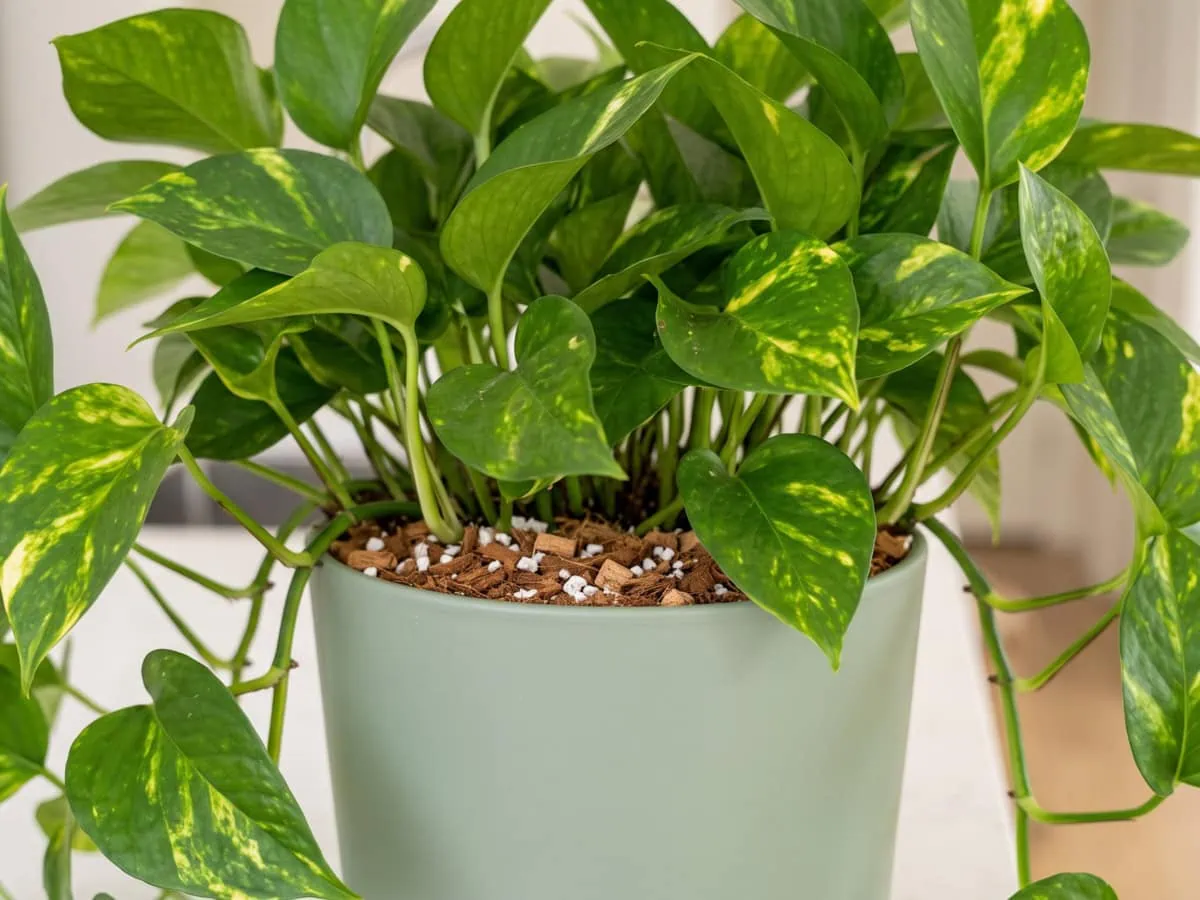
Caveat: this might be wrong for any one home, since how fast that happens depends on your water. The correction is not in doubt: a fresh mix resets the band.
Tap the button below to get more plant fixes in your Google Search results

Test the mix in the pot before you replace anything
Two checks on the pot in front of you settle whether the mix is finished: time the drain, and probe to the base. Neither asks you to unpot anything. Both take under a minute.
- A timer or phone stopwatch — the drain check is a measurement, not an impression
- A pale wooden dowel long enough to reach the pot base — it reads the lower root zone a finger cannot
The leaves can mislead here — reading curled and drooping foliage separates a thirsty plant from a suffocating one.
The checks that follow run in order, then set the replacement point.
The 30-second drain test, run the same way twice
“do pothos need well draining soil” has a measurable answer: water poured onto a saturated pot should clear the drainage hole inside 30 seconds. I run it the same way twice or the number means nothing — same pot, same water volume, same starting moisture, since a dry mix reads faster.
Time it. Fill until water shows at the hole, start the timer, stop at the first drips. Under 30 seconds the mix is sound.
But past that, the pot is holding water your roots cannot use. Pair it with a squeeze check: a handful holds its shape, then crumbles apart.
A mix that passes still has to dry down on schedule, and that is how long a chunky mix should take to dry out.
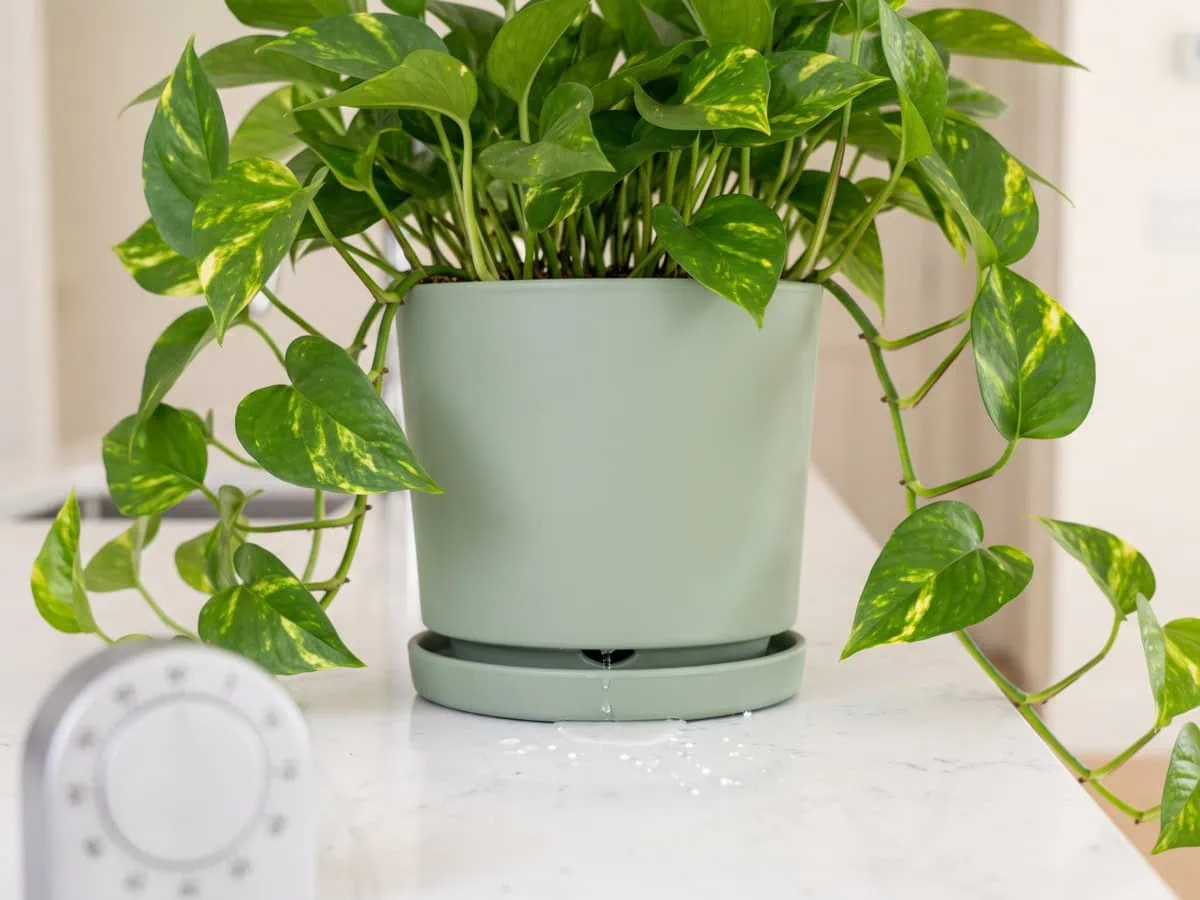
Reading a dense mix: surface drop and probe resistance
“why does my pothos soil stay compacted and dense” is two questions wearing one symptom. Settling and decomposition look identical from the surface, and they need opposite fixes.
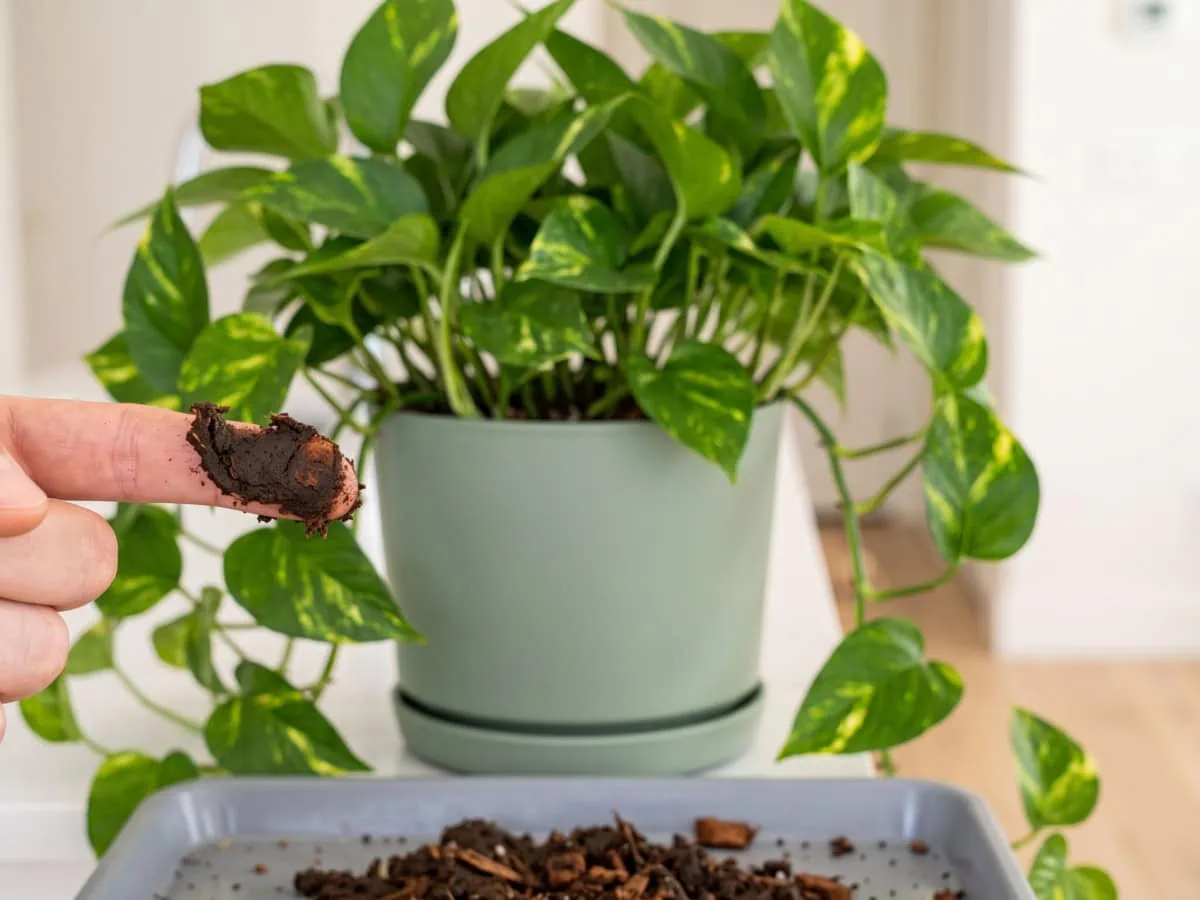
Surface first. A settled mix drops below the rim while the particles stay distinct and gritty when you rub them.
A decomposed mix drops too, but the bark has gone soft, the handful smears, and the core stays cold and clammy hours after the surface looks dry.
When to refresh: the 12 to 18 month window
Replace the medium every 12 to 18 months, and stop reading that as a calendar chore. A settled mix can be corrected at the surface: top-dress with fresh bark and perlite into the top inch. The pot buys a season.
A decomposed one cannot be rescued that way. Once the bark has broken down there is no structure left to loosen. That is the line: surface work fixes settling, and only replacement fixes decomposition.
If the roots have gone soft, that is a different job — see roots that suffocated in a mix that never dried out.
Common mistakes: what never belongs in a Pothos pot
Three materials never belong in a Pothos pot: outdoor bagged products, yard soil, and fine sand added for drainage. A fourth mistake is not a material — it is reusing the mix you removed without looking at it.
Outdoor products, yard soil, sand and spent mix each fail for their own reason.
Outdoor bagged products and yard soil
Topsoil, bagged compost, raised bed soil and yard soil all fail in a container for the same reason. Their air spaces compress. Every time.
The container is what changes, not the material.
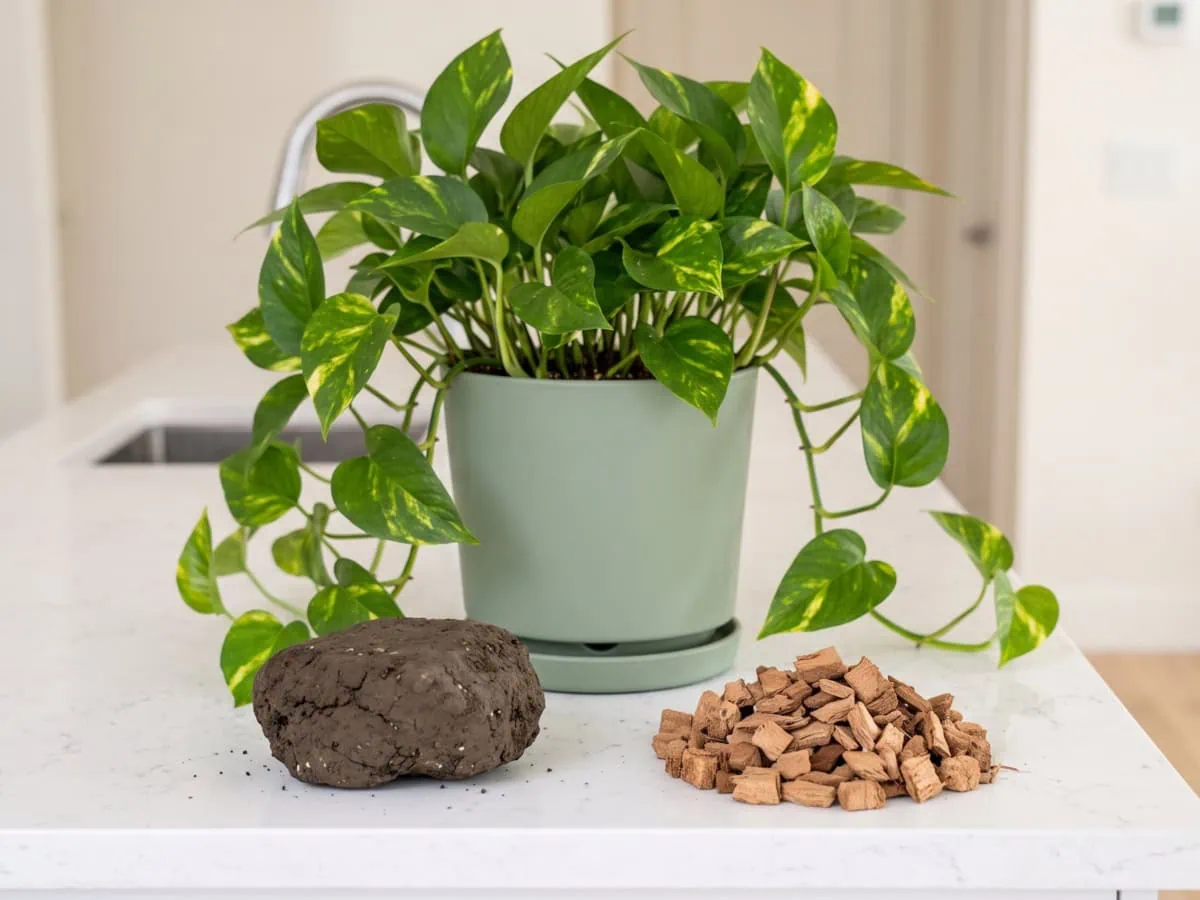
And yard soil adds a second problem: it arrives with whatever was living in it. It also arrives cold and heavy, and stays that way long after a chunky mix drains.
Read the label: if it names beds, borders or lawns, it is not for your pot.
The sand split: named as aeration, blamed for failures
Sand is the one amendment the sources genuinely disagree about: some guides list it as an aeration ingredient in its own right. Others leave it out of every measured recipe, and one records sandy mixes as a documented failure.
What settles it is grade, not the ingredient name. Size decides it. Buy the coarse grade of the bark and perlite you do use — then confirm it landed by running the drain test again, because a tightened mix shows at the sink long before it shows on the plant.
Sand is often named as an aeration ingredient for houseplants. In a container it usually is not one. Iowa State University Extension notes that sand’s reputation for drainage comes from open ground, and cautions against extrapolating that performance to a pot. Build the aeration from orchid bark and perlite instead.
Reusing spent mix without checking it first
Medium from a plant that had root trouble is never reused — beyond that case the sources go quiet. Run the same two checks on the old mix before it goes anywhere near a fresh pot.
Look first. If the bark still has edges and the handful separates when you open your fist, the material is structurally intact. But if it smears, the organic fraction has broken down and nothing you stir in will restore it.
Where it passes, hold it to a third of the new pot — fresh mix makes up the balance. That is the ceiling I work to.
The repot itself is its own procedure, and moving the plant into a fresh pot without stalling it covers the handling.
Frequently asked questions about Pothos soil
Once the ratio is set, growers land on these.
What should I repot my pothos in?
An aroid mix beats a bagged houseplant soil straight off the shelf. Coco coir supplies the moisture the roots draw between waterings, orchid bark and perlite supply the air.
Size the new pot to the root mass you actually have — a wide gap of wet, rootless medium around the ball stays saturated, and that is what rots roots. Step up one size, not three.
Do pothos like potting mix?
Yes. Epipremnum aureum is a soil-rooted climber, not a true epiphyte, so it belongs in a pot of medium rather than mounted on bark.
The catch is that a bagged mix is formulated to stay damp, while this Araceae vine roots in airy forest litter. Open it up. Two of the three parts must be coarse enough to keep gaps between the particles.
Is standard potting soil good for pothos?
Standard potting soil works only as a base, never as the whole medium. A standard bag holds more water than a Pothos root system can use, and it tightens as it settles.
Amend it and the same bag is fine. Roughly a third of the blend wants to be perlite, with bark carrying the structure. What people call a soil problem is nearly always a ratio problem.
Do you need to add perlite or bark to potting soil for a pothos?
Both, and they are not interchangeable. Perlite is the volume amendment: it scatters air pockets right through the blend, and it is the one you raise on a dense base.
Bark is the structural one, and it is what stops the blend packing down in your fist. Neither alone does the job. Use both, and start near a third perlite by volume.
Can you reuse old potting soil when repotting a pothos?
Sometimes, and only after an inspection — never from a plant that had root trouble. Take a handful of what came out and close your fist.
Distinct pieces that break apart again mean the structure held. A paste means the organic fraction is spent, and stirring in fresh perlite will not bring it back.
Even sound material remains a minority ingredient — one part carried over to two parts fresh.
From blaming the bag to building to a ratio
What changed for me was not a product. It was a number. Once the drain had one, each later decision got easier.
So build the ratio, run the test twice, and let the pot report its condition rather than leaving you to guess at what it is doing. A sound mix gives that away — the coir keeps a cool weight in the hand the morning after a pour. The next question is timing.
Get what is the best soil for a Pothos settled early, and how long the mix stays damp answers itself. Time the drain once, and the bag you were blaming turns into a mix you can build to a ratio.
Tap the button below to get more plant fixes in your Google Search results