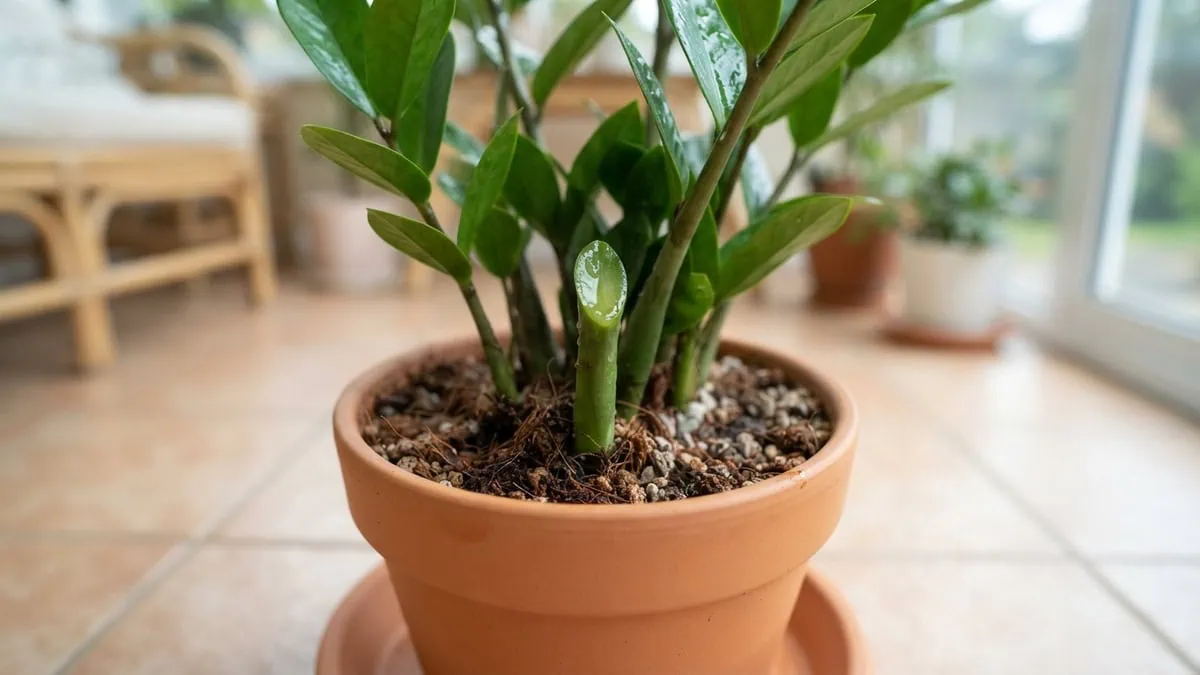
🎯 Quick Answer: Is a ZZ plant toxic to cats and dogs?
Yes, a ZZ plant is toxic to both cats and dogs, but only at a mild-to-moderate level. Zamioculcas zamiifolia, an aroid in the Araceae family, packs needle-like calcium oxalate crystals that sting on contact. The reaction stays local and self-limiting rather than life-threatening.
For years I pruned and divided my ZZ plants bare-handed, and more than once a careless cut left my fingertips stinging and faintly numb before it ever occurred to me to ask why. The leaflets looked so polished and harmless — thick, deep-green, and glossy enough to throw back the light like plastic.
Those years of that “the sap is harmless” failure forced me to learn how a ZZ leaf is actually built. Backtrack: it is not a poison you absorb. It is a packed load of needle-sharp calcium oxalate crystals, called raphides (low-key baffled I got that wrong for so long), that stab any mouth or finger that crushes the tissue.
The reassuring part: this is a mild, local irritation, not a lethal one, and a calm few-minute response settles almost every case. Learn what the crystals do and where to stand the plant, and a “toxic” houseplant becomes a perfectly keepable one — the same way getting a feel for how this aroid is grown indoors makes the rest of its care click.
Quick story: the day I finally read the toxicity facts side by side, the fear turned into a plan. Everything you need sits in the table below.
Is a ZZ plant toxic to cats and dogs? Safety at a glance
| ZZ plant specs | Recommended care |
|---|---|
| Pet safe? | No – toxic to cats and dogs (ASPCA; insoluble calcium oxalate raphides) |
| Toxic principle | Insoluble calcium oxalate raphides (needle-like crystals) |
| Toxic parts | All parts hold it; leaves are the accessible part; sap is the vector |
| Life-threatening? | No – ASPCA classes these exposures as not life-threatening |
| Human toxicity | Immediate oral burning plus stomach upset; self-limiting |
| Skin contact | Contact dermatitis: Yes. Phytophotodermatitis: No |
| Airborne risk? | No – the crystals act on contact and on ingestion |
| Emergency contact | ASPCA Animal Poison Control 888-426-4435 (24 hours) |
Tap the button below to get more plant fixes in your Google Search results

Table of Contents
What is actually in the sap, and why does it burn?
The sting a ZZ plant delivers is mechanical, not chemical – its cells are stuffed with microscopic crystals that physically jab any tissue that crushes them. According to the ASPCA Animal Poison Control Center, the leaves, stems and stalks hold needle-like crystals called raphides, and chewing releases them into the mouth.
Nothing here is absorbed like a drug. The damage happens at the point of contact, in the split second of the bite. It never reaches the blood.
- Calcium oxalate: a hard mineral salt the plant crystallizes and stores inside its tissue.
- Raphides: bundles of those crystals, shaped like fine glass needles.
- Crystal idioblasts: the specialized cells that hold the needle bundles until something ruptures them.
Insoluble vs soluble oxalate: the crystal-form mix-up
The “do ZZ plants have calcium oxalate crystals” question has a subtler answer than most pages give. Yes – but of the insoluble kind, and that word changes everything.
The crystals stay solid needles that never dissolve into the blood, so they cannot reach an organ the way the soluble, dietary oxalate in spinach can. The sting climbs on a clock, too: faint in the first second, then sharp within a minute as more needles work their way in.
| Feature | Insoluble oxalate (ZZ plant) | Soluble oxalate (spinach, rhubarb) |
|---|---|---|
| Form | Solid, needle-like raphide crystals | Dissolved in the plant’s fluids |
| How it harms | Stabs and irritates on contact | Absorbed; can bind blood calcium |
| Reach | Local: mouth, throat, gut lining | Systemic: can reach the kidneys |
| ZZ plant risk | Mild, self-limiting irritation | Not the ZZ plant’s mechanism |
Plenty of articles compare a ZZ plant’s crystals to the oxalate in spinach or to kidney stones. That is the soluble, dietary form a body absorbs. The ZZ plant’s form is insoluble instead – a solid needle that stings on contact but is never absorbed, so it never reaches a kidney or any other organ.
Which parts hold it, and how the sap gets out
Every part of a ZZ plant holds the crystals – the leaves, stalks, and rhizome alike – but they only reach a pet or a person through broken tissue. Intact, unbruised foliage is inert. The raphides ride out in the clear sap the instant a leaf is damaged, and they escape only three ways:
- A leaflet chewed by a curious pet,
- A stalk snapped when the plant is knocked over,
- A cut sliced during pruning or division.
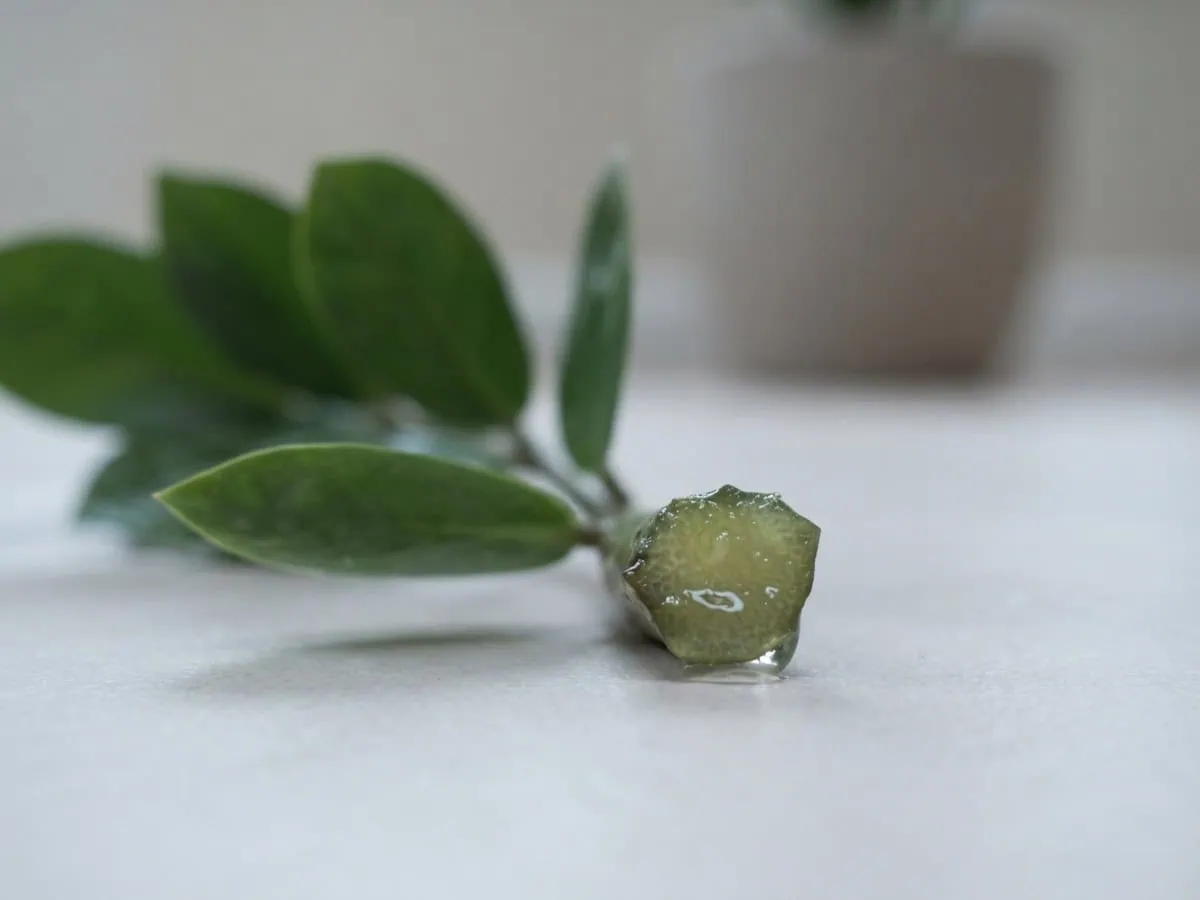
This is also why the “are ZZ plant leaves poisonous to humans” question earns a qualified yes: swallowing a piece brings the oral burn people liken to biting into ground glass, though the sharp pain stops anyone from eating enough to matter.
The same sap is why taking cuttings from the rhizome calls for gloves, and why a bare-handed cut leaves skin red and itchy – a plain contact irritation, not a sun-triggered one.
This content is for informational purposes only. If you experience a severe reaction, seek medical attention. For suspected ingestion by a child, contact Poison Control (1-800-222-1222 in the US) immediately.
The ZZ plant’s sting is mechanical, not chemical: insoluble calcium oxalate raphides in the sap stab tissue on contact but never absorb into the blood, so the reaction stays local. Intact leaves are inert, and the crystals only escape through a chewed, snapped, or cut surface.
Tap the button below to get more plant fixes in your Google Search results

What happens after a cat or dog chews a leaf?
Within seconds of a bite, a cat or dog feels the sting and usually spits the leaf back out – which is exactly why serious cases stay rare. What follows is an oral, short-lived reaction, not a slow internal poisoning. The mouth takes the hit.
Cats: the oral signs, minute by minute
So the “what happens if a cat eats a ZZ plant” sequence is quick and local. The ASPCA lists the classic signs of raphide contact, and in a cat they tend to arrive in a predictable order:
- Immediately: pawing at the mouth, head-shaking, and drooling.
- Within minutes: retching, nausea, and loss of appetite.
- Over the next hour or two: possible vomiting or a little diarrhea.
Most cats settle on their own once the crystals wash clear. Time is the real tell: the heavy drooling that looks alarming in minute one usually eases within a few hours, not days. A cat eating again by the next morning is a cat in the clear.
Dogs: the same crystals, a bigger mouth
The symptoms of ZZ plant poisoning in dogs mirror the feline ones almost exactly – same crystals, same oral burning, drooling, the odd bout of vomiting.
A bigger dog may chew a moment longer before the pain lands, and a determined retriever can shred a leaf (not joking), so the drool and mess look worse without the danger being greater; diarrhea follows only when a dog swallows a fair amount.
And still, the whole reaction stays in the mouth and gut; it never climbs into the bloodstream or the organs. This information is for educational purposes only and is not a substitute for professional veterinary advice. If your pet ingests any part of this plant, seek immediate veterinary intervention or contact the ASPCA Animal Poison Control Center immediately.
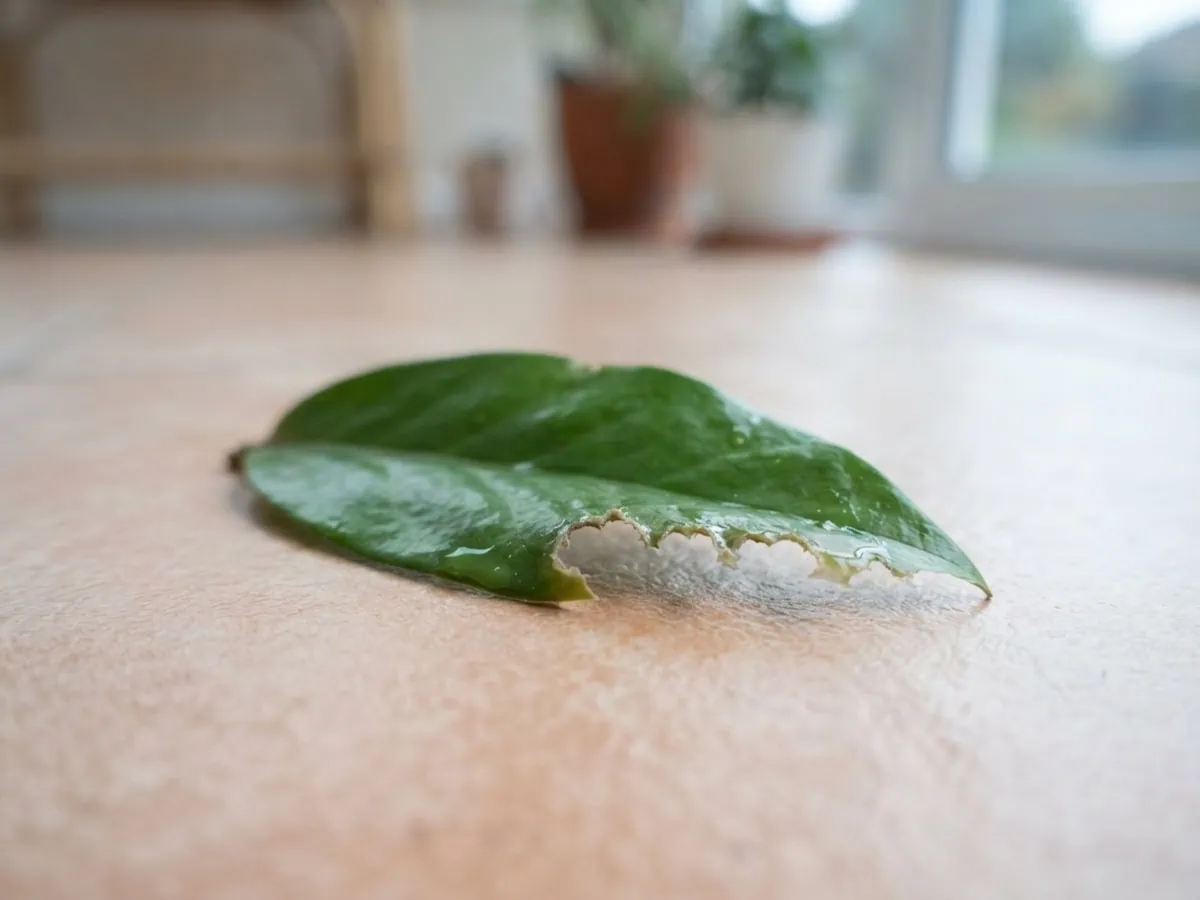
Why this is not a true-lily emergency
This is the reassurance the panic-driven guides skip: a ZZ plant is nowhere near the plants that truly threaten a pet’s life. See where it sits on the danger scale:
- Life-threatening tier: true lilies (fatal kidney failure in cats) and sago palm (liver failure) – real organ damage from a nibble.
- The ZZ plant’s tier: a mild-to-moderate local mouth irritation that fades on its own.
The ZZ plant does neither. Its exposures are, in the ASPCA’s own words, not life-threatening – the one difference that keeps a scary evening from becoming a needless emergency-room dash.
What to do after a chew, and where to put the plant
Your response in the first few minutes matters more than anything else, and it is simpler than most emergency pages make it sound.
Rinse first. Hold off on anything drastic. Watch the clock.
The first five minutes: rinse, do not induce vomiting
Start at the mouth, not the medicine cabinet. The moment you catch a pet chewing, work through three quick moves:
- Clear the mouth: wipe or rinse the crystals off the gums, lips, and tongue with cool water.
- Soothe the sting: offer something cold and bland – a little water, or a lick of plain yogurt.
- Do not induce vomiting: unless a vet or poison line tells you to.
That last rule is the one the folk guides keep missing. Forcing up a mouthful of needle crystals only rakes the throat a second time, doing fresh damage on the way back out.
Do not induce vomiting unless a veterinarian or a poison hotline instructs it. If the mouth swells, breathing or swallowing looks hard, or vomiting will not stop, call for help right away: the ASPCA Animal Poison Control Center at 888-426-4435, or the Pet Poison Helpline at 855-764-7661. Both run 24 hours a day, every day of the year.
The same rinse-first logic covers your own hands after moving it into a fresh pot: hold them under cool running water for a full minute, and within another minute or two the sting fades away to nothing. No cream, no drama.
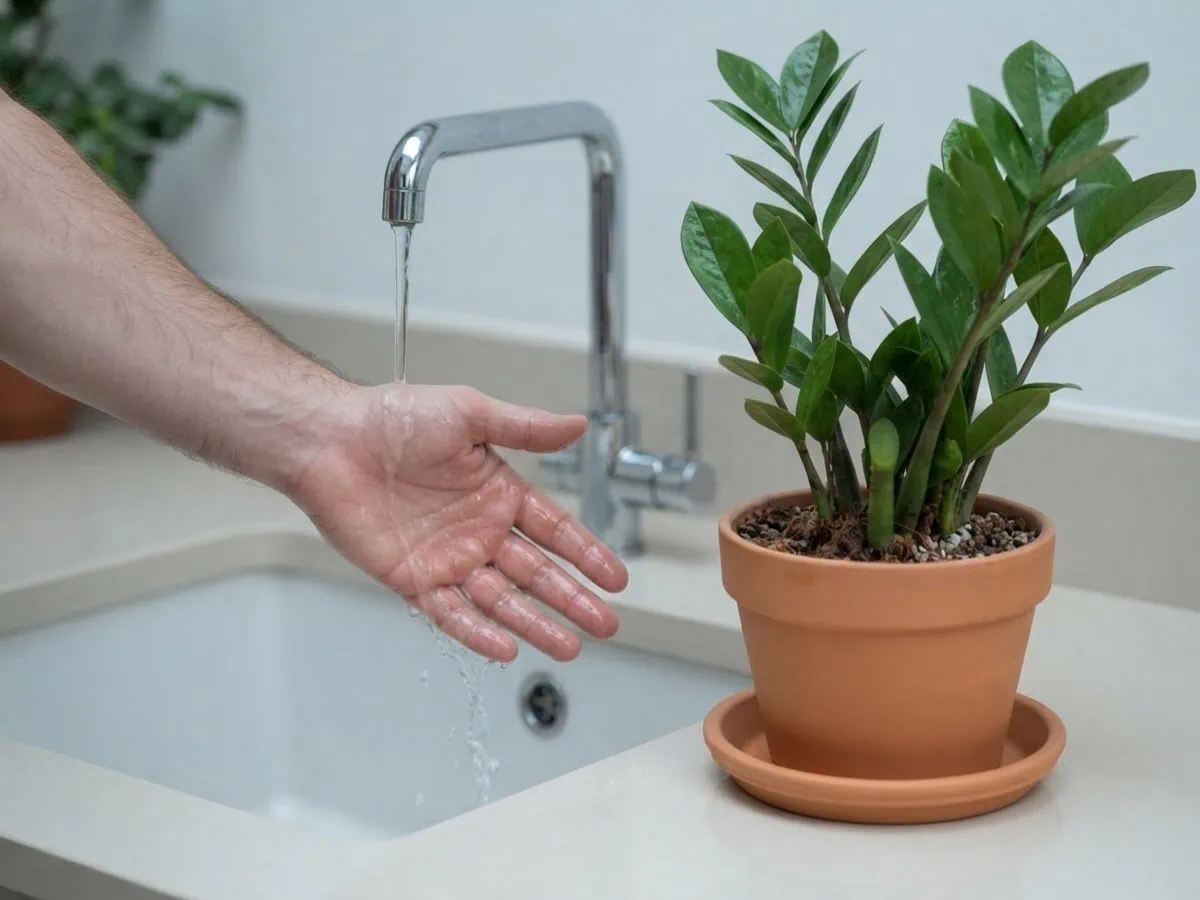
Who to call: the 24-hour hotlines
Two hotlines cover exactly this moment, and both are staffed around the clock. Call when signs run past mild drooling – repeated vomiting, a swelling mouth, or any trouble breathing.
Keep the numbers on the fridge now, while nothing is wrong; hunting for them one-handed at midnight is the worst time to start. And a calm call early always beats a frantic drive later.
Height, barriers, and what does not work
That leaves the practical question: how to keep cats away from a ZZ plant. The honest answer is that placement beats every gadget:
- Height, done right: a tall shelf, a plant stand, or a mantel a cat genuinely cannot leap to, not just “up high.”
- A hanging basket: ceiling-suspended, it lifts the foliage clear above a cat’s jump line and well out of a dog’s reach.
- A closed room: the surest barrier is a door the pet never gets behind; supervise a curious new pet until the novelty wears off.
- Pebble top-dressing: a layer of stones or coarse gravel over the soil to stop digging and soil-play at the pot.
But a cat clears most heights it sets its mind to, so a low bookshelf is not the fortress it looks like. Scent deterrents come up a lot – a dish of citrus peel by the pot.
Caveat: this might be wrong, but I have never seen a citrus rind outlast a determined cat’s curiosity, so I count it as a bonus, never the plan. Where you set the plant also decides its light, so it is worth checking where the light actually reaches it first.
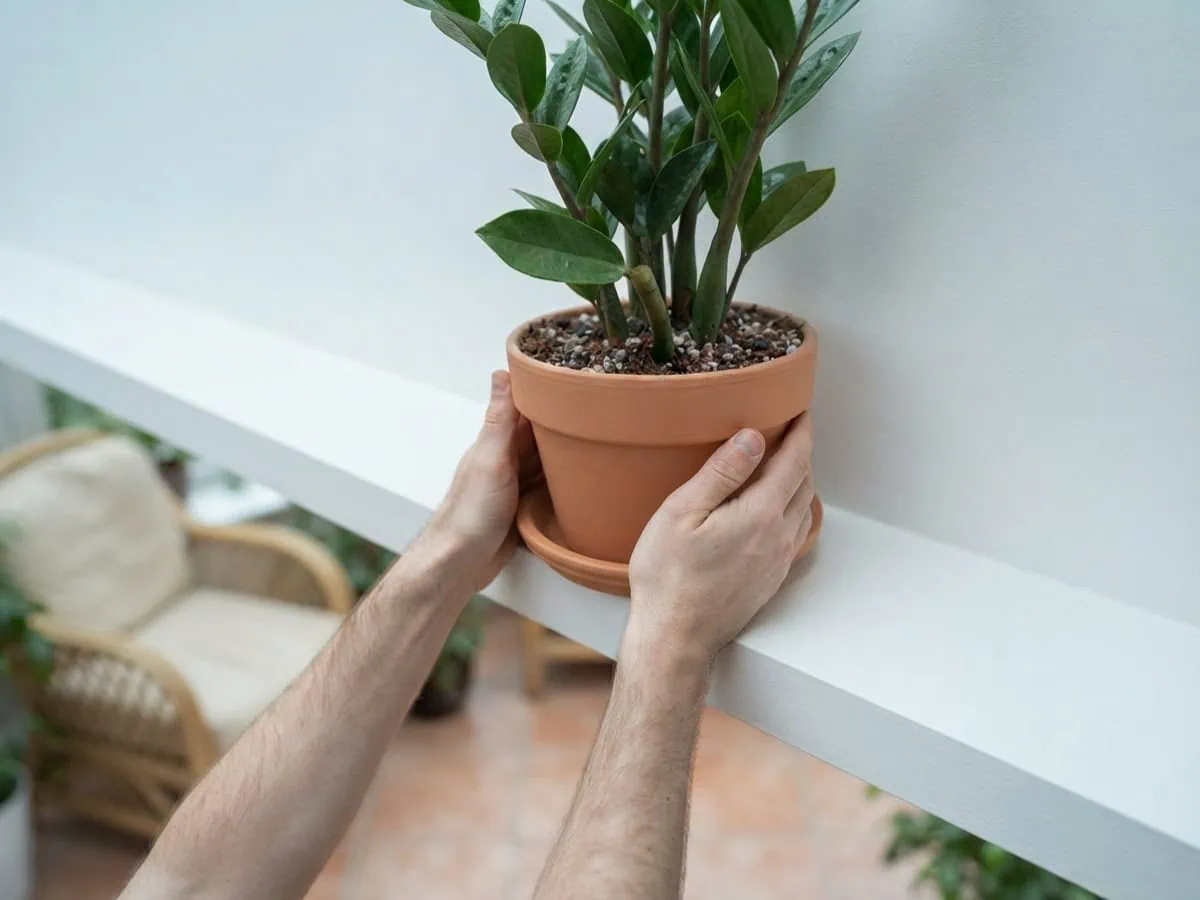
After a chew, the fix is quick: rinse the crystals from the mouth, offer something cold and bland, and never induce vomiting unless a vet says so. Keep the ASPCA and Pet Poison Helpline numbers on the fridge, and set the plant somewhere a curious pet genuinely cannot reach.
Frequently asked questions
Should I get rid of my ZZ plant if I have a cat?
No – you almost never need to rehome a ZZ plant over a cat. The toxicity is a mild, local mouth irritation, not a lethal threat, so placement solves it. Set the plant somewhere your cat truly cannot reach, keep the two emergency numbers on the fridge, and you can keep both the plant and the pet without any real conflict.
What happens if you touch a ZZ plant?
Touching an intact ZZ plant does nothing at all – the crystals stay locked inside undamaged tissue. Trouble only starts if you handle cut or broken parts and the raphide-laden sap meets your skin, which can leave a red, itchy contact irritation.
Rinse with cool water and it settles fast. Wear gloves whenever you prune, divide, or repot the plant.
What is the most toxic houseplant for cats?
The ZZ plant is not it – not even close. The genuinely dangerous ones for cats are true lilies, which can cause fatal kidney failure from a tiny nibble, along with plants like sago palm.
Against those, a ZZ plant’s calcium oxalate sting is minor and self-limiting. It sits firmly in the mild-irritant tier, well below the life-threatening plants.
Can I sleep with ZZ plant?
Yes, a ZZ plant is safe to sleep beside. It releases nothing into the air – no fumes, no toxins, no meaningful oxygen swing – so a bedroom is fine for you and for a pet that leaves it alone. The only real caution is a curious animal chewing the leaves overnight, so keep it off the nightstand and up out of reach.
Do cats know to avoid poisonous plants?
No – that instinct is largely a myth. Cats do not reliably recognize which plants are toxic, and boredom, curiosity, or a taste for chewing greens will override any caution.
A ZZ plant’s fast oral sting does discourage a second bite, but it cannot stop the first one. Never count on a pet to protect itself; rely on placement instead.
Do ZZ plants release toxins into the air?
No – ZZ plants do not release any toxins into the air. The calcium oxalate crystals are locked inside the plant’s tissue and only cause harm through direct contact or chewing, never through breathing.
There is no airborne, pollen, or vapor route documented for this plant. A ZZ plant sitting untouched across the room poses no inhalation risk to anyone.
End the panic-rehoming era
Sidebar — the plant was never the real problem. The panic was. A ZZ plant earns its toxic label honestly, but that label means a brief mouth sting from insoluble calcium oxalate crystals, not a poison that stalks your pet’s organs.
Rinse a chewed mouth, skip the vomiting, keep the two 24-hour hotlines on the fridge, and lift the pot onto a shelf a curious paw cannot reach. Do those four small things, and the question you came in with – “is a ZZ plant toxic to cats and dogs” – finally has a calm answer: yes, mildly, and easily managed.
May your ZZ plant keep its glossy good looks up on a high shelf, its sharp sap crystals sealed safely inside, and not one curious paw ever put them to the test.
Tap the button below to get more plant fixes in your Google Search results