🎯 Quick Answer: the light a ZZ plant actually needs
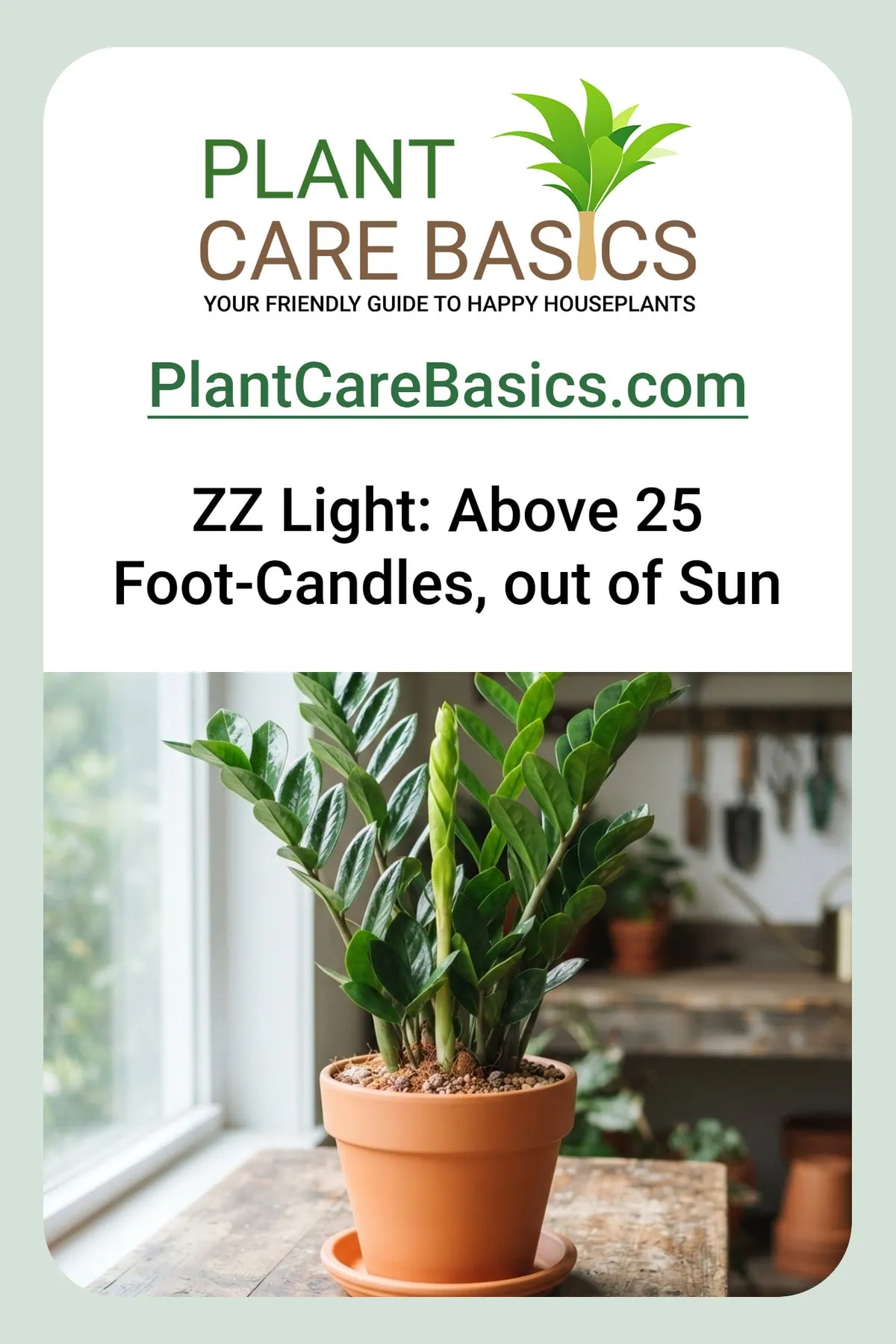
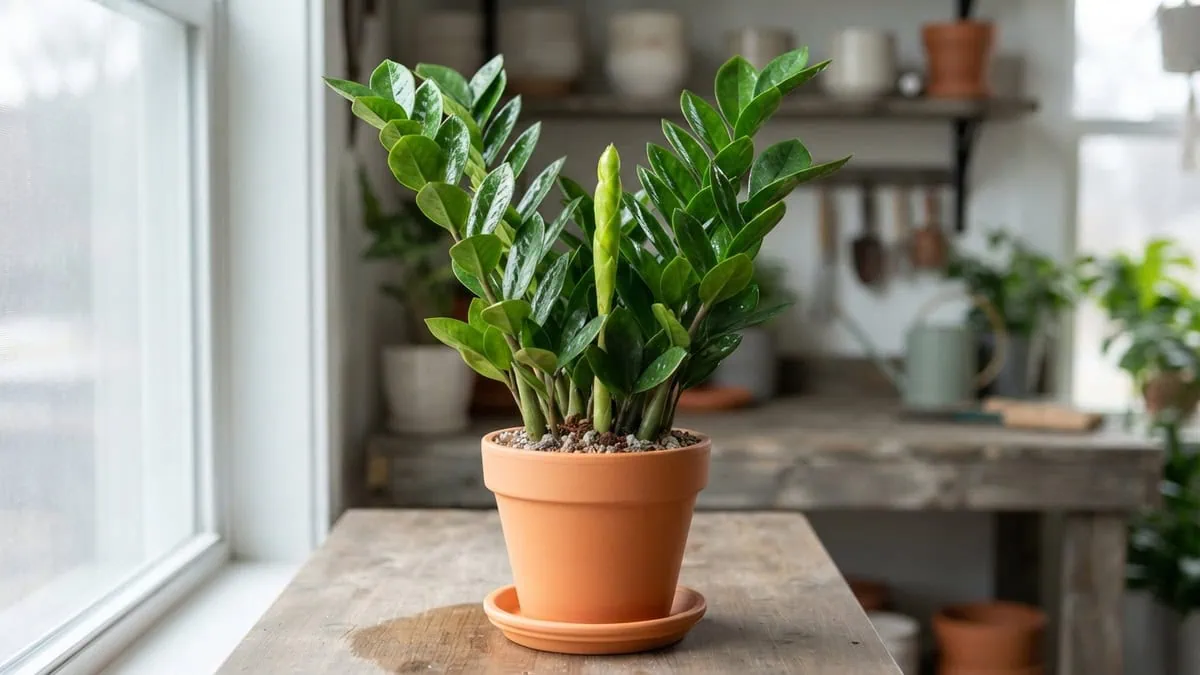
How much light does a ZZ plant need? Zamioculcas zamiifolia, a member of the Araceae family, demands a 25 foot-candle floor to survive. For real growth it needs 500-2,000 FC of bright, indirect light. Direct sun scorches the glossy leaflets, so keep it filtered.
- Read the shadow: a blurry outline means the spot is too dim
- Shift toward brighter glass first: the free fix beats a grow lamp
- Rotate the pot a quarter-turn: each watering, so all sides grow evenly
- Filter a hot window: a sheer curtain turns scorching sun safe
- Do not trust “thrives in the dark”: dim-tolerant is not growing
Nine ZZ cuttings, one dim hallway, one year of trusting the label that said this plant grows anywhere — and every new spear came up pale, thin, and floppy, spaced out like a stretched spring. The light intensity was the problem, not the plant.
Instead of blaming a fussy plant, I realized that pale stretch has a name — etiolation — and a single cause: too little light.
The ZZ tolerates low light because it evolved in the lowland, seasonally dry forests of eastern Africa, where a weak, water-thrifty photosynthesis (more on this below) lets it idle through gloom. Honestly, that’s not quite right — tolerating a dim corner and growing in one differ.
The good news? The one dial that matters is light, and you can read it off the wall in seconds. For the complete care picture, start with the full indoor ZZ plant guide.
Between you and me — the fix is rarely a fancier lamp; it is reading the room honestly. The table below maps this plant’s light, floor to ceiling.
How much light does a ZZ plant need at a glance
| ZZ plant specs | Light guidance |
|---|---|
| Survival minimum | About 25 FC (approx. 270 lux); it kept making new leaves for over a year |
| Optimal range | About 500-2,000 FC (approx. 5,400-21,500 lux) of bright, indirect light |
| Does it tolerate direct sun? | No — scald starts near 1,000 FC of direct sun |
| Best window exposure | North or east; south and west need a setback or a sheer filter |
| Will it survive a windowless room? | Yes — it holds at 25 FC on office fluorescents alone |
| Grow-light run time | A full-spectrum LED, 12-14 hours a day on a timer |
| First sign of too little light | Pale, over-long, floppy new growth and a long stall in new leaves |
Tap the button below to get more plant fixes in your Google Search results

Table of Contents
What light level does a ZZ plant actually need?
A ZZ plant needs a bare minimum of about 25 foot-candles to survive, and 500 to 2,000 foot-candles of bright, indirect light to actually grow. That gap between surviving and growing is the whole story.
According to the foot-candle bands for indoor plant lighting from the University of Maryland Extension, low light runs 25 to 100 FC, medium-bright 100 to 500, and high light 500 to 1,000.
The following sections split that into three tiers — a floor, a sweet spot, and a hard ceiling.
Survival minimum: the documented low-light floor
So, can a ZZ plant survive in low light? Yes — remarkably well.
In one university trial the plant kept pushing out new leaves for more than a year at just 25 foot-candles, a level that would quietly starve most houseplants. It is rated tougher in dim rooms than even a snake plant, and it holds on where nothing else will.
Optimal sweet spot: where growth actually speeds up
Bright, indirect light is where a ZZ stops idling and starts working. Push it into the 500 to 2,000 FC band and new spears arrive faster, fuller, and greener. The difference is real: a plant that sulks in a hallway visibly picks up pace at a bright, filtered window.
Light is the lever here. A little more of it does far more than extra water or fertilizer ever will, and when you starve it, why new shoots stall becomes the obvious next question.
Maximum tolerance: no direct sun on the leaflets
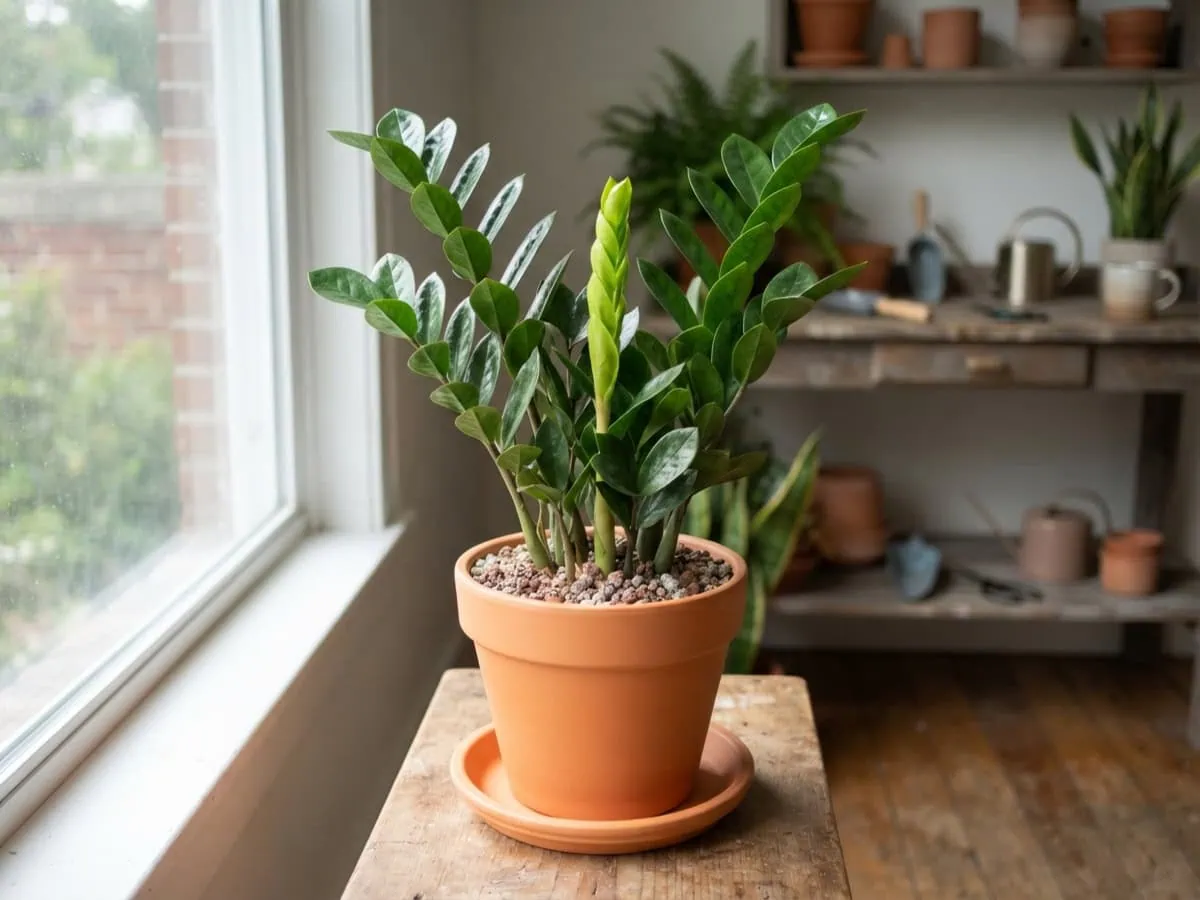
Here the rule flips: too much direct light burns. Unfiltered sun — anything past roughly 1,000 foot-candles on the leaf — bleaches the glossy leaflets white, curls them, then fades them to yellow and brown.
A leaflet against a sun-baked south pane turns sun-warm, almost hot, by early afternoon. The scorch is permanent. Burnt tissue never re-greens, so keep direct sun off the foliage; for the yellow-and-brown pathway, see why the leaflets yellow and brown.
Why does a light-starved ZZ plant stretch and pale?
A light-starved ZZ plant stretches because dim light triggers etiolation: the stalk grows longer and thinner while new leaflets come in pale, soft, and widely spaced. It is a shortage signal.
- Etiolation: the stretched, pale, floppy growth a plant produces when it is starved of light.
- Internode elongation: the widening gaps between leaflets as a stalk lengthens under too little light.
The sections below cover the stretch, the color shift, and how to read the light early.
The stretch: light shortage drives internode elongation
In dim light the plant lengthens its internodes and skips the lignin that stiffens a stalk, so new growth comes up long, weak, and floppy, and thinner chlorophyll leaves the spear washed-out rather than green. Both trace to one cause.
But one widely copied guide blames the bending on too much light. That is backwards; the stretch is a shortage response, not a sunburn one.
Oddly, and unlike most houseplants, a ZZ angles its stalks away from the light rather than toward it, so a lean off the window is normal. Pushed further, it becomes stalks that splay and fall open.
The color question: paler new growth, not darker leaves
A common search — “do ZZ plant leaves get darker in lower light” — has it backwards. Dim light makes new growth paler and thinner, not darker; the deep, glossy green belongs to mature leaves grown bright.
My working theory is that older foliage only looks darker beside that washed-out new growth; no source I trust settles it. A Raven’s near-black color, too, holds only in bright light, which is how the Raven cultivar holds its dark color.
The shadow test: check light before the stretch starts
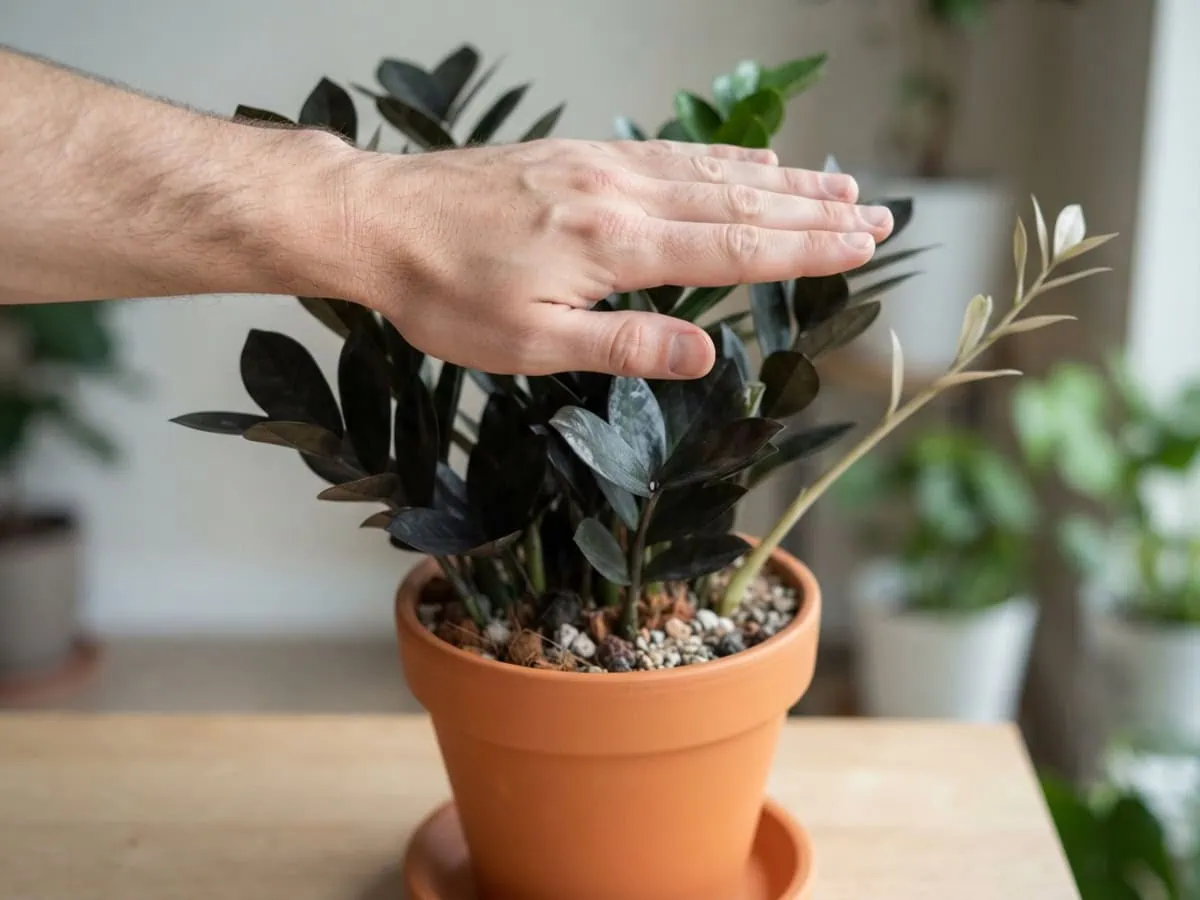
The real question — “is my ZZ plant getting enough light” — is answerable before any damage shows. Touch tells you first: the newest spear feels cool and limp against your fingertips, nothing like the firm, room-warm older stalks standing just a few inches away.
Then read the shadow. Hold your hand a foot above the leaflets at midday — a sharp-edged shadow means bright, soft and fuzzy means medium to low, barely there means too dim.
Want a number? A free phone lux app should read past 270 lux, that 25 FC floor, and several times higher for real growth.
Tap the button below to get more plant fixes in your Google Search results

Window direction, distance, and the windowless-room fix
Window direction sets your ceiling; distance from the glass is the dimmer. The following table matches each exposure to a placement.
| Window exposure | Where to put the ZZ plant |
|---|---|
| North or east | At the glass to a couple of feet back; the low-risk default |
| South or west | Several feet back, or add a sheer curtain to filter the sun |
| No window | A full-spectrum LED for 12-14 hours, or steady office fluorescents |
The following sections walk each exposure from the safest window to no window at all.
North and east windows: the low-risk default
A north- or east-facing window (Northern Hemisphere reference) is the safe default — soft, indirect light that rarely turns harsh enough to scald even a leaflet pressed right against the glass. Set the plant at the pane or a couple of feet back and it settles into the bright-indirect band. At a north window the glass reads cold against the back of your hand even at noon.
South and west: set back from the glass or filter it
South and west windows are the bright, risky ones. At the pane, that brightness scalds. That raises the real question — “how far from a window should a ZZ plant sit” — and the honest answer follows the light, not a fixed number.
Light falls off steeply as you move off the glass: within two feet of a bright south window it reads as near-direct sun, but about 3 feet back drops it to safe, medium light. So set a ZZ back from any south or west pane, or hang a sheer curtain.
Windowless rooms: fluorescents and grow-light targets
So, will a ZZ plant grow in a windowless room? It will hold — slowly. A ZZ keeps ticking over at its 25 FC floor on ordinary office fluorescents alone.
For real growth, add a full-spectrum LED grow light on a timer, 12 to 14 hours a day, and aim past that 25 FC floor toward the 500-plus FC band. Ignore the vague “avoid strong light” warnings — a ZZ struggles from too little artificial light, not too much.
Always follow the manufacturer’s instructions and applicable safety standards for any electrical equipment.
Common light mistakes: what the internet gets wrong
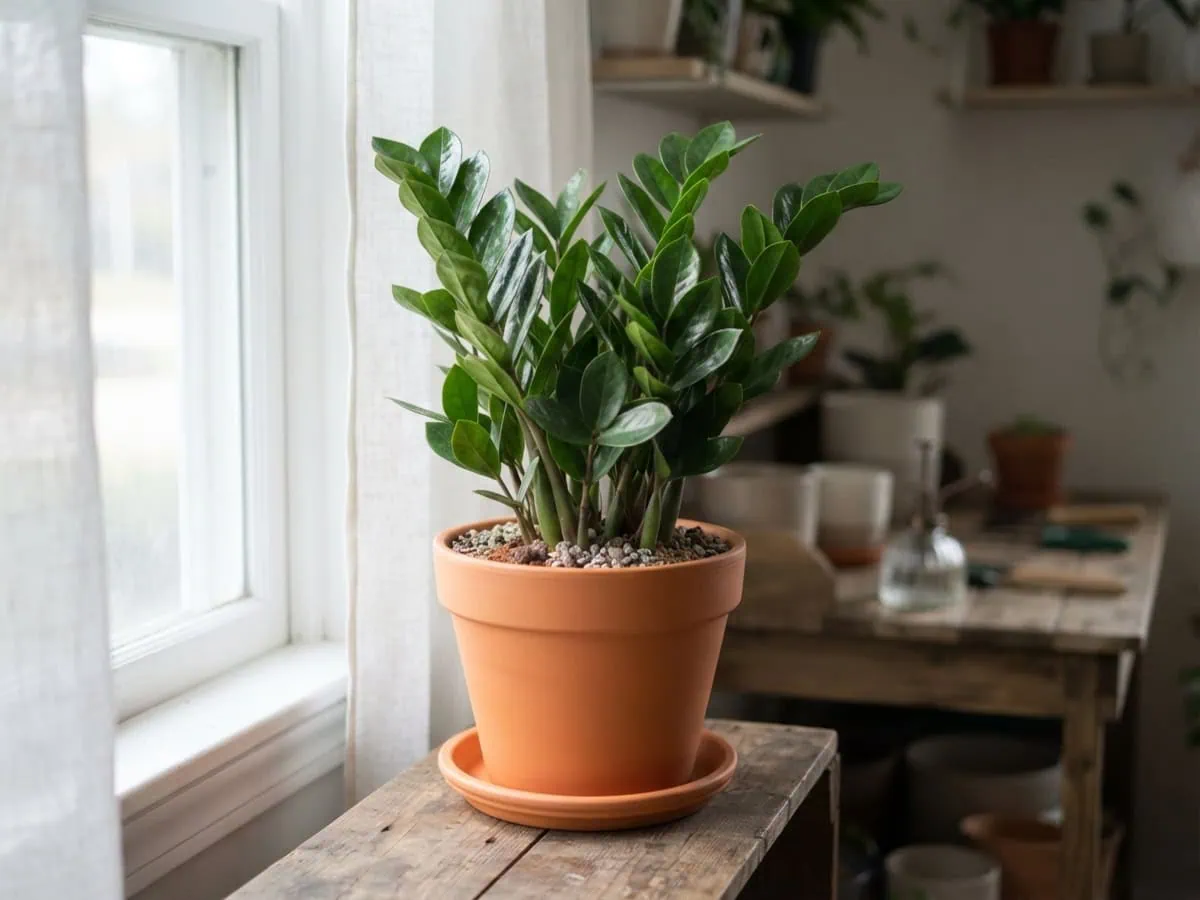
The biggest ZZ light mistake is trusting the line that it does fine in a dark closet. It tolerates a dim corner, but it does not grow in one, and that single confusion stalls more plants than any watering error.
Myth: a ZZ plant thrives in a dark closet. Fact: it survives there and idles; genuine growth needs bright, indirect light. Tolerating dim light is not the same as thriving in it.
The two myths below both ignore the one thing that matters: measured light.
Myth: it thrives in a dark closet
A ZZ in a truly windowless closet does not die — it just quietly stops growing. No new spears for 6 months, the same tired stalks holding steady while the plant lives off its underground rhizome (TBH — I have watched one sit dead-still in a dark hall for the better part of a year).
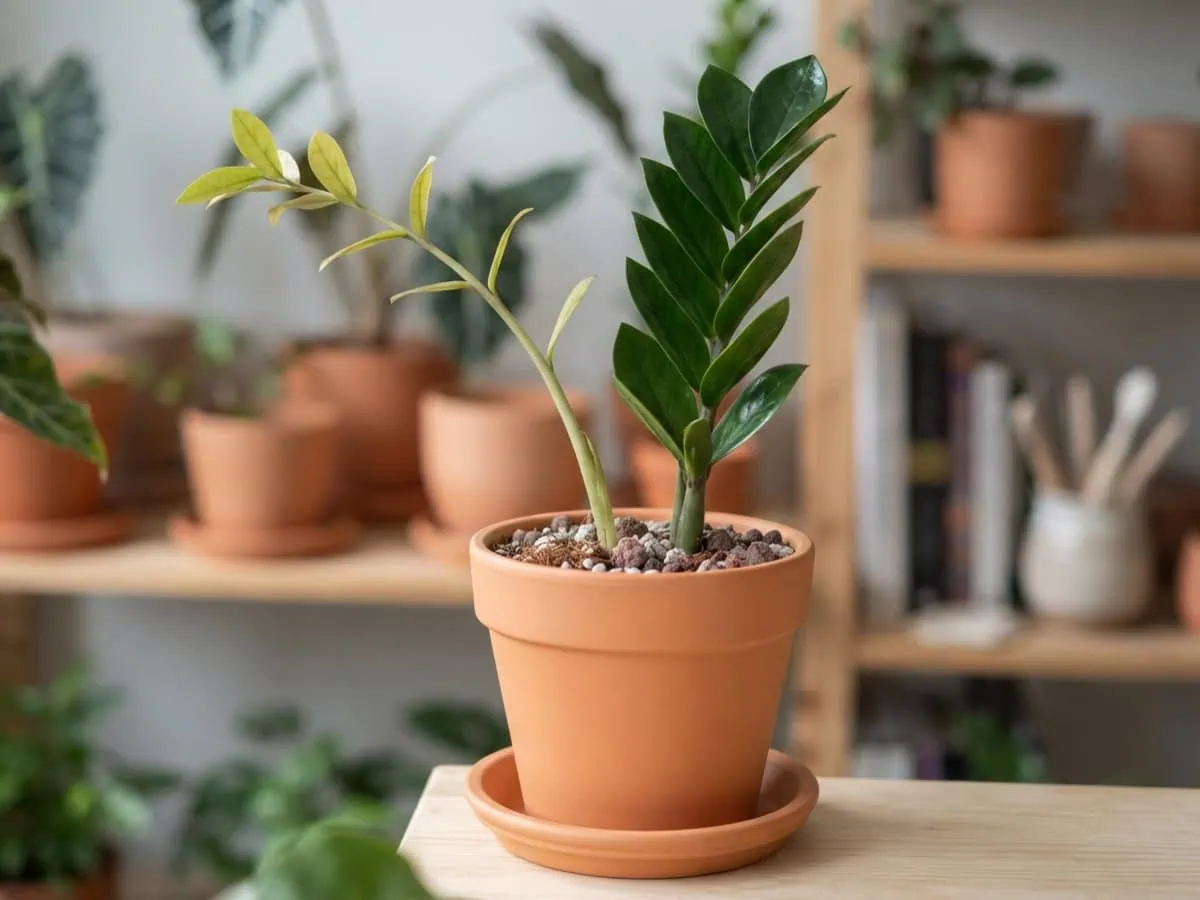
When growth finally does creep out of a too-dim spot, it comes up finger-thin and pale, its leaflets spaced far apart like rungs on a too-long ladder. That is survival, not care. Give it real light and the stall breaks.
Myth: pick the corner by compass direction, not light
The other trap is choosing a spot by which corner is “lucky” or fashionable rather than by the light it actually gets. A ZZ cannot read a floor plan — it reads light. Two identical-facing rooms can deliver wildly different light depending on curtains, overhangs, and wall color.
Judge the spot by the shadow it casts and the foot-candles you can measure, not by the compass. A basic light meter, or a free phone app, settles it in seconds, reading the number where the leaves actually sit. Under that 25 FC floor, the corner only keeps it alive; clear 500 FC and it truly grows.
The trap runs both ways, though. A ZZ is tough, so it is easy to over-correct — parking it on a blazing south sill until the midday sun bleaches the very leaflets you meant to feed. Read the light itself, not the plant’s reputation.
Frequently asked questions about ZZ plant light
Where is the best place to put a ZZ plant?
The best spot is a few feet inside a north- or east-facing window, in bright, indirect light. South and west windows work too, but set the plant back several feet or filter the glass with a sheer curtain so direct sun never reaches the leaflets. With no window, a full-spectrum LED on a timer, or even steady office fluorescents, keeps it going.
How can I tell if my ZZ plant needs more light?
Watch the newest growth: pale, over-long, floppy spears with wide gaps between the leaflets mean it needs more light. A faster check is the shadow test — hold your hand a foot above the leaves at midday, and a soft, fuzzy shadow rather than a sharp one means the spot is too dim. A long stall with no new leaves is the quietest sign of all.
Can ZZ plants live in low light?
Yes. A ZZ plant tolerates very low light — down to about 25 foot-candles — better than almost any houseplant, and in one trial it kept making new leaves for over a year at that floor. But surviving is not the same as growing: in genuine low light it idles and grows slowly, so move it into bright, indirect light for real growth and faster, fuller new spears.
Can a ZZ plant survive in a room with no windows?
Yes, as long as it gets some artificial light. A ZZ holds at its 25 foot-candle floor on ordinary office fluorescents alone, which is why it fills interior offices, bathrooms, and windowless cubicles. For real growth in such a room, add a full-spectrum LED grow light on a timer for 12 to 14 hours a day, aimed toward the 500 FC band.
Rescue it from the dark, revive the shine, repeat the read
Truth is — the ZZ is no dark plant. It is a tough, low-light survivor that rewards you the moment you give it more. Move it into bright, indirect light, keep it clear of direct sun, and the washed-out foliage firms up into deep-green spears — warm and stiff under your fingers.
Once the exposure is sorted, you might wonder why fresh shoots still arrive slowly — that is a growth-pace question, not a lighting one. Pin that figure down, and “how much light does a ZZ plant need” stops being a guess; it becomes something you can measure at the leaf.
May your ZZ plant always sit in the bright, indirect light it likes best, its new spears rising firm and glossy – never stretched thin in a dark corner, never scorched at a sunny pane.
Tap the button below to get more plant fixes in your Google Search results