🎯 Quick Answer: ZZ plant pests
How to get rid of pests on a ZZ plant (Zamioculcas zamiifolia, family Araceae) races a 6-7 day respray clock. Wipe the bugs off first — alcohol swab, soft toothbrush. Then spray insecticidal soap or neem, three rounds minimum. Dry the topsoil to starve fungus gnat larvae.
- Alcohol swab: 70% isopropyl, dabbed on each mealybug, kills on contact
- Wider colony: drop to a 10-25% alcohol spray, or insecticidal soap
- Rhythm: 6-7 days between passes, held across a 2-4 month crawler window
- Soil: dry the top inch hard; cap with 1/2-1 inch coarse sand
- Spot-test: one leaflet, 1-2 days ahead — aroids are soap-sensitive
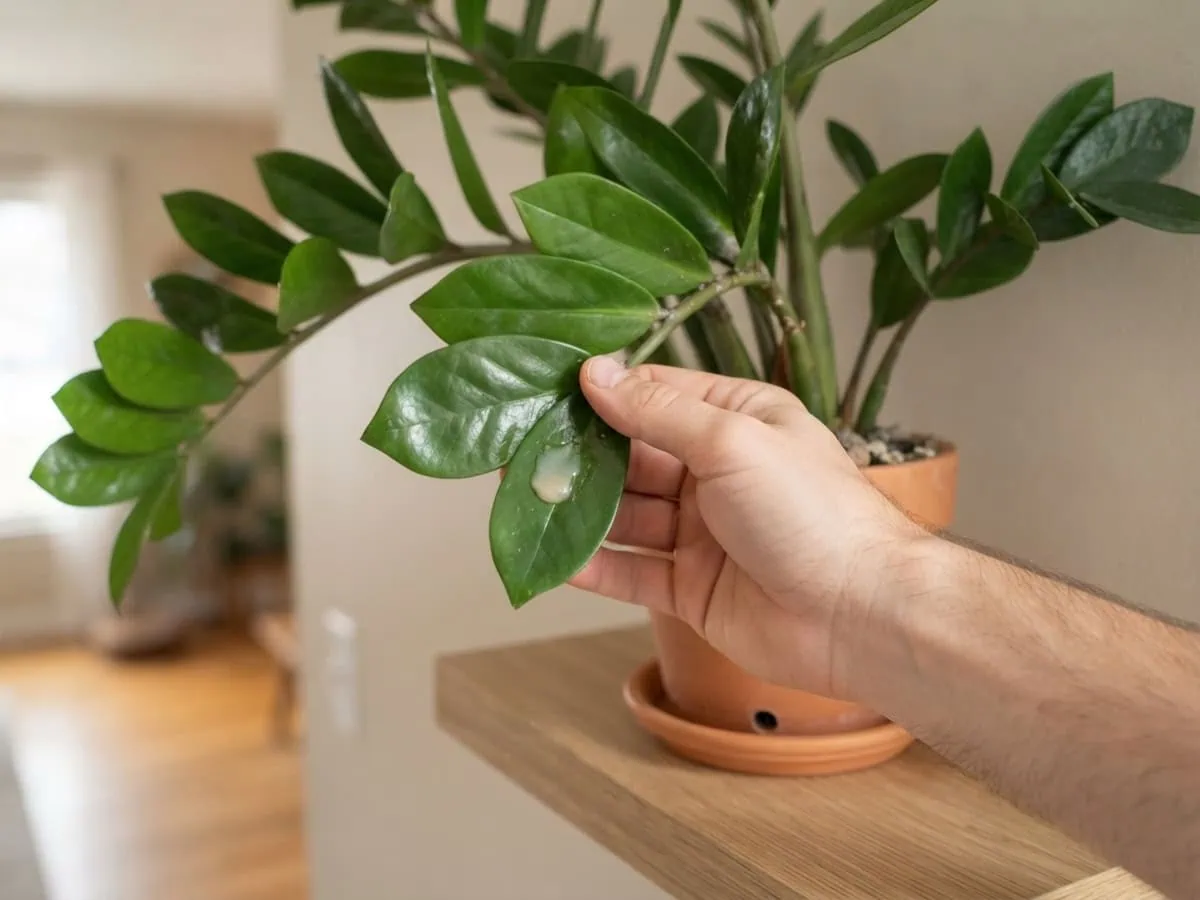
My fingertip came away tacky. Not dusty — tacky, and up close a thin, stale-sweet smell, like syrup dried where a thumb had left it on the glossy leaflet. That sticky smear — honeydew — lost me plants, because I kept reading it as a watering fault.
That failure forced me to learn what the plant’s own anatomy was doing to me — the leaflet’s thick, waxy cuticle is slick enough that a contact spray beads up and rolls off before it touches anything alive, and the tight leaf-stalk crevices hand scale and mealybugs a dry pocket to wait it out in. Let me try that again… my spray was never weak. It was never landing.
(FYI — a ZZ plant is not naturally pest-prone; bugs almost always ride in on a new plant.) All of it assumes the basics are already dialed in — those live in the bigger picture of keeping a ZZ plant healthy.
Pause for a sec. If your plant looks infested, breathe — the following table names the culprit from what you can see, before you touch a single spray.
How to get rid of pests on a ZZ plant: a quick ID check
| ZZ plant pest signs | What it means |
|---|---|
| Sticky, shiny film on the leaves | Sap-sucker honeydew — look for scale or mealybugs feeding above it |
| Hard brown bumps clumped on stems | Scale insects (immobile, waxy/armored) |
| White cottony fluff in the leaf-stalk joints | Mealybugs |
| Fine webbing and pale, speckled leaflets | Spider mites |
| Tiny dark flies rising from the soil | Fungus gnats (larvae live in the wet top layer of soil) |
| Is a ZZ plant naturally pest-prone? | No — generally resistant; pests usually arrive on a new or nearby plant |
| Does one spray finish the job? | No — respray every 6-7 days; eggs and hidden crawlers survive one pass |
Tap the button below to get more plant fixes in your Google Search results

Table of Contents
Start by identifying the pest
Name the insect before you reach for a bottle — the wrong spray hands the infestation another week. Iowa State University Extension keeps the cleanest reference on how to identify common houseplant insect pests, and those cues hold on a ZZ.
Sap-suckers announce themselves twice: the bugs, and the sticky honeydew they excrete while feeding. Find one, find the other.
Scale and mealybugs pierce the leaflet, drink sap, and excrete the surplus as honeydew — the shiny film. A black, dusty sooty mold then colonizes that sugar, but it is not attacking your plant; it is a passenger, which is why wiping it off accomplishes nothing while the insects feed overhead.
Chase the bugs, not the mold. Lean close and you smell it first: a faint sweet-sour note, like the bottom of a juice glass left out overnight.
The plant’s own build shapes what you find. The cuticle is thick and waxy. The leaf-stalk joints are tight.
Bugs wedge into those crevices rather than the open blade. Speculative, but that slick cuticle may be part of why this species is bothered so rarely; care guides widely describe it as generally resistant without pinning the mechanism down.
The following sections cover the three ID calls you will make.
Scale: hard brown bumps and sticky leaves
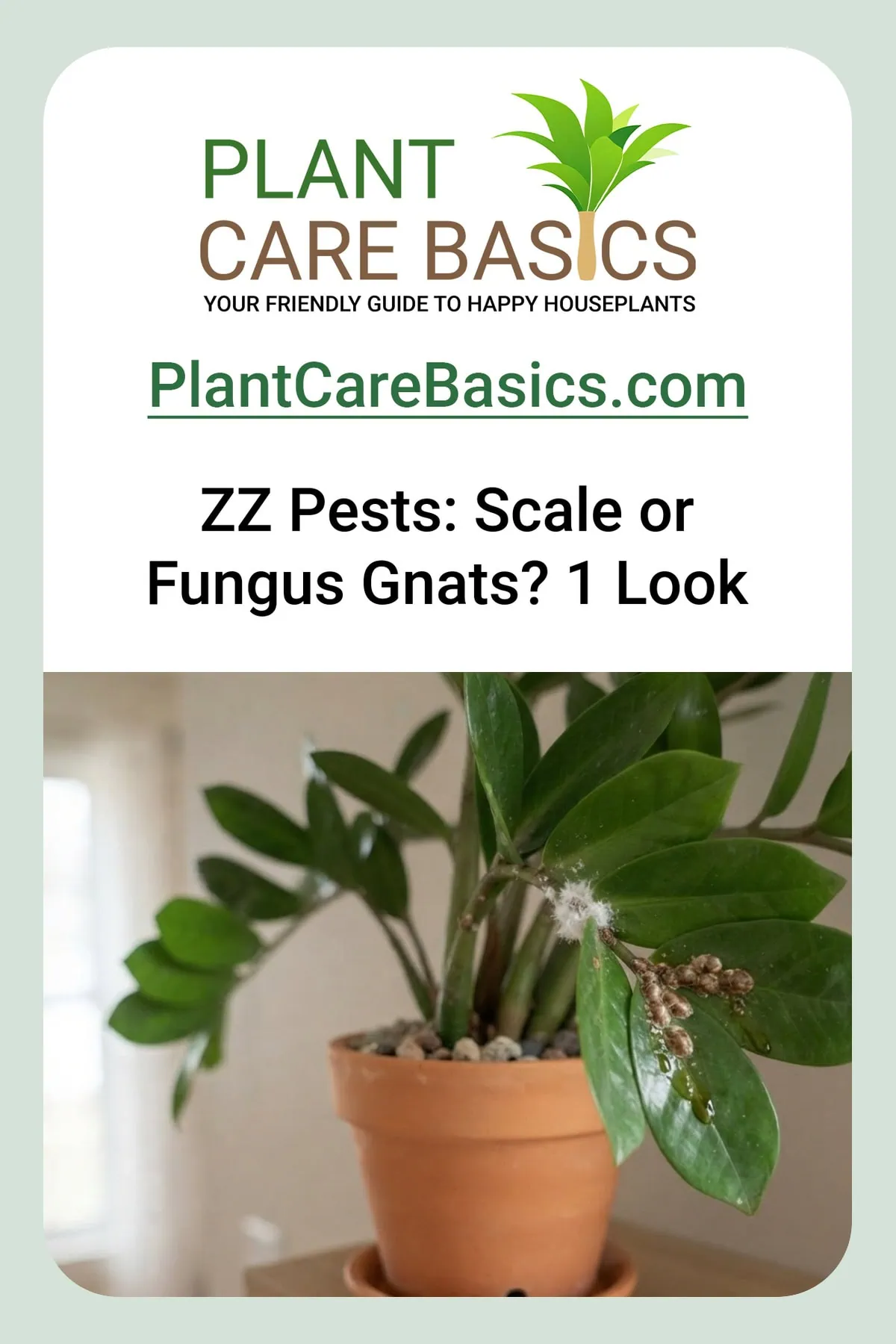
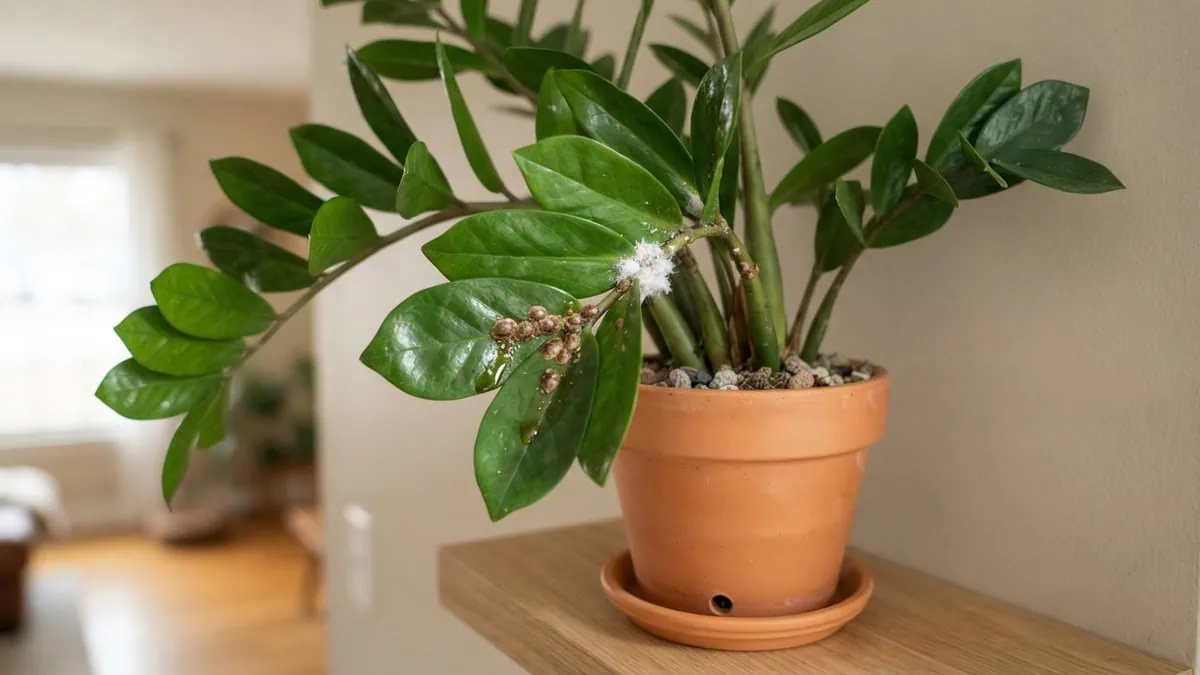
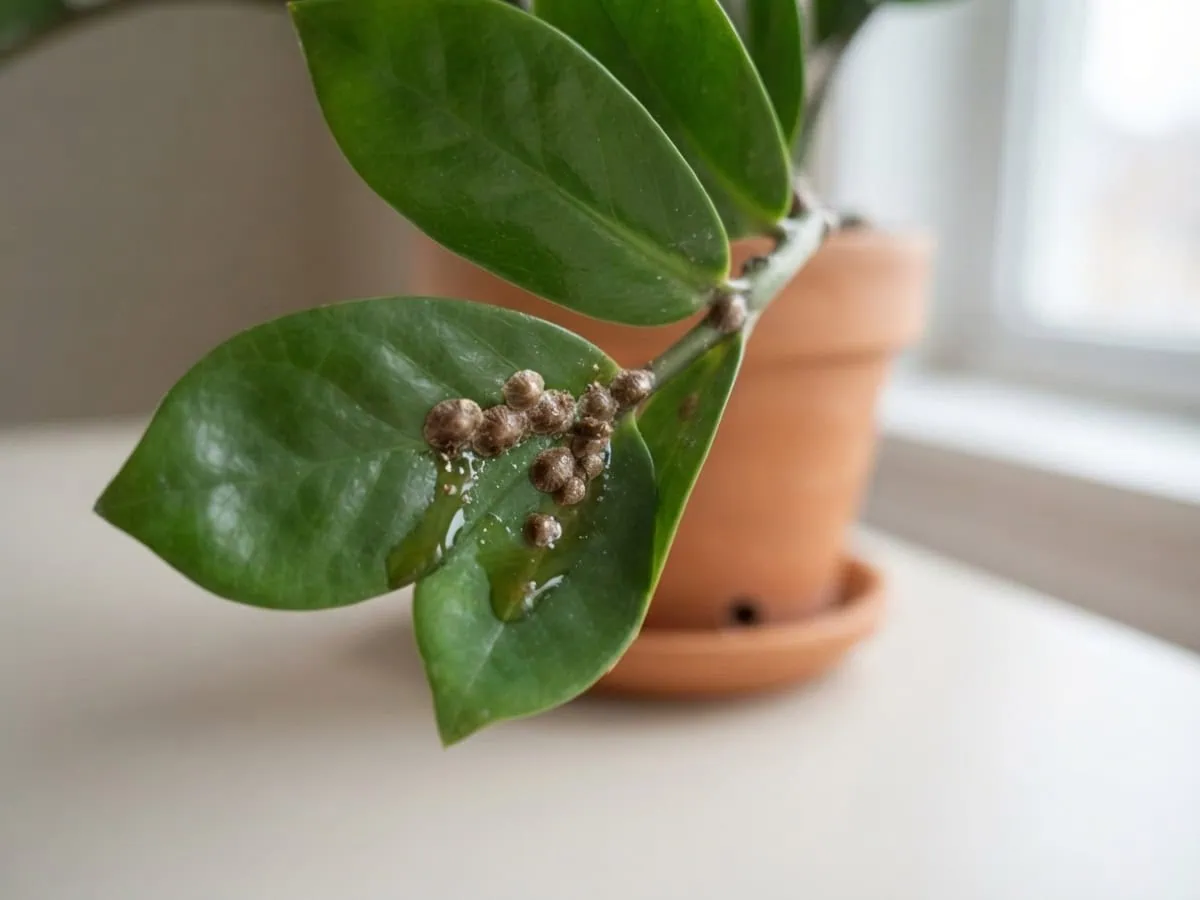
Scale reads as small, hard, brownish bumps clumped along a stalk — immobile, armored, easy to dismiss as a stem blemish. The “what do scale insects look like on a ZZ plant” question comes down to two cues together: the bumps, plus sticky film pooling on the leaflets beneath them.
Scrape one with a fingernail and it lifts off as a shell. A stain will not. Flat, dry, immovable marks are black specks and spots on ZZ stems instead.
Mealybugs: white cottony fluff on the stems
Mealybugs look like flicked lint, soft white cottony masses tucked where a leaflet meets the rachis. Search “white cottony bugs on ZZ plant stems” and you land here every time.
Nudge a clump with a swab: a mealybug smears and shows a soft body underneath, while harmless surface mold crumbles. Lint does not smear.
Spider mites, fungus gnats, and other tiny pests
Spider mites are almost too small to resolve, so you find the webbing first — fine strands across a leaf axil, pale stippling spreading behind. Fungus gnats are the opposite: obvious dark flies lifting off the soil when you water, harmless as adults, damaging as larvae in the wet top layer.
Aphids and whiteflies turn up on soft new growth. But if leaflets yellow rather than speckle, the cause may not be an insect; that is why ZZ plant leaves turn yellow.
Tap the button below to get more plant fixes in your Google Search results

Clear the infestation without harming your ZZ plant
Take the bugs off by hand first, then spray (yeah, learned this the hard way). Everything here is a contact material — alcohol and soap kill only what they touch, with no residual action, which is why one pass never finishes. The following sections work through removal, sprays, and the soil.
Wear nitrile or thick gardening gloves before you wipe, brush, or cut out a heavily colonized shoot. A ZZ’s sap carries insoluble calcium oxalate raphides, needle-shaped crystals that irritate skin and eyes. If sap reaches your skin, rinse under cold running water for at least 60 seconds, then wash your hands. This content is for informational purposes only. If you experience a severe reaction, seek medical attention. For suspected ingestion by a child, contact Poison Control (1-800-222-1222 in the US) immediately.
Wipe, swab, and brush the bugs off first
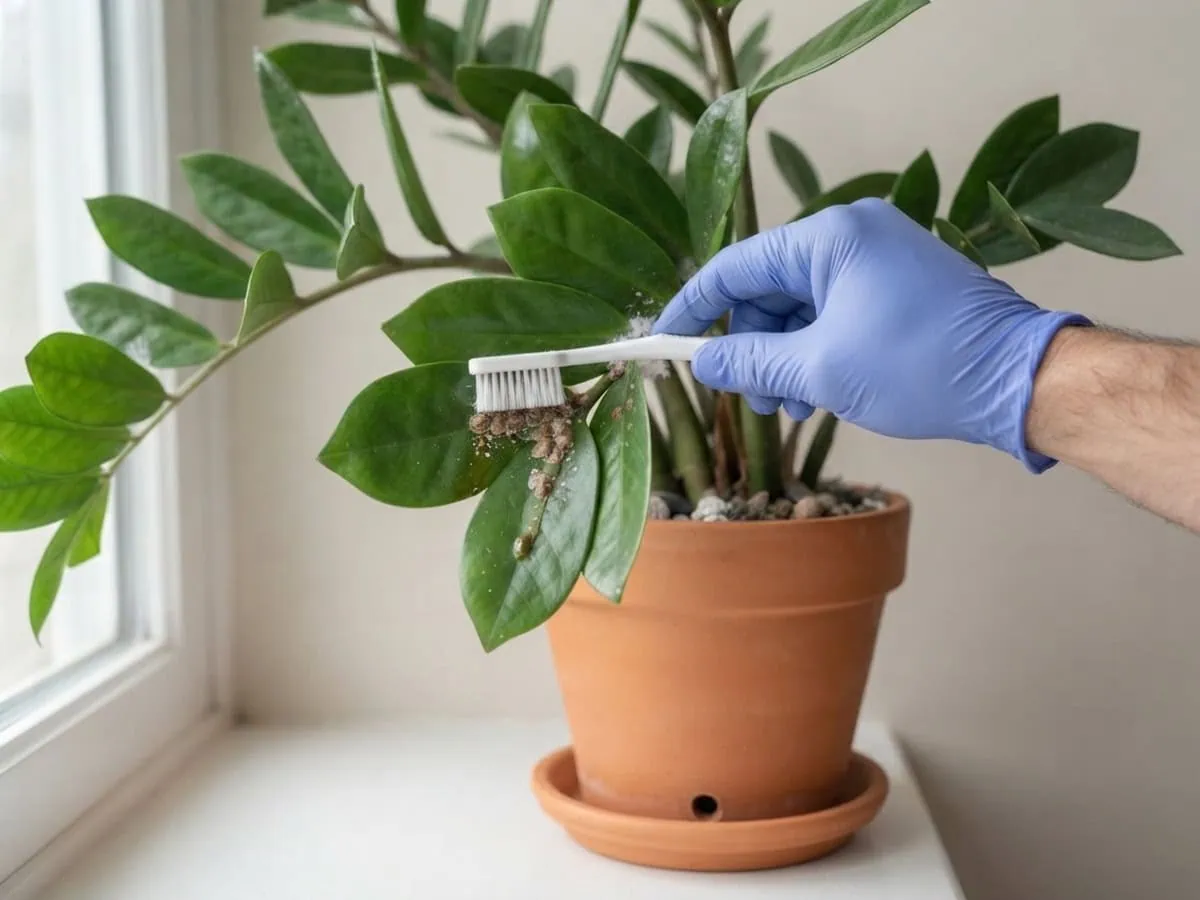
On a light infestation most scales lift off with a soft-bristled toothbrush or a cotton swab dipped in soapy water or 70% isopropyl alcohol. That is the answer behind soapy water and a toothbrush for ZZ plant scale — the brush reaches the tight leaf-stalk crevice a cloth just bridges over.
Work the bristles through each joint, then wash the stalk with mild detergent to strip honeydew and dislodge crawlers. Then spray. A mechanical pass alone leaves eggs.
The spray toolkit: soap, neem, and alcohol
Three materials cover nearly everything: insecticidal soap, neem oil, rubbing alcohol. Coverage beats strength.
For how to get rid of mealybugs on a ZZ plant, dab each insect with a cotton swab carrying 70% or less isopropyl alcohol — it kills on contact. A hit mealybug turns light brown, so you can read your own coverage instead of guessing at it.
For a wider colony, drop to a 10-25% alcohol spray and repeat weekly until it clears. Scale wants soap or horticultural oil at thorough coverage: at least three applications, 6-7 days apart.
Crawlers keep emerging for roughly 2-4 months, so hold that rhythm through the window, not to the first clean-looking stalk. Spot-test any material on one leaflet 1-2 days ahead and check for burn: aroids sit on the documented insecticidal-soap sensitivity list.
Dry out the soil to stop fungus gnats
Type “tiny flies in ZZ plant soil how to stop” into a search bar and the real lever is moisture, not insecticide. Dry beats spray.
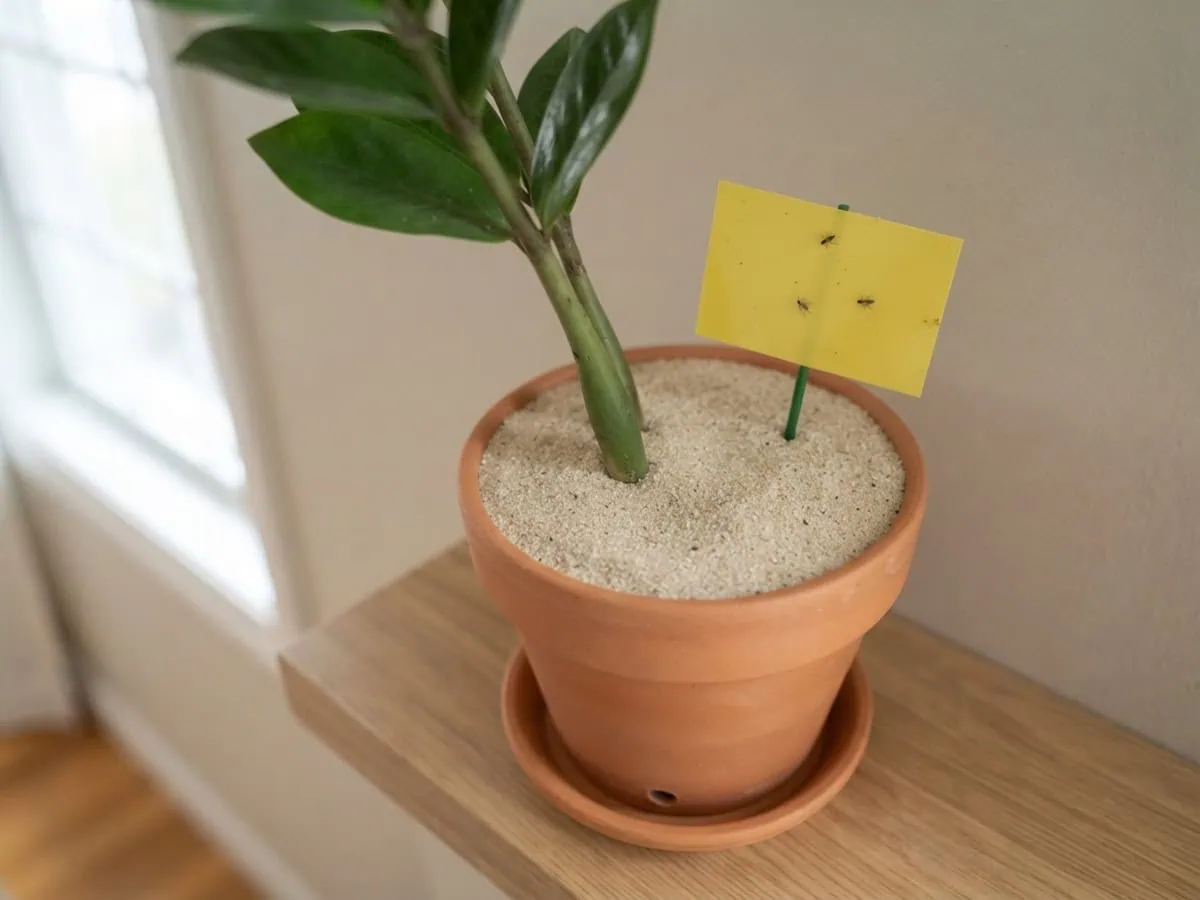
Gnats lay into the damp top layer and larvae feed there, so let the top inch dry hard between waterings, or bottom-water so the surface never invites an egg.
Cap the soil with 1/2-1 inch of coarse sand or fine gravel. Hang a yellow sticky card for adults. To confirm larvae rather than assume them, lay a potato slice flat on the surface and lift it after three to four days.
Where numbers run heavy, water in a Bti larvicide, several passes 5-7 days apart. Give it 3-4 weeks.
Here the ZZ hands you an advantage. Its rhizomes bank their own water, so the pot’s top layer can run dry far longer than a fern would tolerate, starving the larvae without stressing the plant. That dry-down is also the backbone of getting the ZZ plant watering rhythm right.
But if the mix still holds water days after a soak, gnats are the least of it. Sour, waterlogged soil smells faintly of a wet cellar.
That is rot, not pests. Start with rescuing a ZZ plant from overwatering and rot.
Pest-control mistakes and myths to skip
The remedies that circulate hardest are the ones no extension service endorses. Vinegar and coffee grounds surface in pest advice everywhere; neither belongs on this plant. And the biggest error is not a remedy at all — it is skipping quarantine, then wondering why the bugs came back.
Myth: spray vinegar at the gnats, and scatter coffee grounds to drive off aphids.
Fact: vinegar is an acid, and on a waxy leaflet it risks scorching the very tissue you are trying to save; it is not a houseplant pest control. Coffee grounds are not an insecticide either, and on a rot-prone rhizome they mostly add damp organic matter, which is precisely what fungus-gnat larvae feed on in the first place. The tested answer is duller and it works: insecticidal soap, neem oil, or 70% isopropyl alcohol, spot-tested before it goes near the whole plant.
The selective-safety question has a boring answer too. Nothing is universally safe — soap, oil and alcohol all injure foliage at the wrong strength, which is exactly why the 1-2 day spot test exists and why aroids carry their own soap-sensitivity flag.
Neem announces itself the moment you mix it, a raw garlic-and-sulfur smell that hangs in a closed room for an hour, and that pungency is not potency. It is just an odor.
Then there is the word itself. Some care guides describe sun-bleached brown patches as “scaling” — a light-scorch symptom with nothing whatsoever to do with the scale insect you are hunting. Read the mark, not the label.
A scale insect is a raised, hard shell you can lift with a fingernail, and it arrives with sticky honeydew underneath it. Scorch is flat, dry, and sits on the sun-facing side.
The last mistake is timing. Isolate any new plant for at least three weeks — six is the cautious end — and inspect it before it joins the shelf, because a ZZ almost never generates its own infestation; it inherits one.
Wash smooth leaves every 2-3 weeks and look at every watering. But if the pot keeps breeding gnats no matter how long you wait between soaks, the substrate itself is the problem, and that is a job for picking a fast-draining ZZ plant soil.
Frequently asked questions about ZZ plant pests
How do I get rid of bugs in my ZZ plant?
Remove them by hand first, then spray a contact material and repeat every 6-7 days. Wipe or brush scale and mealybugs out of the leaf-stalk crevices with a swab or a soft toothbrush dipped in soapy water or 70% isopropyl alcohol.
Follow with insecticidal soap or neem oil at thorough coverage, at least three rounds. For fungus gnats, dry the top inch of soil rather than spraying the foliage.
Can you spray dish soap on plants for bugs?
Use a product labeled as insecticidal soap rather than kitchen dish soap. Insecticidal soap is formulated for foliage, while household detergents vary in additives and are likelier to strip a leaf’s protective layer.
Mild soapy water still has a role as a mechanical wash to lift honeydew and dislodge crawlers, which is a different job from killing insects. Whatever you use, spot-test one leaflet 1-2 days beforehand, because aroids appear on the documented insecticidal-soap sensitivity list.
What can I spray on my plants to get rid of little bugs?
Insecticidal soap, neem oil, or a 10-25% isopropyl alcohol spray covers nearly every soft-bodied houseplant pest. All three are contact materials with no residual action, so coverage matters more than strength: the spray has to physically reach the insect, including the tight joints where it shelters.
Repeat weekly, or every 6-7 days for scale, and expect at least three rounds. Spot-test any material on a single leaflet first.
What do plant mites look like to the human eye?
Spider mites appear as near-invisible moving dots, and you usually notice their fine webbing first. On a leaflet the earliest sign is pale stippling, a fine speckling where mites have drained individual cells.
Look for webbing strung across leaf axils and along the stalk, easiest to see with light raking across the surface. Individual mites read as reddish or greenish specks against a pale, stippled leaf.
Can I spray my plants with vinegar to get rid of gnats?
No. Vinegar is not a recommended houseplant pest control, and it risks scorching foliage on contact. It also misses the target: fungus-gnat larvae live in the wet top layer of soil, so a foliar spray never reaches the stage doing the damage.
Dry the top inch between waterings or bottom-water, cap the surface with 1/2-1 inch of coarse sand, and water in a Bti larvicide every 5-7 days if numbers stay high.
What kills bugs but not plants?
Insecticidal soap, horticultural oil, neem oil, and diluted isopropyl alcohol are the standard plant-safe options. None is unconditionally safe, though: each can injure foliage at the wrong concentration or on a sensitive species, and aroids sit on the documented insecticidal-soap sensitivity list.
That is why the spot test matters. Apply to one leaflet, wait 1-2 days, check for burn, and only then spray the whole plant. Bti targets fungus-gnat larvae in the soil without harming foliage.
Do coffee grounds get rid of aphids?
No. Coffee grounds do not control pests and do nothing against aphids.
On a ZZ they carry a second problem: damp organic matter on the soil surface is exactly the habitat fungus-gnat larvae feed in, so the remedy can seed a different infestation. Knock aphids off with a water rinse or a soapy wash, then spray insecticidal soap or neem oil and repeat weekly until they are gone.
What can I spray on my plants to get rid of mites?
Insecticidal soap, horticultural oil, or neem oil, applied with thorough coverage and repeated weekly, handles spider mites. Coverage is the whole game, because mites shelter on undersides and in leaf axils and a contact spray only kills what it actually wets.
Rinse the foliage first to knock down webbing and loose mites, then spray. Expect several rounds, since eggs already laid will hatch after the first application.
Stop spraying blind, start naming the bug
Truth is — the spray was never the hard part. The hard part is looking, and looking in the right place: the crevice where the leaflet meets the stalk, tacky under a fingertip a full week before the stalk ever looks wrong. Not the bottle — the bug.
Once you have named it, the rest is just rhythm — wipe, spray, wait 6-7 days, spray again, and hold that line across the crawler window instead of quitting at the first clean-looking stalk. That patience is really all how to get rid of pests on a ZZ plant asks of you. May your ZZ plant’s glossy leaflets stay slick and pest-free, every leaf-stalk crevice clean, and the next sticky smear you spot wipe away to nothing.
Tap the button below to get more plant fixes in your Google Search results