⏱️ 30-Second Answer: what a ZZ plant really needs
ZZ plant care recovers a limp Zamioculcas zamiifolia, a member of the Araceae family, on a bone-dry, 7-14-day soak cycle. Overwatering rots the water-storing rhizome underground, and that is what ends nearly every ZZ plant.
Everything else is forgiving. Give it bright, indirect light — it survives a dim corner but scorches in direct sun. Hold the room above 50F, ignore the humidifier, and feed lightly during active growth. One firm caution: every part is toxic to cats and dogs.
- Water: wait until the mix is bone-dry to the bottom, then soak
- Place it: about 3 feet back from a bright window, out of direct sun
- Pot up: choose snug, unglazed terracotta with a drainage hole
- Keep it warm: stay above 50F and off cold, drafty glass
- Keep pets safe: set it out of reach, since every part is toxic
The rhizome came out of that pot soft enough to dent under a thumb, brown and mushy where it should have been firm and pale, squishing like a rotten potato between my fingers. More than one ZZ plant went that way before one finally thrived.
I was treating root rot — repotting, trimming, dusting the cut ends — but the real fix had nothing to do with chasing the rot. Wait — I’m getting ahead of myself. It was the rhizome: a fat, woody water-store that hoards weeks of moisture, so the plant was quietly drowning while I kept topping it up.
Sidebar — the whole fix is almost embarrassingly small (and I say this confidently): stop watering on a calendar, and let the gritty mix dry out completely first. The soil tells you when. Get that one habit right and the tough, glossy plant everyone promised you finally shows up.
One deep breath first — if your ZZ plant looks rough today, the following table sums up the whole care routine, and each line is unpacked below.
ZZ plant care at a glance
| ZZ plant specs | Recommended care |
|---|---|
| Light | Bright, indirect light; tolerates low light; no direct sun |
| Water | Only when the mix is fully dry, roughly every 7-14 days |
| Soil and pot | Fast-draining gritty mix in an unglazed terracotta pot with a drainage hole |
| Temperature | Comfortable 65-85F; keep above 50F, cold damage near freezing |
| Humidity | Ordinary household air; no humidifier or misting needed |
| Fertilizer | A light, half-strength feed 1-2 times during active growth |
| Maintenance | Low; drought-tolerant and slow-growing |
| Pet safe? | No – toxic to cats and dogs (ASPCA; insoluble calcium oxalate raphides) |
| Needs a moss pole? | No – not a climbing aroid and grows no aerial roots |
Tap the button below to get more plant fixes in your Google Search results

Table of Contents
How the ZZ plant grows: an aroid built for drought
A ZZ plant grows like a desert specialist. Slowly, and from a fat underground rhizome that banks water for the dry months.
It is a true aroid. It sits in the Araceae family beside pothos and peace lily. It behaves nothing like those rainforest cousins.
Kew’s Plants of the World Online lists its accepted botanical record and native range across eastern to southern Africa, and that dry-country origin explains almost every quirk of its indoor care. The sections below follow that biology from the wild into your pot.
Where it grows wild (native range and biome)
In the wild, Zamioculcas zamiifolia ranges from Kenya south to KwaZulu-Natal in South Africa, across a lowland band that rarely climbs above roughly 2,130 feet above sea level. Its native ground is the seasonally dry tropical biome: grassland, dry forest, and riverbanks that flood briefly, then bake for months.
The plant learned to drink hard during a short rain, then coast through a long drought on what it stored. Wet, then bone-dry.
That rhythm — not steady moisture — is the single best template for how you water it at home. Care for it like a tropical fern (constant damp) and you fight its biology; match the wet-then-dry cycle and it barely needs you.
The water-storing rhizome behind its toughness
The whole plant is built around one organ. That organ is a thick, woody rhizome, storing water the way a potato stores starch and swelling underground where you never see it. Each glossy stalk above it is really a single compound leaf, and even the swollen leaf base holds a backup reserve the plant taps during a dry spell.
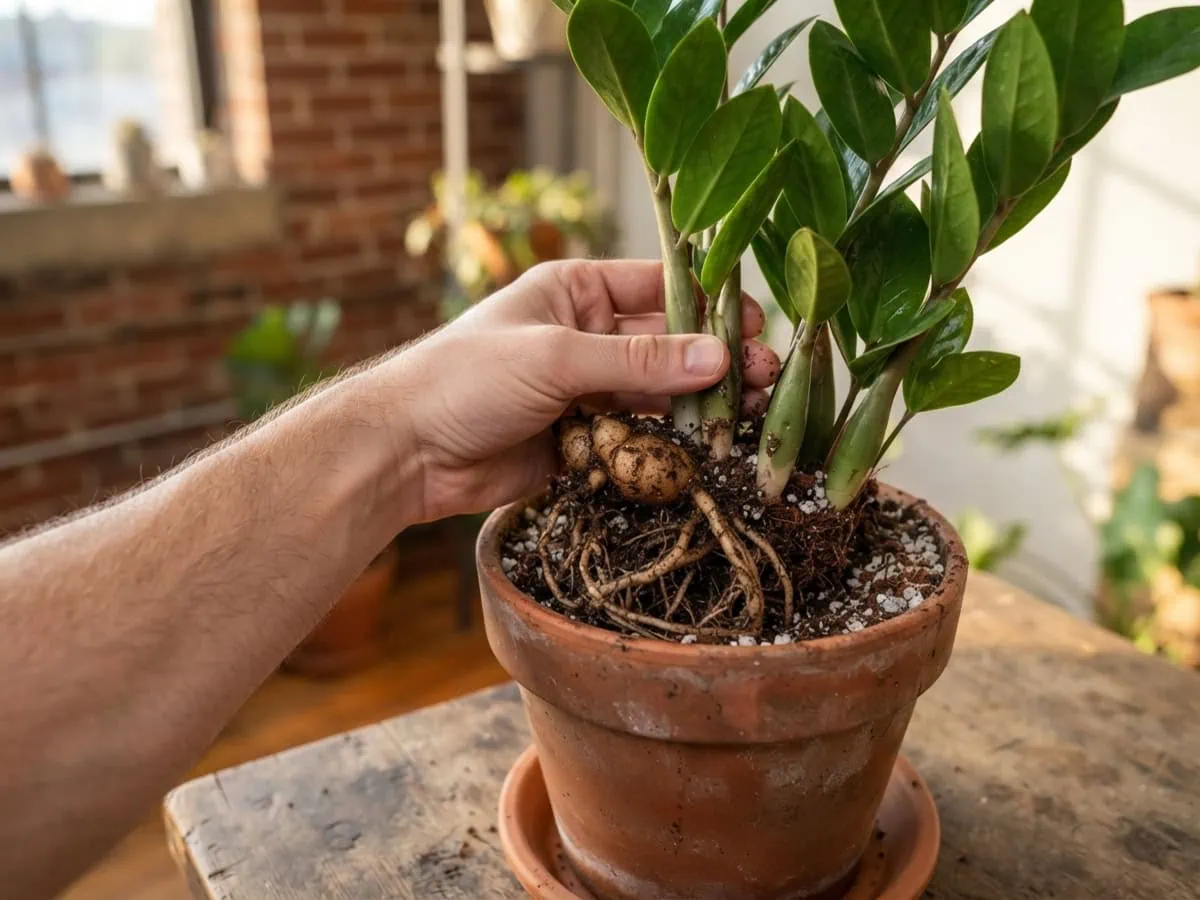
Stranger still, the ZZ runs a water-thrifty form of photosynthesis called CAM, taking in air at night when little moisture escapes. I could be wrong here, but that rare trait is likely why a ZZ shrugs off weeks of neglect that would flatten a pothos. It is the only documented CAM plant in the entire aroid family.
Press a finger against a healthy rhizome and it feels firm and cool, like a raw carrot. A rotting one goes soft and caves in. That firm-versus-mushy test is the truest read on the plant’s health.
- Rhizome: the thick, woody underground stem this plant banks its water and energy in.
- CAM: a night-shift form of photosynthesis that takes in air after dark, so the plant spends far less water doing it.
How long a ZZ plant lives
Grown well, a ZZ plant is a long-term roommate, not a seasonal one. Care guides commonly put its indoor lifespan at two to three decades. That longevity tracks one thing above all: how well you keep the rhizome from rotting.
It grows slowly from that same rhizome (it may add only a few new stalks a year), so an established plant you keep dry and lightly fed can outlast most of the furniture around it. Mature plants top out near 3 to 4 feet.
Stalled growth is rarely trouble. It is usually just normal pacing — I cover when it stops pushing new shoots in a separate guide.
Watering: soak, then let it dry out completely
Water a ZZ plant only after its mix has gone bone-dry all the way to the bottom of the pot. In most homes that lands near every 7-14 days, though the pot, not the calendar, sets the real schedule.
When you do water, soak it thoroughly. Keep going until the excess runs from the drainage hole. Then tip the saucer empty and walk away.
Overwatering is the number-one reason ZZ plants die indoors. Soggy soil suffocates and rots the underground rhizome, and by the time the stalks turn soft and yellow, the damage is already spreading below the surface. When in doubt, wait — a thirsty ZZ bounces back; a rotted one usually cannot.
Per the University of Florida IFAS Extension, how a drought-adapted rhizome rots in poorly drained, waterlogged soil is the plant’s defining indoor risk. If the stalks are already leaning and mushy at the base, you are past watering questions and into rescuing a rhizome that has started to rot.
Here is the trap that catches most owners. Rotted roots can no longer drink, so a plant drowning in wet soil wilts and looks exactly like a thirsty one.
Add more water to that wilting plant and you seal its fate (FYI — a ZZ can idle for weeks on its stored water, so a skipped watering is almost never the real problem).
Read the soil and the stem base first.
How to tell when the soil is truly dry
A finger poked two inches down is not enough for this plant, because the rhizome sits lower, holding moisture the surface has long lost.
Push a long bamboo skewer or wooden dowel to the very bottom instead (a chopstick works too), then pull it out. If it comes away clean and dust-dry, water; if damp grit clings to it, wait a few more days.
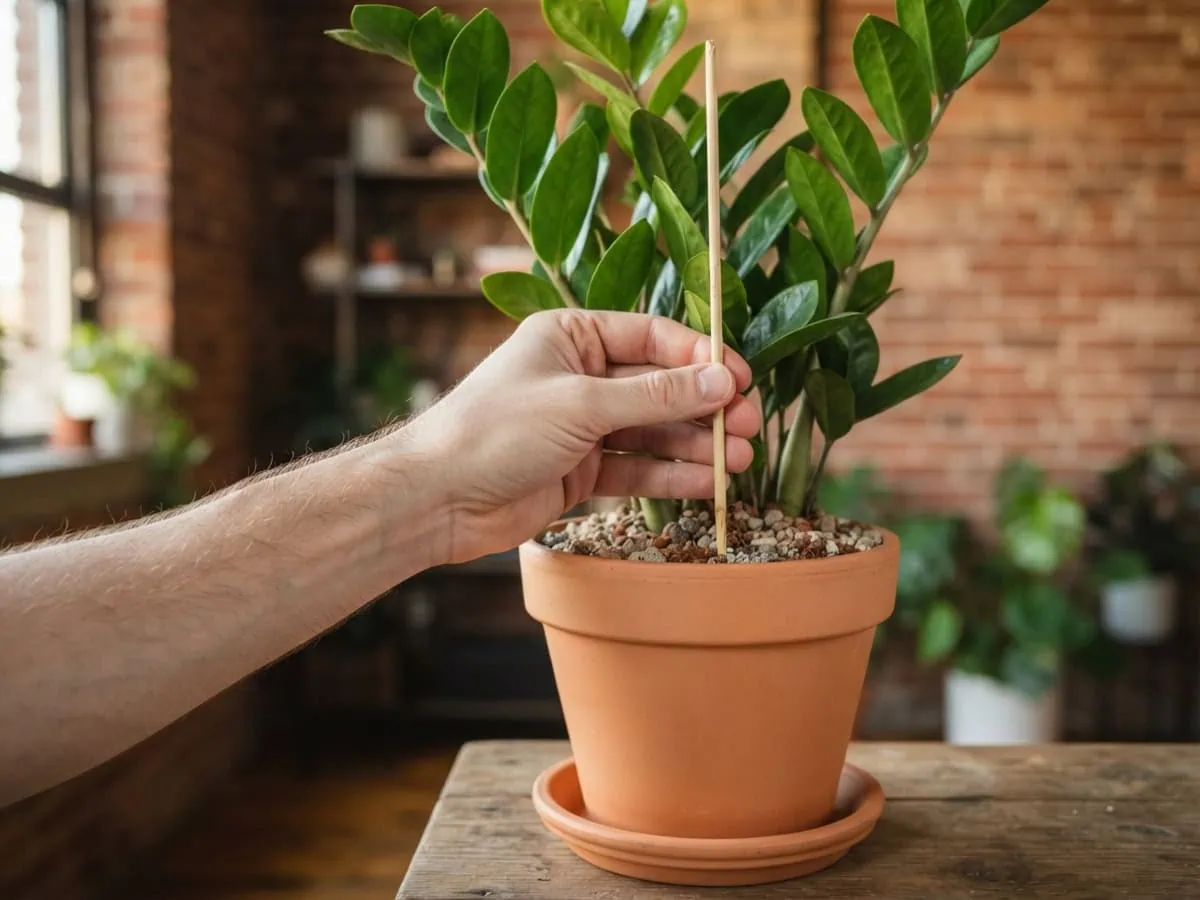
The pot itself is a second gauge. Lift it. A bone-dry ZZ pot rises noticeably light, while a still-wet one feels heavy and dense.
Between the skewer and the heft test, you never have to guess — and you never have to trust a calendar you set weeks ago.
Top watering or bottom watering
Both methods work, so pick the one that fits your setup. Top watering has one real edge: pouring until it drains flushes built-up fertilizer salts out through the bottom, which a salt-cautious ZZ appreciates (its tolerance for mineral buildup is only slight).
Bottom watering — setting the pot in a tray until the surface turns damp — guarantees the deep zone actually wets, but it never clears salt, so flush from the top every few months.
The method matters less than the timing. Whichever you choose, the rule never changes: let the mix dry out completely before the next drink. Nail that rhythm and you have dialing in a watering rhythm down to a two-minute check.
Temperature: how cold is too cold
A ZZ plant is comfortable across the ordinary indoor range of about 65-85F and takes real cold damage only as the air nears freezing. Its African, low-elevation home never freezes. The plant simply never evolved the cold-hardy chemistry that lets a temperate houseplant shrug off a chill.
The “what temperature is too cold for a ZZ plant” question comes down to two numbers, not one. Keep the room above about 50F for the plant to stay genuinely comfortable — Missouri Botanical Garden even suggests bringing a ZZ indoors once nights dip below 60F.
Visible chilling injury sets in far lower: Iowa State documents damage right at 32F, the freezing point itself. The honest answer is a band — cozy above 50F, hurt at freezing — not the single “45F” figure that floats around the internet.
Here is the reassuring part. Because that thick underground rhizome is a reserve organ, a cold-nipped ZZ usually loses only its top growth (the leaflets injure right at freezing). The buried rhizome rides it out and pushes fresh stalks once warmth returns.
A chilled ZZ is rarely a dead one, just a set-back one. USDA rates its outdoor hardiness at Zones 9 to 10, shorthand for a plant that must never freeze.
Warmth, by contrast, only speeds it up. Growth quickens toward the mid-70s and into the 80s (commercial growers push 76-90F for a fast crop), while a cool 68F room just means slower, steadier progress. You never need to heat a room for a ZZ.
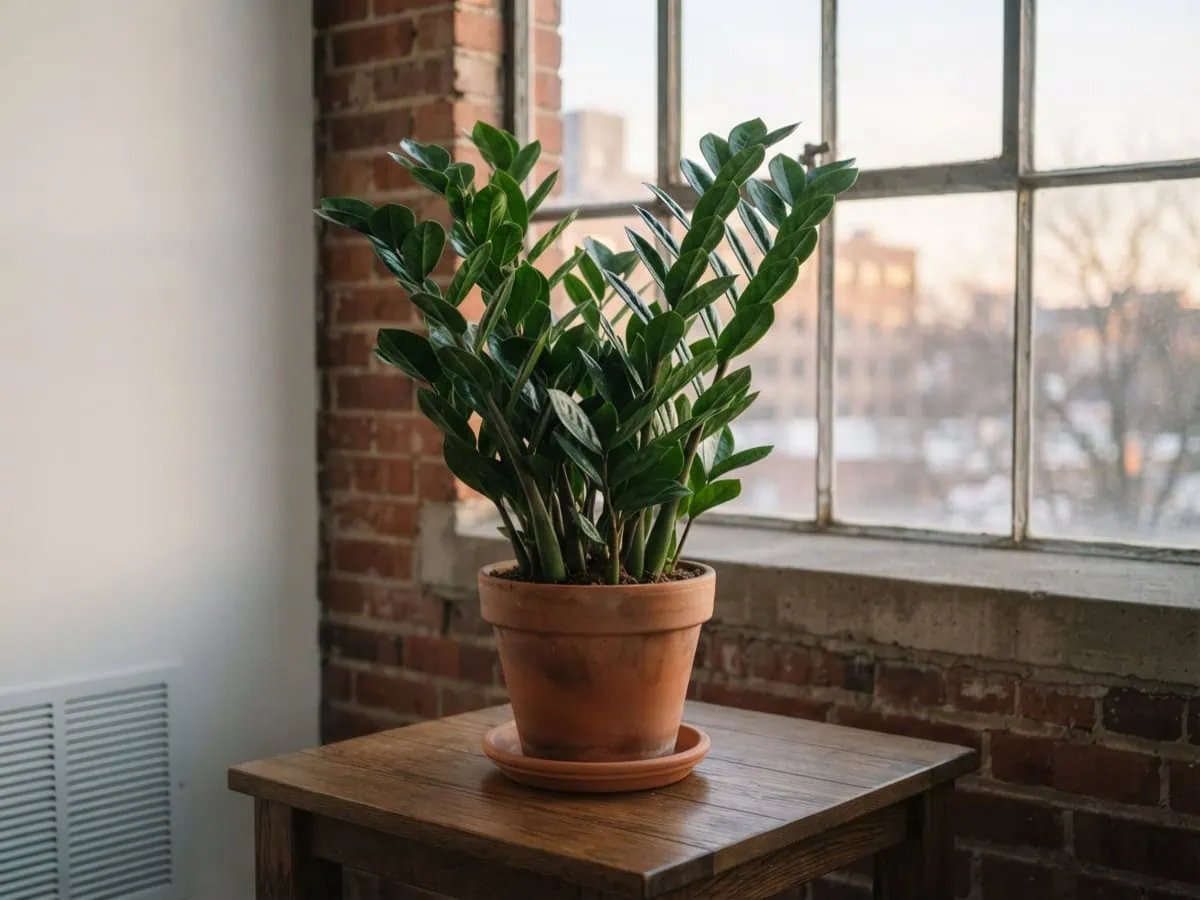
And if it barely moves all winter, that is the thermostat throttling growth, not a health problem. Slow is this plant’s default setting.
Drafts are the real winter hazard, and they cut both ways. A cold stream off single-pane glass or an AC vent holds the plant’s immediate microclimate well below the room reading, and a sustained chill there is how a tough plant still ends up cold-stressed.
A hot, dry blast from a radiator is the opposite problem. It recreates the one condition (low humidity plus heat above about 79F) where even this forgiving plant can crisp a leaf tip. The fix is placement, not equipment.
Slide the pot a few feet off the cold glass in winter, keep it clear of the direct airflow from vents and registers, and let it sit in the calm, stable middle of the room.
Get that right and temperature becomes the variable you can almost forget — the stalks stay firm and rubbery to the touch instead of going limp and cold.
Keep a ZZ plant off cold windowsills in the cold months and out of the direct blast of an AC vent or a radiator. The plant tolerates the room; what it cannot tolerate is a steady cold draft pulling its own little pocket of air toward freezing.
Light: bright shade, never direct sun
A ZZ plant does best in bright, indirect light, tolerates surprisingly dim corners, and scorches in direct sun. The “low-light plant” reputation is half true.
It survives low light. It truly thrives in bright shade (and grows noticeably faster there).
Because a single number hides the range, think in three tiers of foot-candles (FC), the standard indoor light unit. Survival floor: about 25 FC — low enough that UF/IFAS documented a ZZ still pushing new leaves for over a year there. Few houseplants match that.
Sweet spot: roughly 500-2,000 FC of bright, indirect light, where growth actually picks up. Ceiling: no direct sun at all, because unfiltered rays past about 1,000 FC of direct exposure bleach and scald the glossy leaflets.
Those tiers translate to lux if you meter in metric — roughly 270 lux at the 25 FC floor, and about 5,400 to 21,500 lux across the bright-indirect sweet spot.
But the gap between floor and sweet spot is really survive-versus-thrive. At 25 FC a ZZ will not die, it just idles for a year; lift it into the bright band and it starts stacking new stalks again.
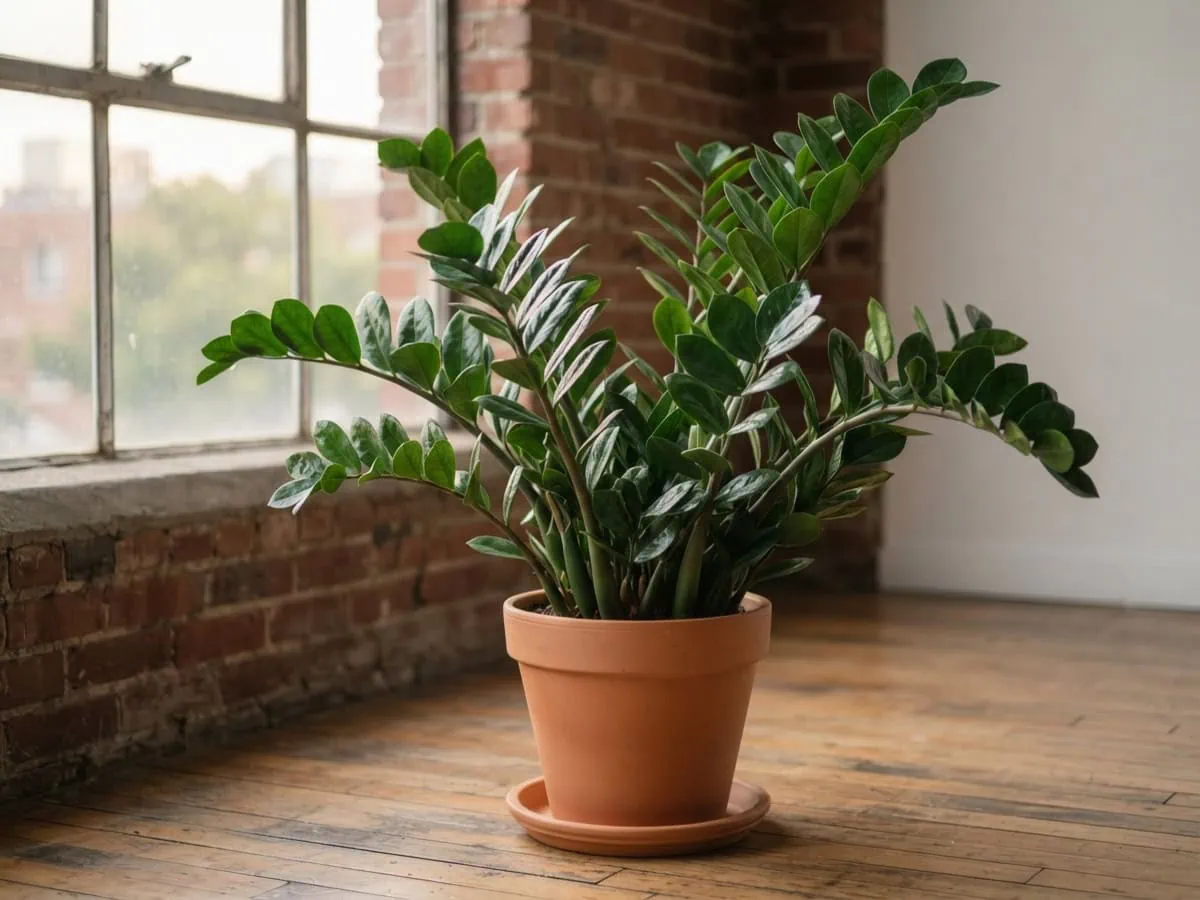
In plain window terms (Northern Hemisphere reference), it maps cleanly. A north window is a fine “it will live” spot. About 3 feet back from an east or west window is the everyday sweet spot.
The real dimmer is distance from the pane.
Light runs strong within about two feet of an east or west window and drops to that comfortable medium band two to six feet back. Sliding the pot in or out along that line tunes the exact tier, no meter needed.
A south window can burn at the glass. Set the plant back several feet, or filter it behind a sheer curtain. For the exact tiers and window math, here’s reading its exact light needs.
Watch for one quirky tell. A light-starved ZZ grows pale, thin, over-stretched stalks — and, oddly, it leans away from the window rather than toward it (the reverse of almost every other houseplant).
New growth that is floppier and paler than the older stalks, thin and lacking the stiff, rubbery feel of a well-lit stalk, is the plant asking quietly for more light. Most owners miss it, because a ZZ can idle for a year at its floor without dramatic complaint.
The good news for dim rooms: this is one of the few houseplants that genuinely lives on artificial light. A full-spectrum LED grow bulb on a 12-14 hour timer covers a windowless office, and even ordinary fluorescent ceiling light keeps one ticking over.
Darker cultivars ask for a little more, though. The near-black Raven needs brighter indirect light to hold its color, which is one place how the Raven cultivar compares to the green form actually matters.
Tap the button below to get more plant fixes in your Google Search results

Soil, pots, and when to repot
A ZZ plant needs one thing from its soil above all else: fast drainage. Give it an airy, gritty mix in a pot that drains freely, and the rhizome stays dry between waterings — exactly what keeps it from rotting. The following sections cover the mix, the pot material, and when to size up.
The exact pH barely matters. Any near-neutral houseplant or cactus-and-succulent mix (nothing fancy) sits well inside its comfortable range.
What matters is air. Fine, dense potting soil packs down and smothers the rhizome, while a chunky, mineral-heavy blend keeps oxygen moving around it.
Fast-draining gritty mix: a blend that sheds water almost instantly and stays full of air pockets. For a ZZ that means roughly 2 parts coco coir to 1 part pumice, top-dressed with a thin layer of coarse pumice grit. The coir holds a little moisture while the pumice keeps permanent air channels open around the swelling rhizome.
Terracotta or plastic for a ZZ plant
For most people, terracotta wins. The choice is really about your own watering habits, so the following table gives the honest split.
| Pot material | How it behaves around the rhizome |
|---|---|
| Terracotta (unglazed clay) | Porous walls wick water out and pull air in; dries fast, braking rot |
| Plastic or glazed ceramic | Holds moisture far longer; forgives a forgetful waterer, punishes a heavy hand |
Verdict: Choose terracotta for a ZZ plant, because its porous wall is a passive, always-on defense against the overwatering rot that ends most of them.
Either way, the mix inside matters more than the pot outside — start from mixing the right fast-draining substrate and even a plastic pot behaves.
Big pots, deep pots, and the drainage rule
Resist the urge to size up big. A ZZ likes a snug pot, and an oversized one is actively risky: all that extra soil stays wet for days after watering, holding moisture against a rhizome built to dry out. When you do repot, go up just one size (roughly 1-2 inches of added width).
Size the pot to the rhizome, not the leaves. Kew puts the underground tuber at only about 1.2 to 1.6 inches across, and the rhizome at up to roughly 8 inches long.
That is a compact organ. It fills a modest pot and wants nothing bigger.
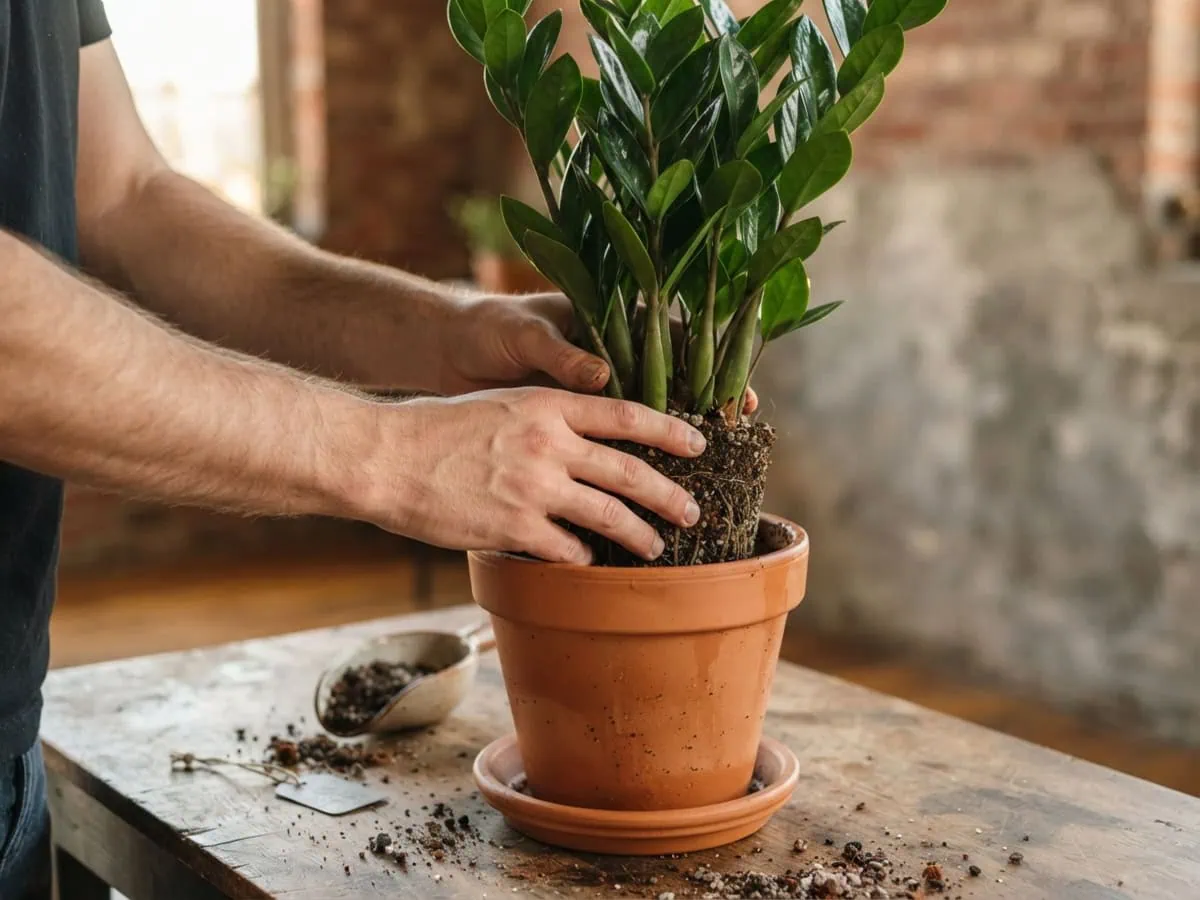
One rule is non-negotiable: the pot must have a drainage hole, and a decorative cachepot only works if you lift the inner pot and tip out the runoff.
Because it grows so slowly, an established ZZ needs repotting only every 2-3 years — usually when firm rhizomes start bulging against the wall. Timing it to avoid a setback is its own small skill, so here’s repotting without transplant shock.
One more thing the pot cannot fix on its own is the mix. Even in perfect terracotta, a fine, water-holding soil keeps the rhizome damp for days — roots need to breathe, and dense soil collapses the air pockets around them. Airy grit lets the whole pot dry evenly, top to bottom, so no soggy layer lingers against the rhizome.
Fertilizer and humidity: how little it really needs
On both counts, the answer is “less than you think.” A ZZ plant is a light feeder and a low-humidity champion, so the two mistakes to avoid are over-feeding it and fussing with a humidifier it never wanted. The two sections below give the specifics.
How often should you fertilize a ZZ plant
Feed lightly, and only while it is actively growing. A balanced houseplant fertilizer at half strength — a 20-20-20 or 10-8-7, or a nitrogen-leaning foliage 3:1:2 — applied once or twice a year, during the warm season, is plenty. Because the plant banks its own energy in that rhizome, it simply has little demand to feed in the first place.
How little? Genuinely little. That once-or-twice-a-year figure is a ceiling, not a target — the most a ZZ should ever get while it is actively growing.
Plenty of growers feed just twice a year (enough for a plant this thrifty) and never see a difference. The number on the fertilizer box matters far less than keeping the dose weak and the schedule sparse.
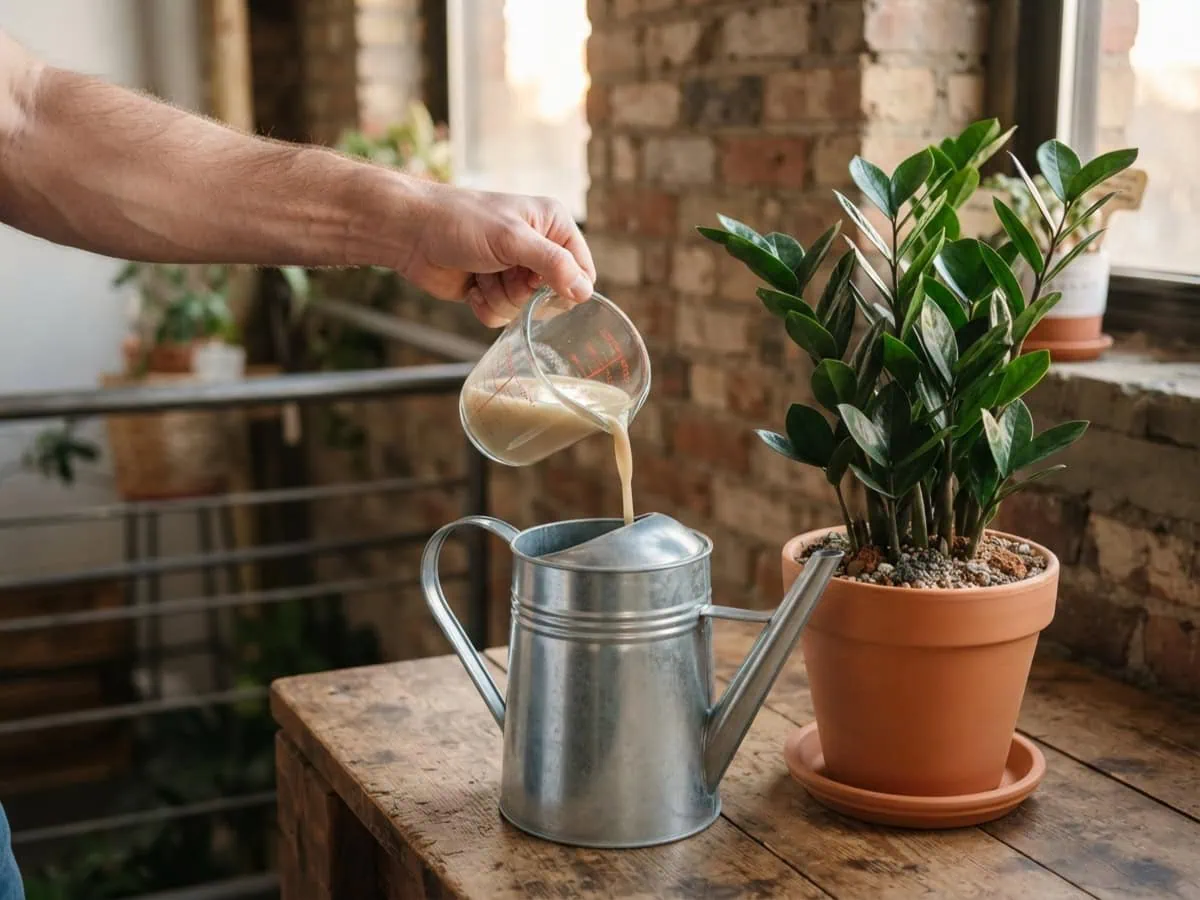
Then stop completely once growth slows in the low-light months. Feeding a resting plant does not help it; the unused salts just build into a white, gritty crust that scorches root tips and browns the leaf edges. If you ever see that crust, flush the pot with plain water until it runs clear.
That flush is worth doing right. Keep pouring well past the first runoff — roughly six inches of through-water rinses out about half the built-up salt, twelve inches most of it. Run it every couple of months and the crust never returns.
The exact cadence is genuinely unsettled in the literature — twice a year, or a dilute monthly feed, depending on the source. I’m honestly not sure why this works — but it does: err light, and a ZZ barely notices which schedule you picked.
My own rhythm is almost lazy: a half-strength feed once or twice while it is actively growing, then nothing for the rest of the year. Pause for a sec. That humidifier I bought for it? Still in the cupboard, unused, because this plant never needed it.
Do ZZ plants need high humidity indoors
No — ordinary household humidity is completely fine. The ZZ is one of the arid-climate exceptions that shrugs off the dry winter air most tropical houseplants resent; the standard indoor 30-60% range suits it with no help at all. That tolerance traces straight back to its seasonally dry African home.
Skip the humidifier, and skip the misting too. The only humidity-related risk is narrow — very dry air (below that 30% end) combined with heat above about 79F can brown a leaf tip, an unlikely pairing in a normal home.
Pebble trays, for what it is worth, barely move a room’s humidity anyway, so they are effort spent on a problem this plant does not have.
Common mistakes and myths that trip up beginners
One “mistake” outranks every care myth here: leaving a ZZ where a curious pet or toddler can chew it.
Every part of a ZZ plant is toxic to cats, dogs, and people if chewed. The sap carries insoluble calcium oxalate crystals — microscopic needles that trigger immediate mouth burning, drooling, and vomiting. Keep it out of reach of pets and crawling children. This information is for educational purposes only. If your pet ingests part of this plant, contact your veterinarian, the ASPCA Animal Poison Control Center at 888-426-4435, or Pet Poison Helpline at 855-764-7661. For a child, call Poison Control at 1-800-222-1222.
According to the ASPCA, the list of common houseplants that are toxic to cats and dogs includes this one. That is no reason to give up the plant, only to set it high and out of reach; the full picture sits in how toxic it is to cats and dogs.
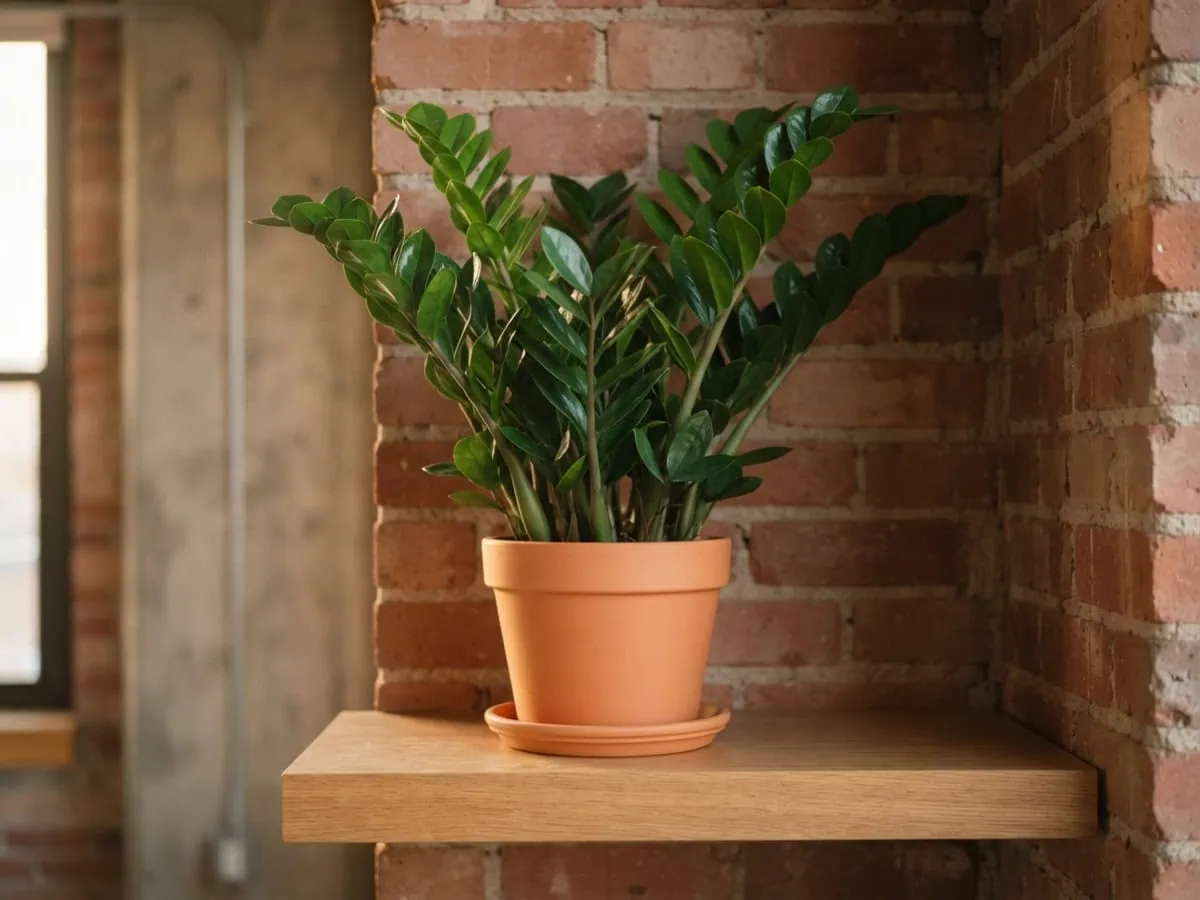
Almost every other ZZ “problem” traces back to a handful of myths and misreadings, not to disease. Sort those out and the plant mostly runs itself.
Take the black flecks that show up on the stems in brighter light — I panicked over mine for a week before learning they are usually normal (cosmetic, not rot). If yours have them, here’s what the black spots on the stems mean.
Truly sick plants are the exception, and they announce themselves.
Sticky leaves or tiny flies rising from the soil point to bugs, not a care slip. Start by clearing scale, mealybugs and fungus gnats.
Here are the four myths worth clearing, one at a time.
Does a ZZ plant need a moss pole or support
No — and I mean a flat no. A ZZ plant is not a climbing aroid, grows no aerial roots, and has nothing to grip a pole with.
Its stalks are self-supporting leaves rising straight from the rhizome. A stake solves a problem it does not have.
The “do ZZ plants need a moss pole or support” question almost always comes from a floppy plant, and floppiness is a light or rot problem, not a support problem.
Propping it up just hides the cause, so the real fix is brighter light or a rescue — which is why floppy stems that droop and splay open get their own guide.
Is bottom-leaf yellowing normal
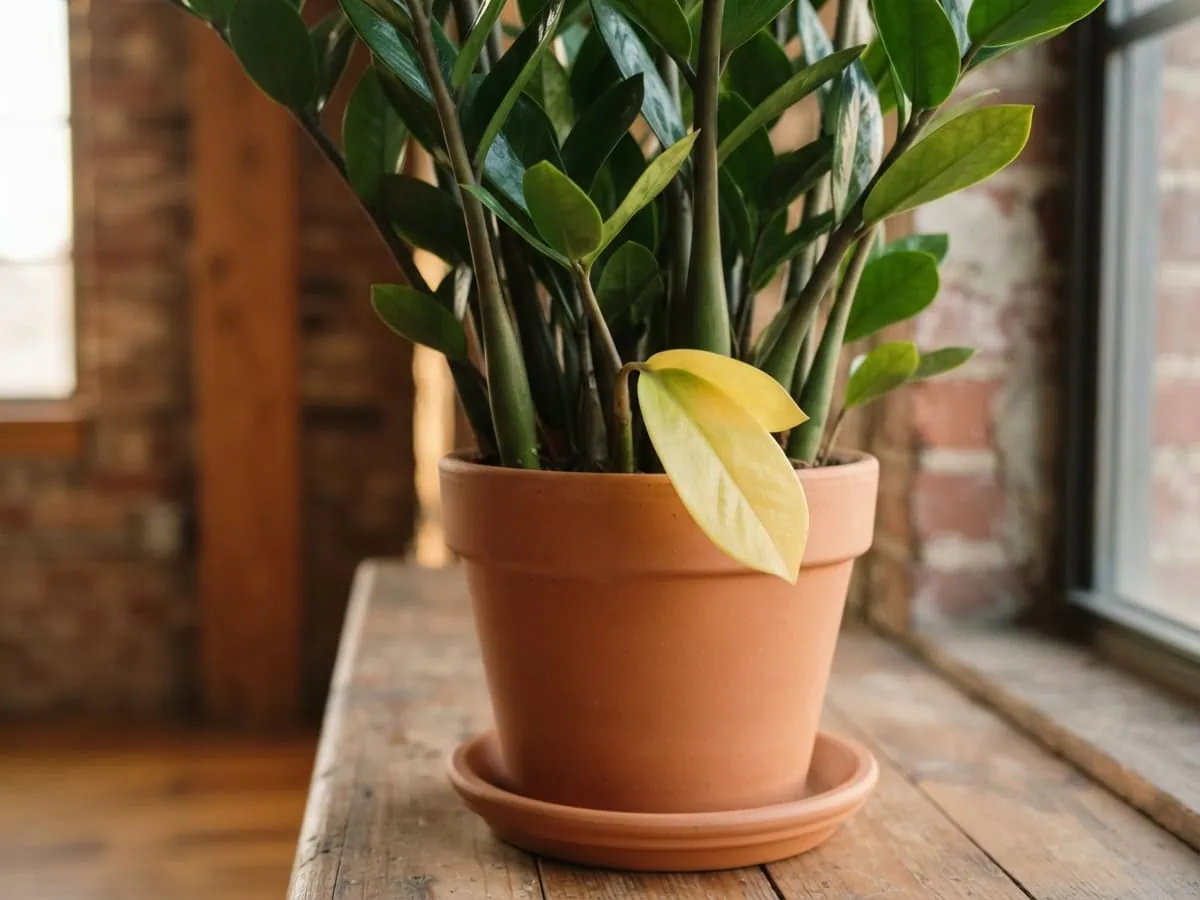
Often, yes. The honest test is which leaves are yellowing. One or two lower, older leaflets fading and dropping is natural aging — the plant shedding a spent leaf to fund new growth.
That settles the common “is it normal for bottom ZZ plant leaves to turn yellow” worry: usually it is.
But when new growth yellows, or many leaves go at once, that points to overwatering and a rotting rhizome — the pathological branch covered in why the leaves are turning yellow.
The myth that it survives total darkness
“Low light” and “no light” are not the same thing. The gap between them is exactly where a ZZ quietly starves — slowly enough that most owners never connect the stall to the dark corner they picked for it months earlier.
The claim that a ZZ plant thrives in complete darkness is a myth that quietly starves plants. It survives very low light — but “survives” is not “thrives.” It still needs at least a dim glow (roughly 25 foot-candles, about a lamp-lit room) to keep pushing new leaves. In true darkness it slowly runs down its reserves and fades.
Place even a “low-light” ZZ where it catches some daylight or steady artificial light. The reputation for surviving a windowless closet is real, but only when that closet keeps its lights on for a good part of the day.
Do coffee grounds help a ZZ plant
No — skip the coffee grounds. They hold moisture at the surface, mat down over the mix, and nudge it toward the constant damp a rot-prone rhizome least wants. For a light feeder that already asks for almost no fertilizer, they solve nothing and add risk.
If your real goal is more plants, grounds will not get you there — propagation will. It is slow but genuinely easy, and here are three proven ways to propagate a new plant.
Your top ZZ plant questions, answered
How do you care for a ZZ plant indoors?
Give it bright, indirect light, water only when the mix is bone-dry (about every 7-14 days), and use a gritty, fast-draining mix in a terracotta pot with a drainage hole. Keep the room above 50F, skip the humidifier, and feed lightly during active growth. The one rule that matters most: let the soil dry out completely between waterings, because overwatering is what harms this drought-adapted plant.
What are the disadvantages of the ZZ plant?
The main drawbacks are that it is toxic to cats, dogs, and people if chewed, and that it grows slowly, adding only a few stalks a year. It also rots fast if overwatered, so a heavy hand can lose one quickly. Otherwise the disadvantages are minor: it rarely blooms indoors, and its glossy leaves collect dust that needs a wipe whenever they look dull.
What is the lifespan of a ZZ plant?
With good care, a ZZ plant commonly lives two to three decades indoors. Its longevity hinges on one thing: keeping the water-storing rhizome from rotting. Because it grows slowly from that same rhizome, an established plant you keep dry and lightly fed can outlast the furniture around it.
Do ZZ plants need big pots?
No — ZZ plants prefer a snug pot only slightly larger than the root ball. An oversized pot holds wet soil for days, trapping moisture against the rot-prone rhizome. Step up just one size (1-2 inches of added width) when you repot, and only every 2-3 years, once firm rhizomes start crowding the pot.
What are common problems with ZZ plants?
The most common problem by far is overwatering, which rots the rhizome and shows as yellowing, drooping, mushy stalks. Others are pale, stretched growth from too little light and brown tips from salt buildup or a hot draft. Nearly all are reversible: read the soil before watering, give bright indirect light, and the plant rarely gives you trouble.
How do I make my ZZ plant happy?
A ZZ plant is happiest when you mostly leave it alone. Set it in bright, indirect light, let the gritty mix dry out fully before watering, and keep the room warm, above 50F.
Feed lightly a couple of times in the growing season, and wipe the dust off the leaves whenever they look dull. Restraint beats attention with this plant.
Are coffee grounds good for a ZZ plant?
No — coffee grounds are not good for a ZZ plant. They hold moisture at the surface and mat over the mix, pushing it toward the constant damp that rots the rhizome.
For a light feeder, they add risk without any real benefit. Use a balanced houseplant fertilizer at half strength during active growth instead.
Where should I place a ZZ plant in my house?
Place a ZZ plant a few feet back from an east- or west-facing window, in bright, indirect light without direct sun. A north window works as a lower-light spot, and a spot set back from a bright south window is fine.
Keep it off cold windowsills and out of AC or heat drafts. It even survives a windowless room on steady artificial light.
How to make ZZ plant bushy?
To make a ZZ plant look fuller, give it brighter indirect light so new stalks grow stout instead of stretching, and be patient with this slow grower. You can also pot several rhizome divisions together for instant fullness. Do not rely on pruning, though — cut stalks do not branch; new growth comes only from the rhizome at the base.
Skip the Myth. Use the Science.
Truth is — good ZZ plant care comes down to one habit, not a dozen rules. Read the soil, not the calendar.
Water only when the gritty mix is bone-dry all the way down. Everything else this plant forgives: dim corners, dry air, a skipped feeding, weeks of being ignored.
The failures nearly all share one root cause (TBH — almost every dying ZZ I have unpotted was drowning, not thirsty). So when in doubt, wait. Get that single move right and ZZ plant care stops being a worry and becomes the easiest, glossiest plant on your shelf.
May your ZZ plant keep its glossy shine in the dimmest corner, its rhizomes ride firm and pale, and its gritty mix run bone-dry before you ever reach for the watering can.
Tap the button below to get more plant fixes in your Google Search results