🛠️ Quick Prep Summary: what to have ready before you lift the plant
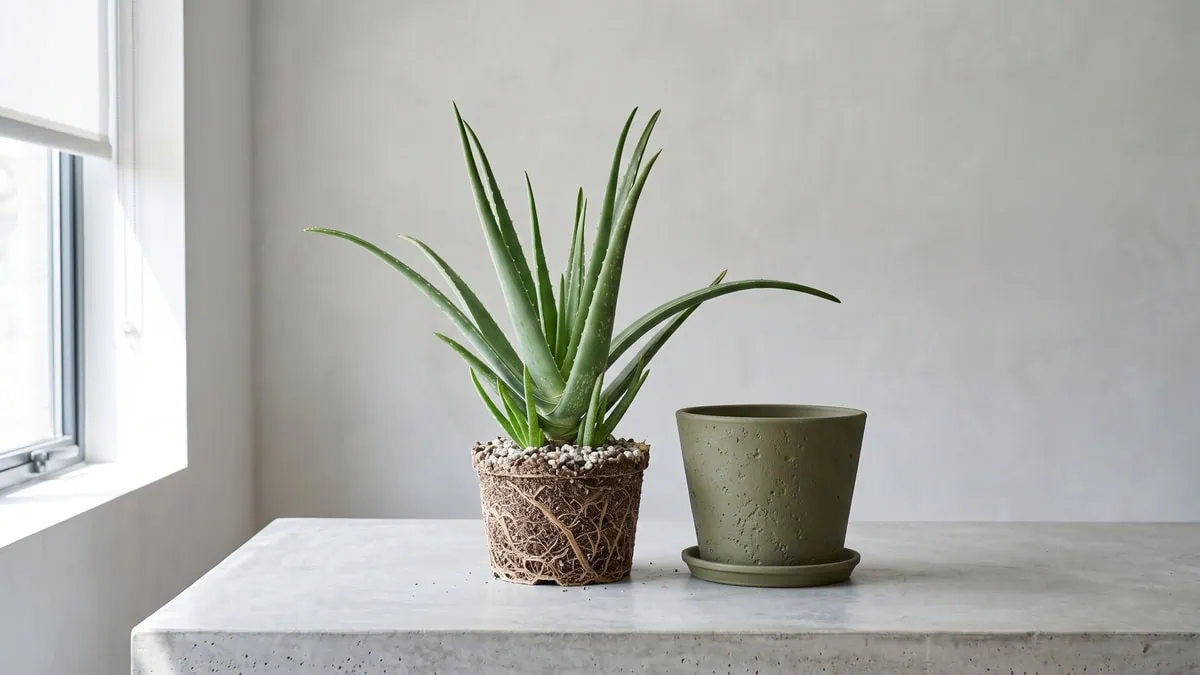
How to repot Aloe vera without transplant shock turns on three choices made before the plant leaves its pot. This Asphodelaceae rosette moves best in spring, into a pot one size up. Gather these three things first, then set aside 20-40 minutes for the whole job.
- Sterile blade: a sharp knife or scissors, wiped down with rubbing alcohol
- Pot and mix: one size up, shallow, with a drainage hole and gritty mix
- Timing: spring, as new growth resumes at the rosette center
Get the one-page care card for this guide, plus a printable A4 copy
We condense this guide into one card for your phone and a print version for the pot shelf. Enter your email and we send both to your inbox. Subscribe once, then request the card of any guide you read.
By subscribing you agree to get emails from Plant Care Basics about plant care guides, about once a week at most. Unsubscribe in one click. Privacy policy
The pot came away dry and gritty, and the rootball lifted out lighter than the bag of pumice beside it. That featherweight heft is the whole tell.
Nine Aloe rosettes have gone into fresh containers on my bench across 4 years, and the ones that sulked afterwards were all sitting in a wet root zone in the days right after (note to self: the damage starts under the mix, never in the canopy).
The mistake I kept making was watering the thing in, the way you would a fern. I’d like to retract that. What fixed it was leaving the fresh potting soil bone dry while the shallow, outward-fanning roots sealed their torn ends.
Two changes in one week is what turns a routine move into weeks of drooping. Time the move, set the depth, hold the first watering, and the plant barely notices. For the whole routine behind an established specimen, start with the main care guide.
This is a twenty-minute job followed by a quiet week, nothing more. Timing, the pot step and the mix come next, with time and difficulty as working estimates.
How to repot Aloe vera without transplant shock: quick specs
| Aloe specs | Quick spec |
|---|---|
| Best time to move | Spring, as new growth resumes at the center of the rosette |
| Pot step-up | One size up only, leaving 1-1.5 in of fresh mix around the root ball |
| Growing medium | A fast-draining gritty succulent mix, roughly 1 part peat-free organic base to 2 parts coarse pumice, top-dressed with a thin layer of coarse pumice grit |
| Time needed | 20-40 minutes |
| Difficulty | Low-medium (Beginner) |
| Water it straight after the move? | No – the mix stays dry for about a week |
| Drainage hole required? | Yes, with the saucer emptied after every watering |
You are subscribed
Press the button and we prepare this guide's one-page care card and its A4 print copy and email both to you within a few minutes.
Tap the button below to get more plant fixes in your Google Search results

Table of Contents
Get the plant, the pot and the day right before you lift it
Move the plant when the root mass has taken over the pot, not when a calendar says so. Aloe (Aloe vera, formerly Aloe barbadensis), a member of the Asphodelaceae family, fans its roots sideways rather than down, so a wide, shallow container suits it better than a deep one. Outgrown signals first, timing second.
Signs an Aloe vera has outgrown its container
A pot is outgrown when the roots take up more room than the mix does. That is only visible once the plant is out, so read the outside cues first:
- Roots pushing out of the drainage hole, or circling and turning back up the wall
- Water running straight through instead of soaking in
- The mix drying out far faster than it used to
- A top-heavy rosette that tips the pot, or pups crowding the surface
The two I misread most often were a fast dry-down and a tipping pot; both looked like thirst until I lifted the plant and found more root than mix. Published intervals disagree anyway: two to three years, three to five, or a root-prune at about three. So ignore the number.
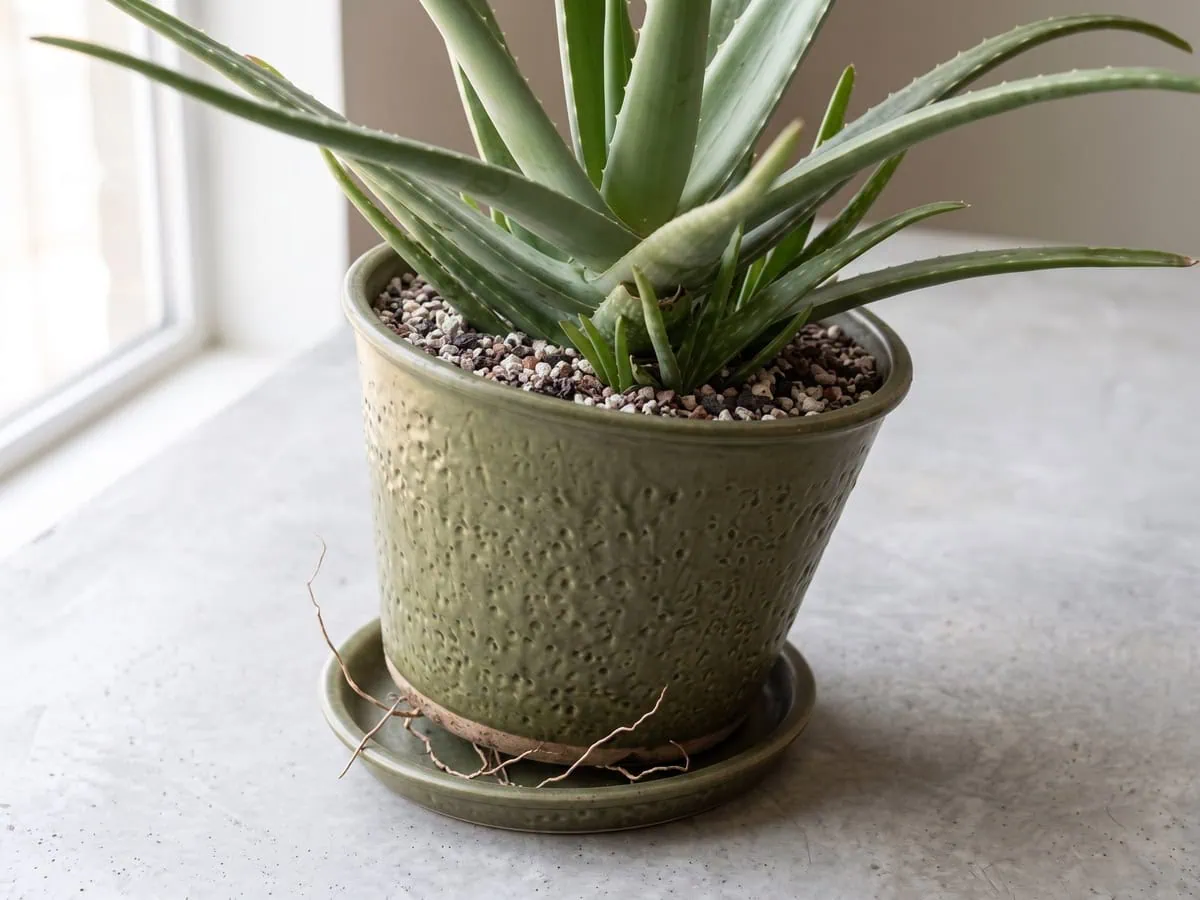
The sign wins, and a rosette heavy enough to tip its own pot (weight you feel the moment you lift it) has answered the question. Two of those cues point somewhere else first. A plant that has stretched instead of thickened is a rosette running to a bare stalk instead of thickening, and light fixes that, not a bigger pot.
The time of year, and the pre-move watering
Spring is the answer, and readers who ask “when is the right time of year to repot an aloe vera” are usually asking about a calendar they cannot see indoors.
The season stands in for two things you can check indoors: how much light reaches the plant, and whether new leaves have pushed up from the center. Both say the same thing. Wait for growth to restart, then move it.
Water the mix about 30 minutes before you lift the plant. Damp mix releases the root ball cleanly, and a bone-dry one crumbles away and tears feeder roots on the way out (skip this only if the plant genuinely does not need water yet).
Get the one-page care card for this guide, plus a printable A4 copy
We condense this guide into one card for your phone and a print version for the pot shelf. Enter your email and we send both to your inbox. Subscribe once, then request the card of any guide you read.
By subscribing you agree to get emails from Plant Care Basics about plant care guides, about once a week at most. Unsubscribe in one click. Privacy policy
Tap the button below to get more plant fixes in your Google Search results

Repot step by step, from lifting to backfilling
Work through the move in one sitting, with everything laid out before the plant leaves its pot. The five steps below run from sanitizing to the last handful of grit. The new pot goes up one size only, which for a small plant means about two inches more across.
Step 1: Sanitize the pot and lay out the tools
Scrub a reused pot with a stiff brush and either plain hot water or a solution of 9 parts water to 1 part bleach, then wipe the blade and the scissors with rubbing alcohol (between plants, not once at the start). Lay out the trowel, the measuring cup, the mixing bowl, a wooden skewer and a pair of gloves. An empty clay pot still feels heavy for its size in the hand, and that wall thickness is what wicks moisture away later.
Step 2: Ease the plant out and read the root ball
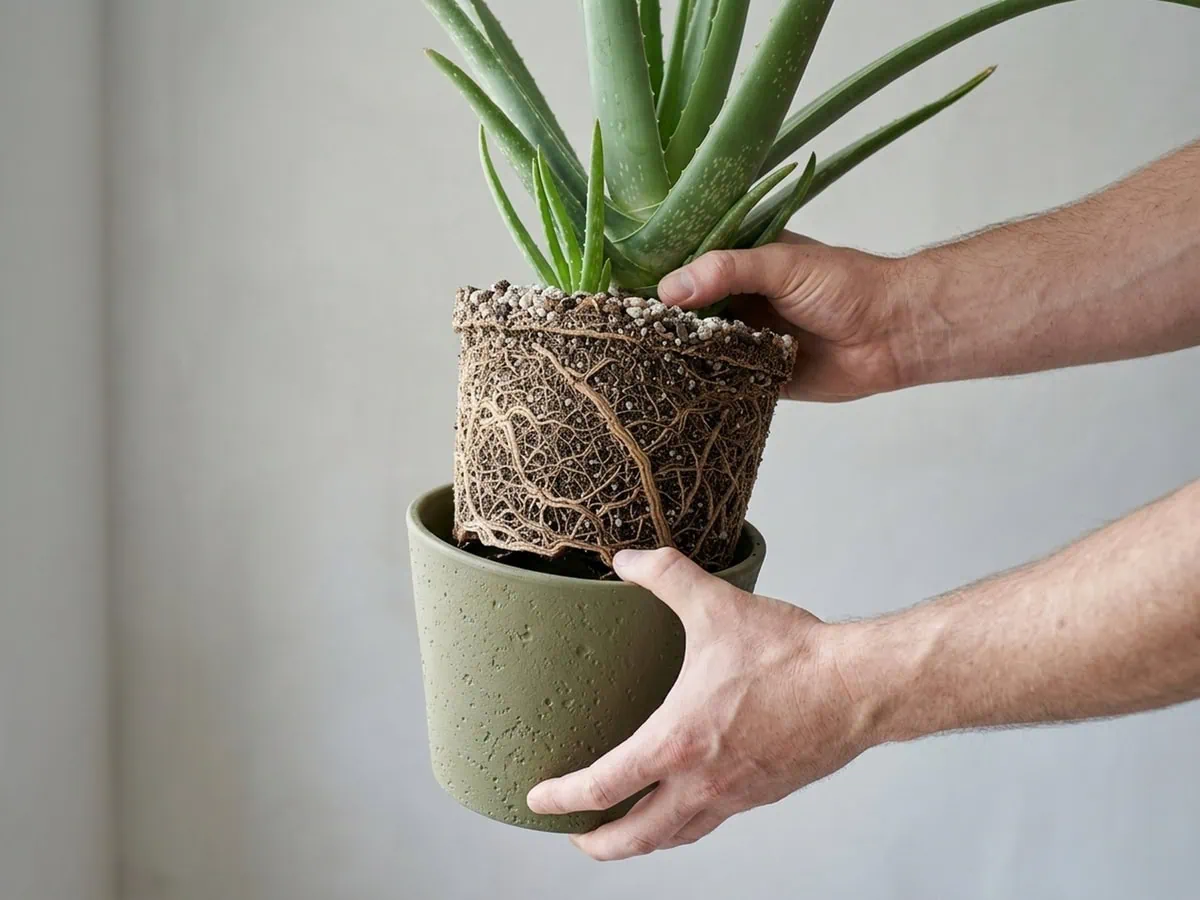
Tip the pot on its side and pull steadily on the base of the rosette rather than on a leaf, so the root ball slides out in one piece. Healthy roots are firm and light-colored with plenty of fine feeder roots, while soft, dark roots found at the moment of the move come off now. The mass should feel dense and barely damp across both palms, never sodden.
That bitter yellow latex under the rind irritates some skin and marks whatever it lands on. Wear nitrile or thick gardening gloves, rinse any contact with cold running water for at least 60 seconds, and wipe drips off the floor at once.
If a severe skin reaction develops (blistering or intense burning), seek medical attention immediately. For chemical exposure, you can also contact Poison Control (1-800-222-1222 in the US).
Always test on a small area first. Results may vary depending on your specific conditions.
Step 3: Decide how much old medium comes off
Old mix comes away where it has broken down, and it stays on the roots where it still holds together. Crumble the outer shell between your fingers, trim the circling roots, and take no more than about a third of the root mass in one session. If offsets are crowding the base, this is the moment for lifting the pups away from the parent at a move.

Step 4: Set the rosette at its old medium line
A reader who types “how deep should an aloe vera sit in its new pot” is really asking about one band on the stem, the mark left by the old substrate line. Bring the plant down until that mark sits level with the new surface (level with the mix, not proud of the rim) and no leaf base is buried. A buried stem rots, and the plant will not tell you until the lowest leaves start releasing.
According to the Texas Plant Disease Handbook, an excessive volume of water at this point risks a soft rot that starts in the crown. That is the mechanism behind the dry window.
That risk sits at the collar, where the stem meets the roots. The backfill below protects that junction.
Step 5: Backfill, top-dress and leave it dry
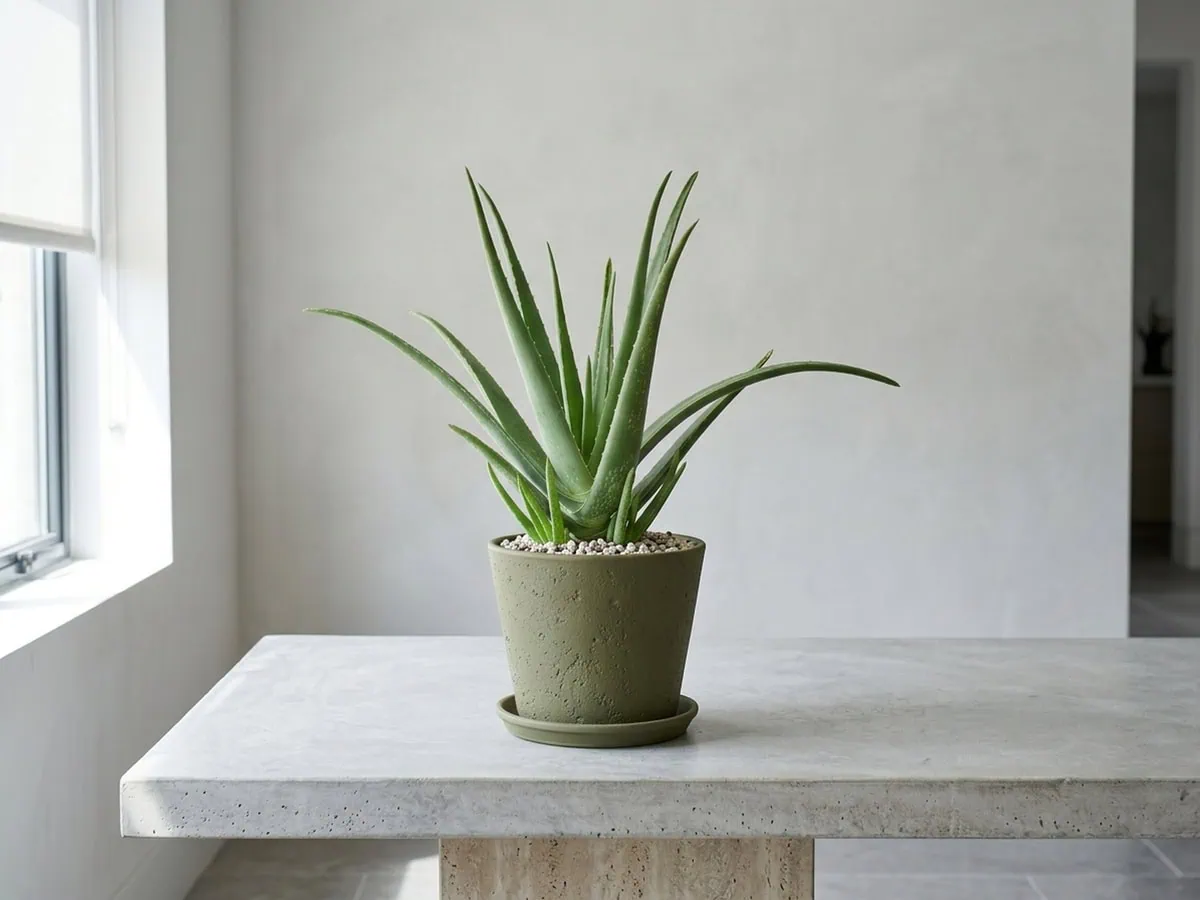
Backfill with a fast-draining gritty succulent mix, roughly 1 part peat-free organic base to 2 parts coarse pumice, top-dressed with a thin layer of coarse pumice grit, firming it only lightly around the collar; what belongs in the mix you are potting into is worth settling before you start. The answer to “should i water an aloe vera right after repotting it” is no, because the mix stays dry for about a week while the torn root ends seal over. The finished pot feels light for its bulk when you lift it back onto its saucer.
The settling window, and how to read the plant
Hold every other variable still while the plant re-establishes. The three sections below cover placement, reading a droop, and when a second move is justified.
Where the plant stands while it settles
Put the pot back in the position it already occupied, not in a better one. Repotting and a brighter window in the same week is the compounding error behind most post-move sulking, because light is the change this plant registers fastest and a torn root system cannot answer it.
Keep it off cold glass and out of the direct blast of a vent (both are cold-side risks, not heat ones). Nothing else moves this week.
I have made that mistake: the plant stayed flat for a month and the pot never regained the heft of a watered one until new roots took hold. Weight told me more than the leaves did.
Reading a droop in the weeks after the move
A plant that goes soft after a move is asking one question: water or not. The answer is no. Readers typing “why does my aloe vera droop for weeks after repotting” have usually already answered it wrongly.
Check the plant in this order instead:
- The base of the stem: firm and green means settling, soft means decay
- The newest leaves at the center: still tight and rising is a good sign
- The oldest outer leaves: these go limp first and mean least
A droop of up to about three weeks is normal, and how long the whole thing takes is set by the light the plant gets back, not by a fixed number of days. This is an open question for me: published guidance ties the restart of growth to the return of light rather than to any counted interval, so a calendar figure is the wrong target.

Until then, the watering rhythm the plant returns to afterwards matters more than anything you do this week.
When a second move is justified
Answer “can i repot an aloe vera twice in the same month” from the fault rather than from a number. Judge it by the fault instead.
A container with no drainage hole, or a peat-heavy mix that stays wet, is worth the second disturbance. A plant that simply will not stand up straight is not (that one is a light problem).
Frequently asked questions about repotting an Aloe
How to repot Aloe vera without losing it?
Move it in spring, into a pot one size up, and leave the mix dry for about a week. The losses come from three things: a buried stem, a container that holds water, and changing the plant’s position at the same time.
Seat the rosette at its old substrate line, use a gritty mix in a pot with a drainage hole, and put it back exactly where it stood. Water only once the torn root ends have sealed.
Do Aloe plants like bigger pots?
No. One size up is the ceiling, because surplus mix around a shallow root mat holds water the roots cannot reach. A pot more than about two inches wider than the old one turns into a moat.
Container proportion and what goes into the pot are covered in depth by the mix-and-container guide; here it is enough to say that a snug pot is the safer error for a desert rosette.
Why is my Aloe vera plant dying after repotting?
Most post-move decline is either settling or decay, and the base of the stem tells you which. A firm, green base with tight new growth at the center means the plant is re-establishing, even while the outer leaves go limp.
A base that dents under a thumb, or leaves releasing from the crown, means the root zone stayed wet. Stop watering, check the drainage hole, and lift the pot to feel whether it is still heavy.
Can you repot Aloe vera in regular potting soil?
No. Standard potting soil stays wet for days on end, which is the leading cause of indoor losses for this plant. Cut it with coarse mineral grit before it goes anywhere near the roots.
A workable ratio is one part peat-free organic base to two parts coarse pumice, topped with a thin grit layer. The full comparison against ready-made cactus mixes belongs to the soil guide.
How often should Aloe vera be repotted?
There is no reliable interval, and the published ones disagree: every two to three years, every three to five, or a root prune at about three. Use the plant instead of the calendar.
Move it when roots show at the drainage hole, when water runs straight through, or when the mix dries far faster than it used to. On a slow indoor plant the gap is often longer than any of the published figures.
Should I water after repotting Aloe vera?
No, and the wait is about a week. The roots are torn at the moment of the move, and wet mix against a fresh wound is the entry condition for decay in this species. Leave the mix dry for about a week.
Water once the cut surfaces have sealed, then return to the plant’s usual soak-and-dry rhythm. Empty the saucer afterwards, because standing water undoes the whole point of the dry window.
What are the biggest mistakes when repotting?
Burying the stem, jumping several pot sizes, and watering the plant in are the three that do the most damage. Each one leaves the root zone wetter than a desert rosette tolerates, which is the leading indoor failure for this plant.
A fourth is changing two things at once: a new pot and a new window in the same week. Hold the position, hold the water, and change only the container.
What to do when an Aloe vera plant gets too big?
Work out first whether it is crowded or stretched, because the two need opposite answers. Offsets packing the surface call for separation rather than a larger container; a bare, leaning stalk is a light problem.
Where the plant is genuinely too large for its position, the published route is to cut the parent down at soil level and let the root system push new plants. The propagation guide covers separating the offsets.
Troubleshoot, assess, fix — the three-check test
Look — the whole move comes down to three checks you can make by hand: the old substrate line on the stem, the weight of the pot when you set it down, and the firmness of the base a week later. Get those right and the plant barely notices.
(Yes, this sounds too simple — bear with me.) The rosette is a water tank on a shallow root mat, so a freshly potted plant lifts light and hollow next to the same pot soaked.
Nothing else this week. A wet root zone against torn roots is the one thing this plant cannot survive, so the mix stays dry and the soil comparison guide is the next thing to read. Master how to repot Aloe vera without transplant shock and the rest of its care stops being fiddly.
Set it down, keep the mix dry, and let the quiet weeks finish the job.
Get the one-page care card for this guide, plus a printable A4 copy
We condense this guide into one card for your phone and a print version for the pot shelf. Enter your email and we send both to your inbox. Subscribe once, then request the card of any guide you read.
By subscribing you agree to get emails from Plant Care Basics about plant care guides, about once a week at most. Unsubscribe in one click. Privacy policy
Tap the button below to get more plant fixes in your Google Search results