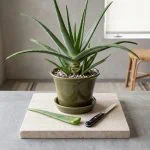
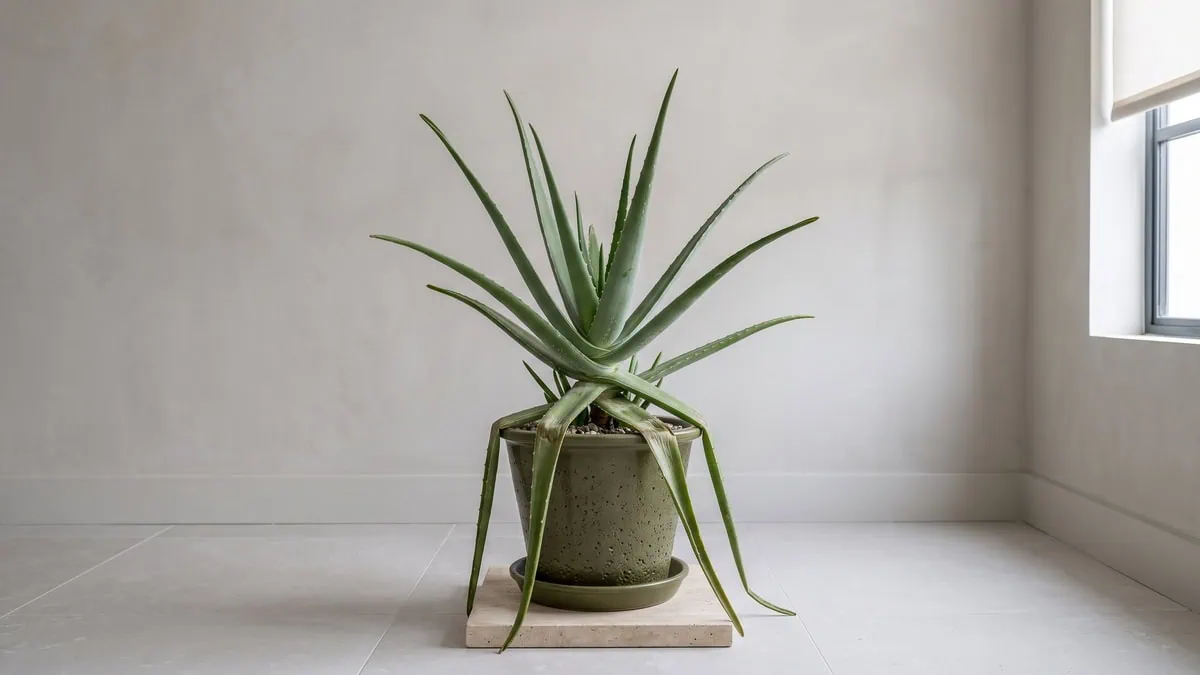
🎯 Quick Answer: the four cold lines for Aloe vera
How to overwinter aloe vera indoors without cold damage decides whether the plant recovers: a member of the Asphodelaceae family, it holds above 50F. Freezing air at 32F collapses the tissue for good. The rest is placement, water discipline and light, not rescue.
- Move it back: set the pot a hand’s width off cold glass
- Clear the vents: keep it away from heaters, doorways and draft lines
- Bring it in early: move a summered plant in before outdoor nights dip below 50F
- Hold the fertilizer: none at all while short days keep growth stalled
- Turn it regularly: stop the rosette leaning toward one weak winter window
Get the one-page care card for this guide, plus a printable A4 copy
We condense this guide into one card for your phone and a print version for the pot shelf. Enter your email and we send both to your inbox. Subscribe once, then request the card of any guide you read.
By subscribing you agree to get emails from Plant Care Basics about plant care guides, about once a week at most. Unsubscribe in one click. Privacy policy
The leaf base folded away the moment I touched it, cold and slack where it should have felt like a firm rubber tube. Several plants went that way, and each of them had been standing beside cold drafts and glass I never thought to put a hand against.
A thermostat holding 68F all night sounds right. It isn’t. Honestly, that’s not quite right either, because the room reading is fine and the air film on the pane is not, and here is what chilling does instead.
It reaches a plant already sliding into dormancy and works on leaves that have spent months banking water, so water-filled tissue gives first (yes, this sounds fussy — bear with me).
Four numbers settle the entire cold stretch, and none of them is the thermostat reading. Get them right and the plant simply idles until the light returns. Start below, then fill in the year-round care for a desert-adapted plant.
Between you and me — the panic is worse than the fix. Every number the cold months turn on sits just underneath, so read it once and stop guessing.
How to overwinter Aloe vera indoors without cold damage: the numbers at a glance
| Aloe specs | Cold-month value |
|---|---|
| Lowest safe temperature | Keep above 50F; at 32F and below the freezing tissue collapses irreversibly |
| Light | Full sun; the brightest window available, optimal 3000-10000 FC, survival floor about 500 FC, maximum tolerance 10000+ FC |
| Cold-month watering trigger | Water only when the mix is dry to the bottom; stretch it as light falls |
| Does windowsill air at night count as room temperature? | No – the air at the glass runs colder than the thermostat reading |
| Supplementary lamp | Full-spectrum LED grow light, 12-18 in above the plant, 12-14 hours on a timer |
| Indoor air in the heating months | Ordinary dry household air suits this plant, and no added humidity is wanted |
You are subscribed
Press the button and we prepare this guide's one-page care card and its A4 print copy and email both to you within a few minutes.
Tap the button below to get more plant fixes in your Google Search results

Table of Contents
Aloe vera cold limits: the four temperature lines
Aloe vera runs on four separate cold thresholds, and confusing one for another is what loses growers their plants. Hold the room above 50F, read 32F as irreversible tissue collapse, and aim for the 55-85F band where growth happens. The fourth line is the one that moves outdoors.
Ten different cold-side figures circulate for this species, and not one of them says which question it answers. The two sections below separate the routine floor from the temperature at which water-storing tissue is lost.
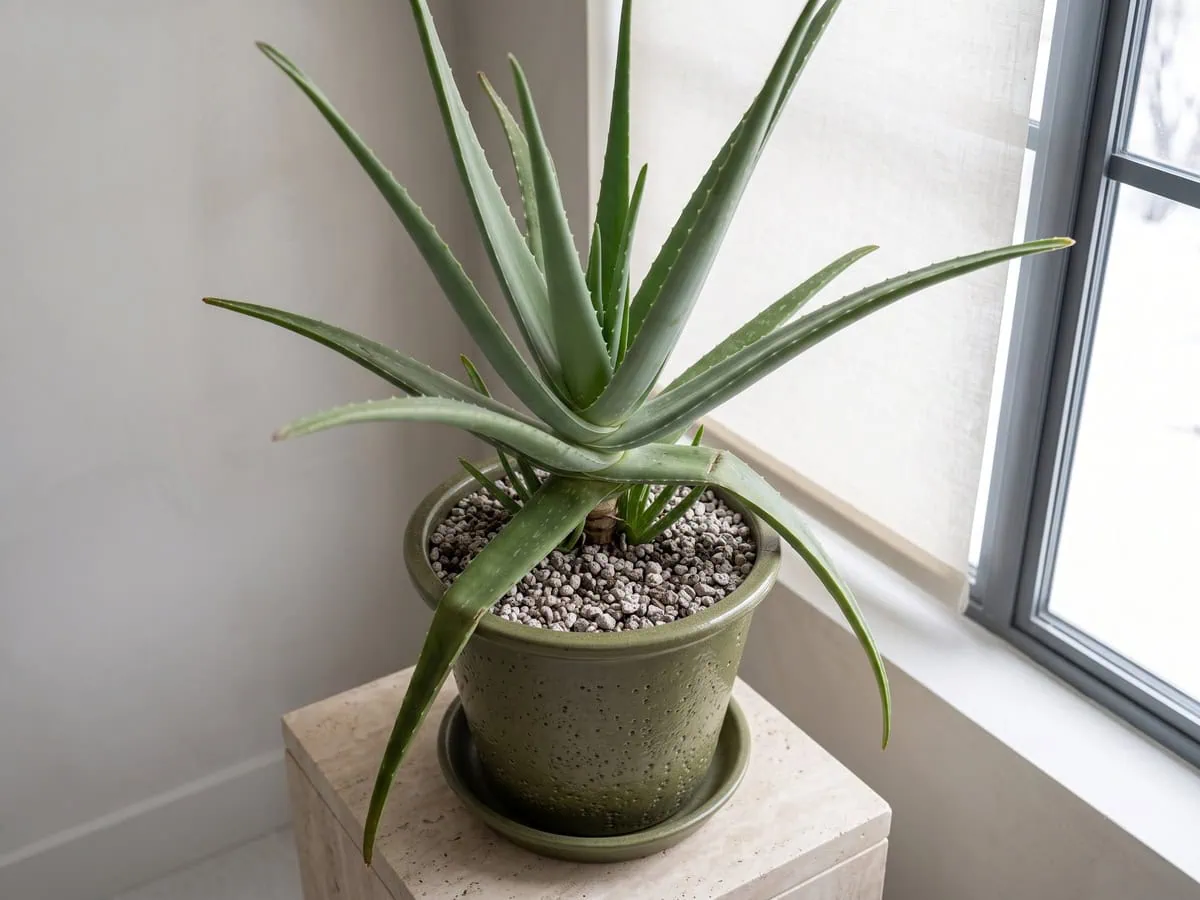
The routine floor and the point tissue is lost
Below roughly 50F the plant stops being comfortable, and below 32F it becomes unrecoverable. UNH Extension states the indoor floor directly: an Aloe should not sit in a room that dips below 50F, and a drafty window shows up as discolored foliage or damaged leaf tips. Freezing is a different threshold entirely.
The four thresholds that matter for a leaf carrying its own water reservoir:
- Routine floor, 50F. Maintain the room above it and nothing is at risk.
- Survival edge, 41-50F. The RHS hardiness band, where the plant persists but does not grow.
- Comfort band, 55-85F. Growth happens here, with nights cooler than days.
- Loss point, 32F. Freezing collapses the water-filled tissue irreversibly.
When a summered-outdoors plant has to come in
Bring it indoors before outdoor nights begin dipping below 50F. Missouri Botanical Garden sets that identical trigger and states that this species is not frost tolerant. Waiting for the first frost means waiting one night too long.
Moving a plant carrying 12-20 in leaves above a shallow, outward-fanning root system takes a brief checklist:
- Confirm the timing. Outdoor night lows approaching 50F, never the daytime reading.
- Confirm the medium. Bring it in dry rather than freshly watered.
- Confirm the leaves. Press the base of every outer leaf and keep only firm tissue.
That press is the entire test. A leaf that has experienced freezing feels slick and yielding beneath the thumb, closer to the skin of an over-ripe plum than the taut wall of a sound leaf, and tissue that stays soft is removed rather than nursed.

Get the one-page care card for this guide, plus a printable A4 copy
We condense this guide into one card for your phone and a print version for the pot shelf. Enter your email and we send both to your inbox. Subscribe once, then request the card of any guide you read.
By subscribing you agree to get emails from Plant Care Basics about plant care guides, about once a week at most. Unsubscribe in one click. Privacy policy
Tap the button below to get more plant fixes in your Google Search results

Winter placement: glass, drafts, heat and light
Placement decides more of the cold season than the thermostat does. Three positions settle most of it. Then settle the light, because a heated dim corner creates its own physiological problem.
- Off the glass. A hand’s width clear of the pane.
- Out of the draft line. Away from doorways and heating vents.
- Clear of the radiator. Dry blast air empties a small pot fast.
The three sections below take the window, the lamp, and two claims that circulate every cold season.
Is a windowsill too cold at night?
A windowsill often is too cold at night, and the thermostat will not tell you. Put “is a windowsill too cold for aloe vera at night” to a search engine and the answers split three ways.
The reason is physical: window glass radiates heat outward continuously overnight, so the boundary film of air resting against the pane stabilizes several degrees colder than the room behind it.
Wisconsin Extension names cold drafts near windows and doors among the placements to avoid, and puts the target at 65-70F by day and 60-65F at night. That is the target.
But my own test is cruder (crude, but it holds). One hand flat on the glass, the other on the pot: if the pot reads colder than the room, the plant is not living at room temperature.
Short days, and what a lamp has to deliver
Short days are a supply problem rather than a temperature problem. The published replies to “how much light does an aloe vera need through the dark months” give hours and compass aspects, never an intensity.
This species is a full-sun succulent: 3000-10000 FC at the optimum, with approximately 500 FC as the survival floor below which the rosette begins to elongate and loosen. Pale leaves, wider gaps.

What a lamp has to deliver for a full-sun succulent:
- Type. A full-spectrum LED fixture, never an ordinary desk lamp.
- Distance. Roughly 12-18 in above the leaves.
- Duration. About 12-14 hours a day on a timer.
Two indoor cold myths, and what a room does
Two claims circulate every cold season and both fail in the same way. One says an indoor plant cannot get too cold; the other says a warm room is what an overwintering succulent wants.
Myth: an indoor plant is safe from cold by definition. Fact: five separate guides name indoor cold sources, from single-glazed panes to the draft line under a door.
And the second claim damages the rosette shape rather than the plant. Warmth without light produces pale, widely spaced growth on a rosette that evolved under desert radiation, which is exactly how a reader ends up with a crown that has flattened out under weak winter light. Cool and bright beats warm and dim.
Water, cold injury and recovery in cold months
Cold alone rarely finishes an Aloe vera. What ends the plant is cold reaching a root zone that still holds water, because chilled tissue stops moving it and the leaf bases give way first.
Tissue reading, the first hours, then the interval.
Cold injury or root decay? Reading tissue
Both routes end in soft, translucent tissue. So appearance settles nothing. The “how do i tell cold damage from rot on aloe vera” question comes down to where the softness starts and how fast it traveled.
| What to check | What it tells you |
|---|---|
| Where softness starts | Cold takes the tips; decay starts at the base |
| How fast it moved | Cold softens in a day; decay creeps up over weeks |
| The crown | Cold leaves the center green; decay takes the stem |
Verdict: Trust the starting point over the color, because the base of an outer leaf is the one place the two routes disagree.
My working theory is that the two overlap more than published guidance admits, since freezing ruptures cell walls and a wet medium colonizes ruptured tissue next. Once the base is collapsing, read it as root decay already under way at the crown.
The first hours after a cold event
The damage is finished before the box is open. Searches like “why did my aloe vera get soft spots after a cold delivery” describe tissue already lost in transit, so the work is sorting sound leaves from spent ones.
Never water a plant that has just come in cold. Warm it first, leave the mix dry, and hold the can for two full weeks.
- Warm it slowly. Indoors at 55-65F, out of direct sun
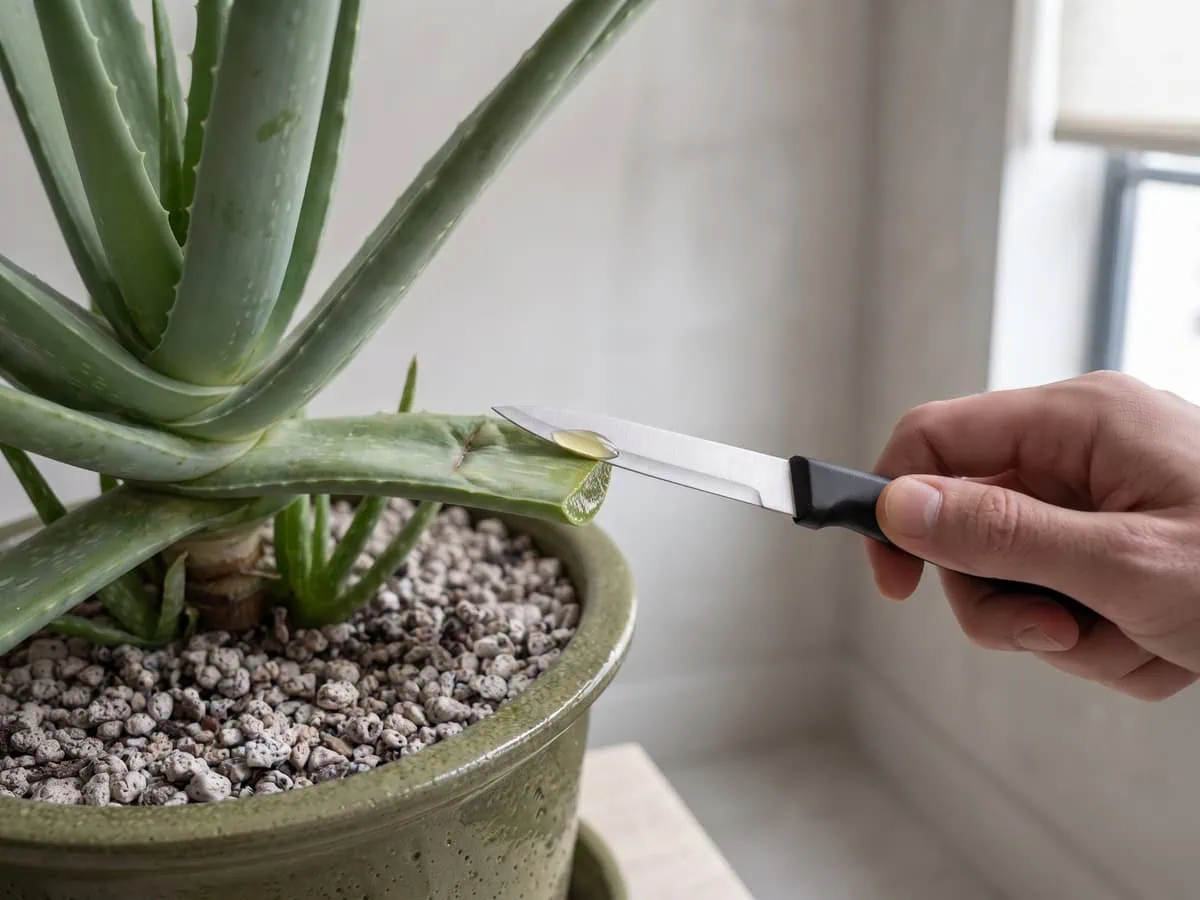
- Cut what is spent. Sterilized scissors, mushy translucent leaves only
- Dry the cuts. Bright indirect light, three to five days
- Hold the water. Two weeks dry before the first drink
A sound cut face parts clean and stays matte where the blade left it, while spent tissue smears and wets the steel. I have binned leaves that looked fine and kept ones that looked ruined.
Watering when the root zone runs cold
Stretch the interval. Do not stop outright. The “should i stop watering aloe vera in winter” split resolves into a ratio rather than a date: roughly double whatever interval the plant took through the bright months.
- Double the gap. Two weeks becomes about four
- Probe to the bottom. A wooden skewer comes out dry
- Water to drainage. Then empty the saucer at once
Heated rooms dry a gritty pumice mix faster than unheated ones do, so the calendar misleads both ways. Weigh that against the year-round watering interval.
Frequently asked questions about overwintering Aloe vera indoors
What is the coldest an Aloe vera plant can tolerate?
The practical indoor floor is about 50F, and 32F is the point of irreversible loss. Between those two figures the plant persists without growing, which is the survival edge rather than a comfort zone.
UNH Extension states that this species should not sit in a room dipping below 50F. The RHS hardiness rating places the same plant in a 41-50F band, kept under cover through the cold months.
Where is the best place to keep an Aloe vera plant in the house?
The brightest window in the home, set a hand’s width back from the glass. South-facing is best in the Northern Hemisphere, west-facing second, and north-facing needs a lamp.
Keep the pot out of the draft line from doorways and away from radiators and heating vents. Wisconsin Extension puts the target at 65-70F by day and 60-65F at night. Turn the pot regularly so the rosette does not lean toward one window.
How to winterize Aloe vera?
Move the plant to the brightest available window, stretch the watering interval, and stop feeding until the light returns. Those three moves cover the whole cold stretch.
Bring a summered plant indoors before outdoor nights dip below 50F, and bring it in dry rather than freshly watered. Under 500 FC a full-spectrum lamp runs 12-14 hours daily, roughly 12-18 in above the leaves.
Will my Aloe plant grow back after a freeze?
Tissue that froze does not recover, but a plant whose crown stayed firm regrows from the center. Remove every mushy translucent leaf with a sterilized blade and leave the firm ones alone.
Hold the plant in bright indirect light for two to three weeks, with no water until the mix is very dry. Firm brown marks that never softened are dark marks that are not a cold event.
What temperature is too hot for Aloe vera?
The published comfort band runs 55-85F, and sustained heat above roughly 85-90F sits outside it. Growth happens inside that band, with nights cooler than days.
A radiator, not the thermostat, is the practical question here. A pot within reach of running heat dries far faster than the same pot across the room, and the leaf tips show it first.
Can I leave my Aloe vera plant outside in winter?
Only where outdoor nights stay above 50F, because this species is not frost tolerant. A 50F minimum through the cold months is the floor, and frost is recorded as unsurvivable.
Do not wait for the first frost, which arrives one night after the plant needed to be inside. Watch the night lows rather than the daytime reading, and move the pot in while the mix is dry.
Read the glass, act early, overwinter without loss
Four numbers carry the whole cold stretch. Keep the room over 50F, read 32F as the end of the tissue, aim for the 55-85F band, and bring a summered plant in before outdoor nights reach the floor.
Placement does the rest. A hand’s width off the pane. Keep it clear of the vents, under the brightest window you own.
After the cold months comes the year-round interval, and that one has its own guide.
Press a leaf base in the cold weeks and it should feel tight and faintly waxy under the fingertip, never slack. That is the whole of how to overwinter aloe vera indoors without cold damage: four numbers, a hand’s width of air, and a mix you leave alone.
Cold arrives at the glass long before the thermostat admits it, so keep your aloe a hand’s width off the pane and its mix bone-dry.
Get the one-page care card for this guide, plus a printable A4 copy
We condense this guide into one card for your phone and a print version for the pot shelf. Enter your email and we send both to your inbox. Subscribe once, then request the card of any guide you read.
By subscribing you agree to get emails from Plant Care Basics about plant care guides, about once a week at most. Unsubscribe in one click. Privacy policy
Tap the button below to get more plant fixes in your Google Search results