🚨 Emergency 30-Second Answer: Aloe vera root rot rescue
Stop watering now — Aloe vera, a member of the Asphodelaceae family, only recovers from rot if the cut face dries 1 to 3 days. How to fix Aloe vera root rot without losing the plant starts under the medium, not at the leaves.
Above the mix the only sign is browning, softening leaves, so the roots have to be seen. A sound root is firm and light colored; black, mushy roots come off completely.
Cut back to firm tissue with a blade wiped in 70% isopropyl alcohol between every cut. Then replant dry, and withhold water until the mix is very dry.
- Above the mix: browning, softening leaves are the only visible sign
- Under it: firm, light-colored roots stay; black or mushy roots go
- Smell test: failed roots carry an unpleasant, sour rotting odor
- Stop line: a firm white stem is still worth rescuing
- Never: keep hydrogen peroxide off roots, crown, leaves and stems
Get the one-page care card for this guide, plus a printable A4 copy
We condense this guide into one card for your phone and a print version for the pot shelf. Enter your email and we send both to your inbox. Subscribe once, then request the card of any guide you read.
By subscribing you agree to get emails from Plant Care Basics about plant care guides, about once a week at most. Unsubscribe in one click. Privacy policy
Plump, matte gray-green, upright — the rosette looked fine right up to the moment it lifted clear of its mix in my hand.
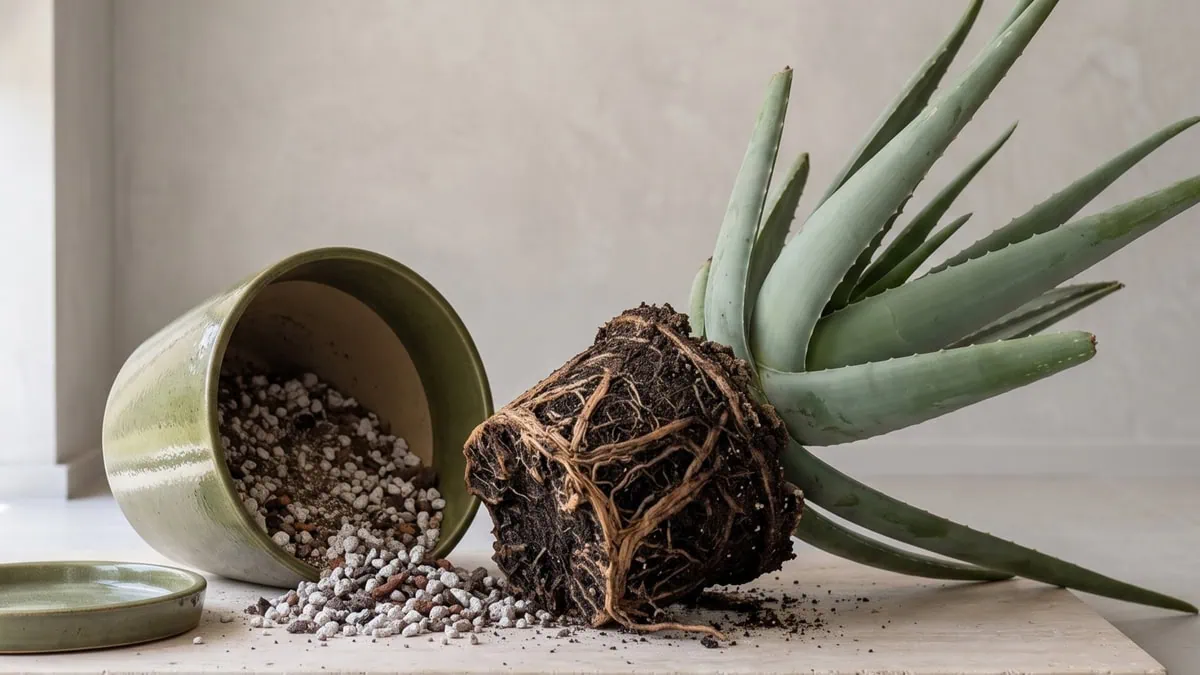
Underneath, the roots had gone dark and slack – root rot from over-watering, not thirst – and the base gave like a soaked sponge under my thumb (no odor yet, which is what fooled me).
Conventional watering advice nearly lost me that plant, because it teaches you to judge thirst at the surface; the real fix is reading the root zone, because soggy soil takes the roots apart while Aloe vera keeps a full reserve sealed in the leaf and holds a convincing shape for weeks.
One cut, one drying window, one dry replant.
For everything outside a rot emergency — the watering interval, the gritty mineral mix this desert species needs — start with the complete indoor guide for this plant.
The plant is not gone yet, whatever the roots looked like. Below sits the whole rescue at a glance, in the order you will actually work through it.
How to fix Aloe vera root rot without losing the plant: the rescue at a glance
| Aloe specs | What this means for the rescue |
|---|---|
| Outlook by stage | Good while damage is root-only; possible once base is soft; poor once the stem collapses |
| Working drainage hole in the pot it goes back into? | Yes – check before lifting the plant; without one the failure returns |
| How much root comes off | All soft or dark roots, cut back to firm, light-colored tissue |
| Medium it goes back into | A fast-draining gritty succulent mix, roughly 1 part peat-free organic base to 2 parts coarse pumice, top-dressed with a thin layer of coarse pumice grit |
| First watering after replanting | Withheld for about a week, then light, and only once the medium is very dry |
You are subscribed
Press the button and we prepare this guide's one-page care card and its A4 print copy and email both to you within a few minutes.
Tap the button below to get more plant fixes in your Google Search results

Table of Contents
Stop the spread: unpot, read the root zone, cut to firm tissue
Stopping Aloe vera root rot starts with lifting the plant out of its mix today, because the leaves hold shape on stored water long after the roots have gone. Slide the rosette out, shake the spent mix off, then read what you are holding.
Work in gloves, over a bowl, away from your other plants. A cut leaf bleeds bitter yellow latex from the rind – not the clear inner gel – and that latex makes this species toxic to cats, dogs and horses.
The question people type, “can an aloe vera survive with no roots left”, has a yes behind it whenever the stem above your cut is firm. The following sections cover the three calls this asks of you.
This information is for educational purposes only and is not a substitute for professional veterinary advice. If your pet ingests any part of this plant, seek immediate veterinary intervention or contact the ASPCA Animal Poison Control Center (888-426-4435) or the Pet Poison Helpline (855-764-7661) immediately.
What sound and failed root tissue look like
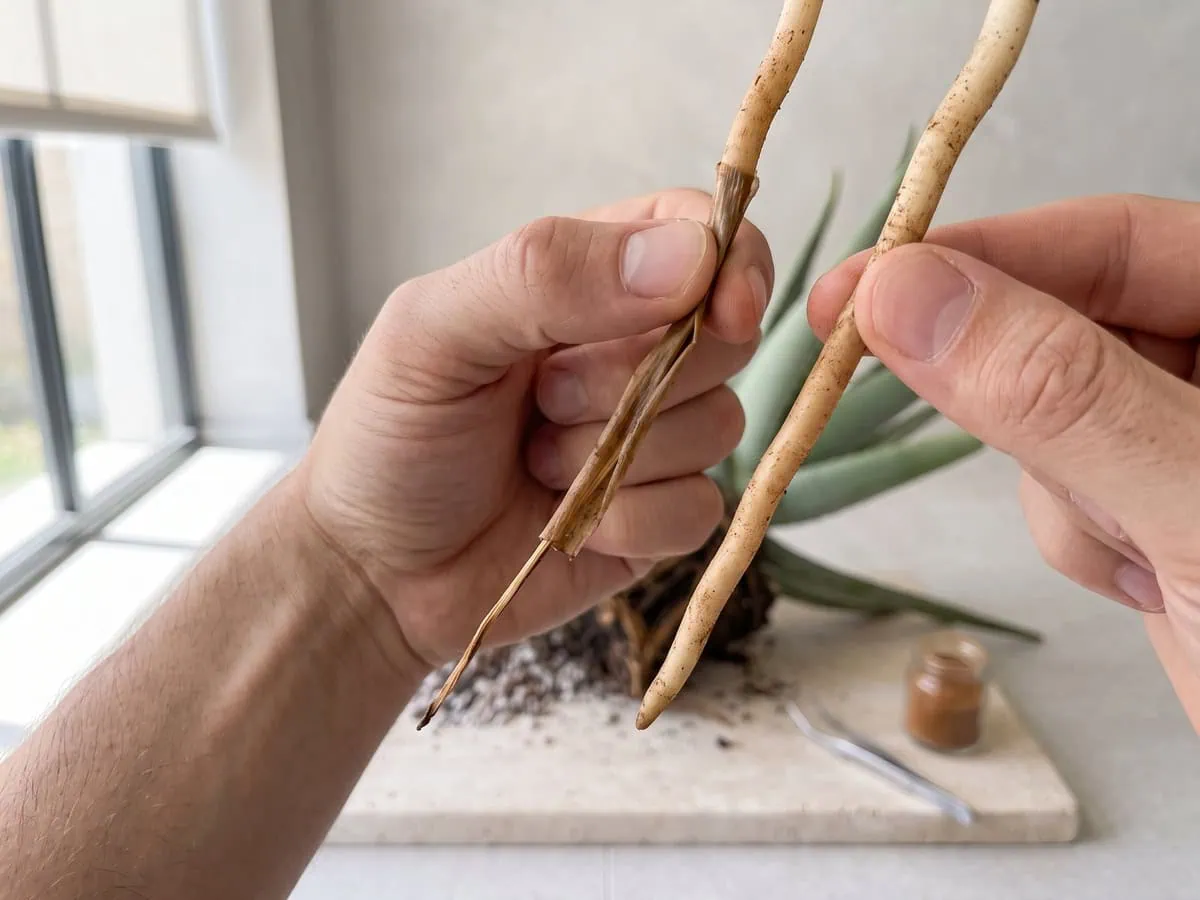
Search “what does aloe vera root rot look like when you unpot it” and a color chart comes back, the least reliable half of the test. Sound roots run white through light tan to orange.
Texture settles it. Sound tissue is firm between finger and thumb; a failed root flattens like wet paper and slides its sheath off the strand inside. Smell is two-state as well (most readers meet only the alarming half): mustiness after watering is ordinary, a sour note lasting days is not.
The organisms that follow a root zone which never dries – Pythium, Phytophthora, Rhizoctonia, Fusarium – are what PLOS calls soil borne fungal pathogens.
How far up the stem to cut, and when to cut again
Work to a face, not a ruler, when you ask “how far up the stem should i cut aloe vera rot”. Cut until the face is clean with no dark streaking; if the next look shows a dark center, slice again (and I say this confidently).
Press it. And there is a stop line: once softness reaches above the lowest leaf join, take the top as a cutting and follow the method for rooting a piece that has no roots left.
Blade hygiene between every cut
Swab 70% rubbing alcohol along the edge between every cut, and wait until it looks dry. The blade also carries bitter yellow latex from the leaf rind, so a wet wipe moves it into the next cut instead of lifting it (and the pause is the whole point). Two seconds, every time.
Scrub a reused pot with hot water or 9 parts water to 1 part bleach, and bag the spent mix rather than working it back around this rosette.
Get the one-page care card for this guide, plus a printable A4 copy
We condense this guide into one card for your phone and a print version for the pot shelf. Enter your email and we send both to your inbox. Subscribe once, then request the card of any guide you read.
By subscribing you agree to get emails from Plant Care Basics about plant care guides, about once a week at most. Unsubscribe in one click. Privacy policy
Tap the button below to get more plant fixes in your Google Search results

What goes back into the pot, and when moisture returns
A rescued Aloe vera goes back into dry gritty mix, in a pot no larger than the one it came out of. The three sections below cover the drying window, the medium, and the first watering.
Drying the cut face until it is dull and papery
Published answers to “how long should an aloe vera cutting callus before replanting” run from a few hours to an open-ended few days. Work to a day or three, longer for a big piece. Read the face, not the clock.
The wait is chemistry: the wound corks over as suberin lays down in the cut cells, and that sealed layer stops damp mix restarting the decay.
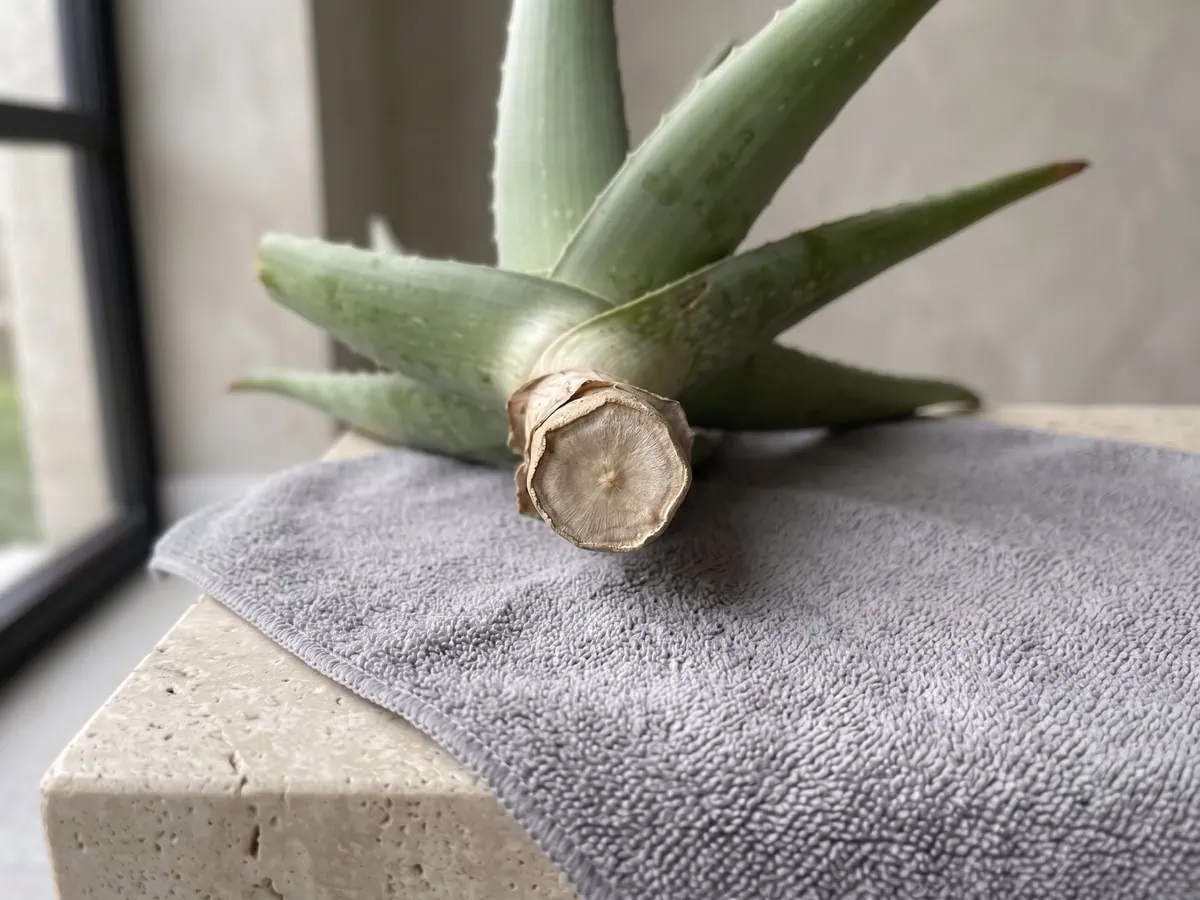
Done looks dull. The cut goes from wet and glassy to a matte tan skin, papery and faintly chalky under a fingertip (in a cool room, expect the third day rather than the first).
Medium and container for a plant with almost no roots
Mix it dry, and mix it first: a fast-draining gritty succulent mix, roughly 1 part peat-free organic base to 2 parts coarse pumice, top-dressed with a thin layer of coarse pumice grit.
Plain potting soil is where most rescued plants get sent back to, and it is the material that drowned the roots. Use the gritty mineral medium this plant needs instead.
Pot size splits the advice — smaller, or the same size — but both camps argue one quantity: how much wet mix sits around how little root (match the pot to the roots left, not the plant you had).
Set it shallow. The lowest leaves sit just above the grit, because a buried leaf base is where crown decay starts.
Water now or withhold: the split, and what settles it
Withhold. Half the rescue guides water the pot in and half keep it bone dry, and that split loses more plants than any other step here.
| The first-watering split | What it means for a rootless plant |
|---|---|
| Water it in now | Settles the mix, but nothing down there takes the water up |
| Withhold, then water lightly | Keeps the sealed face dry while new roots form |
| What decides it | Whether any working root is left to drink with |
Verdict: Withhold for about a week, then water lightly and only once the mix is very dry, because a plant cut back to bare stem has no working root to drink with.
And the ones I lost twice were the ones I potted while the face still looked wet. Once roots hold, the ordinary rhythm takes over: how far down the medium should dry before the next watering.

The days after: what to watch and when to stop
The rescue is a loop with an exit. The sections below cover the second look, the rooting signal, and the myths to ignore.
The second look at the cut face and the base
Look again. At the end of the drying window, if any part of the face is still soft, damp or dark at the center, another slice comes off and the clock restarts.
Then press the base. Firm means the operation held; any give means the decay is still traveling, and the answer is another cut rather than another pot (a week after replanting is early enough to catch it).
Leaf marks are a separate question, and worth telling a surface mark from tissue that is failing before anything else comes off.
Re-rooting time, and the signal you can read
Readers who type “how long before a rerooted aloe vera shows new growth” are usually a week in and losing their nerve. Give it weeks, not days.
The signal is new tissue at the center of the rosette, tight and pale where the newest leaf pushes up. Do not lift the plant to look (lifting breaks the young roots that answer the question).
So the honest range runs from weeks to months. Bright indirect light for the first two to three weeks helps; a cold windowsill pushes it toward the far end.
The rescue myths this procedure has to survive
Peroxide poured over the roots is the loudest. That chemical belongs on the empty pot and the blade; powdered cinnamon is what goes on a cut face, if anything does.
But the gravel layer at the bottom of the pot is the more stubborn one, because it feels like drainage. It is not. A coarse base layer only lifts the wet zone up into the roots.

And the gentlest myth is that a plant left alone firms up on its own. Softened tissue does not come back; whatever is still soft in that pot is still going.
Frequently asked questions about a rotted rosette
Can Aloe vera recover from root rot?
Yes, and the odds read from the stem rather than the leaves. Recovery is good while the damage is root-only, possible once the lower leaves and the base have gone soft, and poor once the stem itself has collapsed.
Locate your plant on that scale first. One at the first stage keeps its rosette; one at the second is a cutting.
What is the safe way to treat root rot?
Cut it out, dry the cut, and replant dry. Every soft or dark root comes off, the blade works back to firm light-colored tissue, the face dries a day or three, and the plant returns to gritty mix.
Nothing chemical goes on the wound. Rubbing alcohol at 70% is for the blade, bleach solution for the pot, and powdered cinnamon is the only thing that belongs on a cut face.
Can I plant recover from root rot?
Only if the condition that caused it changes with the plant. A rosette returned to a pot with no working drainage hole, or to a water-retentive mix, fails again however carefully it is watered.
Check the pot before the plant comes out. A drainage hole, a gritty mineral mix and a saucer emptied after every watering are what make the second attempt different.
How to save rotting Aloe vera?
Unpot it today and work through five steps in order. Shake the old mix off, read the roots by feel, cut back to firm tissue with a wiped blade, dry the face until it is dull, then replant dry.
Water waits after that. Hold off about a week, then water lightly and only once the mix is very dry, because almost no root is left to take it up.
How can I treat root rot on my Aloe vera plant?
The hygiene half decides how far it spreads. Swab the blade with 70% rubbing alcohol between every cut, wait until it looks dry, and work over a bowl away from your other plants.
The old mix is bagged and discarded rather than reused, and a reused pot is scrubbed out with hot water, or with nine parts water to one part bleach, before anything goes back in.
How to bring a dying Aloe plant back to life?
Decide first whether the base is worth keeping. If softness has reached above the lowest leaf join, the top comes off as a cutting; if the stem below is firm and white, the plant stays whole.
The sequence is the same from there. Dry the cut face, plant shallow in dry gritty mix, hold the water, and read fresh center growth as the first sign of roots.
Skip the peroxide myth, use the firmness test
One test carries this whole procedure. Firm tissue stays, soft tissue goes, and the cut face dries before it touches medium again.
The pot, the grit and the water you withhold all serve one end: keeping that dry face dry while the plant rebuilds a root system underneath, on a clock you cannot hurry.
Then comes the interval. Once new growth shows at the center, the watering rhythm read at depth rather than at the surface is the next thing worth learning.
Two thumbs and a clean blade. That is the whole of how to fix Aloe vera root rot without losing the plant. Firm pale tissue under the blade is the whole test, and an Aloe that gets its cut face dry has already done the hard part.
Get the one-page care card for this guide, plus a printable A4 copy
We condense this guide into one card for your phone and a print version for the pot shelf. Enter your email and we send both to your inbox. Subscribe once, then request the card of any guide you read.
By subscribing you agree to get emails from Plant Care Basics about plant care guides, about once a week at most. Unsubscribe in one click. Privacy policy
Tap the button below to get more plant fixes in your Google Search results