🎯 Quick Answer: the leaf layer that decides it
Yes, the bitter yellow latex under the rind carries saponins and anthraquinones — the clear gel does not. Aloe vera is listed toxic to cats, dogs and horses by the ASPCA.
So: is aloe vera toxic to cats and dogs indoors? Yes — but reach, not chemistry, decides the real risk.
- Height first: put the pot somewhere no cat can land on it
- Wipe drips: clean cut-leaf latex off floors and furniture at once
- Skip citrus: citrus repellents are themselves listed toxic to cats
- Weight the pot: a heavy planter resists a determined paw better
- Know the route: keep the animal poison line reachable before you need it
Get the one-page care card for this guide, plus a printable A4 copy
We condense this guide into one card for your phone and a print version for the pot shelf. Enter your email and we send both to your inbox. Subscribe once, then request the card of any guide you read.
By subscribing you agree to get emails from Plant Care Basics about plant care guides, about once a week at most. Unsubscribe in one click. Privacy policy
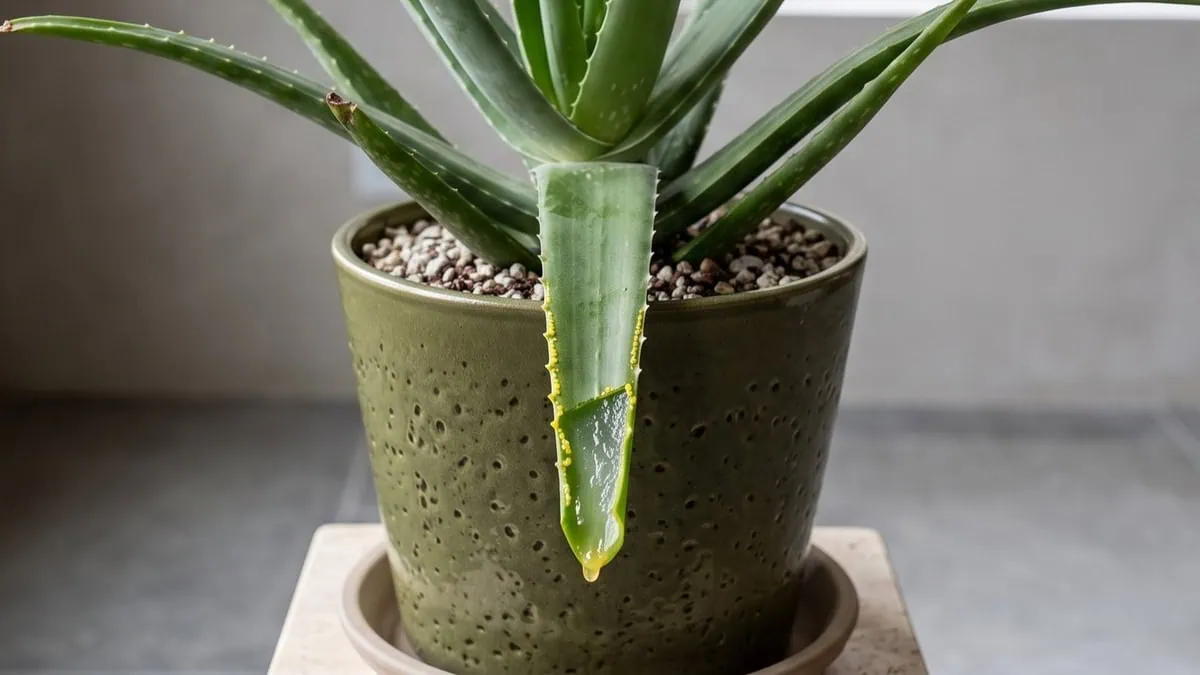
The cut edge of a snapped Aloe leaf beads yellow within seconds — a bitter film of latex sitting under the rind, right above the clear Aloe gel.
Honestly? Eight chewed leaves later, I stopped blaming the gel. Each bite sounded identical — a dry snap from the shelf, then nothing.
Three years of failure at this forced me to learn that the plant is not uniformly risky (yeah, learned this the hard way). Let me reframe that… the saponins and aloin ride in the latex under the rind, while the inner gel is the part the ASPCA calls edible.
So the real question is not whether it is toxic. It is which layer a curious animal actually reaches — and a shelf that a cat clears in one jump is not out of reach, whatever the label on the pot says. If you also want what this plant needs day to day indoors, the full care guide has it.
Most of the worry about this plant lands on the wrong layer, and the panel beneath this line maps the layer, the signs and the reach rule onto one screen.
Is Aloe vera toxic to cats and dogs indoors: the safety card at a glance
| Safety check | What the sources say |
|---|---|
| Pet safe? | No – toxic to cats, dogs and horses (ASPCA) |
| Toxic principles | Saponins plus anthraquinone compounds, the main one aloin, concentrated in the bitter latex |
| Riskiest part of the leaf | The yellow latex just under the rind, not the clear inner gel |
| Signs after a bite | Vomiting, lethargy, diarrhea, and urine that turns reddish |
| Does a lick count as a swallow in a cat? | Yes – a cat grooms whatever lands on its coat straight into its mouth |
| Animal poison control line | ASPCA Animal Poison Control Center, (888) 426-4435, open around the clock |
You are subscribed
Press the button and we prepare this guide's one-page care card and its A4 print copy and email both to you within a few minutes.
Tap the button below to get more plant fixes in your Google Search results

Table of Contents
Where the risk sits inside an Aloe leaf
The risk sits in one thin layer rather than in the whole leaf — a bitter yellow latex carried in the vascular bundles just beneath the rind. The clear inner gel behind it is a different tissue doing a different job. The following two sections separate them, and then show why a bite blurs the line anyway.
According to the ASPCA Animal Poison Control Center, saponins listed among this plant’s toxic principles sit beside anthraquinone compounds in that latex. Because the compounds concentrate there, the tissue map matters more than the label on the pot.

The bitter latex sitting under the rind
A fresh leaf snaps with a short wet crack, nothing like the dry click of a spent one, and the cut face beads yellow within seconds. That bead is the latex. It answers “which part of the aloe vera leaf is toxic to pets” better than any shelf label ever will.
Behind it, the gel stays clear.
The layer even has a home worth naming: pericyclic tubules running with the vascular bundles, pressed tight against the rind.
- Saponins: soap-like plant compounds that irritate the gut lining when swallowed.
- Anthraquinones: the laxative compound family in the latex, with aloin as the main one.
The practical picture is a film, not a filling. Anyone who has cut a leaf for a scrape knows the two textures already — the thin bitter smear that stains the blade, and the cool jelly underneath that does not.
Why a bitten leaf ignores the gel-and-rind split
A curious animal does not dissect. One bite takes rind, latex and gel together in the same mouthful, which is why the reassuring gel-is-edible line collapses when an owner most needs it to hold.
A processed gel in a tube is a different object from a leaf on a plant, and only the tube earns that reassurance. The tube is not the leaf.
Myth: the gel is edible, so the plant is safe for pets. Fact: the ASPCA lists this species toxic to cats, dogs and horses, and a bitten leaf delivers the bitter latex under the rind along with any gel.
In my experience — though n=1 — the leaves that get chewed are the low outer ones, the arching ones a paw can hook without leaving the floor. I lost three of those before the pattern registered. They carry the same latex as every leaf standing above them.
Get the one-page care card for this guide, plus a printable A4 copy
We condense this guide into one card for your phone and a print version for the pot shelf. Enter your email and we send both to your inbox. Subscribe once, then request the card of any guide you read.
By subscribing you agree to get emails from Plant Care Basics about plant care guides, about once a week at most. Unsubscribe in one click. Privacy policy
Tap the button below to get more plant fixes in your Google Search results

What a cat or dog shows after a bite, and how long to watch
Expect stomach signs rather than drama: vomiting, lethargy, diarrhea, and urine that turns reddish. The reddish color is pigment moving through, not bleeding. The following sections give the order, the clock and the species question in turn.
So “what happens if a cat chews an aloe vera leaf” has a boring answer most of the time — an upset gut that settles — and a dull answer is the one to plan around. This information is for educational purposes only and is not a substitute for professional veterinary advice. If your pet ingests any part of this plant, seek immediate veterinary intervention or contact the ASPCA Animal Poison Control Center (888-426-4435) or the Pet Poison Helpline (855-764-7661) immediately.

The signs the listing names, in the order owners meet them
Drooling comes first and gets missed. Owners write it off as a wet chin. By the time the vomiting starts, the bite is already an hour behind them.
That ordering is the whole value of knowing “what signs should i watch for after my pet bites an aloe vera”.
After the drool, the list runs in a familiar sequence. Vomiting, then loose stools, then a flat animal that would rather sleep than eat — and somewhere in that window, urine the color of weak tea. A genus-level review adds low blood sugar as a possible extra.
If the animal ate any part of the leaf, call your veterinarian or the ASPCA Animal Poison Control Center at 888-426-4435, which answers around the clock. For a child who has mouthed a leaf, the human line is Poison Control at 1-800-222-1222 instead — the animal service is for animals only. This content is for informational purposes only. If you experience a severe reaction, seek medical attention. For suspected ingestion by a child, contact Poison Control (1-800-222-1222 in the US) immediately.
How long the watch window runs
Start the clock at the bite. Not at the first sign. Signs commonly appear within six to twelve hours of ingestion, so a quiet first hour is not an all-clear.
Keep the animal in view across that window and note two things: how much leaf is missing, and what time the bite happened. The service works from that estimate, so make it as exact as you can.
Confirm, too, that the plant is the species you think it is, because which Aloe is actually standing on your shelf changes nothing about placement but everything about what you tell the vet.
Which animal in the home is more exposed
Cats are generally more sensitive than dogs, and inside the dog side of the house the smaller animal carries the higher risk for the same reason. That makes “is aloe vera more dangerous to cats or to dogs” a body-mass question first. Species comes second.
| Factor | Cat | Dog |
|---|---|---|
| Baseline sensitivity | Higher of the two | Lower, but size-dependent |
| Route that gets missed | Grooming a smeared coat | Chewing a fallen piece |
| Who to check first | Any cat with access | The smallest dog with access |
Verdict: size beats species. Check the smallest animal that had access first, whatever it is.

Keeping the plant when the household has animals
Keep it, and change the geometry of the room instead. A door you are willing to keep shut is the only placement that reliably works; everything else is mitigation. The two sections below examine the furniture test and the floor.
That reframes “how to keep cats and dogs away from an aloe vera plant” as a question about your room rather than about your animal. The same listing names horses alongside cats and dogs, so a third animal receives the same rule.
Placement decided by the furniture, not the shelf height
Height is not out of reach. A cat climbs, a standing dog clears most shelves, and what settles it is the surface sitting adjacent to the plant — a sofa back or a counter turns an elevated pot into a short hop.
Stand in the room and look for the launch pad within one jump of the pot (yes, this sounds excessive — bear with me). Move the plant relative to that surface, not relative to the floor.
- Out of reach first: a room the animals do not enter beats any shelf in a shared room.
- Weight the pot: a heavy, tip-resistant planter survives a determined shove.
- Top-dress the surface: a layer of coarse grit over the mix discourages digging.
- Never citrus: citrus repellents are themselves listed toxic to cats and dogs.
- Wipe drips at once: a cut or snapped leaf drips bitter latex onto floors and furniture.
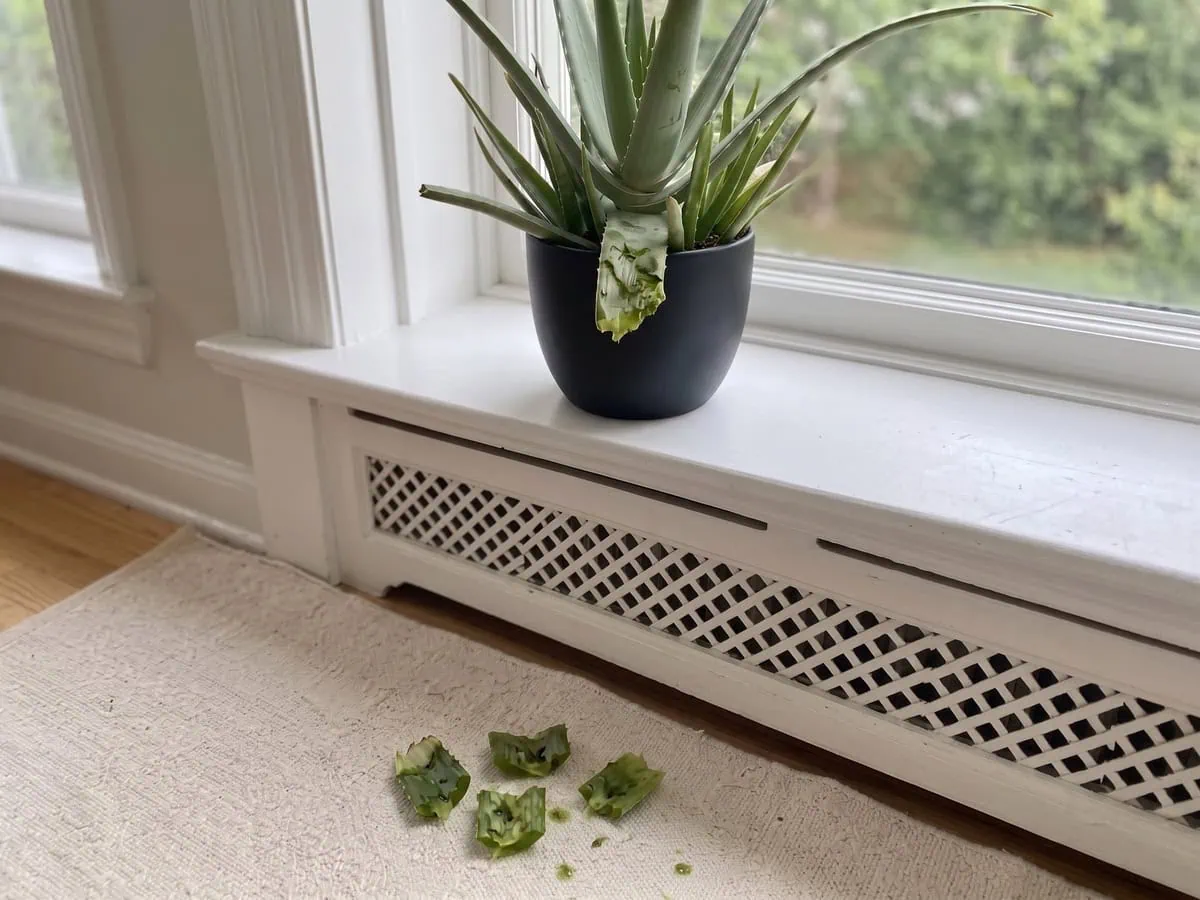
None of those is a guarantee, which is why the room question comes first. My own worst arrangement was a bright sill above a radiator cover, and I only realized the cover was a staircase after the third chewed leaf turned up on the rug.
The floor is part of the placement problem
Most animals never contact the standing plant. What they discover is a fallen piece — a snapped tip, a leaf knocked loose while you were cutting a leaf without wearing the exudate — lying at nose height on the rug.
Sweep after every cut. And after every knock.
A toppled pot is the worst variation of this: broken leaves with fresh open surfaces, at floor level, in a room where the animal is already agitated by the noise. Move the animal out first, then clear the pieces, then deal with the substrate.
A planter that drains rapidly is one you water less often, and which mix drains fast enough for this plant decides how often you are handling it near an animal at all.
Frequently asked questions about Aloe and pets
Is Aloe vera toxic to cats if they smell it?
No. Smelling the plant is not an exposure route, because the compounds sit inside the leaf and have to be swallowed to act.
The material has to physically reach the mouth, which means a bite, a chew, or a smear the cat later grooms off its coat. Decide placement on chewing access rather than on proximity, and the smell question stops mattering.
What happens if a cat licks Aloe vera?
A lick counts as a swallow in a cat, because grooming moves anything on the coat straight into the mouth.
Wipe any visible smear off the fur or paws before the cat grooms it away, then watch for drooling, vomiting and loose stools across the same window a bite would need. Call the vet if the smear was large or the cat is already drooling.
What happens if my dog licks Aloe vera?
It depends on what the tongue actually met: a manufactured lotion or the raw leaf.
For a lotion, the plant fraction is not the usual problem and the ingredient list is; read the label for anything else in it. For a bitten leaf, the latex under the rind is the exposure and the dog gets the same gut signs a cat would.
Can I use Aloe vera gel if I have a cat?
Keeping a gel product in the house is fine; putting it on the cat is a veterinary question, not a plant-care one.
Most processed gel has had the latex removed, but no label tells you how to confirm that for the container in your hand. Anything applied to a cat is groomed off and swallowed within the hour. Ask the vet before it touches the animal.
Is Aloe vera pet friendly?
No. The ASPCA lists it as toxic to cats, dogs and horses, so it is a keep-out-of-reach plant rather than a pet-safe one.
In most households the episode stays mild to moderate and settles within twenty-four to forty-eight hours with appropriate care. The plant is not a lily-grade emergency, and it is also not a plant to leave on a low shelf beside a cat.
Should I remove Aloe plants if I have cats?
You do not have to. The plant can stay if there is one room the cats do not enter, which is the only placement that reliably works.
Everything short of that is mitigation: height, weight, grit on the surface, sweeping fallen pieces. The honest test, then, is whether your home contains a door you are willing to keep shut, and the answer settles the question.
How long does it take for plant poisoning to show in cats?
Expect the first signs six to twelve hours after ingestion, so a quiet opening hour proves nothing at all.
Set the clock running at the bite and keep the cat in view across the whole window. Note how much leaf is missing and the time it happened. A cat that seems fine at hour two can still be showing signs at hour eight.
Master the placement, skip the panic
One layer determines this plant’s risk. One door determines your exposure. The bitter latex underneath the rind is what a bite releases, and the room your animals never enter is what stops the bite.
Look — the reason this matters beyond a solitary succulent is that it establishes a test you can perform on any plant in the house. Where the hazardous material sits, and what furniture stands alongside the pot. That pair of questions applies to every poisonous houseplant.
So walk the room, identify the launch surface within one jump of the pot, and move one of the two. Then listen after every knock for the dry snap that signals a piece came down anyway — whether is aloe vera toxic to cats and dogs indoors matters less than whether the pieces reach the rug.
May the only aloe your cat ever meets be the one it cannot reach.
Get the one-page care card for this guide, plus a printable A4 copy
We condense this guide into one card for your phone and a print version for the pot shelf. Enter your email and we send both to your inbox. Subscribe once, then request the card of any guide you read.
By subscribing you agree to get emails from Plant Care Basics about plant care guides, about once a week at most. Unsubscribe in one click. Privacy policy
Tap the button below to get more plant fixes in your Google Search results