🎯 Quick Answer: the grit fraction that decides it
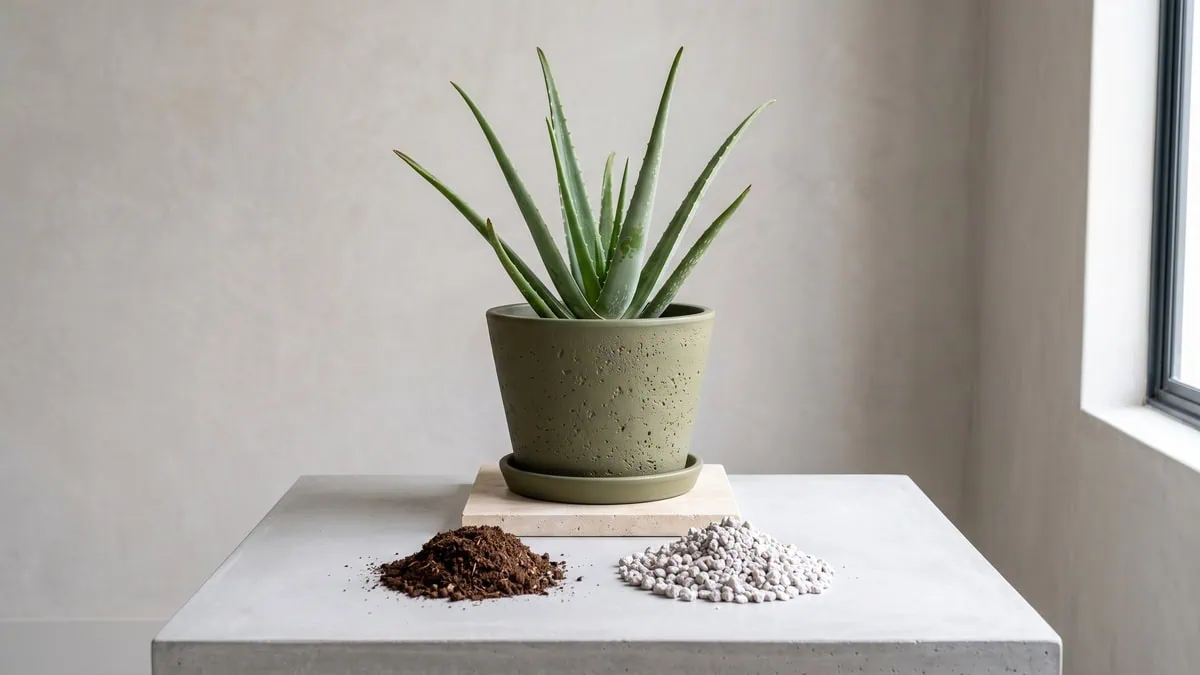
Best soil mix for aloe vera vs cactus potting mix: Aloe vera, an Asphodelaceae family succulent, stalls below 50-70 percent grit. A bagged cactus mix is the right family of product, yet rarely gritty enough alone. Cut one part peat-free base with two parts coarse pumice, then empty the saucer.
- Mix ratio: one part peat-free base to two parts coarse pumice
- Bagged cactus mix: usable base, but cut it with extra coarse grit
- Ordinary potting soil: peat-heavy, so it holds water far too long indoors
- Pot step-up: allow only 1 to 1.5 inches of fresh mix
- Drainage: one open hole, no gravel layer, saucer emptied after watering
Get the one-page care card for this guide, plus a printable A4 copy
We condense this guide into one card for your phone and a print version for the pot shelf. Enter your email and we send both to your inbox. Subscribe once, then request the card of any guide you read.
By subscribing you agree to get emails from Plant Care Basics about plant care guides, about once a week at most. Unsubscribe in one click. Privacy policy
Aloes went soft on me, every one in bagged potting mix off the shelf. The outer leaves collapsed between my fingers, cool and slack where they should have been rigid.
(TBH — an Aloe fails from the base upward, so the leaves feel wrong long before the rosette looks wrong.)
Rather than blame the watering can, I discovered the fault was sitting in the peat. Let me try that again… Aloe vera carries a week’s supply in the leaf itself and asks nothing of the pot between soaks, so a substrate that stays damp for a week hands the roots a problem this desert plant never evolved to solve.
So the shelf question comes down to grit. A ratio, a pot and a two-day weight test settle it, and the wider frame sits in the indoor culture of a gritty-mix succulent.
Pause for a sec. If your plant already feels soft at the base, your target numbers are laid out immediately below.
Best soil mix for Aloe vera vs cactus potting mix at a glance
| Aloe vera specs | Mix and container specification |
|---|---|
| Growing medium | A fast-draining gritty succulent mix, roughly 1 part peat-free organic base to 2 parts coarse pumice, top-dressed with a thin layer of coarse pumice grit |
| Mineral fraction by volume | 50-70 percent coarse grit |
| Medium pH | 6.0-8.5, a wide tolerance rather than a target |
| Drainage hole required? | Yes – one open hole, and the saucer emptied after every watering |
| Pot step-up at a move | One size, about 1-1.5 in of fresh medium around the root ball |
| Semi-hydro compatible? | No – the species roots in vitro on a laboratory nutrient medium |
You are subscribed
Press the button and we prepare this guide's one-page care card and its A4 print copy and email both to you within a few minutes.
Tap the button below to get more plant fixes in your Google Search results

Table of Contents
How much grit an Aloe vera mix actually needs
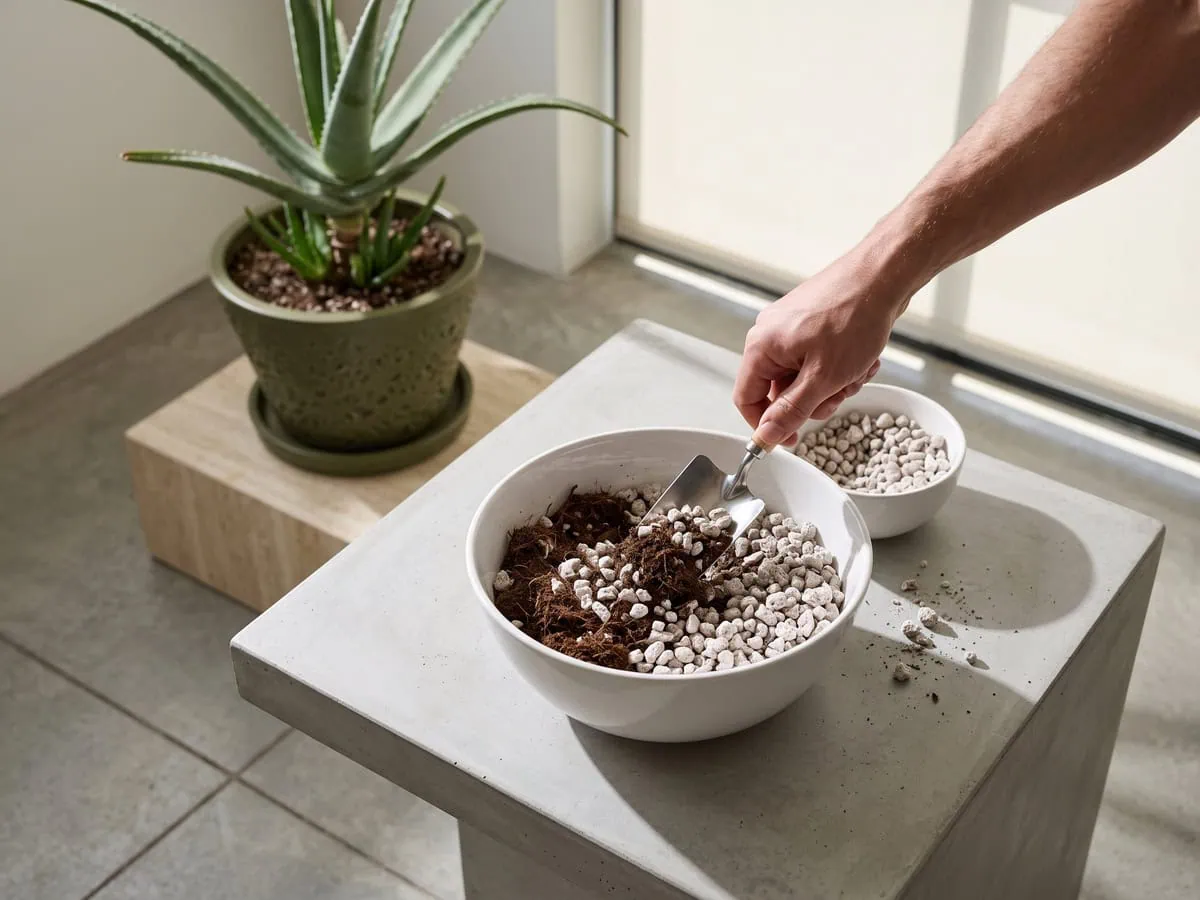
A working Aloe vera mix runs about one part peat-free organic base to two parts coarse grit, which sits inside the 50-70 percent mineral fraction the better guides quote. That ratio is not decoration.
It is the difference between a substrate that drains and one that stays heavy for a week. First the ratio itself, then the grit you actually buy.
The mineral fraction band, and the two ratios behind it
Two ratios circulate for this plant. The species literature runs a 1:1 blend of organic base and mineral, while general succulent guidance goes to 1:2.
Indoors the grittier one is safer, because a pot on a shelf dries far slower than the rocky, sun-exposed ground of its native range. So the answer to how much perlite or pumice to mix into aloe vera soil is simple. Grit is the majority, not the garnish.
Best guess only: the low end of that band probably suits a dim room and the high end a bright one, since a plant in strong light empties its pot faster. Medium pH is a side issue here. Aloe vera tolerates roughly 6.0-8.5, so you are buying drainage rather than chemistry.
Pumice or perlite: which grit belongs in the pot
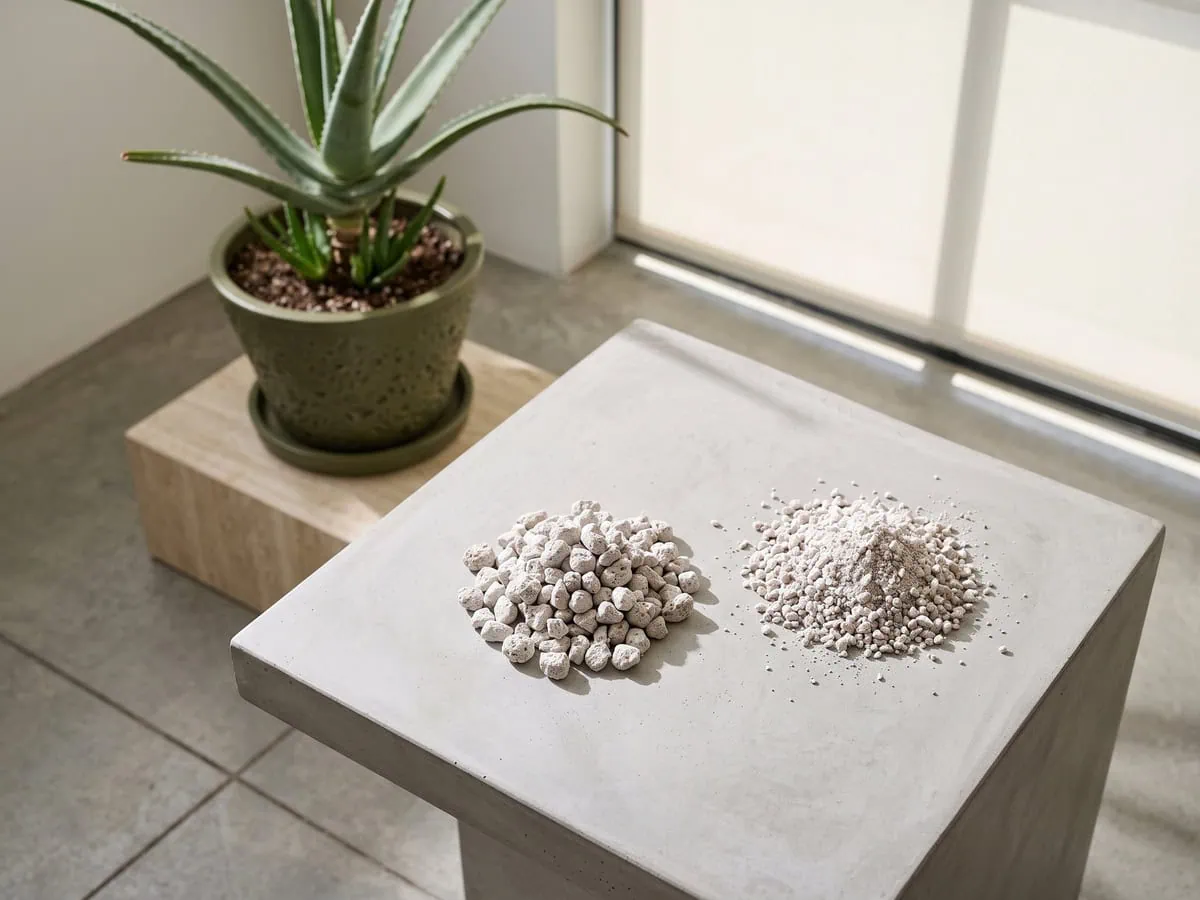
Both work. I have mixed both by hand for years, and pumice keeps winning, because its grains pour across a dry palm like coarse sugar, sharp-edged and gritty rather than powdery.
It also stays down in the mix. Perlite floats to the surface over time, and dry perlite powders the air when poured.
| Property | Pumice | Perlite |
|---|---|---|
| Weight in the pot | Heavy enough to stay mixed | Light, floats to the surface |
| Use as a top dressing | A thin gritty layer dries the surface | Sprinkled to protect fleshy leaves |
| Aeration delivered | High, and stable over time | High while the grains stay mixed |
Verdict: Choose pumice for a top-heavy rosette in a shallow pot, because it stays where you mixed it. Perlite is fine if that is what the shop stocks.
Mist both components before you stir them. Dry grit throws a fine dust across every leaf in the room.
Get the one-page care card for this guide, plus a printable A4 copy
We condense this guide into one card for your phone and a print version for the pot shelf. Enter your email and we send both to your inbox. Subscribe once, then request the card of any guide you read.
By subscribing you agree to get emails from Plant Care Basics about plant care guides, about once a week at most. Unsubscribe in one click. Privacy policy
Tap the button below to get more plant fixes in your Google Search results

Bagged cactus mix, all-purpose soil and garden soil compared
Bagged cactus mix is the right starting point, and it drains faster than a standard potting mix. Whether it is enough on its own is a property of the individual bag, not of the category. The test is drying time.
The following sections take the bagged mix first, then ordinary soil.
What a bagged succulent mix does and does not fix
So, is cactus mix enough for aloe vera on its own? Sometimes. A coarse bag with visible white grit through it can go straight into the pot.
A fine, dark, peat-heavy bag cannot, and the tell is that it still feels cool and damp two days after a soak. Cut that one with an equal volume of quarter-inch pumice and it becomes usable.
| Medium | Dry-down behavior | Use for an indoor Aloe |
|---|---|---|
| Cactus or succulent mix | Fast, if the bag is visibly gritty | Usable base, amend when fine |
| All-purpose potting soil | Slow, holds water for days | Not suitable as sold |
| Garden soil from the ground | Slowest, compacts in a container | Never used in this pot |
Verdict: Choose a gritty bagged succulent mix and amend it, because that is the only route where you control the grit fraction.
Why ordinary potting soil fails as sold
Does peat based potting soil hold too much water for aloe vera? Yes — the fault is physical rather than chemical.
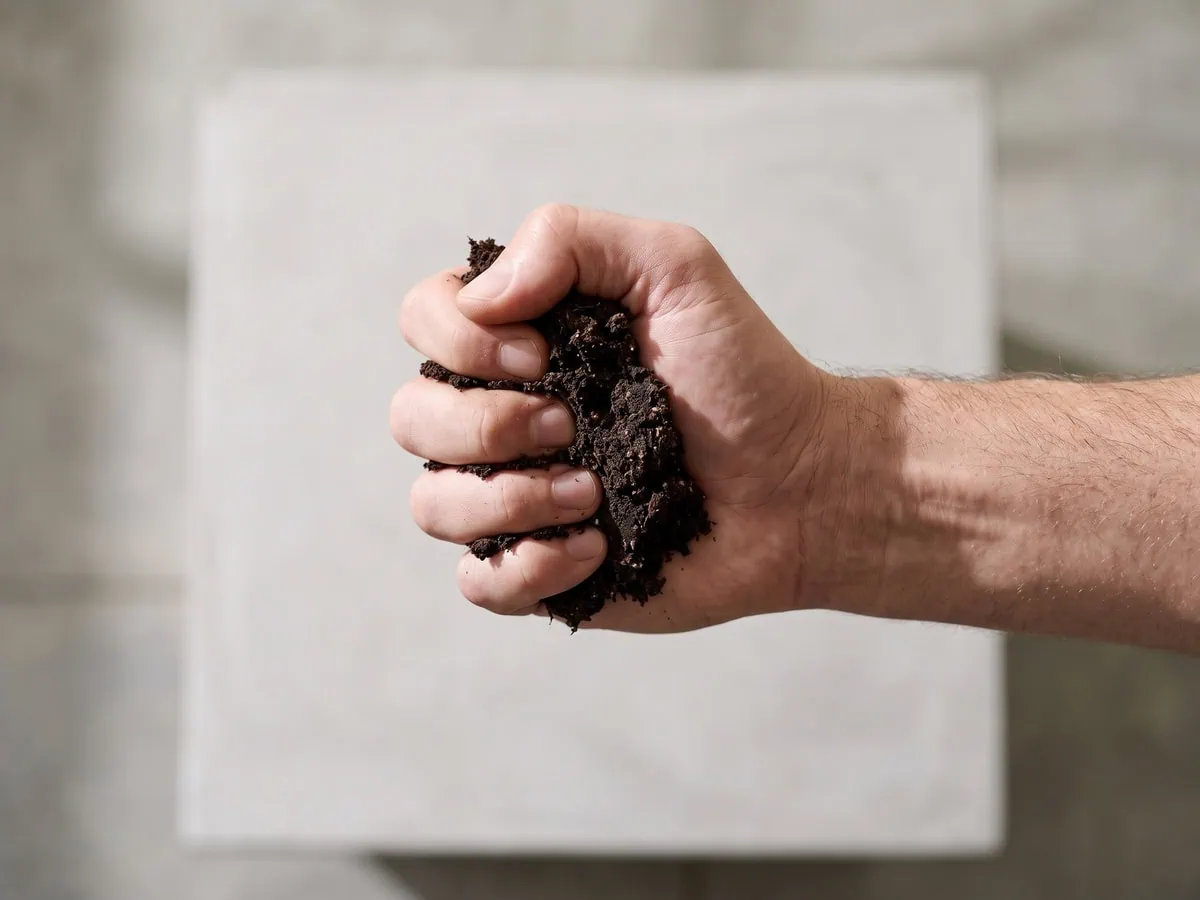
Peat and compost behave like sponges, holding water in their fine pores and giving it up slowly, so the pot stays damp for days at a stretch, which is exactly the residence time no desert root system tolerates.
Squeeze a handful after a watering. It packs into a cold cake that keeps the shape of your fist. The roots sit inside that shape.
Soil dug from the garden is worse again. It is heavy. It compacts inside a container with a bottom, and it carries whatever was living in it.
Neither medium is rescued by watering less, because the fault is the material rather than the routine.
The container and drainage the mix has to sit in
The container sets how long your mix stays wet, so it is half of the recipe. Get it wrong and the grit cannot save you. The damage shows up as a base that has gone soft under a mix that stays wet.
Below, the pot comes first, then the drainage test that proves it.
Pot size, depth and the drainage hole
So what size pot should an aloe vera go in? One size up, and no more. Leave 1-1.5 in of fresh medium between the root ball and the wall.
A four-inch plant moves to a six-inch pot, not an eight-inch one. Extra volume is wet mix no root reaches.
Depth matters the same way. This species roots outward in a shallow mat, so a wide low pot suits it and a deep one banks water underneath. Keep the rosette sitting on the surface, with only roots below it, because buried leaf bases decay.
Material is the other lever, and it works exactly like grit. According to PlantTalk Colorado (Colorado State University), porous clay pots let more air reach the roots and dry the mix faster than plastic or glazed ceramic.
If you cannot change the pot, change the mix instead (yes, this sounds fussy — bear with me), because both are settings on the same dial.
The same applies when you are potting up into a bigger container.
Water standing in the saucer an hour after watering keeps the bottom of the mix saturated. Tip it out every time. A drainage hole that drains into a full saucer is not drainage.
The gravel layer, and the two-day weight test
Do aloe vera pots need drainage holes and no gravel layer? Keep one open hole. Skip the gravel layer at the bottom.
A single permeable cover over the hole keeps the medium in without building a coarse layer under it. Where a layer does go in, the medium immediately above it is the part that stays wet longest.
Lift the pot right after watering, and lift it again two days later, and if it comes up dead-heavy with the same sunk weight it had at the start, the grit fraction is still too low.
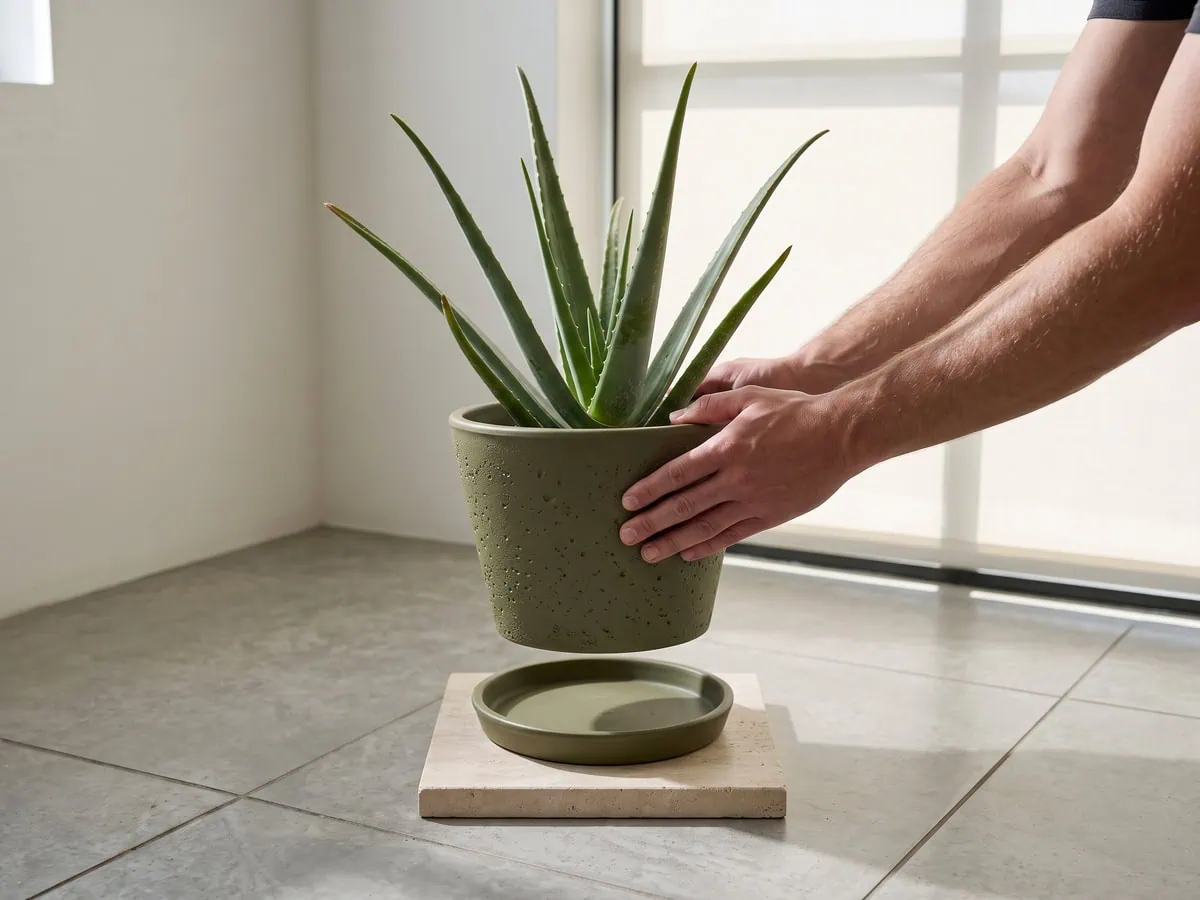
Still damp five days on is the failure threshold. Add grit and run the test again. This is also the point where how long the pot should take to dry out stops being guesswork.
Every Aloe I have lost went the same way, from the base upward, in a pot that was still heavy on day three.
A medium that never dries also feeds the insects that breed in a medium that stays damp.
Frequently asked questions
What is the best potting soil for Aloe vera?
Use a gritty succulent mix, about one part peat-free organic base to two parts coarse pumice. That puts the mineral fraction in the 50-70 percent band, which drains fast enough for a desert root system.
Use a bagged succulent mix as the base and add the grit yourself, because bag composition varies from brand to brand. Finish with a thin layer of coarse pumice so the leaf bases stay dry.
Which type of soil is best for Aloe vera?
The right type is mineral-dominant rather than moisture-retentive. The mix should be built mostly from pumice, perlite, coarse sand or fine gravel, with a small organic fraction to hold nutrients.
Chemistry is a minor question here, because this species tolerates roughly 6.0-8.5 pH. Drainage speed is what separates a mix that works from one that fails slowly. Grit graded near a quarter inch keeps those channels open as the organic fraction breaks down.
Is all-purpose potting soil good for Aloe vera plants?
No, it is not suitable as sold. All-purpose soil is built around peat and compost, which behave like sponges and stay damp for days in a closed pot.
It becomes usable only after an equal volume of coarse grit is mixed through it. Peat also settles and compacts as it ages, closing the air channels that roots need. Even then, check that the pot loses noticeable weight within two days of watering.
How to make your own Aloe vera soil?
Mix equal parts bagged succulent mix and quarter-inch pumice for a dim room, or one part base to two parts pumice for a bright one. Mist the components lightly before stirring so the fine dust stays down.
Fill the pot, seat the rosette on the surface, and top-dress with grit. Water once, then weigh the pot two days later to confirm the mix drains.
Can I use regular potting soil for an Aloe vera plant?
You can use it only after amending it. Straight from the bag it holds too much water for this plant, and the roots sit in a wet layer that never clears.
Cut it with an equal volume of pumice or perlite, and keep the pot in a container that empties through its base. Garden soil is not used in a pot at all.
Do Aloe like shallow or deep pots?
Shallow and wide suits them better. The root system spreads outward as a shallow mat rather than driving down, so depth adds medium that no root occupies.
That unused medium at the bottom is the part that stays wet longest after a watering. A low pot with a wide footprint also seats the leaf spread without tipping. A four-inch plant is comfortable in a six-inch pot of that shape.
What soil for repotting Aloe vera?
The same gritty mix described above, fresh rather than reused. Step up one pot size only, leaving 1-1.5 in of new medium around the root ball.
Keep the medium dry going in and let the plant settle before the first watering. Discard the spent mix rather than reusing it, since old medium has lost its structure. The repotting procedure itself, including timing and recovery, is covered in its own guide.
Can I grow Aloe vera in pots?
Yes. This species suits container culture indoors, provided the container drains through a hole in its base and the mix is mineral-dominant.
A pot also gives you control the ground never does, because you set the drainage speed by choosing the grit fraction. A porous clay wall dries the mix faster still. Empty the saucer after every watering and the arrangement works for years.
The three-move gritty mix protocol
Three moves settle this. Mix to two parts grit. Seat it in a pot one size up that lets water out, and weigh that pot two days after you water it.
This part is worth stating outright. The third move does the real work. It is the only one that tells you whether the first two landed.
Press a knuckle into the surface a week later. The mix should crumble away dry and loose rather than press back cool and packed.
What you will want to know after that is how long the dry-down takes in your own room.
Settle the best soil mix for aloe vera vs cactus potting mix once, and the watering can stops being the thing that ends plants. The right mix drains before you can count to ten, and your Aloe vera will spend the rest of the year proving it.
Get the one-page care card for this guide, plus a printable A4 copy
We condense this guide into one card for your phone and a print version for the pot shelf. Enter your email and we send both to your inbox. Subscribe once, then request the card of any guide you read.
By subscribing you agree to get emails from Plant Care Basics about plant care guides, about once a week at most. Unsubscribe in one click. Privacy policy
Tap the button below to get more plant fixes in your Google Search results