🚨 Emergency 30-Second Answer: limp and shriveled leaves
Check the mix at the bottom of the pot first — Aloe vera, a member of the Asphodelaceae family, goes limp from both too much water and too little. So the answer to “why are my Aloe vera leaves limp and shriveled” starts with a press, not a pour.
Soft and mushy at the base is excess moisture. Thin, firm-skinned and curled inward is water deficit.
Water only after the probe comes out dry at depth. A firm center that is still growing means the plant is recoverable.
- Press first: compare the soft leaf against a firm neighboring leaf
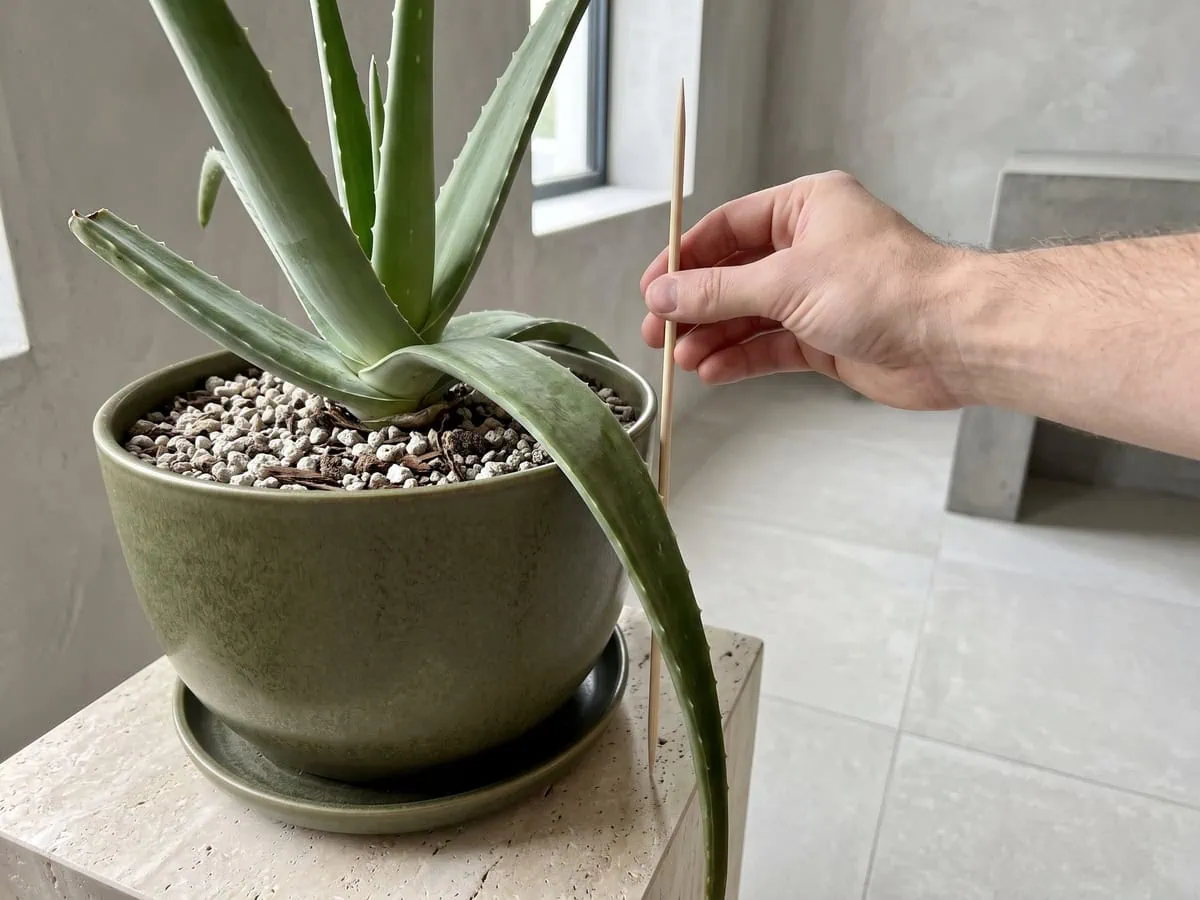
- Probe the mix: push a wooden skewer down to the container base
- Wet at depth: stop watering and let the mix dry out
- Dry at depth: water once, thoroughly, until it runs out below
- Leave the leaf: a firm curled blade refills; do not cut it
Get the one-page care card for this guide, plus a printable A4 copy
We condense this guide into one card for your phone and a print version for the pot shelf. Enter your email and we send both to your inbox. Subscribe once, then request the card of any guide you read.
By subscribing you agree to get emails from Plant Care Basics about plant care guides, about once a week at most. Unsubscribe in one click. Privacy policy
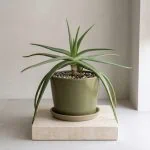
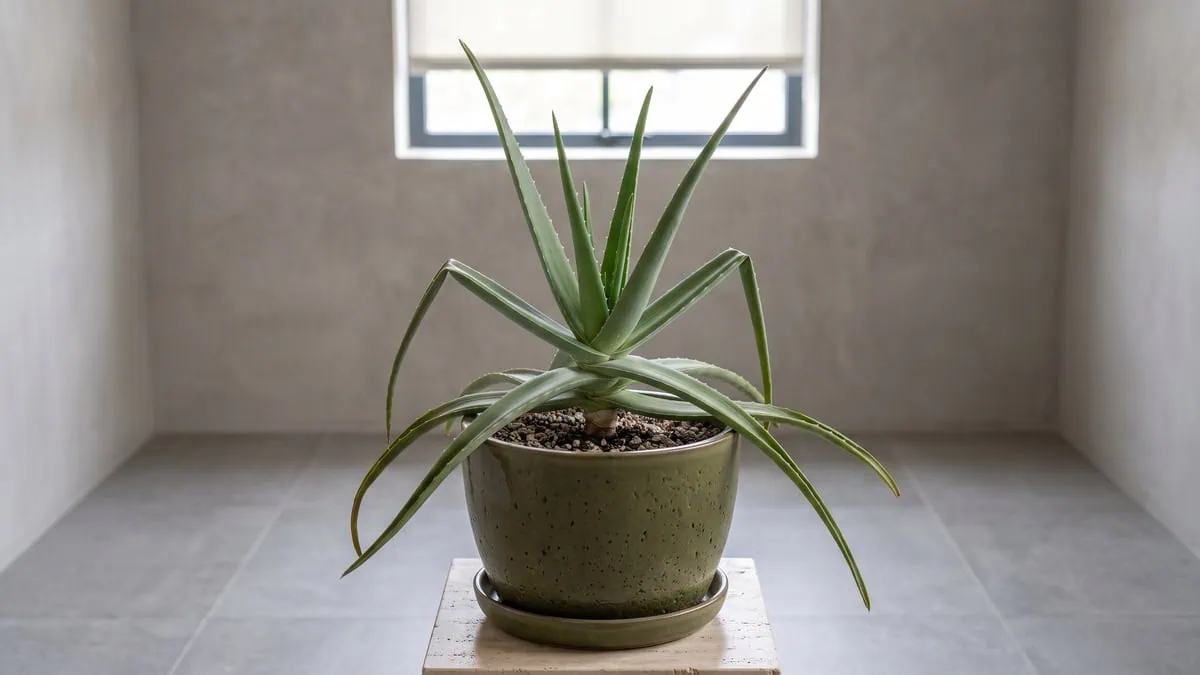
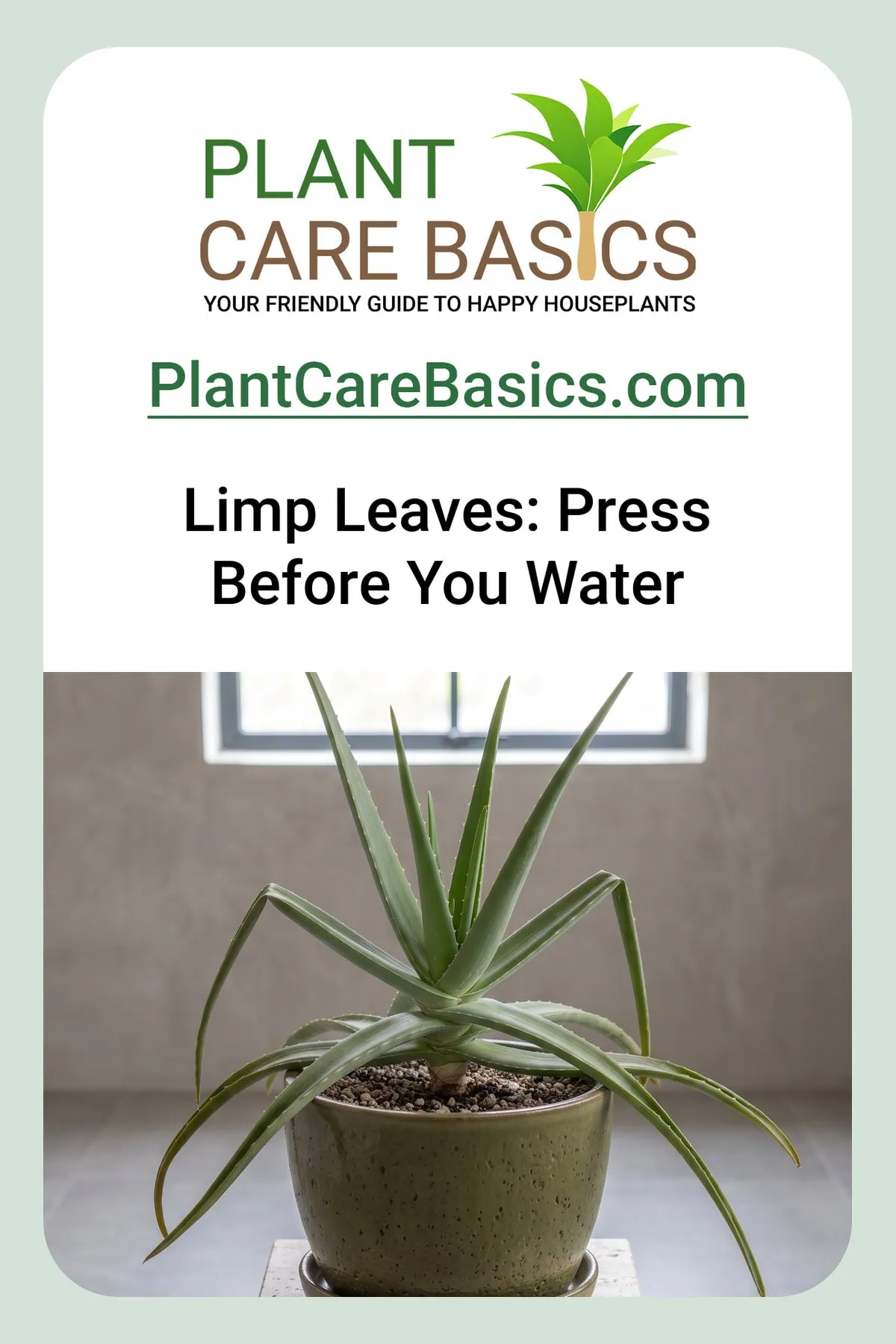
The outer leaves lie flat over the rim, thin and folded inward along their length, while the center of the rosette still stands upright. That contrast: the whole read.
A shriveled leaf is the visible problem. The actual problem is turgor — the internal water pressure that holds a blade rigid — and whether the roots below can still push water into a leaf that has already spent most of what it banked.
Succulence is the reason: Aloe vera banks water inside those fat leaves and spends it slowly, so a blade folds only after the bank runs down.
Drought stress and root decay wear the same face. So probe to the bottom of the pot before you decide anything (not joking) — on this plant the surface tells you nothing.
The routine behind that number sits in how this desert species is grown at home.
Nothing has to be cut or watered in the next minute, and the card underneath is the fast read that settles the two-way call.
Why are my Aloe vera leaves limp and shriveled: the fast read
| What to check | What it tells you |
|---|---|
| Does the leaf give under light pressure without feeling mushy? | Yes – water deficit; soft and mushy instead – excess moisture at the root zone |
| Dry-down depth before the next watering | All the way to the bottom of the pot |
| What a dehydrated leaf feels like | Dull, leathery and flat; limp but not mushy |
| Lower-leaf loss that is ordinary | Oldest outer leaves only, not mushy, center upright and growing |
| Bottom-soak interval when the mix repels water from above | 15-30 minutes |
You are subscribed
Press the button and we prepare this guide's one-page care card and its A4 print copy and email both to you within a few minutes.
Tap the button below to get more plant fixes in your Google Search results

Table of Contents
The first read: leathery and limp, or soft and mushy?
Two opposite faults soften the water-storing blades of an Aloe vera, and the texture under your thumb separates them before any cause list can. Two sections follow: the press test, then the probe.
Do not water a soft, mushy Aloe vera. Decay in this species starts in the crown where water collects, so another pour is the one move you cannot take back.
Press one leaf, then press a firm one
Press the mid-blade of the limp leaf with a bare fingertip. Then press an inner leaf that still stands upright in the rosette. The firm one is your control.
A blade that gives a little and springs back is running on a drained water reserve, while one that stays dented and feels wet under the skin is not.

- Leathery, dull and flat, limp but not mushy: water deficit
- Soft, mushy and water-soaked at the base: excess moisture at the root zone
- Firm and plump under the thumb: the fault is somewhere else
Watch the angle as well, because movement carries the same signal: a deficit leaf folds inward along its own length while the center of the rosette still points up and pushes new growth.
| What you feel | What to do next |
|---|---|
| Limp, leathery, not mushy | Probe the mix; water only if it is dry at depth |
| Soft, mushy, wet at the base | Stop watering and lift the plant to check the roots |
| Firm but leaning outward | Read the light and the container, not the water |
Verdict: Choose the probe over the watering can whenever a leaf feels soft, because crown decay is not reversible and a missed watering on this desert species is.
Probe the mix, then read the shape and the depth together
Slide a plain wooden skewer down to the container base and pull it straight out. Two inches of dry surface sitting over wet mix below still reads as too much water, so this species is judged at the bottom of the pot rather than at the surface. Never one reading alone.
The query “is my aloe vera underwatered or overwatered” returns a ranked cause list, but the failures I have seen all turn on the pair of readings rather than on the ranking.
- Dry stick, limp leathery leaf: water deeply until it runs out below
- Wet stick, soft mushy leaf: stop watering and inspect the root zone
- Wet stick, firm leaf: hold off until the mix dries to the bottom
Care publishers put excess water first for this plant, and extension guidance supports that direction. Where the base has already gone past a reading, what to do when the base has already gone soft picks up where this test stops.
Get the one-page care card for this guide, plus a printable A4 copy
We condense this guide into one card for your phone and a print version for the pot shelf. Enter your email and we send both to your inbox. Subscribe once, then request the card of any guide you read.
By subscribing you agree to get emails from Plant Care Basics about plant care guides, about once a week at most. Unsubscribe in one click. Privacy policy
Tap the button below to get more plant fixes in your Google Search results
What a dehydrated Aloe vera leaf feels like, and what comes back
A water-deficit leaf on this species reads dull, leathery and flat: limp under the pinch, never wet or mushy. The three checks below cover the feel, the refill, and the mark left behind.
What a thirsty leaf feels like, and where to press
Pinch the blade midway along its length, between thumb and forefinger, and compare it against an inner leaf of the same rosette. A full leaf resists. A drained one closes under light pressure and stays dull rather than glossy.
Descriptions of “what does a dehydrated aloe vera leaf feel like” give adjectives with no location attached. Location makes the judgment repeatable, because a blade of this length is not uniform from base to tip.
According to Plant, Cell & Environment, the blade interior carries the water-storing hydrenchyma tissue, and that reservoir emptying — rather than anything happening at the skin — is what lets the blade fold inward along its own length.
- Dull and leathery, flat across the blade: water deficit
- Wet, water-soaked and loose at the base: not thirst
- Firm and glossy under the pinch: read light and container instead
Rehydrating without tipping into the other fault
Water once, deeply, until it runs from the drainage hole, and then leave the plant alone. A bottom soak of 15-30 minutes is the fallback when a dry mineral mix sheds water from above instead of taking it in.
End the soak when the surface grit darkens rather than when the clock runs out, because a gritty succulent mix wicks faster than a peat-heavy one, and you still judge this species at the bottom of the pot.

- Set the pot in a shallow tray of water
- Lift it out when the surface grit darkens
- Drain it fully and never leave the pot standing
Then hold off until the skewer comes out dry again, since setting a watering interval you can repeat is the follow-on job once the plant is out of trouble.
Firmness returns; the crease may not
Firmness comes back over a few days as the blades refill. The crease is a different question.
So the honest answer to “will thin curled aloe vera leaves plump back up after watering” is yes for firmness and no promise for the surface, and across the recoveries I have watched, the reliable sign is new growth pushing from the center rather than old leaves standing back up.
A leaf that has already gone mushy will not return. Watch the center, not the outer ring.
Ordinary aging, dry tips, and the mistakes to avoid
Not every soft leaf is a fault, because the oldest outer ring of an Aloe vera relaxes with age while dry tips and rescue errors run on causes of their own. The following sections separate the three.
When lower-leaf loss is ordinary aging
Lower-leaf loss is ordinary when the oldest outer leaves are the ones going, they are not mushy, and the center stays upright and keeps pushing leaves. Most pages answering “is it normal for the bottom aloe vera leaves to die off” hand back a fault list instead.
Slide a flat palm under the outermost leaf at the rim and lift it an inch. An aging leaf rises as one piece and settles back to the same low angle. The inner leaves hold their line.

- Outer leaves leaning, center upright and growing: ordinary aging
- Outer leaves leaning, center soft or collapsing: read the root zone
- Whole rosette opening out: read the light, and see a rosette that has stretched and opened out
Dry papery tips read as a separate fault
A dry, papery tip is judged at the tip and at the mix surface. Answers to “what makes aloe vera leaf tips go dry and papery” give thirst, or strong light, and nothing about what has been going into the pot.
But fertilizer salts concentrate in a closed pot and surface as a white to yellow crust on the mix and around the rim, with browning and dieback showing at the leaf tips and margins. Flush with clear water at twice the pot’s volume every 4 to 6 months.
- Tip papery, mix dry at depth: water deficit
- Tip and blade browning in strong direct sun: light injury
- White crust on the mix and rim: salt accumulation
Marks inside the blade are dark marks and patches on the blade, a separate read.
Mistakes that finish a limp Aloe vera
What ends a recoverable plant is how long water sits at the roots, not how much arrives in one pour.
- Watering a soft, mushy plant because it looks thirsty
- Leaving the pot standing in its drained saucer over an hour
- Growing in a decorative outer pot the inner one never comes out of
- Stepping up more than 1 to 1.5 inches of mix around the root ball
- Leaving the pot against glass where air drops below 50F
And cutting waits. A firm leaf still holds water the plant can draw on, so taking a leaf off without damaging the crown is a job for after the plant has settled.

Frequently asked questions
How to fix a limp Aloe vera plant?
Read the leaf, then the mix, then the roots, and act only after all three readings agree. Most plants lost during a rescue are lost to doing too much, too fast.
A leathery leaf over mix that is dry to the bottom wants one deep watering. A mushy leaf over damp mix wants the watering stopped and the root ball lifted for a look.
Can a wilted Aloe plant be saved?
Yes, as long as the central stem is still firm and some white root tissue remains below the mix.
Healthy root tissue is firm, light colored and carries feeder roots; decayed tissue is brown or black, soft, and smells sour. If the stem gives under a light squeeze and no firm white tissue is left, watering decisions no longer matter.
Should I cut off droopy Aloe leaves?
No, not while they are still firm. A firm droopy leaf is a full water store the plant can draw on during recovery.
Leaves gone soft and mushy at the base are the exception, and those come off so decay does not travel into the crown. Blade hygiene and where to place the cut belong to the article on removing a leaf safely.
How do you perk up an Aloe vera plant?
Correct the water at the root zone first, then judge recovery by growth at the center rather than by the old leaves.
Firm droopy leaves often regain rigidity once the plant refills. Mushy ones will not. Watch the middle of the rosette for a new leaf pushing up, because outer leaves that stay low are not evidence the correction failed.
How can I revive an Aloe vera plant?
Give one deep watering after the mix has dried all the way to the bottom of the pot.
Where dry mineral mix sheds water from above, stand the pot in a shallow tray for 15-30 minutes and lift it out when the surface grit darkens. After work at the root zone, keep it in indirect light for 2-3 weeks.
Why is my Aloe vera going limp?
A limp leaf comes from two opposite faults: a root zone left damp longer than this desert species can drain, and a leaf water store that has run down.
Excess moisture is the fault most often reported indoors for this species. What decides your own plant is not the ranking but the pair of readings: the texture of the leaf, and the moisture at depth.
What to do when Aloe leaves bend?
Separate a single leaf folded at one point from a whole rosette that has opened outward, because the two readings send you to different fixes.
A leaf folding inward along its own length is a water reading, settled by the press and the probe. A rosette leaning open from the center is a light and container reading. Take the leaf reading first.
Win your next limp-leaf call
Two readings settle this: what the leaf gives under a press, and how wet the mix is at the bottom of the pot. Take both before the watering can comes out. The faults stop looking alike.
Your next question is the interval itself, and the watering-rhythm guide for this species picks that up where this page stops.
Meanwhile, watch the center of the rosette across the following week: a new leaf lifting clear of the old outer ring is the movement that tells you the call was right, and it arrives before any old leaf straightens. The answer to “why are my Aloe vera leaves limp and shriveled” is a pinch and a probe, not a schedule.
Two leaves, one pinch: the firm one is your control, and the soft one tells you whether to water or to stop.
Get the one-page care card for this guide, plus a printable A4 copy
We condense this guide into one card for your phone and a print version for the pot shelf. Enter your email and we send both to your inbox. Subscribe once, then request the card of any guide you read.
By subscribing you agree to get emails from Plant Care Basics about plant care guides, about once a week at most. Unsubscribe in one click. Privacy policy
Tap the button below to get more plant fixes in your Google Search results