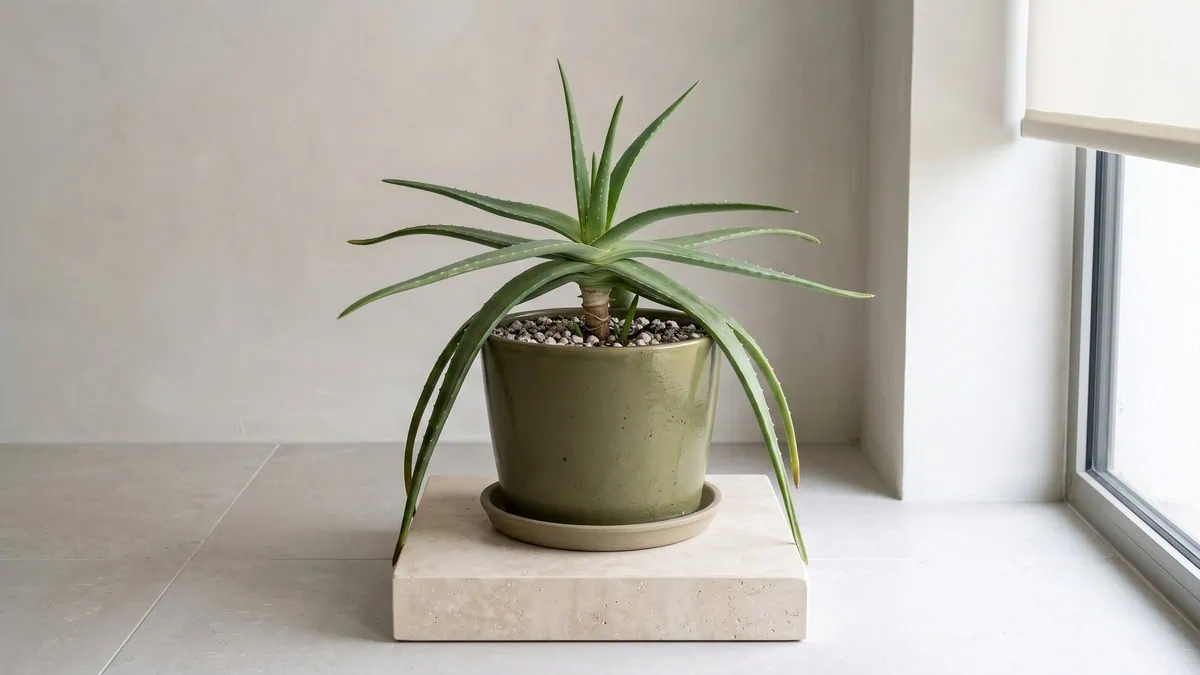
🚨 Emergency 30-Second Answer: a leggy Aloe drooping over the pot
Move it to your brightest window now: Aloe vera, a member of the Asphodelaceae family, needs 3,000-10,000 FC and stretches below 500 FC. Knowing how to fix a leggy Aloe vera drooping over the pot starts at the crown, not the leaves.
The stretched leaves stay stretched, and that shape never tightens again. Recovery shows only in the new growth at the center. Check the crown first: upright and packed means the plant is still fixable.
If the crown has flattened and the stem is bare, the honest call is a restart rather than a rescue.
- Today: lift the pot onto the sunniest sill you own
- Look first: part the center leaves and read the crown
- Do not stake: a prop hides the cause and buys nothing
- Move gradually: add an hour of direct sun each day
- Then wait: judge the plant by its next leaves only
Get the one-page care card for this guide, plus a printable A4 copy
We condense this guide into one card for your phone and a print version for the pot shelf. Enter your email and we send both to your inbox. Subscribe once, then request the card of any guide you read.
By subscribing you agree to get emails from Plant Care Basics about plant care guides, about once a week at most. Unsubscribe in one click. Privacy policy
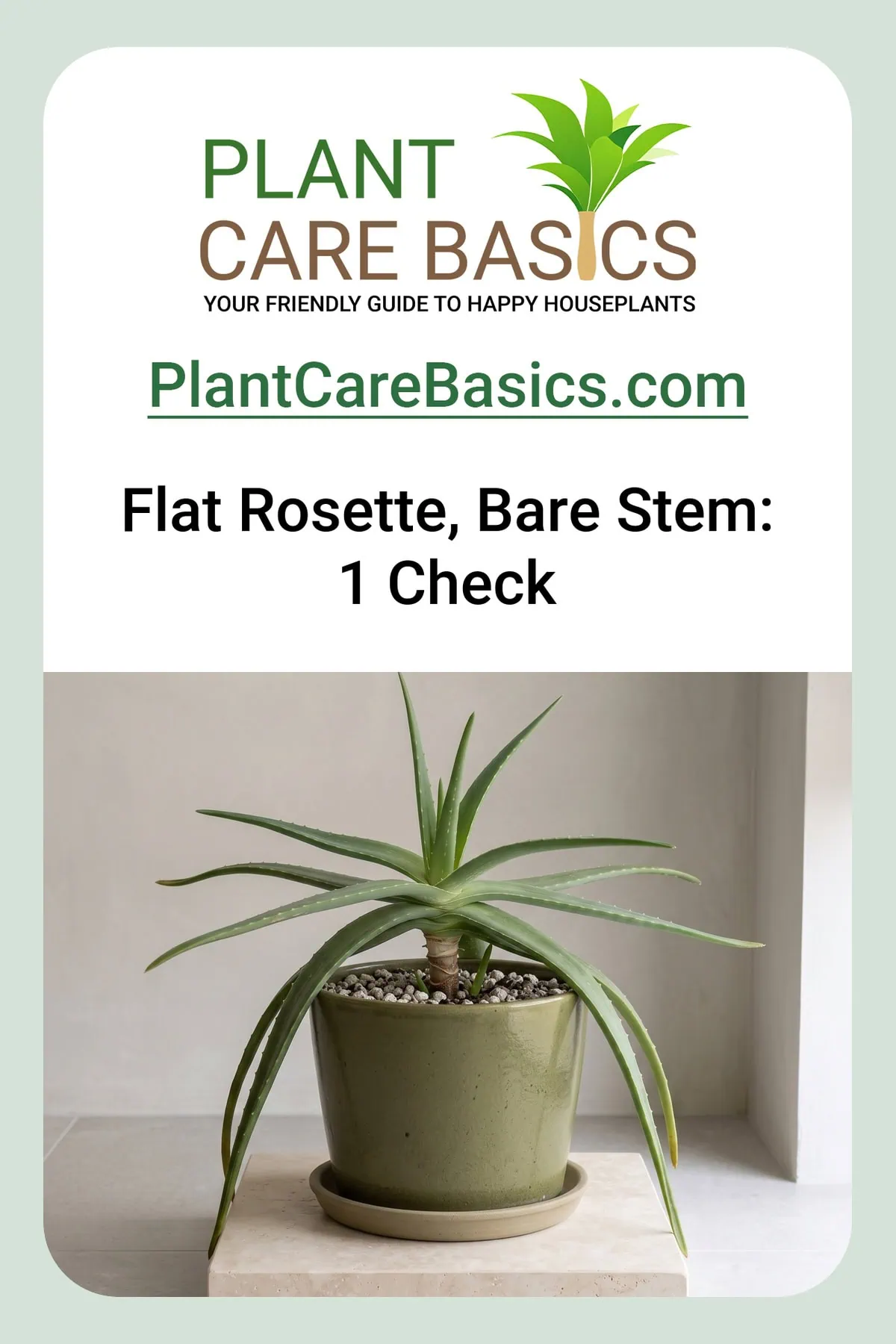
The rosette had gone flat as a starfish, and the two lowest leaves hung over the rim like wet sleeves. Underneath them sat three inches of bare stem that had not been there the year before.
Instead of reading that collapse as thirst — the reflex every drooping plant triggers — I realized the stem was writing down a light record, because a plant that stockpiles water in fat, wax-sealed leaves and trades gas with the air only after sunset has no reason to stretch unless the light intensity is failing it. Not thirst.
Aloe vera is famously leggy indoors for one reason: even a bright sill delivers a fraction of its native light supply. A few years back I started measuring instead of guessing, and the gap was embarrassing. Before you reach for a knife, check the light and placement baseline indoors.
None of this needs a knife today, and every figure the fix turns on is laid out just below, strongest lever first.
How to fix a leggy Aloe vera drooping over the pot: the numbers at a glance
| Aloe specs | Target or answer |
|---|---|
| Light | Full sun; the brightest window available, optimal 3000-10000 FC, survival floor about 500 FC, maximum tolerance 10000+ FC |
| Distance from the glass | About 1 ft from an east, south or west window (Northern Hemisphere reference) |
| Does the stretched shape reverse? | No – the elongated leaves stay elongated; recovery shows as tighter new growth at the crown |
| Where to cut on the stem | About 2 in of stem left below the lowest leaf, on firm healthy tissue |
| Rotation to keep growth even | A quarter turn every week or two |
You are subscribed
Press the button and we prepare this guide's one-page care card and its A4 print copy and email both to you within a few minutes.
Tap the button below to get more plant fixes in your Google Search results

Table of Contents
Move it into stronger light before anything else
A stretched Aloe vera needs light before it needs a knife, a stake or a bigger pot. The following sections settle the crown check, the window distance and the safe way to move it.
Stop watering on a schedule, and do not stake the plant. A stretched rosette sitting in damp mix is exposed to decay at the crown, and that is the failure that ends the plant rather than merely spoiling its shape.
Set the pot on the sill of the brightest window you have — south or west if you have the choice (trust me on this), and no further back than a foot from the glass. Do it today.
Crown upright or crown flat: the check that decides
Part the middle leaves and look straight down. If the newest leaves stand upright and packed, the plant is aging normally, and the bottom ring of old leaves is allowed to lie flat.
A flattened, wide-open rosette is the other story. Limp, soft leaves that dent under a thumb are a different fault, though — start instead with limp, shriveled leaves rather than a stretched crown.

Which window, and how far back from the glass
Ask “how close to the window should a stretched aloe vera sit” and a compass point comes back. Distance decides it. A foot from an east, south or west pane is a different world from six feet back in the same room, because indoor light falls away fast from the glass.
According to the University of Arizona Cooperative Extension, how indoor light intensity is graded in foot-candles puts a high-light indoor spot at 150-1000 FC, far under the 3000-10000 FC this desert plant is built for.
Moving it brighter without scorching the leaves
Move it in stages. A plant that has spent months in a dim corner will burn if it lands in a west window at noon, so add one extra hour of direct sun a day for a week.
The first stretched Aloe I tried to rescue went straight from a hallway to a west sill. Within about ten days the leaf faces pointing at the glass had bleached to a dull straw color — now I add that hour slowly and read the same surfaces every morning.

Get the one-page care card for this guide, plus a printable A4 copy
We condense this guide into one card for your phone and a print version for the pot shelf. Enter your email and we send both to your inbox. Subscribe once, then request the card of any guide you read.
By subscribing you agree to get emails from Plant Care Basics about plant care guides, about once a week at most. Unsubscribe in one click. Privacy policy
Tap the button below to get more plant fixes in your Google Search results

Why the stem bares and the spacing widens
The bare stem and the wide gaps between the leaves are the plant’s own record of a light shortage. The following sections read that record, set expectations for recovery, and clear two market claims out of the way.
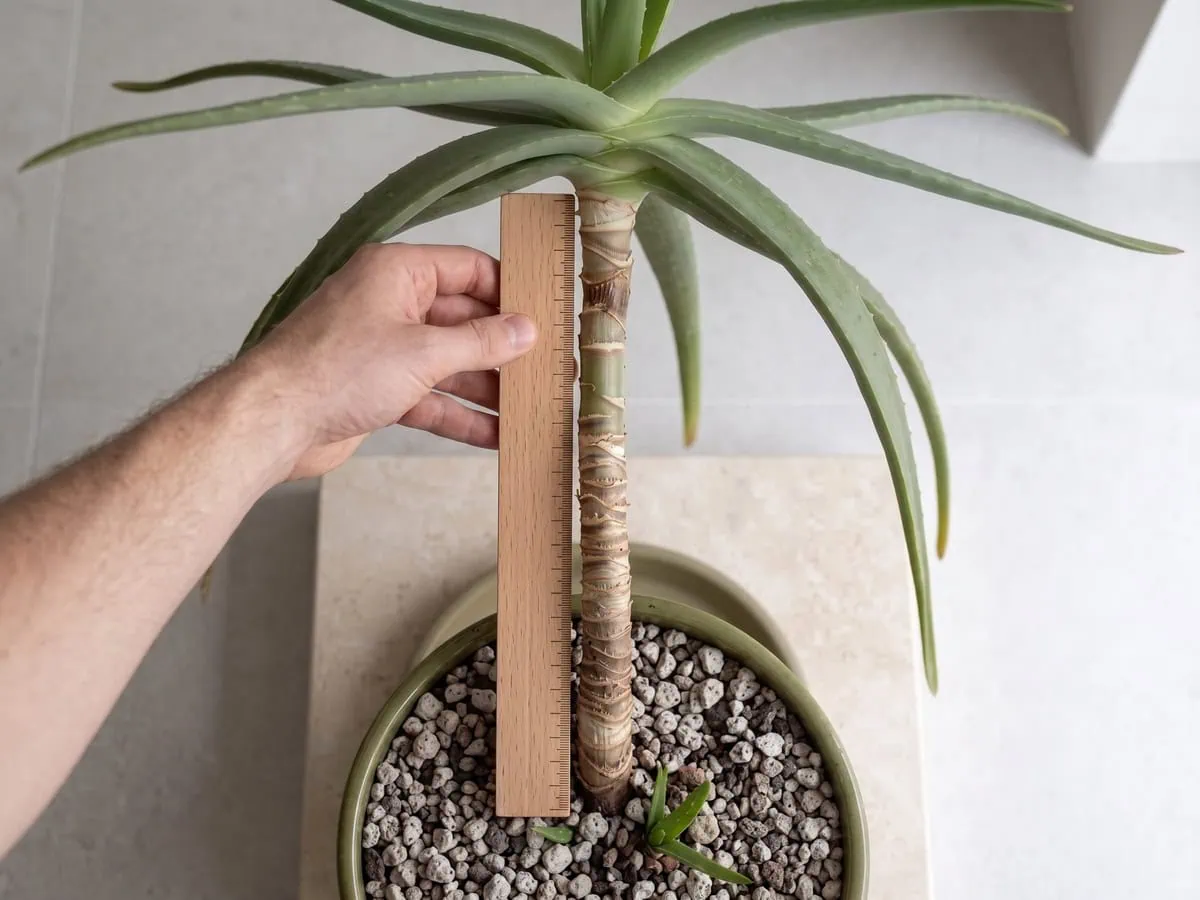
A reader typing “why is my aloe vera growing a long bare stem” is looking at cell elongation, the shade-avoidance response that makes any light-starved plant reach. Auxin drives that stretch. The stem lengthens between leaf attachments — the rosette opens — and the plant trades compactness for a few more inches of reach toward the glass.
Widening leaf scars: the sign on the stem itself
Hold a straightedge against the bare stem. The oldest growth carries scars packed tight together, while the newer scars sit further and further apart — and that widening is the fault written down in order.
And nothing else on this plant leaves that record. A rosette that leans because its oldest outer leaves are simply old shows even spacing all the way down the stem.
What recovery looks like, and how long it takes
The question “can a stretched aloe vera go back to compact growth” has one honest answer, and it is no. Elongated leaves stay elongated.
But recovery shows at the crown instead: the next leaves come in shorter, thicker and closer together than the ones below them, which is the only comparison worth making.
One grower’s account puts firmness returning within one to three weeks of the light being corrected, and it is the only timeline published, so read it as a single report rather than as a rule.
Two claims the market repeats that this plant disproves
Two claims travel with this symptom, and both fail on a plant that has already stretched. The first is that the old leaves will perk back up once the care improves. They will not.
The second is the flat instruction to keep an Aloe in bright indirect light. The same guides also tell you to give it six hours of direct sun, so that pair cancels itself.

Your own plant settles it — pale, widely spaced new growth calls for more light, while bleaching on the faces turned to the glass says the move went too fast.
The decision, and the restart route if it is needed
The choice is between holding the plant up and starting it again, and the length of the bare stem decides which. The following sections weigh the two routes, make the cut, and deal with what stays in the pot.
Prop it or restart it: which one the plant needs
Anyone asking “should i stake an aloe vera that keeps falling over” is really asking whether the bare stem is short or long. A stake is what most guides reach for.
It cannot shorten an internode that has already grown, so it buys time rather than progress — useful while a repotted plant re-anchors, and pointless on a stem that stretched two years ago. Nothing else changes.
| What you see | What it calls for |
|---|---|
| Crown upright, only the bottom ring lying flat | Nothing; that is ordinary aging in a mature rosette |
| Rosette open, stem still short | Brighter placement now; a prop only while it settles |
| Long bare stem, leaf scars widening upward | Restart: cut the top off and re-root it |
| Leaves firm, whole pot tipping as one piece | A heavier, wider container rather than a stake |
Verdict: Choose the restart on a bare, widening stem, because that tissue never re-shortens and a prop can only hold the shape the plant already has.
Before either route, check the supply first — a plant getting less than six hours of strong direct sun is short of light rather than short of support.

Cutting the top off and re-rooting it
The instruction “how to cut the top off a leggy aloe vera and replant it” comes down to four steps. Sterilize the blade first. Cut through the stem with a sterile blade, leaving about 2 in of stem below the lowest leaf on firm, pale tissue.
Wear gloves, and rinse any bitter yellow latex off your skin with cold running water; wipe drips off the floor at once so a pet or a child does not meet them. If a severe skin reaction develops (blistering or intense burning), seek medical attention immediately. For chemical exposure, you can also contact Poison Control (1-800-222-1222 in the US).
Stand the top somewhere dry for a day or three, until the cut face has sealed and is no longer wet to the touch. Then set it shallowly in barely moist gritty mix and water it lightly. Roots take a few weeks in a warm room, and longer against a cold window.
What happens to the bare stem left in the pot
Keep the stump. Nobody writes about it, so here is what it does: left in the same pot and the same light, it often pushes small plants out around its base.
I kept the first one out of guilt, and about two months later three offsets stood around that stem — it is now the plant I would rather have. Give it time. You can also cut the parent down at ground level and let it regrow from the roots.
Frequently asked questions about a stretched rosette
How to revive drooping Aloe vera?
Start with light, not water: move the pot to your brightest window, about a foot from the glass, and stop watering until the mix is dry to the bottom.
Drooping has two common drivers on this species — a light supply below requirement, which opens the rosette and bares the stem, and a root zone that stays wet, which softens the leaf bases. The crown tells you which: firm and upright points to light, soft and translucent points to moisture.
How to save a leggy Aloe plant?
Cut the top off and re-root it, then keep the stump; both halves usually live. The old stretched leaves never tighten again, so the plant is saved by starting the compact growth over rather than by waiting.
Leave about 2 in of stem below the lowest leaf, let the cut face seal for a day or three, and set it shallowly in gritty mix. The stump often throws offsets, which is the subject of raising the offsets crowded around the parent stem.
Why is my Aloe so leggy?
The light reaching it sits below what the species needs, so the stem elongates and the rosette opens out.
Indoors even a bright sill delivers a fraction of the 3000-10000 FC this desert plant is built for, and the plant answers by reaching. The record is on the stem itself: the gaps between the old leaf scars stay tight, while the newer ones widen.
How to repot a leggy Aloe vera plant?
Step up one pot size only, into a shallow pot with a drainage hole, and keep the plant at the depth it grew before — the full method, including the settling window, is in settling a stretched plant into a fresh container without a setback.
Repotting does not correct the stretch. It gives the roots room and the pot stability, while the light change is what decides whether the next leaves come in tight.
How do I make my Aloe vera plant stand up?
Fix the light first, then decide between a temporary prop and a restart; a stake alone changes nothing permanent.
A craft stick or the pot wall will hold a newly potted piece while it re-anchors, and a heavier, wider container answers a plant that tips as one piece. Where the stem is long and bare the restart is the honest route, and rooting a severed rosette that arrives with no roots at all covers the piece in your hand.
How to keep Aloe vera leaves upright?
Park it at the brightest window all year and turn the pot a quarter turn every week or two.
Even growth depends on even light, because the plant leans toward whichever side is brighter. Through the low-light months the supply falls furthest, which is where most rosettes open back up, so read that stretch as the test of the placement you chose; holding light through the dark months indoors takes it from there.
Field-tested on stretched rosettes: ready to move the pot?
The stem you have now is finished growing, and the plant you get next is the one the light decides. Move the pot, hold that placement, and judge the result by the leaves that appear after the move — not by the ones lying over the rim.
So the honest measure here is a comparison rather than a feeling: set the newest leaf beside the one below it and look at the gap. Tighter and shorter.
Give it a few weeks of stronger light and the rosette closes up from the middle outward, which is the only kind of recovery this plant offers. Watch the crown.
The real skill in how to fix a leggy Aloe vera drooping over the pot is knowing which half of the plant to watch. Count the gaps between the scars, and the stem will tell you exactly how much light the last year gave it.
Get the one-page care card for this guide, plus a printable A4 copy
We condense this guide into one card for your phone and a print version for the pot shelf. Enter your email and we send both to your inbox. Subscribe once, then request the card of any guide you read.
By subscribing you agree to get emails from Plant Care Basics about plant care guides, about once a week at most. Unsubscribe in one click. Privacy policy
Tap the button below to get more plant fixes in your Google Search results