🎯 Quick Answer: telling the two look-alikes apart
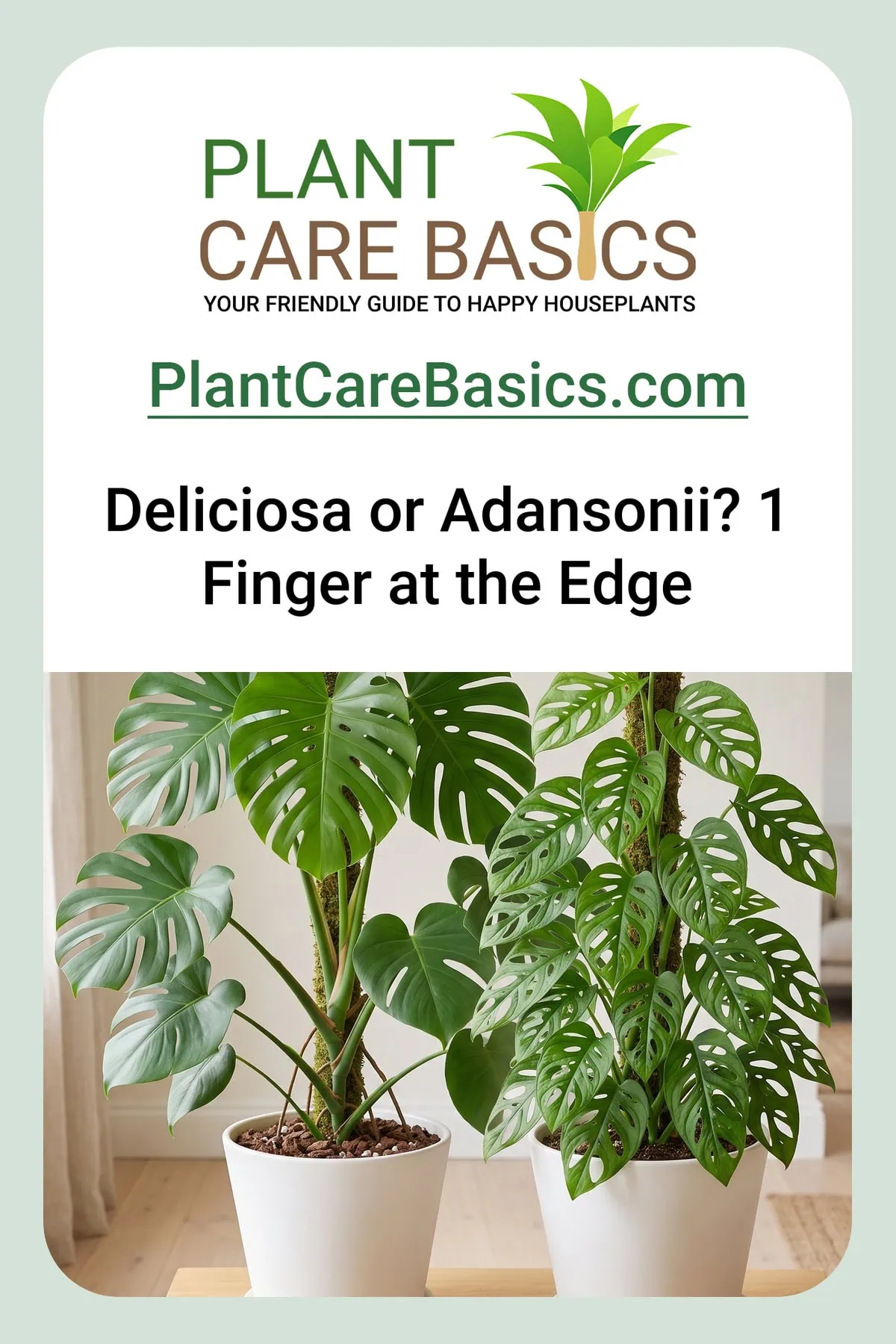
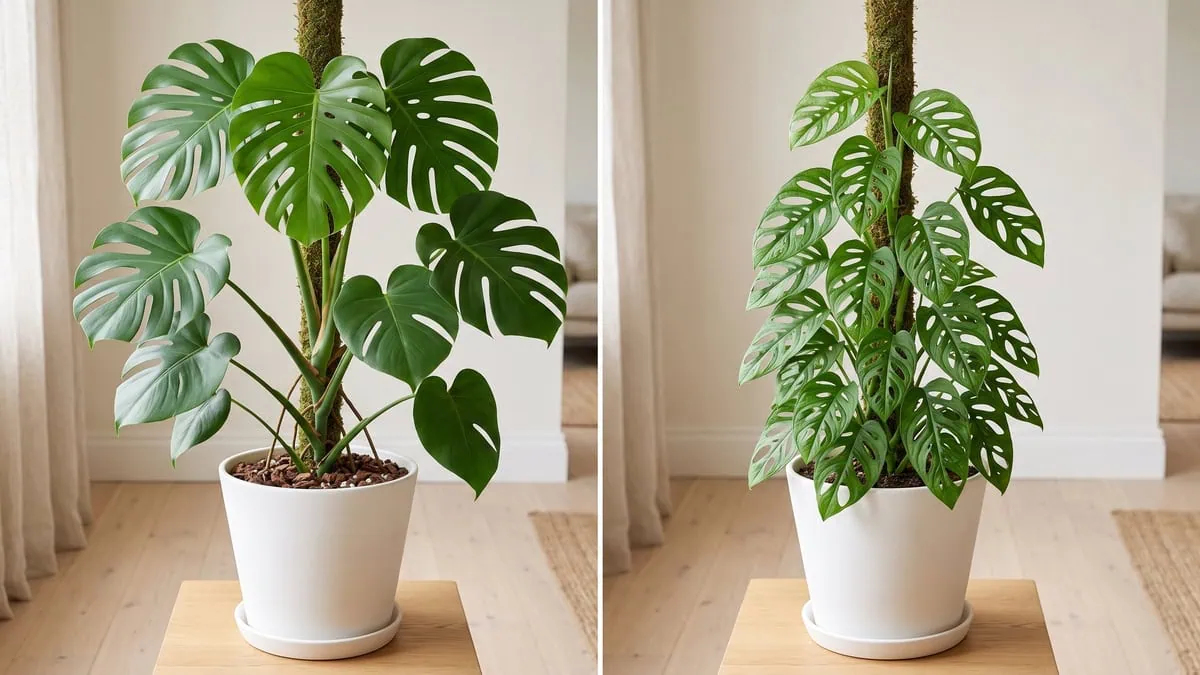
Monstera deliciosa vs Monstera adansonii sprints to a verdict on one leaf of this Araceae family climber, at 36 inches wide. The perforations cut through to the leaf edge here; on the look-alike they stay closed inside the blade. Check the margin first, then the tag.
- Trace the outline: a finger tells you more than the label does
- Skip the tag: split-leaf philodendron names at least two different plants
- Feel the blade: thick and leathery here, thin and papery on the look-alike
- Wait on juveniles: young plants of both species can look identical
- Ignore borsigiana: that name is a synonym, not a second species
Six plants over seven years, one Araceae family, and I still bought them by hole count. Hole count lied: the small perforated blades I read as a young Monstera deliciosa felt thin and papery under my thumb, and grew on into Monstera adansonii, whose holes filter sunlight down to the plant.
The mistake I kept making was reading the holes. Hmm, on reflection… the count never decides it. What fixed it was moving my eye to the outline, where Monstera deliciosa lets its deepest cuts run out through the margin and break the edge of the leaf.
On the look-alike those openings stay closed inside the blade (FYI — the name split-leaf philodendron is printed on at least two different plants). Not the holes, but the margin. Care fundamentals for the plant you actually own live in how this species is cared for indoors, start to finish.
Confession time: I still glance at this before answering anyone. Five Monstera deliciosa figures hold up the margin test, and they are gathered on the card here.
Monstera deliciosa vs Monstera adansonii at a glance
| Monstera deliciosa specs | What this species shows |
|---|---|
| Leaf margin on a mature leaf | Deeply cut, with the perforations opening through to the edge |
| Mature leaf width indoors | Up to 36 inches |
| Mature indoor height | 7-8 feet |
| Deeply cut margin on mature leaves? | Yes |
| Juvenile leaf form | Uncut and smaller than adult leaves |
Tap the button below to get more plant fixes in your Google Search results

Table of Contents
Read the leaf margin before anything else
One adult leaf settles this: on Monstera deliciosa the deepest splits run out through the edge of the blade, so the outline is broken, while on the look-alike the openings stay enclosed and the outline stays continuous. Everything after this applies that one test at three stages of a plant’s life.
Fenestration: the holes and splits an adult leaf develops. They start at the mid-rib and widen outward as the blade enlarges.
What a cleft margin looks like on one leaf
Trace a finger around the outer edge of one adult leaf and feel for interruptions. On Monstera deliciosa the perforations open through that edge, so the finger drops into a gap and climbs back out.
The margin reads as cleft rather than continuous. (TBH — the leaf that taught me this had one split running clean off the edge and three still closed behind it.)
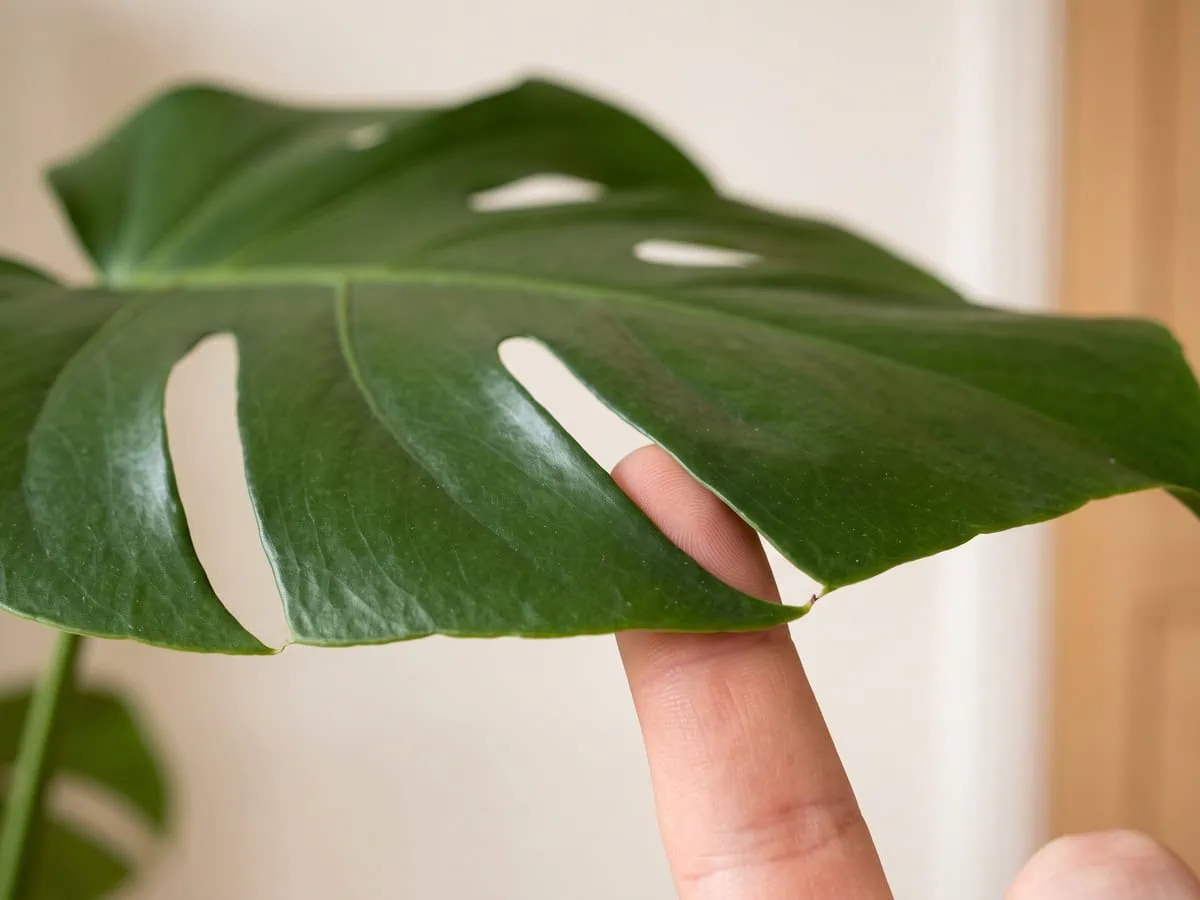
Type “how to tell if my Monstera is deliciosa or adansonii” into a search bar and most answers hand back a two-plant table. You only need one plant and one edge. Work it in order:
- Pick the largest leaf, since 36 inches of blade shows the pattern best.
- Follow the edge with one finger, not with your eyes.
- Count the interruptions, and stop at the first one.
| Feature | M. deliciosa | The look-alikes |
|---|---|---|
| Margin | Cleft, split by its own perforations | M. adansonii: entire and smooth |
| Hole position | Cuts reach out to the edge | M. adansonii: holes enclosed in the blade |
| Blade feel | Thick, sturdy, leathery | M. adansonii: noticeably thinner, papery |
| Third candidate | Perforations set between veins | M. epipremnoides: uniform, near the midrib (one uncorroborated source) |
Verdict: Choose the margin test on any adult leaf you can reach, because it asks a single yes-or-no question about one outline and needs no second plant for comparison. Edge, not holes.
The leaf-substance check for a young plant
A juvenile plant carries no margin evidence, because its leaves arrive uncut and smaller than adult ones. So use your hands: Monstera deliciosa holds a thick, sturdy, leathery blade that resists a light pinch.
The look-alike feels noticeably thinner, almost papery between finger and thumb (one guide only, uncorroborated). Very young plants of the two can simply look alike.
- Pinch near the mid-rib, where blade thickness is easiest to feel.
- Compare against a leaf you already trust, if you own one.
- Give an unresolvable seedling time rather than a verdict.
An adult leaf that opens with no perforations is a light problem rather than an identity problem, and why a mature leaf can still open without a single hole covers that separately.
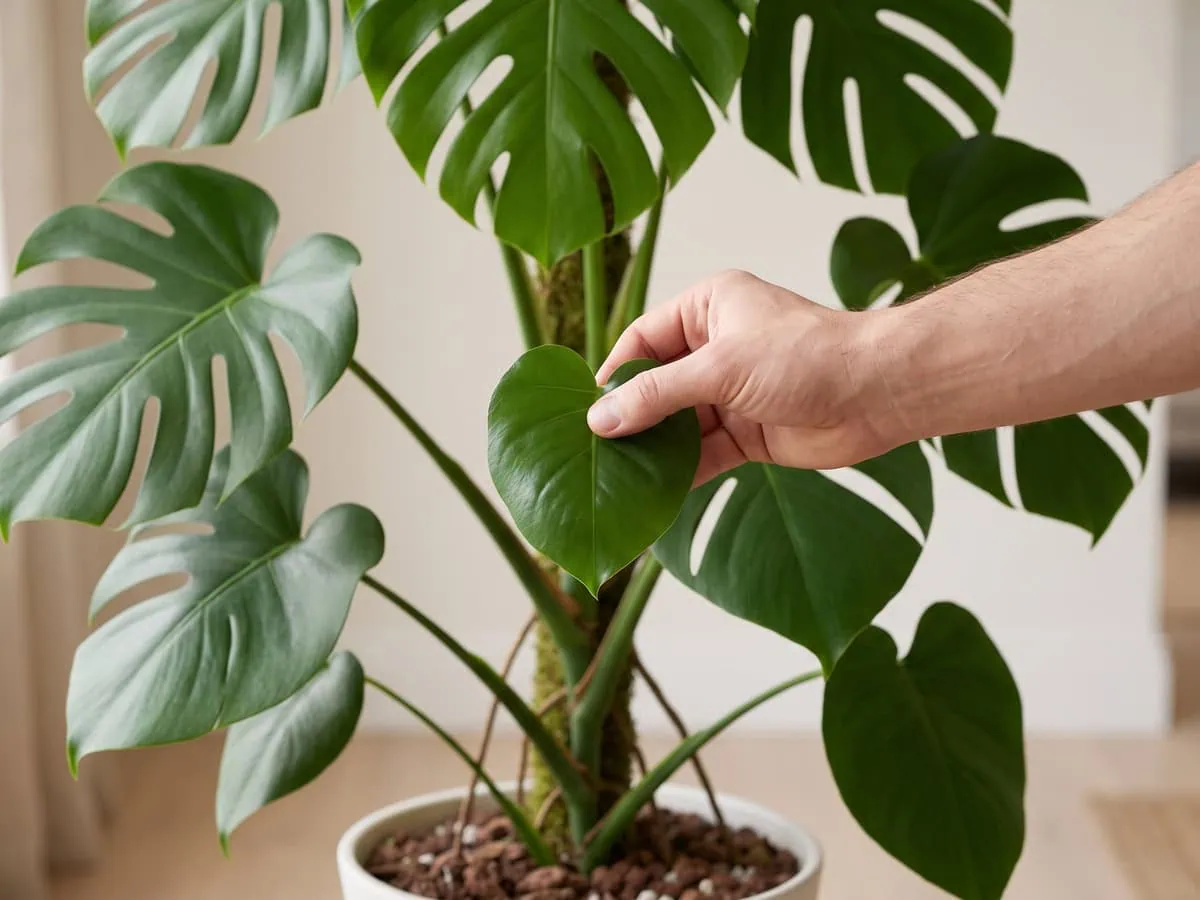
The leaf-stalk check on a mature specimen
On a mature specimen the joint at the top of the leaf stalk adds another signal. That joint, the geniculum, is the flexible knuckle where the stalk meets the blade.
That knuckle reads as ruffled on a mature Monstera deliciosa, while on the look-alike it reads no differently from the rest of the stalk, so read it only as a secondary check (one guide only, uncorroborated).
Tap the button below to get more plant fixes in your Google Search results

What the plant tag can and cannot tell you
A tag records what a seller typed, not what you carried home. Its most common words name a genus this plant is not in. Everything after this takes the tag traps one at a time.
Shop tags file split-leaf philodendron under Philodendron. NC State Extension says the opposite: it “is not actually a philodendron but a woody, perennial, broadleaf evergreen, climbing vine in the arum family (Araceae).” Same family. The genus differs.
Why borsigiana is not a second species
Borsigiana is a synonym, not a species. Kew folds Monstera borsigiana and Monstera deliciosa var. borsigiana back into Monstera deliciosa. Then six more synonyms sit beside them.
So one word does three jobs. It has been a species name, a variety name and a cultivar label.
Type “Monstera deliciosa vs Monstera borsigiana” into a search bar and you are matching one plant against itself. That is a label, not a rank.
Split-leaf philodendron names more than one plant
In fact, split-leaf philodendron is not a single address. It lands on this plant and on Philodendron bipinnatifidum. Swiss cheese plant lands on three: this one, Monstera adansonii and Monstera epipremnoides.
Over years of checking tags against leaves I stopped reading the printed name first. Searching “Monstera deliciosa vs split-leaf philodendron” returns two different match-ups under one title, and a fifth shelf name, Mini Monstera, belongs to Rhaphidophora tetrasperma in a third genus.
- Swiss cheese plant: three species carry that name.
- Split-leaf philodendron: two plants, in two genera.
- Mini Monstera: neither of them, a separate genus.
Is split-leaf philodendron the same plant
Yes when the seller means this plant. No when they mean the other one. The name lands on Monstera deliciosa often enough that “is split-leaf philodendron the same as Monstera deliciosa” is the version people type.
A young plant made the muddle worse. Before that, its uncut leaves were sold as Philodendron pertusum. One species, two names, two ages.
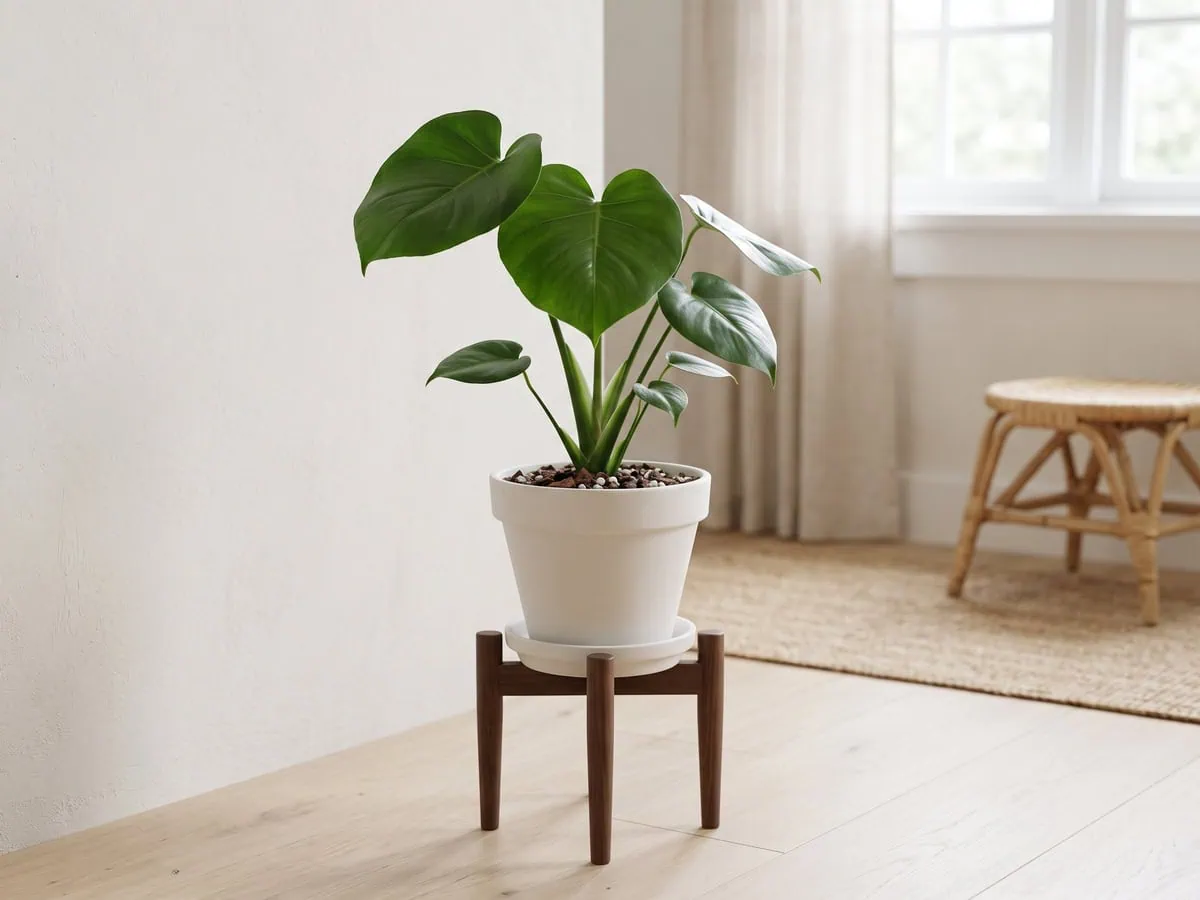
Two variegated forms and which one holds its pattern
Thai Constellation holds its pattern. However, the white forms often do not. Its cream flecks are fine and even, on a squat plant with short gaps between leaves, while ‘Albo Variegata’ throws big white blocks that can turn back to plain green.
Under a thumb those cream patches feel chalk-dry and matte, where the green beside them on the same blade stays waxy and slick. The cause is layering in the growing tip, not care.
A steady pattern comes from a periclinal chimera, which UF/IFAS calls the most stable chimera type; sectorial and mericlinal layers are the shaky ones. White patches hold no chlorophyll. I have a hunch about this but no peer-reviewed source: tissue culture seems to keep that layering intact.
- Fine cream flecks spread evenly across the blade: Thai Constellation.
- Solid white blocks, sometimes a half-white leaf: the Albo group.
- A plain green leaf on a variegated plant: reversion.
Searching “Monstera deliciosa Thai Constellation vs variegata” mixes both patterns under one heading. Read the flecks, not the heading.
Where each plant ends up in your room
This species finishes as a floor-standing statement plant of 7-8 feet indoors, so it needs a corner and a pole rather than a shelf. Everything after this covers the footprint first, then the climbing habit.
Mature footprint and why it decides placement
First, plan a floor circle, not a tabletop. Indoors this plant reaches about 7-8 feet, against the 50-plus feet it climbs in the wild. One mature blade widens to roughly 36 inches.
That leaf span, swung around its pole, sets the footprint. Read the width off the leaves and off the support you give them rather than off any number printed on a label at the shop.
- Corner or wall position, where a tall pole stands stable.
- Ceiling clearance of about a foot above the crown.
- Walkway kept outside the three-foot leaf span.
Then placement follows the same figures. An unobstructed east window, or a spot back from a sheer-curtained south window, sits in the medium band; a north window is a survival slot.
Judge that spot by the narrower-leaved look-alike if you own one. On the same shelf, at the same distance, its stem sections stretch first, well before this species registers any shortfall at all.
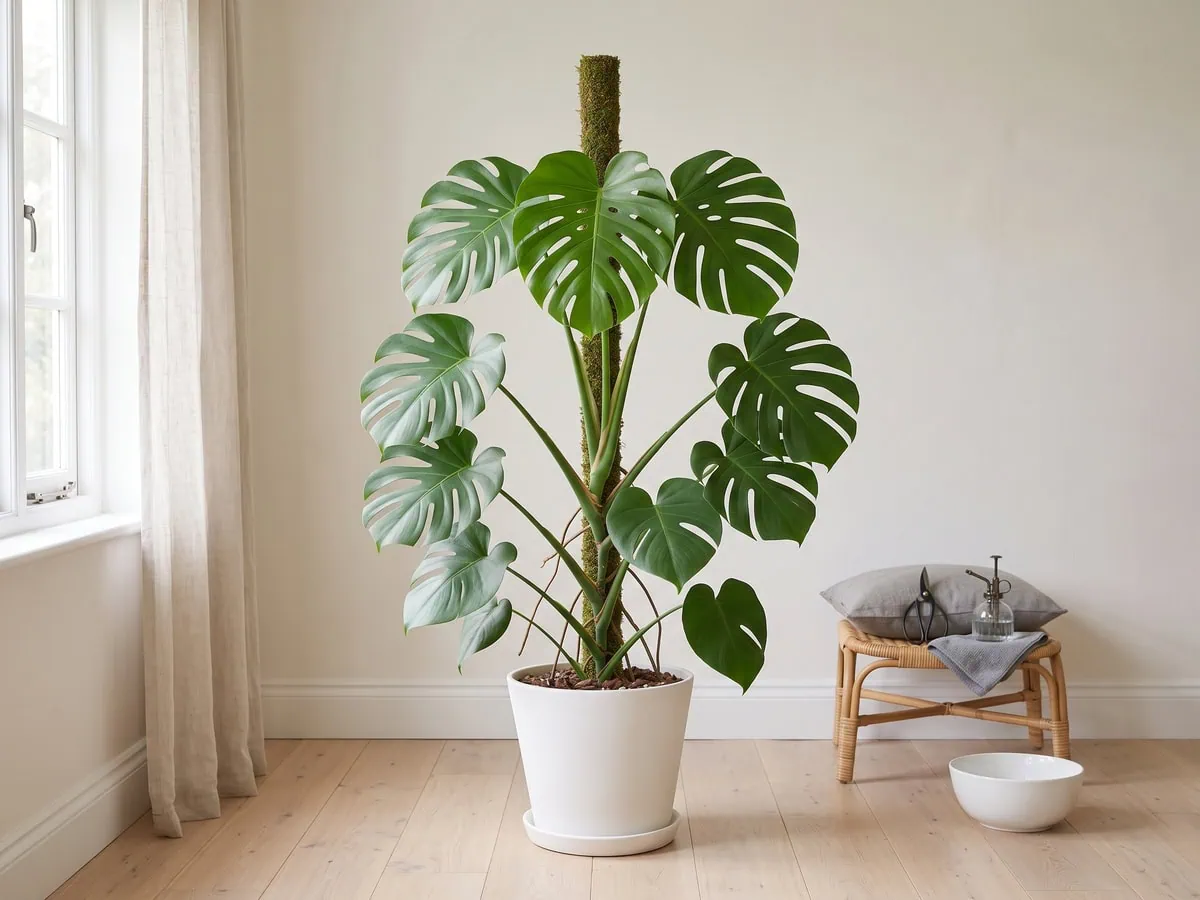
What changes when the plant climbs
Attachment changes the leaves, not just the height. Roots do the gripping. Those cord-like roots take hold of a rough surface, and UConn records that leaf size increases drastically once the vines have attached.
A moss totem gripped for a season feels furred and faintly damp under the fingers, unlike the dry springy netting of a new one. Pole work of that kind belongs to training a climbing stem onto a moss totem.
But light decides whether the bigger leaves arrive with holes. Fenestration builds through the medium-to-bright indoor band. It stalls near the 75-100 foot-candle floor, which is why a dim corner grows a tall plant with plain flat leaves.
- Set the pole at potting time, not after the stem leans.
- Guide the lowest cord roots onto the moss, leave the rest exposed.
- Move the pot brighter before you blame the pole for flat leaves.
Frequently asked questions about telling the two apart
How do I tell if my Monstera is a deliciosa?
Trace the margin of one adult leaf: on Monstera deliciosa the deepest splits open through the edge, breaking the outline. On the look-alike the holes stay enclosed and the outline runs unbroken.
A juvenile carries no margin evidence, because its leaves arrive uncut and smaller than adult ones. Judge blade substance instead, since this species holds a thick, leathery leaf while the look-alike stays noticeably thinner.
Should Monstera adansonii hang or climb?
Climb. NC State Extension describes Monstera adansonii as a tender, evergreen, herbaceous perennial climber from tropical rainforests, so a support suits it better than a basket.
Both species in this comparison are aroid climbers that attach by cord-like aerial roots rather than by twining stems, and what those cord-like roots leaving the stem are for explains how to steer them once they appear.
Which one gets bigger indoors, Monstera deliciosa or Monstera adansonii?
Monstera deliciosa is the larger of the two indoors, reaching about 7-8 feet on a pole with leaves widening to roughly 36 inches across.
The comparison rests on leaf scale rather than on two measured heights, which is what you can check in a shop. NC State notes that this species is the larger plant with bigger leaves.
Do Monstera deliciosa and Monstera adansonii need the same care?
Broadly yes, with light as the divergence worth planning around. Both are Araceae climbers that want a support, a fast-draining mix and warmth well above freezing.
Iowa State Extension lists Monstera deliciosa among its low-maintenance houseplants for beginners, and its own light band is set out in how much light those leaves actually need indoors. Variegated forms of either plant need more light than plain green ones.
Read the leaf, act on the edge, win the tag argument
I gave up on tags altogether the day a young blade folded over my knuckle with no stiffness at all, where an adult leaf would have carried its own weight. The edge decides. One leaf, one traced edge, one verdict.
Act on that edge and the rest of the shelf sorts itself out, because every other clue is shared with a look-alike or printed by a guess. The care fundamentals guide linked earlier covers what comes next. Read the margin, act on what your finger finds, and the Monstera deliciosa vs Monstera adansonii question stops needing a second opinion.
Two Monsteras, one margin: read where the perforation meets the edge and the label stops deciding.
Tap the button below to get more plant fixes in your Google Search results