🎯 Quick Answer: indoor light levels for a Monstera
The answer to how much light does a Monstera deliciosa need is 200-1000 FC; below it, this Araceae-family Monstera deliciosa wilts into stretched, unsplit growth. Survival starts near 75 FC, but growth needs the medium-to-bright band. Read it with a shadow, not a guess.
- Shadow test: hold a hand a foot above the leaf.
- Soft-edged shadow: right band; a razor edge means step back.
- Raise light in stages: one short move, then watch for two weeks.
- Stop signal: pale bleaching on the leaves nearest the source.
- Measure at leaf height: a meter reads the room, not the plant.
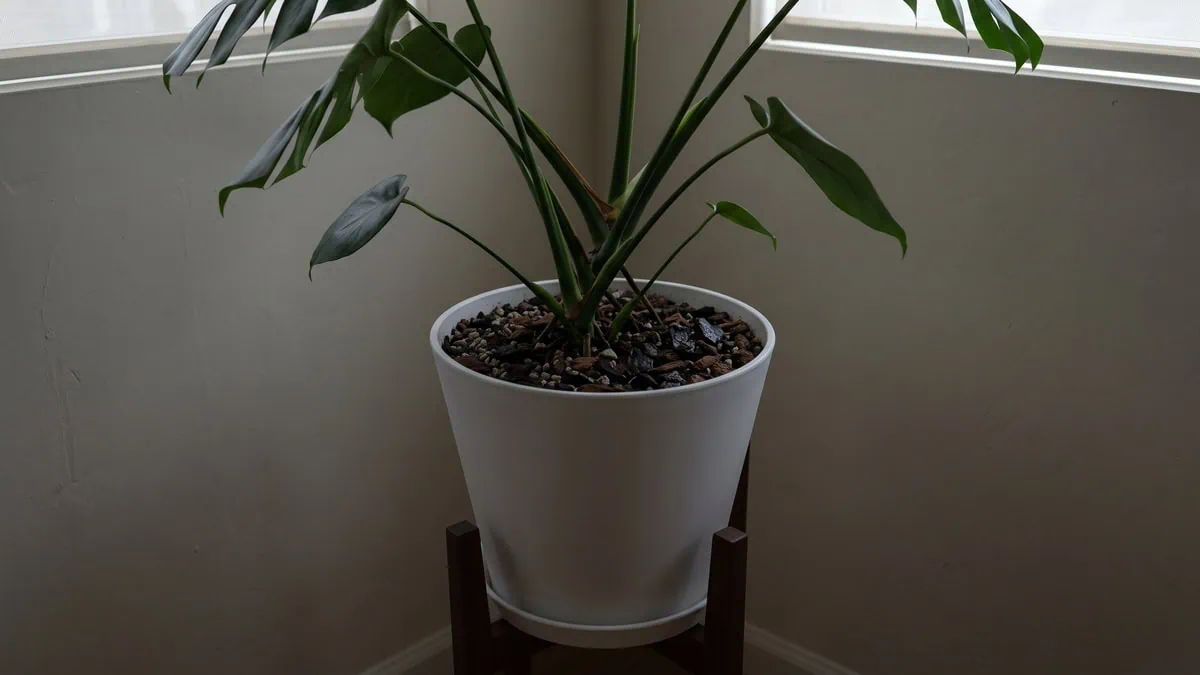
In 7 years this plant pushed 12 new leaves, and each one came in smaller than the last. That is what a dim corner did to a plant I had moved there for the view: petioles running long, blades shrinking, and the pot still heavy a week after I watered it. The pot told me first.
I assumed a bright room was a bright spot, until a footcandle reading at leaf height taught me otherwise. Updating my earlier point: dose at the leaf is the variable. Elongated shoots and spindly, lanky growth are what you get below the 200-1000 FC band that extension data gives this plant.
So everything starts with a measured number (not joking), because every placement rule here hangs off one band. That is the trick. For water, mix and support, see the whole-plant routine sitting behind these numbers.
Real talk: six lines answer it in full, and everything after them is how to hit those numbers in your own room.
How much light does a Monstera deliciosa need: the quick specs
| Monstera specs | What the light data says |
|---|---|
| Survival minimum light | 75-100 FC (about 800-1100 lux); it lives, stretches, and stalls. |
| Optimal range | 200-1000 FC (about 2150-10800 lux), read at leaf height. |
| Maximum tolerance | 1000-2000 FC of bright filtered light, reached gradually. |
| Best window aspect | East (Northern Hemisphere reference), unobstructed, within a few feet. |
| Daily hours under a supplemental fixture | 12-14 hours; 10 is the floor and 16 the ceiling. |
| Does a north-facing room (Northern Hemisphere reference) need a supplemental fixture? | Yes. |
Tap the button below to get more plant fixes in your Google Search results

Table of Contents
The light level a Monstera deliciosa needs, in numbers
A Monstera deliciosa needs 200-1000 FC at leaf height to grow, and 75-100 FC only to stay alive. Band first, then the way to read it, then the hours.
Where survival light ends and growth light begins
The question people type is “can a Monstera deliciosa grow in low light”, and the honest answer is yes, with a catch. Clemson’s interior-plant tables put this species in the low-light-tolerant class, so 75-100 FC keeps it alive. Growth is a different band.
Below the growth band the plant does not die, it just stops adding size, which is a separate question from why the new leaves come in solid instead of perforated.
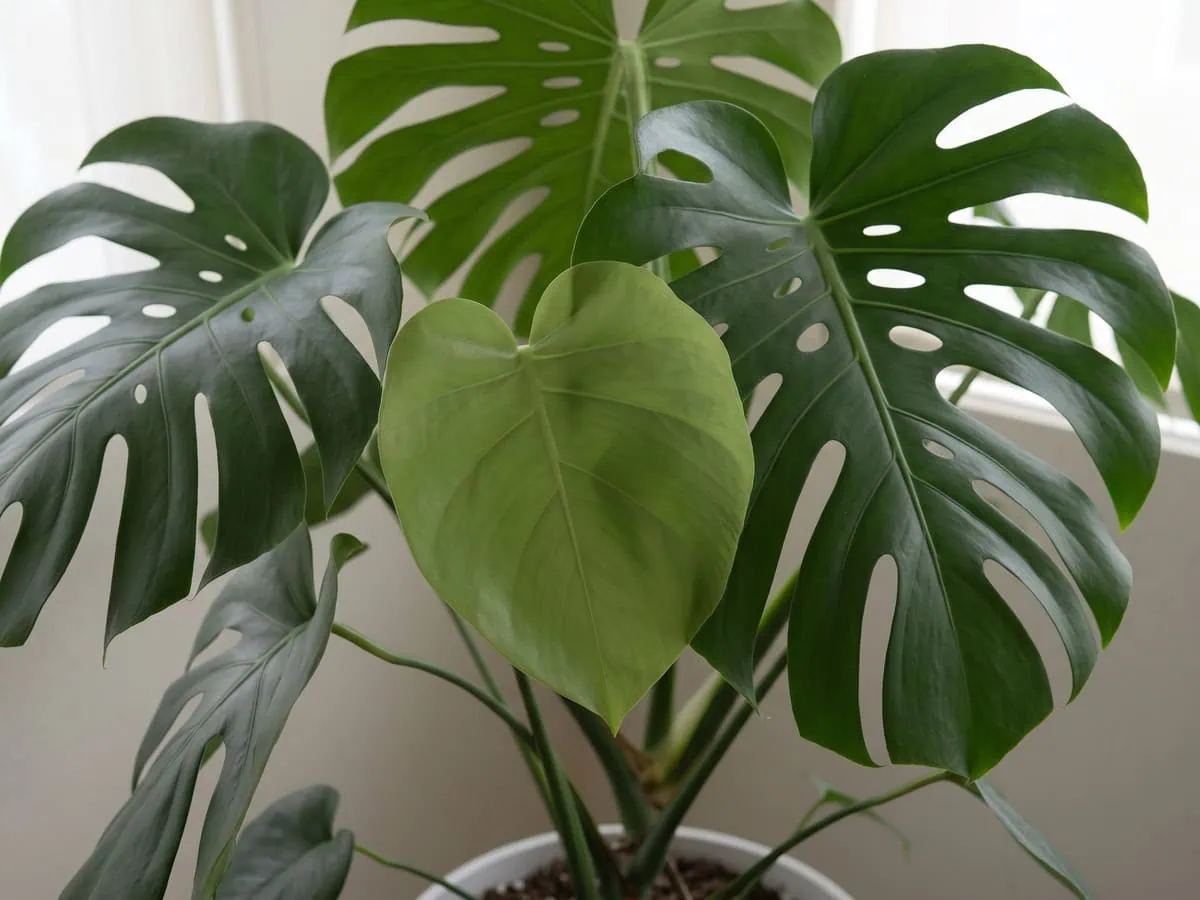
Why the two bands sit so far apart traces to where the plant grew up: an understory climber living on brief sunflecks under a closed canopy (that is the design brief). I’m still figuring this out… the practical read is that tolerance and performance are not the same setting.
Measuring it: foot-candles at leaf height
Measure at the leaf, not at the window. According to Iowa State University Extension, the footcandle scale used to measure indoor light is read with a meter placed at foliage level. A phone app held at chest height is measuring your room, not your plant.
No meter? Hold a hand about a foot above the leaf at the brightest hour and read the shadow: soft but clearly edged is the target. Razor-sharp means step back.
That hand test approximates the reading rather than measuring it, so the numbers above come from the extension tables. Weigh the pot while you are there (a bone-dry pot in a dim corner tells you two things at once).
How many hours of light a day it needs
12-14 hours is the run time under a fixture, with 10 the floor and 16 the ceiling. Window hours are not the same thing and are not additive with lamp hours. Count them separately.
A fixture on a timer removes the one variable a window cannot fix, which is the short day (and it is the simplest correction available). Iowa State’s own guidance is to judge a fixture by the footcandles it delivers at these leathery blades, not by its wattage.
Tap the button below to get more plant fixes in your Google Search results

Where the plant goes: window aspect and distance
An unobstructed east window, with the pot within a few feet of the glass, is the placement that reaches the growth band without a fixture. Four aspects first, then the distance, then the swing across the year.
The window aspects that work, and the one that does not
Search “best window direction for a Monstera deliciosa” and the answer splits, so this is the measured version. Illinois Extension maps footcandles onto window aspects and distance, and the table below reads from that map. Compass alone is half an instruction.
| Window aspect | What it delivers, and what to do |
|---|---|
| East | About 150-300 FC in front to a few feet back; the default. |
| South | Brightest aspect; set back a few feet or hang a sheer curtain. |
| West | Similar brightness, hotter afternoon; same setback or the same curtain. |
| North | About 75 FC at the glass; survival light, so add a fixture. |
Verdict: Choose east for the least work, because it holds this understory climber inside 200-1000 FC without the midday exposure a south window has to be defended against.
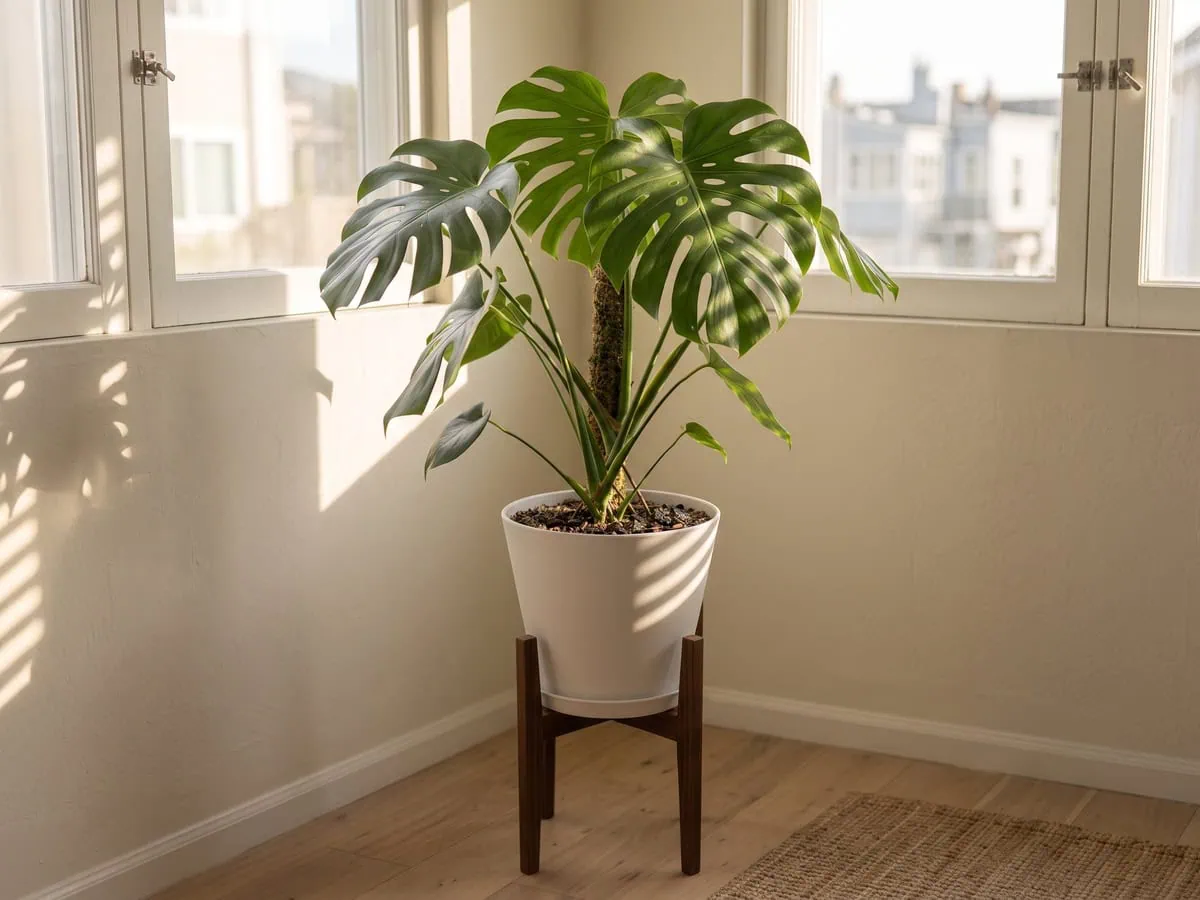
How far back from the glass to stand the pot
A few feet from a clear east or west window, and a few feet further back from a diffused south one. Distance is the dial.
Indoor light drops off fast, and the extension map shows exactly how fast: the same 75 FC that sits a few feet from a north window sits fifteen to twenty feet back from a south one, because the south exposure is that much stronger at the glass.
Move the pot in one-foot steps, not by eye (this one is worth the fuss). A foot either way decided whether the next blade fenestrated here; a hand’s width did not. Mark the spot on the floor.
Start with the pot directly in front of an unobstructed east window, then move it back one foot at a time and wait two weeks before judging the change. On this slow-fenestrating aroid the pot lightens between waterings before any blade shows you anything.
Adjusting the position as daylight rises and falls
Walk the pot toward the glass as available daylight falls, and back again as it rises. Guidance from New York Botanical Garden is plain: this plant wants bright filtered light in active growth and more direct light in the darker months, when the extra exposure matters most. Nothing else changes.
A plant that has already stretched will not un-stretch when you move it, which is a separate job: cutting a stretched stem back into a fuller shape. Fix the light first, then cut (in that order). Order matters.
Reading the plant when the light is wrong
An under-lit Monstera deliciosa shows it in three places: new leaf size, leaf gaps, and how long the mix stays damp. The “why are my Monstera deliciosa new leaves so small” question splits two ways, juvenile stage or light. Those two first, then two myths, then a fixture.
What too little light looks like on leaves and substrate
The clearest signs a Monstera deliciosa needs more light sit on the newest growth, where blades open solid and small while the stems that carry them stretch toward the glass. Both happen at once.
That stretch is etiolation, and on this species it arrives with blades that stay unsplit. Yellowing runs on its own track, worth what a yellow blade means when the crown looks fine.
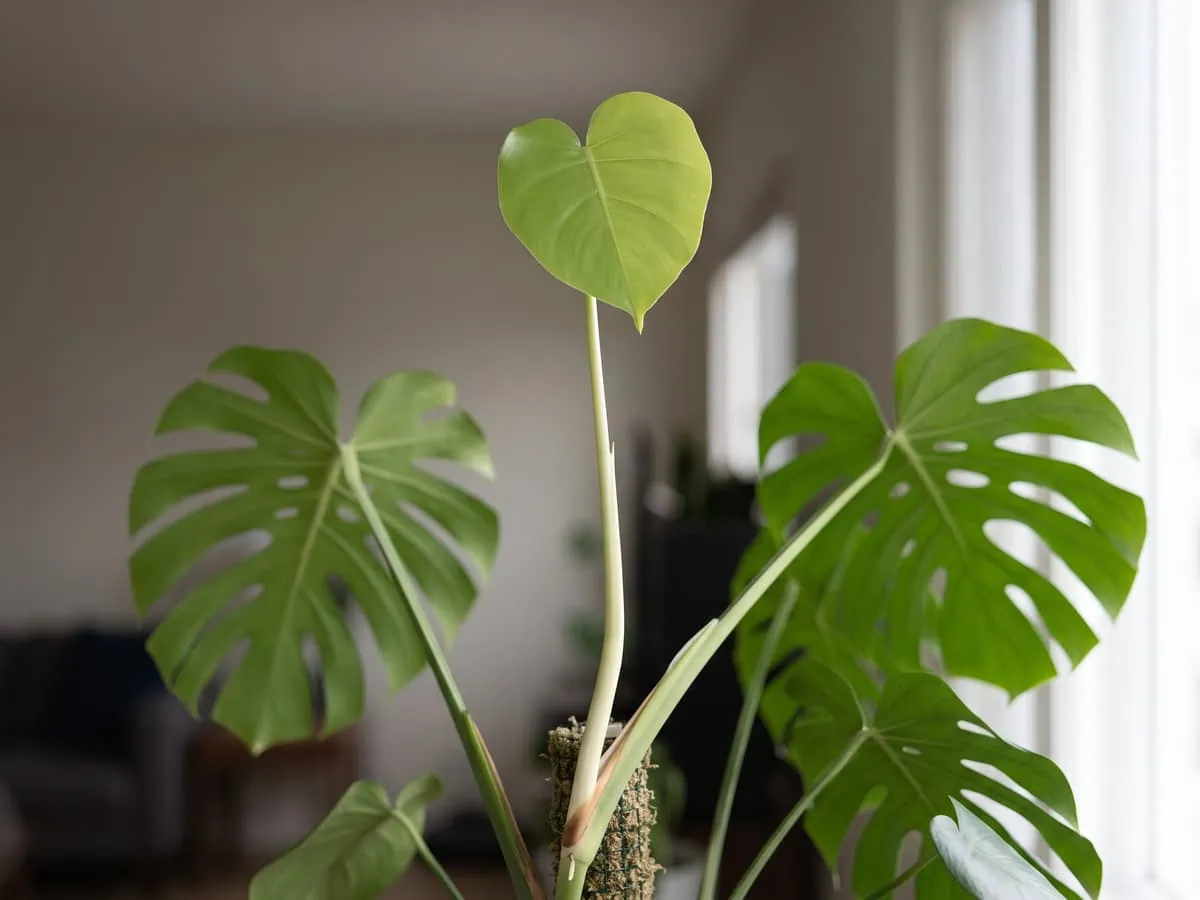
Excessively long internodes are the measured form of leggy. Put a thumb between two leaf joints on one stem (the plant records its own light there). A full-size blade spans about 36 inches and lies heavy on a forearm; the leaf a starved plant opens next weighs almost nothing.
Read the mix at the two-inch depth, not the top. In a dim corner it stays damp longer, because a plant in lower light drinks far less, which turns the dry-down check that sets the watering interval into a light reading. Two clues, one cause.
Light myths this plant gets judged by
Two myths cause most of the trouble. But neither one survives the measured bands. Usually when the holes fail to show, low light is the fault this plant gets blamed for.
Myth: low-light tolerant means a low-light plant. Clemson’s interior-plant tables do place Monstera deliciosa in the low-light class, and 75-100 FC keeps it alive. Fact: the holes only arrive in the 200-1000 FC band, so tolerance buys survival and the band buys the splits.
Myth: the holes turn up on their own once the plant is old enough. Fact: New York Botanical Garden states the perforations will not form when the light is too low, so age here is gated by light, not by months.
Adding a grow light, and raising the level safely
So, do Monstera deliciosa need a grow light? Only where the window cannot reach the growth band, which is what a north room cannot do. Iowa State sets a four-foot LED shop fixture 12-24 inches above the foliage and judges it on a light meter at leaf level, never on its watts.
Then raise the level in stages. This plant lives in deep shade and in bright canopy light, and under strong light its chloroplasts slide to the side walls of the cells within minutes as a photoprotective mechanism. The whole plant adjusts much more slowly, so a sudden move scorches leaves.
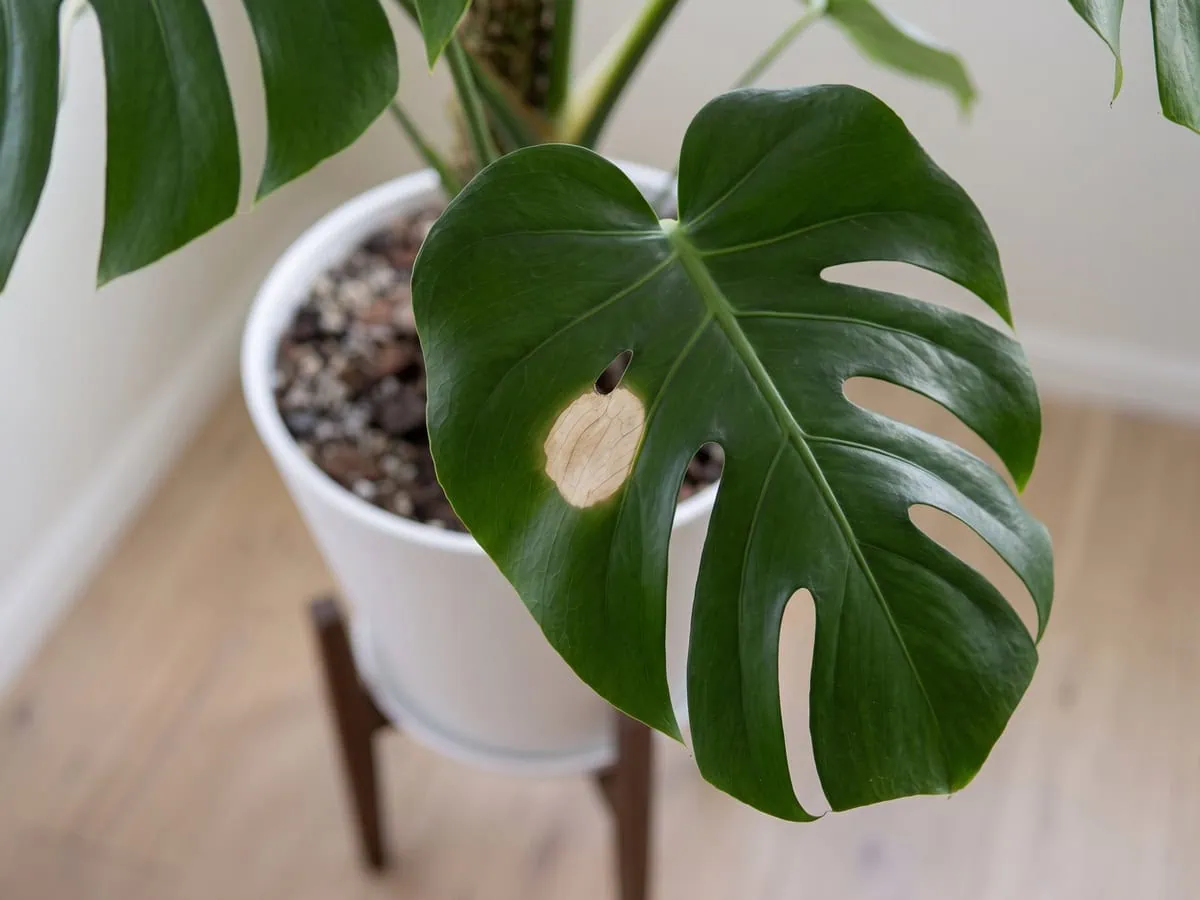
Move it one step, then wait. The verdict on this plant is written in the next blade, so change one thing at a time (and only one).
Frequently asked questions about indoor light levels
How do I know if my Monstera has enough light?
Measure at leaf height: 200-1000 FC is enough light, and 75-100 FC is survival only. A light meter at foliage level gives that reading; a phone at chest height measures the room.
Without a meter, hold a hand a foot above the leaf at the brightest hour and read the shadow. Soft but clearly edged is the target; razor-sharp says step back.
Can Monstera deliciosa live in low light?
Yes. Clemson’s interior-plant tables place this species in the low-light-tolerant class, so 75-100 FC keeps it alive, in leaf and slowly stretching.
Tolerance is not performance, though. The perforations develop only in the 200-1000 FC band, so a plant held at survival light holds its leaves, adds almost no size, and opens each new blade solid. That gap is the answer.
What does a Monstera with not enough light look like?
New leaves open small and solid, the leaf stems stretch, and the gaps along the stem lengthen. New York Botanical Garden ties stretched leaf stems and stunted, unperforated leaves to inadequate light.
The mix also stays damp longer between waterings, because a plant in lower light drinks far less. Read the substrate at the two-inch depth before blaming the watering can.
How many hours of light a day does a Monstera need?
Under a fixture, run 12-14 hours a day, with 10 hours the floor and 16 hours the ceiling. Iowa State Extension sets that range for indoor plants grown under supplemental light.
Window hours are a separate measure and do not add to lamp hours, so count the two apart. Judge a fixture by what it delivers at the foliage rather than by its wattage.
Troubleshoot, assess, fix – the 3-number light test
Three numbers carry everything here: 75-100 FC to stay alive, 200-1000 FC to grow and split, and 12-14 hours under a fixture. Read them at leaf height, and the guesswork ends. One more thing worth having: a pot that still feels heavy a week after a soak tells you where the light went before the leaves do.
And the next question is not about light at all: what to do with a stem that already stretched, which the pruning guide above handles (one job at a time). Fix the light first. Then the stem.
Whatever the label promises, the answer to how much light does a Monstera deliciosa need is a number you read at the leaf, not a guess at the window. A foot of shadow off your fingers says more about that corner than any tag ever will, and your Monstera reads it long before you do.
Tap the button below to get more plant fixes in your Google Search results