🎯 Quick Answer: Raven vs the regular ZZ, in short
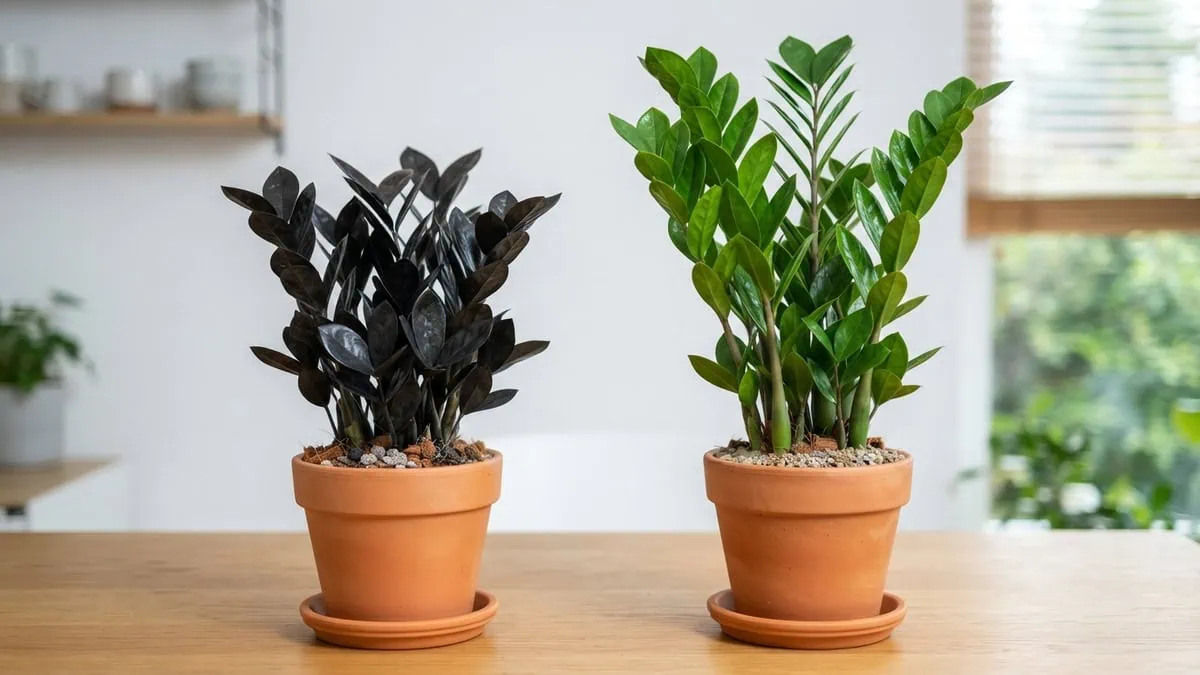
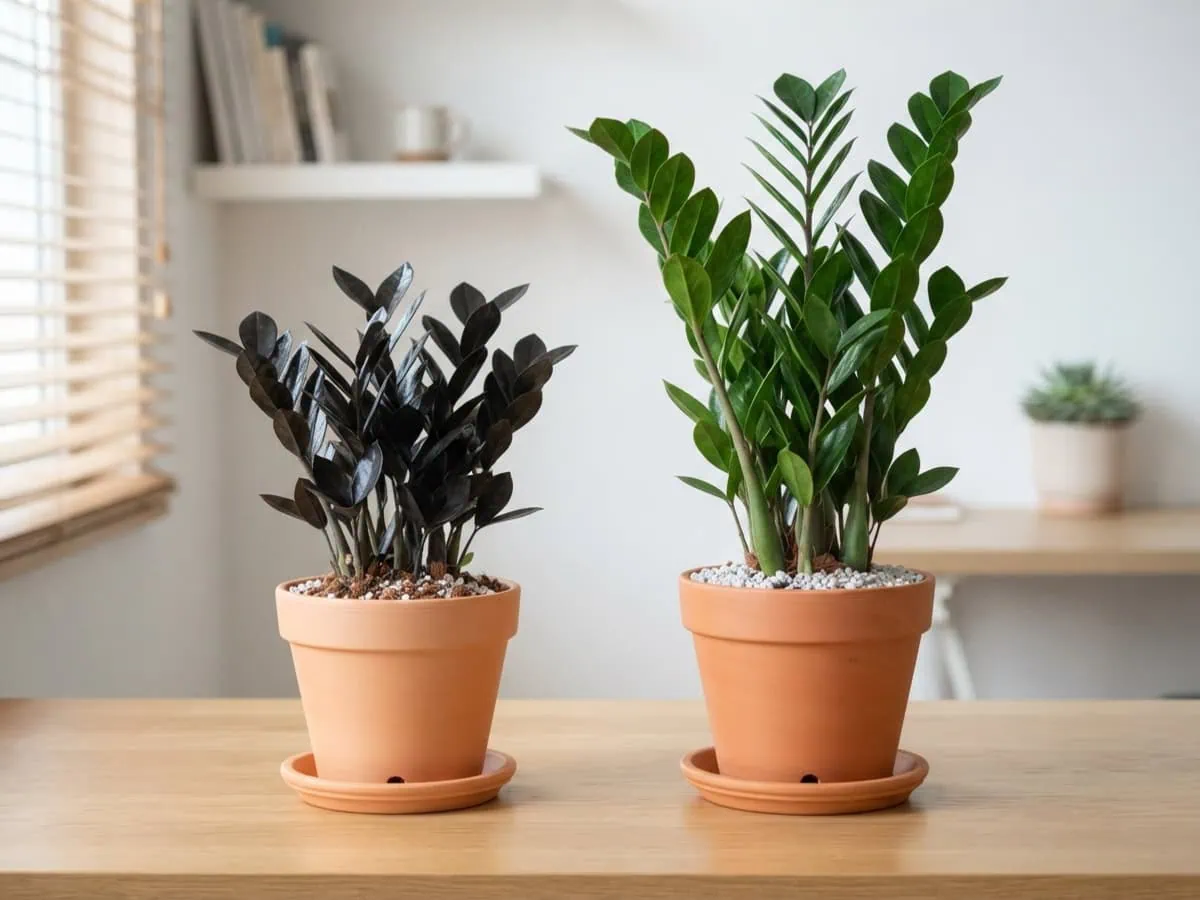
Raven ZZ plant vs regular ZZ plant needs bright indirect light near 500 foot-candles to darken; both are Zamioculcas zamiifolia, family Araceae. The standard green form keeps its color in far lower light. Growth aside, every care need is the same.
- The one real difference: Raven needs more light to build and hold its dark color
- Everything else matches: identical water, soil, feeding, temperature, and toxicity for both plants
- Why the leaves darken: a light-triggered pigment called anthocyanin builds up as light rises
- Green new growth: normal on both plants, so check the light
- Choosing between them: pick by size and how dark you want
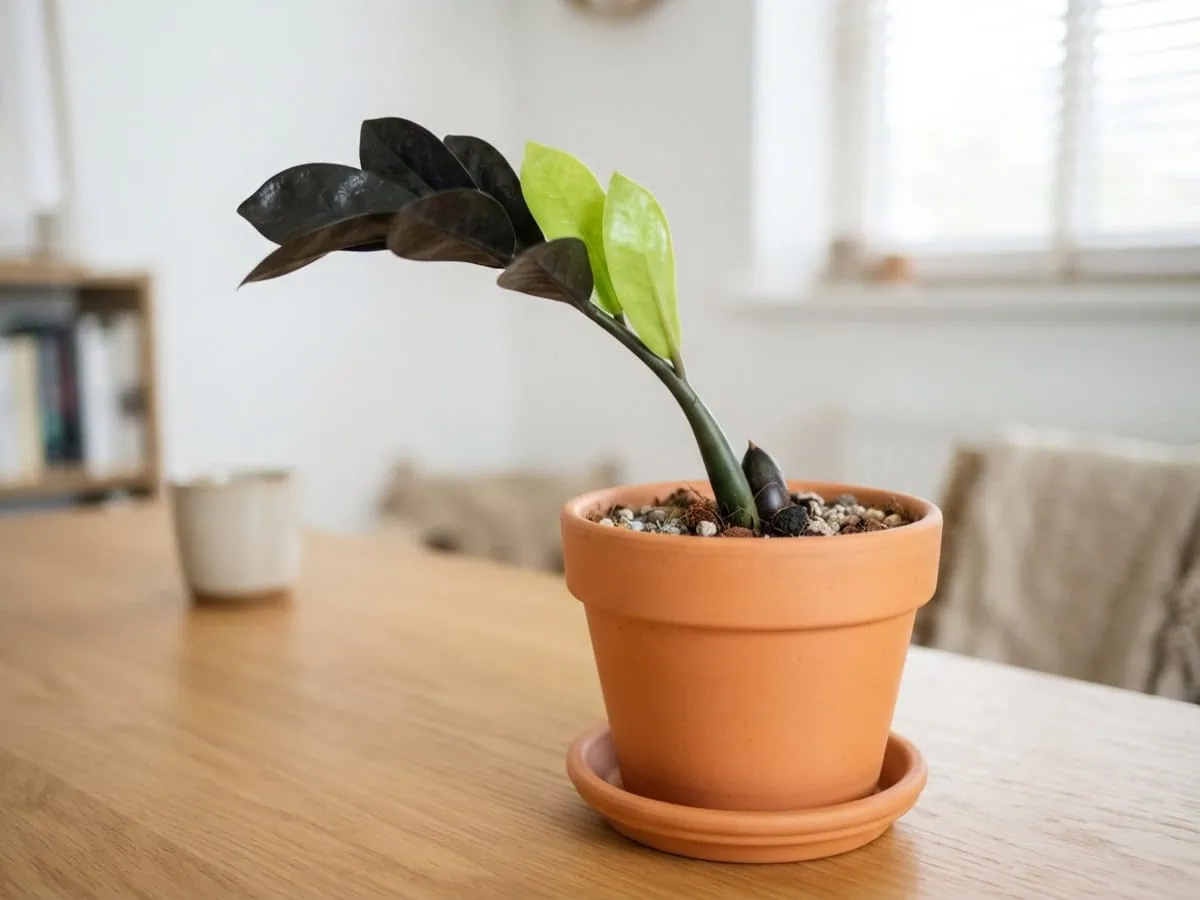
Picture one arching ZZ stalk in two colors at once: a fresh lime-green leaflet beside a mature leaf so dark it looks wet with ink. That two-tone stalk (stay with me here) is the whole Raven story.
I have grown ZZ plants of every kind. My first Raven still scared me witless. Its newest leaves came in bright green, and I was sure the dark cultivar I had hunted down was quietly reverting to a plain green ZZ.
I assumed the green meant a defect — until two patient months taught me the color is a light-dose response, not a fault. Let me rewind for a second. I nearly moved that plant three times and repotted it once, chasing a problem that never existed.
The real fix was doing nothing but brighter light. For the whole-plant backdrop, start with keeping a ZZ plant alive and growing.
Let me level with you: the whole comparison fits in one small table. The following table lines up Raven against the standard green ZZ, point by point.
Raven ZZ plant vs regular ZZ plant at a glance
| Feature | Raven vs the standard green ZZ |
|---|---|
| Mature leaf color | Raven matures near-black; the standard green stays deep emerald |
| New growth color | Both push bright lime-green; only Raven then darkens with age |
| Time for new growth to reach full color | About 4-8 weeks, depending on light and warmth |
| Typical indoor mature height | Green reaches 3-4 feet; Raven stays compact at 2-2.5 feet |
| Same care routine as the standard green ZZ? | Yes — identical water, soil, feeding, and temperature needs |
| Can you legally propagate a Raven for sale? | No — it is patented; unlicensed selling infringes the patent |
| Light level needed for full dark color | Bright indirect, roughly 500 foot-candles and up |
Tap the button below to get more plant fixes in your Google Search results

Table of Contents
The pigment behind the near-black leaves – and what switches it on
The near-black color has one cause and one dial. The sections below trace both. Light intensity is that dial, and the University of Maryland Extension frames indoor light levels measured in foot-candles — the number that turns a vague bright-indirect guess into a reading off a light meter.
The anthocyanin behind the near-black leaves
Raven’s dark leaves are loaded with anthocyanin. In fact, it is the same red-purple pigment that colors blueberries and red cabbage. The plant makes more of it as light rises, so a well-lit Raven reads almost black while a dim one settles at muddy olive.
Anthocyanin: a natural red-to-purple-black plant pigment that builds up under stronger light and, in high amounts, makes a leaf read near-black.
The usual explanation is that this pigment works as a built-in sunscreen. Take this with a grain of salt. That read comes from other dark-leaved plants, not a Raven trial.
What is certain is more useful: the color is stable and heritable, so a leaf cutting grows up just as dark as its parent under the very same light. The dark trait is locked in the plant’s genetics, not invented by the light, which only decides how fully that fixed color shows. Light dials it, genetics sets it.
Light that builds color, light that only sustains
Here is the split most guides skip. A green ZZ holds its color in low light. A Raven, however, needs bright light to build its dark color.
Both survive at the species floor of about 25 foot-candles — the dim glow of a north room (Northern Hemisphere reference). But that floor only keeps a Raven alive; it does not make it dark.
For full near-black, give a Raven bright indirect light, roughly 500 foot-candles and up. Aim a few feet inside an east or west window, or back from bright south glass behind a sheer.
Keep direct sun off the leaves; above about 1000 foot-candles of raw sun, both scorch. The green form holds its emerald far lower down the scale — see the light levels a ZZ plant will tolerate.
How to make a Raven ZZ darker
You cannot re-darken a leaf that matured green. Pigment sets once a leaf hardens off. What you can fix is every leaf that comes next:
- Shift the pot to your brightest indirect spot, no direct midday sun.
- Rotate a quarter-turn at each watering so every side colors evenly.
- Give it weeks, not days; fresh spears darken on their own clock.
That is the whole intervention. Move it to the light, then leave it alone. The next flush still arrives lime-green, then deepens through olive and burgundy to near-black over a month or two.
Common myths about the dark ZZ, corrected
Three beliefs cause most of the worry. The following myths fall apart once you know the pigment story.
Myth: new green growth means the Raven is failing
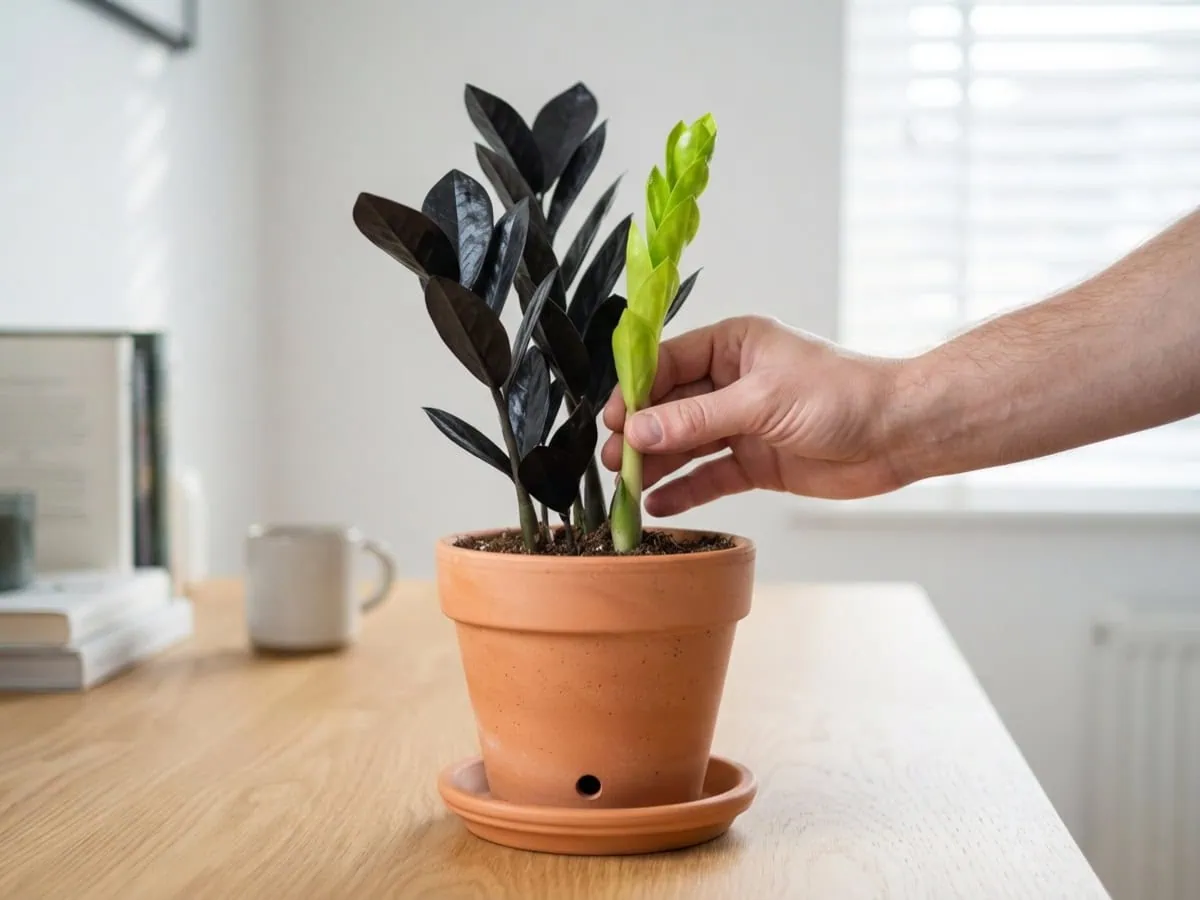
New lime-green leaves are normal, not a warning. Type “why is my Raven ZZ plant turning green” into any search bar and you meet the same panic on repeat.
Indeed, every Raven leaf starts life bright green and darkens as it hardens off. A plant pushing pale new spears is doing exactly what it should.
Real reversion shows up only in the newest leaves, which mature slowly to a dull, flat olive instead of near-black, and only when the light around the plant stays genuinely and persistently too weak. Bright light stops it.
Already-dark leaves never fade back. So do not confuse a green flush with true leaves that yellow rather than darken, which is a different problem.
Myth: the dark one needs its own care routine
No. A Raven wants the identical routine to a green ZZ. Same dry-down watering, same gritty mix, same terracotta pot, same light feeding, same warm room.
One care sheet covers both. Anyone selling you a special dark-ZZ regimen is inventing a difference that does not exist.
The one honest asterisk is speed, covered just below. A Raven spends real energy making that pigment, so it grows a touch more slowly.
That gets misread as needing less water. It does not; it just spends what it has more slowly.
Myth: a ZZ plant cleans the air in your room
This one sells plants but does not hold up.
Myth: a ZZ or Raven scrubs the air in your home. Fact: at the plant density any normal room can hold, houseplants do not measurably change your air. The sealed-chamber result behind the claim does not scale to a living room, where cracking a window does far more. Keep a ZZ for its looks and its toughness, not as a filter.
Still, none of that knocks the plant. It is one of the toughest, most forgiving houseplants around, dark or green. Keep it for the right reason: the glossy leaves, the low-maintenance habit, and the Raven’s slow shift from lime-green to near-black.
Tap the button below to get more plant fixes in your Google Search results

Same care sheet, slower clock: the differences that are real
Strip away the color and the two plants are near twins. The following table shows where they match and where they part.
| Aspect | Raven | Standard green ZZ |
|---|---|---|
| Watering | Dry-down every 1-2 weeks | Dry-down every 1-2 weeks |
| Soil and pot | Fast-draining gritty mix; terracotta pot | Fast-draining gritty mix; terracotta pot |
| Feeding | Light, growing season only | Light, growing season only |
| Growth pace | A little slower | Baseline pace |
| Mature height | 2-2.5 feet | 3-4 feet |
The takeaway is short: care is identical, so choose on looks and size, not difficulty.
The care variables that stay identical
The real Raven ZZ plant care differences come down to speed and size, never routine. Nothing else shifts. Water both only when the mix has dried out, roughly every one to two weeks.
Give both the same mix: a fast-draining gritty mix of roughly 2 parts coco coir to 1 part pumice, top-dressed with a thin layer of coarse pumice grit. Likewise, pot both in the same unglazed terracotta pot with a drainage hole.
The porous clay wicks away the excess water that rots a ZZ from the rhizome up. Feed both lightly in active growth, and skip the humidifier for either.
Safety is identical too: both are toxic to cats and dogs from the very same calcium oxalate crystals in the sap. One rule covers the whole species — here is why this species is unsafe around cats and dogs.
This information is for educational purposes only and is not a substitute for professional veterinary advice. If your pet ingests any part of this plant, seek immediate veterinary intervention or contact the ASPCA Animal Poison Control Center (888-426-4435) or the Pet Poison Helpline (855-764-7661) immediately.
Growth rate, mature size, and the color timeline
If you have wondered “do Raven ZZ plants grow slower than green ones”, the honest answer is a qualified yes: Raven tends to grow a little more slowly and finish more compact (and I say this confidently — it holds up across multi-year growing).
One plausible reason is energy budgeting: making that dark pigment likely draws on resources a plant would otherwise put toward new stalks. But the evidence is thin. Published descriptions note only that every ZZ grows slowly, with no measured per-cultivar rate.
Expect a mature Raven around 2-2.5 feet, against 3-4 feet for a standard green ZZ. New growth on either is slow to appear, so a stalled Raven usually just needs light and patience — the same thing that stalls new shoot production in any ZZ.
A fresh spear runs its lime-to-black course over about 4-8 weeks. Bases darken first, then the stalk goes burgundy-black, then the leaflets settle near-black. That color is set.
Beyond Raven: the dwarfs, the variegated forms, and the patent
Raven is the famous dark one, not the whole family. The following sections sort the dwarfs, the variegated forms, and one legal catch.
Zenzi and Zamicro: two different dwarfs
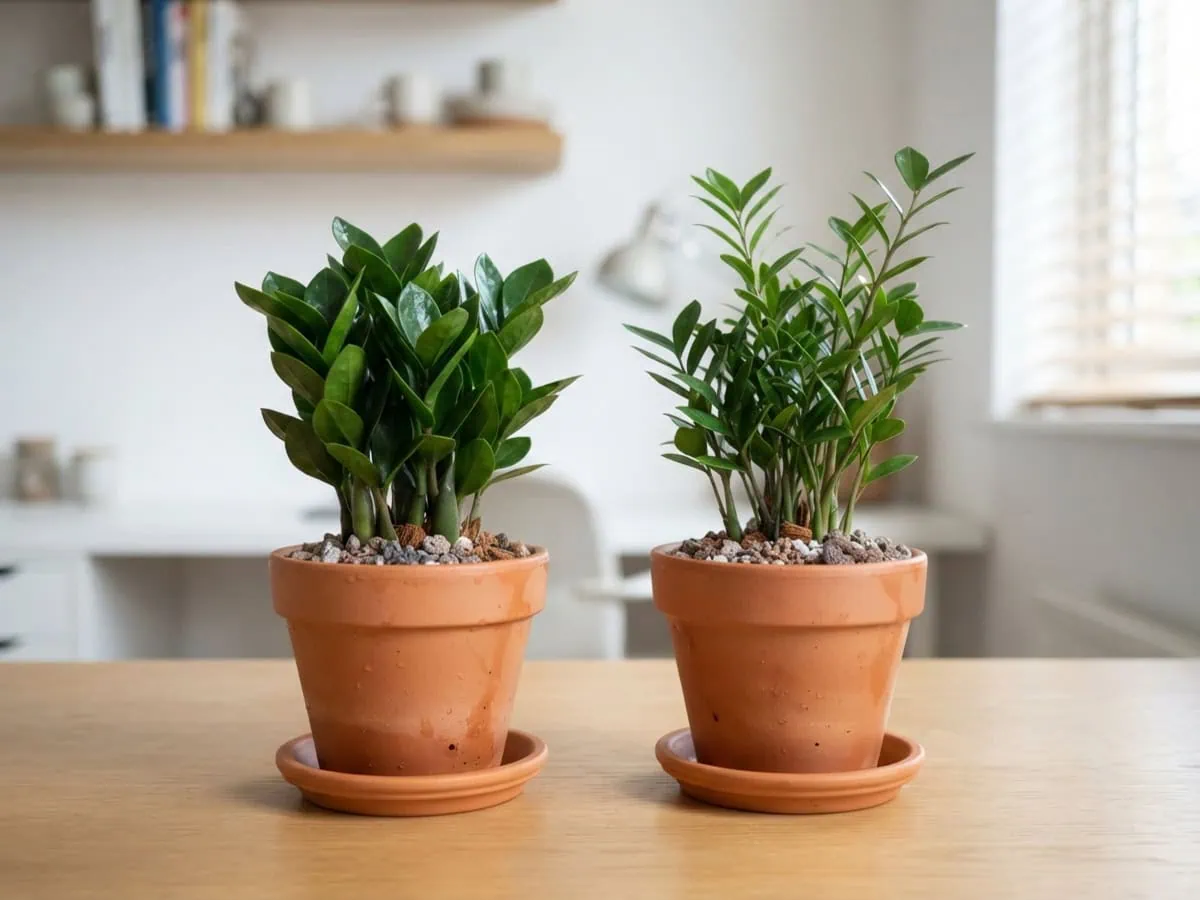
Buyers lump every small ZZ together, but the ZZ plant Zenzi vs Zamicro dwarf split is real, and it comes down to leaf shape and branching, not height, since both dwarfs stay similarly compact. Zenzi is the tight, curled one. Zamicro is the bushier, more-branching one.
| Trait | Zenzi | Zamicro |
|---|---|---|
| Mature height | 10-15 inches | Under 2 feet |
| Leaves | Curled, densely bunched | Smaller, more finely spaced |
| Habit | Tight, urn-like | Bushier, branches more |
Both stay under about two feet, so both suit a shelf. Pick Zenzi for the stubby, bonsai look; pick Zamicro for a fuller, leafier mound.
Keeping a variegated ZZ from reverting to green
Variegated ZZs — leaves splashed cream-on-green, some heavily streaked pale — drift back to solid green in dim light. The reason is chlorophyll. The pale patches carry little of it, so they cannot feed themselves.
In weak light the plant favors its fully green, food-making growth. That greener growth slowly out-competes the variegation until the cream pattern disappears altogether.
So how to keep a variegated ZZ from reverting to green comes down to two moves. First, give it steady bright indirect light — more than a plain green ZZ needs, to pay for the non-working pale tissue.
Second, cut any fully-reverted all-green shoot back at the base before it takes over. Miss either and the cream fades for good.
Why selling a propagated Raven is off-limits
Here is the catch nobody explains. A Raven grows true from a leaf cutting, so propagating one is easy. Doing it for your own shelf is completely fine.
Selling what you grow is where the line sits.
Raven is a patented cultivar. A plant patent bars anyone from reproducing the protected plant by cuttings or division for sale without the cultivar’s patent holder authorizing it. Propagate one for yourself all you like; propagate to sell, and you infringe that patent. That is the whole of why people call it illegal.
If you only want more ZZ plants for your own home, propagation is open to you, and the standard green ZZ carries no patent at all. For the method, see the three ways a ZZ plant can be propagated.
Frequently asked questions about Raven and green ZZ plants
What is the difference between ZZ plant and ZZ Raven?
The difference is color and pace, not care. A Raven matures near-black as light-triggered pigment builds in the leaf, while a standard ZZ stays deep green.
Both are the same species and the same to water, feed, and place. The Raven just needs brighter light to darken, and it grows a little more slowly and finishes more compact, about 2-2.5 feet versus 3-4 feet.
Why is it illegal to propagate a raven ZZ plant?
It is not illegal to propagate one for yourself; it is illegal to propagate and sell it. Raven is a patented cultivar, and a plant patent bars unlicensed reproduction of the protected plant for sale.
Grow all you like for your own home, and no license is needed. The line is crossed only when you sell what you propagated without the patent holder’s permission.
Is Raven ZZ rare?
Raven ZZ is no longer rare. It was a specialty plant at its mid-2010s launch, hard to find outside collector circles.
Availability has since normalized: licensed growers scaled up production, and it now sells widely at ordinary garden centers and plant shops, right beside the standard green ZZ. Finding one today takes no special hunting, and it no longer counts as a collector’s rarity.
What is the best ZZ plant variety?
There is no single best; the right ZZ variety is the one that fits your light and space. Choose Raven for drama in a bright indirect spot, a dwarf Zenzi or Zamicro for a tight shelf, or the plain green ZZ for the toughest, most shade-tolerant option, happy even in a dim corner. Match the plant to your conditions, not to a ranking or a trend.
From color panic to a confident Raven owner in a few weeks
Truth is — the Raven is not a harder plant. Just a more compact, darker one. Everything that keeps a green ZZ thriving keeps a Raven thriving.
The only extra move is light. Give it the bright indirect spot its pigment needs, then let each new spear run its own lime-to-black clock. Do not chase color backward on old leaves; steer the next flush forward.
Once the color settles, the next question is how bright is bright enough — and that is what a dedicated light guide answers. Get the light right, and the rest of Raven ZZ plant vs regular ZZ plant takes care of itself.
May your Raven’s newest leaves unfurl fearless lime-green and darken to near-black in their own slow time, on the very same light and water every green ZZ already asks for.
Tap the button below to get more plant fixes in your Google Search results