🎯 Quick Answer: telling a harmless ZZ spot from a harmful one
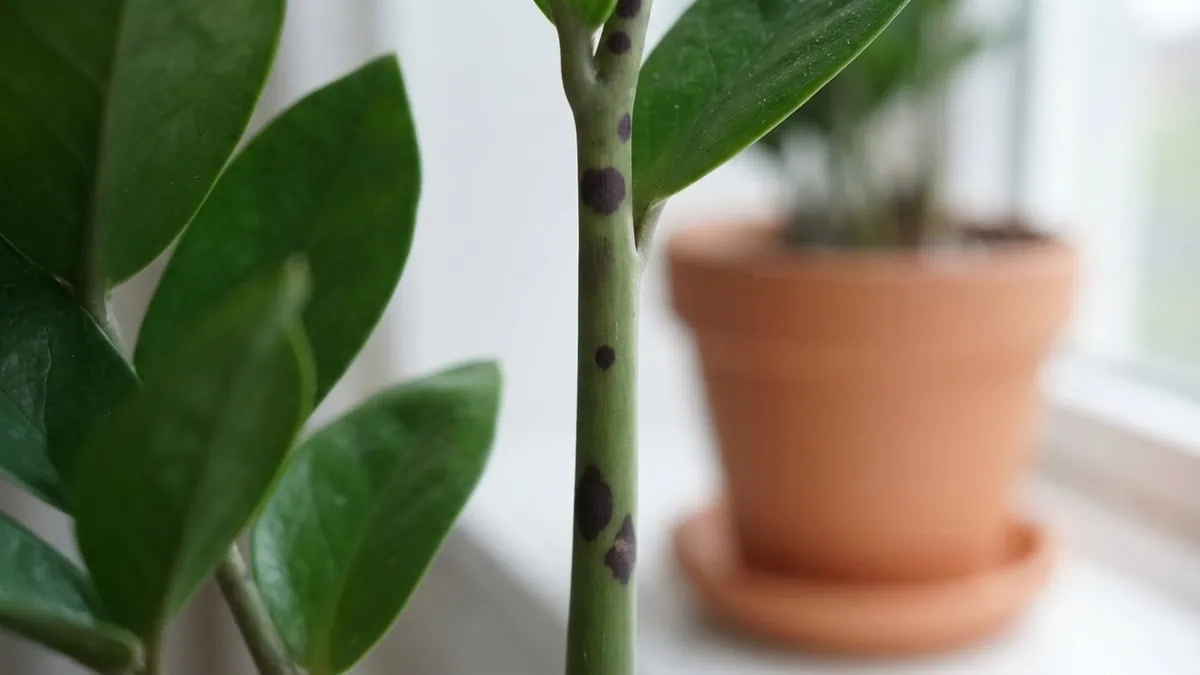
What causes black spots on a ZZ plant (Zamioculcas zamiifolia, family Araceae) is usually cosmetic — a real lesion sprints, widening within 1-2 weeks. Press it first. Flat, dry, flush with the stalk means natural coloring, so leave it alone. Soft, spreading, or yellow-ringed means moisture. Check the rhizome.
- Press test: a firm, flush fleck stays; a yielding spot needs action
- Watch window: re-check the same spot after 1-2 weeks for spread
- Wrong disease: rose black-spot fungus never infects an aroid like this
- After a repot: handling bruises and a wet fresh mix both mark stalks
- Rule out pests: scale wipes off with a fingernail; a lesion will not
A dark speckle on a glossy ZZ stalk reads like the first move of a spreading lesion. Over two years I cut three perfectly healthy stalks chasing marks exactly like it (TBH — every one of those flecks was flat, dry, and welded into the stem’s own surface). Three stalks gone, permanently.
The mistake I kept making was reading every dark mark as disease. What fixed it was anatomy: a ZZ leaf-stalk is thick, waxy and semi-succulent, so a natural fleck or an old bleached sunburn sits flush in that surface, not raised on it. Correction — what I meant was flush and dry, because a real lesion can look flat too.
So the real question is never whether your plant has a spot. Ask instead: flat and dry, or soft and growing? That single fork decides whether you reach for shears or leave the plant alone, and it sits inside the wider routine that keeps a ZZ plant healthy.
Truth is — most of these marks are nothing. The following table sorts every common ZZ spot and residue by what it actually is.
What causes black spots on a ZZ plant: a quick ID chart
| What you see | Recommended care |
|---|---|
| Flat, dry dark fleck that is part of the stem | Natural coloring – harmless, leave it |
| Soft, mushy, spreading dark patch on a stem | Active moisture problem – press-test, then check the rhizome for rot |
| Dark spot ringed with a yellow margin on a leaflet | Fungal or bacterial leaf spot – isolate the plant, remove the leaf |
| Chalky white film that wipes off the leaves | Hard-water mineral deposits – cosmetic, wipe away with a damp cloth |
| Fuzzy white patch on the soil surface | Harmless soil-surface mold – scrape off, dry the top layer, add airflow |
| Is a flat, dry black spot on a ZZ stem harmful? | No – it is usually natural coloring, not a disease |
| Should you cut a stem for a cosmetic spot alone? | No – a cut ZZ stalk will not re-leaf; remove only soft, rotting tissue |
Tap the button below to get more plant fixes in your Google Search results

Table of Contents
First, work out what the dark spot is
Every dark spot on a ZZ plant lands in one of two piles: a cosmetic mark that never changes, or a live lesion driven by too much moisture. Firmness and spread separate them, not color or size.
Leaf spots are the version that actually matters, and the University of Maryland Extension documents how bacterial leaf spots show up on indoor plants — watery, angular or V-shaped where a vein halts them, ringed with yellow margins. Nothing there describes a flat stem fleck. The three checks below sort your spot in a minute.
The two-signal test for a harmless spot
Signal one is firmness. Press the spot with a fingertip: a harmless mark is flat, dry, and part of the stalk’s own waxy surface, so your finger crosses it without catching and the tissue underneath feels exactly as firm as the stalk beside it. A problem spot yields.
It gives under the pad of your thumb, feels softer than the tissue around it, and often looks water-soaked rather than dry. Signal two is time. Photograph the spot’s edge (a fingertip in frame gives you scale) and look again after 1-2 weeks.
A cosmetic fleck sits exactly where it was. A live lesion widens, runs into its neighbors, or drops its center out.
Are black spots on ZZ plant stems normal?
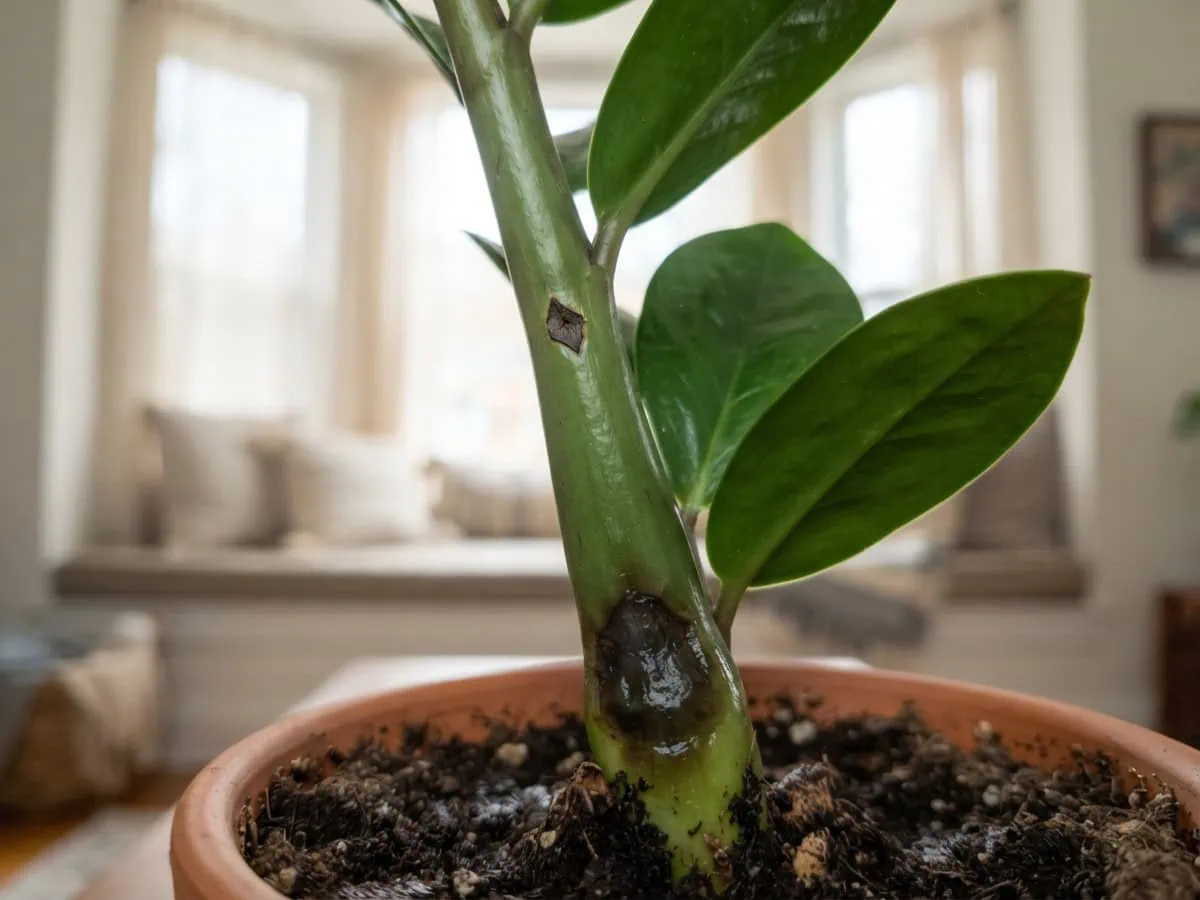
Type “are black spots on ZZ plant stems normal” into a search bar and the honest answer is yes, usually. Dark flecks and short streaks along ZZ stalks are commonly reported as normal on plants sitting in brighter light (natural coloring, not a disease). They sit in the surface, not on it.
The concern threshold is narrow. A stem mark matters only when the stalk is also squishy, smelly, or collapsing — all three together, not one of them. That combination means the rhizome is rotting under saturated soil, and rescuing a ZZ plant from overwatering and rot is a root-zone job that starts by unpotting and cutting back to firm tissue.
When a dark spot signals a real problem
Leaves tell you when it is real. Genuine fungal leaf spots on a ZZ plant are uncommon (a thick, waxy leaflet is a poor host), but they look nothing like a stem fleck: black-to-brown, watery, angular or V-shaped where a vein stops them, ringed with a yellow margin.
Push a spotted leaflet and the tissue collapses into something soft and rotten-smelling. Spots run together or drop their centers out, and leaf drop follows. Both versions burn the same fuel: leaf wetness plus stagnant air.
So starve them of both. Move the pot where air actually moves, water at the soil rather than over the foliage, and water early enough that any splash dries fast. Household air of 30-60% RH already sits inside this plant’s range — about moisture, a ZZ behaves like a succulent, not a fern.
Run the thumb-and-photo test before you run anything else. Press the mark: flush, dry and firm buys it a pass. Photograph its edge against a fingertip for scale, then re-shoot the same angle 1-2 weeks later. Same edge, same size, no action needed.
Tap the button below to get more plant fixes in your Google Search results

White marks: mineral film, mold, and mildew
White marks on a ZZ split three ways, and only one of them is a problem. Chalky film on the leaves is tap-water minerals; fuzz on the soil is harmless mold; a powdery coating on living tissue is the fungus.
The three sections below tell them apart by where they sit and whether they rub off.
White mineral film on the leaves
Search “white mineral deposits on ZZ plant leaves how to remove” and the fix is a damp cloth. Hard tap water leaves lime and dissolved salts behind when a droplet evaporates, so the residue is chalky, sits on top of the wax, and rubs away under a thumb.
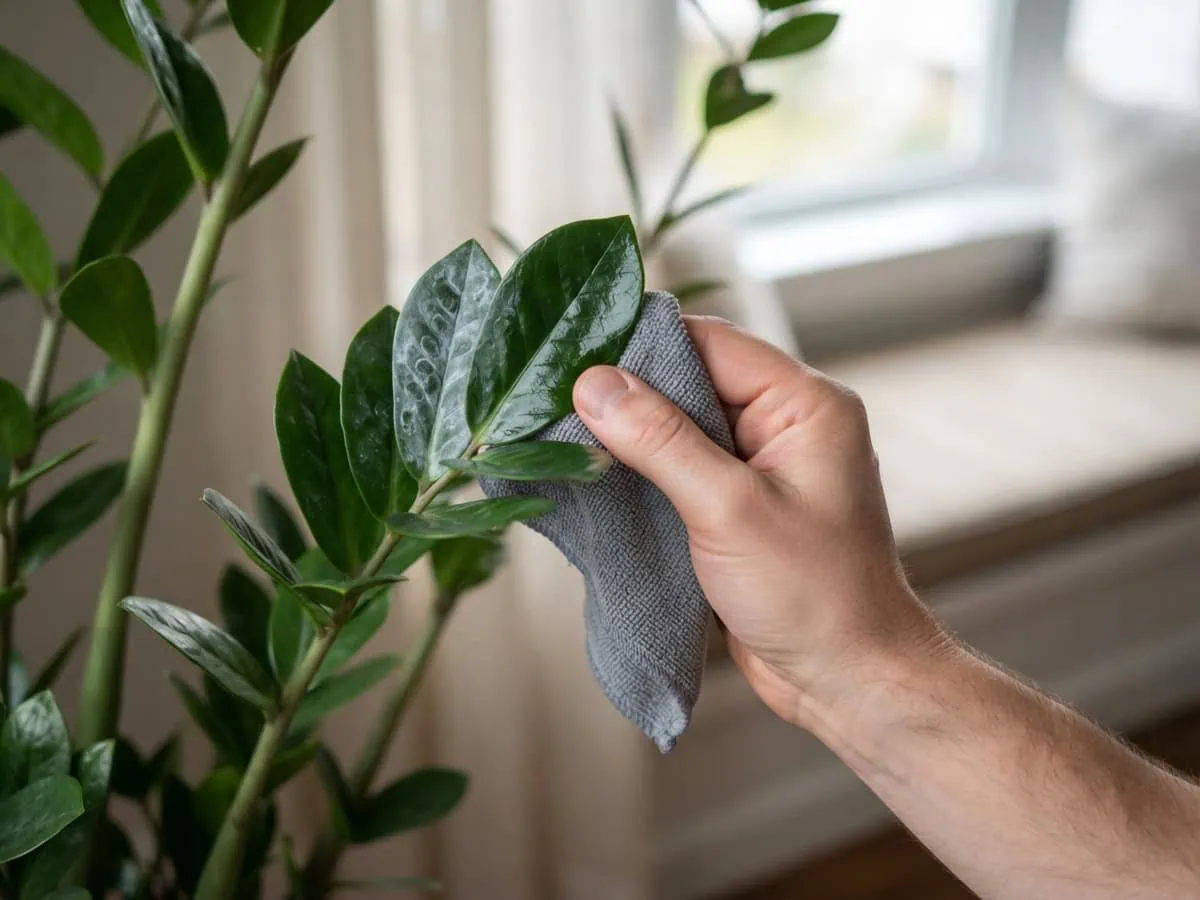
Microfiber cloth, plain water, done. Household soaps can damage the waxy surface layer that gives a ZZ leaflet its shine, and leaf-shine products only add a residue this plant never needed; a quarter-teaspoon of dish soap per quart is the ceiling for genuinely grimy foliage.
Film on the leaves usually means crust on the soil too, and this plant has only a slight tolerance for salt, so skip softened water (it trades hardness minerals for sodium, the one salt a ZZ handles worst).
Those salts brown the leaf tips and margins from the inside, which makes this a watering-habit question — getting the ZZ plant watering rhythm right, soaking to runoff and then letting the pot dry all the way through, is what stops the film returning.
Powdery white mold on the soil surface
That “powdery white mold on ZZ plant soil surface” is almost always harmless. It is a surface-feeding mold living on damp, decaying matter in the top layer (saprophytic — it eats dead matter, not your plant), and the plant beneath it usually carries on completely unbothered.
Tentatively, the mold itself is a symptom rather than an agent: it needs a surface that stays damp, which is the same condition that breeds fungus gnats and rots rhizomes. That mold feeds on the organic matter in the mix rather than on an established ZZ. What is settled is the trigger.
So fix the cause, not the fuzz. A mix that dries through in 7-14 days never gives mold a bed, which is why picking a fast-draining ZZ plant soil matters more than any spray. Scrape the mold off, let the top layer dry, and get air moving across the pot.
Powdery mildew, the harmful white coating
One white thing on a ZZ is a real fungus. Powdery mildew grows on living tissue rather than on soil, so it coats the leaflet itself in a dry, dusty, talcum-like bloom that smears when you rub it and comes straight back.
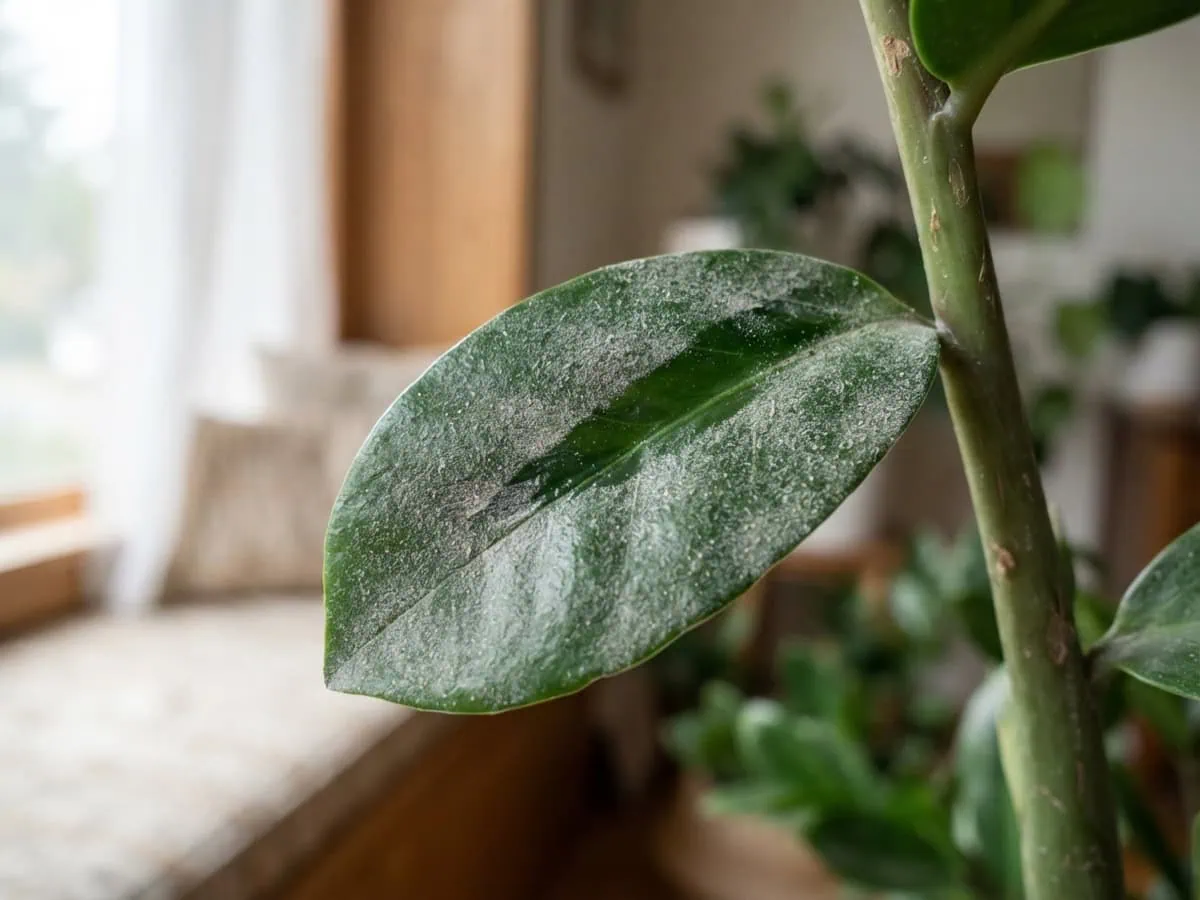
That is the tell. Mineral film lifts clean and stays gone; mildew smudges, leaves a stain, and re-powders within days. Location settles the rest — soil fuzz is not on the plant at all.
Handle it the way you handle leaf spot: cut the humidity, open up the airflow, remove the worst leaflets, and keep water off the foliage. A labeled biofungicide carrying 9.88% Bacillus amyloliquefaciens (a bacterium, not a chemical) is the listed option for powdery mildew if it spreads past a leaflet or two.
Black-spot mistakes and myths to skip
Most black-spot advice on the internet was written for a different plant. Rose growers, tomato growers, and a fungicide label wrote those rules, and none of it transfers to a semi-succulent aroid on a windowsill.
Three mistakes below account for most needless ZZ surgery.
The rose black-spot disease myth
Black spot is a rose disease. The fungus behind it, Diplocarpon rosae, attacks roses and nothing else; the tomato version is a different organism again. Your ZZ cannot catch either one (and I say this confidently), because the host list simply does not include an aroid.
So every rose protocol you find — the spray calendar, the fallen-leaf cleanup — is aimed at a plant with thin, wettable leaves that a ZZ does not have. Skip it.
There is a second look-alike worth ruling out before any spray. Scale sits on the surface as a raised brown bump and lifts off under a fingernail; a lesion is in the tissue and will not budge. If it scrapes away, you are telling ZZ plant pests apart from spots — a different problem with a different fix.
Black spots after a repot
A ZZ plant developing black spots after repotting is usually not sick. Three ordinary things happen on repot day, and all three leave marks: fleshy stalks bruise where fingers grip them, disturbed rhizomes stall while roots re-seat, and fresh mix holds water far longer than the old root ball did.
The third one is the dangerous one. An oversized pot surrounds a drought-adapted rhizome with a moat of wet mix (the exact condition that turns a bruise into rot). If the fresh soil is still damp two weeks on, the pot is too big.
So water once after a repot, thoroughly, let it drain, then go back to the dry-down. Resist the kindness watering — that is how most post-repot ZZ plants actually decline.
What to cut off, and what to leave
Cut almost nothing. A ZZ stalk does not branch from a cut and will not re-leaf (every new stalk comes up from the rhizome instead, on its own slow schedule), so removing a stalk for a cosmetic fleck is a permanent trade for a mark nobody but you will notice.
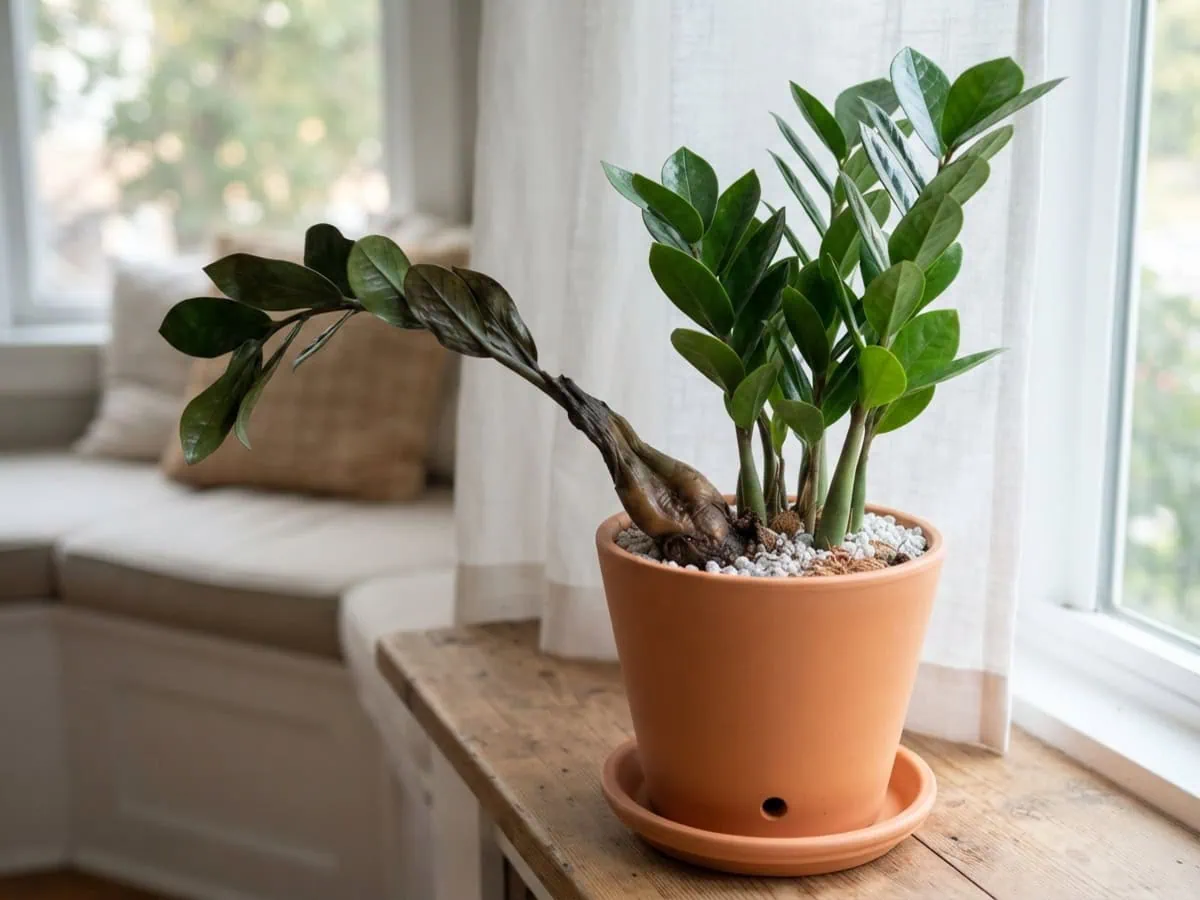
Remove a stalk only when it is genuinely soft or rotting. Keep each session under a third of the clump, because taking more risks pushing the plant into shock. Sterilize the blade between cuts: wipe it with 70% isopropyl alcohol, or soak it in one part bleach to nine parts water for at least 10 minutes and rinse.
Spotted leaflets are different. Pick off a leaflet carrying a real leaf spot and destroy it — one leaflet out of dozens, and the spread stops. Scorch marks and flat flecks stay: they never green up again.
Wear nitrile or thick gardening gloves for every cut that opens ZZ tissue. The sap carries needle-fine calcium oxalate crystals that irritate skin and eyes on contact. If sap touches skin, rinse under cold running water for at least 60 seconds, and keep your hands away from your face until you have washed them. If a severe skin reaction develops (blistering, intense burning, or photosensitivity), seek medical attention immediately. For chemical exposure, you can also contact Poison Control (1-800-222-1222 in the US).
Frequently asked questions about ZZ plant spots and residue
How to get rid of black spots on ZZ plant stem?
Most ZZ stem spots need nothing at all — a flat, dry fleck is natural coloring, not a disease. Press the mark first. If it stays firm and flush with the stalk, leave it and re-check in 1-2 weeks.
If the stalk is squishy, smelly, and collapsing all at once, the rhizome is rotting under saturated soil: unpot the plant, cut every soft section back to firm white tissue with a blade wiped in 70% isopropyl alcohol, repot into fresh fast-draining mix, and water far less.
What kills black spots on plants?
Nothing does, because most black spots are damage, not a living organism you can remove. Sunburn, a bruise, and natural coloring are all permanent marks in the tissue; no product returns them to green.
Where a genuine fungal or bacterial leaf spot is active, the lever is the environment rather than a chemical: lower the humidity, increase air circulation, water at the soil, and remove the infected leaflets. A labeled biofungicide carrying 9.88% Bacillus amyloliquefaciens is the listed option for stubborn cases.
Will black spot disease go away on its own?
The rose disease called black spot never appears on a ZZ, so there is nothing to wait out. Its fungus, Diplocarpon rosae, attacks roses and nothing else.
A ZZ’s own dark marks behave differently: a cosmetic fleck simply stays, unchanged, for the life of the stalk, while a moisture-driven lesion widens and never reverses on its own. Neither one resolves by waiting — the first needs no action, and the second needs the soil to dry out.
What is the best black spot remover?
A damp microfiber cloth, if the mark wipes off — which means it was never a spot in the tissue. Chalky white film is hard-water minerals and lifts with plain water. A raised brown bump that scrapes away under a fingernail is scale, an insect.
Anything that stays put after a wipe is inside the leaflet or stalk, and no remover reaches it; the only real levers there are drier soil, more airflow, and removing genuinely infected leaflets.
What is a safe way to deal with fungal black spots on plants?
Dry the leaf surface and move air across it — fungal leaf spots run on wetness plus stagnant air. Lower the humidity, space plants so air passes between them, water at the soil rather than over the foliage, and water early enough that any splash dries fast. Pick off and destroy the spotted leaflets.
A labeled biofungicide carrying 9.88% Bacillus amyloliquefaciens is the listed product option, and pots should be cleaned with one part bleach to nine parts water. Only a plant infected throughout is beyond a remedy; discard that one rather than risk the rest of your collection.
How do you make homemade black spot remover?
Skip the recipe — no homemade mix removes a mark that already sits inside ZZ plant tissue. The only homemade solution with a real job here is a cloth and plain water for hard-water film.
Household soaps can damage the waxy surface layer that gives a ZZ leaflet its shine, so a quarter-teaspoon of dish soap per quart of water is the ceiling, and only for genuinely grimy foliage. Leaf-shine products add residue this plant never needed.
Should I cut off leaves with black spots?
Only when the spot is a genuine leaf spot — a wet, spreading lesion ringed with yellow. Pick that leaflet off and destroy it, because one leaflet out of dozens stops the spread. Leave everything else.
Dry cosmetic flecks and old scorch marks never green up again and never spread, so cutting them changes nothing. Never remove a whole stalk for a surface mark: a cut ZZ stalk does not re-leaf, and the plant only replaces it slowly from the rhizome.
The 3-move black-spot protocol
Honestly? The hardest part of a ZZ spot is doing nothing about it. Press it, photograph it, wait 1-2 weeks — that is the whole protocol, and semi-succulent stalks (thick, waxy, water-storing) carry marks the way old furniture carries scratches.
Once you can read a discrete spot, the diffuse one is next — whole leaves going pale or yellow. Start with why ZZ plant leaves turn yellow for the other half of the picture, because a ZZ tells you two different stories with color. Three healthy stalks taught me what a fingertip teaches in two seconds.
Knowing what causes black spots on a ZZ plant is mostly knowing when to keep your hands off it. May the next dark spot on your ZZ plant turn out to be nothing, your fingertip tell a firm stalk from a soft one at a touch, and your shears stay put until the rot is real.
Tap the button below to get more plant fixes in your Google Search results