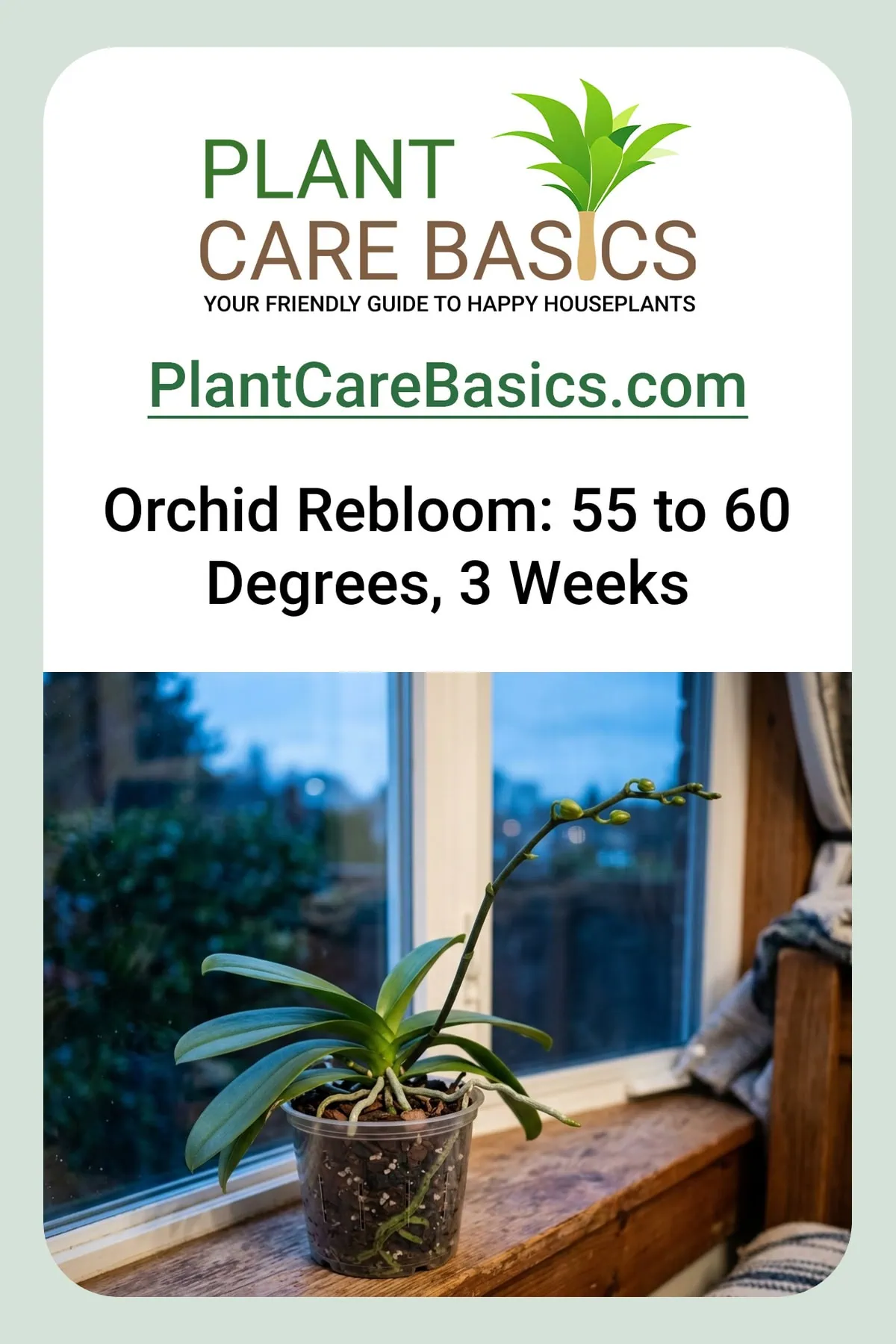
🎯 Quick Answer: How to rebloom a moth orchid
How to get a Phalaenopsis orchid to rebloom, a member of the Orchidaceae family, relies on 2-3 weeks of 55-60F nights. Keep days below 82F, then pair that cool-night drop with bright, indirect light. No pantry trick triggers a spike.
- Cool the nights: drop them to 55-60F for 2-3 weeks
- Hold days mild: keep daytime below 82F during the cue
- Find bright shade: an indirect window, never a dim corner
- Skip the pantry: coffee, Epsom salt, and baking soda do nothing
- Re-cut a spent spike: just above the second node, healthy plants only
Let me level with you: the spent spike snapped like a dry drinking straw the day I finally gave up. Two moth orchids, three years, and not one new bud between them. Just leaves, then more leaves.
I’d dribbled coffee grounds and Epsom salt into the bark, sure some pantry additive would force a flush. Rather than a missing nutrient, I discovered the real lever was light. Strike that — it was the leaves themselves. A Phalaenopsis is an epiphyte built for dappled, understory brightness, and its leaves are the only engine that banks the carbohydrate a spike runs on (and I say this confidently).
Recovery was dull work: I flushed the salty crust those experiments left in the bark, moved both pots to a bright sill, and let the nights run cool. The first spike showed in weeks. Here is everything that keeps a moth orchid thriving indoors.
Take a breath — none of this needs special gear. The following table lays out every number that actually moves a moth orchid from leaves to a flower spike.
How to get a Phalaenopsis orchid to rebloom: the trigger numbers
| Moth orchid specs | Recommended care |
|---|---|
| Night-temperature trigger | About 55-60F nights for 2-3 weeks |
| Daytime ceiling | Keep days below about 82F while inducing |
| Day-to-night differential | Around 10-15F cooler at night |
| Light to rebloom | Bright indirect, about 1,000-1,500 FC |
| Spike re-cut point | Just above the second node from the base |
| Time to a second bloom | Roughly 8-12 weeks after the cut |
| Do coffee grounds trigger blooms? | No |
| Is a high-phosphorus bloom booster required? | No |
Tap the button below to get more plant fixes in your Google Search results

Table of Contents
The night-temperature drop that starts a new spike
A new flower spike starts when nighttime temperatures drop to about 55-60F for two to three weeks while days stay below 82F. That gap between warm days and cool nights is the actual switch (not a calendar date, and certainly not a fertilizer).
Cool nights flip the switch.
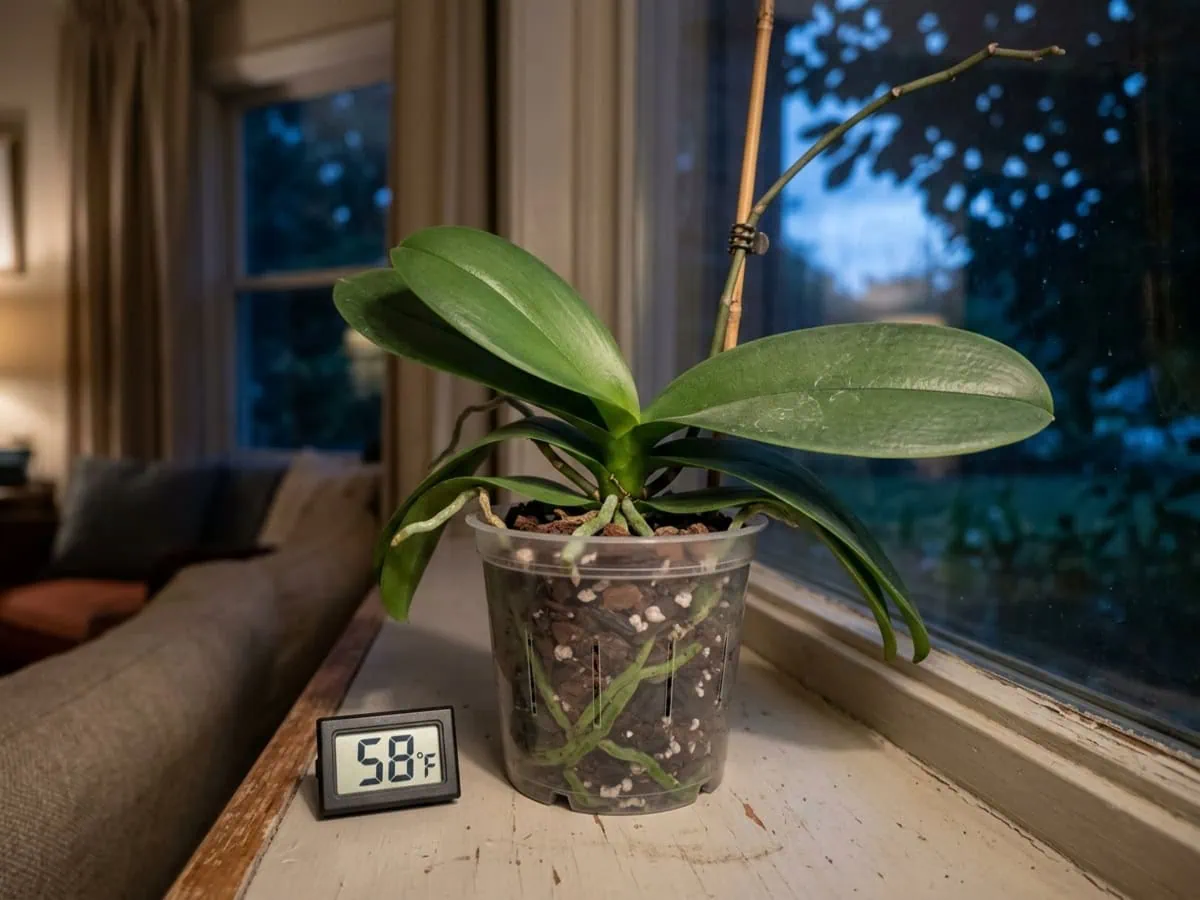
Per a peer-reviewed orchid flowering-induction study, sustained warmth above roughly 77F holds the plant in leaf-making mode, which is exactly why the temperature triggers for orchid flowering sit at the center of any rebloom plan.
How cool, how long, and the daytime ceiling
If you have ever wondered what nighttime temperature triggers a Phalaenopsis to spike, the target is a steady 55-60F after dark. Hold it for two to three weeks. Days still need warmth — above 70F, ideally below the 82F ceiling (think 72-80F) — because heat past that point stalls the whole process.
Measure the nights; do not guess.
The leaves should feel faintly cool to a fingertip at night, windowsill-cool like the side of a water glass left out, never refrigerator-cold. Once a spike is clearly visible, ease nights back to a normal 60-70F so the forming buds do not drop.
- Weeks 1-3: cool 55-60F nights running the induction cue
- A few weeks on: a small green tip pushes from a lower leaf axil
- Weeks 8-12 onward: the spike lengthens and buds swell toward open flowers
Why the differential, not a calendar month, flips the switch
Take this with a grain of salt — the exact hormone cascade is still being mapped — but the cool-night signal is what nudges the growing tip out of making leaves and into building an inflorescence (the flower spike itself).
But what the plant reads is the difference between day and night, ideally around 10-15F cooler after dark, not a date on the wall.
A room held at a flat 72F day and night never delivers that contrast, so the orchid just keeps stacking leaves.
No swing, no spike.
Triggering a spike is one job; holding onto buds once they form is a separate one that leans on steadier warmth.
Tap the button below to get more plant fixes in your Google Search results

Enough light to fund a bloom — and spike versus aerial root
Light is the fuel a rebloom runs on, and a shortage of it is the most common reason a healthy-looking plant just sits there.
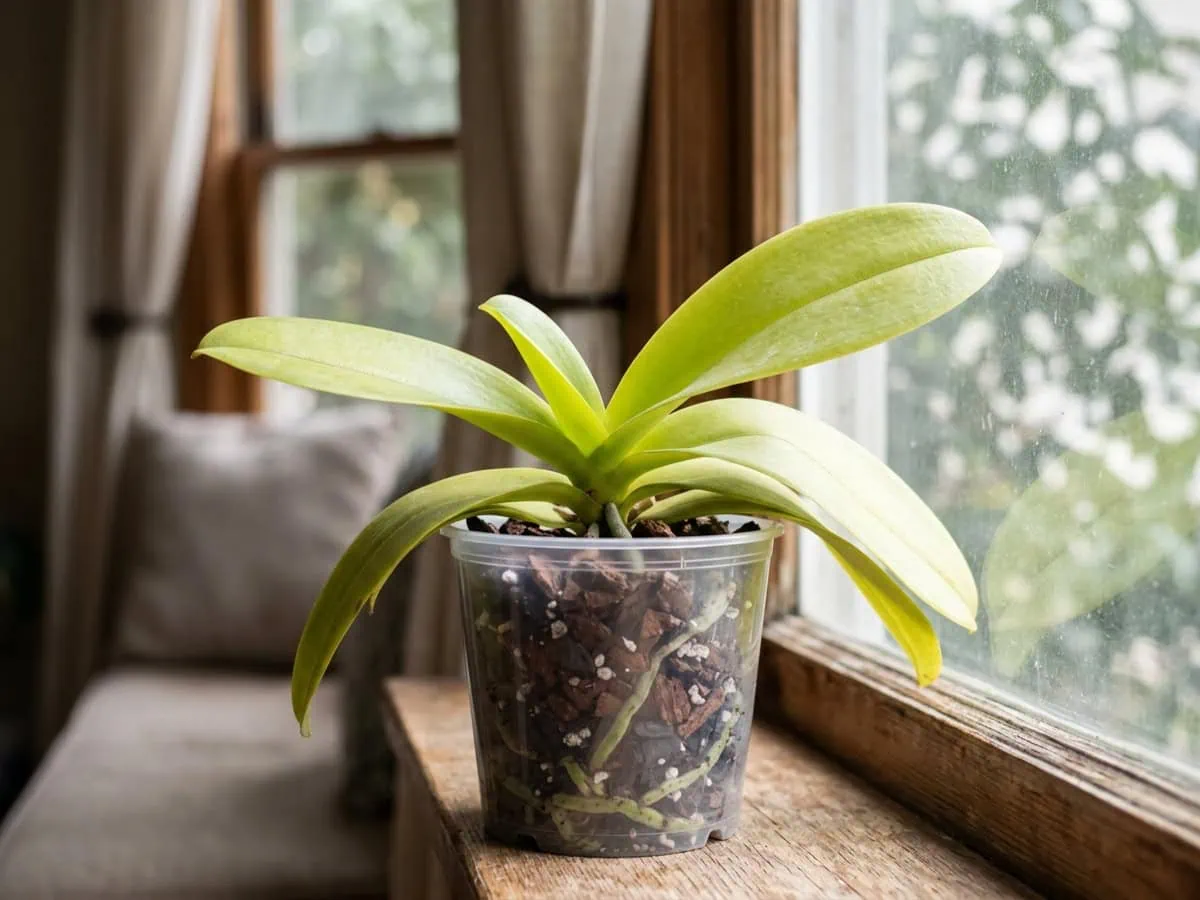
If you have asked why is my Phalaenopsis only growing leaves and no flower stem, low light is the first suspect: the leaves cannot bank enough energy (stored carbohydrate, really) to pay for a spike.
Three gates have to open before a flower spike forms. The plant has to be healthy, it has to have stored enough energy from good light, and it has to catch the cool-night cue. But miss any one, and you get foliage.
A vigorous plant blooms, so reading leaves that look off tells you when vigor is the gate that is stuck.
Bright indirect light is the fuel a spike runs on
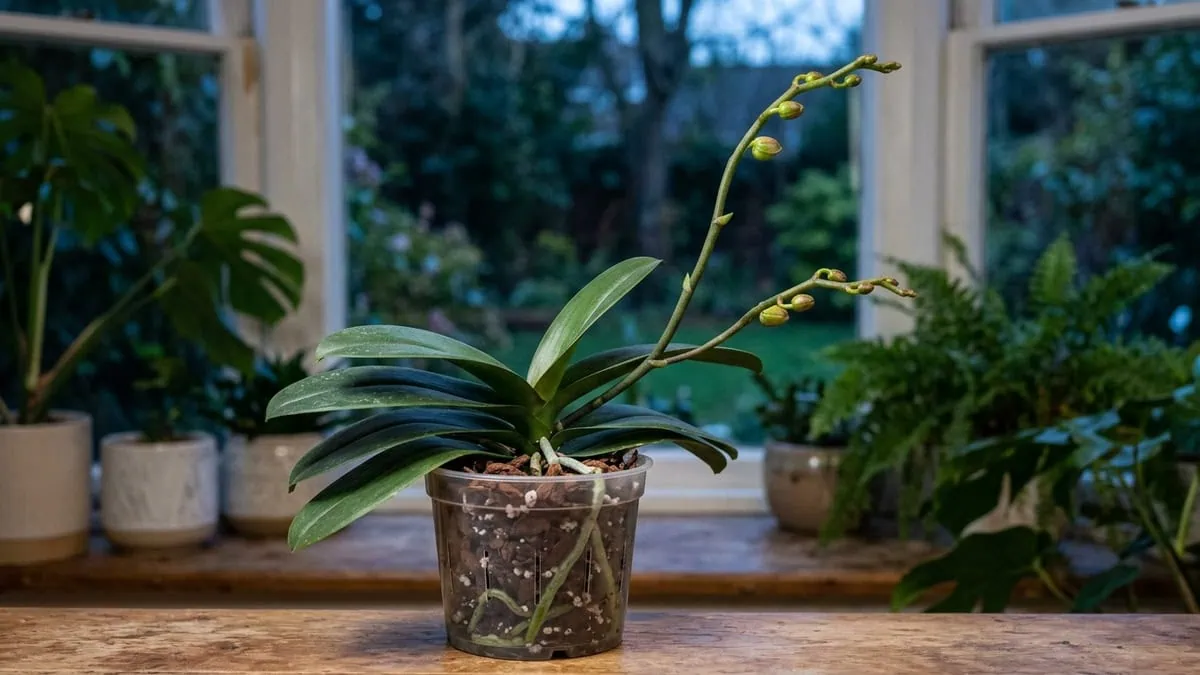
Aim for bright, indirect light around 1,000-1,500 foot-candles — an east window, or a sheer-curtained south or west one. A south pane can feel warm against the back of your hand by mid-afternoon, and that warmth is the same energy the leaves quietly bank toward a spike.
Below roughly 500 FC the plant survives but rarely spikes; above 1,500 FC the leaves scorch (TBH — the leaf color tells you more than any meter does). Well-lit foliage sits at a light yellow-green. A deep, lush grass-green means too little light, and a red-bronze flush means too much.
Color is your meter.
Spike or aerial root? The flattened mitten tip
Here is how to tell a Phalaenopsis flower spike from a new aerial root: a spike grows upward and its tip flattens into a small mitten shape, while an aerial root keeps a smooth, rounded green growing point (think fingertip, not paddle).
Roots wander sideways or down toward the pot; spikes climb toward the light. When in doubt, wait a week — that mitten tip is unmistakable once it forms.
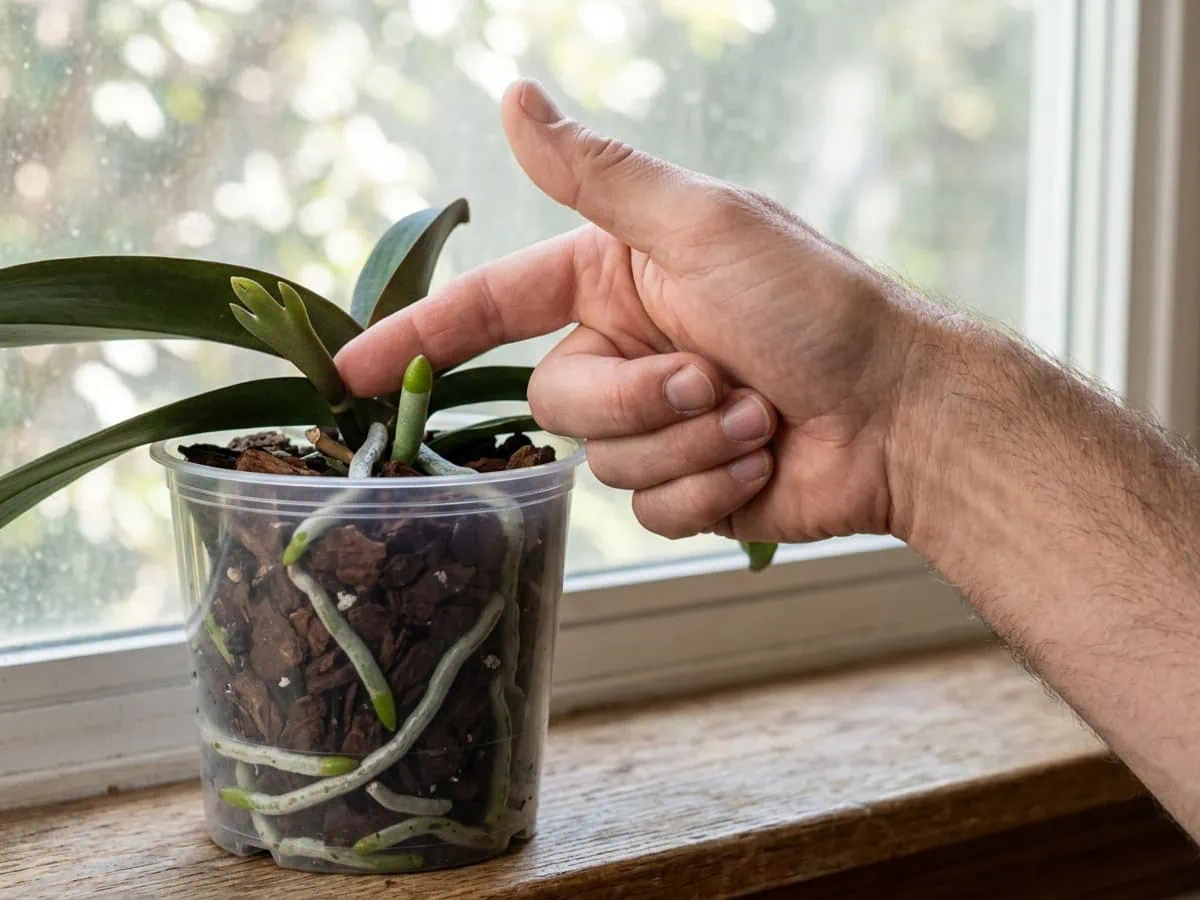
The stakes here are real. Cut a developing spike believing it is a stray root, and you throw away the very bloom you were waiting on — months of banked leaf energy gone in a single snip. A misread root is harmless; a misread spike loses you the whole show.
Confession time: I once snipped off three perfectly good spikes thinking they were stray roots. The tell I missed was the angle — every one was reaching up toward the cool glass, the way a spike does, while my real aerial roots hung down over the rim like pale gray shoelaces.
Rebloom myths: pantry boosters and where the spike gets cut
No kitchen additive makes a moth orchid bloom. Coffee grounds, baking soda, and Epsom salt all trade on the same hope — that the right sprinkle forces a spike — yet the real triggers are light and the cool-night drop, full stop. None of it works.
At best these tricks shift the bark chemistry a little, and at worst they leave a salty crust the roots then have to fight against.
Triggers beat tricks.
Pantry bloom boosters that do nothing
Epsom salt is simply magnesium; it helps only a genuinely magnesium-starved plant, and even then it greens up tired leaves rather than flipping a bloom switch. Coffee grounds and baking soda do even less.
But a moth orchid does not need a high-phosphorus bloom booster either — a balanced, dilute feed during active growth is plenty, and the right feeding that fuels a spike matters far more than any single miracle nutrient.
Myth: a spoonful of coffee, baking soda, or Epsom salt forces an orchid into bloom. Fact: spikes are set by a 55-60F cool-night cue and bright light — nothing from the pantry moves that needle. Save the coffee for yourself.
Where to cut a spent spike for a second flush
Growers ask the same thing constantly: where exactly should I cut my Phalaenopsis spike for a secondary bloom? Count up from the base and cut just above the second node — each node hides under a small triangular bract — leaving the lower two intact.
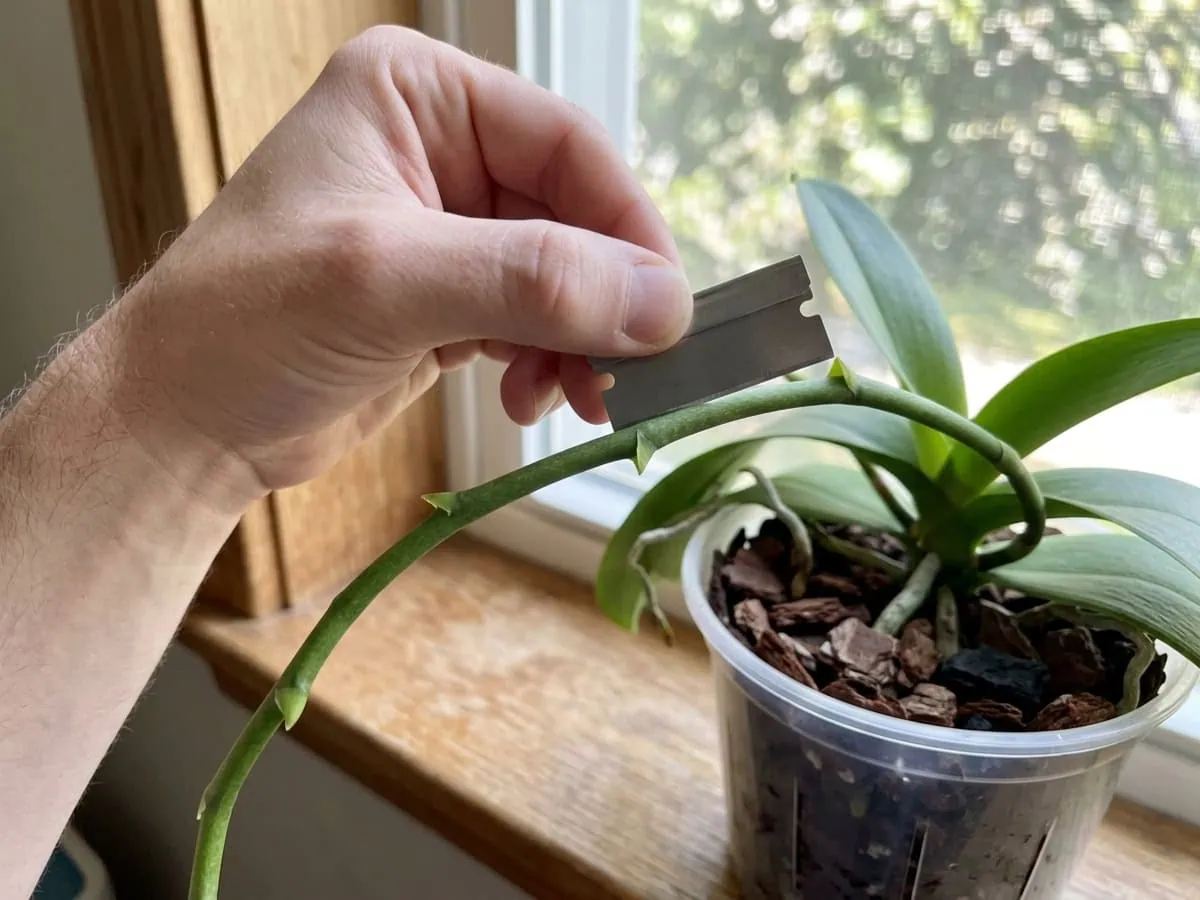
Use a blade wiped with 70% rubbing alcohol, cut at a slight angle, and stay above any dried, brown stretch — a spent spike turns straw-dry and cool to the touch once it has given all it can. Only push a healthy, vigorous plant this way.
A tired one should rest and be cut right down to the base, which trades quick reward for a stronger spike later. So how long until a Phalaenopsis blooms again after pruning the spike? On a healthy plant, a side shoot usually shows in about 8-12 weeks, with open flowers a few weeks after that.
How often a healthy plant really reblooms
Realistically, one main bloom cycle a year is the natural rhythm, with each display holding for two to four months. Strong plants can throw a secondary spike, and a few generous ones rebloom more often, but the never-ending blooms promised on plant tags are a sales pitch, not biology.
Give the orchid its cool-night cue year after year and it will keep spiking for you — the same plant can rebloom for many years on end.
Frequently asked questions about reblooming a moth orchid
How to force a Phalaenopsis to bloom?
Drop nighttime temperatures to 55-60F for two to three weeks while keeping days below 82F and the plant in bright, indirect light. That cool-night cue, not any feed, sets the spike. Once a small green tip appears, return nights to 60-70F so the buds develop and hold. A healthy, well-lit plant follows this routine reliably; a shaded or underfed one needs its light and vigor sorted out first.
How long does it take for an orchid to rebloom after cutting a spike?
Expect a new side shoot in roughly 8-12 weeks when you cut a healthy spike just above the second node. Open flowers follow a few weeks later as the buds form. A cut taken right to the base skips the shortcut but tends to build a stronger spike the next cycle. Cool nights and bright light through this window keep the new growth moving steadily.
Do coffee grounds help orchids bloom?
No. Coffee grounds do not trigger blooming and can sour or salt the bark over time. Spikes are set by a 55-60F cool-night drop plus bright light, never by a soil additive. If you want to help, give the plant cooler nights and a brighter window instead.
Will baking soda help orchids bloom?
No. Baking soda has no bloom-triggering effect and can push the bark’s chemistry in unhelpful directions. A moth orchid spikes in response to temperature and light, full stop. Skip the baking soda and focus on the cool-night cue and a bright, indirect spot.
What household item helps orchids bloom?
Honestly, none reliably triggers a bloom. The most useful household item is a simple thermometer, which lets you confirm the 55-60F cool nights the plant actually responds to, plus a sheer curtain to soften a hot window. The trigger is environmental — measure and adjust the conditions rather than dosing the pot.
Does Epsom salt make orchids bloom?
No. Epsom salt is magnesium; it only helps a plant that is genuinely magnesium-deficient, and even then it corrects leaf color rather than forcing a spike. Blooming is driven by cool nights and light. Routine Epsom-salt dosing mostly adds salt the roots then have to handle.
How many times can a Phalaenopsis orchid bloom?
A healthy moth orchid blooms about once a year as its natural rhythm, with each display lasting two to four months. You can often coax a secondary spike from a strong plant by re-cutting above a node. Across its life the same plant reblooms year after year for many years, as long as it keeps getting the cool-night cue.
From all leaves to a fresh spike
The whole arc in one breath: cool the nights to 55-60F for two to three weeks, hold days under 82F, and keep the plant in bright, indirect light. No kitchen sprinkle ever tipped the balance — the plant’s own foliage and your thermostat always did. That is the whole secret.
So once the flowers fade, that quiet stretch becomes the moment for repotting once the bloom finishes and resetting for the next round. A single spike can carry flowers for up to four months, so the cool-night habit pays back in a long, slow show.
Master that rhythm and you have mastered how to get a Phalaenopsis orchid to rebloom, season after season. May your nights turn cool on cue, your leaves stay sun-fed and firm, and a fresh spike climb up year after year.
Tap the button below to get more plant fixes in your Google Search results