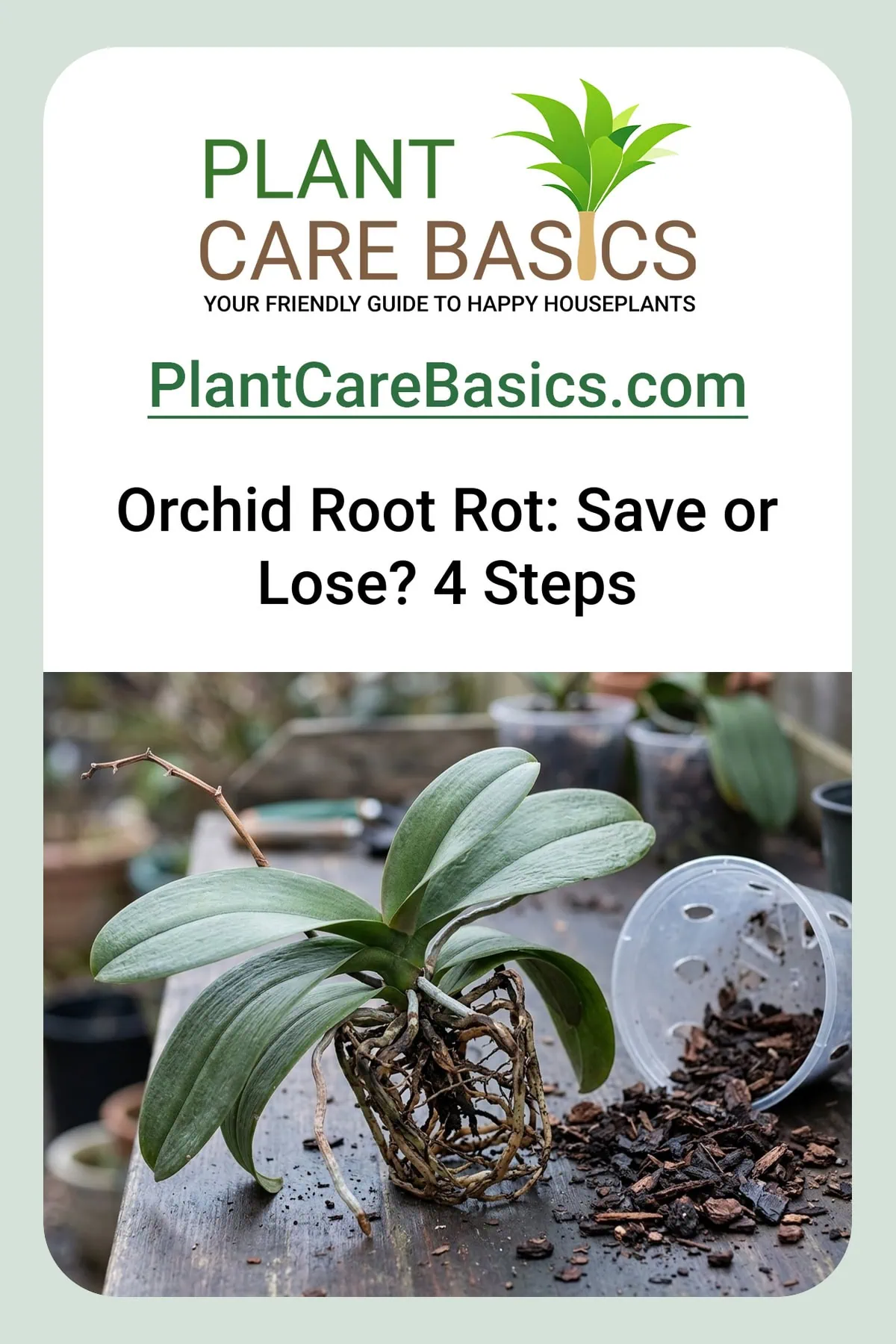
🚨 Emergency 30-Second Answer: root-rot rescue
Stop watering and unpot it now — a moth orchid (Phalaenopsis, family Orchidaceae) rots from the roots up in soggy, airless bark. The fix is mechanical, not chemical.
Knowing how to save a Phalaenopsis orchid with root rot is one decision, repeated: keep every firm, living root and cut away every soft, dead one. Soak the roots a full 24 hours before cutting, so you never trim a live root by mistake.
Then repot into fresh, open orchid bark and let warmth and humidity do the slow work. Even a plant stripped to its crown can rebuild in about 4–6 weeks.
- Speed is the rescue: every extra soggy day takes more living root
- Read before you cut: the firm white roots show what to keep
- Cut, do not pour: removing the dead tissue beats any bottled remedy
- Give roots air, not a soak: use open medium, water only when it dries
- Then wait it out warm: new root tips return only with time
The first warning is rarely the roots themselves. It is a new leaf going soft and yellow, or a sweet, swampy reek the moment you lift the pot — pond water left too long in a bucket.
For weeks I was treating root rot with home remedies — a peroxide rinse, a pinch of cinnamon dabbed straight on the roots — and each one only sped the decline. The real fix had nothing to do with any bottle or jar. It was mechanical.
Underneath the bark, the velamen — the spongy silver sheath that lets these epiphytes breathe between rains — had drowned and gone to brown mush. A moth orchid hoards almost no spare water, so the day its roots quit, the clock starts.
Here is the reassuring part. This rot is mechanical to reverse, and even a near-rootless plant can rebuild from the crown. Unpot it and read the roots first — the same instinct behind the indoor moth orchid survival guide.
Take a breath. If the roots already feel mushy, the table below sorts what to keep from what to cut — and what to never put on living tissue.
How to save a Phalaenopsis orchid with root rot, at a glance
| Moth orchid specs | Recommended care |
|---|---|
| Healthy root | White or silver, firm when squeezed, bright green tip |
| Rotted root | Brown or black, mushy or hollow, peels to a string |
| Tool | Sterile blade, wiped with 70% alcohol between every cut |
| Cut dressing | Ground cinnamon on the cut edge only, never live roots |
| Repot medium | Fresh coarse fir bark, kept dry-side after the rescue |
| Recovery window | About 4–6 weeks for new root tips (grower-reported) |
| Can it survive with no live roots? | Yes — a humidity chamber works if the crown stays firm |
| Is hydrogen peroxide safe on roots? | No — reserve it for pots and tools only |
Tap the button below to get more plant fixes in your Google Search results

Table of Contents
The root-trim rescue: unpot, cut to firm white tissue, repot dry
The rescue is surgery, not a spray — act now, not this weekend. Unpot the plant, rinse the roots under tepid water, and cut every brown, soft, or hollow root back to firm white-and-green tissue with a sterile blade.
One hard rule: keep hydrogen peroxide off the plant — it burns living root cells the way it sterilizes a bench. Save peroxide for pots and tools; cinnamon goes on cut edges only, never the living roots.
The rescue runs in four steps: unpot, remove dead tissue, sterilize, repot dry. Sterilize the blade between every cut. A single swipe through rot smears spores onto the next healthy root (more on this below).
Tell live roots from rotted ones first
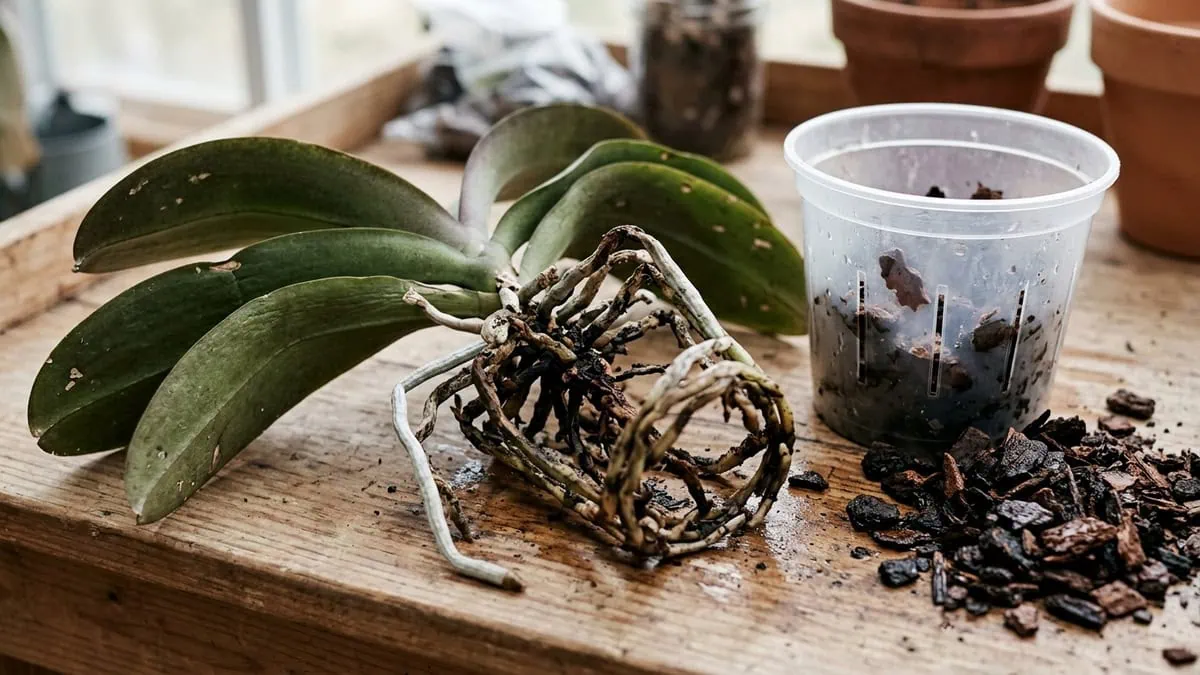
What do healthy versus rotted Phalaenopsis orchid roots look like? Squeeze each root between your fingers and sort it into one of three groups.
- Live: firm and plump, white or silver, with a bright green growing tip
- Rotted: brown or black, soft, mushy or hollow — the sheath peels off to a thin thread
- Thirsty, not rotted: gray, wrinkled, and crackled, yet still firm — water it, never cut it
You usually smell the dead roots before you finish sorting — a sour, swampy pond-water funk rising off the wet bark. In my testing, soaking the whole root ball a full 24 hours before cutting plumps the living tissue, so a thirsty-but-live root is never mistaken for a dead one.
If the soft blackening has already climbed into the crown where the leaves meet, that is rot at the central crown instead, and it needs a faster response.
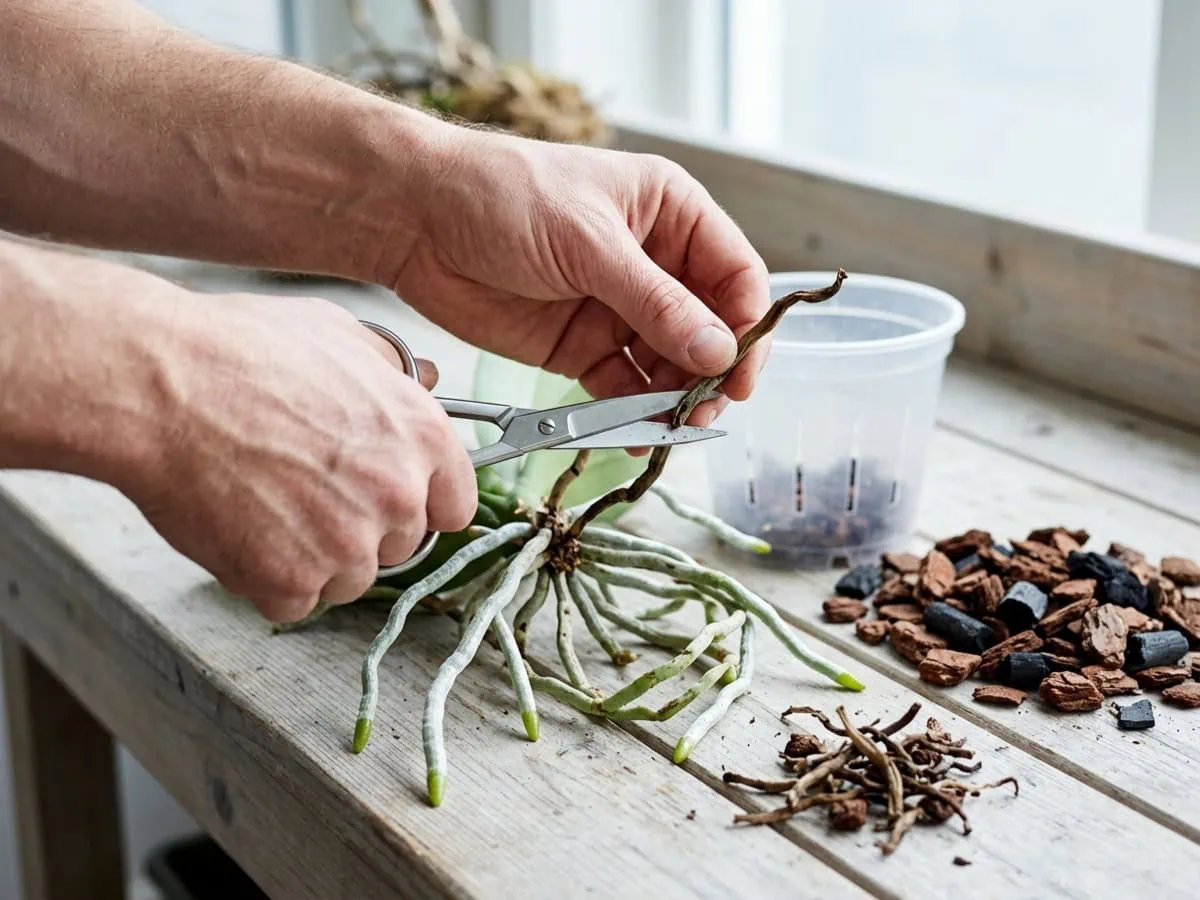
Dust cut edges with cinnamon, not the roots
Cinnamon is a cut-edge sealant, not a root soak. A light dusting on a fresh wound dries and seals it against fungus. Exactly what a trimmed stub needs.
Coat the living roots, though, and that same drying action backfires: cinnamon pulls moisture out of velamen that is fighting to recover. So cinnamon touches cut ends only.
For a badly infected root mass, a fungicide labeled for orchid root rot and its water molds is the appropriate option — a kitchen rinse of hydrogen peroxide is not.
Always test on a small area first. Results may vary depending on your specific conditions.
Repot into fresh coarse bark, keep it dry-side
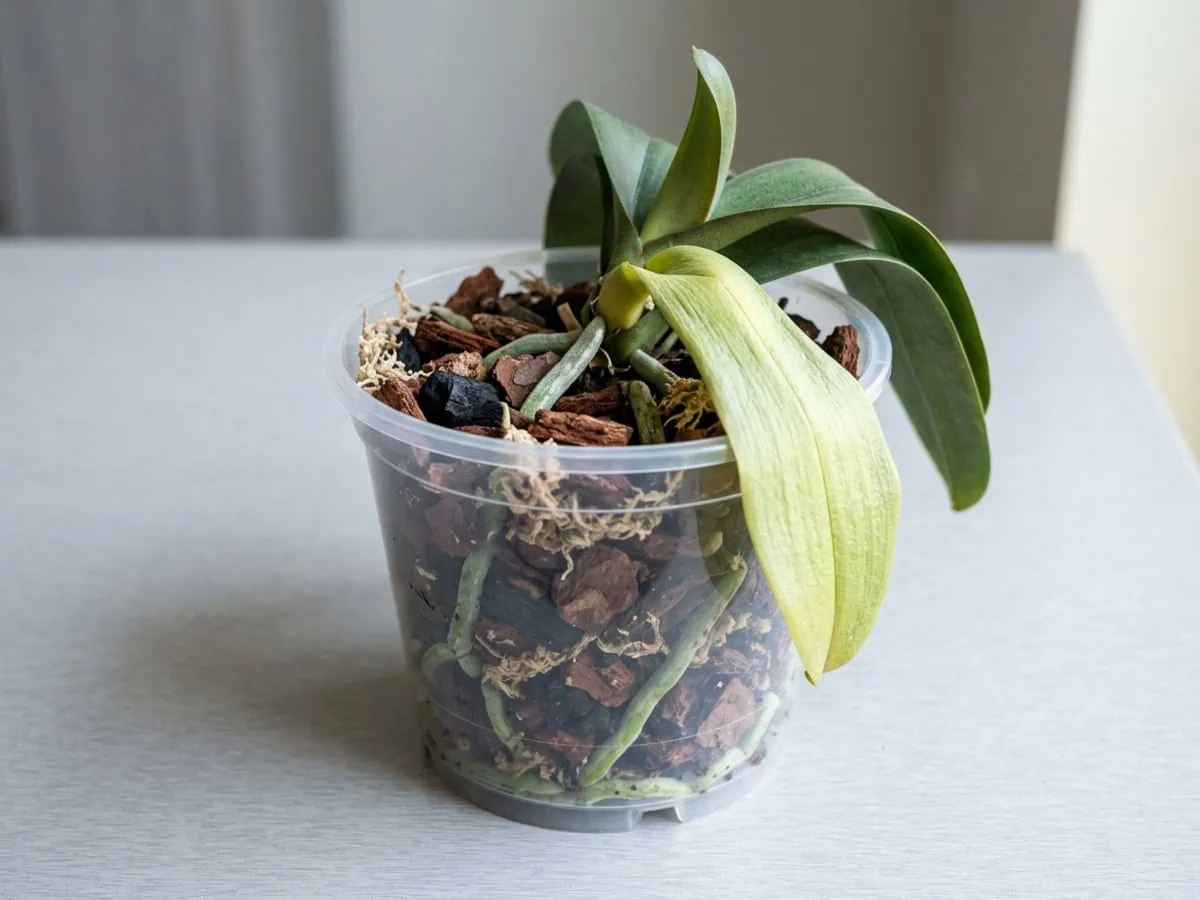
Repot straight into fresh, coarse fir bark. Never back into the broken-down medium that drowned the roots. After a heavy trim the plant has little left to drink with.
So keep the bark on the dry side and skip fertilizer entirely until new growth shows. A root-reduced plant cannot process the salt and only scorches further. Feeding comes later.
Phalaenopsis orchid recovery time after root rot trimming runs on two separate clocks, not one:
- Resume light watering: within several days to about a week
- New root tips: roughly 4–6 weeks, by grower accounts
- A fresh leaf: often months further out still
If the plant looks worse after the repot rather than steadier, that is usually shock, not failure — the slow rebound of a plant struggling after the repot.
Tap the button below to get more plant fixes in your Google Search results

Why it rotted — and saving a near-rootless plant
Root rot starts with water, not a germ. When bark stays soaked and compacted, the air pockets the roots breathe through collapse, the velamen suffocates, and only then do water molds move in on tissue that is already dying. The drowning comes first.
Waterlogged medium plus water mold: both are true
You will read that root rot is “just bad watering” or “a disease.” It is both, in sequence. The waterlogged, low-oxygen medium is the trigger; the pathogens are the agents that finish the job.
According to the University of California IPM Program, root rot and its water-mold pathogens — the oomycetes Pythium and Phytophthora — need free water to spread, exactly the standing moisture a soggy pot keeps on tap. Dry medium starves them out.
Inside the plant, rot climbs root to crown. A rescue that trims but leaves the plant wet simply reseeds it. That is why cut-and-repot-dry beats any spray.
In my experience the medium’s smell confirms it before the scissors do — a sour, stagnant reek means the water mold has spread through the root ball.
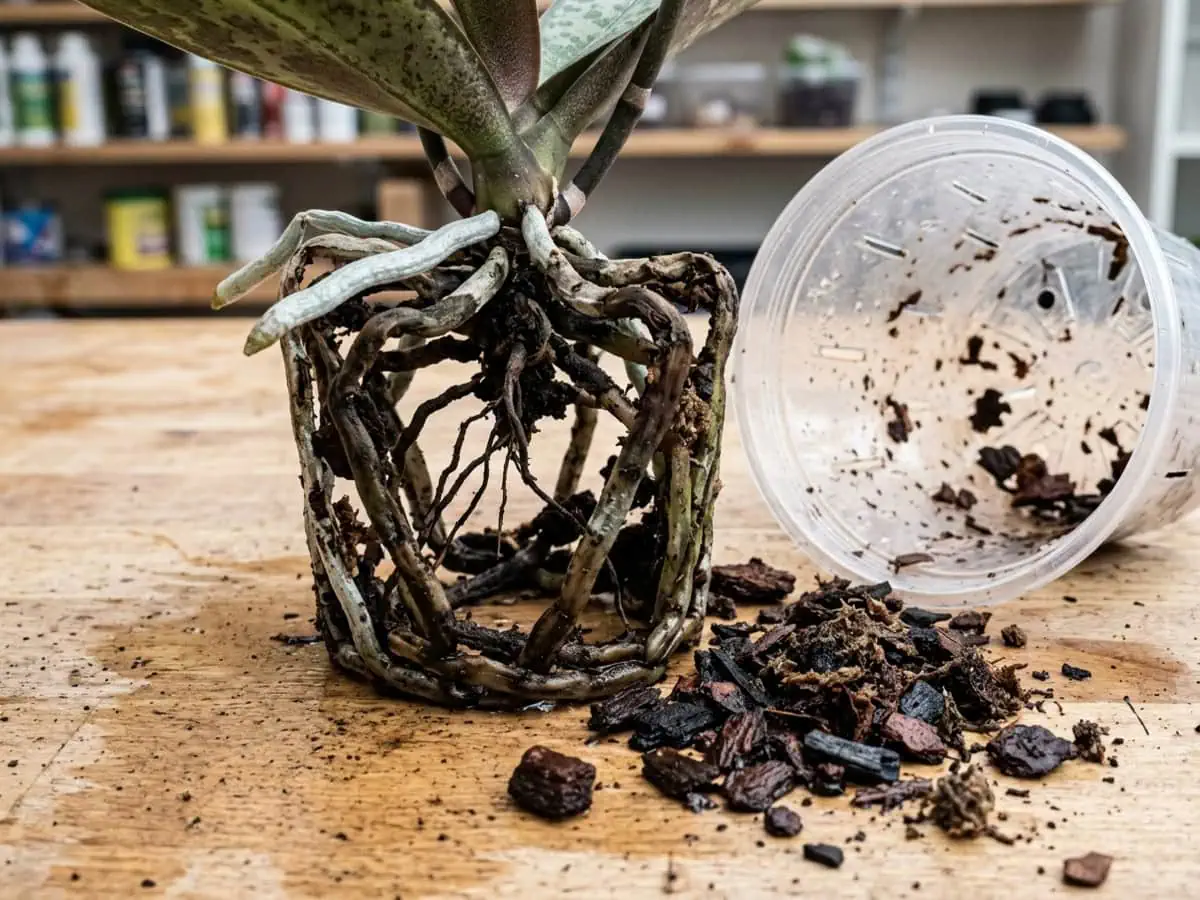
Moss or bark for a recovering plant?
So should I use sphagnum moss or bark to revive a rootless orchid? Match the medium to how many live roots remain:
- Sphagnum moss: holds many times its weight in water — rescues a rootless plant that needs steady humidity, yet can drown a recovering root system if left too long
- Coarse bark: more airflow and faster dry-down — safer long-term, but drier in the short window a weak plant wants moisture
The rule is a sliding one. Lean on moss while roots are scarce, then move to bark as new tips harden off.
That water-holding gap is the whole decision: sphagnum buys humidity for a plant that cannot yet drink, while coarse bark protects the new roots it will soon grow back.
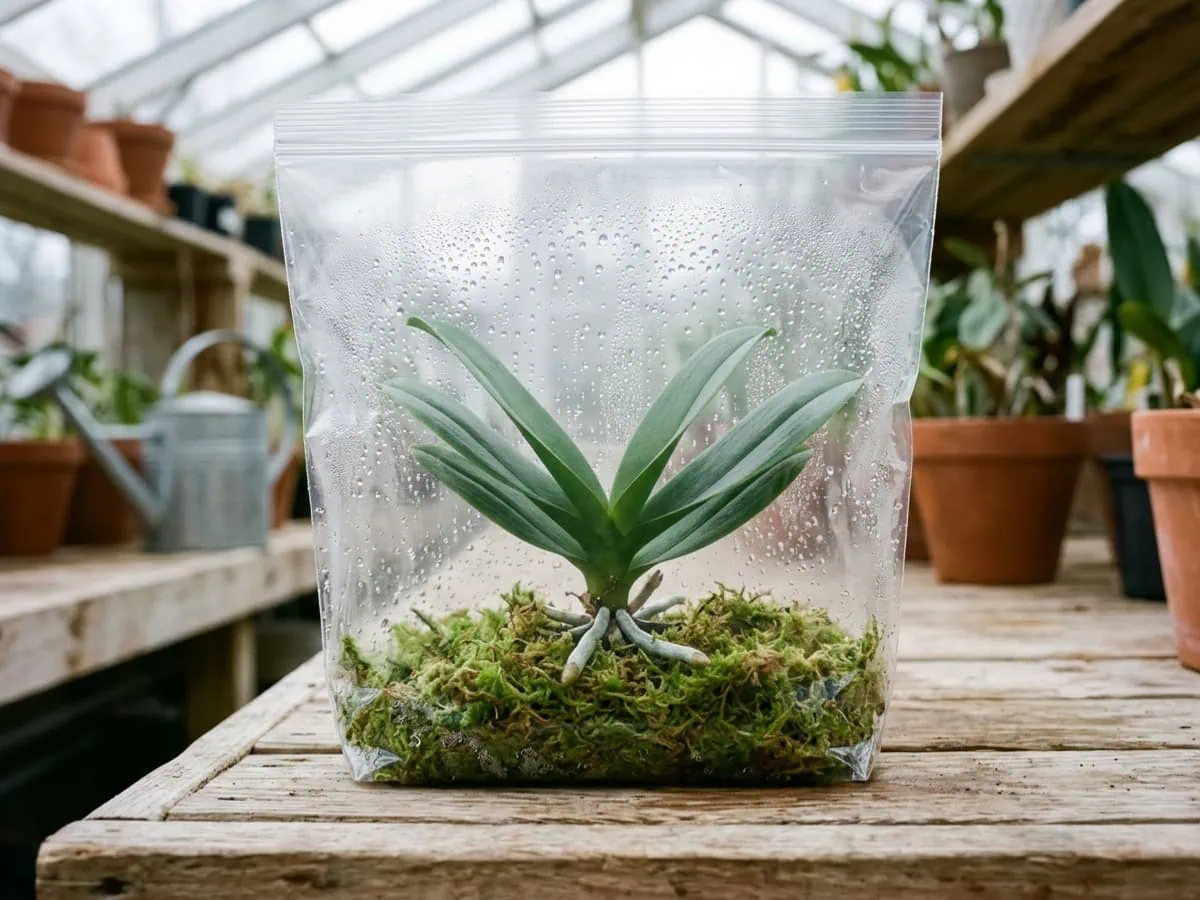
A near-rootless plant: a humidity chamber, not water
Can a Phalaenopsis orchid survive with no live roots left? Yes — surprisingly often, as long as the crown and leaves stay firm and the growing point is intact.
The plant is living on the water banked in its leaves, so standing the bare stump in a glass of water only rots whatever remains. Water is the trap, not the fix. Build a humidity chamber instead — two simple versions work:
- Suspend over water: hang the base just above a tray, never touching the surface
- Sphag-n-bag: seal the plant in a clear bag over damp sphagnum, base held clear of the moss
Give it bright, indirect light, no direct sun, and steady warmth. New roots usually push out within a few weeks. They reach into the humid air the way velamen evolved to in the canopy.
That spongy silver sheath drinks moisture straight from damp air — the same adaptation that keeps a rootless plant alive long enough to grow its way back.
Root-rot myths that finish the job
The remedies that finish more orchids than the rot itself are the ones that sound harmless. Here are the three that push a recoverable plant over the edge — plus the one symptom growers keep misreading.
Peroxide and cinnamon on living roots: don’t
Hydrogen peroxide and ground cinnamon both belong in a rescue. Just not on living roots.
A 3% peroxide rinse foams and hisses white the instant it meets rotten tissue, because it is oxidizing whatever it touches. The fizz is damage, not cleaning. On a bench or an empty pot that is sterilizing, but on velamen it burns the same living cells you are trying to save.
Oxidation cannot tell rot from root.
Cinnamon, for its part, seals a cut edge well, yet that drying action desiccates healthy roots it coats. So each remedy has exactly one safe place:
- Hydrogen peroxide: pots and tools only — never living tissue
- Ground cinnamon: cut ends only — never healthy roots or the crown
- The living roots: neither — clean cutting is what actually saves them
Ice baths, tea, keiki paste: not root remedies
Three kitchen-and-hobby fixes do nothing for rot:
- Ice cubes: chill the roots of a tropical epiphyte toward cold injury and never wet the medium through
- Black tea: adds a trace of nitrogen that a plant’s rotted roots cannot absorb anyway
- Keiki paste: a cytokinin dab that grows clones, not roots — once a node sprouts, its meristem is spent
None of them removes dead tissue, which is the only move that reverses rot.
A new yellow, floppy leaf is a root signal
Why is my new Phalaenopsis leaf turning yellow and floppy? Because the newest leaf starves first when the roots fail.
A moth orchid feeds its freshest growth from what the roots pull in, so the moment root capacity drops, that young leaf goes soft, thin, and yellow long before the older ones flinch.
That newest leaf is the plant’s hungriest tissue, still expanding and drawing hardest on the roots, so it is the first to feel a supply it can no longer get.
Read a floppy new leaf as a root readout, not a leaf disease — go straight to the pot and check the roots. The wider leaf-by-leaf picture, from wrinkles to yellowing, sits in reading limp, yellowing leaves.
Phalaenopsis root rot: quick answers
Can an orchid recover from root rot?
Yes, when enough healthy tissue remains. An orchid recovers from root rot once you cut away every dead root and repot it dry. The rot itself — driven by water molds like Pythium and Phytophthora — only spreads through soggy medium, so a dry, open mix stops it. Even a plant with no live roots can rebuild from a firm crown inside a humidity chamber. What never comes back is brown, mushy tissue; that gets removed, not revived.
What do rotted orchid roots look like?
Rotted roots are brown or black, soft, and mushy or hollow. Squeeze one and the outer sheath slides off, leaving a thin inner thread — the dead velamen sloughing away from the root core. Healthy roots stay firm and white or silver with bright green tips. Gray, wrinkled-but-firm roots are only dehydrated, not rotted, and a sour, swampy smell off the medium usually confirms which is which. Fix thirsty roots by watering; cut the rotted ones away.
Why put cinnamon on orchids?
Cinnamon is a natural fungicide used to seal a fresh cut. Dusted on a trimmed edge, it dries the wound and blocks fungus and water mold from entering the exposed tissue. Keep it to cut edges only — cinnamon desiccates living roots if you coat them, pulling moisture from the velamen you are trying to save. It is a wound dressing, not a root soak, and it never goes on the crown or on healthy roots.
Can orchid root rot spread?
Yes, both within a plant and between plants. The water molds behind rot release swimming zoospores that need free water to travel, moving root to crown inside one orchid and splashing to neighbors on shared trays. Sterilize tools between cuts, never compost the diseased roots, and keep a recovering plant isolated until it stabilizes. Letting the medium dry between waterings is what finally starves the pathogen of the moisture it depends on.
How to revive an orchid with dead roots after?
Revive a rootless orchid in a humidity chamber, not a glass of water. Trim the dead roots, then suspend the plant above water or seal it over damp sphagnum without touching the moss, so the velamen draws moisture from humid air rather than standing wet. Give it bright, indirect light and steady warmth. New roots usually appear within a few weeks as the plant lives off the water banked in its leaves.
What is the safe way to treat root rot?
The safe way to treat root rot is mechanical: unpot, cut every rotted root back to firm white tissue with a sterile blade, and repot into fresh, dry-side bark. Dust only the cut edges with cinnamon, and for a heavy infection use a fungicide labeled for the water molds Pythium and Phytophthora. Reserve hydrogen peroxide for pots and tools, and skip ice, black tea, and hormone pastes — none removes the dead tissue that drives the rot.
Rescue, revive, repeat — read the roots first
Root rot looks fatal and rarely is. The plant in front of you is almost never beyond saving — it is waiting on three moves: cut the dead tissue, repot dry, and let a humid recovery do the slow work.
Read the roots before you reach for any bottle, because the rescue is decided by what you remove, not what you pour on. The fix is subtraction, not addition.
Once new tips are out and hardening, the job shifts from rescue to routine — and the one habit that stops a repeat is getting the watering right, exactly the watering rhythm that avoids rot.
Master that and you rarely need to learn how to save a Phalaenopsis orchid with root rot twice. May every cut reveal firm white tissue, and may that swampy smell never come back.
Tap the button below to get more plant fixes in your Google Search results