🎯 Quick Answer: feeding a moth orchid without burn
A Phalaenopsis, a member of the Orchidaceae family, collapses its velamen root cells under full-strength feed, so dilute to a quarter strength. That is the whole answer to how to fertilize a Phalaenopsis orchid without fertilizer burn. Wet the bark first, flush monthly, and skip high-phosphorus boosters.
- Strength: quarter to half of the label rate, never full strength
- Target: roughly 40-60 ppm nitrogen, nitrate-form, not urea, in bark
- Order: wet the bark with plain water, then feed
- Flush: plain water every two to four weeks clears salt
- Stop: ease off once a spike opens its first flower
Between you and me — the fastest way I have ever hurt a moth orchid was kindness. I fed three of them at full label strength every week, certain I was being generous. Within two years all three wore brown, crisped leaf tips under a gritty crust of dried salt.
I assumed orchid roots shrug off extra feed the way garden soil does — until a long run of scorched root tips taught me otherwise. Backtrack: they hoard nothing. A Phalaenopsis grips bare, velamen-sponge roots with no soil to buffer a dose, so every hit of concentrated salt reaches those cells at full force.
More feed has never meant more flowers in my experience (low-key skeptical about this). Get the dose right and your orchid bounces back faster than you would think. For the full feeding-and-watering picture, start with the indoor moth orchid playbook.
Take a breath — if your orchid is already crisping at the tips, the table below is the cheat sheet to dial the feed back in.
How to fertilize a Phalaenopsis orchid without fertilizer burn — quick specs
| Moth orchid specs | Recommended care |
|---|---|
| NPK ratio | Balanced 20-20-20 (or 30-10-10 in a bark mix) |
| Strength and cadence | Quarter to half strength, weak and frequent (every 1-2 waterings) |
| Target feed | About 40-60 ppm nitrogen; nitrate-form, not urea, in bark |
| Flush | Plain water every 2-4 weeks; flush at once if EC reaches 2.0 dS/m |
| Stop feeding | When the spike hits ~10 in or the first flower opens |
| Burn signal | Leaf-tip scorch, root-tip browning, salt crust on the bark |
| High-phosphorus bloom booster needed? | No — a balanced feed carries bloom on stored reserves |
| Urea-based food good in bark? | No — bark lacks the bacteria to convert urea |
Tap the button below to get more plant fixes in your Google Search results

Table of Contents
The weak, frequent dose that spares the roots
Feed lightly and often; that single habit spares a moth orchid’s roots more than any special formula does. A Phalaenopsis banks almost no nutrient buffer, so a big monthly dose just leaves a gritty salt film on the bark that you can feel with a fingertip. Small, steady amounts keep the velamen working without that crust. Less is plenty.
Velamen is the spongy, silvery-white layer that sheathes a moth orchid’s bark-clinging roots. It soaks up water and dissolved feed on contact, and with no soil around it to dilute a dose, concentrated salt reaches the living cells underneath at full strength — which is why over-feeding scorches these roots so quickly, and why the potting mix you pick sets how fast salt builds up between flushes.
Should I fertilize a Phalaenopsis while it is in bloom? You can, but ease off — an open spike runs mostly on reserves it banked months earlier, so heavy feeding during flower does little except raise the salt load.
Quarter strength, balanced NPK, around 40-60 ppm nitrogen
What is the best NPK ratio for a blooming Phalaenopsis orchid? A balanced 20-20-20 covers almost every case, and in a bark mix a higher-nitrogen 30-10-10 offsets the nitrogen that decomposing bark steals. Either way, dilute hard. Mix to about a quarter of the label rate, which lands you near 40-60 ppm nitrogen, the band that feeds steady growth without tipping into burn. Reach for nitrate-form nitrogen, not urea.
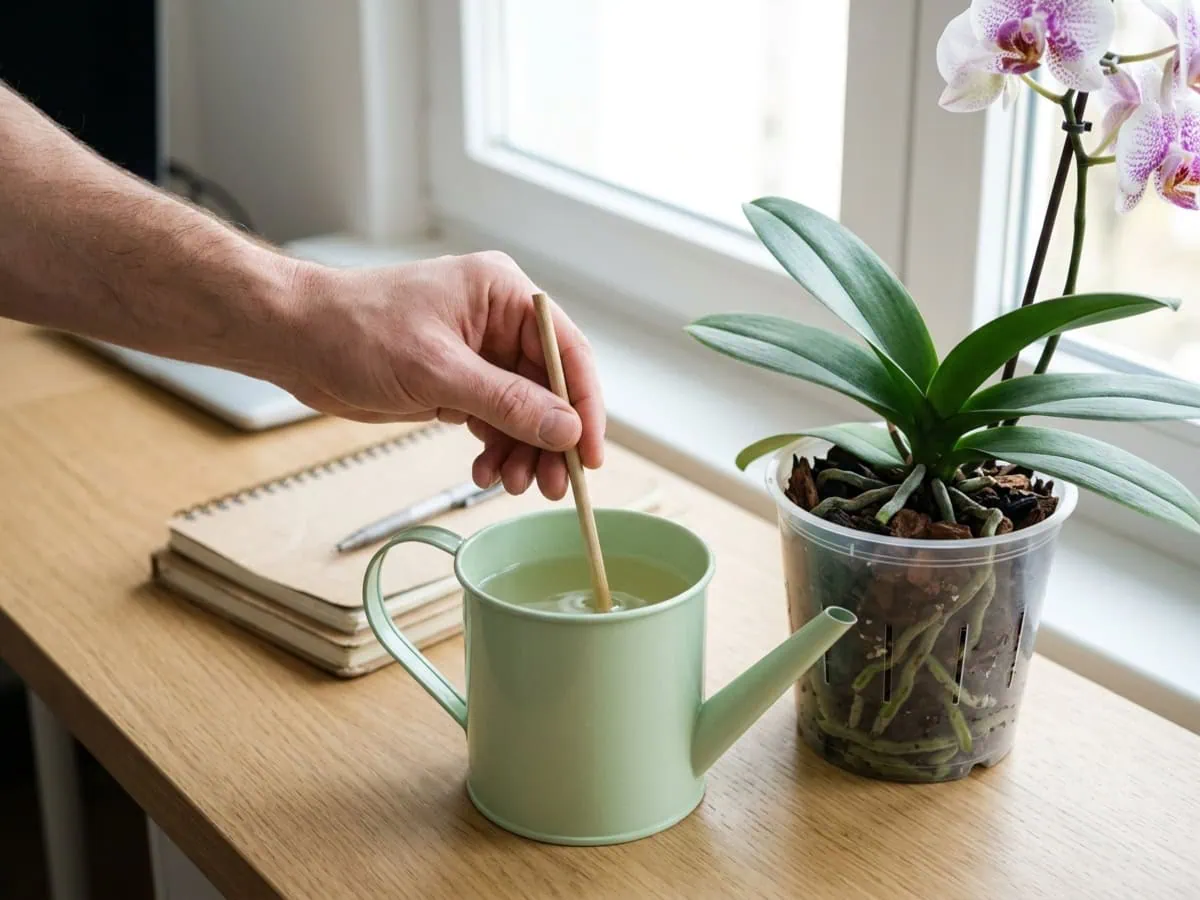
Run plain water through the pot until it drains, wait a minute, then pour the diluted feed. Pre-wetting hydrates the velamen so the dose spreads thin instead of hitting dry root cells at full concentration.
Wet the roots with plain water before you feed
Never feed a bone-dry pot. Dry velamen turns silvery and thirsty, grabbing whatever you pour first, so undiluted salt lands straight on the cells and pulls water back out of them. Soak with plain water until the roots flush green, then follow with the weak feed. It is the same watering rhythm fertilizer rides on; feed is just one of those soaks carrying a trace of nutrient.
Confession time: I used to dump feed straight onto dry bark because I was in a hurry. The roots that paid for it turned tan and hollow at the tips within weeks, so now a second can of plain water sits beside the feed can, and the plain one always pours first.
Get the two cans in that order and most burn fades before it starts. The plant tells you it is working: roots flush green on contact, leaf tips stay smooth, and the bark stays clean instead of dusty with dried salt.
Tap the button below to get more plant fixes in your Google Search results

Reading fertilizer burn — and flushing the salt back out
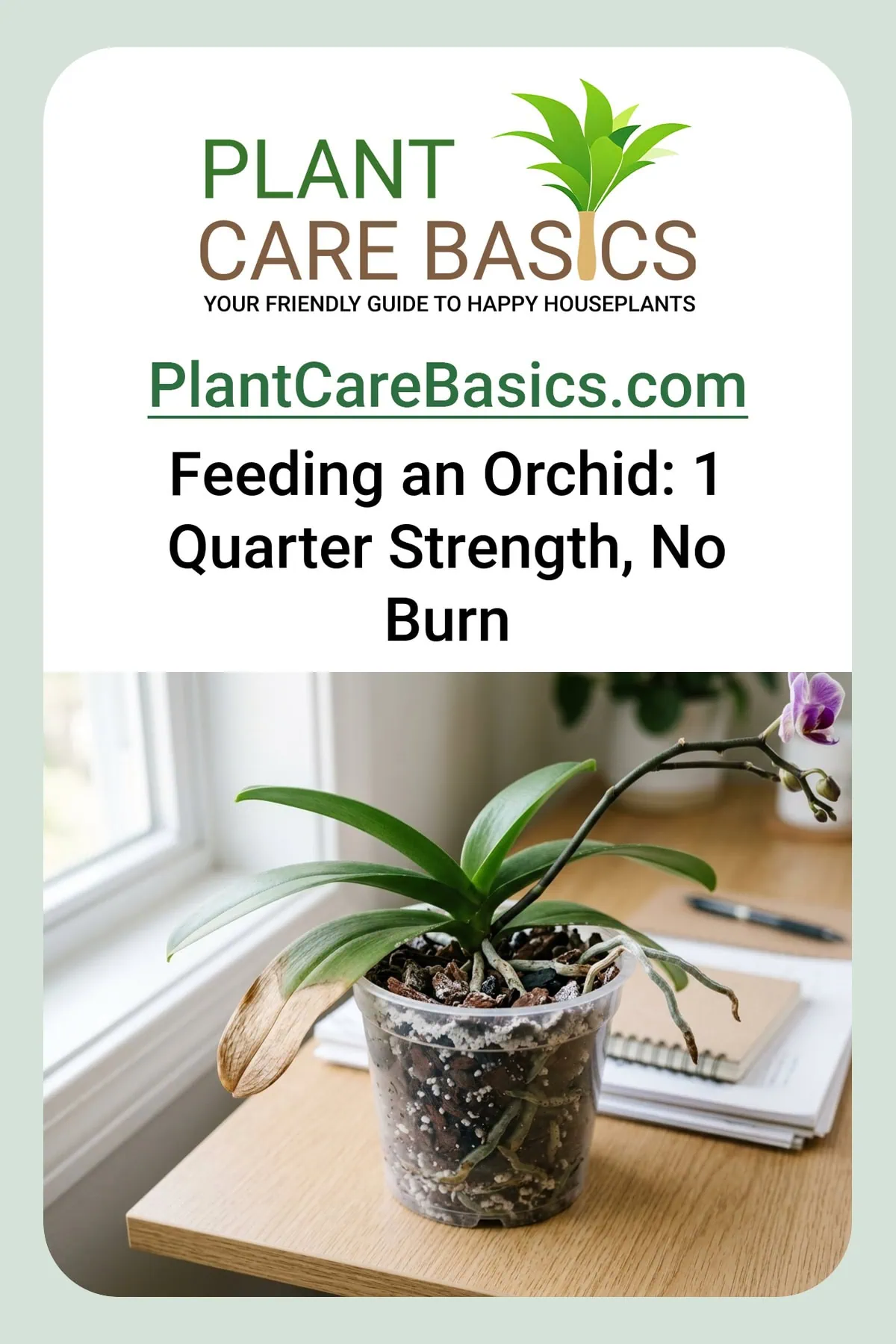
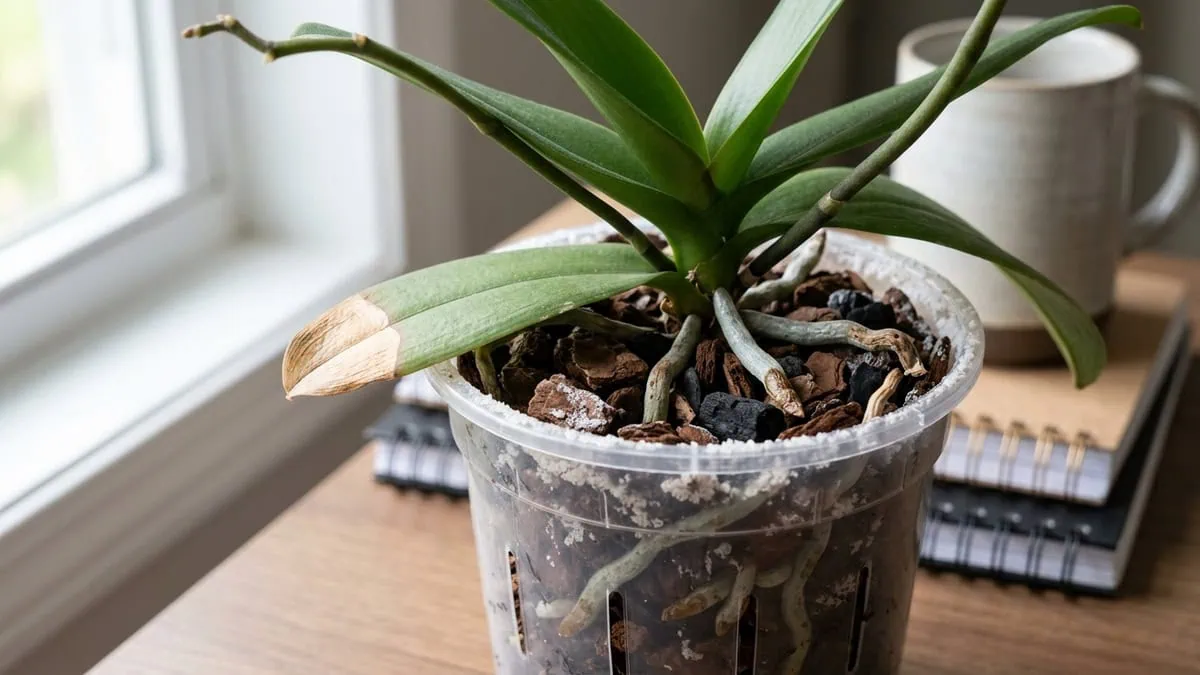
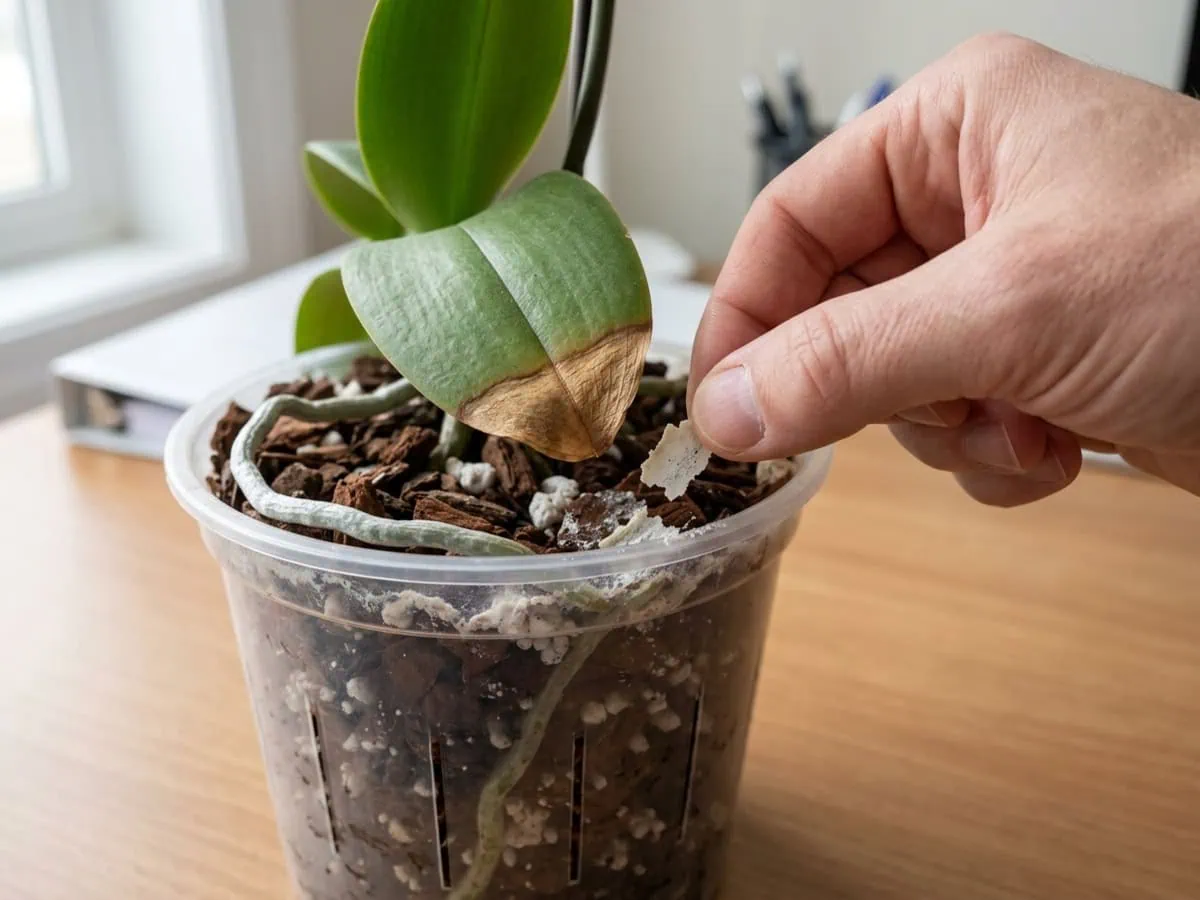
Fertilizer burn shows up at the edges first. Read the tips and the bark, not the whole leaf. Salt cannot travel far inside the plant. It stacks up where water exits the leaf and where it evaporates off the medium. That gives you three tells (TBH — the crust is the one I spot soonest): a dry brown scorch creeping in from the leaf tip, blackened or shriveled root tips, and a chalky, scrape-it-off crust ringing the bark and pot rim.
Leaf-tip scorch, root-tip browning, a salt crust on the bark
What does fertilizer burn look like on a Phalaenopsis leaf? Look for a hard, dry, tan-to-brown band along the very tip and margin, sharp-edged, not the soft yellow of an aging lower leaf. The edge gives it away.
Below the surface the story matches: firm white or green root tips give way to brown, mushy, or hollow ends. That same brown tip can also trace back to low humidity or hard-water minerals, so check the bark for a salt crust before you blame the feed.
One mechanism drives all three signs. A Phalaenopsis is epiphytic, its velamen-wrapped roots clinging to bark and tree limbs in the wild with no soil to dilute or hold nutrients. Caveat: this might be wrong, but the exact salt concentration where the velamen starts to collapse seems to shift with the plant and the mix; what stays constant is the direction.
As the medium dries between waterings, the leftover salt grows more concentrated and pulls water back out of the root cells by osmosis. Per Michigan State University, managing soluble salts in growing media is mostly a matter of never letting them build up in the first place.
A plain-water flush every 2-4 weeks for soluble salts
How often to flush Phalaenopsis bark to remove fertilizer salts? Run plain water through the pot every two to four weeks, with no feed in it. Pour slowly and let it drain fully, and keep going until the water runs clear, then tip out whatever pools in the saucer so the salt leaves instead of soaking back in. Salt leaves the way it came.
Keep the leachate EC in the 1.0-1.5 dS/m band between feeds; once a meter reaches 2.0 dS/m, flush at once, not later. When roots are already scorched, a flush plus fresh medium is the same move as salvaging roots damaged by salt or rot.
The flush is your reset button — fast, forgiving, and almost impossible to overdo with plain water. No fuss. Before, a white ring crusts the bark and the leaf tip turns crisp and brown; after a thorough flush, the bark is clean and the roots green up on the very next soak.
Bloom-booster and kitchen-remedy myths
Most feeding myths fail the same test: they promise a shortcut your orchid’s biology cannot actually use. The plant runs on stored energy and direct salt uptake, so anything that does not feed those two systems is, at best, decoration. Read each remedy against that bar.
Why a balanced formula beats a high-phosphorus booster
A balanced feed beats a high-phosphorus bloom booster, full stop. That big middle number sells the idea that phosphorus forces flowers, but a Phalaenopsis spikes on energy it banked over the previous year, not on a sudden phosphorus jolt. A steady balanced formula keeps the whole plant fed — leaves, roots, and the coming spike — which is the real feeding that supports a second spike. Skip the booster; consistency does the work.
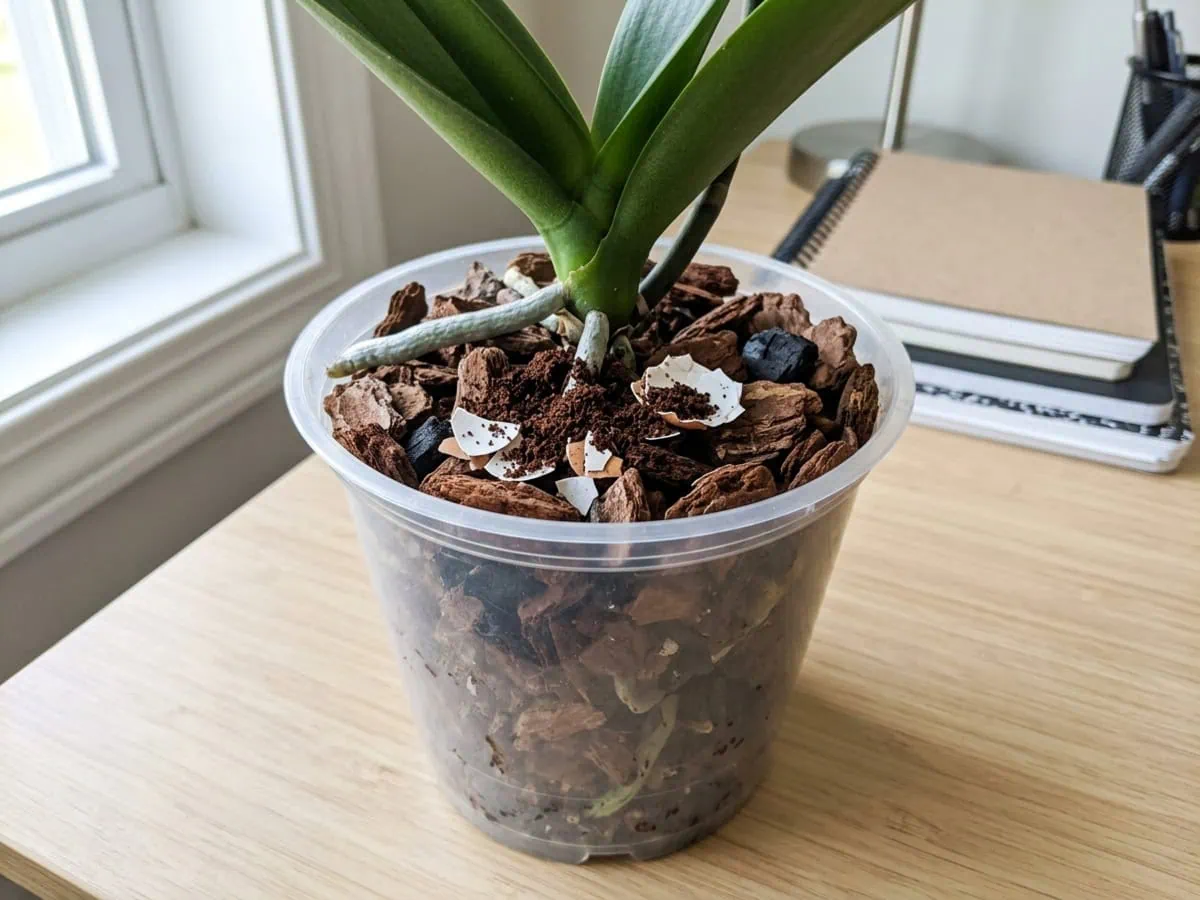
❌ “Switch to a high-phosphorus bloom booster and stir in coffee grounds to feed the flowers.” ✅ A balanced dilute feed carries bloom on stored reserves, and coffee grounds do nothing useful in bark; they break down slowly, acidify the mix, and rinse out at the next flush before roots take in much.
Coffee grounds, eggshells, Epsom salt guesses
Kitchen remedies each hand the plant a single nutrient, unpredictably, never a balanced feed. Eggshells are slow-release calcium and little else; Epsom salt is magnesium only; a used tea bag leaks a trace of nitrogen. Worse, any solid you sprinkle on open bark just sits there until the next flush rinses it through, because the chunky mix never grips it the way soil would. Use them as occasional extras at most; a complete water-soluble orchid feed stays the baseline.
MSU versus urea in a bark mix
Is MSU fertilizer better than urea-based food for orchids? In a bark mix, yes. The microbes are the catch: urea nitrogen has to be converted by them before roots can use it, and chunky bark holds far fewer microbes than soil, so urea-based feed largely passes through unused.
MSU-type formulas (a 13-3-15 blend that bundles calcium and magnesium, sold in tap-water and RO-water versions) lead instead with nitrate nitrogen the roots absorb directly. Read the label and pick nitrate-driven, non-urea nitrogen for bark, whatever the brand on the bottle.
Strip away the folklore and the program is genuinely short: a balanced dilute feed, nitrate-form nitrogen, a plain-water flush every few weeks, and an easing-off once the buds open. Everything else is noise dressed up as a shortcut, and your moth orchid quietly ignores all of it.
Common feeding questions, answered
What is a good homemade fertilizer for orchids?
No homemade fertilizer reliably matches a balanced, water-soluble orchid feed. Kitchen ingredients each deliver one nutrient in an uncontrolled dose — eggshells give slow calcium, Epsom salt gives magnesium, a used tea bag leaks a little nitrogen — and none supplies balanced nitrogen, phosphorus, and potassium together. On chunky bark, solids also rinse out before roots absorb much. A quarter-strength complete orchid fertilizer beats any pantry mix.
Do coffee grounds help orchids grow?
No, coffee grounds do not help orchids grow in bark. They release nutrients slowly and unpredictably, acidify the mix as they break down, and add a soggy layer that holds water against roots built for fast drainage. On open bark, most grounds simply rinse through at the next watering. A dilute, balanced orchid fertilizer delivers the same nutrients in a form the velamen can actually absorb.
Is Epsom salt a good fertilizer for orchids?
Epsom salt is not a fertilizer; it supplies only magnesium, not the nitrogen, phosphorus, and potassium a plant needs to grow. It can correct a confirmed magnesium shortfall in small amounts, but used as a routine feed it only adds to the dissolved-salt load that scorches orchid roots. A complete, balanced orchid fertilizer already includes magnesium, so most growers never need to add it.
What to feed Phalaenopsis orchids?
Feed Phalaenopsis orchids a balanced, water-soluble fertilizer at a quarter of the label strength, weakly and weekly. A 20-20-20 works well; in a bark mix, a higher-nitrogen 30-10-10 offsets what the decaying bark ties up. Aim for roughly 40-60 ppm nitrogen in nitrate form, not urea, and wet the bark with plain water before you feed. Flush with plain water every two to four weeks to stop dissolved salts from building up.
Are used tea bags good for orchids?
Used tea bags are not a good orchid fertilizer. Spent tea holds only a trace of nitrogen and no meaningful phosphorus or potassium, so it cannot feed a plant on its own. Laid on bark, the damp bag also traps moisture against the medium and invites mold, working against the fast-drying conditions orchid roots need. A dilute complete orchid fertilizer gives steadier nutrition without the soggy residue.
What to sprinkle on orchids to make them grow?
Nothing sprinkled dry on the bark reliably makes an orchid grow. Solid add-ons such as eggshell, crushed bone, or granules sit on the surface and rinse straight through the chunky mix at the next watering, so the roots see little of them. Orchids feed best from a dilute liquid fertilizer the velamen absorbs on contact. If growth has stalled, check light, watering, and salt buildup first.
Are eggshells good orchid fertilizer?
Eggshells are not an effective orchid fertilizer. They are almost pure calcium carbonate, which breaks down very slowly and washes out of a fast-draining bark mix before much releases. They also supply none of the nitrogen, phosphorus, or potassium an orchid needs to grow. A balanced orchid fertilizer already carries calcium in an available form, so crushed shells only add cleanup work without usable nutrition.
Field-tested feeding: dilute, flush, ready to try?
The whole method fits in one breath: feed weak, feed often, wet the bark first, and flush the salt out every few weeks. That is it. Get that rhythm down and the gritty crust never comes back; your roots stay firm and silver-green, your leaf tips stay smooth.
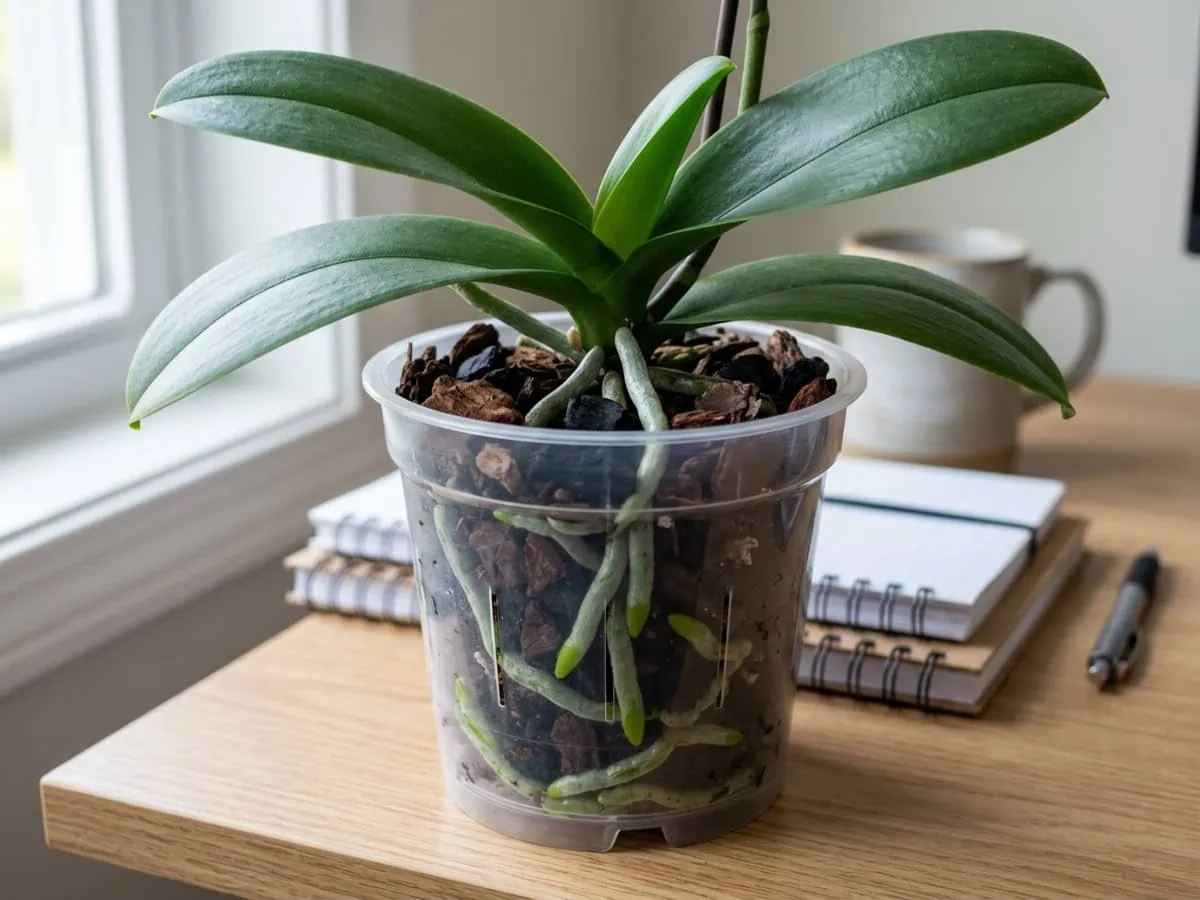
Once the bark looks tired and salt-streaked, the next move is refreshing spent, salt-loaded bark so the reset is complete. Nail that quarter-strength habit and you have learned how to fertilize a Phalaenopsis orchid without fertilizer burn, for good.
May your feed stay weak, your bark flush clean, and your roots never wear a crust of salt.
Tap the button below to get more plant fixes in your Google Search results