🎯 Quick Answer: why orchid buds and flowers drop
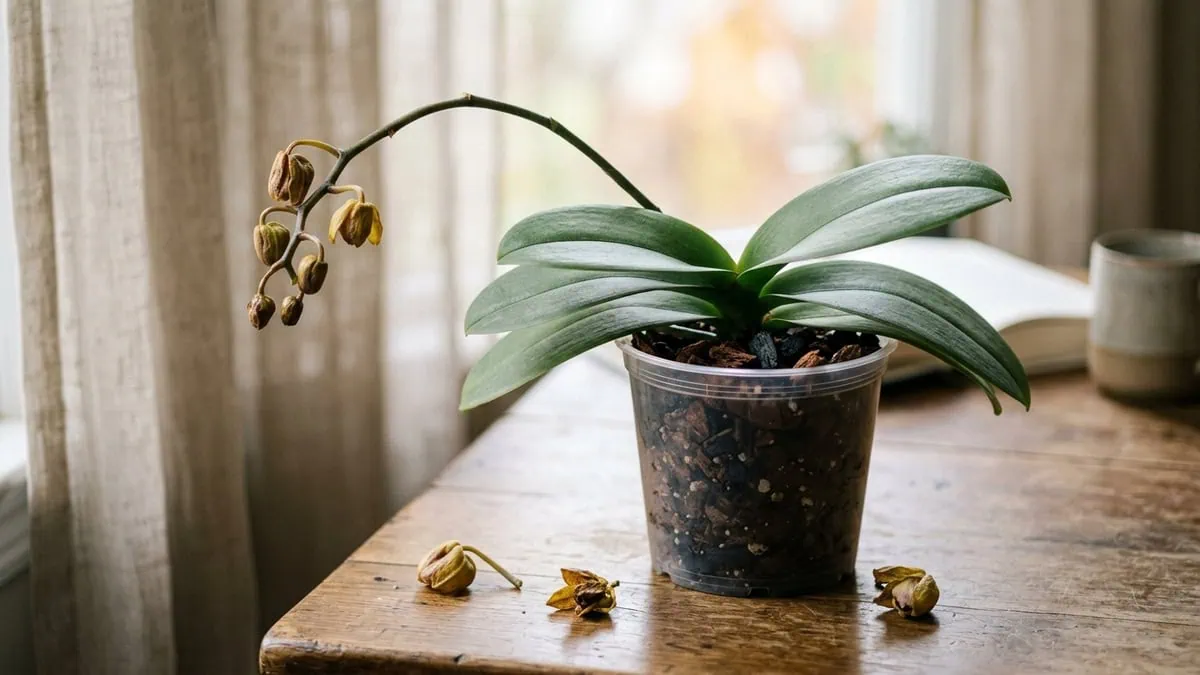
Why is my Phalaenopsis orchid dropping buds and flowers? This orchid, a member of the Orchidaceae family, fails to hold its buds under stress. The top trigger is a cold draft below 55F; ethylene and a humidity crash do the same. Steady those fast and the rest hold.
- Cold drafts: a drafty window or AC vent dipping below 55F
- Ethylene gas: ripening fruit, smoke, or a gas flame within 10 feet
- Humidity crash: dry indoor air under 40% shrivels developing buds
- Watering stress: bone-dry roots or waterlogged roots both starve buds
- Natural fade: oldest flowers age out from the spike base upward
Confession time: I lost the buds on four moth orchids before the lesson stuck. Each time I grabbed the watering can first (TBH — a light, dry pot fooled me every round).
Two years of that failure forced me to learn the real culprit. Wait — I’m getting ahead of myself.
Buds do not starve here. They drop. A cold draft below 55F off the glass, or ethylene rising off a fruit bowl, fires the abscission zone — the thin band of cells behind flower abscission that releases a sealed bud on cue.
Cold, ethylene, a humidity swing. Any one trips that switch. Steady the air around the spike and the rest of the buds hold.
For the full routine, start with the moth orchid care handbook.
Take a breath. If the spike is already shedding, the table below maps every common bud-drop trigger to the number that stops it.
Why is my Phalaenopsis orchid dropping buds and flowers? The quick read
| Moth orchid specs | Recommended care |
|---|---|
| Bud blast | Buds yellow, shrivel, and drop before they open |
| Temperature edges | Day 70-80F, night 60-70F; loss likely below 55F or above 85F |
| Ethylene sources | Ripening fruit, smoke, gas — keep the plant 10 ft away |
| Humidity | 50-60% RH; bud-blast risk rises as it falls below 40% |
| Natural fade | Oldest flowers fade from the spike base upward over weeks |
| Light | Bright indirect; never direct sun on the buds |
| Does a cold draft cause bud drop? | Yes — a drafty window is the number-one cause |
| Is the plant dead when flowers fall? | No — fade is rest, not death |
Tap the button below to get more plant fixes in your Google Search results

Table of Contents
What bud blast is, and the triggers that set it off
Bud blast is the loss of flower buds before they open. So what causes Phalaenopsis bud blast before the flowers open? Almost always an environmental jolt, not a pest.
According to a peer-reviewed study of ethylene’s effect on flower abscission, a stressed plant switches on a layer of cells that releases the bud on purpose. The flower is not damaged. It is let go.
- Abscission zone: a band of cells at each bud’s base that the plant uses to drop the bud on purpose.
- Ethylene: a natural ripening gas from fruit, smoke, and flames that signals a bud to let go.
Three triggers flip that switch.
Temperature, drafts, and the 55-85F edges
Does a cold draft cause Phalaenopsis flower buds to fall off? Yes. A drafty window is the number-one cause.
Hold days at 70-80F and nights at 60-70F. Loss turns likely below 55F or above 85F. The real danger is local, not the room average.
A bud an inch from cold glass meets a chill the thermostat never sees, and by morning the buds have rolled loose across the sill.
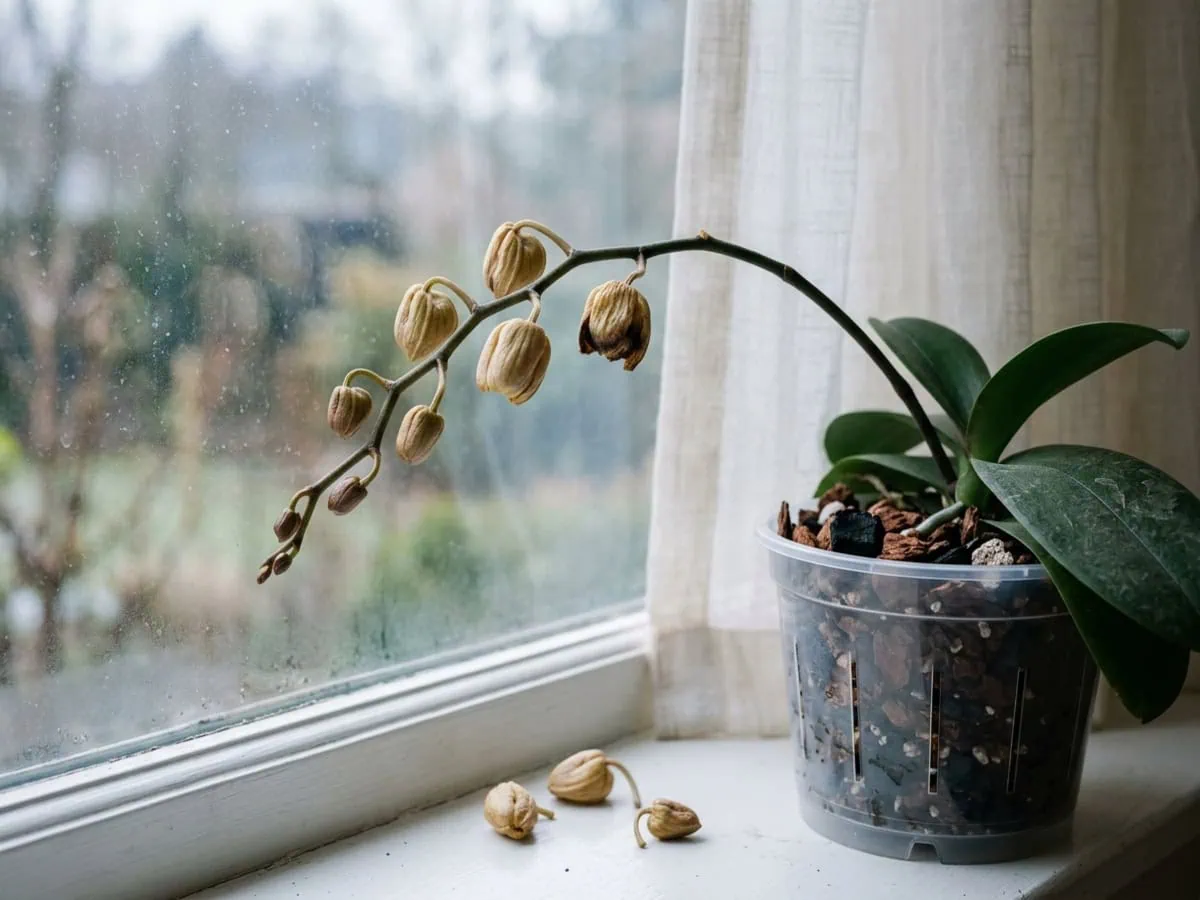
Heat is the quieter half: above 85F, open flowers drop early and new buds stall.
If the leaves go soft too, this guide to reading stressed leaves separates a heat problem from a root problem.
Ethylene from fruit, smoke, and gas
Ethylene is the trigger most growers miss. Ripening fruit, cigarette smoke, a gas stove, any open flame pushes ethylene into the room (stay with me here), and the plant reads it as a cue to drop its flowers.
So keep a budding orchid at least 10 feet from fruit, smoke, and burners.
Ethylene signaling tells the abscission zone to separate. Even a healthy bud is shed. I have a hunch about this but no peer-reviewed source for the exact dose each hybrid tolerates. The direction holds well enough to act on.
Humidity swings and watering at the buds
Humidity belongs in the 50-60% band. Bud-blast risk climbs once indoor air drops below 40%. Dry, heated air pulls moisture from a thin-walled bud faster than the roots replace it.
Watering errors feed the same failure from below. Bone-dry roots cannot push water to the buds. Waterlogged roots rot.
Either way the buds starve. Match watering to the roots, not the calendar. This watering that won’t shock buds guide covers the read-the-roots method.
Changing one thing at a time is how to stop a Phalaenopsis from dropping flowers prematurely.
Keep a budding moth orchid clear of three triggers: cold drafts under 55F from windows, doors, and vents; ethylene from fruit, smoke, or gas within 10 feet; and roots left bone-dry or waterlogged. Any one can drop a full spike overnight.
Tap the button below to get more plant fixes in your Google Search results

Store-to-home shock — and bud blast versus natural fade
The move from shop to living room is the second-biggest reason buds drop. Shop air is bright, humid, and stable. Your home is none of those.
A budded spike registers the gap at once. The following sections cover bringing one home, telling a real problem from a normal one, and the light.
Bringing one home without dropping buds
Is it normal for a Phalaenopsis to drop buds after moving it home? Yes. A first-week tumble of a few buds is a shock response, not a care failure.
The fix is the trip itself. Sleeve the plant for the walk to the car. Never set it in a cold trunk or on a hot dashboard.
Run the cabin air on recirculate so exhaust fumes stay out. Once home, pick one bright, draft-free spot and leave it there.
A plant already nursing shock after a move or a repot wants stability above all else.
Bud blast or an old flower fading?
The difference between bud blast and natural flower fade in orchids comes down to which flowers go, how fast, and what the spike looks like after.
Natural fade starts at the base. The oldest flowers thin to paper, and the change creeps slowly upward over weeks.
The spike stays green. The plant stays firm. Bud blast is the opposite.
Several buds or flowers let go at once, often overnight, yellowing and shriveling before they open.
A healthy moth orchid holds its display for 2-4 months; flowers leaving from the bottom after that is rest, not death.
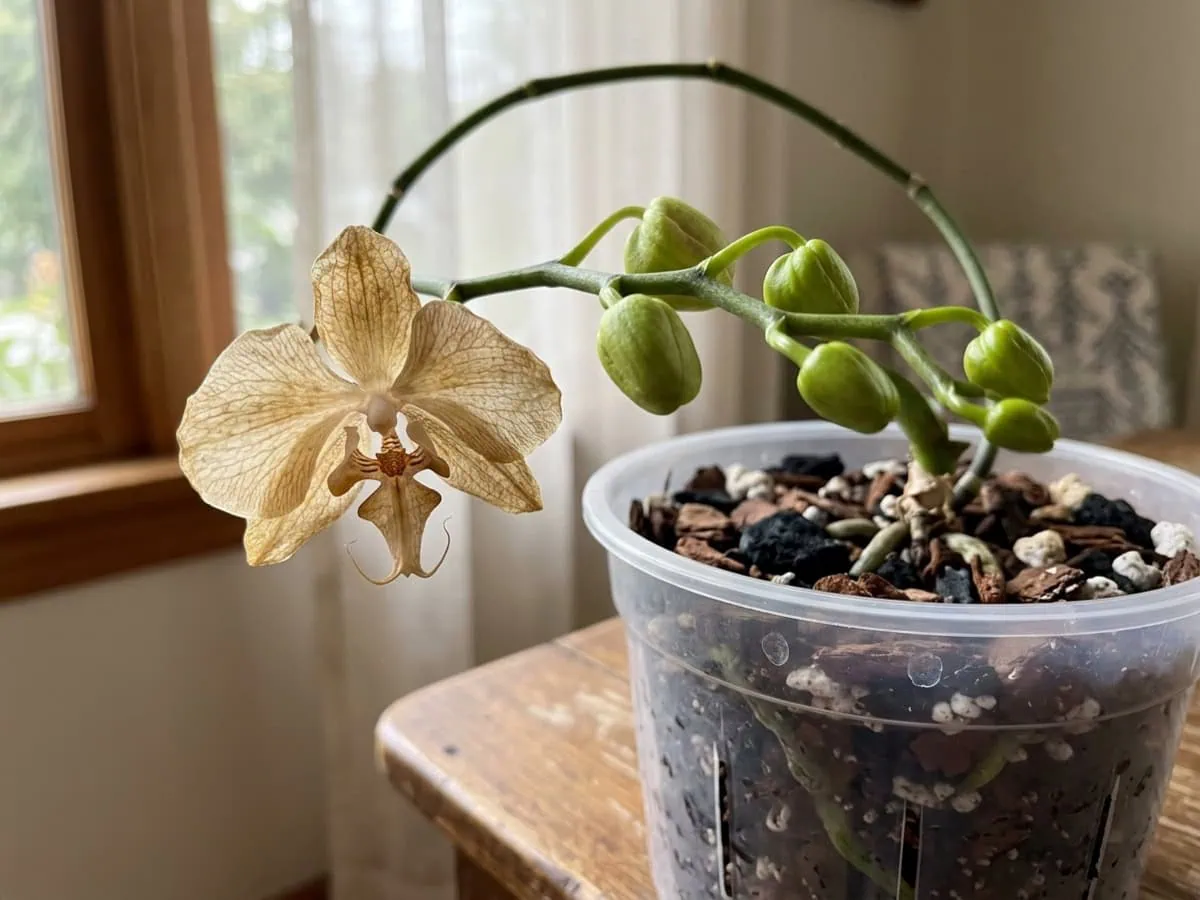
Quick story: the first spike I “rescued” by moving it somewhere brighter, I finished off myself. Every shift to a new windowsill knocked another bud loose until the spike stood bare. It never needed a better spot — it needed me to stop moving it. One stable corner, and the next spike held every bud.
Light at the buds: bright but never direct
Light decides whether a spike finishes, and “bright, indirect” is too vague to act on. So here are the numbers.
A moth orchid wants roughly 1,000-1,500 foot-candles, the band where buds mature and open. It survives near 500 FC. Spikes stall and buds drop in chronic low light.
Sustained light above 1,500 FC scorches leaves and buds alike. No meter? Read the leaves.
Light yellow-green says the level is right, dark green means too little, and a red flush means too much.
An east window, or a sheer-curtained south window, lands in the sweet spot, with direct midday sun kept off.
Bud-drop myths and the fixes that backfire
Most standard advice for a dropping orchid does more harm than good. It piles a second stressor onto the first.
The sections below sort the myths from the moves that actually hold buds.
Ice water, ‘move it brighter’, daily misting
Three popular fixes backfire on a budding plant. Ice cubes and cold tap water shock the roots and set off the very bud drop you are trying to stop. Use room-temperature water instead.
“It must need more sun,” so the pot goes to a hot, bright window, and direct sun overheats and desiccates the buds. Bright but indirect is the rule, and when in doubt, err shady.
Daily misting feels caring. Yet water pooling in the crown and bud sheaths invites rot. Lift humidity with a tray or humidifier and keep the buds dry.
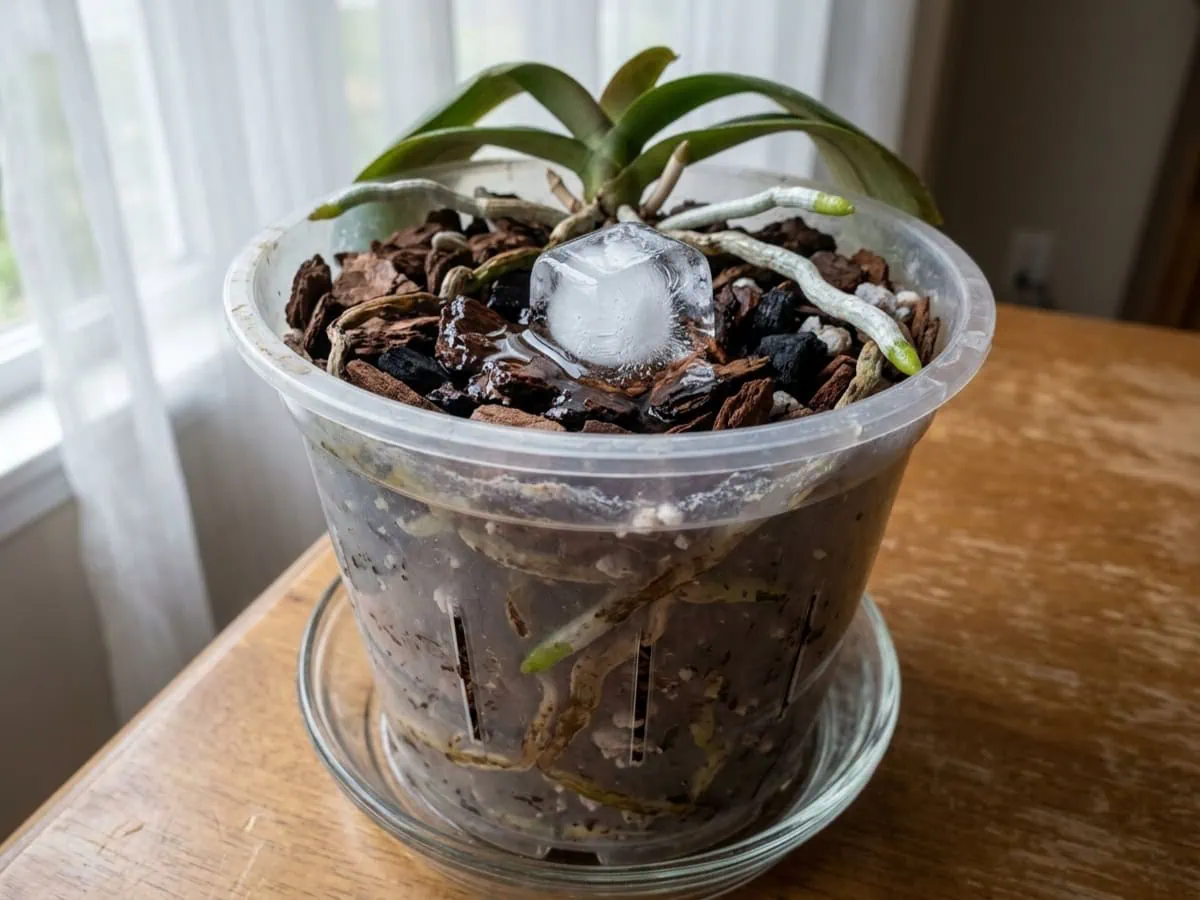
❌ Myth: a dropping orchid needs ice water, more direct sun, and daily misting. ✅ Fact: cold water shocks the roots, direct sun scorches the buds, and misting pools water in the crown — all three speed up bud drop. Use room-temperature water, bright indirect light, and tray or room humidity instead.
Each myth adds a jolt the plant reads as one more reason to drop.
The fix is the opposite of effort: fewer changes, held steady, for longer. Pick one good spot, one watering rhythm, and one humidity source, then leave the spike to finish its run.
Dropped flowers don’t mean a dead plant
When the last flower finally falls, the plant is not dead. It is resting.
Keep watering on the same read-the-roots rhythm. Hold the light bright and indirect. A green spike can branch and rebloom from a node, so leave it in place.
But a spike gone brown and dry all the way down has finished. Cut it back to the base with a sterile blade.
Either way, firm leaves and live, silvery-green roots mean the plant is fine and quietly building toward its next round of buds.
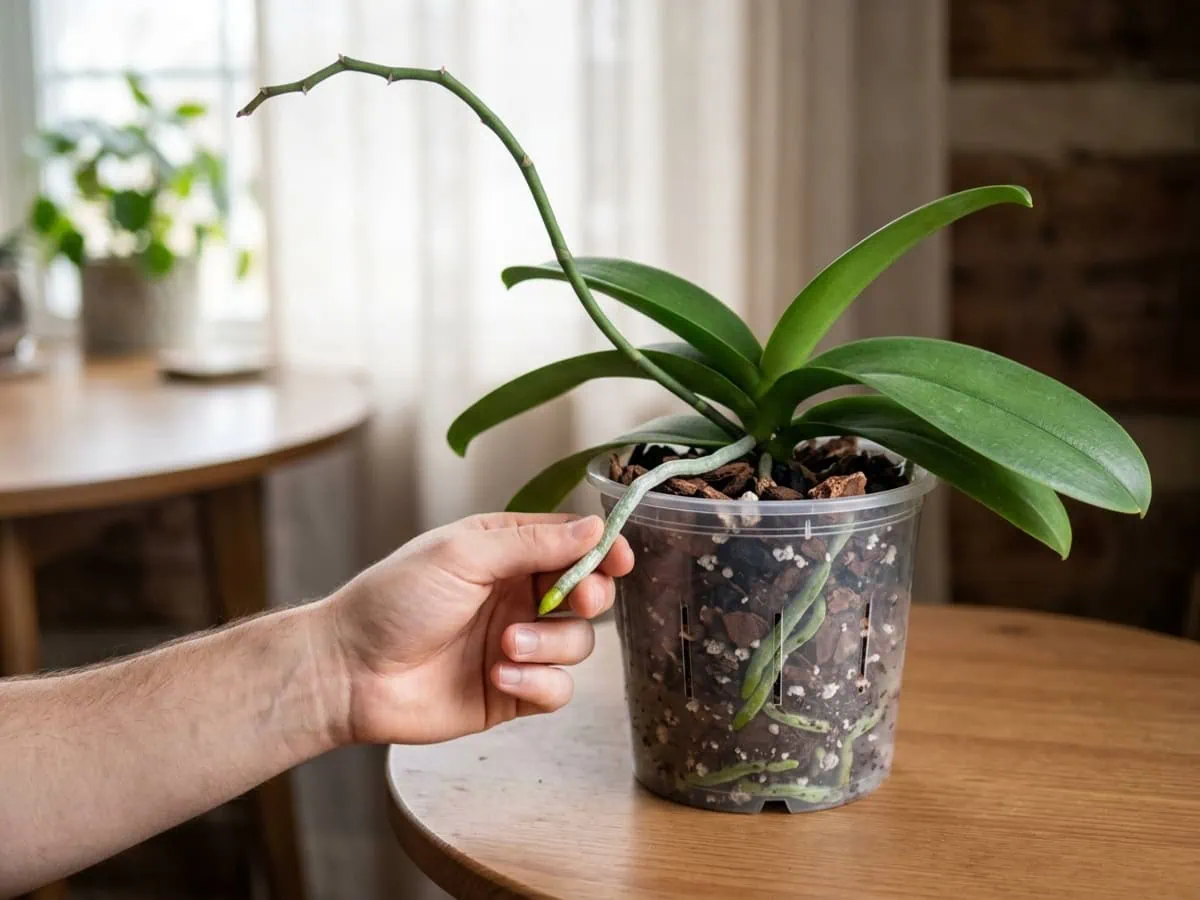
Give it steady light and water, and a fresh spike or side branch pushes out on its own schedule, usually within a few months of the last flower dropping. Watch the roots, not the spike. Plump, silvery-green roots tipped with bright, active growing points are the first real sign the plant has stopped resting and is banking the energy to push that new spike.
No rush. The recovery runs on the plant’s own clock, not yours.
Bud and flower drop: common questions
Why is my orchid dropping its flower buds?
Bud blast — buds dropping before they open — is almost always an environmental jolt. The usual culprits are a cold draft below 55F, ethylene from nearby fruit or smoke, a humidity crash under 40%, or roots left bone-dry or soggy. Steady those and the remaining buds hold.
Each trigger flips the abscission zone behind flower abscission, so steady the air, not the plant.
What are the signs of an overwatered orchid?
Overwatered roots turn brown, soft, and mushy, then stop delivering water — so the buds starve and drop even while the pot feels wet. Above the mix you may see yellowing lower leaves and a wobbly base. For a budding plant, soggy roots are a direct bud-drop trigger.
Healthy roots stay plump and silvery-green; a brown, airless velamen can no longer push water to the spike.
What month do orchids lose their flowers?
There is no set month — loss tracks conditions, not the calendar. Flowers and buds drop whenever indoor air turns cold and drafty or heater-dry, whichever part of the year that happens where you live. Watch the thermometer and hygrometer, not the date.
A draft below 55F or air under 40% humidity flips the abscission zone — physics, not a date.
What do I do when my orchid drops all its flowers?
Do not bin it — the plant is resting, not dead. Keep watering on the read-the-roots rhythm, hold bright indirect light, and leave a green spike in place, since it can rebloom from a node. Cut a fully brown, dry spike back to the base.
Hold about 1,000-1,500 foot-candles of bright indirect light; a new spike usually pushes from a node within a few months.
Do you still water an orchid after the blooms fall off?
Yes. Keep watering on the same rhythm after the blooms fall off — the roots and leaves still need moisture to build the next spike. Water when the roots turn silvery and the pot feels light, then let it drain completely so nothing pools.
Hold 50-60% humidity and 70-80F days so the leaves keep photosynthesizing and bank the energy a new spike demands.
Are orchids still alive when the flowers fall off?
Yes — losing flowers is a normal rest phase, not death. As long as the leaves stay firm and the roots are plump and silvery-green, the plant is healthy and storing energy for its next bloom cycle. Flower loss is the end of a display, not the plant.
Natural fade creeps upward over weeks; a sudden overnight drop of several buds is stress-driven bud blast.
How to encourage orchid buds to bloom?
Hold everything steady so the current buds finish: bright indirect light, 70-80F days, 50-60% humidity, and no drafts or ripening fruit nearby. Change one thing at a time. Once this round opens, a cool night drop is what sets the next spike.
Keep ethylene sources — fruit, smoke, gas — about 10 feet off, since even a trace tells the abscission zone to release a bud.
Your next step: from dropping buds to a steady bloom
The fix is stability. Buds drop when the plant reads a jolt and decides to let go. A draft. A fruit bowl. A humidity swing. A watering miss. Any one trips the switch, so steady the air, keep the buds dry, and stop relocating the pot to hold that abscission switch off.
Once this spike opens clean, the natural next move is coaxing the following one. Start with getting the next spike to form. Hold those conditions steady and you have answered, for good, why is my Phalaenopsis orchid dropping buds and flowers.
May your buds hold fast and open one steady row at a time.
Tap the button below to get more plant fixes in your Google Search results