🛠️ Quick Prep Summary: rooting a Pothos cutting in water
Epipremnum aureum roots from a stem segment, never from a leaf alone. Everything in how to propagate Pothos from cuttings step by step rests on one node. Three prerequisites come first: a sterile blade, a node below the water line, and active growth. Gather them before you cut.
- Sharp, sterilized snips — wipe the blade with alcohol before the cut
- A clear glass jar — plain room-temperature water, deep enough to cover one node
- Timing: take cuttings while the plant is in active growth
Pothos cutting after cutting has gone into a jar on my sill over the years, and the failures all failed alike. I had cut through the smooth middle of a stem instead of just below a node, and that bare tube stayed cold to the fingertip week after week. Nothing formed, week after week, and it took me far too long to see why.
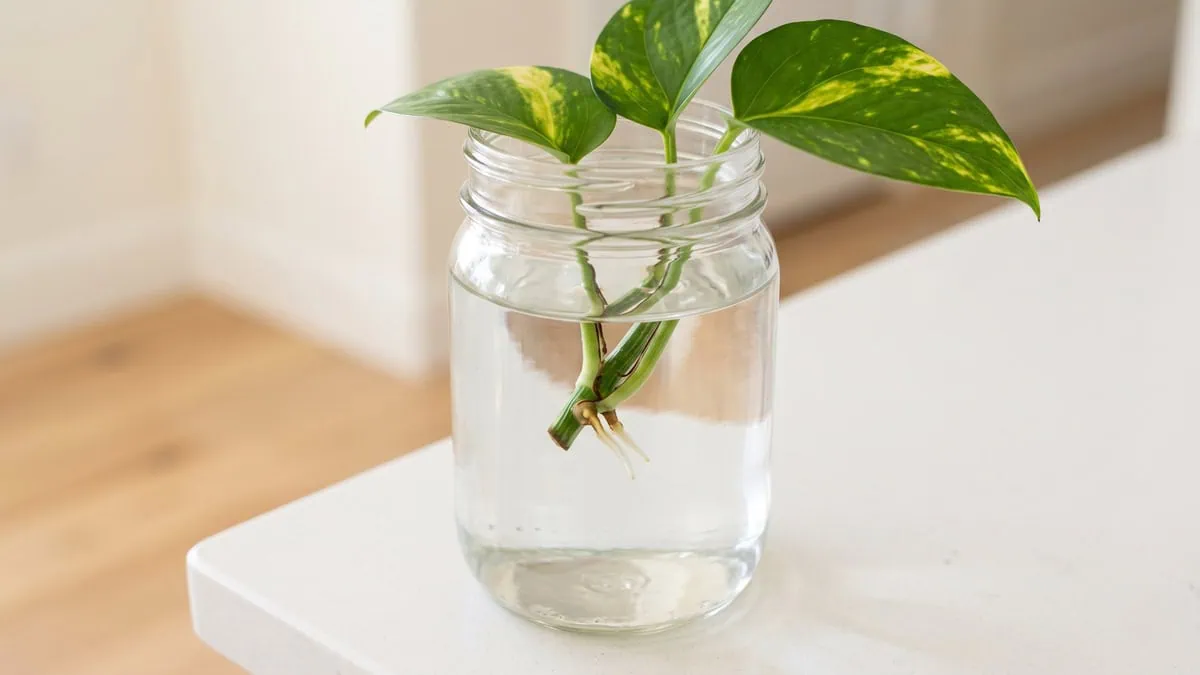
Rather than a length of stem that roots anywhere along it, I discovered this vine roots at one point only — the node, which already carries a short adventitious root grown straight from stem tissue. Correction — what I meant was that a cutting with two of those joints shows white tips inside 1-2 weeks, because the nub is already a root.
So everything turns on where the blade lands relative to that joint. Nothing more exotic. And once these cuttings root and move into mix, the wider routine for keeping an established Pothos healthy indoors takes over.
None of this needs special equipment, which is the good news. Every spec you will check before and during the cut is gathered into a single spec table underneath.
How to propagate Pothos from cuttings step by step: the quick specs
| Pothos specs | Specification |
|---|---|
| Difficulty level | Low (beginner) |
| Time needed per cutting | 5-10 minutes |
| Minimum cutting spec | Two nodes minimum (not more than six), 3-6 inches long |
| Snips sterilized before the nodal cut? | Yes |
| Rooting hormone required? | No |
| First visible roots | About 1-2 weeks |
| Pot-up trigger | First roots about 1 inch long |
Tap the button below to get more plant fixes in your Google Search results

Table of Contents
Before you cut: what a usable cutting needs
A usable Pothos cutting has to carry a node — the swollen joint where a leaf meets the stem — and the working spec is two of them.
Start with node count and segment length, then tools, then hormone, then which of the two rooting routes to take.
No node, no roots: what every cutting must carry
The question people type is “do pothos cuttings need a node to grow roots” — and the answer is yes, without exception. A leaf pulled off alone, stalk and all, softens in water instead of rooting.
Roots form there because the node holds live meristematic cells, undifferentiated cells that can still become something else, plus a short adventitious root pointed downward, opposite the leaf stalk.
Tentatively, the exact trigger is still argued: auxin pooling at the cut end, the wounding response itself, or both. Where it happens is not in doubt.
How many nodes per cutting, and how long
Take a segment carrying two nodes minimum and no more than six, cut 3-6 inches long. According to Illinois Extension, that node count and segment length are the working standard for taking stem cuttings from houseplants, and the same page covers the rooting media.
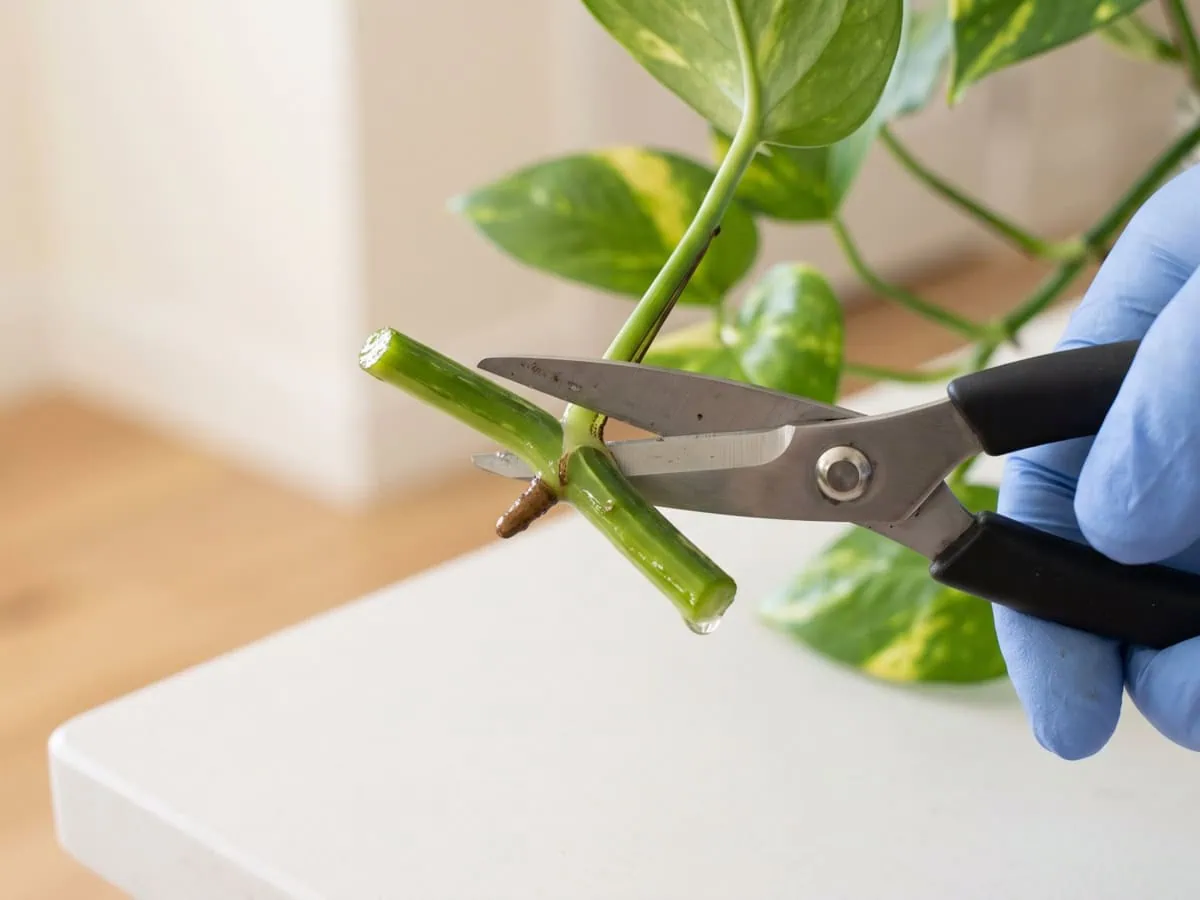
Place the cut roughly three-eighths of an inch below the node, on a slight angle. That short stub keeps live tissue at the base without stranding a dead tail in the water.
You can go smaller. Single-node pieces on my own sill rooted just as readily, and taking a long vine apart into them turns one plant into many.
Clean snips, safe sap handling, and the timing question
Wipe the blade before the first cut. A 10% bleach solution or plain rubbing alcohol across the cutting edge does it.
Wear gloves. The blade comes out of that alcohol cold enough to feel through a nitrile glove, and it dries in seconds; rinse with cool running water if sap lands on your skin.
Cuttings taken while the plant is actively pushing new leaves root fastest, and a room held between 70-85F is where that growth happens. From a cool room they still root — just slower.
Rooting hormone: optional, and only on the mix route
You need to buy nothing to start: rooting hormone powder is an aid rather than a requirement, and on a vine that roots this freely it changes very little indeed.
If you use it, use it on the straight-to-mix route: dip the cut end, tap off the excess, insert. In water it disperses, with no cut surface holding it in place.
Water route or straight-to-mix route: how to choose
Both routes work. Here they are side by side on the four points that actually differ.
| What changes | Water route | Straight-to-mix route |
|---|---|---|
| What you can see | Roots visible day by day in the glass | Nothing visible until new leaf growth appears |
| Root type formed | Coarser roots adapted to water | Roots adapted to the mix from the start |
| Transfer step | One move into mix, at about 1 inch of root | None |
| Best suited to | A first attempt, or a stem you want to watch | A grower who already trusts the medium |
Verdict: choose the water route for a first attempt, since you can watch the roots and act on what you see. Choose straight-to-mix once you trust your medium.
That medium is a chunky coir-based aroid mix, 1 part coco coir to 1 part orchid bark to 1 part perlite, top-dressed with a thin layer of fine orchid bark.
Tap the button below to get more plant fixes in your Google Search results

Rooting the cutting: the five-step water method
Rooting a Pothos cutting in water takes one node under plain water, a warm bright spot, and a weekly refresh until roots reach about an inch. The last step turns on root length, not a date.
Run these in order; a safe-handling stop sits between the cut and everything after it.
Step 1: Cut just below a healthy node
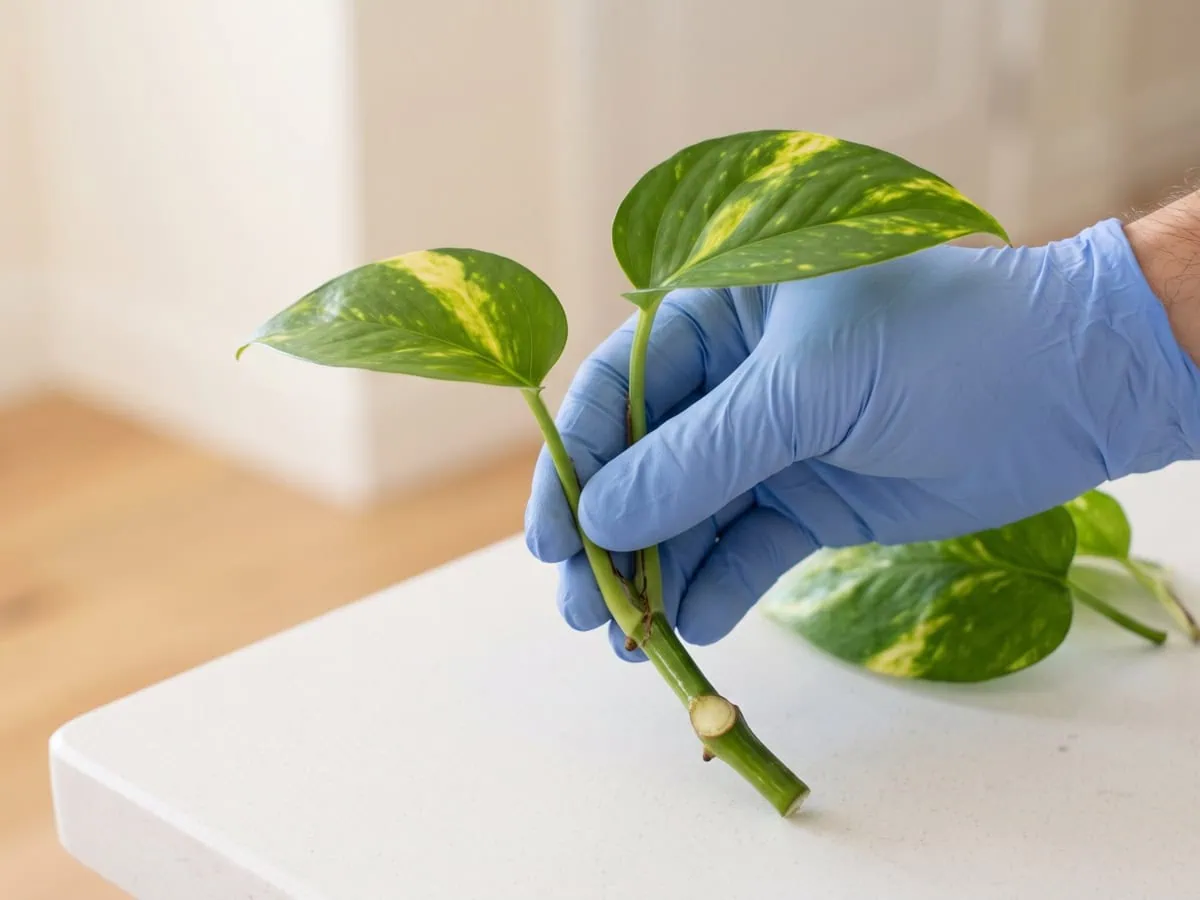
Choose a firm green stem and count two swollen joints along it. Cut just below the lower joint, blade on a slight angle so the face comes away oval rather than square — the wound itself is part of what starts the root response. The fresh face is wet and cool against a thumbnail, dulling to matte inside a minute. Keep the segment 3 to 6 inches.
- Glove up before the first cut, because every cut face and every stripped leaf scar keeps weeping while you work.
- Sap on skin goes straight under a cold running tap for a full minute, before you touch anything else on the bench.
- Hands stay off your face until they are washed — the liquid on them carries the same crystals the leaf tissue does.
If a severe skin reaction develops (blistering or intense burning), seek medical attention immediately. For chemical exposure, you can also contact Poison Control (1-800-222-1222 in the US).
Step 2: Strip the leaves that would sit underwater
Pull off every leaf whose stalk would fall below the water line, including the one at the node you plan to submerge. Two or three leaves stay at the top. Submerged leaf tissue breaks down within 2 days and clouds the water, and the bare scar left behind feels slick and cooler under a fingertip than the leaf you just took.
Step 3: Submerge every node, then place the jar warm
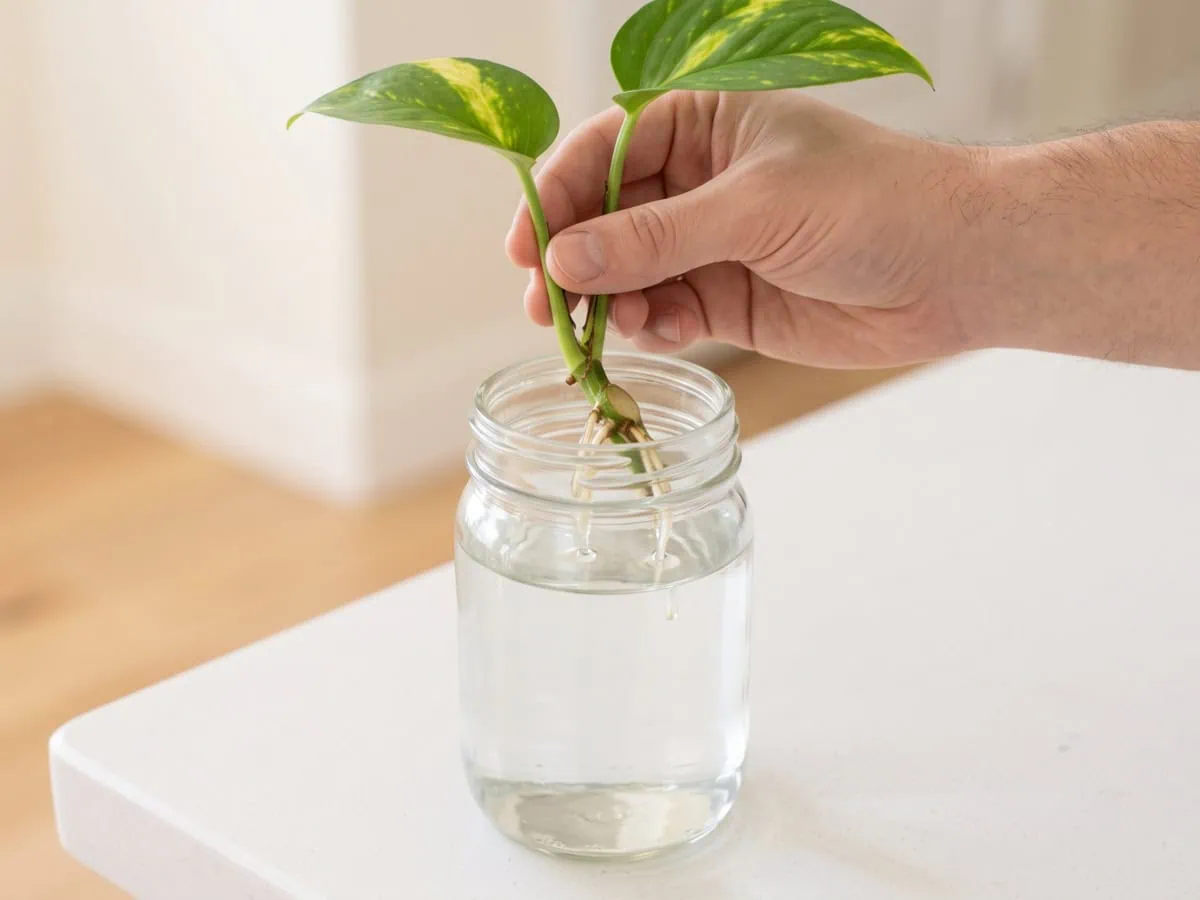
Set the cutting into a clear glass jar and add plain water until at least one node sits under the surface — a stem end alone in the water is a cutting that never starts. Water from a cold tap reads chilly against the inside of the wrist; let it stand until it reads like nothing at all. Site the jar in bright indirect light. Keep it out of direct sun. Hold the room inside the plant’s active-growth range, 70-85F.
Step 4: Refresh the water weekly, sooner if it clouds
Change the water once a week. Change it sooner if the cut end blurs behind the glass. Roots need oxygen as much as they need water, and a jar left a full week is where submerged tissue starts breaking down — clearing that is the whole point of the change. Week-old water comes out at room temperature and faintly slick; what goes back in is cooler. Crowd four cuttings into one small vessel, as I have, and it clouds sooner.
Step 5: Read both milestones before you pot up
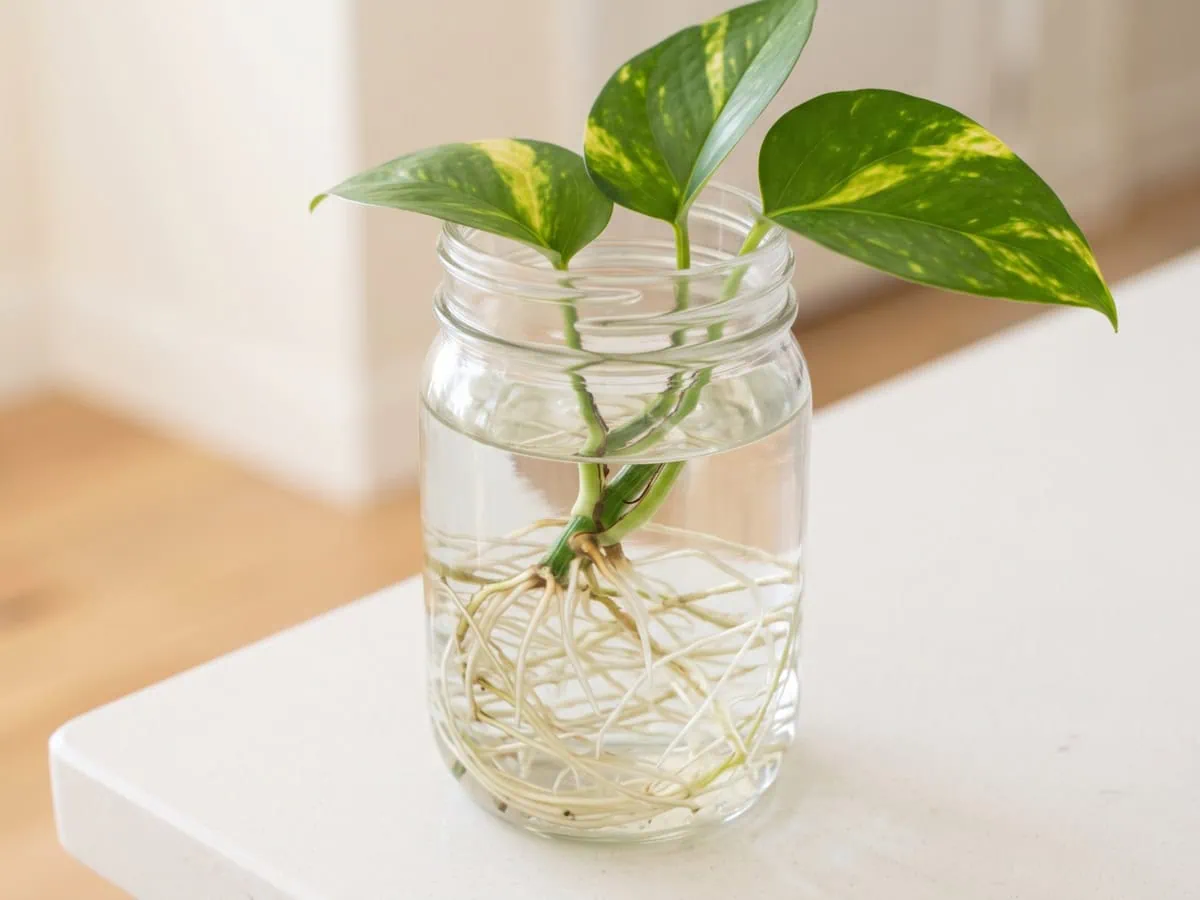
Readers search “how long do pothos cuttings take to root in water” expecting one number, and the honest answer is two. First white tips show at roughly 1-2 weeks. The move into mix is not a date but a length — pot up when the first roots reach about 1 inch, because water-formed roots are coarser and the longer they run in the glass the worse they take to a mix. The glass reads it back: cool on the shaded side, warm where the light lands.
After the roots: potting up, stalls, and the mother plant
Potting up happens on root length, about 1 inch — a stalled cutting is usually one of four fixable things, and the plant you cut regrows from its last node.
Five short sections follow: depth, drainage, a stall, water culture, and the cut plant.
Planting depth and the first two weeks of moisture
Ask “how to move rooted pothos cuttings into soil” and depth is the one thing the results skip. Set the crown about half an inch down, then firm the mix so the cutting stands.
Hold that mix evenly moist — not saturated — through the first two weeks while the water roots convert. A terracotta pot watered that way draws cold through the palm. After that, let the top inch dry before the next watering.
Depth is only half of it. The medium matters as much: pick the airy mix a young rooted cutting should go into over a dense bagged soil that holds water.
The pebble-layer myth and the drainage hole
A drainage hole is not optional on a freshly potted cutting. It carries a fraction of an established plant’s root mass, so it cannot draw down a saturated pot, and its new roots suffocate in days rather than weeks. That hole is not negotiable.
A coarse layer of gravel or pebbles at the base is no substitute — the mechanics of that belong with moving an established plant into a larger container. Use a pot with a hole.
When a cutting stalls: four checks, in order
Nothing at day 20 is not failure. First roots run to two weeks, and slow cuttings run past that. The query “why are my pothos cuttings not rooting” almost always resolves to one of four things.
- Is a node under the water, or only the stem end?
- Has submerged tissue gone soft? Strip it and refresh.
- Is the jar in bright indirect light, not a dim corner?
- Is the room warm and clear of vents?
If the submerged stem has gone brown and slippery rather than firm, that cutting is done, though the same softness on an established plant means rescuing roots that have gone soft and brown.
Keeping a cutting in water for good
Yes, it can. Search “can a pothos live in water permanently” and the honest reply is that the plant can live in water as a long-term home, though an unfed one stays smaller and thinner than a sibling grown in mix.
A closed vessel both depletes and accumulates, so feed at half strength every two weeks while it is pushing new leaves, less when growth stalls, and empty the jar rather than top it off.
What happens to the plant you cut
The mother plant is fine. New growth pushes from the last node behind your cut, so the vine does not simply end where you took the tip.
Leave roughly a third of the original vine on the plant. Cut further back and you are into reviving a long bare vine that has lost its lower leaves, a different job.
Frequently asked questions about Pothos propagation
What is the fastest way to propagate pothos?
Plain water in a clear jar needs no equipment, and first roots show at about one to two weeks. Warmth drives the speed: hold the room at 70-85F and the jar in bright indirect light.
Rooting hormone is optional and belongs on the mix route, not in water. Take a segment of two nodes and 3 to 6 inches, submerge one node, and leave it alone.
What are common pothos propagation mistakes?
Most failures trace to four mistakes: no node, no node submerged, a dark spot, a cold room. Leaf-only cuttings are a fifth, and they never root, because roots form at the node and nowhere else.
Trim to a segment carrying two nodes and 3 to 6 inches of stem, hold it warm and bright, and the odds swing the other way.
Can pothos cuttings go straight into water?
Yes — a fresh cutting goes straight into plain water, with no drying-out period and no rooting powder. Strip any leaf that would sit below the surface first, since submerged leaf tissue breaks down and clouds the jar.
Keep at least one node under the line, because that is where adventitious roots emerge, and refresh the water weekly. Room-temperature water is fine.
Can you put pothos cuttings straight in soil?
Yes — the mix route works, and it is the one place an optional rooting hormone dip actually earns its keep. Insert the node into a chunky, well-drained mix, hold that mix evenly moist, and keep the pot in bright indirect light.
The trade-off is visibility: water shows you the first white root, while mix hides it until new growth appears. Both routes reach the same plant.
How long will it take my pothos to propagate?
First roots show at about one to two weeks; pot up at roughly 1 inch of root. Those are two separate milestones, and the second is read on the roots rather than the calendar.
Tender water-filled stems run to the fast end of that window, and tougher stems take 10 to 14 days. A cutting still bare at day 20 is slow, not finished.
What time of year to take pothos cuttings?
Cuttings root fastest while the plant is in active growth — warm room, bright light, new leaves opening. That condition, not the month, decides the speed.
Cool, dim conditions slow rooting rather than stop it, so a cutting taken then still works and simply waits longer. Hold a room at 70-85F in bright indirect light and that active window runs all year indoors.
Where to cut a pothos to propagate it?
Cut just below a node, the swollen joint where a leaf stalk meets the stem. That joint is where roots emerge; a length of bare stem between joints will not produce them.
Angle the blade slightly so the cut face comes away oval rather than square, and count two nodes onto the segment before you cut. Sterilize the blade before you start.
How to get pothos to root faster in water?
Keep the jar in a warm room rather than a cool one, and in bright indirect light. Cool rooms and dark corners are the two conditions that slow a cutting most.
Refresh the water weekly so the cut end is not sitting in water that has gone cloudy, keep the jar off cold glass and away from vents, and expect no gain from rooting hormone on this route.
Stop guessing at the calendar, start reading the roots
Making the cut was never what beat me. The waiting breaks people, and the jar answers faster than any schedule does.
You now have the two readings that end the guesswork: a white tip at one to two weeks, and a move into mix at about 1 inch of root. Neither is a date.
Once it is potted, the next question is what that young root system should be growing in — the airy mix it needs is a subject of its own.
Lift that pot the day after its first watering: it comes up heavier than you expect, and the mix still holds the room’s warmth rather than the chill of the tap.
Learning how to propagate Pothos from cuttings step by step turns one vine into a shelf full of them. Jar after jar, the only variable that ever changed the outcome was where the blade landed relative to one swollen joint.
Tap the button below to get more plant fixes in your Google Search results