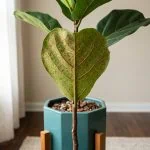

🚨 Emergency 30-Second Answer: fiddle leaf fig drooping after repotting
Stop watering on a schedule — a drooping Ficus lyrata, a member of the Moraceae family, holds that droop for 1-2 weeks after repotting. Owners searching “why is my fiddle leaf fig drooping after repotting” are usually watching that repair happen.
Check the mix before you change anything. Wilting while the medium is still wet points at the root zone instead. A light pot means the root ball dried through.
Water it in, clear the run-off dish, and leave it alone. The honest caveat: that window is a typical range, not a promise for every plant.
- Wet mix, still wilting: the root zone is the problem, not thirst
- Light pot: the root ball dried through and needs one full soak
- Depth probe: a dowel to the bottom reads moisture the surface hides
- Newest leaf: small or malformed growth flags root damage, not a pest
- Hold everything else: no feeding, no second repot, no fresh position yet
Get the one-page care card for this guide, plus a printable A4 copy
We condense this guide into one card for your phone and a print version for the pot shelf. Enter your email and we send both to your inbox. Subscribe once, then request the card of any guide you read.
By subscribing you agree to get emails from Plant Care Basics about plant care guides, about once a week at most. Unsubscribe in one click. Privacy policy
The big lyre-shaped leaves hang at a steeper angle every hour after a repot, and the stem tips bow toward the floor instead of the window. Nothing else changed — same window, same potting media.
Instead of a plant that was thirsty, I realized I was looking at a root system that had just lost most of its absorbing surface. Fine root hairs do the drinking, and a repot shears them off by the thousand — hard on a fig that prefers its roots tight and undisturbed. Every time.
This tree banks nothing. And it has no swollen stem, no tuber, no reserve to ride out the week its roots spend rebuilding. Before the next two weeks make sense, it helps to know how this tree is looked after from day one.
Guesswork is not required here. The six numbers set out under this line are the ones that decide how the next two weeks go.
Why is my fiddle leaf fig drooping after repotting? The quick read
| Fiddle leaf fig specs | What to do, and what to expect |
|---|---|
| Water it in at the repotting event? | Yes – water until it drains, then empty the run-off dish within about an hour |
| Expected droop window | 1-2 weeks of unchanged care before anything is reassessed |
| New container step | One size up, about 1-2 inches wider; seat the root ball at its original depth |
| Feeding after the move | Nothing until active growth resumes; unused fertilizer salts stay behind in the pot |
| Growing medium | A peat-and-perlite foliage mix lightened with chunky pine bark, 2 parts peat to 1 part perlite to 1 part pine bark, top-dressed with a thin layer of the same coarse pine bark |
| Where it stands while it settles | Indirect light for about 7-10 days after the move, then its usual position |
You are subscribed
Press the button and we prepare this guide's one-page care card and its A4 print copy and email both to you within a few minutes.
Tap the button below to get more plant fixes in your Google Search results

Table of Contents
Start here: what to do in the first 48 hours
For the first 48 hours after a repot, change nothing: no extra water, no feed, no new position. A Ficus lyrata that droops on the day it was moved is reporting root damage rather than a care mistake, and the repair runs on its own clock.
Empty the run-off dish within about an hour of watering. A root ball that has just lost fine roots cannot drink what is standing under it, and a container left in its own run-off turns a two-week recovery into root loss.
Two readings decide what you do next, and the sections below take them in order.
Is the mix wet or dry? The check that picks your next move
Lift the container before you reach for the watering can (a small ritual, I know, but it pays), because the weight of the pot reports the bottom of the profile and the surface never does. Then push a thin wooden dowel down to the base of the mix. Pull it out and look.
- Damp, with mix clinging to it: the profile is still wet, so wait.
- Dry, and the pot feels light: soak it through once, slowly.
- Dry, and the pot still feels heavy: the drainage is the problem.
At the repotting event itself the instruction is not conditional. Water the plant through until it runs from the base, because a fresh mix holds air pockets around the roots that only a full pour closes.

Then leave the interval alone. A fig whose roots are rebuilding cannot use a shortened watering cycle, and the everyday rhythm is a separate question from this one.
How long the droop should last, and the two-week checkpoint
So how long does a fiddle leaf fig take to recover from repotting? Expect 1-2 weeks of unchanged care, with the plant standing in indirect light for the first 7-10 days before it goes back to its usual spot.
Watch the angle, not the calendar. That is what I check.
By day three the droop should have stopped deepening. The newest leaves at the top should be the last to hang, not the first. If two weeks pass with the leaf angle unchanged and the mix still slow to dry, stop blaming the move and read what root-zone decay looks like when the droop does not lift.
Get the one-page care card for this guide, plus a printable A4 copy
We condense this guide into one card for your phone and a print version for the pot shelf. Enter your email and we send both to your inbox. Subscribe once, then request the card of any guide you read.
By subscribing you agree to get emails from Plant Care Basics about plant care guides, about once a week at most. Unsubscribe in one click. Privacy policy
Tap the button below to get more plant fixes in your Google Search results

Why disturbed roots show up in the canopy
Repotting removes absorbing surface, and the canopy is what reports the shortfall. The fine root hairs that do almost all of the drinking sit on the outside of the root ball, exactly where a lift, a shake and a trim take them off. Leaf area does not shrink to match.
So the leaves hang — the lowest pair first, and at a steeper angle each morning until the roots catch up. According to the University of Maryland Extension, handling the root ball when an indoor plant is potted and repotted includes cutting horizontally into the mass at intervals, which severs feeder roots the canopy was drawing on.
Every one of those cuts is a supply line the leaves were using an hour earlier. Two choices made during the move set how deep the shortfall goes, and the sections below take each in turn.
How much old mix should come off the root ball
Inside “should I remove the old soil when repotting a fiddle leaf fig” sits the wrong half of the question. Published guidance answers a narrower one: scrape the top inch of old medium away, because that is where accumulated salts sit, and replant at the depth the plant grew before.

Beyond that, let the ball decide. Mix that falls away on its own when you lift the plant is gone either way. Mix bound into living roots stays.
Open the ball only where roots circle the outside, and where the mass is genuinely dense, take the outer half-inch to one inch and no more. The rule underneath is short. Save living root.
How much bigger the new container should have been
From “how much bigger should the new pot be for a fiddle leaf fig” follow one published answer and one widely repeated misreading. One size up — about 1-2 inches more across the top — with the root ball seated at its original depth and its surface within an inch of the rim.
The misreading is a unit. Other care guides publish two to three inches as clearance on each side of the ball, which works out at four to six inches of added diameter and twice the container this tree wants.

This fig keeps a tight root mass by preference, so surplus mix just holds water that no root can reach, which is where the mix and the drainage the new container needs stops being a detail.
What to hold back, and when the grower pot was the better call
Almost every move an owner makes in the first fortnight of a droop makes the droop last longer. In my own testing the plants that came back quickest were the ones I did least to, and the ones I kept adjusting stayed limp for weeks. What to hold back comes first, then the choice that came before it.
Moves that stretch the recovery out
Hold feeding for about a month, and start again only once a new leaf has opened and expanded. A plant that is not growing cannot take nutrients up. The salts stay in the mix instead, sitting on exactly the surface that has just been damaged.
Do not repot a second time to fix the first. Do not move the plant to a brighter spot to cheer it up. Do not shorten the watering cycle because the leaves look thirsty — they are not.

They are short of roots.
If you have already fed it, flush the container with plain water until it runs freely from the drainage hole, then stop. Then walk away. Adding anything else is the error repeating itself.
Grower pot or new container: which one this plant needed
The honest answer to “is it better to leave a fiddle leaf fig in its nursery pot” is that it usually was, right up until the roots said otherwise. A newly bought plant is generally fine where it is for months, and this species prefers a tight root mass anyway. It usually was fine.
| The call | What decides it |
|---|---|
| Leave it in the grower pot when | No roots show through the holes or across the mix surface |
| Move it up one size when | Roots come through the drainage hole, mat the base, or lift the surface |
| Either way | Lift the inner pot to water, drain it, empty the sleeve, put it back |
Verdict: choose the grower pot inside a decorative sleeve until a root trigger appears, because that arrangement never disturbs the root ball and so never produces this droop at all.

That is the whole call. It also keeps the everyday watering rhythm this tree settles into intact.
When one container held two plants
Splitting a container that held two plants is ordinary root disturbance carried out with a blade. That is why did my fiddle leaf fig wilt after I split it into two pots has a harsher answer than the ordinary repot does.
Each half keeps its own root mass and its own leaves. Rarely in equal measure. The half that ended up with most of the canopy and least of the root hangs lowest, and holds that angle longest.
Where the two stems share one root mass with no natural line between them, pot the pair on together and leave them joined. A cut through a shared mass takes absorbing surface from both halves at once, and neither half has a full canopy worth of leaves left to spare.
A sudden collapse of foliage afterwards is a different story from leaf shedding on a tree that has not been moved.

Frequently asked questions about post-repotting droop
Will a droopy fiddle leaf fig recover?
Yes. A droopy fiddle leaf fig recovers in one to two weeks when the roots are sound and the care stays unchanged. The droop is a supply problem rather than a disease, and the plant closes it by growing replacement root hairs.
Watch the trend rather than the day. By the third day the angle should have stopped worsening, and the newest leaves at the top should be the last to hang.
Should I water my fiddle leaf fig right after repotting?
Yes. Water it through at the repotting event, until water runs from the base of the container. A fresh mix holds air pockets around the roots, and only a full pour closes them.
Then empty the run-off dish within about an hour and leave the interval alone. A root ball that has just lost its fine roots cannot use extra water, and a container standing in its own run-off is the fastest way to turn a two-week recovery into root loss.
How can I fix my fiddle leaf fig’s droopy leaves?
Do less. The correction after a move is unchanged care for one to two weeks in indirect light, and nothing else. Hold the feed, skip a second repot, and do not shorten the watering cycle.
Read the mix at depth before you act. A thin wooden dowel, pushed to the bottom of the pot, tells you whether the profile is still wet or dry through. Wet and wilting sends you to the root zone; dry and light sends you to one full soak.
How can you tell if a fiddle fig is overwatered?
Wilting while the medium is still wet is the clearest sign. Lift the container and compare its weight against the weight just after watering, because a heavy pot days later means the profile never drained.
Yellowing on the lower and inner leaves points the same way, while a white crust on the mix surface points at fertilizer salts instead. The full reading, and the watering interval behind it, belong to the watering guide for this tree.
Master the trigger, skip the droop
Two weeks of doing nothing is the whole of it. Genuinely nothing. The roots lost in the move grow back, and the canopy lifts from the newest leaves down, a few degrees at a time.
The next repot is what all of this is for. Wait for roots at the drainage hole, step up one size, and lift the inner pot to water.
The next question is the everyday one. The watering guide takes on how often this tree wants water once it settles.
Knowing that “why is my fiddle leaf fig drooping after repotting” has an answer measured in weeks is what stops a second repot happening at all. Every drooped leaf on that fig is a root still rebuilding the surface it lost, and it will finish the job faster than you can help it.

Get the one-page care card for this guide, plus a printable A4 copy
We condense this guide into one card for your phone and a print version for the pot shelf. Enter your email and we send both to your inbox. Subscribe once, then request the card of any guide you read.
By subscribing you agree to get emails from Plant Care Basics about plant care guides, about once a week at most. Unsubscribe in one click. Privacy policy
Tap the button below to get more plant fixes in your Google Search results