
🎯 Quick Answer: fiddle leaf fig leaf drop
Why is my fiddle leaf fig dropping leaves is usually a light question: Ficus lyrata, a fig in the Moraceae family, accelerates shedding below 500 FC. Its bright band runs 500 to 1,000 FC; a north window sits near 200. Read which leaves go first, then change one thing.
- Light band: 500-1,000 FC, an east window or bright south pane
- North window: about 200 FC at its brightest, usually too dim to hold leaves
- Water trigger: the top 2 inches of mix dry, never a fixed date
- Hard floor: never let the rootball shrink away from the pot wall
- First move: change one variable, then wait two weeks before changing another
Get the one-page care card for this guide, plus a printable A4 copy
We condense this guide into one card for your phone and a print version for the pot shelf. Enter your email and we send both to your inbox. Subscribe once, then request the card of any guide you read.
By subscribing you agree to get emails from Plant Care Basics about plant care guides, about once a week at most. Unsubscribe in one click. Privacy policy
The first leaf came off in my hand while I was turning the pot, and the blade was cold as the windowpane behind it. Truth is — I lost 8 leaves across seven months before I stopped blaming the watering can. Every one from the bottom up, and a bare trunk left with nothing above it worth looking at.
Watering less sounds right. It isn’t. Here’s what the plant is doing instead: leaf drop on Ficus lyrata runs through an abscission zone that loosens on cue, and low light is the cue that fires it fastest.
Correction — what I meant was that the trigger is a change in light load, not a dim reading on its own.
So read the pattern before you touch anything: which leaves are going, in what order, and what moved in the two weeks before. For everything that keeps this tree alive in a living room, start with the care guide.
A decision can wait (yeah, learned this the hard way). The rows that come next sort the ordinary shed patterns from the ones that read as a fault.
Why is my fiddle leaf fig dropping leaves? The pattern at a glance
| What to check | What it means |
|---|---|
| Shed pattern that reads as ordinary aging | One or two lowest, oldest leaves yellowing slowly while the crown holds color |
| Shed pattern that reads as a fault | Several leaves a week, or leaves going from the middle and upper canopy |
| Does a bare lower trunk grow its leaves back? | No – new growth comes from the top; the bare stretch may stay bare |
| First suspect, by recent history | Something changed in two weeks: stop changing. Nothing changed: read the water |
| Feed a plant that is shedding? | No – hold until it holds its remaining leaves and pushes out a new one |
| What to watch instead of counting fallen leaves | The newest leaf at the top and the growing point above it, firm and green |
You are subscribed
Press the button and we prepare this guide's one-page care card and its A4 print copy and email both to you within a few minutes.
Tap the button below to get more plant fixes in your Google Search results

Table of Contents
Which leaves are going, and in what order
The order of loss tells you more than the count: on a settled plant the oldest, lowest leaves go first, and any other order is a fault signal.
Low light strips from the bottom, because a plant abandons the leaves it can no longer supply. So the question is not how many went. It is where they sat.

| Reading | Ordinary aging |
|---|---|
| Position on the trunk | Lowest and oldest tier only |
| Pace | One leaf at a time, over weeks |
| Crown above it | Holds its color and firmness |
Verdict: read position first, then pace, then the crown; a fault reverses all three at once, taking several leaves a week from the middle and upper canopy.
Normal aging or a real fault: the pattern that tells you
A reassurance and an alarm about the same leaf both come back from “is it normal for a fiddle leaf fig to lose its bottom leaves”. Both appear in print, and both are right about different plants. The separator is free and needs no equipment.
- Mark which leaf went and where it sat on the trunk.
- Count again a week later, same two questions.
- Check the newest leaf at the top for firmness and color.
The myth is that a yellow lower leaf is always aging. Yellowing of the oldest lower leaves is a natural sign of aging by itself, but the same leaf goes yellow when a dim corner leaves the plant short of the energy to hold it, so the position and the pace decide, not the color.
My own plant made that clear the week I moved it: the blade came away cool and slack against my palm, cooler than the glazed pot rim I was steadying it with, while the leaf above it stayed firm.
How many leaves can it lose before it is in trouble?
A rate is the honest answer to “how many leaves can a fiddle leaf fig lose before it is in trouble”, because a count on its own, 1 leaf or 20, settles nothing.
The published tolerance is a low one: one or two older leaves while the rest of the plant looks healthy is not a major problem. Take a rate instead of a total.

- Count what the plant sheds in one week, not since it started.
- Sort that week’s leaves into lowest tier and everything above it.
- Several a week, or any from the upper canopy, reads as a fault.
Get the one-page care card for this guide, plus a printable A4 copy
We condense this guide into one card for your phone and a print version for the pot shelf. Enter your email and we send both to your inbox. Subscribe once, then request the card of any guide you read.
By subscribing you agree to get emails from Plant Care Basics about plant care guides, about once a week at most. Unsubscribe in one click. Privacy policy
Tap the button below to get more plant fixes in your Google Search results

The three events that pull leaves off a settled plant
Three events account for nearly all sudden shedding on a plant that was fine last month: a drop in light load, a cold draft across the canopy, and a disturbance at the root.
The light one leads. Across owner reports for this species, a change in light load is the most reliable trigger of a clean shed, with nothing wrong on the leaf itself.
| Event | The tell | First move |
|---|---|---|
| Light load dropped | Clean leaves, no marks, lowest tier first | Move it brighter, then leave it alone |
| Cold draft | Loss on the side facing glass, a vent or a door | Break the airflow or move the plant |
| Root disturbance | Shedding began within days of a repot or a move | Stop changing things and wait |
| Nothing changed at all | No recent event you can name | Read the water at the bottom of the pot |
Verdict: name the event first. If two of them happened in the same fortnight, work the light one first and correct it alone.
Leaf drop after you buy it or move it indoors
What the shop should have said is the same thing that answers “why did my new fiddle leaf fig drop leaves after I brought it home”. The shed comes with the move, and repositioning restarts it.
- Pick one position and commit to it for a month.
- Extend the interval between waterings while the plant is in lower light.
- Halve the feed rate, or stop feeding altogether, until growth resumes.
Cold is the second event, and it acts faster. This fig has no cold adaptation, so a leaf resting on winter glass sheds within days; cold drafts around an indoor fig are named as a stress factor by Iowa State University Extension. Hold the room above 60F.

The stone sill under mine numbed my knuckles, colder than the wall a foot away, and the two leaves touching it went first (yes, this sounds obvious — bear with me: the plant read the sill, not the thermostat).
How far from a window should it sit?
Close. A light reading rather than a tape measure settles “how far from a window should a fiddle leaf fig sit”, because the FC band at the leaf governs the outcome.
- East window: 5,000 to 8,000 FC of gentle morning sun, at or near the pane.
- South window: brightest at roughly 10,000 FC at noon, so set it back or filter it.
- North window: about 200 FC, usually too dim to hold the lower leaves.
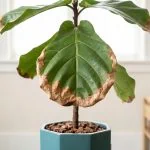
Stand where the plant stands and look toward the window. A wide patch of open sky is the light it wants; a blocked view strips the bottom tier away, and it is where brown edges and patches on the blade appear alongside the shed.
What to change first, and how long to wait for an answer
Change one thing, write the date on it, and change nothing else until the newest leaf answers you. Order, the leaf-removal decision and the waiting period each get their own heading.
What to change first once shedding starts
The selector is your own recent history, which is why “what to change first when a fiddle leaf fig starts shedding” has two correct answers rather than one.
- Something changed in the last fortnight: stop changing things and hold the plant still.
- Nothing changed: read the water at the bottom of the container, not the surface.
- Either way: hold the feed until the plant has held its leaves and pushed a new one.
Weight is the fastest reading. Lift the pot after watering, lift it again three days later, and let the difference tell you whether the core is still wet; a rootball that has been dried past re-wetting needs one full soak rather than the interval between one soaking and the next being shortened.
Two readings can point opposite ways, and the difference decides the repair.
If the pot is heavy days after watering and the plant wilts anyway, you are looking at a rootball that has been sitting wet, and that is a different repair from this one.
Should you pull the loose leaves off?
Resistance is the test, and your hand is the instrument. A leaf the plant has finished with slides off at a gentle pull, cool and slack between finger and thumb; one that holds is still being supplied and gains you nothing.
- Pull gently. If it resists, leave it and check again next week.
- Where a leaf is wholly brown, take it off at its base.
- Where only tips or spots are damaged, trim those and leave a narrow brown margin.
How long before you know the change worked
Tentatively, two to three weeks, because the shed continues for a period after the cause is corrected and the canopy answers on its own clock.
- Week 1: leaves may still drop; the correction has not reached the canopy yet.
- Weeks 2 to 3: the pace slows and the newest leaf stays firm and green.
- Spring: new growth returns from the top, and a bare lower trunk stays bare.
Watch the growing point, not the floor. That is also the signal that feeding can resume: a plant that is shedding cannot spend what you add, so salts concentrate in a medium nobody is drawing down, and the first new leaf is the only receipt worth waiting for.

Where the shed began within days of a repot, compare it against the slump that a fresh potting mix triggers, which runs on its own clock.
Frequently asked questions
Should I remove the lower leaves from my fiddle leaf fig?
Only the ones the plant has already released. A leaf that comes away at a gentle pull is finished; a leaf that resists is still being supplied and should stay.
Where a leaf has gone wholly brown, take it off at its base and snip the stem only if it does not release. Where the damage stops at tips or spots, trim the damaged area and leave a narrow margin of brown rather than cutting into live tissue.
How to bring back a dying fiddle leaf fig?
Correct one cause, then wait for the top of the plant rather than the floor. Recovery is read at the growing point, because the shed continues for a period after the cause is removed.
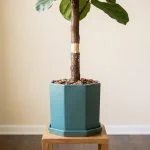
Check that the stems are still flexible rather than brittle, since flexible wood means new growth is still possible. New leaves return from the top in spring, and a bare lower stretch of trunk may never refill, which is a permanent change of shape rather than an injury in progress.
How do I know if I overwatered my fiddle leaf fig?
You read the weight and the wilt together. A pot that stays heavy for days after watering, on a plant that wilts anyway, is the excess-water pattern rather than a dry one.
Lower and inner leaves yellow first, and the roots turn brown to black and soft instead of firm and white. The full watering routine, including how the two directions of the same fault are told apart, belongs to the article that owns the watering question rather than to this one.
What to do if your fiddle leaf fig is dropping leaves?
Name the recent event before touching anything. A move, a purchase, a cold draft or a repot inside the last fortnight is the first suspect, and the correct response is to stop changing things.
If nothing changed, read the water at the bottom of the container and correct that alone. Hold the feed until the plant holds its remaining leaves, and compare the pattern against a plant that has stalled without shedding, which is a different problem with a different fix.
Stop chasing the shed, start watching the growing point
Cards on the table. The hardest part of a shed is not the leaves. It is the fortnight afterwards, when nothing visible improves and every further leaf reads as proof that the correction failed.
So keep the reading small: position, pace, crown. That is the whole job. Correct one thing, write the date on it, and let the plant answer where the answer appears — at the newest leaf, firm under a fingertip and cooler than the heated air around it.
Once that leaf holds, why is my fiddle leaf fig dropping leaves stops being your emergency and becomes a pattern you can read on any plant in the room.
Stop counting what is on the floor – on a fiddle leaf fig the newest leaf at the top is the only reading that tells you the shed is over.

Get the one-page care card for this guide, plus a printable A4 copy
We condense this guide into one card for your phone and a print version for the pot shelf. Enter your email and we send both to your inbox. Subscribe once, then request the card of any guide you read.
By subscribing you agree to get emails from Plant Care Basics about plant care guides, about once a week at most. Unsubscribe in one click. Privacy policy
Tap the button below to get more plant fixes in your Google Search results