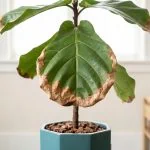

🎯 Quick Answer: red dots and pale patches on new leaves
What are the red dots and pale patches on new fiddle leaf fig leaves: Ficus lyrata, of the Moraceae family, demands measurement — 1-3 mm across. That band runs a twenty-fifth to an eighth of an inch, on newly opened leaves only. Give the next leaf a month before changing anything.
- Measure first: a ruler settles this faster than any photo search
- Touch test: run a fingertip across; raised and corky changes the read
- Wipe check: a damp cloth lifts surface deposits but never true marks
- Wait window: change nothing for one month while the leaf hardens
- Escalate only if: a new leaf still opens deformed after that month
Get the one-page care card for this guide, plus a printable A4 copy
We condense this guide into one card for your phone and a print version for the pot shelf. Enter your email and we send both to your inbox. Subscribe once, then request the card of any guide you read.
By subscribing you agree to get emails from Plant Care Basics about plant care guides, about once a week at most. Unsubscribe in one click. Privacy policy
The newest leaf on my fiddle leaf fig opened with a scatter of rust-red freckles, 1 to 3 mm across and heavier on the underside than the top. I counted nine more like it inside a single year, and every time I read those marks as lesions and reached for a spray bottle.
Let me reframe that… I was treating a disease, but the real fix had nothing to do with that. It was plumbing: Ficus lyrata banks no water reserve at all.
So the swelling is physiological rather than infectious, and a half-grown blade can distort whenever the root zone swings from soaked to bone-dry inside one fortnight.
Color first, not the count. Rust-red on a still-expanding blade dulls to flat tan as the leaf hardens, and that shift separates a passing mark from one worth acting on. For the surrounding routine, start with the parent guide covering light, water and feeding.
Straight answer first. Nothing here needs settling on the spot, and the grid below pins the 1 to 3 mm band, the leaf age it shows on, and what it asks of you.
At a glance: what are the red dots and pale patches on new fiddle leaf fig leaves
| What to check | What the published sources show |
|---|---|
| Individual mark size | 1-3 mm across |
| Leaf age it shows on | Newly opened, still-expanding leaves |
| Raised and corky to the touch? | Yes for the swelling disorder, no for flat freckling |
| Where on the blade | More pronounced on the lower surface than the upper |
| What it asks of the owner | Nothing while the leaf hardens; a root check if deformity persists past a month |
You are subscribed
Press the button and we prepare this guide's one-page care card and its A4 print copy and email both to you within a few minutes.
Tap the button below to get more plant fixes in your Google Search results

Table of Contents
What the red freckles on a new leaf actually are
The red freckles on a newly opened fiddle leaf fig leaf are pressure marks in tissue that is still expanding, not an infection. Water arriving faster than the blade can use or release it ruptures cells under the surface. The mark then stays until that leaf hardens.
Other care guides split on the direction of the fault (five blame too much water, four blame too little, one blames both), and the condition that selects between them sits in the size of the swing. Because the blade reacts to that swing, reading the mix before each watering settles more than either direction does.

The raised version has a name. Clemson Cooperative Extension Home and Garden Information Center records edema as a physiological condition, which is exactly why a spray bottle does nothing to it. The following sections give the size band, the color, and the raised form.
Edema: a physiological swelling in which rough, corky bumps form on the petioles and lower leaf surfaces, so the fault sits in the plant’s own tissue rather than in an organism.
The 1-3 mm size band and how the mark feels
Each individual mark runs 1-3 mm across, and that band is the only published measurement in all fourteen guides I compared. Adjectives measured against nothing are what “why does a new fiddle leaf fig leaf have red freckles” returns.
So hold a pencil line beside it. Then run a fingertip across. A flat freckle passes under the skin unnoticed, but a corky one catches, and that catch tells you more than any photograph will.
Why the mark is red and not brown
One guide in fourteen answers the question a reader actually asks. It names anthocyanins, the pigments behind red and purple fruit, produced after the cells rupture (the sunscreen reading beside it is a theory). Carry it as one.
The shade does the work, not the tally. A freckle that opens rust-red goes flat tan as the blade hardens, and that progression separates a mark that is finishing from one that is spreading.
What the swelling disorder looks like on this species
Edema arrives as pale blisters that harden into rough, corky raised bumps, more pronounced on the underside of the blade than on the face turned toward you. It never leaves a hole. My first nine marked leaves I read as bacterial spotting, and I lost a fortnight to a spray bottle before the next leaf opened clean.
Deformed or holed new growth belongs here only after a root cause is ruled out, because a leaf still misshapen a month after opening is reporting on the root zone rather than on the blade. From there the correction is reading the mix before each watering instead of watering to a schedule.

Get the one-page care card for this guide, plus a printable A4 copy
We condense this guide into one card for your phone and a print version for the pot shelf. Enter your email and we send both to your inbox. Subscribe once, then request the card of any guide you read.
By subscribing you agree to get emails from Plant Care Basics about plant care guides, about once a week at most. Unsubscribe in one click. Privacy policy
Tap the button below to get more plant fixes in your Google Search results

Pale patches, holes and rusty rims: three markings, three different reads
A pale patch, a hole and a rust-rimmed tear are three separate markings, and not one of them reads the way the red freckling above does. Other care guides name three unrelated causes for the pale patch (more on this below) and publish nothing telling them apart.
One physical property does most of the work. It needs one damp cloth (nothing else). The following sections take the pale patch first, then the hole.
Cup the blade in your palm and take a damp cloth over the pale area. If it lifts or dulls, the marking was sitting on the leaf. If the outline survives the wipe, what changed is the tissue beneath it.
What causes pale mottled areas on a fiddle leaf fig leaf
Three guides in fourteen describe a pale marking, and they name hard-water minerals, a fungal growth and sun scorch. None of the three separates a deposit lying on the surface from tissue altered underneath. So the wipe comes before the list, because it removes one candidate without asking you to judge anything.
| What the wipe shows | What it points to |
|---|---|
| Pale film lifts or dulls | A mineral deposit sitting on the surface |
| Outline survives unchanged | Altered tissue under the surface |
| Bleached areas on the topmost leaves | The light those leaves are standing in |
| Whitish tint with fine webbing | An organism, and a different article |
Verdict: wipe first, then explain what stays. I spent a whole evening reading a mineral film as scorch before a cloth settled it in four seconds, and the leaf underneath was never marked at all.

A torn edge versus feeding damage
Every guide that interprets a hole in the blade points at an organism, and none of them offers the mechanical route for the same picture. Yet edema leaves no hole. That exclusion (the only one those guides publish) is worth keeping.
Every result under “why does my fiddle leaf fig leaf have a hole with a rusty rim” arrives already committed. Read the edge instead: a tear has one continuous margin that follows a fold and stops growing, while removing armored and cottony pests from a stem is the route only when several unaligned perforations arrive with other signs.
How the mark gets its color, and what published sources do not settle
The color comes from pigment the leaf makes after the damage, not from the damage itself. Thirteen of fourteen guides answer why the leaf was hurt and stop, which leaves the question a reader actually typed unanswered.
Two things stay unsettled even now. Three headings follow for the worry, the fading and the second look.
Is edema on a fiddle leaf fig something to worry about?
In my experience — though n=1 — a corky freckle on a leaf that is still expanding has never gone on to set the plant back. The published account supports that reading: the fault is a pressure event inside tissue the plant is still building, and it ends when the blade stops growing.
What deserves attention is the flush behind it. If the next leaves arrive small, pale or slow, the question is no longer this marking but a flush that stalls before the blade opens.
Do the marks fade as the leaf matures?
Under “do the marks on a young fiddle leaf fig leaf fade as it matures”, five pages promise the marks go while one insists they never do. Only one page carries both halves. Many marks fade or disappear entirely, and some of the damage stays.
So split the question before you answer it (the two camps are not answering the same one). The marked leaf keeps its history. The plant does not (that is the whole distinction).

Dull rust settling into the same matte green as the blade around it is the fade you are watching for, and it takes weeks rather than days.
When a marking is worth a second look
Change across a week is the whole test. Every pathogen those guides name is described as spreading, while the benign markings are described as static, so an outline that is the same today as it was last Sunday has already answered you.
Yellowing around the mark, a spread onto neighboring leaves, or a growth that rubs off under a fingertip moves the question elsewhere (rust rubs off, a pressure mark does not). Damage that arrives brown and crisp at the edges belongs with margin browning driven by the water regime at the root.
Frequently asked questions
What are the red dots on my new fiddle leaf fig leaves?
Small red-to-rust freckles on a newly opened leaf are pressure marks, 1-3 mm across, in tissue that is still expanding. They are not an infection.
The published record splits on the cause: five care guides blame too much water, four blame too little, and one blames both. What every account agrees on is that the marks appear on immature tissue and settle as the blade hardens, so the reading to make is the next leaf rather than this one.
What are the small dots on my fiddle leaf fig leaves?
Small dots on a fiddle leaf fig leaf are read by size, position and texture, not by color alone.
Individual marks of 1-3 mm on newly opened leaves, heavier on the underside, are the benign freckling. Marks that are raised and corky under a fingertip point to the swelling condition, while a whitish tint with fine webbing points to an organism instead. Anything spreading across a week is a different question.
What causes red dots on leaves?
Red dots on leaves come from cells rupturing under water pressure while the leaf is still growing.
Only one guide I compared explains the shade itself, naming anthocyanins, the pigments behind red and purple fruit, and stating the sunscreen reading as a theory rather than as fact. The damage and the color are two separate events, which is why the fault those pages argue about never explains the shade.
What does fungus look like on a fiddle leaf fig?
A fungal growth on a fiddle leaf fig reads as an all-over color rather than as discrete spots, and it rubs off.
Powdery mildew is described as white spotting arising with poor air movement. The property that separates it from a pressure mark is removal: a surface growth comes away under a fingertip or a cloth, while a mark inside the tissue survives the wipe unchanged.
What are some common diseases that affect fiddle leaf figs?
The care guides I compared name bacterial leaf spot, rust and powdery mildew as the conditions reported on this species.
Their descriptions contradict each other on the one property a reader can use: one page places bacterial leaf spot on new leaves by preference, another places it on new and old leaves at random. Behavior across a week is the safer test, rather than position on the plant.
What does a diseased fig tree look like?
A fig carrying an active problem spreads: the marking grows, yellowing follows it, and neighboring leaves pick it up.
A benign marking does none of that. It stays the size it was, keeps its outline, and remains confined to the leaves that opened while conditions were swinging. A static outline reads more reliably than a photograph, because every pathogen published sources name is described as moving.
What causes brown spots on the underside of a fiddle leaf fig?
Brown spotting on the underside is a moisture question rather than a marking question, and it belongs to a different article.
The benign underside position is this: red freckling and corky swelling both show more strongly on the lower surface than on the upper. Brown, crisp or spreading patches driven by the water regime at the root are answered in full by the brown edges and patches guide on this site.
Your next step: from marked leaf to the next flush
Plain fact — the leaf in your hand has already told you what it can. A 1-3 mm freckle on still-expanding tissue records a pressure swing that has passed (yes, this sounds anticlimactic — bear with me). Rust dulling to flat tan on a hardened blade closes it.
The judgment belongs to the leaf that opens next month. Read the mix before each watering, wipe a pale patch before you name it, and check the outline weekly. Not hourly.
One honest answer covers “what are the red dots and pale patches on new fiddle leaf fig leaves”, and it is a measurement rather than a remedy. Nothing on that young fiddle leaf fig blade has to be answered today; give the next leaf a month, and let its shape make the call.

Get the one-page care card for this guide, plus a printable A4 copy
We condense this guide into one card for your phone and a print version for the pot shelf. Enter your email and we send both to your inbox. Subscribe once, then request the card of any guide you read.
By subscribing you agree to get emails from Plant Care Basics about plant care guides, about once a week at most. Unsubscribe in one click. Privacy policy
Tap the button below to get more plant fixes in your Google Search results