🎯 Quick Answer: watering by the pot, not the calendar
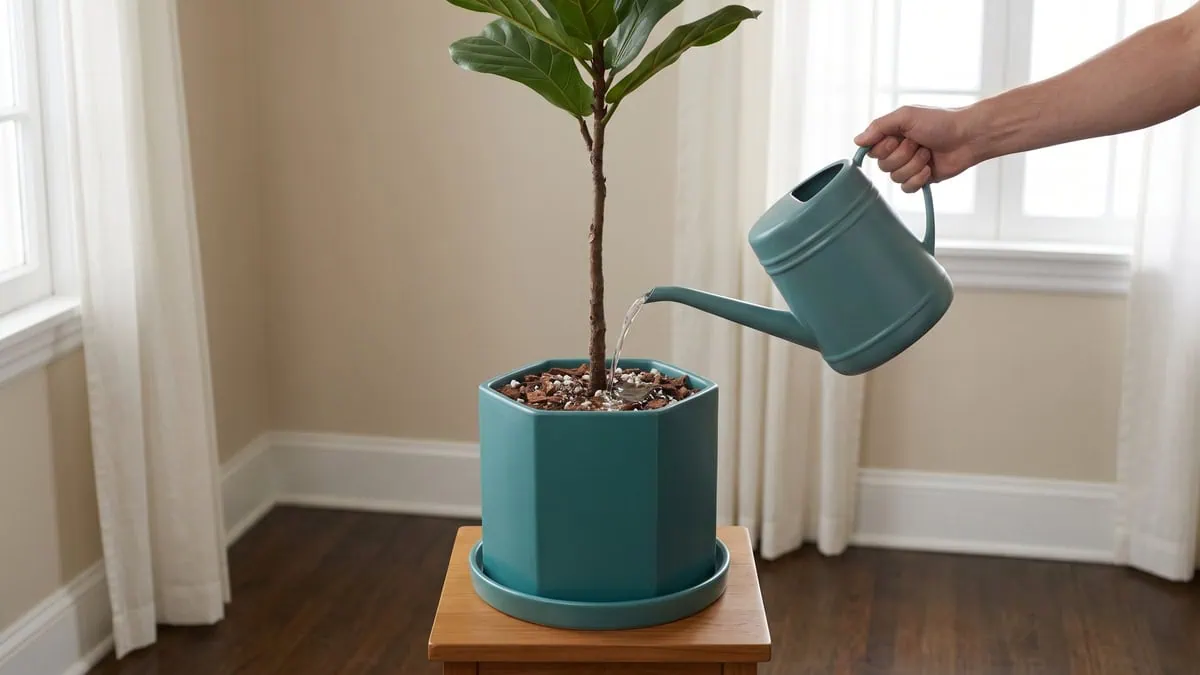
How often to water a fiddle leaf fig indoors depends on the mix: Ficus lyrata, a member of the Moraceae family, drinks at 2 inches dry. No calendar interval survives contact with a deep pot. Read the medium, then pour until it drains and stop.
- Lift the pot: a dry rootball weighs markedly less than a watered one
- Meters vary: extension guidance rates moisture meters as widely inconsistent instruments
- Water runs straight through: the ball has shrunk off the pot wall
- Less light: the gap between waterings stretches, and the calendar does not
- Bone dry: one full soak re-wets it; watering frequency stays unchanged
Get the one-page care card for this guide, plus a printable A4 copy
We condense this guide into one card for your phone and a print version for the pot shelf. Enter your email and we send both to your inbox. Subscribe once, then request the card of any guide you read.
By subscribing you agree to get emails from Plant Care Basics about plant care guides, about once a week at most. Unsubscribe in one click. Privacy policy
Straight to it — I dropped 10 leaves off one fiddle leaf fig over 2 years before I stopped blaming the plant. Overwatering and underwatering were both on my list, and neither fit: the potting media stayed dark on top, the pot never felt light, and the saucer stayed dry.
Then I lifted it out. The mix underneath had gone sour — the flat, stagnant smell of a medium that had not drained in weeks.
A better schedule was what I kept chasing, right up to the repotting that showed me the rootball had shrunk off the wall, so every pour ran down the gap and out the holes.
I’d like to retract that (and I say this confidently): the calendar was never the instrument. The only reservoir this species has is the mix around it, since Ficus lyrata keeps nothing back in its own tissue.
And that reorders everything. Let the medium set the interval instead of the month, and set this reading inside the wider husbandry this species is grown under.
Your routine can stay exactly as it is today. The rows immediately below condense every reading that follows into one screen.
How often to water a fiddle leaf fig indoors: the readings at a glance
| Fiddle leaf fig specs | Reading to act on |
|---|---|
| Water when | The top 2 inches of mix are dry; never let the rootball dry until the soil pulls away from the pot wall |
| Growing medium | A peat-and-perlite foliage mix lightened with chunky pine bark, 2 parts peat to 1 part perlite to 1 part pine bark, top-dressed with a thin layer of the same coarse pine bark |
| How much at one watering | Enough that excess appears at the drainage holes after about a minute, then stop |
| Water standing underneath | Empty the saucer or the outer sleeve within about an hour of watering |
| Drainage hole required? | Yes – the plant grows in a holed nursery pot, and a decorative pot without a hole is used only as an outer sleeve |
| Reading a deep pot | Push a dowel to the bottom; mix clinging to it means the profile is wet |
You are subscribed
Press the button and we prepare this guide's one-page care card and its A4 print copy and email both to you within a few minutes.
Tap the button below to get more plant fixes in your Google Search results

Table of Contents
The check that decides when to water
A watering is decided by a finger pushed 2 inches into the mix at the center of the pot — dry at that depth means water, damp means wait. Depth, the calendar and meters are dealt with in that order.
How deep to read, and where in the pot
One inch, two inches and a vague few inches all come back under “how to check whether a fiddle leaf fig actually needs water”.
Two inches is the depth three published care guides agree on, and the rim is the wrong place to take it — the edge of the mix dries first and reads dry while the rootball is still wet. Read at the center.

Three tool-free confirmations need no gadget: lift the pot, because a dry rootball is markedly lighter; rap the wall, where a dull thud means moist and a hollow ring means dry; and watch the surface fade from dark to pale.
But one floor sits under all of it. Past the point where the mix shrinks off the pot wall, the next pour takes the gap and misses the roots, so that line is the one to stay behind.
Why a weekly reminder is the wrong instrument
Uptake on Ficus lyrata moves with light load, pot size and how fast the medium gives water up, so the interval is a variable rather than a constant. A fixed weekly pour lands right twice a season by accident.
Keep the weekday — just make it an inspection day rather than a watering day. I ran a Sunday reminder for two years and watered on it every time, and the mix under the surface stayed heavy and cold to the knuckle, a sodden weight that never lightened between pours.
Do moisture meters give a reading you can act on?
Readers keep asking “are moisture meters accurate for a fiddle leaf fig” and the published answer is a qualified yes. Extension guidance states plainly that such meters vary widely in accuracy, so the instrument is a comparator rather than a truth teller.
Two rules make it usable. Put the probe near the roots rather than at the surface, and water when it reads almost dry rather than fully dry.
Then calibrate it once: take a reading immediately after a thorough watering and another when the finger test says the top of the mix is dry, and take those two numbers as that meter’s usable range in that pot.

Get the one-page care card for this guide, plus a printable A4 copy
We condense this guide into one card for your phone and a print version for the pot shelf. Enter your email and we send both to your inbox. Subscribe once, then request the card of any guide you read.
By subscribing you agree to get emails from Plant Care Basics about plant care guides, about once a week at most. Unsubscribe in one click. Privacy policy
Tap the button below to get more plant fixes in your Google Search results

How much water goes in, and what ends the watering
One watering ends when excess reaches the drainage holes, about a minute into a steady pour. Volume, the stopping signal and the water left underneath get a heading apiece.
How much water at one time
Cups are the unit that comes back from “how much water does a large fiddle leaf fig need at one time”. Cups are the wrong unit — a deep pot decides the volume, not the plant standing in it.
Pour steadily over the whole surface until water shows at the holes. That is the measure. A peat-and-perlite mix lightened with chunky pine bark takes what it takes, and what a container medium must drain like sets that number for you.
The first time I mixed a fresh batch of that recipe I watered it (low-key baffled about this) exactly as I had watered the tired old mix — and the runoff arrived in half the time, because fresh bark holds air where broken-down peat holds water.
The endpoint: water until it drains, then stop
Runoff is the endpoint, and on a deep pot it arrives within about a minute. Stop there.
Two things go wrong here. Stopping early leaves the bottom third of the profile dry, so a quarter-inch wooden dowel run to the base comes out clean while the surface still reads damp. Pouring on past runoff floods the air spaces that feed oxygen to Ficus lyrata roots.
The water that collects under the pot
Empty the saucer or the outer sleeve within about an hour of watering. The holed nursery pot lifts out, drains, and returns to a dry sleeve — that is the whole ritual, and it is the step most growers skip.
Leave the water standing and the base of the rootball sits in a layer it cannot drain away from, which is the short road to a rootball starved of air.

I know the smell of that mistake — a sharp, sour, low-tide reek lifting off water that had stood in the sleeve for three days.
One variable is left, and it is what goes into the can. Municipal tap water carries fluoride and chlorine, and extension guidance ties both to the brown leaf tips and edges growers usually blame on dry air.
| Water source | What it changes |
|---|---|
| Municipal tap water | Carries fluoride and chlorine, both tied to brown leaf tips and edges |
| Distilled or filtered | Drops that load; the working choice where tips brown with no other cause |
| Periodic leach | Flushes accumulated soluble salt out of the medium instead of switching sources |
Verdict: Stay on tap water and leach the pot on a rhythm while the leaves stay clean; move to distilled where tips brown and every other reading on this plant is normal.
What moves the interval on a fiddle leaf fig indoors
Four things move the gap between waterings: light load, pot volume, how fast the medium gives water up, and whether the rootball still touches the wall. The following sections take them in that order.
Light load, and the low-light months
Light is the throttle on water use. A fiddle leaf fig in a bright window empties its pot faster than the same plant three feet back from the glass, because light drives the growth the water is spent on — and when light drops, growth slows first and uptake follows it down.
This is an open question for me: how much of a winter slowdown is the shorter day and how much is the heated, drier air around the plant. Published guidance keeps those two apart. A living room does not.

Keep reading the mix on the old rhythm and pour on fewer of those readings, and read leaves shed after a change in light as a lighting signal rather than a watering fault.
Pot size and how fast the medium dries
Pot volume sets the drying rate more firmly than any habit does. A container one size up from the rootball holds mix no root has reached, and that outer collar stays wet long after the root zone has dried out.
Go up one size. Never two. Depth is the lever worth using, because a deeper pot drains itself to more air for the same medium — width only adds a wet rim.
Why water runs straight through the pot
The gap is nearly always behind “why does water run straight through my fiddle leaf fig pot”. A rootball dried past its limit shrinks off the wall, and the next pour takes that channel instead of the mix.
The tell is speed. Runoff arriving in seconds rather than about a minute means the water bypassed the profile, and a dowel pushed to the base comes out dry after what felt like a thorough watering, the same dry ball behind discolored margins that follow a dry rootball.
Re-wetting a rootball that pulled from the wall
Every page under “how to rewet a fiddle leaf fig rootball that has gone bone dry” says soak it. That is right. The detail that decides it is the stop rule.
Stand the holed nursery pot in a basin of water reaching a third of the way up the side, and leave it until the surface of the mix goes dark. Lift it out then, let it drain fully, and set it back in a dry sleeve.
The basin comes up smelling of dry, dusty peat for the first ten minutes — a flat mineral smell with nothing sour in it. According to Iowa State University Extension, that early resistance is what happens when dried potting media turn hydrophobic, so the fix is contact time in a basin rather than a bigger pour from the can.
Hydrophobic: a dried mix that repels water instead of taking it in, so the first pours run off the surface and straight out the holes.
One soak does it, and the interval afterwards is unchanged. The plant did not turn thirstier; the mix simply started accepting water again, and the marked leaves fade only as new ones replace them.
Frequently asked questions about watering this fig
Do fiddle figs like to be misted?
Misting is not a watering method for this species. A spray puts water on the blade, and the mix is the only reservoir Ficus lyrata owns, so the interval on the pot does not move whatever the bottle does.
Air moisture sits on a separate axis from the watering interval. Extension guidance attributes brown, dry leaf tips and margins to low humidity, and the answer there belongs to the room rather than the watering can.
Where is the best place to put a fiddle leaf fig indoors?
Bright indirect light, close enough to the glass that the pot dries on a readable rhythm. A specimen set three feet back from a window drinks slower than the same plant beside it, and the interval stretches with the light.
Two placement limits come from the plant rather than the room. Keep the foliage out of reach of cats and dogs, because the leaf tissue and the milky sap both carry risk, and keep the pot off a cold draft line. Keep the ASPCA Animal Poison Control Center (888-426-4435) and the Pet Poison Helpline (855-764-7661) to hand for a chewed leaf.
Do fiddle leaf figs prefer morning or afternoon sun?
Morning sun is the gentler of the two. Early light from an east window suits this plant, while hot afternoon sun through a west or south pane is what scorches the broad blades, and any move into direct light is made in steps rather than in one afternoon.
Where a beam does fall across the plant, the watering consequence follows the light: more light on the leaves means faster drying in the pot, so read the mix more often in that spot rather than pouring more each time.
What should I do if the mix has shrunk away from the side of my fiddle leaf fig’s pot?
Soak the whole rootball once. Set the holed nursery pot into a basin of water reaching a third of the way up the side, and lift it out as soon as the surface of the mix goes dark, then let it drain fully.
That gap is the reason water was running straight through. One soak closes it, and the watering interval afterwards is unchanged, because the mix started accepting water again rather than the plant turning thirstier.
Rescue this fig from the calendar, revive the reading, repeat it
One habit carries the whole article: push a finger two inches into the mix at the center of the pot before every pour, and let that reading decide. And everything else — pot volume, light load, water quality — only changes how often the reading comes back dry.
Real talk: the hardest part is not the technique. It is letting go of the reminder. Just a habit dressed as care.
The medium itself is the next thing to settle, because a mix that has broken down changes the answer however well you read it. The interval covers only the first half of this plant’s water story; what that mix should drain like is the second.
Push a finger past the surface layer before you pour, and this fig stops being watered on a date and starts being watered on a fact.
Get the one-page care card for this guide, plus a printable A4 copy
We condense this guide into one card for your phone and a print version for the pot shelf. Enter your email and we send both to your inbox. Subscribe once, then request the card of any guide you read.
By subscribing you agree to get emails from Plant Care Basics about plant care guides, about once a week at most. Unsubscribe in one click. Privacy policy
Tap the button below to get more plant fixes in your Google Search results