
🎯 Quick Answer: is fiddle leaf fig sap dangerous to handle when pruning
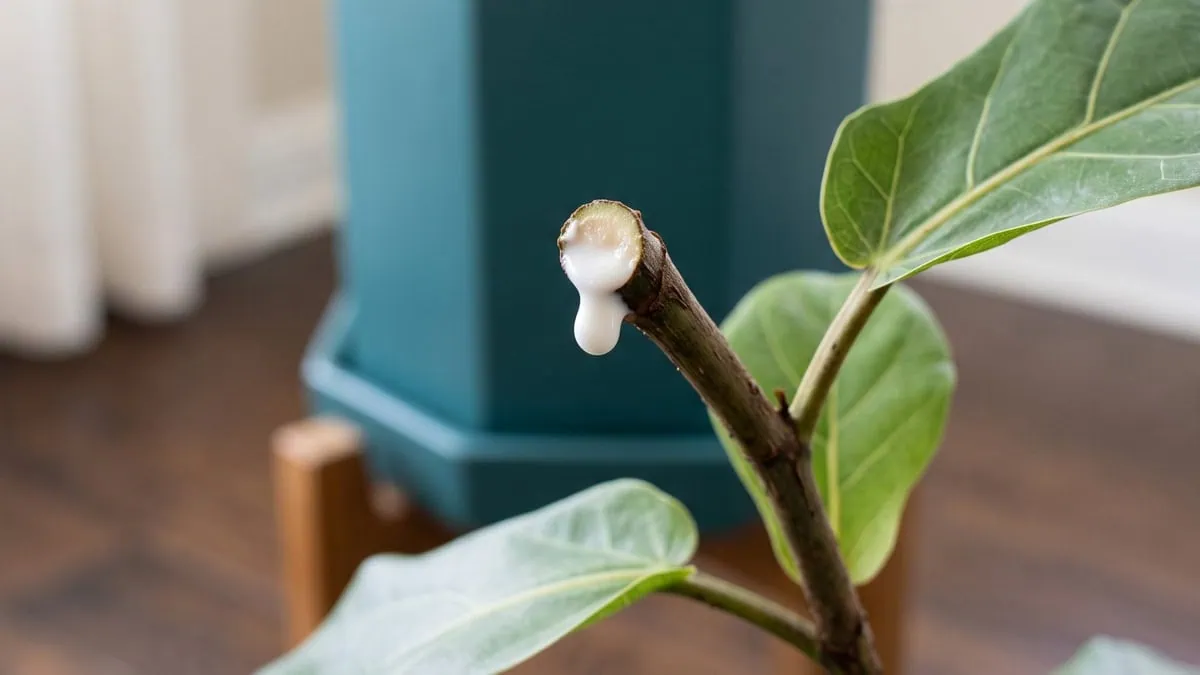
Yes, every cut bleeds, so handle the sap as a skin-contact event. Every wound on Ficus lyrata, a member of the Moraceae family, weeps a sticky white latex documented to irritate skin. Wear gloves for any cut, and wash skin promptly while the latex is still wet.
- Before the cut: lay a disposable sheet under the working area
- During the cut: the drip lands wherever the stem is pointing
- The severed piece: it keeps weeping after it leaves the plant
- Dried latex: it dries onto surfaces and resists a dry wipe
- Species scope: the light-triggered fig reaction belongs to other fig species
Get the one-page care card for this guide, plus a printable A4 copy
We condense this guide into one card for your phone and a print version for the pot shelf. Enter your email and we send both to your inbox. Subscribe once, then request the card of any guide you read.
By subscribing you agree to get emails from Plant Care Basics about plant care guides, about once a week at most. Unsubscribe in one click. Privacy policy
One from my own notes: five cuts across a single year of pruning taught me what this plant does when a blade goes in. Each one beaded white within seconds.
One bead ended up on my wrist, tacky and faintly rubbery, and it did not wipe off dry. No gloves that day.
The mess I kept wiping up turned out to be the plant’s own latex system – a known skin irritant – doing what a wounded fig does. Backtrack: the sealing part is my reading, and published sources end at what the sap does to skin (more on that shortly).
The answer sits in three parts: what the latex is, what it does on skin, and what to do in the first minute after it lands there. For the wider routine, start with the day-to-day handling routine for this species.
A bleeding stem is about to be in your hand, and the facts that matter are few. The short list under this carries them in the order you meet them.
Is fiddle leaf fig sap dangerous to handle when pruning at a glance
| What to check | What published sources state |
|---|---|
| What the cut releases | Milky white latex, from any cut or broken stem or leaf |
| Gloves required for every cut? | Yes – for a single leaf as well as for a full reduction |
| Documented skin effect | Skin irritation, and an allergic reaction in some people |
| First action if sap reaches skin | Wash the skin promptly, while the latex is still wet |
| Blade before the cut | Clean and sharp, wiped with 70 percent isopropyl alcohol, no prolonged soak |
You are subscribed
Press the button and we prepare this guide's one-page care card and its A4 print copy and email both to you within a few minutes.
Tap the button below to get more plant fixes in your Google Search results

Table of Contents
Is fiddle leaf fig sap dangerous? What the latex does on skin
The cut sap of Ficus lyrata irritates skin, and in some people it triggers an allergic reaction. Mild is the word the sources use.
Blistering is also in the published sources, on the same page. Neither reading cancels the other, because the sources describe the effect and stop short of dose, duration and rate. Substance first, person second.
What the white latex is, and what it does at the cut
The answers to “what is the white sap that comes out of a fiddle leaf fig” reach for chemistry that belongs to other plants entirely.
It is milky white. It appears at the cut face within seconds, stands proud of the wound as a bead, tacky, not wet, and dries onto whatever it touches. I have wiped one off dry and only spread it wider.

According to University of Illinois Extension, the act of pruning or otherwise damaging a fig is what produces the latex a Ficus releases when a stem is cut. Past that point the guidance turns practical: work in gloves, and wash promptly if sap gets on skin.
The compound behind the irritation is not established for this species, and the calcium-oxalate line that circulates online belongs to a different plant in a different family.
What published sources do support is what your eyes report. White at the cut, sticky on contact, and hard once it has dried on a leaf or a floorboard.
Latex: the milky fluid a fig releases from a cut or broken stem. Sap and latex name the same substance here.
Who reacts, and why you cannot tell in advance
Some people react. Nobody says who. I may be reading this wrong, but repeat handling is where I would expect the risk to sit, and the sources I have end at the effect itself.
So the qualifier is useless at the moment you need it. The glove goes on before the cut, not after the reaction.
And the reaction that does show up is a skin reaction, not something that travels further. Wash it off, watch the spot, and stop guessing about your own group.
Get the one-page care card for this guide, plus a printable A4 copy
We condense this guide into one card for your phone and a print version for the pot shelf. Enter your email and we send both to your inbox. Subscribe once, then request the card of any guide you read.
By subscribing you agree to get emails from Plant Care Basics about plant care guides, about once a week at most. Unsubscribe in one click. Privacy policy
Tap the button below to get more plant fixes in your Google Search results

Gloves first, then the wash: handling a bleeding cut
Gloves go on for every cut on this plant, including the removal of one leaf. That is what the published sources say. It carries no exception for one-leaf jobs.
The job splits two ways: what you wear, and what to do if sap lands anyway.
The glove myth: optional is the wrong call
Both answers turn up under “should I wear gloves when taking fiddle leaf fig cuttings”. One page in ten calls the glove optional. The rest do not, and the ones that describe an outcome describe an allergic reaction in some people and a blistered patch of skin.
Optional is the wrong reading, and the reason is not severity. It is the qualifier every source uses. Some people, with no way to place yourself inside or outside that group before the first exposure.

I skipped gloves on a single leaf once, because a single leaf felt too small to bother with. A mistake, and a small one to avoid. The bead went onto the web of my thumb, and it was still there, gummy and gray with dust, an hour later.
Any cut that can release sap is a gloved cut, nitrile or thick gardening leather. Where sap does land on skin, the published instruction is room-temperature water, run over the area without pause for 15 minutes or longer. For a person, the national line is Poison Control, 1-800-222-1222 in the United States, which is never the animal hotline.
If a severe skin reaction develops (blistering or intense burning), seek medical attention immediately. For chemical exposure, you can also contact Poison Control (1-800-222-1222 in the US).
Sap on skin: wash it off while it is still wet
Pages returned for “what to do if fiddle leaf fig sap gets on your skin” stop at the warning. None of them says what to wash with, or for how long.
The actionable part is small. Wash it off while it is still wet, because a dry wipe moves the latex sideways across the skin and lifts almost none of it. Watch the spot afterwards.
And if the reaction goes past a patch of irritated skin, that is a question for a medical professional rather than for a plant page, whatever a search result tells you.
Stopping the drip, and what happens after the cut
A cut stem stops dripping on its own, and the two situations in front of you are not the same one. The wound stays on the plant. The severed piece leaves with you.
The three sections below follow that split, from the blade to the bin.
The wound on the plant and the piece in your hand
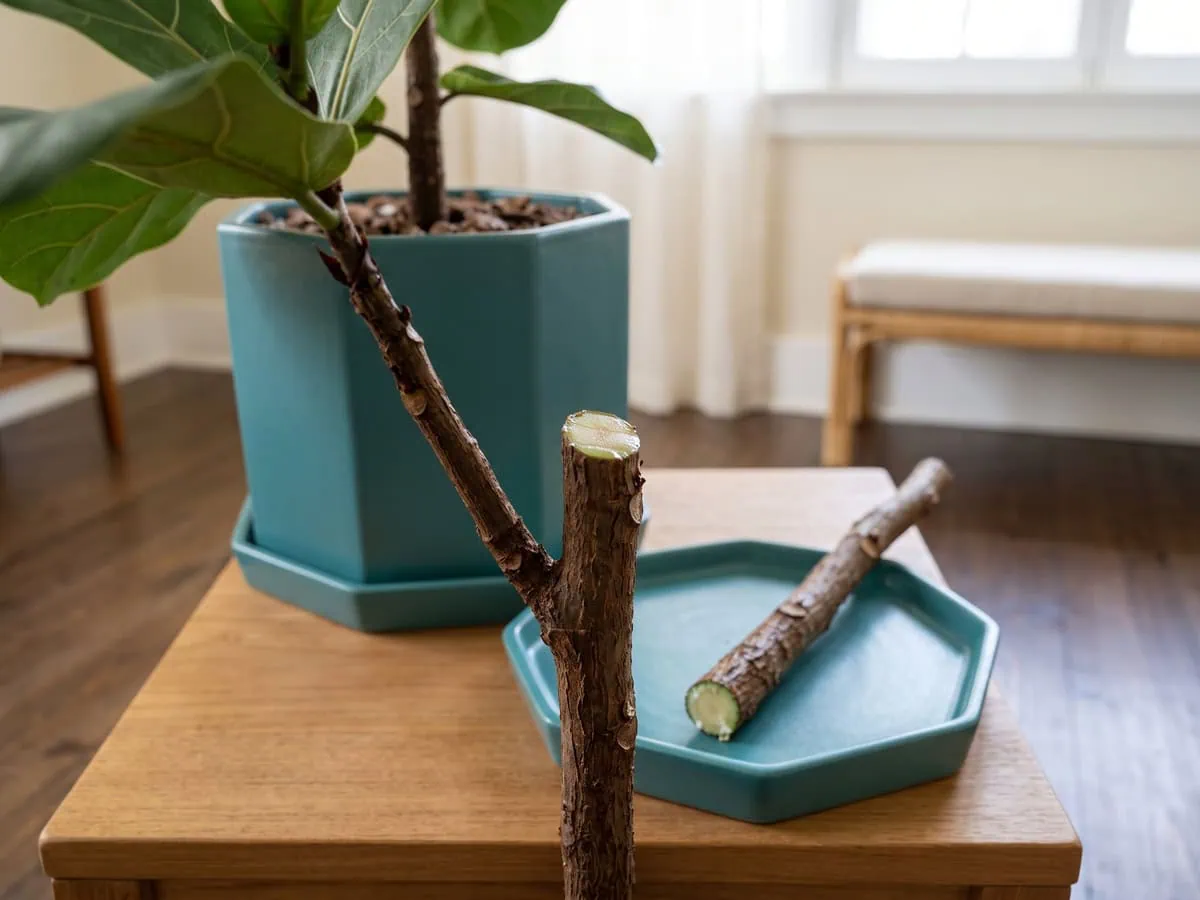
Answers filed under “how to stop a cut fiddle leaf fig stem from dripping” merge two jobs into one. Two jobs, not one. On a severed cutting, the published action is to stand the cut end in water until the flow stops, then set it aside to dry.
On the wound left behind, the action is smaller: dab the fresh cut with a cloth dampened with water. That is framed as helping the plant rather than as stopping the flow, and I am carrying it that way (fussy, I know, but it matters). The white bead stops re-forming at the cut face when it is done.
Clean blade, cut, contain: one sequence
Clean the blade, make the cut, keep the flow off skin and surfaces, and leave the wound alone. Blade hygiene and sap handling are one motion.
Where that cut belongs is a separate decision, and where a reduction cut belongs once the trunk is bare covers the placement.
For the blade, the published household option is undiluted 70 percent isopropyl rubbing alcohol, with no prolonged soak. Bleach at 9 parts water to 1 part bleach works too, soaked at least 10 minutes and rinsed. Wipe the dirt and sap off first.
- A sharp, clean blade – a dull edge crushes the stem instead of cutting it
- Rubbing alcohol and swabs – wiped on the blade, no prolonged soak
- An absorbent cloth and nitrile gloves – on before the first cut, off after the last piece is down
Where the severed piece goes next
The published record stops at the moment of the cut and follows the piece no further. It keeps weeping after separation, so it goes cut-end down onto something disposable, not onto a work surface, where it sets hard and will not lift with a dry cloth.
Carry it. Do not drag it. But keep the gloves on until it is in the bin, and if you are keeping it instead, that is starting a new specimen from a cut stem.

The floor is the part people forget. A dropped leaf is not the same problem as a dripping stem.
Sweep up any fallen leaf while you are there, because whether a chewed leaf harms a household animal is a question with its own answer.
Frequently asked questions about fiddle leaf fig sap
Is fiddle leaf fig sap toxic?
Yes, in the contact sense. Skin irritation is what published sources attach to the sap of Ficus lyrata; for dogs and cats the plant itself carries a mild toxicity rating.
No compound is established for this species, so the honest answer ends at the effect. The strength words in published sources are mild and slight. Handle every cut with gloves, and wash skin promptly if the latex lands on it.
Is it good to prune fiddle leaf figs?
Yes, pruning is a normal part of keeping this species indoors, and the genus tolerates a hard reduction.
Timing and placement decide the result: late winter to early spring, cutting back to a bud or to the lowest set of leaves. Where the cut goes on a bare trunk is answered by the pruning guide on this site rather than here.
Is Ficus sap poisonous?
For this species, the reported risk is contact irritation from the milky sap rather than a poisoning syndrome. Published sources name the effect and stop there.
The proteolytic enzyme and psoralen record that circulates for figs belongs to a different Ficus species and is not carried across here. Wear gloves for cuts, wash skin promptly, and keep the sap away from eyes.
What to do if you get fig sap on your skin?
Run room-temperature water over the skin, without pause, for 15 minutes or longer, while the latex is still wet.
A dry wipe spreads the latex sideways instead of lifting it. Keep an eye on the area, and if a severe reaction develops, seek medical attention; a plant page is not the place for it. The human line and the animal hotline are different numbers, and the one for people is the one to call here.
How toxic are fiddle leaf fig leaves?
The leaves and the stems hold this plant’s milky latex, and that material is what published sources implicate.
A small mouthful leaves a cat or a dog with mild gastrointestinal upset, usually vomiting and diarrhea. For people, the documented hazard is contact irritation, and published human data covers skin contact. A chewed leaf is a call to the ASPCA Animal Poison Control Center (888-426-4435) as the primary line and the Pet Poison Helpline (855-764-7661) as the secondary one, not a home remedy.
Are fig leaves poisonous to touch?
The known risk is the sap a cut or a break releases, not an intact leaf under your hand.
That sap is listed as a skin irritant, and an allergic reaction is recorded in some people. Handle cut tissue with gloves, and wash promptly if the latex reaches skin. No light-activated reaction is established for this species, whatever the fig-tree literature reports.
Skip the myth. Use the science.
The search that brought you here, “is fiddle leaf fig sap dangerous to handle when pruning”, has a two-part answer. The sap irritates skin, and nobody can tell you in advance whether you are one of the people it does more to.
No hedging here. Gloves are the easy half.
The harder half is the minute after the cut, when the latex still lifts off a fingertip with one pass of a damp cloth. Wash it then. Not later.
Next time you reach for the shears, set the sheet down before the blade goes in, and keep the gloves on until the last piece is in the bin. A cut you planned takes ten seconds longer and leaves you nothing to scrub afterwards.
May every cut you make on this fig bleed clean and white onto a gloved hand, and never onto bare skin.
Get the one-page care card for this guide, plus a printable A4 copy
We condense this guide into one card for your phone and a print version for the pot shelf. Enter your email and we send both to your inbox. Subscribe once, then request the card of any guide you read.
By subscribing you agree to get emails from Plant Care Basics about plant care guides, about once a week at most. Unsubscribe in one click. Privacy policy
Tap the button below to get more plant fixes in your Google Search results