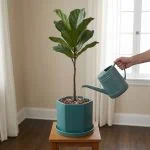

🚨 Emergency 30-Second Answer: fiddle leaf fig root rot
Stop watering now — Ficus lyrata, a member of the Moraceae family, recovers from root rot in place once the pot drains within one hour. Restoring air first, then reading the roots, is how to fix fiddle leaf fig root rot without repotting.
A wilt that shows up over wet mix is the gate. Free the inner pot, let every drop clear, and leave the sleeve empty.
Not every plant comes back. A firm stem decides that, not the leaves you have already lost.
- Stop the water: every extra drop deepens the oxygen debt underground
- Empty the inner pot: tip it slowly until the last runoff clears
- Open the surface: scrape the top layer, move air across it
- Read at depth: push a long probe to the container floor
- Judge the stem last: a firm trunk still holds a route back
Get the one-page care card for this guide, plus a printable A4 copy
We condense this guide into one card for your phone and a print version for the pot shelf. Enter your email and we send both to your inbox. Subscribe once, then request the card of any guide you read.
By subscribing you agree to get emails from Plant Care Basics about plant care guides, about once a week at most. Unsubscribe in one click. Privacy policy
The pot smelled sour before anything on the plant looked wrong — a flat, cellar-damp note that got stronger over four days while the leaves stayed up. Then the lowest leaves went limp on a mix that was still wet, and that single mismatch is what separates root rot from thirst.
I reached for a fungicide; what the pot actually wanted was oxygen. Ficus lyrata is a forest tree with no water-storing organ anywhere in it, so a rootball held in anaerobic water starves at the root and answers at the canopy within days. No reserve, no delay.
So the container decides this, not the leaves. Get the water out, get air back to the roots, and the plant can rejoin the ongoing regime a recovered specimen returns to.
You are not too late if the stem is still firm — the following table is the short version of every check that follows.
How to fix fiddle leaf fig root rot without repotting, in numbers
| What to check | What it should show |
|---|---|
| Sound root against failed root | Firm and white to tan, against brown-to-black and soft, outer layer sliding off |
| Wilting while the mix is still wet? | Yes – read the root zone, not the watering can |
| Water when | The top 2 inches of mix are dry; never let the rootball dry until the soil pulls away from the pot wall |
| Standing water under the pot | Emptied from the saucer or the outer sleeve within about an hour of watering |
| Drainage hole required? | Yes – a holeless decorative pot is used only as a removable outer sleeve |
You are subscribed
Press the button and we prepare this guide's one-page care card and its A4 print copy and email both to you within a few minutes.
Tap the button below to get more plant fixes in your Google Search results

Table of Contents
Stop the water and get air back to the roots
Stopping the water and restoring air to the root zone is the whole of the in-pot correction, because oxygen, not a product, is what a suffocating fiddle leaf fig is short of. Excess water pushes the oxygen out. The fine roots die, and the plant loses its ability to drink.
The following sections work outward: drainage first, then drying, then the organism.
Do not add water while the mix is still wet at depth. On this fig a second pour onto a saturated rootball is the move that closes the door.
Check the drainage before you check the roots
Yes is the answer to “can root rot start in a container that cannot drain”, and that setup is the most reliable route to this failure. A holeless pot gives water nowhere to go.
Gravel does not fix that. Two extension authorities reject the substitute outright. Meanwhile the medium that decides how fast a pot drains is the other half of the same problem.

- Check the inner pot for open drainage holes
- Tip the outer sleeve and pour off anything standing in it
- Feel the bottom of the rootball, never the surface
Drain the pot, then raise the evaporation
The short answer to “how to dry out a waterlogged fiddle leaf fig pot” is that you stop adding water and let the container do the work. Draw the inner pot out of its sleeve and let every drop run out (stay with me here), because a sleeve holding an inch of runoff cancels the whole exercise.
Then raise the evaporation. I lost a rootball once by pouring a second time on a pot that still read wet at the bottom. As the days pass that surface should shift from dark and cold to pale and dusty under a fingertip.
- Scrape away the top inch of crusted surface mix
- Empty the sleeve or saucer within about an hour of any watering
- Water again only when the top 2 inches are dry and the pot drains freely
Why naming the organism changes nothing you do
Naming the organism changes nothing you do, and that is worth saying plainly to a reader who has just spent an evening reading genus names off a forum thread. Pythium, Phytophthora and Fusarium are the genera named for this failure, and you cannot separate them at home. You also do not need to.
Every one of them needs the same wet, airless medium, so the correction aims at the conditions rather than at the organism. According to University of Wisconsin-Madison Extension, the root rot fungi that survive in soil and plant debris prefer wet soil conditions, which is why a fungicide drench answers nothing in a container that still cannot dry.

Get the one-page care card for this guide, plus a printable A4 copy
We condense this guide into one card for your phone and a print version for the pot shelf. Enter your email and we send both to your inbox. Subscribe once, then request the card of any guide you read.
By subscribing you agree to get emails from Plant Care Basics about plant care guides, about once a week at most. Unsubscribe in one click. Privacy policy
Tap the button below to get more plant fixes in your Google Search results

Root rot, or a rootball that dried too far?
Both failures wilt a fiddle leaf fig, and the container tells them apart in one touch. Reading “how to tell root rot from underwatering on a fiddle leaf fig” rests on one thing: whether the mix under the canopy is wet or dry. The following table sets the two readings side by side.
| Root rot | Rootball dried too far |
|---|---|
| Wilts while the mix is still wet | Wilts on a container that has gone light |
| Roots brown-to-black and soft, outer layer sliding off | Roots firm, with the mix shrunk back from the pot wall |
| Lowest leaves go first | Marks begin at the margin and stay dry and papery |
| Correction is to stop watering and drain | Correction is one full re-wetting, then normal watering |
Verdict: a wet mix under a wilting canopy is the root zone; a light pot whose soil has pulled from the wall is thirst.
What failed root tissue feels like
A texture rather than a color answers “what do rotted fiddle leaf fig roots feel like”.
Sound tissue is firm and white to tan, and it snaps cleanly when you pull it, the way a fresh green bean snaps rather than bending. Failed tissue is brown to black and soft, and its outer layer slides off the core between finger and thumb, leaving a fine thread.
Color alone decides nothing. Over the first week the sour note in the mix fades as the surface dries, while the roots already lost do not come back.
- Pull gently: sound roots resist and snap
- Rub between finger and thumb: failed roots shed their sleeve
- Smell the mix, not the leaves
Myth vs. fact: leaf spots and the root zone
One claim in circulation says a bacterial leaf problem and root rot do not have to be separated, because the correction is the same either way. Three separate sources contradict it. Yellowing that spreads with the brown mark points at the leaf, while a mark on a leaf that stays dark green around it points at the root zone.
I dried a pot for two weeks. The problem sat on the leaf. So the separation is worth a minute: reading the marks a swinging water regime leaves on a blade sends you to the container, while the leaf-side problem sends you to the shears.

- Green around the mark, oldest leaves worst: read the root zone
- Yellow spreading with the mark, newest leaves worst: read the leaf
The recovery window, and when the plant will not come back
A fiddle leaf fig comes back from a root-zone episode only once the container starts draining again, and the plant sets that pace rather than a calendar. So “can a fiddle leaf fig recover from root rot on its own” resolves to no, not while the medium stays wet. Change the conditions and the plant does the rest.
The watering endpoint sits under the first heading, the foliage decision under the second, and the two closing checks under the last.
When the mix is dry enough to water again
Water again when the top 2 inches are dry. Read at depth, never at the surface.
The top layer of a saturated container dries first and reads dry while the zone the roots occupy is still wet, which is the exact error that produces the second watering. Never let it dry so far that the soil pulls away from the pot wall.
After that, the routine to resume once the pot drains freely again takes over from this rescue.
- Weigh the pot in your hand against how it sat after a full soak
- Push a long probe to the container floor, not two inches down
What to take off the plant, and what to leave
Take off nothing you do not have to. Leaves that are fully brown, or that detach at a touch, come off because they are already gone. A partly marked leaf stays, since a leaf that is still green is how the plant pays for the roots it has to rebuild.
Two published caps circulate, 10 percent and 30 percent, and neither is measured against the same thing. Neither applies here, because only leaves that are already gone come off. The one real exception is mechanical: a canopy too heavy for the roots left under it is a balance problem, not a light problem.

The two salvage checks: roots and stem
Two checks end the attempt. You can run both in a minute. If firm tissue remains anywhere below and the stem is still hard, the correction proceeds and the plant is judged on whether it holds its remaining leaves over the following weeks.
Where no firm tissue remains and the stem gives under a squeeze, no watering change alters the outcome. Say so plainly rather than run another fortnight of drying on a plant with no roots left, because the drying branch is the correct action in one case and pure delay in the other.
Week by week the stem tells you more than the canopy does, staying cool and firm under a thumb while leaves are still dropping. If it does come back, expect what a disturbed root system does in the weeks after a repot to look much the same.
- Roots: anything firm and white to tan still left below
- Stem: hard under a squeeze, never shriveled
Frequently asked questions about fiddle leaf fig root rot
Can fiddle leaf fig recover from root rot?
Recovery is possible while firm root tissue remains below and the stem is still hard. Recovery depends on the container draining, not on a product and not on a schedule.
Withhold water, set the inner pot outside its sleeve, and let the mix dry until the top 2 inches read dry at depth. Judge the plant on whether it holds its remaining leaves over the following weeks.
Will root rot go away on its own?
No. Nothing improves while the medium stays wet, because the organisms responsible need exactly those conditions. Left alone, a wet rootball keeps oxygen out and the fine roots keep dying.
The episode ends when water leaves the container. That means emptying the sleeve, opening the surface, and holding off the next watering until the mix has genuinely dried at depth.
What are the signs of root rot in fiddle leaf figs?
The signature sign is a wilt that appears while the mix is still wet. Below the surface, failed roots are brown to black and soft, and the outer layer slides off the core and leaves a fine thread.
Lower leaves usually go first. A sour note rising off the mix, and standing water left in the saucer an hour after watering, complete the picture.
Can you fix root rot by repotting?
Yes, repotting into fresh mix is a valid route, and it is the one to take when water will not leave the container at all. The in-pot correction suits a pot that still drains, because such a plant rarely needs the disturbance.
Repotting technique, and the recovery that follows it, belong to the article on drooping after a repot, which carries that aftermath in full.
What are the first signs of root rot?
The earliest sign is a container that stays heavy and a surface that stays dark for days after watering. Next comes wilting on a wet mix, which reverses the reading most owners make.
Lower leaves yellow and drop before anything looks wrong higher up. By the time marks appear on the blades, the root zone has usually been wet for some time.
What is the best treatment for root rot?
Restoring drainage and air to the root zone is what fixes it. Take the inner pot out of its sleeve, let every drop run out, scrape away the crusted top layer, and move the pot where air passes across it.
No product substitutes for that, because the organisms are reached by removing the conditions that sustain them. Water again only when the top 2 inches are dry, read at the bottom of the rootball.
Troubleshoot, assess, fix — the two-check test
The rescue was never a product; it was drainage, and you now have the two checks that decide it. Roots, then stem. Everything else here — the endpoint at 2 inches, the foliage you leave on, the organism you never need to name — hangs off whether water can leave the container within the hour.
So go and free the inner pot from its sleeve tonight. Tip it, and watch how long the last of it takes to stop. Where nothing runs at all, the next question is the repotting one, and that is where this stops being an in-pot job.
That is how to fix fiddle leaf fig root rot without repotting: change what the container does, and let the plant answer over the next few weeks. A pot that drains is doing the rescue for you, and an empty saucer an hour after every soak is the only proof this fig will ever need.

Get the one-page care card for this guide, plus a printable A4 copy
We condense this guide into one card for your phone and a print version for the pot shelf. Enter your email and we send both to your inbox. Subscribe once, then request the card of any guide you read.
By subscribing you agree to get emails from Plant Care Basics about plant care guides, about once a week at most. Unsubscribe in one click. Privacy policy
Tap the button below to get more plant fixes in your Google Search results