🎯 Quick Answer: fixing a leggy peace lily
How to fix a leggy peace lily: Spathiphyllum wallisii, a member of the Araceae family, suffers stretch in the 50-100 FC band. Move it to a north or east window instead. Nothing you prune will shorten a stalk that already grew.
- Check first: hold the newest leaf beside the oldest one
- Read the blades: smaller, paler new growth confirms a light deficit
- Watch the spathes: a leafy plant that never flowers is under-lit
- Skip the shears: cutting the stalks back adds no fullness at all
- Wait for proof: judge the next leaf, not the stretched ones
Get the one-page care card for this guide, plus a printable A4 copy
We condense this guide into one card for your phone and a print version for the pot shelf. Enter your email and we send both to your inbox. Subscribe once, then request the card of any guide you read.
By subscribing you agree to get emails from Plant Care Basics about plant care guides, about once a week at most. Unsubscribe in one click. Privacy policy
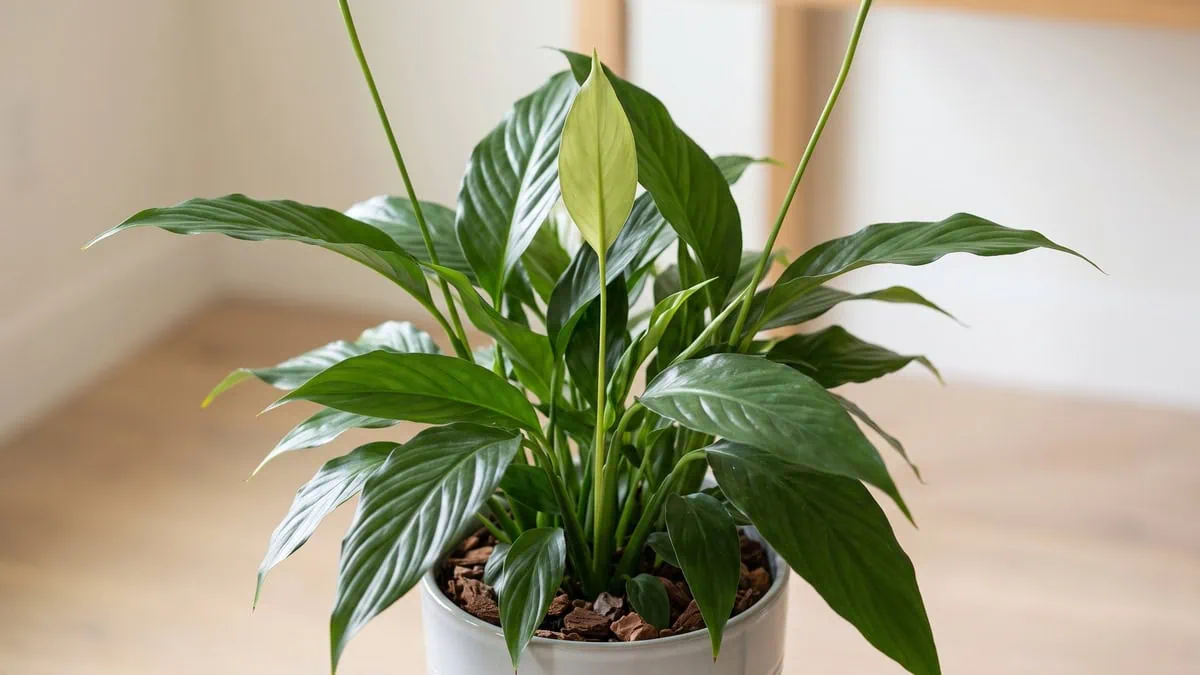
The newest leaf on my stretched peace lily opened on a stalk longer than my hand, its blade smaller and paler than the glossy dark ones below (trust me on this: the thinning chlorophyll is the tell, not the height).
Seven years of growing this plant taught me its name: etiolation, the stretch this plant makes in low-light conditions. Cutting the long stalks back to force a bushier plant sounds right. It isn’t.
Let me reframe that — here’s what a forest-floor plant does instead: Spathiphyllum wallisii draws its petioles toward the window, pale and spindly, because below its light floor photosynthesis stops covering what respiration burns.
So the fix is placement, not pruning. Shift the pot into the light band this plant can work in, and the next leaf comes up shorter and darker; the stalks already grown stay the length they are. For the whole picture, start with the wider indoor regimen this species asks for.
None of this is hard once you can see it. The table below sets out the light numbers, the window and the two things pruning cannot fix.
How to fix a leggy peace lily: the numbers at a glance
| Peace lily specs | Setting or answer |
|---|---|
| Optimal light for compact new growth | 150-500 FC, partial shade or medium indirect, never direct sun |
| Light floor where stretch begins | 50-100 FC, the survival band |
| Best window and distance | North or east window, or 15-20 ft back from an unshaded south pane (Northern Hemisphere) |
| Does cutting it back make it bushier? | No, the leaves rise from a basal crown with no aerial node to cut to |
| Does it need a stake or a moss pole? | No, it has no climbing stem and no aerial roots |
| Artificial light schedule | Cool white LED, 12-16 hours daily, intensity set by distance |
You are subscribed
Press the button and we prepare this guide's one-page care card and its A4 print copy and email both to you within a few minutes.
Tap the button below to get more plant fixes in your Google Search results

Table of Contents
Is it really legginess? Two checks before you move the plant
Legginess on a peace lily is a proportion rather than a posture: long pale stalks carrying undersized blades. The two sections below run the checks in order.
The newest leaf against the oldest: a 10-second check
Hold the newest fully opened leaf against one of the oldest outer leaves and compare stalk length to blade size. Nothing else is needed. On a plant short of light the newer stalk runs longer, the newer blade runs smaller, and its color slides from deep glossy green to a flat yellow-green.
Look at the crown as well. The gap between neighboring leaf bases sits wider than it does on a plant in adequate light (the same spacing shift that shows up on shade leaves anywhere).
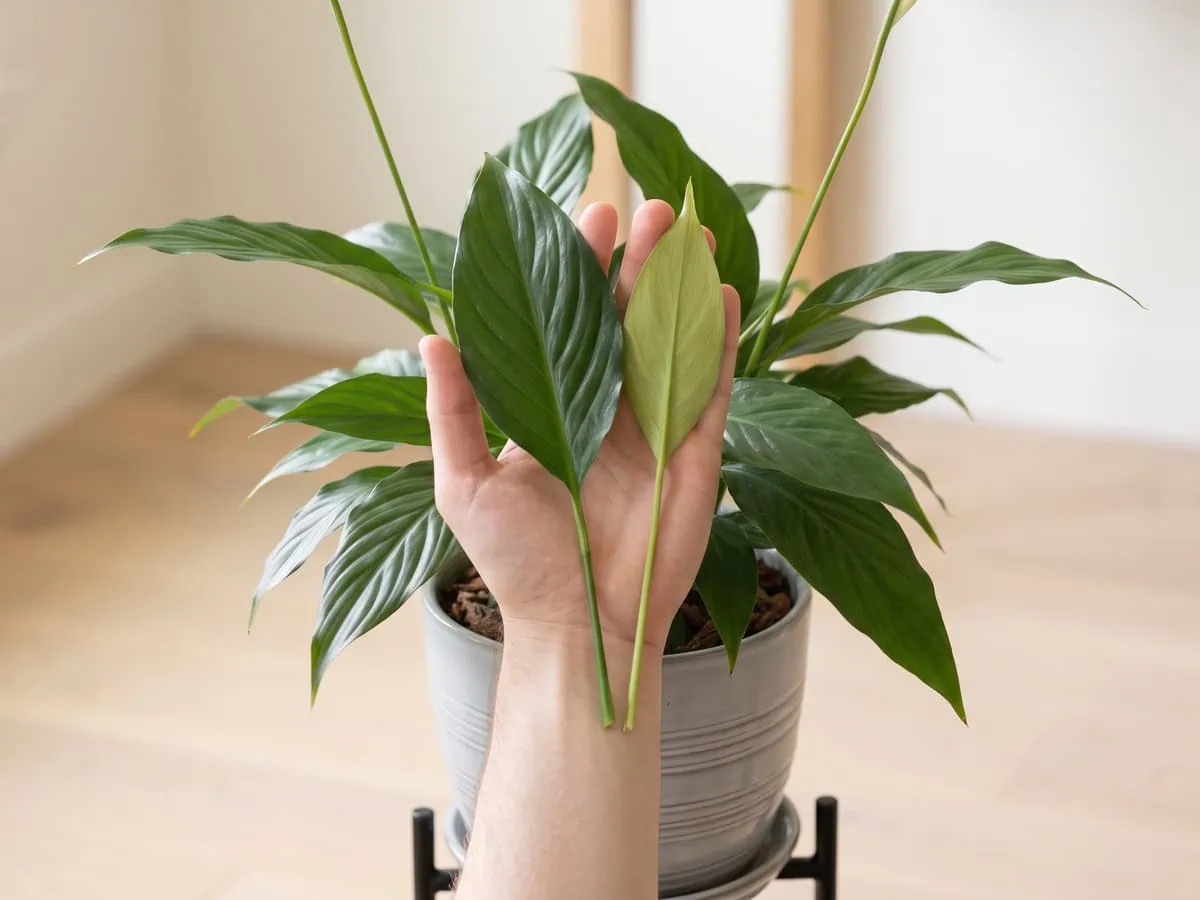
Stalled growth and dying outer leaves ride along with it. That makes “why is my peace lily growing tall and floppy” a question two leaves answer, not a ruler. One more tell is free: a healthy-looking plant that never opens a white spathe is usually under-lit rather than unwell.
Leaning one way, or splaying open in every direction?
Two different stories. A crown leaning all one way is answering the light. A crown splaying open from the middle in every direction at once is reporting its root zone instead, and that second pattern belongs with a crown that has splayed open in every direction.
Two readings keep the sort honest. A steady outward arch on the oldest leaves is ordinary indoor posture (nursery plants stand crowded, then spread once they have a room to themselves). And where a thorough soak lifts the whole plant within a few hours, “peace lily stems falling over and not standing up” was thirst.
Stretch behaves differently. On the plant I moved out of a dim corner, the newest blade opened two shades lighter than the ring of older leaves below it, on a stalk half a hand longer, while flowers kept coming as though nothing were wrong. That is why a stake tidies the look and changes nothing underneath it.
Get the one-page care card for this guide, plus a printable A4 copy
We condense this guide into one card for your phone and a print version for the pot shelf. Enter your email and we send both to your inbox. Subscribe once, then request the card of any guide you read.
By subscribing you agree to get emails from Plant Care Basics about plant care guides, about once a week at most. Unsubscribe in one click. Privacy policy
Tap the button below to get more plant fixes in your Google Search results

Where a stretched peace lily has to stand
A stretched peace lily wants 150-500 FC of indirect light, the partial-shade band, and the only way it gets there is if the pot moves. The following sections give the distances and the turning habit.
Below roughly 50-100 FC the plant persists without gaining anything. Leaves keep coming. Each one simply arrives longer in the stalk and paler in color, so “does low light make a peace lily leggy” has a measured answer rather than an opinion.
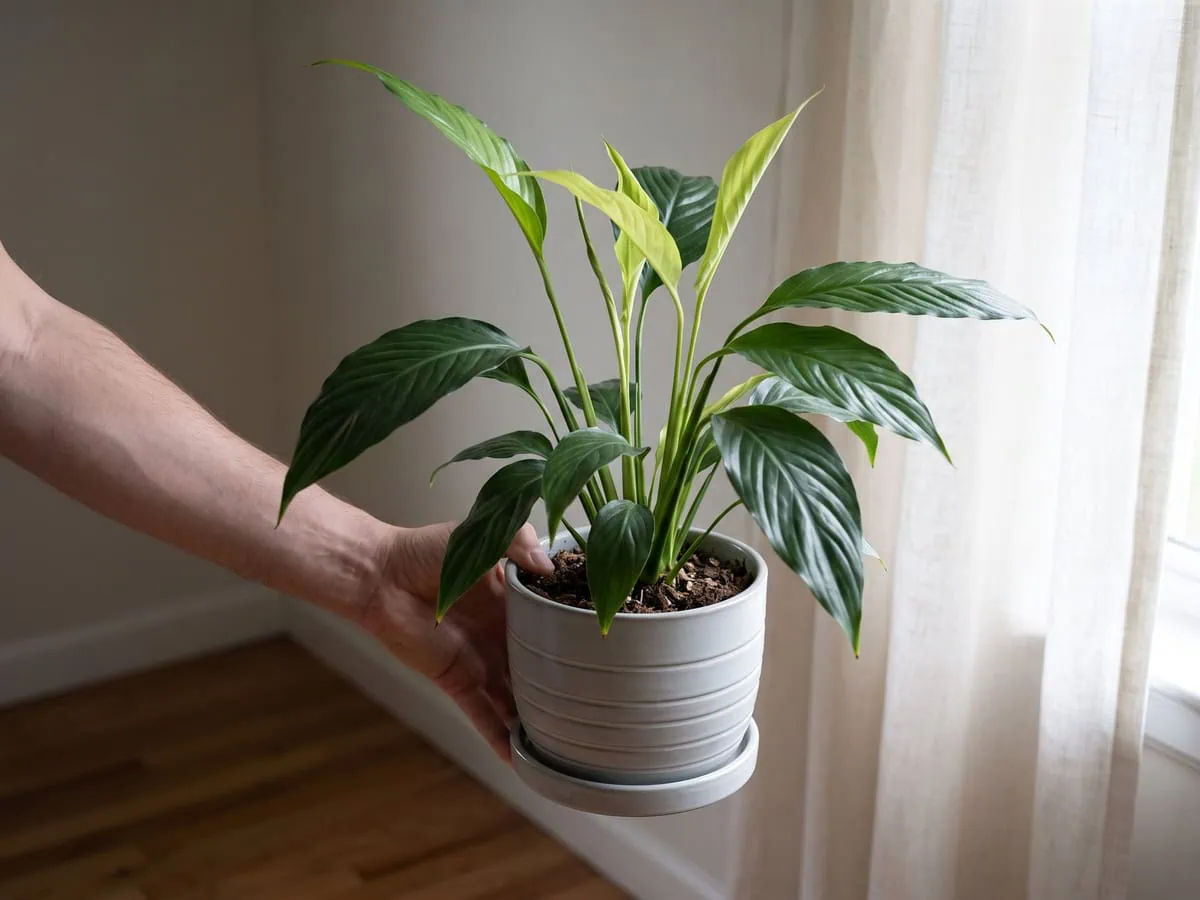
According to University of Maine Cooperative Extension, etiolation in plants grown in low light is a chlorophyll shortfall rather than a growth spurt (yes, this sounds backwards — bear with me).
The same dimness takes the flowers as well. One move therefore answers two complaints, and the plant I moved into an east room proved it by opening its next spathe that season.
Months without a bloom usually means the same thing. Readers who arrived that way are standing in the same dim corner that stops the white spathes.
North, east, south or west: how far back from each window
Direction sets the distance. The distance is what keeps the light indirect, so read the table and then pace it out across your own floor.
| Window | Where the pot stands |
|---|---|
| North | Near the glass, even directly in front; the light never turns direct |
| East | A few feet back from soft morning light; the easiest window to get right |
| West | 3-10 ft back, or behind a sheer curtain; afternoon sun scorches |
| South | 15-20 ft back, or behind a sheer curtain; never in the beam |
Test the spot by what you can do in it. If you can read there comfortably without switching a lamp on, the plant is inside its band; if you reach for the lamp, so would the plant.
A windowless room is not a dead end. A cool white LED run 12-16 hours a day carries this species, with intensity set by how close the fixture hangs.
Turning the pot before the crown commits
Give the pot a half turn every time you water. That habit heads off a lean, and it adds nothing to the job (you are already standing there with the can).
A crown that has already committed needs that half turn kept up, so the shaded side gets the light it has been missing, and expect the balance to come back over the next several weeks rather than overnight.
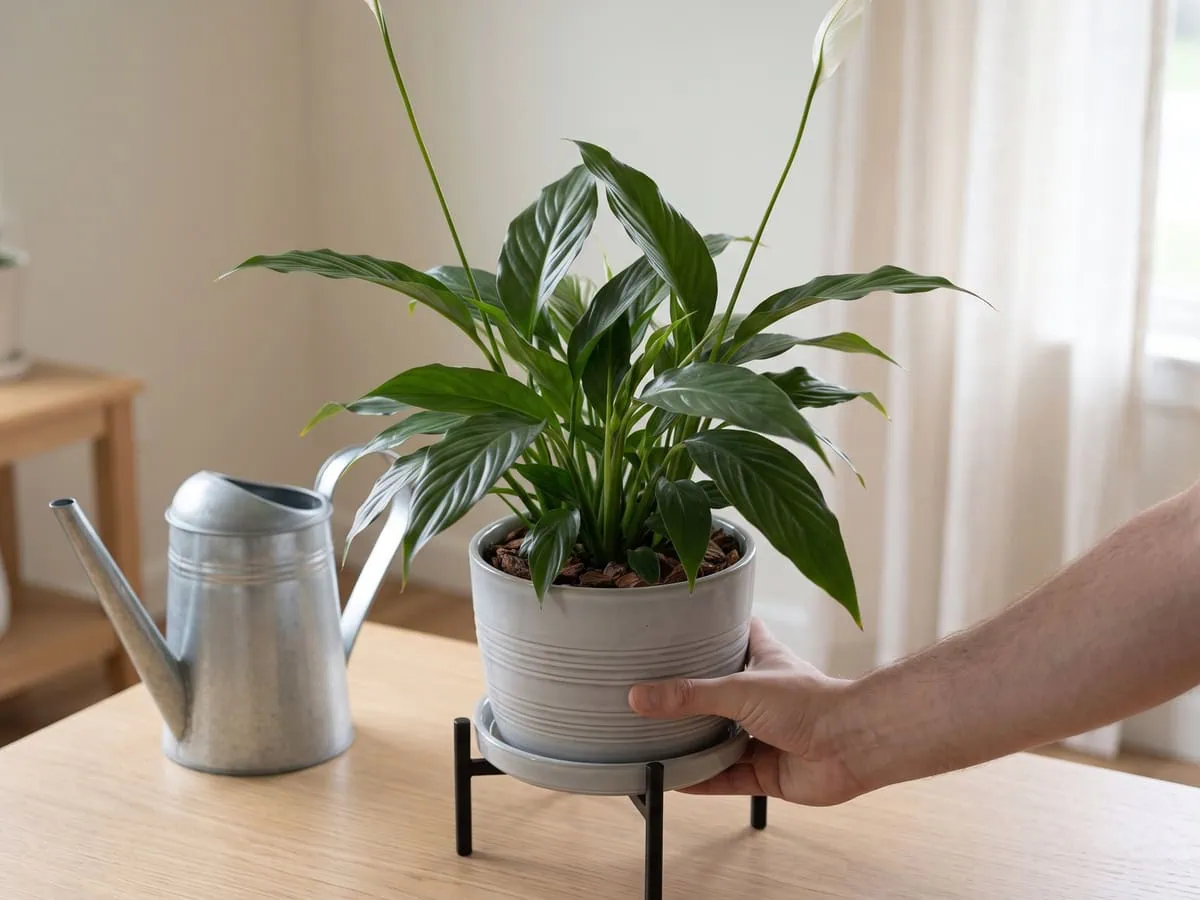
That is the working answer to “how to stop a peace lily from stretching toward the light”. It works because the plant moves, not because anything gets cut.
What recovers, what never does
Stalks that already grew long stay long, and only the leaves that open after the light changes arrive short. The following sections separate what recovers from what is finished.
Why cutting it back cannot make it bushier
Every leaf rises on its own stalk straight out of a basal crown, with no bare stem between leaves and no aerial node to cut back to (which is exactly what the generic advice assumes you have). Shorten a stalk and you have removed a leaf. No node, no branch.
The instruction to cut long stems above a node is imported from vines and stemmed houseplants. On a crown-forming plant with no aerial node the same instruction removes a leaf and buys no branching at all.
So “how to make a peace lily bushier and fuller” resolves to fan count rather than to branching. Fullness arrives when the crown keeps building new fans, which is a light job first and, for a clump that has outgrown its pot, a question of how one overgrown crown becomes several.
If you cut it down anyway: what grows back
It comes back. Taking every leaf slows that return, which is why the usual advice is to leave several stalks in place and to remove only spent flower stalks and yellowing leaves at their base, using a blade wiped or dipped in alcohol first.
One caution outranks the technique. Whatever regrows is built under the light the pot is standing in, so a hard cutback done without moving the plant returns the same stretched growth a few months later (same light, same result).
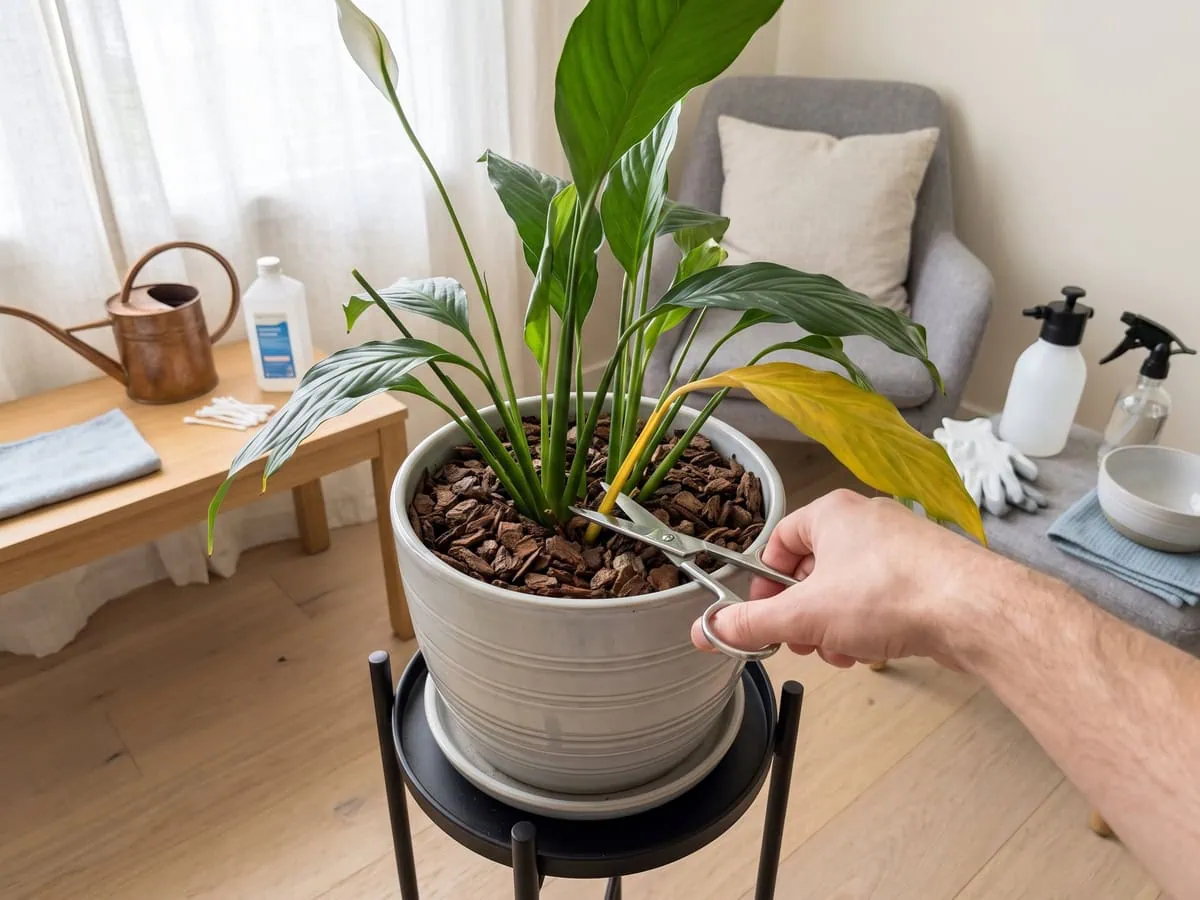
How long before the next leaf tells you it worked
Judge the move by the next leaf out of the crown, never by the stretched ones already open. In my experience — though n=1 — the first honest signal was one new blade in the deep glossy green of the oldest leaves instead of the flat yellow-green of the stretched ones.
Judge this plant by its own next leaf; the three-to-four-week figure is a general houseplant number. Selection sets the ceiling as well: a compact one tops out near a foot, the classic large one around two feet, so it is worth knowing which selection you are actually growing.
Frequently asked questions about a stretched peace lily
Why is my peace lily very leggy?
Too little light is the cause, not a missed pruning: below roughly 50-100 FC this plant holds on without gaining anything.
Each new leaf then opens on a longer stalk with a smaller, paler blade, and the crown stops sending up white spathes. Move the pot into the 150-500 FC partial-shade band and the stretch stops with the leaf after the move.
How do I make my peace lily bushier?
Bushiness is a matter of fan count, not of branching, because every leaf rises on its own stalk out of a basal crown.
Brighter light is what builds new fans fastest, so the placement fix ranks first. A crowded clump can then be lifted and split into pieces that each carry leaves and their own roots, or root-pruned back into the same pot so it thickens in place instead of widening.
Will a peace lily grow back if cut down?
Yes. New leaves rise from the crown after a hard cutback, although taking every leaf slows that return.
The usual advice is to leave several stalks in place and remove only spent flower stalks and yellowing leaves at their base, with a blade wiped or dipped in alcohol first. New growth is built under the light the pot stands in, so move it before you cut.
Why won’t my peace lily get bigger?
Ultimate size is set by which selection you own, and most plants are already sitting at their documented ceiling.
Compact cultivars finish near a foot, the classic large one around two feet, and the largest, ‘Sensation’, at 4 feet or more, with spread staying narrow at every height. Newer selections reach that ceiling in two to five years; the older species type takes five to ten.
Can you hard prune peace lily?
No. This plant takes grooming rather than structural pruning, because it has no aerial node anywhere on the crown.
Take off spent flower stalks, dying or yellowing leaves and dead material at their base, and trim dry brown tips with sharp scissors. The boundary is the condition of the leaf rather than a count, so take what is finished or dying and leave the rest.
How to make a peace lily bigger?
Light ranks first, because a plant parked at its survival floor grows slowly whatever else it is given.
Three levers move the size after that: a pot about two inches wider once roots run out of the base, feeding only across active growth, and a room held in the warm middle of the tolerance band. Even then the clump fills out over years rather than months.
Your next step: from stretched stalks to a compact new leaf
Everything here points back to placement. Move the pot. Then judge the crown by the next leaf.
The new blade comes up a full shade darker than the pale ones beside it. And no blade changes that.
Look — the stall people blame on feeding is usually position (the pot never moved). But once the light is right, a crowded clump is the next question.
Work through how to fix a leggy peace lily in that order and the plant answers in weeks. Nothing you cut will shorten a stalk that is already grown, so move the pot into better light and let the crown answer you leaf by leaf.

Get the one-page care card for this guide, plus a printable A4 copy
We condense this guide into one card for your phone and a print version for the pot shelf. Enter your email and we send both to your inbox. Subscribe once, then request the card of any guide you read.
By subscribing you agree to get emails from Plant Care Basics about plant care guides, about once a week at most. Unsubscribe in one click. Privacy policy
Tap the button below to get more plant fixes in your Google Search results