🚨 Emergency 30-Second Answer: Why does my Aloe vera have brown spots and dark patches?
Press first: on Aloe vera, a member of the Asphodelaceae family, a patch that yields means excess water, the mix still wet at the bottom of the pot. A patch that stays firm and dry is a light or cold mark instead. That single test sorts the two.
Soft, sunken tissue spreading from the crown needs the plant unpotted and the roots read today. Firm brown tips stay put; they dry to a string and stop. Neither one is settled by color, so place the pot and read the mix instead.
- Dry-down depth: the mix dry all the way to the bottom before the next watering
- After a move: acclimate over about a week through dappled or filtered light
- After cutting soft tissue: indirect light for 2-3 weeks, water only when bone-dry
- Blade hygiene: disinfest with 70 percent isopropyl alcohol or nine-to-one bleach
- Keep leaves dry: prolonged surface wetness is how leaf-infecting organisms get in
Get the one-page care card for this guide, plus a printable A4 copy
We condense this guide into one card for your phone and a print version for the pot shelf. Enter your email and we send both to your inbox. Subscribe once, then request the card of any guide you read.
By subscribing you agree to get emails from Plant Care Basics about plant care guides, about once a week at most. Unsubscribe in one click. Privacy policy
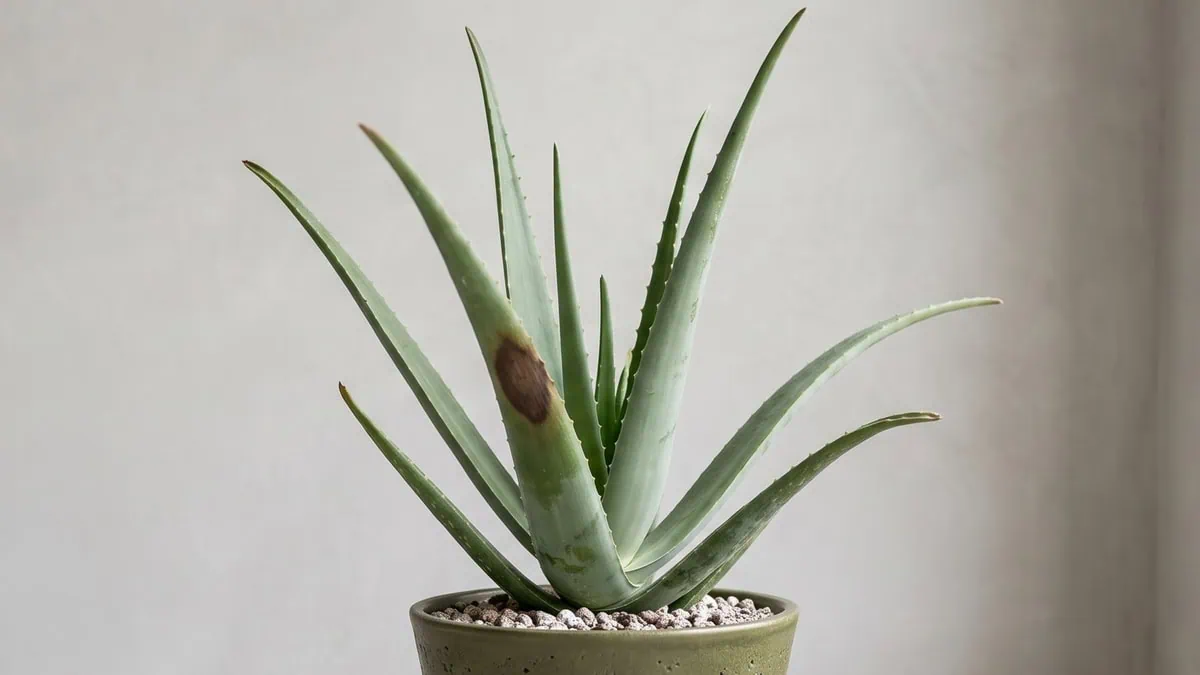
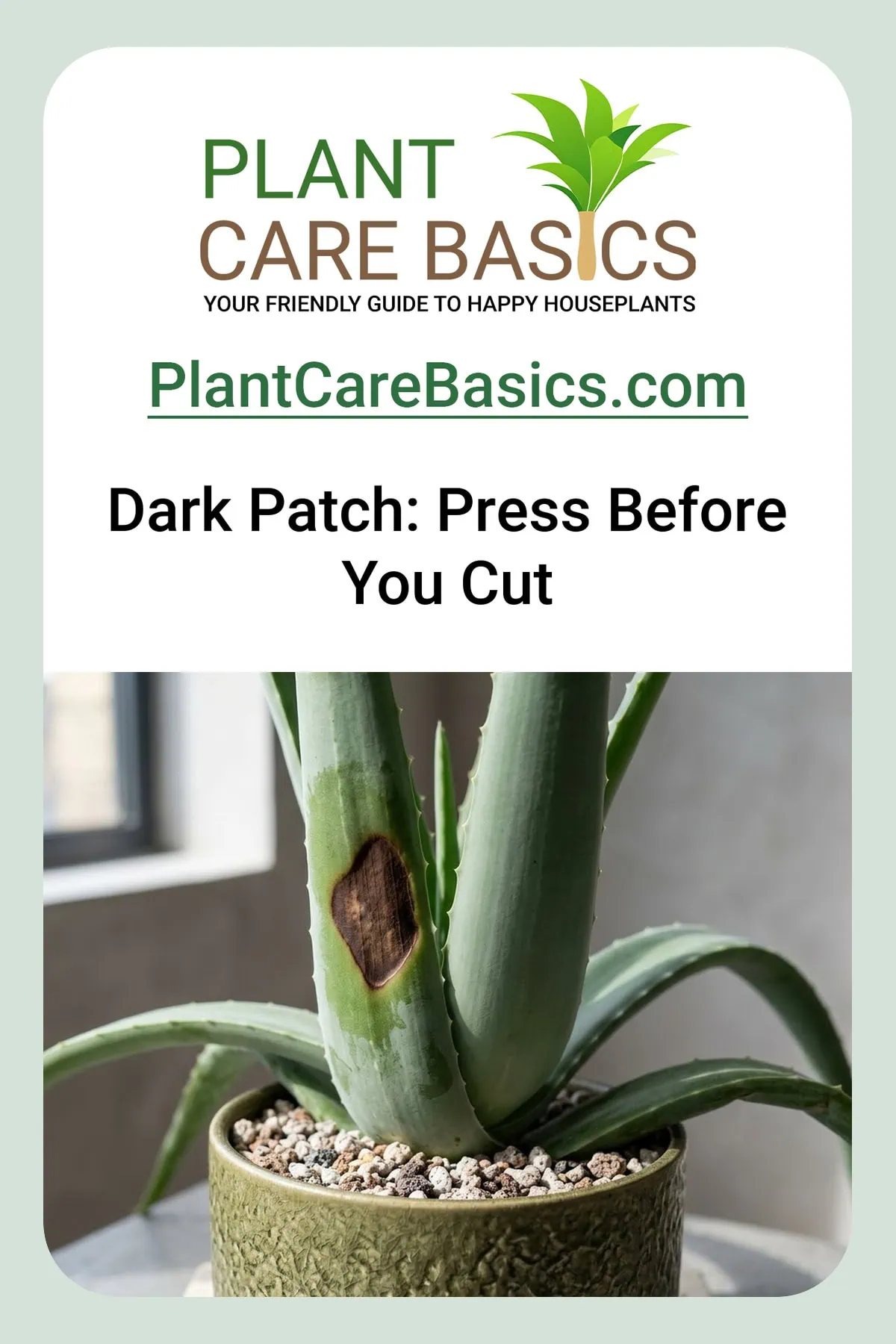
A dark, sharply bordered patch sits on the mid-blade; the leaf beside it is still gray-green and unmarked. For a long time I read that color as sunburn. I ignored the texture.
I was treating leaf spot disease on those patches, something to spray, but the real fix had nothing to do with that. It was the water sitting under the crown, where this plant keeps its whole reserve and has no way to shed a surplus.
Lay a bare fingertip on the mark (low-key obsessed about this) and press the same spot again on each of the next three days: by the second morning the tissue that gives has sunk a shade lower than the surface beside it, while a firm patch has already tightened into a brown string and moved no further.
Sunburn and rot can leave the same color, so start by reading the healthy baseline for this succulent.
Most marks on this plant need no blade at all. The fast read for a marked leaf is right below, so you can place yours in one pass.
Why does my Aloe vera have brown spots and dark patches: the fast read
| What to check | What it means |
|---|---|
| Does the mark give under light pressure? | Yes, soft: root zone. No, firm: light or cold. |
| Where the mark started | Base upward points to the root zone; middle or tip points to an environmental cause |
| Lowest safe temperature | Keep above 50F; at 32F and below the freezing tissue collapses irreversibly |
| White to tan crust on the mix surface or pot rim | Present with dry brown tips – read it as accumulated feeding salts, not a pathogen |
| Removing a marked leaf | Sterilized blade, marked tissue only, removed parts binned rather than composted, blade sterilized again |
You are subscribed
Press the button and we prepare this guide's one-page care card and its A4 print copy and email both to you within a few minutes.
Tap the button below to get more plant fixes in your Google Search results

Table of Contents
Start here: what to press, and what to do first
Press the edge of the mark before you do anything else, because texture decides the route and color does not. In order: the press test, the mark’s position, and a bump that is not a mark.
Soft tissue spreading from the crown will not wait. Unpot the plant today and read the roots. Firm and white is sound; brown or black and mushy is not.
Soft and sunken, or dry and firm?
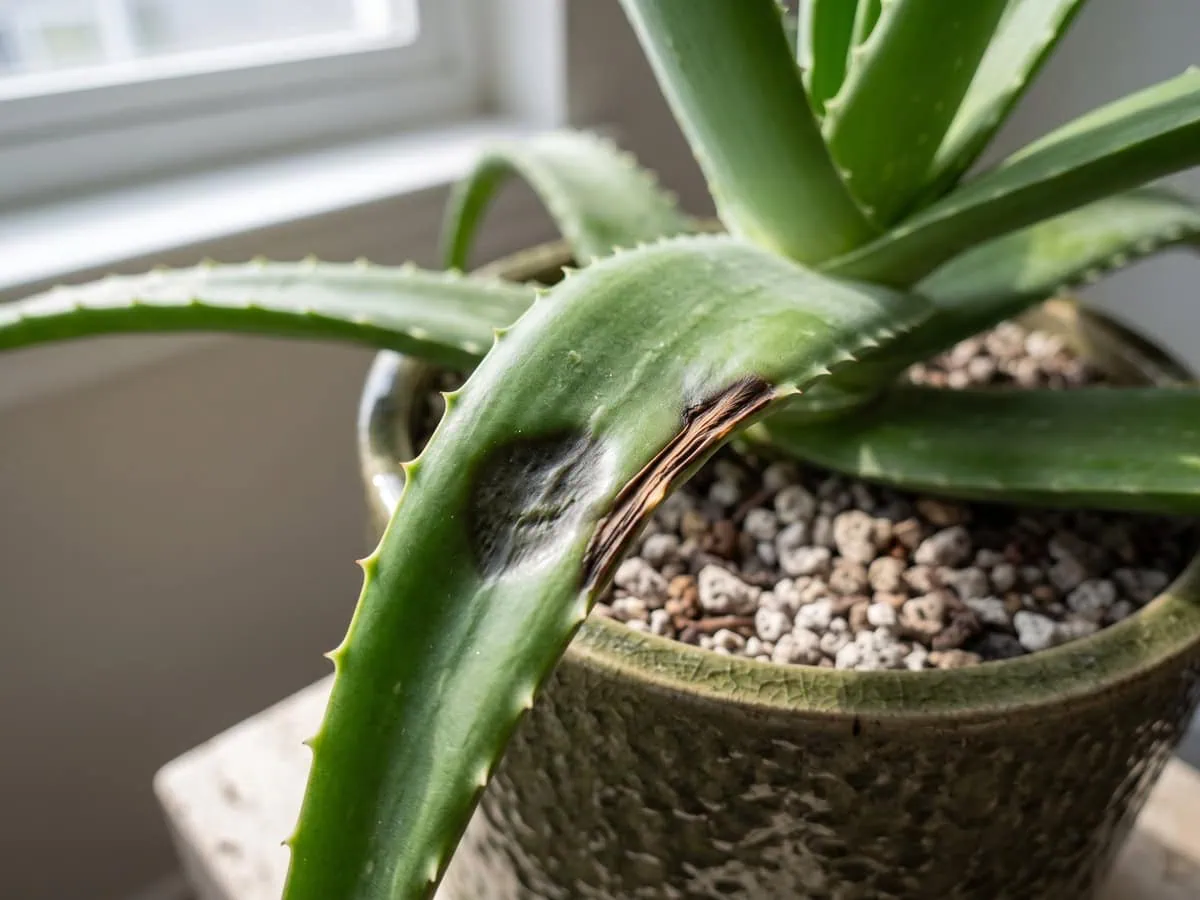
Enter “what do black sunken spots on aloe vera mean” in a search box and a color chart comes back. Feel the mark instead, because a patch that yields and sits below the surrounding surface is carrying water it cannot lose, and getting decay out of the root zone is then the job.
A firm patch behaves differently across the following week. By the third morning it has shriveled to a brown string of rigid tissue, and by the seventh the green around it is still plump to the thumb. Then it stops.
| What you feel | What it is |
|---|---|
| Gives under pressure, sits below the surface | Excess water at the root zone; check the base |
| Stays rigid, dries to a brown string | A noninfectious tip disorder; nothing to do |
| Lifts away under a fingernail | An insect sitting on the leaf, not a lesion |
Verdict: Take the soft reading first and check the base, because a mark that yields is the only one that reaches the crown.
One mark can be soft at its center and dry at its rim, and no page says what to do then.
Read the soft part as the live edge. That is the part you act on. Then check the base and the drainage tray before you blame light.
Where the mark sits: base, blade or tip
Position is the second reading, and it holds when texture gives you both answers at once. Marks that begin at the base and travel upward point at the root zone. Marks on the middle of a blade or at its tip point at the room instead.
Leaf scorch and heat stress land on the faces that met the light. Not where the water pooled – where the sun struck.

A bump you can lift off is not a lesion
Ask “how do i tell scale bumps from a leaf disease” and the pages hand you two names and no test. Draw a fingernail across the brown thing instead, since an armored insect shows up as a tiny flat brown oval on either leaf face and carries an edge that stands proud of the blade.
I have scraped plenty of these and found nothing but plant. Nothing lifted. Clearing a shell-forming insect off the blade matters only once something does.
Ten pages will tell you to cut and none will tell you when to stop, which is exactly the moment a reader with a badly marked plant reaches.
Stop cutting while the plant still holds leaves that are firm along their whole length. Take a second pass only once the rosette pushes a fresh leaf from its middle.
Get the one-page care card for this guide, plus a printable A4 copy
We condense this guide into one card for your phone and a print version for the pot shelf. Enter your email and we send both to your inbox. Subscribe once, then request the card of any guide you read.
By subscribing you agree to get emails from Plant Care Basics about plant care guides, about once a week at most. Unsubscribe in one click. Privacy policy
Tap the button below to get more plant fixes in your Google Search results

The other things that darken an Aloe vera leaf
Most dark marks on this plant are not an organism at all. Pale markings, cold at the window, and feeding crust follow in the following sections.
Pale marks that were never damage
Every page that answers “are the pale markings on my aloe vera leaves a disease” says the same thing, which is that the mark is damage. Not always.
Young leaves carry scattered white speckling that fades as they mature, so a pale fleck on the newest growth and absent from the oldest is the plant’s own pattern.

Run a fingertip across it, then run the same finger over the same fleck a week later. If nothing lifts on either morning and the blade stays firm underneath both times, you are looking at coloring rather than a wound.
Cold at the glass and the water-clear patch
A translucent, water-clear patch has two roads to it and the leaf will not tell you which one it took.
Cold is the first: this plant is stressed below 50F, freezing at 32F collapses the tissue outright, and a windowsill on a cold night runs well below whatever the thermostat in the middle of the room is reporting. Water sitting at the root zone is the second.
So separate them by circumstance instead of appearance. Note how close the pot sits to glass or to a much-used door, and how wet the mix was in the days before the patch showed up.
Cold-month placement away from the glass settles the first road.
Feeding salts, crusts and dried tips
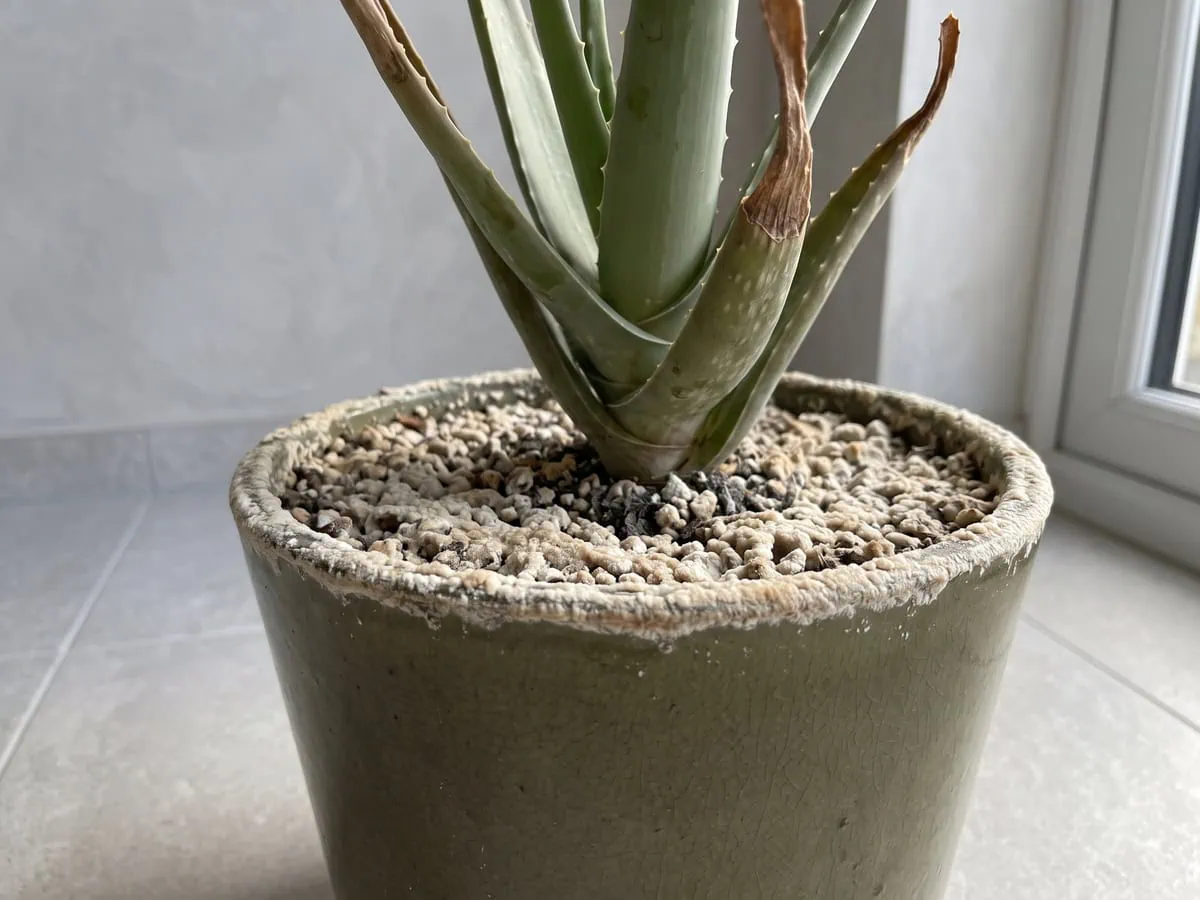
Look at the mix surface and the pot rim before you look at the leaf. A white-to-tan crust in either place, paired with dry brown tips, is accumulated feeding salt rather than a pathogen. Flush the pot with clear water at twice its own volume and hold the feeding until growth restarts.
A shortage reads differently. According to the University of Delaware Cooperative Extension, interveinal chlorosis in ornamental plants turns up on the newest leaves, while the mobile shortages show on the oldest ones first.
No page gives you a humidity figure. So watch where the air moves, keep water off the blades, and note whether the mark is still damp hours after watering.
Wrong readings, and the mistakes behind them
Three readings send more plants to the bin than any pathogen does. Below, the following sections cover reversion, color after a move, and one label the pages fight over.
Readers also ask “does a bad smell from a cut leaf mean my aloe vera is rotting” and no page answers it. Note three things instead of concluding.
Is the fluid at the cut face clear or discolored, does the odor come from the cut face or from the mix, and does the leaf give under light pressure away from the cut?
The same restraint applies to the gel. Set aside any marked leaf rather than cutting around it, because the reach of a mark into tissue you cannot see is beyond judging from the surface. Removing a whole leaf with a clean blade is the cleaner move.

Does a brown patch ever turn green again?
Reversion is real, but only for color that came from sun stress. Where over-watering or burning has destroyed the tissue, that leaf does not come back, and waiting for it wastes the weeks the rosette needs.
Judge recovery from the center instead. New growth at the middle of the rosette tells you the plant is fine even while the marked leaf outside it stays marked forever.
Dark red after a move is often pigment, not burn
Ask “why did my aloe vera turn dark red after i moved it” and you will find the pages split two against two. Both readings start from the same trigger, so the trigger cannot separate them.
Touch decides it. A burn goes brownish or bleached and ends up dry and crisp, while the stress response gives a reddish or reddish-brown coloring with no severe drying, and that coloring drains back to green across roughly two weeks once the light is less direct. Acclimate over about a week through dappled or filtered light and the question answers itself.
The label three pages use and one rules out
One named condition gets affirmed by three pages and ruled out by a fourth.
You cannot settle that from a page. Check the two features the description actually supplies. Did the mark begin pale and yellow rather than dark, and is anything powdery and orange sitting on the underside of the leaf?
I chased that label for a long stretch and both checks came back negative. Go back to texture and position, and read leaves that went thin and limp instead as a separate question with its own answer.
Frequently asked questions about dark marks on Aloe vera
Why does my Aloe vera have dark spots?
Excess water at the root zone is the leading cause, and texture tells you when it applies.
A mark that gives under a fingertip and sits below the surface points at the mix. A firm, dry mark points at light, cold or feeding salt instead. Color alone separates none of them on this plant, which is why the press comes first.
How to fix brown Aloe vera?
Remove only the marked tissue with a sterilized blade, and then fix the condition that made the mark.
Bin the removed parts rather than composting them and sterilize the blade again afterwards. Stop while the plant still holds leaves that are firm along their whole length. Then let the mix dry all the way to the bottom before you pour again.
Do brown patches on an Aloe leaf ever turn green again?
Only color that came from sun stress fades back to green; destroyed tissue never does.
Over-watering and burning both break the cells outright, so the marked area on that leaf stays marked for the rest of its life. Judge the plant from the center of the rosette instead. New growth there is the recovery signal, not the appearance of the old leaf.
How do I tell a sun-scorch patch on Aloe from a rot patch?
Feel it and place it: scorch stays dry and firm on the sunlit face, decay gives and starts low.
A sun mark sits where the light struck and can look glazed, silvery or reddish brown. A decay mark begins at the base and travels upward, and the tissue under an intact skin has already gone. Check the base before you blame the window.
End the guess-and-cut era with your Aloe vera
The whole method fits in one motion. Press the mark, note where it started, and only then decide whether anything needs to come off the plant.
Soft and low means the root zone and a fast dry-down. That is the whole fork. Firm and dry means light, cold or salt, and a week later that same patch is still exactly the size it was on the morning you first pressed it.
Color settles neither. And every page leads with it anyway.
Once you can place a mark, the question behind it, “why does my aloe vera have brown spots and dark patches”, stops being a hunt for an organism and turns into a question about the watering interval instead.
Read the mark with a fingertip before the blade, and most dark patches on this rosette turn out to need nothing at all.
Get the one-page care card for this guide, plus a printable A4 copy
We condense this guide into one card for your phone and a print version for the pot shelf. Enter your email and we send both to your inbox. Subscribe once, then request the card of any guide you read.
By subscribing you agree to get emails from Plant Care Basics about plant care guides, about once a week at most. Unsubscribe in one click. Privacy policy
Tap the button below to get more plant fixes in your Google Search results