🎯 Quick Answer: Telling snake plant varieties apart
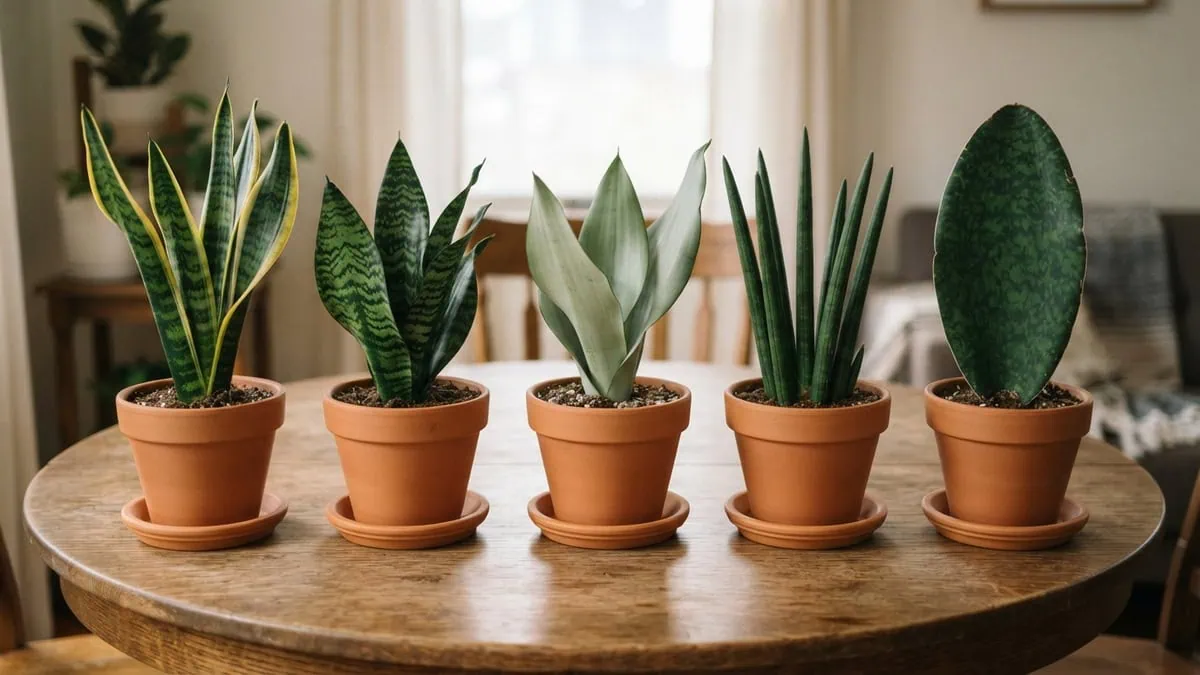
How to identify snake plant varieties stalls until you read the leaf — flat sword blades to 4 feet mark Dracaena trifasciata (Asparagaceae). Round or tubular leaves point to a different species. Margin color and height then name the exact type.
- Leaf cross-section: flat sword blade, round tube, or one broad paddle
- Margin: solid yellow edge, white vertical stripe, or none
- Height: dwarf rosette near 6 inches to 4-foot uprights
- Most common: yellow-edged ‘Laurentii’, the upright form most people picture
- Name check: legacy Sansevieria now equals the accepted Dracaena trifasciata
Confession time: for years I bought snake plants by the tag, not the leaf. Same rosette, same stiff blades — yet one wore a gold-edged margin, its neighbor wore none, and the labels swore they were different plants.
The mistake I kept making was trusting the sticker; what fixed it was reading the leaf’s own build — the flat, water-storing sword blade that marks true Dracaena trifasciata, against a round, tubular leaf that belongs to a separate species. Hmm, on reflection, the tag was never the plant’s fault. Mine, for trusting it.
Name any snake plant in three fast reads: cross-section, margin, height (note to self: read the leaf, never the label). For the full care picture behind every variety, start with the complete guide to growing snake plants indoors.
Take a breath — you do not need a botanist’s eye for this. The following table lays out the exact tells, name by name, so you can match your plant fast.
How to identify snake plant varieties at a glance
| Snake plant specs | Identification detail |
|---|---|
| Accepted botanical name | Dracaena trifasciata (Prain) Mabb. |
| Legacy genus on most labels | Sansevieria trifasciata |
| Plant family | Asparagaceae (subfamily Nolinoideae) |
| Type-species leaf form | Flat, sword-shaped, upright basal rosette |
| Mature indoor height | Uprights 2-4 ft; dwarf bird’s-nest 6-7 in |
| Most recognizable variety | ‘Laurentii’, with bright yellow leaf margins |
| Pet safe? | No — toxic to cats and dogs (steroidal saponins) |
| Stays variegated from a leaf cutting? | No — divide the rhizome to keep the margin |
This information is for educational purposes only and is not a substitute for professional veterinary advice. If your pet ingests any part of this plant, seek immediate veterinary intervention, or contact the ASPCA Animal Poison Control Center at 888-426-4435 or the Pet Poison Helpline at petpoisonhelpline.com immediately.
Tap the button below to get more plant fixes in your Google Search results

Table of Contents
The fastest way to tell which snake plant you own
The fastest way to tell which snake plant you own is to read three features in strict order: leaf cross-section, then margin, then height. Each read rules out whole groups. By the third, only one name is left.
I learned that order the slow way. For six years a plant sat in a dim dining corner because its tag read “zeylanica” — a plain-green, low-light type. Five new leaves pushed up over those years, each one a shade less gold at the edge than the last, until the bright margin had all but washed to plain green.
It was a mislabeled ‘Laurentii’ the whole time, its variegated edge starving for light. Once I read the leaf, not the label, and moved it to bright, indirect light, the newest growth held its gold.
Care barely shifts across these varieties. They all want the same lean, dry-down watering rhythm. So naming yours buys correct light, not a new routine. If you want that shared rhythm spelled out, see the watering routine every variety shares.
Type the phrase “which snake plant variety do i have” into any search bar and you drown in 20-item galleries. Pure guesswork. The three reads below hand you a name instead of a scroll.
Step 1: Read the leaf cross-section
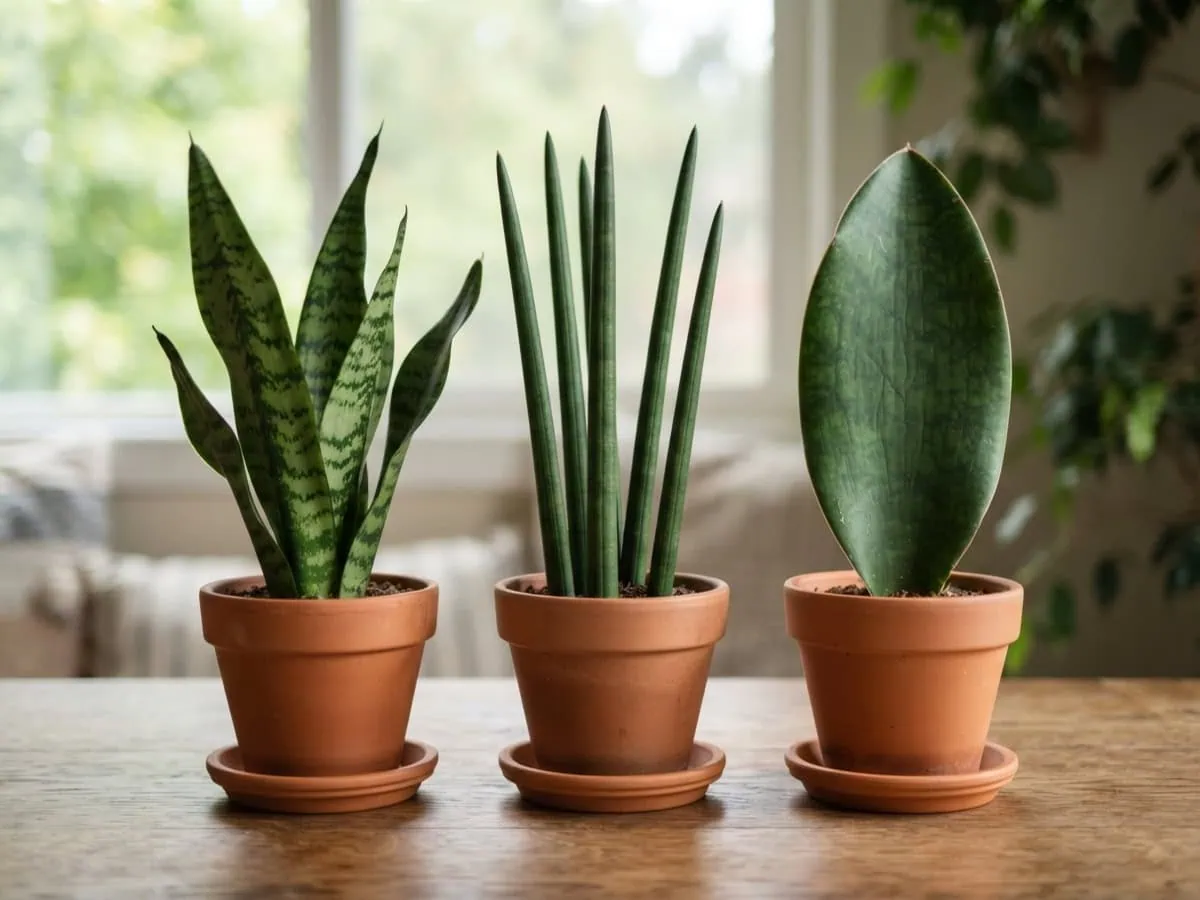
Pinch one leaf and feel its shape in profile. Flat, sword-like blades — thin edge to thin edge — mean true Dracaena trifasciata or one of its cultivars. A round, pencil-thick tube means a cylindrical species, not a cultivar. A wide, flat paddle held nearly upright points to a whale fin. This single read splits the whole genus into three camps before color even matters.
Step 2: Check the margin color and stripe
Now read the leaf edge and face. A solid, unbroken yellow margin flags ‘Laurentii’ or a gold-edged cousin. White stripes running the length of the blade flag ‘Bantel’s Sensation’. A silvery, near-plain wash with a fine dark rim flags ‘Moonshine’. No colored margin at all, just green cross-banding, points to plain zeylanica.
Step 3: Match the height and growth habit
Then size it up. Tight little funnel rosettes near 6 to 7 inches are the bird’s-nest ‘Hahnii’ dwarfs. Stiff uprights from 2 to 4 feet are the standard forms. Height flags a care quirk too: the tallest blades grow top-heavy and can splay, which is what makes a tall snake plant lean or topple. Read all three features and the guesswork ends.
Tap the button below to get more plant fixes in your Google Search results

Species or cultivar? The two-tier map
Every snake plant sorts onto one of two tiers. It is either a separate species or a cultivar of the common snake plant. That single sort, then, settles most confusion. A cylindrical spear and a broad whale fin are not “types” of the same plant. They are their own species — though whichever tier yours lands in, it is toxic to cats and dogs just the same.
The Royal Botanic Gardens, Kew (Plants of the World Online) lists the everyday snake plant as Dracaena trifasciata, long sold as Sansevieria trifasciata. So you can check Kew’s accepted-name record yourself.
Species vs cultivar: a species (say, Dracaena masoniana) is a distinct wild plant; a cultivar (say, ‘Laurentii’) is a selected form of a single species, written in single quotes. Sort your plant to its tier first, then name it.
With the tier fixed, the rest is quick. Tier one holds the separate species. Then tier two holds the trifasciata cultivars — one leaf blueprint, different colors.
Separate Sansevieria species at a glance
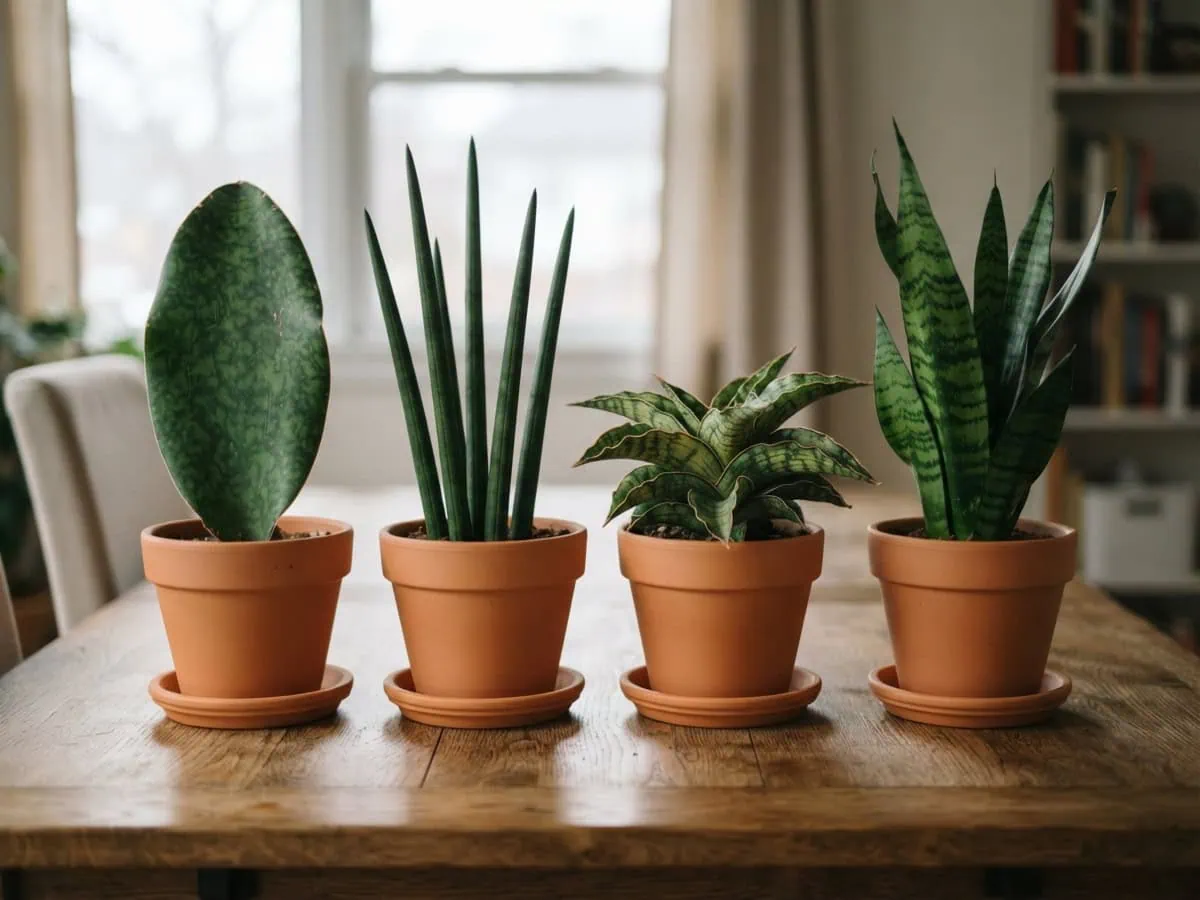
These are their own plants, not cultivars. The clearest outlier answers the “what is a whale fin snake plant” question with one look. It is a single, broad, upright paddle roughly 10 inches wide. The color is dark green with a fine red-brown edge. The table below also sorts the species you are most likely to meet.
| Species (common name) | Leaf tell |
|---|---|
| Whale fin (D. masoniana) | Single broad paddle, ~10 in wide, red-brown edge |
| Cylindrical (D. angolensis) | Round, tubular spear leaves, not flat |
| Star Sansevieria (D. pethera) | Broad leaves, faint cross-banding, kirkii lineage |
| Zeylanica (green snake plant) | Flat sword, all green, no colored margin |
Cylindrical vs flat-leaf snake plants
The “cylindrical snake plant vs regular snake plant” question is a species split, not a cultivar one. Feel the leaf:
- Cylindrical spear: round, rigid, pencil-to-finger-thick tubes; a separate species (D. angolensis). Best for a stark, upright look.
- Regular flat-leaf: thin, flat sword blades fanning from the base; true D. trifasciata. The familiar banded upright.
Verdict: if the leaf is round in cross-section, stop calling it a variety of the flat snake plant. It is a separate species. It just shares the genus, so its care stays the same.
Common trifasciata cultivars worth knowing
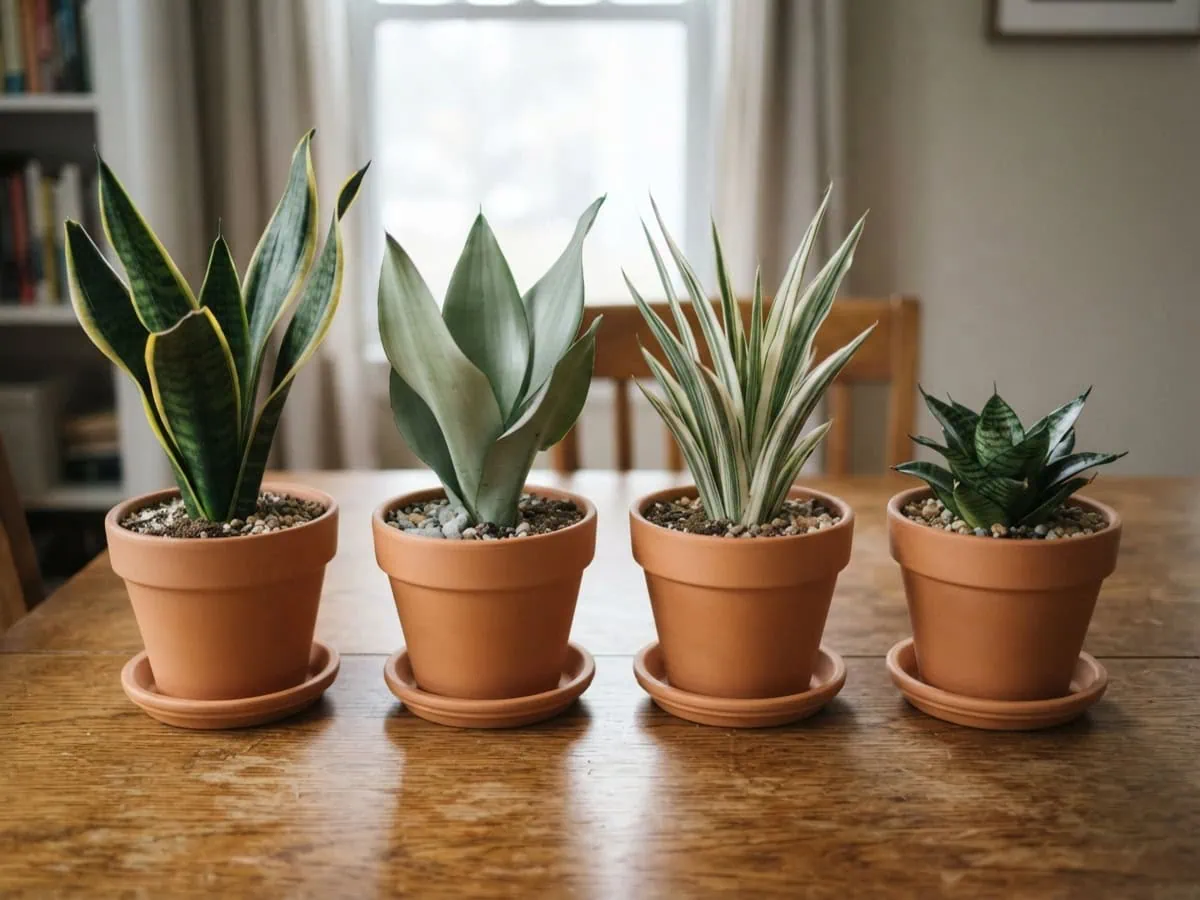
Tier two is where the famous names live — all one species, all one flat-sword blueprint. For example, ‘Laurentii’ carries the bright yellow margin. ‘Bantel’s Sensation’ runs narrow with white vertical stripes. ‘Moonshine’ glows pale silver. And the ‘Hahnii’ dwarfs bunch into a squat bird’s-nest rosette barely 6 to 7 inches tall.
I have a hunch about this but no peer-reviewed source: the silvery ‘Moonshine’, ‘Silver Moon’, and ‘Moonglow’ names seem to circle one or two near-identical selections rather than three truly separate plants.
A squat dwarf and a 4-foot upright want very different containers. This is where sizing the right pot when you move one up starts to matter.
Look-alikes and store mislabels to watch for
Most naming mistakes trace to three look-alike pairs and a mislabeled pot, not rare plants. Nail the yellow-margin test, the silvery-cultivar names, and the reversion trick. Then you out-read the tag every time. Store labels are wrong often enough that the plant itself is the only source I trust (trust me on this).
Laurentii vs zeylanica: the margin test
The “snake plant laurentii vs zeylanica” call comes down to one feature. That feature is a stable yellow margin. ‘Laurentii’ shows a bright, unbroken gold edge down each flat blade. A true zeylanica has none — just green cross-banding on a plain sword. It also often looks bushier, with more leaves. Care is the same, so the only stake is an accurate name.
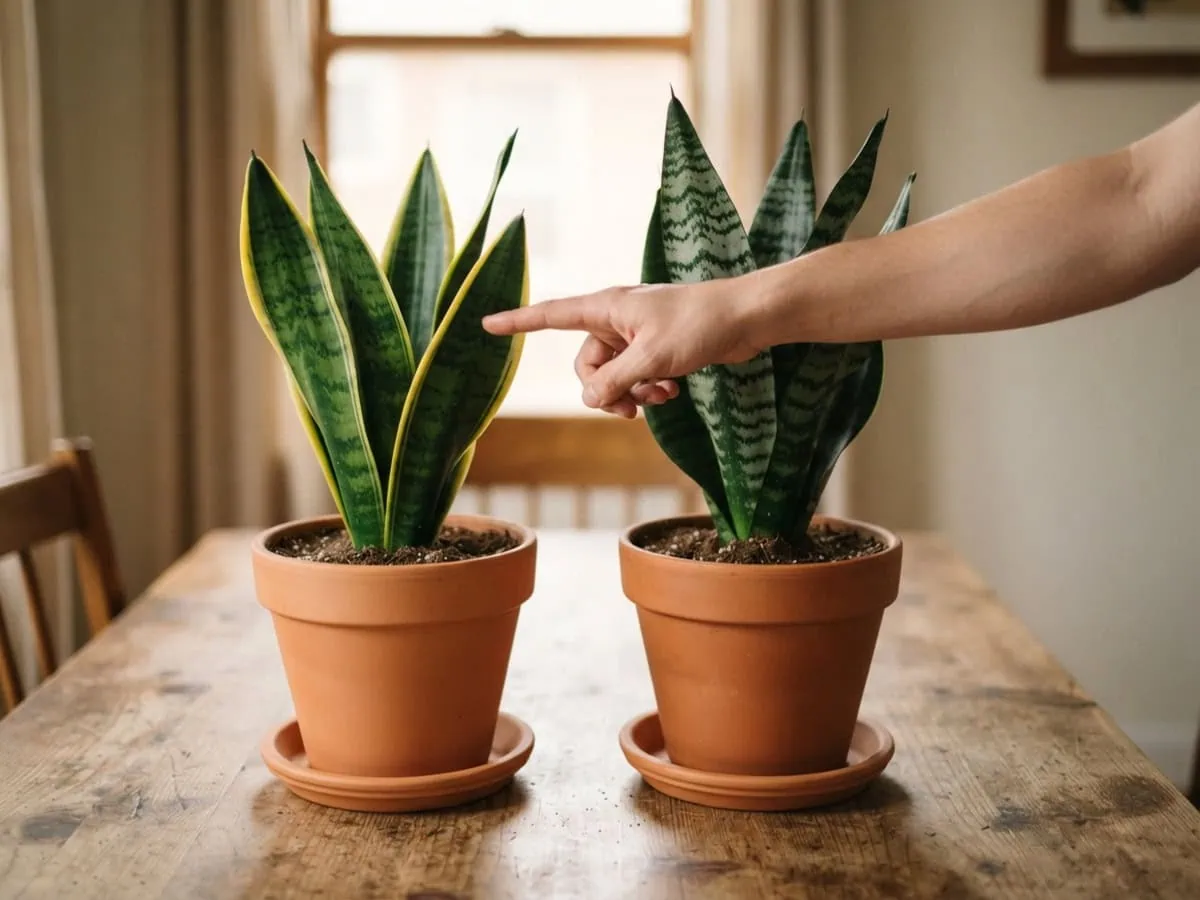
| Feature | ‘Laurentii’ | Zeylanica |
|---|---|---|
| Leaf margin | Bright, unbroken yellow edge | No colored margin |
| Leaf center | Mottled gray-green banding | Plain green cross-banding |
| Growth habit | Fewer, bolder blades | Bushier, more leaves |
| Comes true from a leaf cutting? | No — reverts to green | Yes — already green |
Verdict: a stable gold edge means ‘Laurentii’. A fully green blade means zeylanica — or a reverted ‘Laurentii’, which the reversion note below settles.
Moonshine, Night Owl, and Bantel’s mix-ups
Yes — the “is moonshine a type of snake plant” question has a simple answer. ‘Moonshine’ is a cultivar of Dracaena trifasciata, not its own species. It is prized for pale silvery-green blades with a fine dark rim. Solid.
But it gets muddled with two neighbors. ‘Night Owl’ is a darker, compact selection. ‘Bantel’s Sensation’ is the narrow, white-vertical-striped one. Still, none of the three is a binomial species. Each is just a selected form of the one snake plant they all came from.
Why a variegated type can revert to plain green
A variegated snake plant can turn plain green. In fact, the colored edge is a chimera. That means the color sits in a genetically distinct outer layer of cells, not a pigment spread evenly through the whole leaf, so it never reaches tissue that regrows from the inside.
Start one from a single leaf cutting and the offspring comes up plain green, a zeylanica look-alike. So a mislabeled ‘Laurentii’ and a true zeylanica can end up identical on a shelf. To hold the gold, skip leaf cuttings and keep the rhizome whole; dividing a snake plant to keep its markings is the only reliable route.
Myth: “‘Moonshine’ and ‘Bantel’s Sensation’ are the same plant,” and “an all-green snake plant is always a true zeylanica.” Fact: ‘Moonshine’ is a solid silvery leaf while ‘Bantel’s Sensation’ carries white vertical stripes, so they are separate cultivars. An all-green plant can be a real zeylanica or a ‘Laurentii’ that lost its margin — so read the plant, not the tag.
Run those three checks — cross-section, margin, height — on any pot and the name resolves fast. The questions below cover the edge cases readers ask most.
Snake plant variety questions, answered
What variety of snake plants do I have?
Read three leaf features in order to name it. Check the cross-section first: flat sword blades mean a Dracaena trifasciata cultivar, round tubes mean a cylindrical species, and a broad paddle means whale fin. Then read the margin — solid yellow is ‘Laurentii’, white vertical stripes are ‘Bantel’s Sensation’, and none at all is zeylanica. Lastly, match height: 6-to-7-inch rosettes are ‘Hahnii’ dwarfs, while 2-to-4-foot uprights are the standard forms.
What is the most popular snake plant variety?
‘Laurentii’ is the most popular and most recognizable snake plant variety. It is the tall, upright form with a bright creamy-yellow margin running down each mottled gray-green blade, and it is the plant most people picture when they hear “snake plant.” It is a cultivar of Dracaena trifasciata, so it shares the same easy, dry-down care as every other variety.
Are snake plant and Sansevieria the same?
Yes — snake plant and Sansevieria are the same plant. Botanists moved the species from the genus Sansevieria into Dracaena, a reclassification published in 2017, so the Kew-accepted name is now Dracaena trifasciata, while most plant labels and older books still read Sansevieria trifasciata. Both names point to one species, and the plant itself is identical whichever label it wears. When you see either name on a tag, read them as the same plant.
How to identify a good snake plant?
A good snake plant has firm, upright, unblemished leaves and a healthy, snug root system. Look for stiff blades with no mushy base, no soft brown patches, and even color or crisp variegation. Slide it from the pot if you can: firm, pale roots are healthy, while brown, soft, foul-smelling roots signal rot. Skip any plant with a collapsing, soft center at the soil line.
What is the rarest type of snake plant?
The rarest snake plants are collector species rather than common cultivars. Forms like Dracaena masoniana (whale fin) and Dracaena pethera (star Sansevieria) show up far less often than ‘Laurentii’, and among trifasciata cultivars the harder-to-find silvery and dark selections, such as ‘Whitney’, are less commonly stocked. Rarity shifts with the market, though, so today’s hard-to-find form can be next year’s shelf staple.
What are the different types of Sansevieria varieties?
Sansevieria varieties fall into two tiers: separate species and trifasciata cultivars. Separate species include whale fin (D. masoniana), the cylindrical spear (D. angolensis), and star Sansevieria (D. pethera). Cultivars of the common snake plant include ‘Laurentii’, ‘Bantel’s Sensation’, ‘Moonshine’, and the dwarf ‘Hahnii’ bird’s-nest forms. They share one flat-sword blueprint and differ mainly in leaf color, stripe, and height. Sorting any plant to its tier first makes the exact name easy to pin down.
Are there different versions of snake plants?
Yes — there are dozens of snake plant versions across two groups. Some are separate species with their own leaf shapes, like the round-leaved cylindrical spear and the broad whale-fin paddle. Others are named cultivars of one species, Dracaena trifasciata, that vary in margin color, stripe, and size. Care stays nearly identical across all of them, so the differences are mostly visual.
From anxious to confident in three leaf checks
You do not need a plant tag to be right anymore. Cross-section, margin, height. Three reads, and any snake plant on your shelf gives up its name.
Truth is — the label was always the least reliable thing in the pot. The leaf never lies. A gold-edged blade is ‘Laurentii’, a round spear a cylindrical species, a broad paddle a whale fin.
Once you can name yours, the natural next question is how to keep its color and form sharp, which comes down to bright light and the occasional rhizome division.
Master how to identify snake plant varieties, and every future mystery pot becomes a two-second read instead of a guessing game. May every snake plant you own give up its name at a glance, read straight from the shape of the leaf and the color of the margin.
Tap the button below to get more plant fixes in your Google Search results