🎯 Quick Answer: when and how to water
How to water a snake plant without overwatering: Dracaena trifasciata (Asparagaceae) crashes unless the mix dries several inches down first. It stores its own water, so the danger is always too much, never too little. Let the pot dry out, water deeply, then drain every drop.
- When: soil dry several inches down, pot feels light
- How often: condition-driven, roughly every few weeks — never a fixed calendar
- Method: deep soak until water runs out, then empty the saucer
- Water: room-temperature tap is usually fine for this plant
- Cool months: cut watering back as light and warmth drop
I lost snake plants before I understood the one thing this plant actually asks of me. Each time the base went soft, and when I pressed it I heard a faint wet squelch — the sound of roots that had already rotted away under a surface that still looked perfectly fine.
Pause for a sec. They were never thirsty. They were drowning.
The mistake I kept making was watering on a calendar, like any thirsty houseplant; what fixed it was learning that Dracaena trifasciata runs a night-shift metabolism and banks its own water in its thick leaves and underground stem (and I say this confidently, after far too many funerals). It spends that reserve so slowly that the soil, not the date, becomes the only honest signal of when to pour.
Get the rhythm right and this plant is nearly impossible to lose. The whole skill is reading the soil, not the calendar — once it clicks, watering stops being a guess. For everything beyond watering, lean on the complete snake plant care routine.
Take a breath — if your plant is mushy or wrinkled right now, the following table distills every watering decision into one quick, scannable table.
How to water a snake plant without overwatering: the at-a-glance table
| Snake plant specs | Recommended care |
|---|---|
| When to water | Only after the mix dries several inches down |
| Typical interval | No fixed schedule; tolerates about a month dry |
| Best delivery method | Deep soak, top or bottom; discard the run-off |
| Water type | Room-temperature tap is usually fine |
| Drainage hole required? | Yes — non-negotiable for this rot-prone plant |
| Safe in a self-watering or reservoir pot? | No — constant moisture rots the roots |
| Reduce watering in cool, low-light months? | Yes — the plant barely drinks then |
Tap the button below to get more plant fixes in your Google Search results

Table of Contents
When to water: let the root zone dry out first
A snake plant signals thirst through its soil, not the calendar. Let me reframe that: the question is never whether a week has passed, but whether the root zone has truly dried out — and according to the University of Illinois Extension, the two-inch finger test is how you check.
Why dryness, not a calendar, sets the schedule
Type how often should i water my snake plant into a search bar and you will get a dozen conflicting numbers, because no fixed number exists. The dry-down rate shifts with light, warmth, pot size, and mix.
So a calendar lies. The soil does not. A snug terracotta pot in a gritty blend can dry in days; a big plastic pot of dense soil stays soggy for weeks on the same sill.
Myth: Water a snake plant on a fixed weekly schedule.
Fact: The same plant swings from weekly to monthly drinks as light, warmth, and pot size shift. Dryness sets the timing, never the date.
Myth: A self-watering or reservoir pot makes it easier.
Fact: Constant root-zone moisture is exactly what rots this plant, so a free-draining pot you empty by hand always wins.
The finger and chopstick test at root depth
The finger test is the simplest way to learn how to tell when a snake plant needs water: push your finger in, and if the top two inches feel dry, most houseplants are ready for a drink. This one, though, dries from the top down and hoards water deeper, so the surface can read bone-dry while the root zone below stays damp.
So go deeper than your finger reaches. Slide a wooden chopstick or a bamboo skewer to the bottom of the pot, pull it out, and read it: dry and clean means water, dark particles clinging means wait. A dry pot even sounds different — tap the terracotta and it answers with a hollow knock, where a still-wet one gives a dull, flat thud.
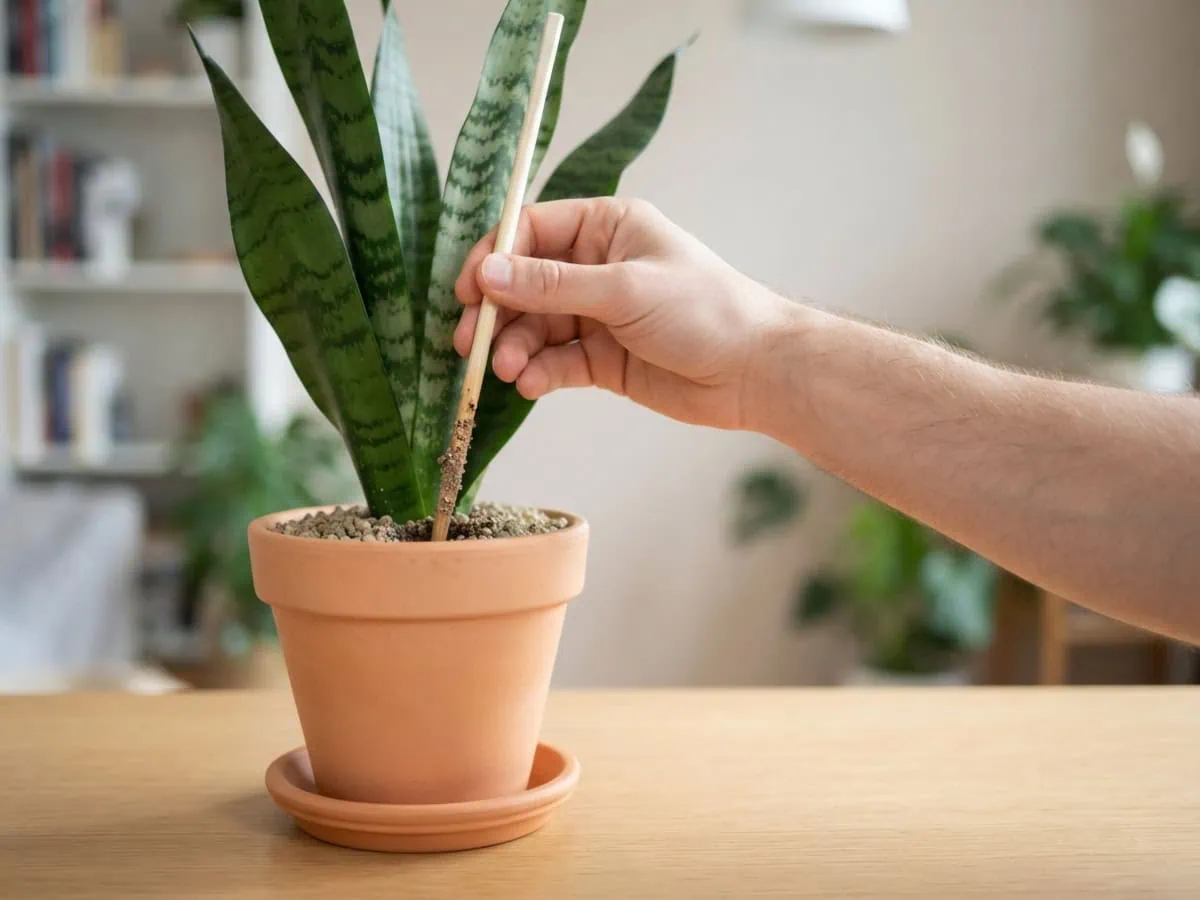
That deep read is the whole game. Miss it, and you pour into a pot that was already wet underneath.
How long a snake plant can go between drinks
Longer than you think. A healthy snake plant shrugs off about a month of neglect without harm: its fleshy leaves and thick underground stem are a water reserve it spends slowly. A week or two away needs no special setup at all.
The catch is that the pot and mix set the clock as much as the plant does, so the same specimen swings from weekly to monthly drinks as light and warmth change. That is why it pays to repot a snake plant without root shock into a snug pot and gritty blend — the right container lets the soil dry fast enough to keep the roots breathing.
Tap the button below to get more plant fixes in your Google Search results

Overwatered or just thirsty? The wet-and-wilting test
A drooping, wrinkling snake plant is far more often too wet than too dry. That single fact is why so many supposedly unkillable plants get quietly loved to death.
Speculative, but I think the reason this trips up almost everyone is that the two opposite problems wear the same mask. When soil stays waterlogged it drives the oxygen out, the roots suffocate and rot, and a plant that can no longer draw water up wilts and wrinkles exactly as if it were parched — while the soil sits soaking wet.
Never water a snake plant that is soft, wet, and wilting. Reaching for the watering can here is the single most common way to finish off a plant that is already drowning. Check the soil and the base first — every single time.
The one check to run before every watering
Before you lift the watering can, read two things together: the soil and the base of the leaves. Wet soil plus a soft base means stop; dry soil plus firm leaves means go. Lifting the pot settles any doubt — a dry one feels surprisingly light, while a still-wet one stays heavy in the hand.
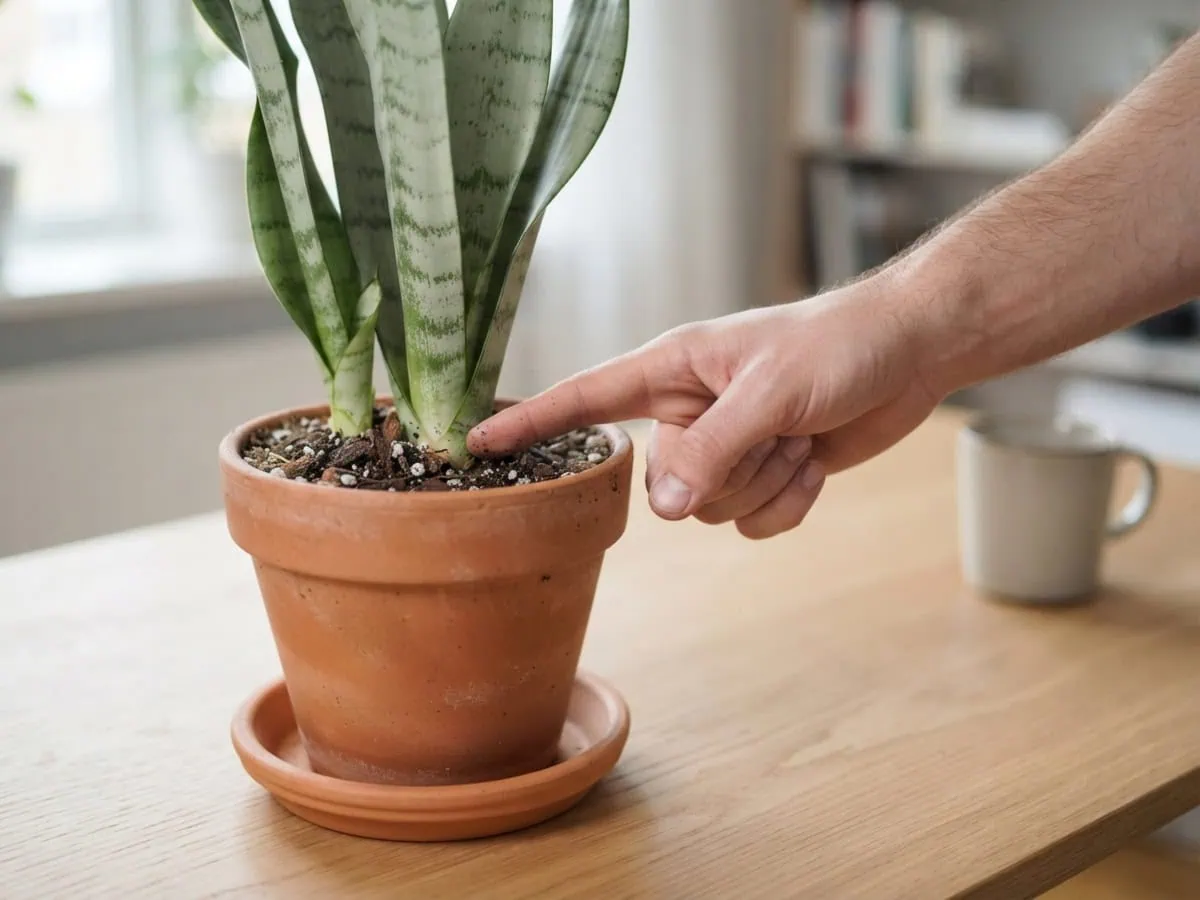
Wilting on its own tells you nothing. To read what curling or yellowing leaves are telling you, pair the leaf look with what the soil is actually doing underneath.
Soft and sour, or firm and wrinkled?
Texture and smell are the tells. An overwatered plant goes soft at the base — press it and it yields with a faint wet squelch — and a sour, swampy smell rises off the soil line.
Soft, sour, squelchy. That is rot.
A thirsty plant is the opposite: firm and dry to the touch, merely creasing along the blade, with no smell.
If the base has turned to mush and the whole fan begins to keel sideways, the damage is already structural — that is the territory of why a snake plant leans and topples, not a watering tweak.
Can a snake plant be underwatered?
The flip side — can a snake plant be underwatered — is yes, but it is the far gentler failure. Starved of water the leaves wrinkle, curl, and soften, yet a single deep soak plumps them back within a day or two.
Overwatering kills from the roots up and rarely reverses. But thirst is just a wrinkle you can undo.
How to water without overwatering: top, bottom, and water type
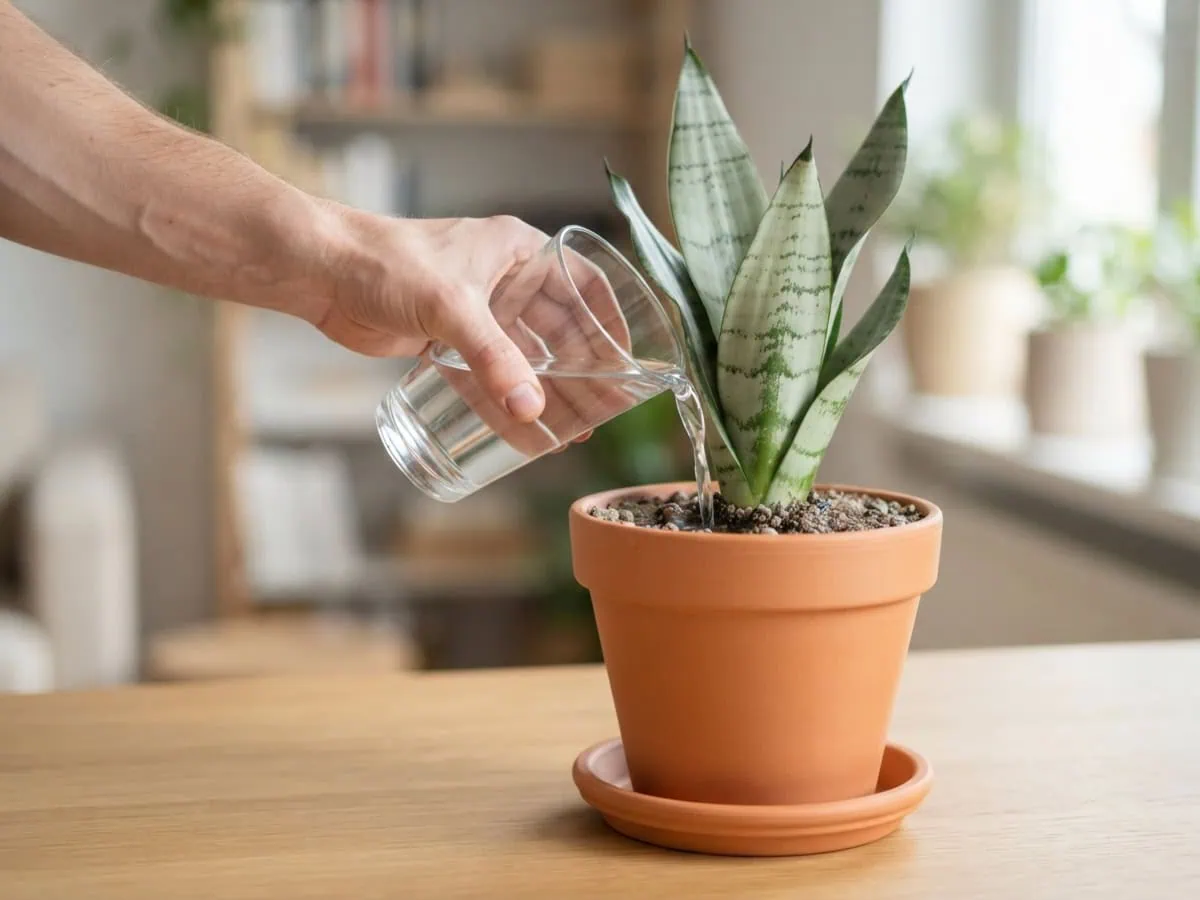
Once the soil is dry, how you deliver water matters almost as much as when. Wet the whole root ball. Then drain the excess back out.
Top-watering vs bottom-watering
If you have ever wondered, should i water my snake plant from the top or bottom, the honest answer is that both work — as long as the run-off actually leaves the pot. Bottom-watering keeps the crown dry. Top-watering rinses built-up salts out through the drainage holes.
| Factor | Top-watering | Bottom-watering |
|---|---|---|
| Where water enters | Poured over the mix surface | Wicked up from a tray below |
| Crown and leaf base | Can get wet if you are careless | Stays dry — safer for the base |
| Flushes salts out? | Yes — carries salts out the holes | No — salts build up over time |
| Best for | A periodic deep flush | Routine, crown-safe watering |
Verdict: bottom-water for routine drinks to keep the crown dry, then top-water every few months to flush out the salts that bottom-watering leaves behind.
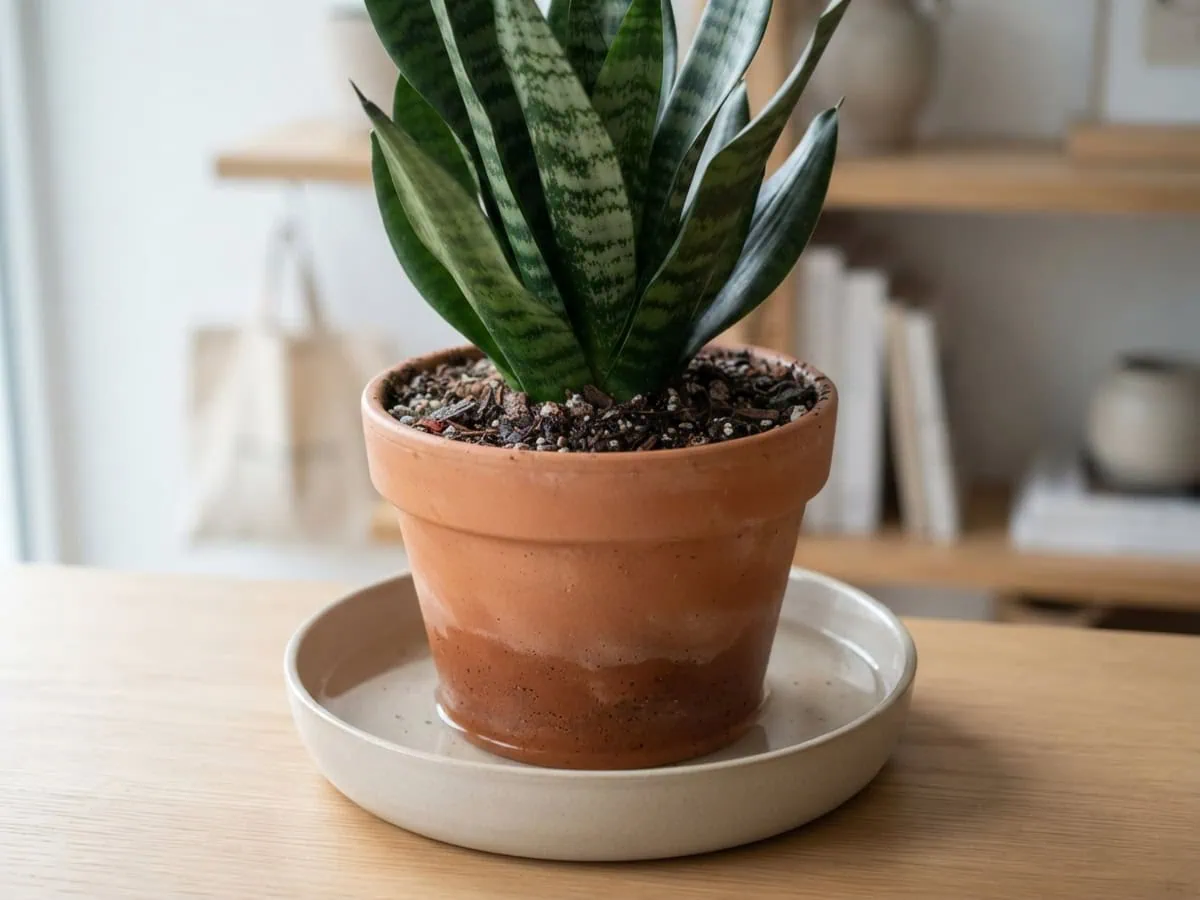
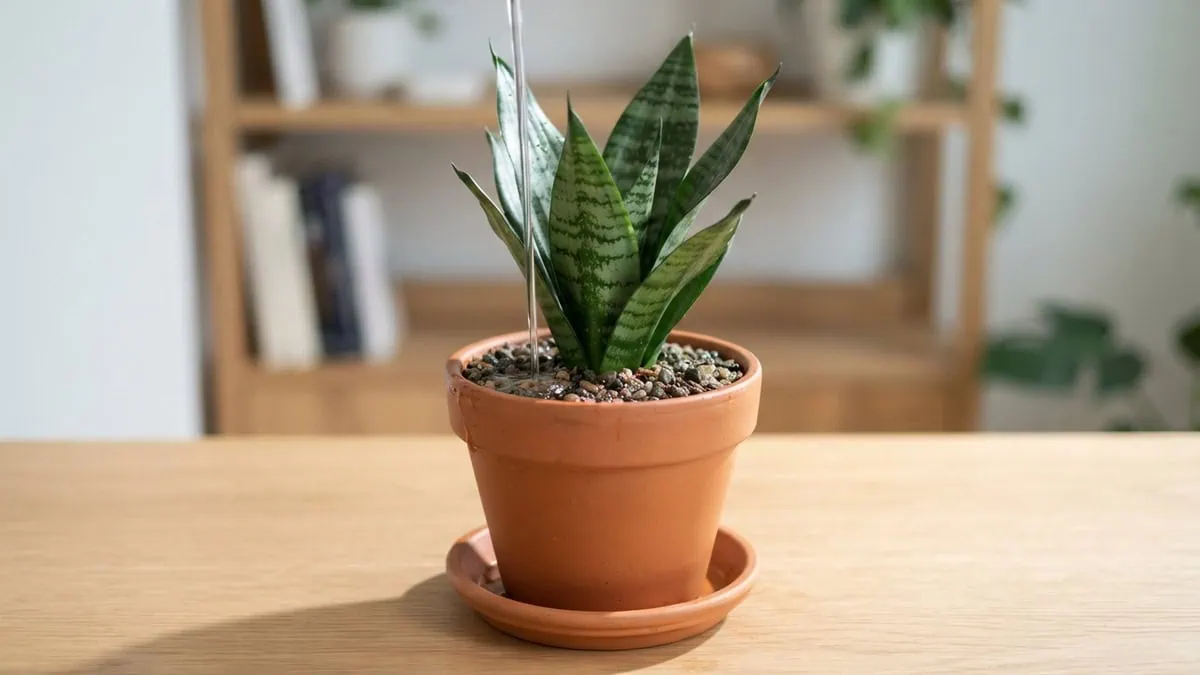
To bottom-water, stand the pot in a few inches of water and leave it until the surface of the mix turns dark and damp, then lift it out and let it drain completely. You can almost hear a bone-dry mix drink — a faint tick of air bubbling up through the gritty blend as the water climbs.
Empty the saucer, and flush the salts
Empty the saucer every single time (not joking). A pot left standing in its own run-off is just slow overwatering, undoing everything the dry-down was for.
After every soak, tip out the water that pools in the saucer or the decorative outer pot. Then, every few months, top-water heavily and let it pour straight through to flush the mineral salts that creep into the mix — the one real drawback of routine bottom-watering.
The reason salts accumulate is simple physics: capillary action pulls water upward but leaves the dissolved minerals behind, so they concentrate toward the surface with every bottom-soak. A heavy top-flush every few months carries that buildup back out through the drainage holes before it ever scorches a root.
Tap water, temperature, and the cool-season dial-back
Readers often ask, do snake plants need less water in winter, and the answer is yes. As light and warmth fall, this slow plant’s metabolism slows further and it barely drinks, so stretch the gaps between waterings and keep it above roughly 55F, well clear of cold drafts and chilly window glass.
Room-temperature tap water is usually fine for a plant this tough. If dry, crispy brown tips appear, that is mineral buildup, not thirst — switch to rainwater or distilled, and note that letting tap water sit overnight removes chlorine but not chloramine or fluoride.
Common snake plant watering questions
Can I water a snake plant with tap water?
Yes, room-temperature tap water is usually fine for a snake plant. As a thick-leaved succulent it transpires slowly and is watered seldom, so it shrugs off the chlorine and minerals most tap water carries. Letting water sit out overnight removes chlorine but not chloramine or fluoride, so if you ever see dry, crispy brown leaf tips, switch to rainwater or distilled water rather than just waiting.
Is it better to water a snake plant from the top or bottom?
Both work, as long as every drop of excess drains away afterward. Bottom-watering keeps the crown dry and is the safer routine for a rot-prone plant, while top-watering flushes accumulated mineral salts out through the drainage holes. The best approach combines the two: bottom-water for regular drinks, then top-water heavily every few months to rinse the mix clean. Keeping that base dry matters because a snake plant rots from the crown and rhizome up.
How to tell if a snake plant is thirsty?
Check the soil, never the leaves. Push a finger or a wooden chopstick several inches into the mix; if it comes out dry and clean, it is time to water. A pot that feels light when lifted, plus leaves that are firm but faintly wrinkled, both confirm thirst. A soft, squishy base means the opposite problem — too much water, not too little.
What is the number one killer of houseplants?
Overwatering. Roots need both water and oxygen, and waterlogged soil drives the oxygen out, so the roots suffocate, rot, and can no longer absorb water. For a drought-adapted snake plant the rule is blunt: when in doubt, do not water. Letting the mix dry out fully between drinks is the single most protective watering habit you can build. A snake plant stores its own water and sips it slowly, so standing moisture, not drought, is its single biggest indoor hazard.
How long can snake plants go without water?
Comfortably weeks, often a month or more. This succulent banks water in its leaves and underground stem and spends it slowly, so a one-to-two-week trip needs no setup — just water well, let it drain, and leave. Underwatering is far easier to undo than overwatering; wrinkled leaves plump back after a deep soak. Its night-shift metabolism loses very little water by day, which is how the same plant rides out roughly a month between drinks.
Lesson locked. Take the dry-down test.
Watering a snake plant comes down to a single habit: you read the soil, and the soil tells you when. Honestly? Once you trust the dry-down instead of the calendar, the worry evaporates — you stop hovering, and the only sound that matters is the hollow knock of a pot that has finally dried out.
If the base has already gone soft and sour on you, do not wait — learn how to rescue a snake plant from root rot before the rhizome is lost. Get the timing right and you have all but mastered how to water a snake plant without overwatering — most of the battle. May you read the soil before every pour, and your snake plant never taste a drop too many.
Tap the button below to get more plant fixes in your Google Search results