🎯 Quick Answer: treating moth orchid leaf spot
Knowing how to treat Phalaenopsis orchid leaf spot disease needs one fast call, bacterial or fungal — the moth orchid belongs to the Orchidaceae family. Then cut 1 inch below the lesion with a sterile blade. Dust the cut with cinnamon. Keep the leaves dry with steady airflow.
- Bacterial: soft, water-soaked, oozing, spreads in days
- Fungal: dry, sunken, concentric rings, slow to spread
- Cut margin: 1 inch below the lesion, into firm tissue
- Sterilize: wipe the blade between every single cut
- Indoors: water at the roots, blades dry in 2-3 hours
Conventional advice says spray a fungicide the moment a dark spot appears. That advice nearly lost me a moth orchid. Truth is — I lost plants reaching for a bottle before I ever read the spot.
Correction — what I meant was, I was not unlucky. I was spreading the infection myself, because soft bacterial lesions travel in the thin film of water I kept leaving on the leaves, and on a single-crowned Phalaenopsis with no branching stem to fall back on, one spot that creeps into the growing point takes the whole plant down with it (not joking).
The real fix is slower, simpler, almost boring: read the spot, then own the leaf surface. Start with the bigger picture in the moth orchid health guide.
The following table sorts the two real diseases from the abiotic look-alikes and names the single indoor lever that slows both.
How to treat Phalaenopsis orchid leaf spot disease, at a glance
| Moth orchid specs | Recommended care |
|---|---|
| Bacterial brown spot (most common) | Soft, water-soaked, oozing, spreads fast; yellow halo |
| Fungal leaf spot | Dry, sunken, concentric rings or a black fruiting body |
| Abiotic look-alike | Sunburn, cold, or salt; no halo, no ooze, not a disease |
| Tool disinfection | Sterile blade; cut about 1 inch below the lesion; between every cut |
| Indoor lever | Keep leaves dry 2-3 hours; gentle fan; water at the roots |
| On the cut | Copper-based product; dust the cut edge with ground cinnamon |
| Is hydrogen peroxide a fungicide? | No; a short-lived surface oxidizer only |
| Is white mold on fresh bark dangerous? | No; a harmless surface saprophyte |
Tap the button below to get more plant fixes in your Google Search results

Table of Contents
Bacterial, fungal, or neither? The spot decision rule
Three quick checks sort almost every leaf spot.
Is it soft or dry? Does it weep when pressed? Is it even a disease at all?
Work through the sections below in that order.
- Bacterial brown spot: the soft, oozing leaf rot caused by the bacterium Acidovorax (older label Pseudomonas) — the most common moth orchid leaf disease.
- Soft rot: a fast, foul-smelling tissue collapse driven by Erwinia-type bacteria.
- Fungal leaf spot: dry, bounded lesions from fungi such as anthracnose (Colletotrichum), Cercospora, or Phyllosticta.
Get the category right and the rest follows: bacteria and fungi leave different marks and need different tools. Two enemies, one look. But guess wrong and you burn a fungicide on a bacterium that shrugs it off.
Bacterial brown spot: soft, wet, oozing, fast
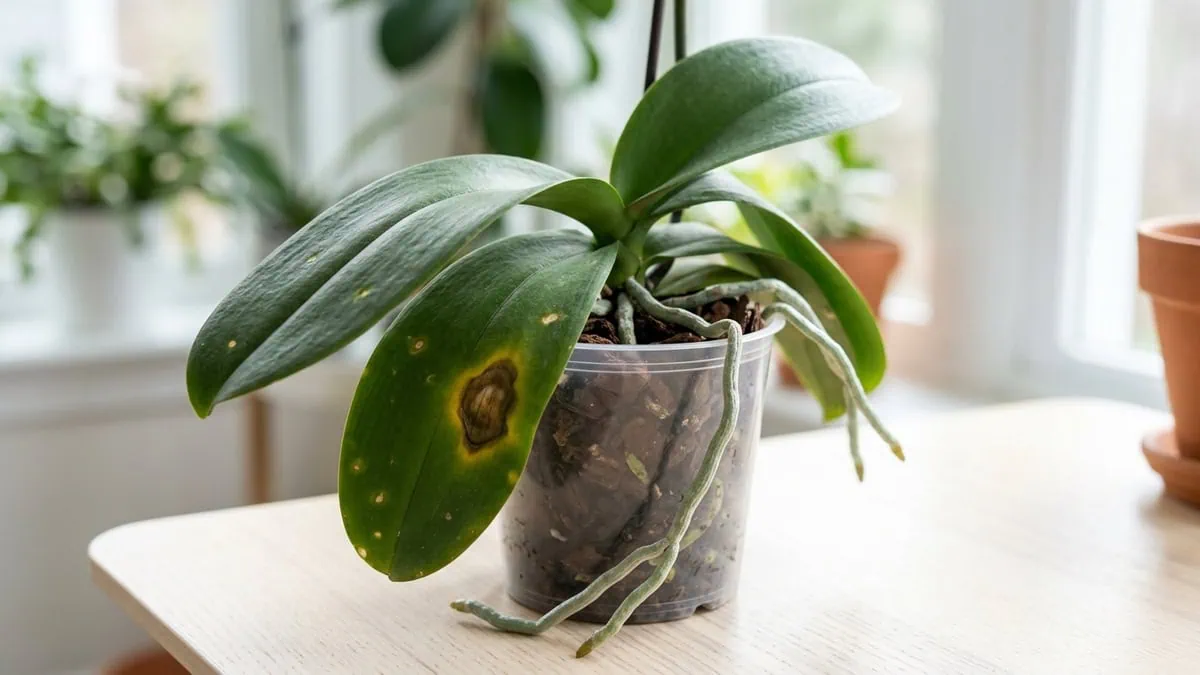
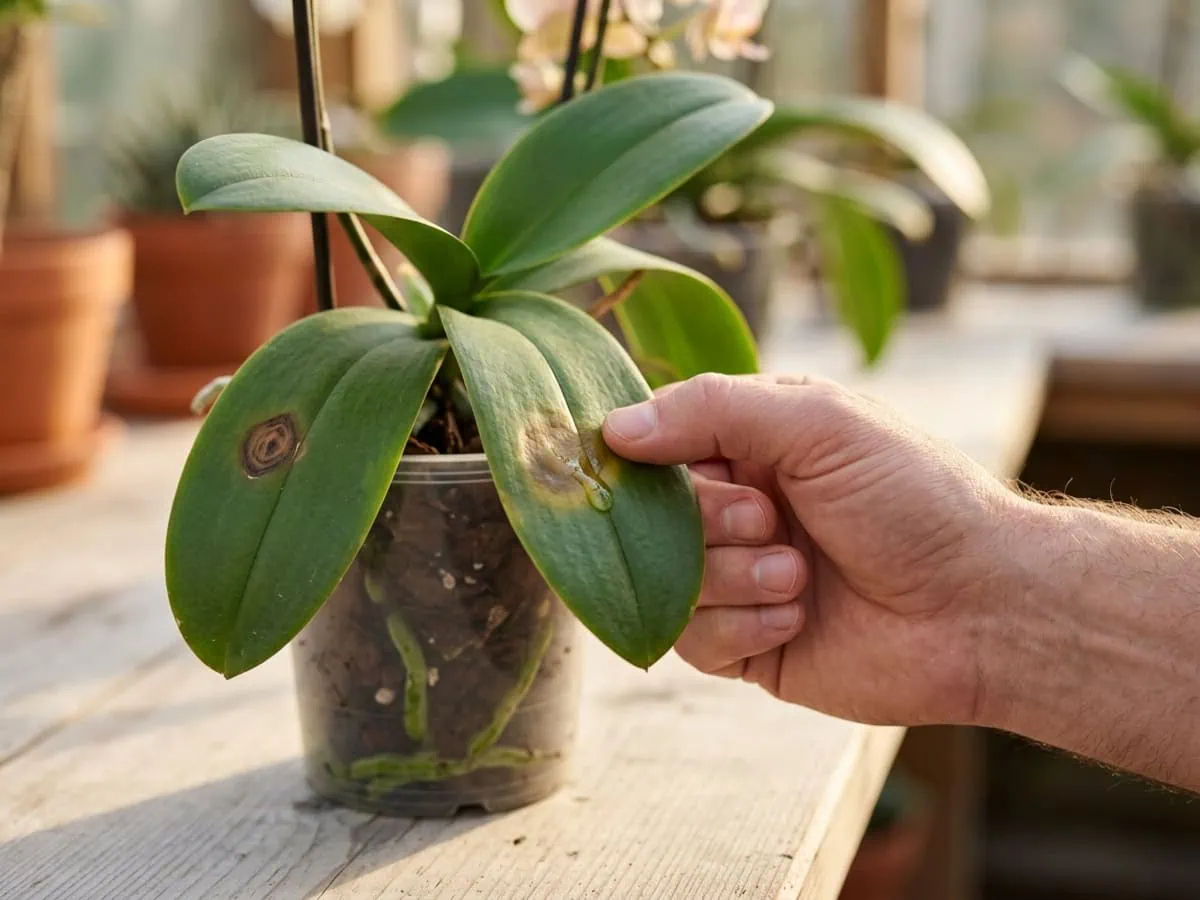
What does bacterial brown spot look like on a Phalaenopsis leaf? A small, soft, water-soaked blister, sunken and glassy, ringed by a thin yellow halo.
Press it and clear, sticky liquid beads up, often with a faint sour smell. It spreads in days, not weeks (TBH — on a moth orchid the yellow halo shows up before the ooze does).
Fungal spot: dry, sunken, concentric rings
How to tell fungal leaf spot from bacterial spot on an orchid comes down to texture and pace. A fungal spot is dry, sharply outlined, and slightly sunken, sometimes ringed or studded with pinpoint black fruiting bodies. It creeps over weeks.
According to a peer-reviewed review of orchid fungal diseases, those lesions trace to fungi like anthracnose — see global orchid disease research.
Press test: ooze and smell or dry sandpaper
One fingertip settles it. Bacterial lesions feel soft and weep a sour bead. Fungal lesions feel dry, bounded, and faintly rough — like fine sandpaper from the spore bodies underneath.
If the spot is soft and a bead of liquid rises when you press it, then it is bacterial — move today. However, if it stays dry, sunken, and bounded with no ooze, then it is fungal — and far less urgent.
Not every mark is a disease. Sticky scars and fine sunken stippling come from pests, not pathogens, and no fungicide touches them — compare pest damage that mimics spots.
Sunburn, cold pitting, and salt-tip scorch fool people too. And they carry no halo and no ooze.
These are abiotic leaf marks and stress, not infections.
Orchid leaf-spot fungi each carry their own host list, and which ones truly threaten a moth orchid indoors is not fully settled, since most lab work grows these fungi on greenhouse hosts, not the windowsill plants I have lost over the years. I’m honestly not sure why this works — but it does: keep the blade dry and most never get a foothold.
Tap the button below to get more plant fixes in your Google Search results

Removing a spot and disinfecting tools indoors
Removing a leaf spot is surgery, not spraying: cut into clean tissue, sterilize the blade, then keep the leaf dry so nothing comes back. The three steps below do exactly that.
Cut ~1 inch below the lesion, sterilize each cut
Knowing how to disinfect orchid cutting tools to stop disease spread starts with one habit: sterilize the blade between every single cut. Use a fresh single-edge razor or sharp shears. Cut about 1 inch below the discolored area, down into firm green tissue.
Sterilize each pass one of three ways — flame the steel to glowing then let it cool, wipe it in 70% isopropyl alcohol for a few seconds, or soak tools and empty pots in a 1:9 bleach solution and rinse.
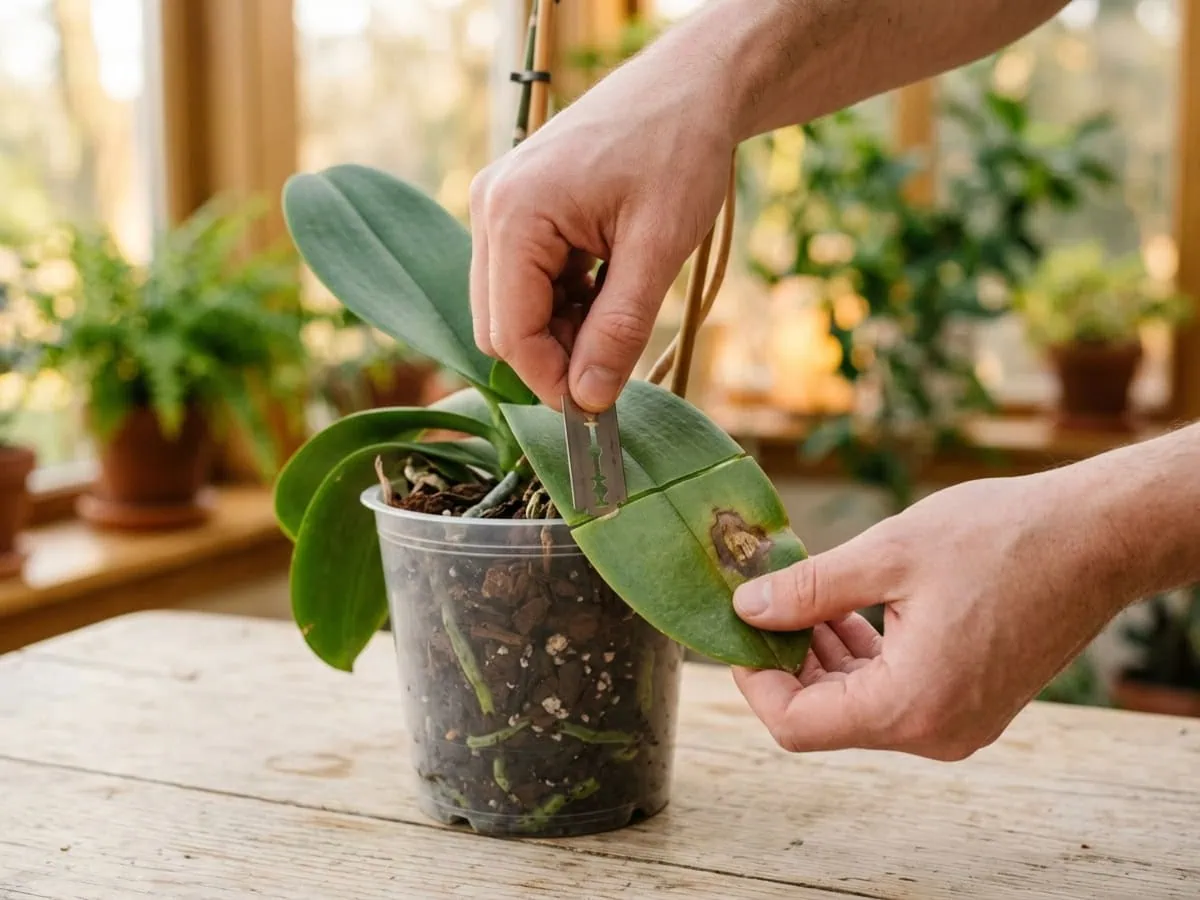
Stop once the blade reaches firm, pale-green tissue. Then protect the wound.
Dust the cut edge with ground cinnamon, a tissue-safe antifungal, or touch on a copper-based product. Re-wipe the steel before the next leaf — one skipped pass is how a single spot becomes five.
Keep leaves dry, add gentle airflow
Bacteria ride water. A film of moisture on the leaf is how soft lesions jump from blade to blade, so the biggest indoor lever is dry foliage. Water at the roots in the morning so leaves dry within 2-3 hours.
Never pour into the crown. Run a small fan for steady airflow. Indoors that is easy — far easier than any greenhouse — and leaves that never bead up past nightfall starve most pathogens.
If rot has already reached the growing point, that is rot at the central crown.
Look — the first bacterial spot I cut, I wiped the blade once at the start and felt clever. By the third leaf I had smeared the same soft rot into two clean ones, a faint sour film bridging every cut. Now the alcohol wipe happens between every pass. The spread stops at one leaf.
One more place to look. If a spot keeps marching after a clean cut and the lower leaves go limp, the real trouble is below the surface — in rot that reaches the roots.
White mold on bark: harmless bloom or snow mold?
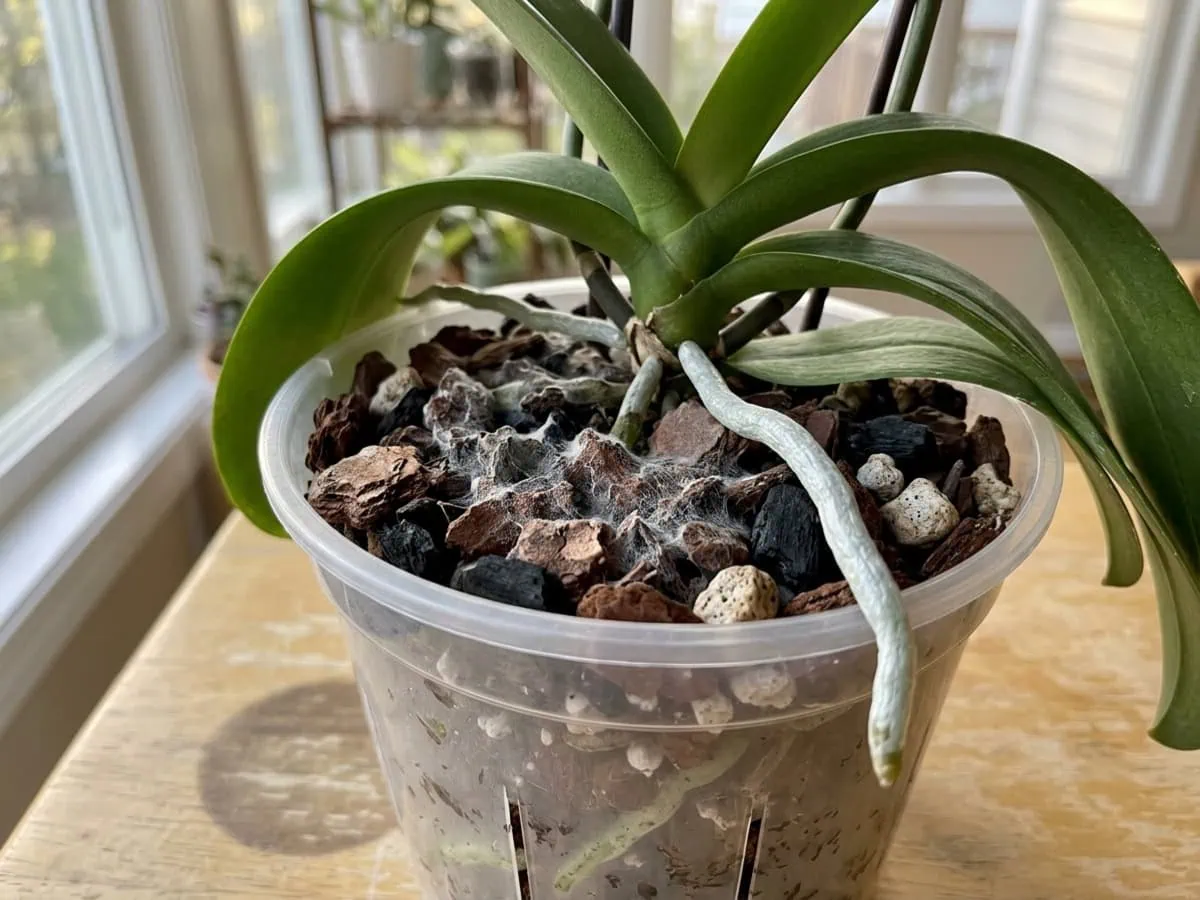
Is white mold on Phalaenopsis bark dangerous to the plant? Usually not.
A thin, cobwebby white bloom on the topmost bark chips after repotting is a harmless surface saprophyte feeding on fresh medium. It fades as the surface dries and airflow rises.
The one to watch is different: a water-repellent snow mold that mats through a wet, broken-down mix and coats the roots until they cannot drink. That one needs a repot into fresh bark, not a leaf spray.
Leaf-spot myths: peroxide, baking soda, and vinegar
Three home remedies waste more orchids than the diseases do. None of the popular sprays fixes a leaf spot. The sections below sort myth from fix.
Peroxide is a surface oxidizer, not a fungicide
Hydrogen peroxide has one honest job indoors: sterilizing empty pots and tools. It is a short-lived oxidizer that foams, spends itself in seconds, and leaves nothing behind. But a fungicide has to linger and guard new tissue; this cannot, so as a spot remedy it fails.
I learned that the slow way. Keep it for pots and tools, and reach for ground cinnamon on the cut instead.
Baking soda and vinegar: limited and risky
Baking soda is mild, not magic. Its only solid evidence covers gray flower mold, at about 2 teaspoons per gallon. That makes the surface too alkaline for some fungi — never a leaf-spot eradicant.
Apple cider vinegar is worse: no reviewed source supports it on orchids, and its acetic acid can scorch the very leaf you are trying to save. Skip the vinegar.
So what is the best fungicide spray for Phalaenopsis orchid leaf spots? For a confirmed fungal spot, a copper-based product is the broadest, gentlest indoor option. Keep a labeled garden fungicide in reserve for stubborn cases.
For bacterial brown spot, copper is again the standard, because no spray reverses an open lesion — you cut it out first. Whatever the label says, spray cool and shaded, never in midday sun. Always test any spray on a small area first. Results may vary depending on your specific growing conditions.
❌ Myth: a splash of hydrogen peroxide or a kitchen spray fixes the problem. ✅ Fact: peroxide only sterilizes pots and tools, baking soda merely buffers gray flower mold, and vinegar can scorch tissue. The real fix is mechanical — identify, cut, sterilize, dry.
When to monitor, cut, or discard
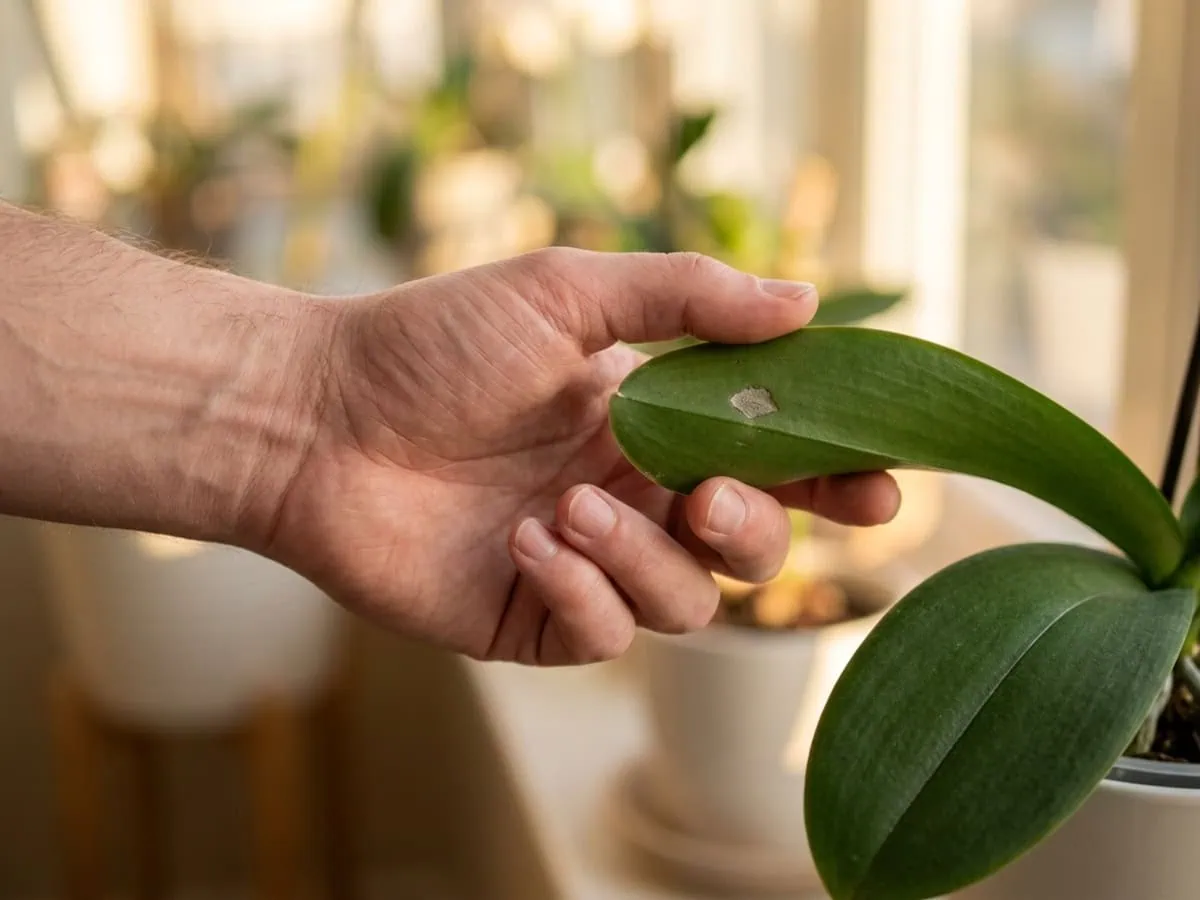
One ladder answers “will it go away.” Monitor a small, dry, dust-gray spot that has not widened in two weeks — it is cosmetic, so leave it. Cut and guard any enlarging spot, or any soft bacterial lesion, while it stays above the lowest leaf and clear of the crown.
Discard the plant only when rot reaches the crown, or when mottled, streaky, systemic patterning marks a virus — that one has no remedy, rides your cutting tools straight into the whole collection, and ends the plant’s run for good.
Common leaf-spot questions, answered
How do you treat leaf spot on orchids?
Treat leaf spot on orchids by identifying it first, then cutting it out. Soft, oozing, fast-spreading spots are bacterial; dry, sunken, ringed ones are fungal. Cut about an inch below the lesion with a blade sterilized between every cut, dust the wound with ground cinnamon, and for fungal cases add a copper-based product. Keep the leaves dry afterward, because the disease moves in water.
Will leaf spot disease go away?
Leaf spot disease does not reliably go away on its own. A small, dry, inactive fungal blemish may stop enlarging and stay cosmetic, but a bacterial spot expands over days and only halts once you cut it out and dry the leaf. A virus-caused spot never clears. Monitor a static spot, remove an enlarging one, and discard a plant with crown rot or a virus.
What does a diseased orchid leaf look like?
A diseased orchid leaf shows a defined spot or lesion, not just an even color shift. Bacterial brown spot is soft, water-soaked, and sunken, ringed by a yellow halo and often oozing. Fungal spots are dry and bounded, sometimes with concentric rings or tiny black specks. Plain yellowing or a dry tan sunburn patch is usually stress, not disease, so look for a sunken or raised edge.
How to get rid of leaf spot fungus?
Get rid of leaf spot fungus by removing infected tissue and drying the leaf surface. Cut about an inch below the lesion into firm tissue with a sterilized blade, dust the cut with ground cinnamon, and isolate the plant. For active spread, apply a copper-based product. Then water at the roots in the morning so the leaves dry fast, since spores need free water.
Can apple cider vinegar be used as a fungicide?
Apple cider vinegar is not a recommended fungicide for orchids. No reviewed horticultural source supports it for leaf spot, and its acetic acid can scorch the soft tissue you are trying to save, opening a fresh wound for infection. A copper-based product is far safer. For the cut surface itself, ground cinnamon is the proven, tissue-safe choice, dusted on lightly and left to seal the wound.
What is the best homemade fungicide for orchids?
The best homemade option for orchids is ground cinnamon on a fresh cut, not a spray. Cinnamon is a natural antifungal that seals a wound and is gentle around pets and people. Baking soda, at about 2 teaspoons per gallon, has evidence only against gray flower mold, not leaf spot. Hydrogen peroxide belongs on pots and tools, nothing more, since it foams out in seconds and leaves no residue to protect tissue.
What does baking soda do for orchids?
For orchids, baking soda works only as a mild surface buffer, not a true fungicide. Dissolved at about 2 teaspoons per gallon, it shifts the leaf surface slightly alkaline, which discourages gray flower mold on blooms. It has little effect on an established leaf spot, and the sodium left behind can stress the plant, so use it as a minor aid at most.
Will fungus ever go away on its own?
A fungal spot can stop spreading on its own, but the existing damage will not disappear. In dry, bright conditions with good airflow, an inactive lesion may stay put as a cosmetic scar. It will never turn back into healthy green tissue, and any spot that keeps enlarging needs cutting plus a copper-based product. Bacterial and viral problems never resolve passively.
Skip the myth, use the science on leaf spot
You do not need a shelf of sprays. Two checks, one cut. Read the spot — soft and oozing is bacterial, dry and ringed is fungal — then cut an inch into clean, pale-green tissue, dust the wound with cinnamon, and keep the leaves dry with moving air.
The kitchen remedies stay in the kitchen, and peroxide stays on pots and tools. Once the leaf is clean and the next one pushes up glossy and unmarked, knowing how to treat Phalaenopsis orchid leaf spot disease turns from panic into a five-minute habit — and the day a spot creeps toward the center, you will catch it long before it turns into crown rot.
May your leaves stay matte-green and spotless, and the next spot you find turn out to be nothing at all.
Tap the button below to get more plant fixes in your Google Search results