🎯 Quick Answer: watering a moth orchid without the guesswork
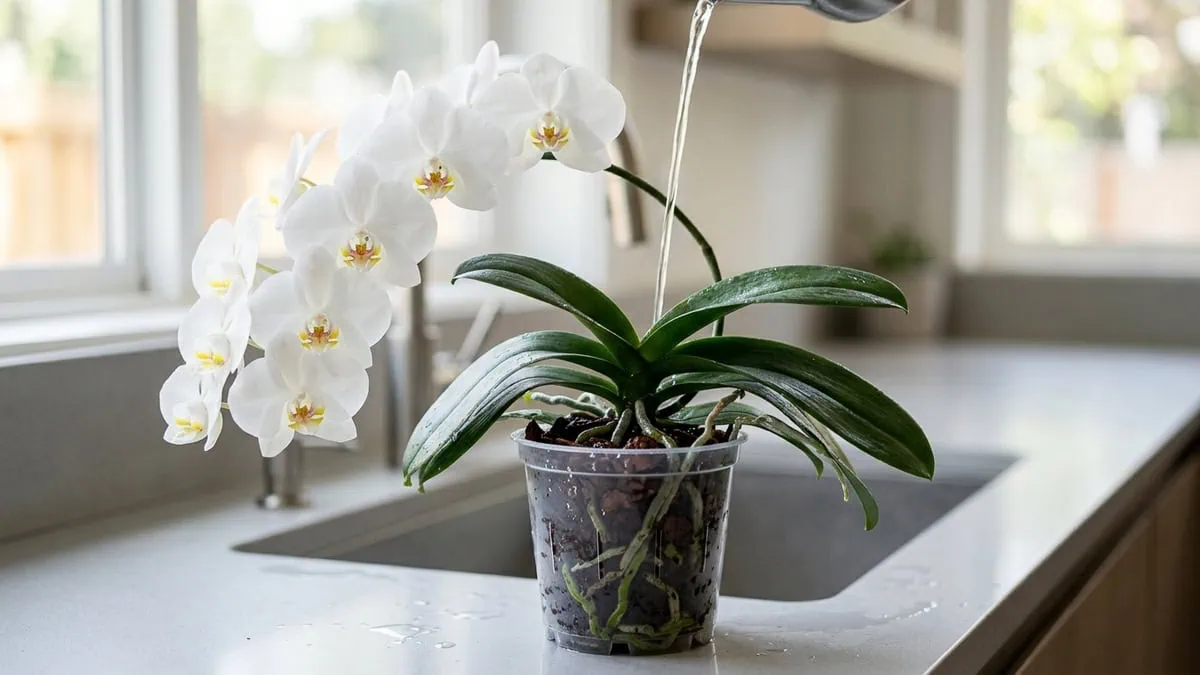
How to water a Phalaenopsis orchid without killing it depends on the bark drying out — soak this Orchidaceae epiphyte about every 7-10 days. With no pseudobulb to bank water in, it leans on its leaves and roots between soaks. Read the roots before you pour, not the leaves.
- Check first: lift the pot — light means dry, heavy means wet
- Then soak: drench until water runs from the holes, then drain it
- Never: leave the pot standing in a saucer of water
- Skip the ice: it is too cold and far too little water
- When unsure: wait a day — a dry orchid forgives, a wet one rots
The leaves had gone soft and folded, drooping over the pot rim like wilted ribbon. Every instinct said water it.
Real talk: it wasn’t thirsty — it was drowning. It took more than one limp, overwatered moth orchid for me to accept that the soft leaves were a root problem, not a watering shortage (trust me on this).
Conventional “water it once a week” advice nearly emptied my whole windowsill — the real fix is to ignore the calendar and read the roots. Let me rewind for a second: a Phalaenopsis has no pseudobulb, so its roots, wrapped in a spongy layer called velamen, must drink fast and then breathe dry air before the next soak.
Get the rhythm right and this becomes one of the most forgiving plants you can own. The rest is just learning what “nearly dry” looks like, and when in doubt, the fundamentals live in the complete moth orchid growing guide.
Take a breath — none of this is hard once the numbers are in front of you. The table below lays out every watering parameter at a glance.
How to water a Phalaenopsis orchid without killing it, in numbers
| Moth orchid specs | Recommended care |
|---|---|
| Watering trigger | Just before bone-dry — the leaves are the only water store |
| Interval (8-inch bark pot, warm and bright) | About every 7-10 days; sphagnum moss closer to every 12-14 days |
| Method | Thorough soak 10-20 minutes, drain fully, keep the crown dry |
| Best water type | Rain, reverse-osmosis (RO), or distilled; hard, high-TDS water builds salts |
| Water temperature | Tepid, room temperature (never ice) |
| Clear-pot root read | Green roots are hydrated; silver roots are drying |
| Is the ice-cube method safe? | No — cold shock plus under-saturation |
| Is misting enough to water? | No — surface benefit only, about 20 minutes |
Tap the button below to get more plant fixes in your Google Search results

Table of Contents
Before you water, read the roots — the 3-state check
The fastest way to tell whether a moth orchid needs water is to read its roots, not its leaves.
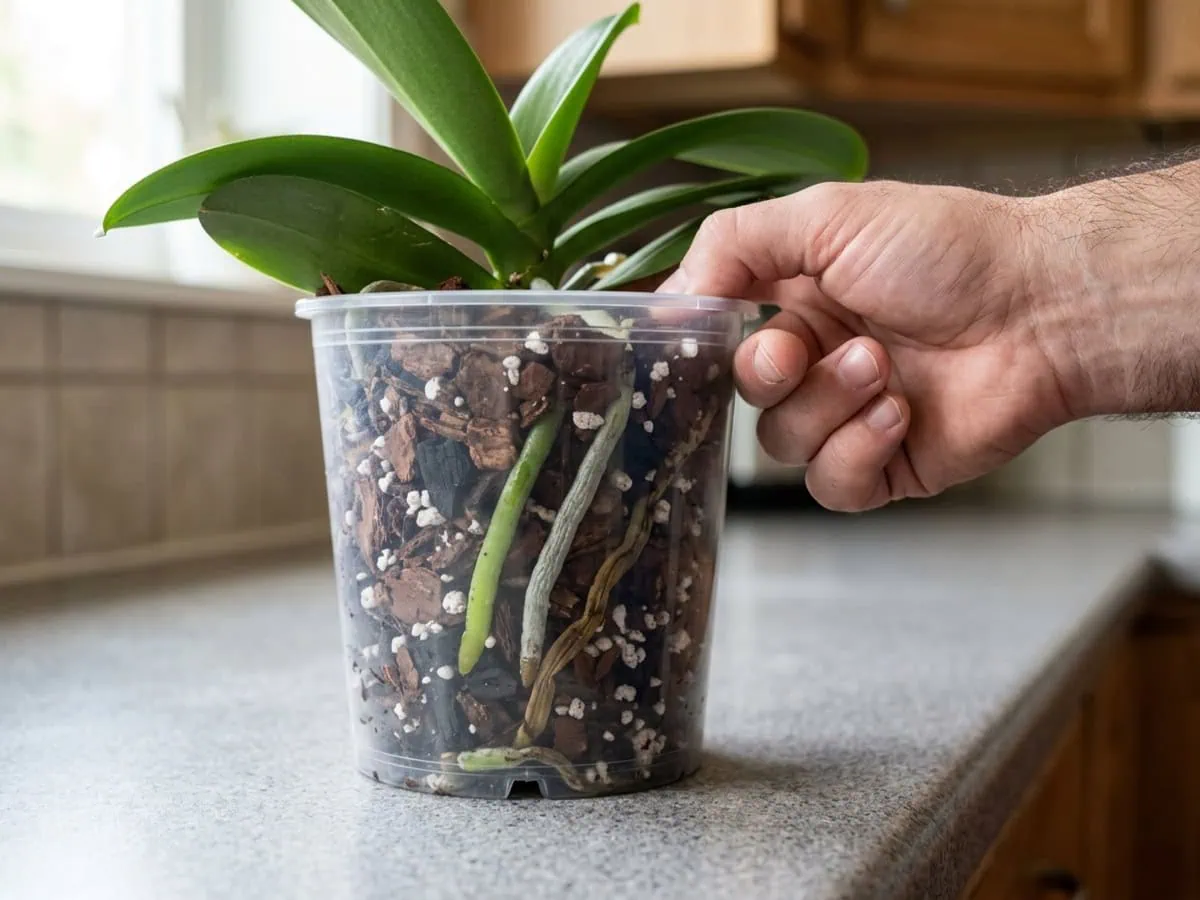
A two-finger lift under the pot rim settles it. A watered pot pulls down like a brick, a dry one lifts with almost nothing to it. The three states below tell you exactly what to do.
Quick aside: the cue that finally retrained me was the pot’s weight. A freshly soaked pot felt as heavy as a full coffee mug; ten days later, bone-dry, it lifted like an empty paper cup. Same pot, half the load — that gap is your watering schedule, written in your own hand.
Run a ten-second check before every watering. The roots and the pot give you three honest signals the leaves never can:
- Lift the pot: light means dry, oddly heavy means still wet
- Glance at the roots through the clear pot: silver or green?
- Squeeze one root: firm and solid, or hollow and collapsing?
Plump, green or silver roots: wait
Healthy roots are firm and plump, silvery-white when dry and flushing bright green within minutes of a soak. Both colors are normal — green means the velamen is saturated, silver means it has breathed dry and is ready for the next drink. So if the roots are still firm and green, wait.
Resist the urge. Watering roots that are already saturated only keeps the zone airless and invites rot. Patience here is not neglect; it is matching the soak to the dry-down the velamen evolved for.
Brown, mushy, hollow roots: stop, route to rescue
Brown, soft, or hollow roots mean the opposite problem: the medium has stayed wet too long and the roots have suffocated and begun to rot. Squeeze one gently — live tissue is solid, dead tissue collapses to a hollow thread.
Do not add water. More water on rotted roots is the single fastest way to lose the plant, because dead roots cannot drink no matter how full the pot is.
This is the moment to unpot and start rescuing roots that have already rotted, not to top up the watering can.
Gray, brittle, shriveled roots: soak now
Gray, brittle, papery roots that stay limp even after a drink point the other way — this orchid is genuinely thirsty, and the leaves usually wrinkle like a slowly deflating balloon to match. Here the fix is simple. Soak it.
Give the bark a long, thorough drink, let it drain, and watch the leaves firm up over the next couple of weeks. A plant this dry recovers slowly. But it recovers, as long as enough live, silver-firm root remains to take the water back up.
Tap the button below to get more plant fixes in your Google Search results

How often to water in a bark mix — let the dry-down decide
There is no fixed schedule for watering a moth orchid; the bark mix, not the calendar, decides when the next soak is due — so the mix you pot into shapes the rhythm before you ever pick up a watering can. The two sections below break the interval into the things that actually move it — how fast your pot dries, and what is in your water.
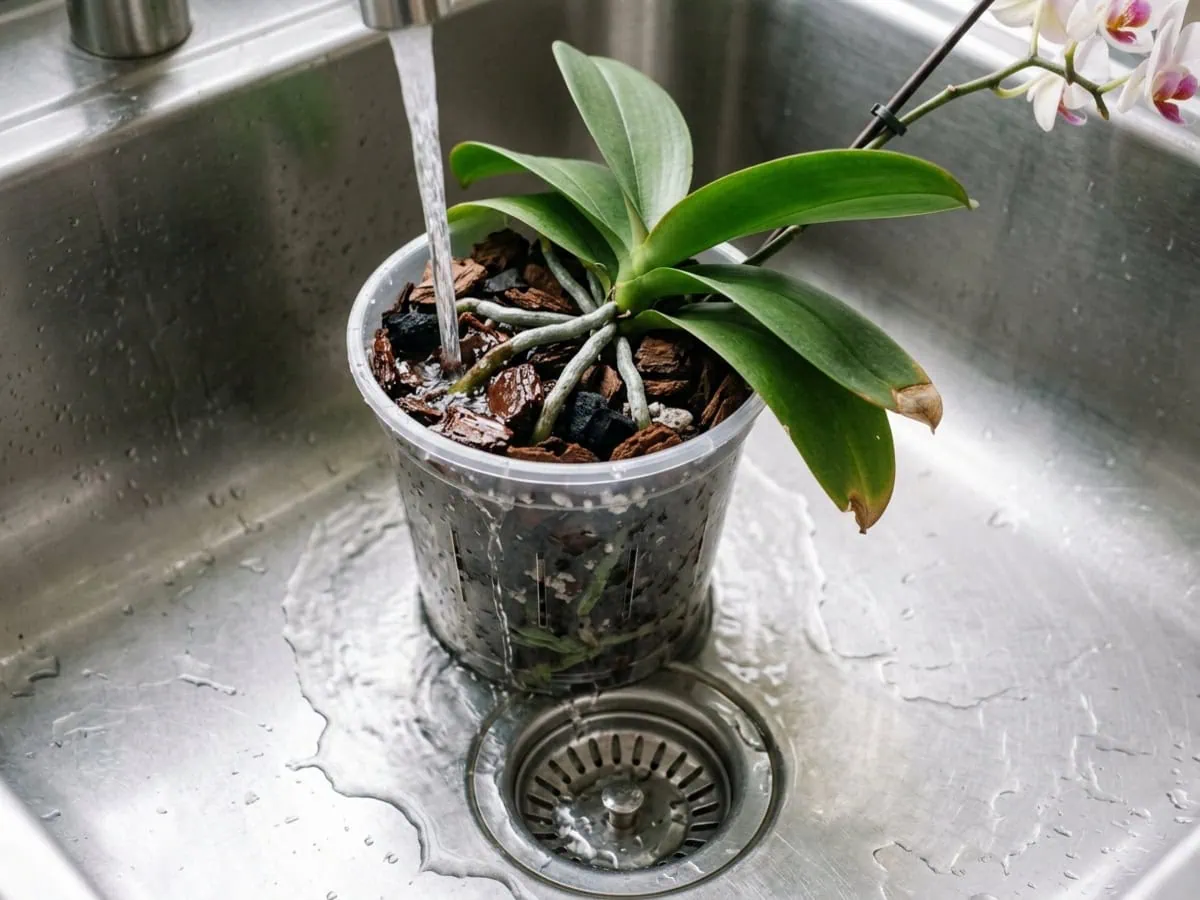
A healthy soak floods the bark, then drains, and that drain is the whole point (I’ll explain in a sec). Phalaenopsis roots breathe — they pull oxygen straight from the air around them, which is why a mix that never dries suffocates them from the inside out.
According to the American Orchid Society, the real danger is not how often you water but a medium that stays wet too long, and their guidance on how to water an orchid centers on letting the bark approach dryness first.
A freshly watered pot carries a reassuring fullness; when it starts to feel suspiciously light, the bark has given up its water and re-aerated.
Why the bark, not the calendar, sets the interval
Watering frequency comes down to how fast your medium gives up its water. As a rough starting point, a mature moth orchid in a bark mix wants a soak about every 7-10 days in a warm, bright spot, while the same plant in moisture-holding sphagnum moss can stretch closer to two weeks.
But take those as starting numbers, not rules. Several things shorten the gap between soaks:
- A small pot that holds less moisture
- Dry, heated indoor air pulling water out faster
- Brighter light and warmth driving up transpiration, the leaf’s water loss
The bark itself shifts over time, too. As it breaks down into fine, water-logging crumbs across a year or two, it holds moisture longer, which is the signal it is time for moving into fresh bark. Until then, let the dry-down decide.
Tap, rain, or distilled: hardness, not chlorine
For the best water type, hardness, not chlorine, is what harms a moth orchid over time. Hard tap water carries dissolved minerals, measured as TDS (total dissolved solids), and those soluble salts pile up in the bark and scorch the root tips. Use a simple rule of thumb:
- Under 100 ppm TDS: ideal, close to rainwater
- 100-200 ppm: perfectly usable
- Over 300 ppm: dilute with distilled, or switch to rain or RO
Chlorine, for the record, is a non-issue; chloramine is the catch. In my experience — though n=1 — letting tap water sit overnight did nothing on a chloraminated supply, and the chemistry agrees: chloramine, unlike free chlorine, does not gas off on standing.
If your water runs hard, a plain-water flush every two to four weeks leaches the salts out before they bite — the same discipline behind feeding without a salt buildup.
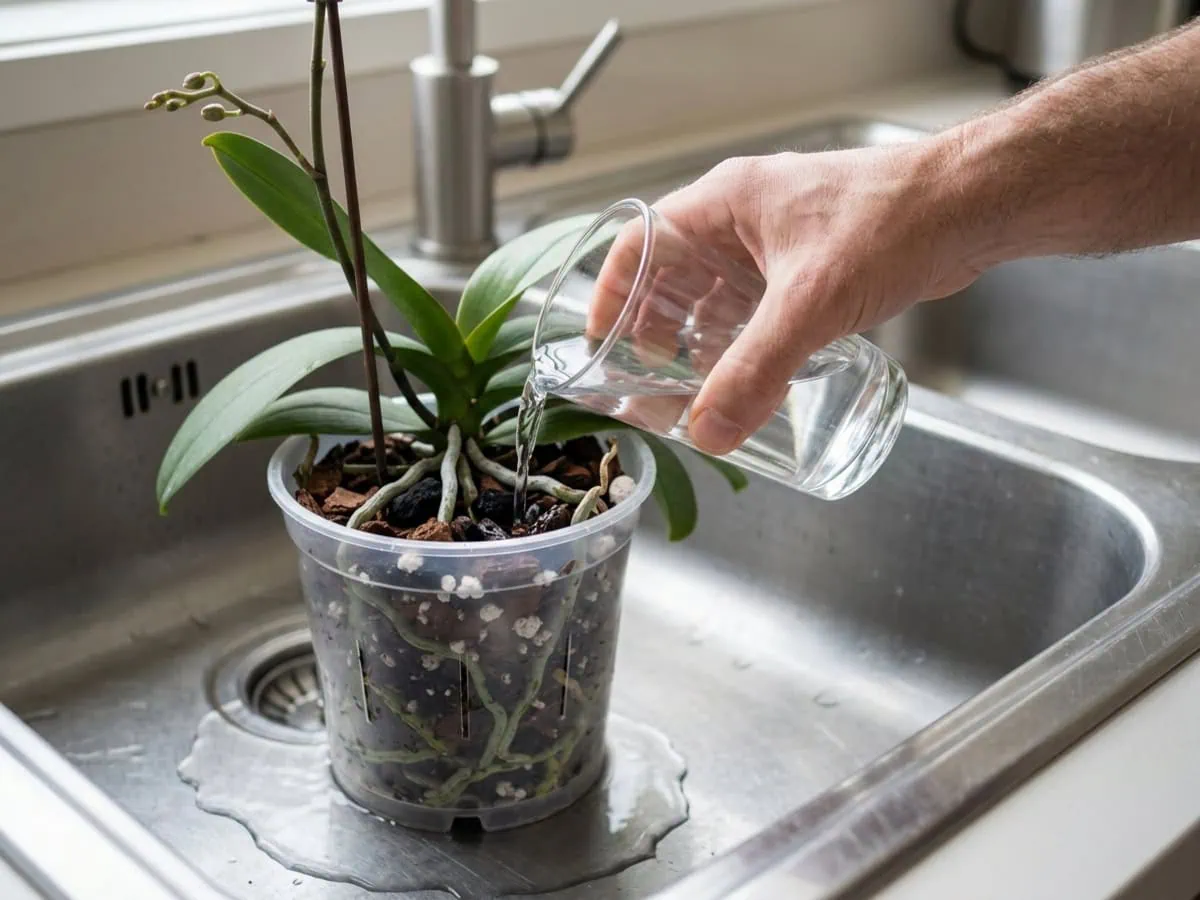
Watering myths that quietly kill an orchid
A few popular shortcuts do more harm than good, and two of them cause most of the avoidable losses. The myths below look convenient on the surface and fail at the root.
Myth: a few ice cubes a week is the easy way to water a moth orchid. Fact: ice works against a tropical plant on two counts — the cold shocks its warm-growing roots, and a couple of melting cubes barely change the pot’s weight, let alone wet a whole bark mix. A long, room-temperature soak does the job ice never can.
Both myths share one root error: they reduce watering to a fixed ritual instead of a response to what the plant is actually doing. Get past them and the rest of watering falls into place.
Ice cubes: why a room-temperature soak wins
Is the ice-cube method safe for watering moth orchids? No. These are warm growers from humid tropics, and cold water near 32F shocks roots adapted to a steady 65-85F range — cold contact alone can pit and collapse leaf tissue within hours.
The volume is wrong, too. A pot watered with three ice cubes barely shifts on the scale, which means the deeper roots never actually drink.
Swap the cubes for a tepid, room-temperature soak, drench until water pours from the holes, and let it drain.
The limp-leaf reflex: when more water is the lethal move
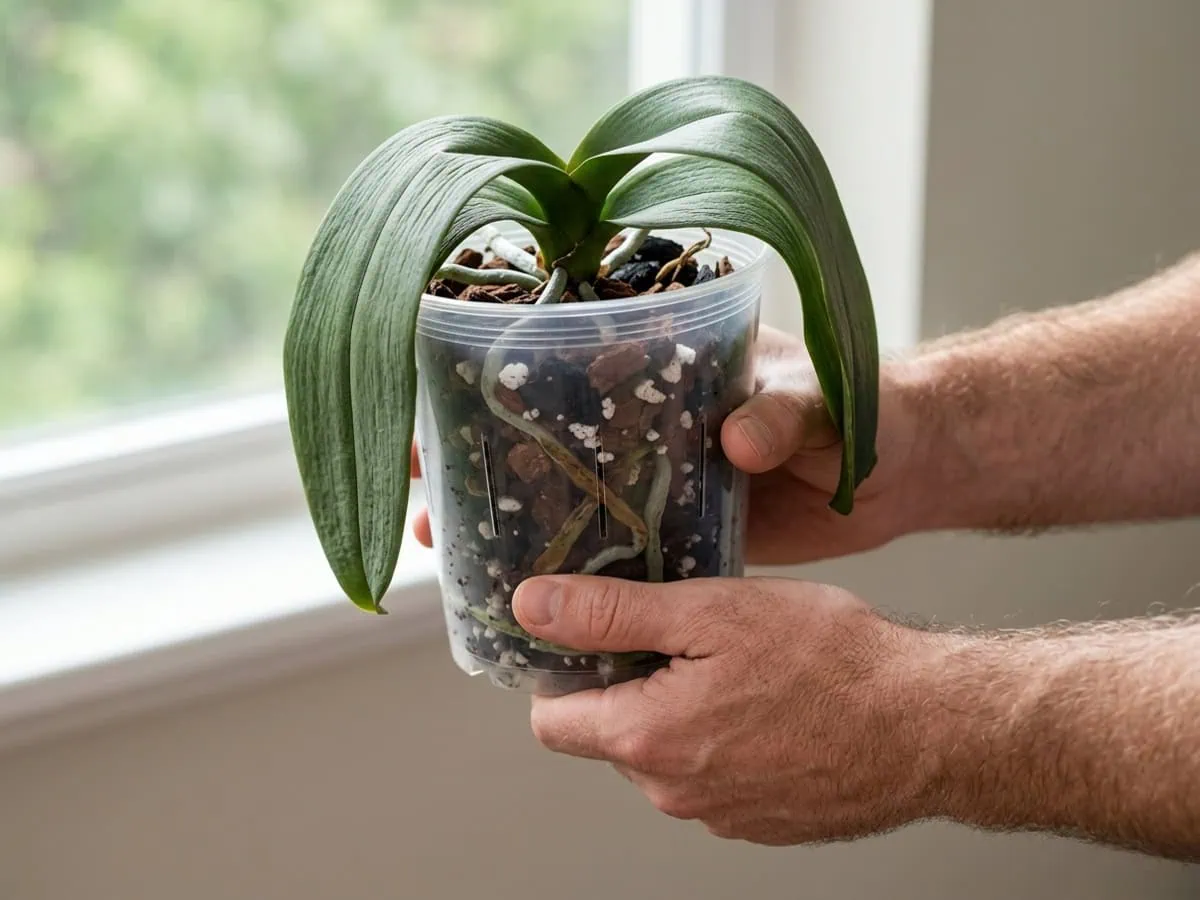
The most dangerous instinct in all of orchid care is to water a limp plant. Here is the trap: an overwatered moth orchid and an underwatered one can show the exact same floppy, leathery leaves, because in both cases the roots have stopped delivering water to the foliage.
But the causes are opposite. Same droopy leaf, two enemies. Reach for the watering can on a plant whose roots have already rotted, and you finish it off.
This is precisely why the leaf is the wrong organ to read — the answer is always in reading limp, wrinkled leaves back to their roots before you decide anything.
Mist or soak, top or bottom, crown dry
Should you mist a moth orchid or soak it instead? Soak it. The two are not equivalent:
- Mist: wets the surface for roughly 20 minutes, then evaporates
- Soak: saturates the entire root zone for days
Misting raises humidity briefly but never counts as watering. As for top versus bottom: watering from below keeps the rot-prone crown dry and is the safer routine, while a top-down flush every two to four weeks clears built-up salts.
Either way, the rule is the same — drain the pot fully, and blot any water that lands in the central crown, where trapped moisture invites crown rot. And always water in the morning, so the leaves dry before nightfall.
Frequently asked questions about watering moth orchids
What is the best way to water Phalaenopsis orchids?
The best way is a thorough soak followed by full drainage. Drench the bark until water runs from the drainage holes, let it drain completely, and never leave the pot standing in a saucer. Water in the morning with tepid water so the leaves and crown dry before nightfall, and wait until the bark is nearly dry before the next soak rather than following a fixed day of the week.
What are common orchid watering mistakes?
The most common mistake is watering on a fixed calendar instead of checking the medium first. Others include leaving the pot in standing water, splashing water into the central crown, using cold water or ice, and reaching for the watering can when limp leaves are actually a sign of rotted, overwatered roots. When in doubt, read the roots before you pour, since a dry orchid recovers but a waterlogged one rots.
Should I water orchids from the top or bottom?
Either works, and each has a use. Watering from below, by setting the pot in water to soak, keeps the rot-prone crown dry and makes it the safer routine choice. Watering from the top every two to four weeks flushes accumulated mineral salts out of the bark. Whichever you choose, drain the pot fully afterward and tip out any water left in the saucer so the roots never sit in standing water.
Is it better to water orchids with water or ice cubes?
Room-temperature water beats ice cubes every time. These are warm-growing tropical plants, and cold shocks their roots, while a few melting cubes deliver far too little moisture to wet a whole bark mix. A long, tepid soak hydrates the roots evenly and safely. Use tepid, room-temperature water, drench until it runs from the drainage holes, and skip the ice-cube shortcut entirely.
When not to water an orchid?
Do not water when the bark is still damp or the roots are plump and green, since the medium has not yet dried and the roots cannot use more. Also hold off when the leaves are limp but the roots look brown and mushy — that is rot, not thirst, and more water makes it worse. Check the roots first, and when you are unsure, wait a day rather than risk a soggy root zone.
Can I water my orchids with tap water?
Often yes, but it depends on hardness, not chlorine. If your tap water is soft and low in dissolved solids, it is fine to use. Hard, high-mineral water builds salts in the bark over time and can scorch the root tips, so flush with plain water every two to four weeks or switch to rain, distilled, or reverse-osmosis water. Note that chloramine, unlike chlorine, does not disappear simply by letting water sit out overnight.
Master the dry-down, skip the root rot
None of this takes a green thumb. Just the habit of checking before you pour. Lift the pot, read the roots, soak only when the bark runs dry, and a moth orchid will reward you for years.
The roots never lie. The day they turn soft and brown, though, you are past watering and into a root-rot rescue instead, so the watering can is best set down the moment a root feels mushy.
That, in one line, is how to water a Phalaenopsis orchid without killing it: let the dry-down lead, and trust the roots over the calendar every single time. May your pots always feel feather-light before you ever reach for the watering can.
Tap the button below to get more plant fixes in your Google Search results